Chapter 18 – Genetics of Behavior
True / False
1. Individuals with a genetic variant in the promoter region of the MAOA gene display violent behavior, independent of
environmental factors.
a.
True
b.
False
False
18–1: Human Behavior Is a Complex Trait
2. Learned behaviors are defined as behaviors with which we are born.
a.
True
b.
False
False
18–2: Models, Methods, and Phenotypes in Studying Behavior
3. Drugs, such as cocaine and nicotine, mimic the action of neurotransmitters.
a.
True
b.
False
18–3: The Nervous System Is the Focus of Behavior Genetics
4. Females who are heterozygous for a violence-associated mutation in the X-linked MAOA gene will display abnormal
behavior.
a.
True
b.
False
False
18–4: Single-Gene Mutations Cause Behavioral Disorders
5. The greater the polyglutamine expansion in the huntingtin gene (greater than 35 CAG trinucleotide repeats), the greater
the chance for developing Huntington disease.
a.
True
b.
False
True
6. The transgenic mouse models for amyotrophic lateral sclerosis (ALS) and Huntington disease show symptoms similar
to those seen in humans affected by these conditions.
a.
True
b.
False
True
18–6: Animal Models: The Search for Behavior Genes
7. If a psychiatric condition displays 15% concordance in monozygotic twins, and 8% concordance in dizygotic twins,
then genetics plays a major role in this trait.
a.
True
b.
False
False
18–7: The Genetics of Complex Behavioral Disorders
8. All psychiatric illnesses studied to date have been shown to result from a mutation in a single gene.
a.
True
b.
False
False
18–7: The Genetics of Complex Behavioral Disorders
9. As the average age of the population increases, the incidence of Alzheimer’s disease is also expected to increase.
a.
True
b.
False
True
18-8 Genetics and Social Behavior
10. Because sons adopted by alcoholic men show a rate of alcoholism more like that of their biological father, there is an
argument for the role of genetic factors in this disease.
a.
True
b.
False
18–5: Huntington Disease Is a Model for Neurodegenerative Disorders
disease.
Chapter 18 – Genetics of Behavior
Multiple Choice
11. A mutation in the MAOA gene is associated with ____ behavior.
a.
depressive
b.
risk-taking
c.
violent
d.
schizophrenic
e.
bipolar
c
Bloom’s: Understand
18–1: Human Behavior Is a Complex Trait
violent behavior.
12. Researchers have found that schizophrenia may be caused by multiple genes, each contributing equally to the
behavioral phenotype. This is an example of _____.
a.
a polygenic additive model
b.
epistasis
c.
single gene, dominant trait
d.
single gene, recessive trait
e.
genome wide association
a
Bloom’s: Understand
18–2: Models, Methods, and Phenotypes in Studying Behavior
traits, and list the models used to analyze the genetics of behavior.
13. It is difficult to assign a precise phenotypic definition to alcoholism because _____.
a.
not enough volunteers agree to participate in genome wide association studies
b.
alcoholism does not have environmental components
c.
alcoholism is an innate behavior
d.
genetic testing for alcoholism is not available
e.
excessive consumption of alcohol is subjective
e
Bloom’s: Understand
18–2: Models, Methods, and Phenotypes in Studying Behavior
the importance of precise definitions of behavioral phenotypes.
14. To quantify the environmental contribution of a behavioral trait, scientists turn to ____.
True
Bloom’s: Understand
18-8 Genetics and Social Behavior
predisposition towards, or protection from, alcoholism.
Chapter 18 – Genetics of Behavior
a.
whole genome sequencing
b.
heritability
c.
genome wide association studies
d.
analysis of innate behaviors
e.
SNP and haplotype analyses
b
Bloom’s: Remember
18–2: Models, Methods, and Phenotypes in Studying Behavior
genetic contributions to behavioral traits.
15. When a nerve impulse travels from neuron 1 to neuron 2, neuron 1 is known as the _____.
a.
postsynaptic neuron
b.
presynaptic neuron
c.
synapse
d.
gated channel
e.
dendrite
b
Bloom’s: Remember
18–3: The Nervous System Is the Focus of Behavior Genetics
16. The finding that mutations in synapse genes are associated with many genetic disorders that have a behavioral
component suggests that _____.
a.
individuals with these mutations lack synapses
b.
individuals with these mutations lack neurotransmitters
c.
malfunctions in presynaptic neurons cause abnormal behavior
d.
malfunctioning synapses are associated with abnormal behavior
e.
behavior disorders are attributable to environmental factors
d
Bloom’s: Understand
18–3: The Nervous System Is the Focus of Behavior Genetics
normal brain function, behavior, and mood.
17. What is the function of a normal MAOA protein?
a.
It breaks down neurotransmitters in the synapse.
b.
It carries neurotransmitters across synapses.
c.
It is a neurotransmitter.
d.
It is an enzyme essential in the formation of certain neurotransmitters.
e.
It is an enzyme responsible for the construction of neurotransmitter receptors.
a
Bloom’s: Remember
18–4: Single-Gene Mutations Cause Behavioral Disorders
18. Huntington disease is _____.
a.
a model of a multifactorial trait, controlled by several genes
b.
inherited as an X-linked dominant trait
c.
a disease with onset in early childhood
d.
one that produces no significant changes in brain cells
e.
a model of a single gene defect affecting behavior
e
Bloom’s: Understand
18–5: Huntington Disease Is a Model for Neurodegenerative Disorders
disease.
19. Why is the most damage to the brains of Huntington disease patients observed in the striatum?
a.
The Rhes protein, needed for mutant huntingtin to become toxic, is only produced in the striatum.
b.
The huntingtin gene is only expressed in the striatum.
c.
The mutant huntingtin protein becomes toxic when bound to the Rhes protein, which is abundant in the
striatum.
d.
Only the cells of the striatum contain the huntingtin mutation.
e.
The CAG expansions are corrected in regions of the brain other than the striatum.
c
Bloom’s: Understand
18–5: Huntington Disease Is a Model for Neurodegenerative Disorders
disease.
20. Research on transgenic Drosophila models of Huntington disease has found that ____.
a.
the NUB1 protein decreases levels of mutant huntingtin protein, and thereby, cell death
b.
the mutant huntingtin protein is destroyed by the SOD1 protein
c.
Drosophila and humans share more than 90% of genes
d.
the accumulation of mutant proteins in the brain causes Huntington disease
e.
treatment of patients with Rhes protein cures Huntington disease
a
Bloom’s: Understand
18–6: Animal Models: The Search for Behavior Genes
21. Research using transgenic animal models of neurodegenerative diseases not only helps scientists understand the
disorders, but also may lead to _____.
a.
new vaccines
b.
Drosophila genome sequencing projects
c.
discovery of the environmental causes of schizophrenia
d.
identification of the mutant gene that causes Huntington disease
directly related to abnormal behavior in one family.
Chapter 18 – Genetics of Behavior
e.
new drugs and treatments
Bloom’s: Understand
18–6: Animal Models: The Search for Behavior Genes
22. Monozygotic twin concordance values are less than 100% in both bipolar disorder and schizophrenia. This suggests
that these disorders ____.
a.
are strictly polygenic
b.
have environmental components
c.
are X-linked
d.
genetically dominant
e.
are not genetically based
b
Bloom’s: Understand
18–7: The Genetics of Complex Behavioral Disorders
components underlying schizophrenia and bipolar disorder.
23. Schizophrenia and bipolar disorder are caused by _____.
a.
one gene, plus environmental triggers
b.
the same gene
c.
many genes, plus environmental triggers
d.
copy number variants, without environmental triggers
e.
the same mutations that cause autism spectrum disorders
Bloom’s: Understand
18–7: The Genetics of Complex Behavioral Disorders
psychiatric disorders.
24. The observation that schizophrenia is associated with duplications of a certain copy number variant (CNV), while
autism spectrum disorders are associated with deletions of the same CNV, suggests that _____.
a.
CNV mutations are present in all psychiatric disorders
b.
both disorders have identical phenotypes
c.
both disorders have an environmental component
d.
both disorders share common developmental pathways
e.
neither disorder has a genetic component
d
Bloom’s: Remember
18–7: The Genetics of Complex Behavioral Disorders
psychiatric disorders.
25. For which of the following diseases would animal models likely yield the most information?
Chapter 18 – Genetics of Behavior
a.
alcoholism
b.
schizophrenia
c.
bipolar disorder
d.
Huntington disease
e.
nicotine addition
d
Bloom’s: Apply
18–6: Animal Models: The Search for Behavior Genes
to new therapies and treatments.
26. The only gene that has been positively identified with the onset of Alzheimer disease encodes a protein that _____.
a.
is involved in cholesterol metabolism
b.
breaks down neurotransmitters
c.
maintains the health of striatum cells
d.
attaches amino acids to tRNA molecules
e.
breaks down fatty deposits around neurons
a
Bloom’s: Remember
18-8 Genetics and Social Behavior
research supporting both genetic and environmental contributions to this condition.
27. An ALDH2 allele results in slow alcohol metabolism, leading to an accumulation of acetaldehyde. Therefore,
individuals with this allele tend to _____.
a.
consume more alcohol than typical social drinkers
b.
be protected against alcoholism
c.
become alcoholics at high rates
d.
contain other alleles that protect against alcoholism
e.
have parents who are alcoholics
b
Bloom’s: Understand
18-8 Genetics and Social Behavior
predisposition towards, or protection from, alcoholism.
28. Individuals with nicotine acetylcholine receptors that bind tightly to nicotine are more likely to _____.
a.
have a family member who is resistant to nicotine addiction
b.
have behavioral disorders
c.
have mutations in the GABBR2 gene
d.
be vulnerable to nicotine addiction
e.
show resistance to nicotine addiction
d
Bloom’s: Remember
18-8 Genetics and Social Behavior
29. It is clear from current research on human behavior genetics that _____.
a.
animal models of human disease are not useful for behavior research
b.
epigenetics does not play a significant role in behavior disorders
c.
few abnormal behaviors have an environmental component
d.
most abnormal behaviors are due to single-gene effects
e.
abnormal behaviors are not due to single-gene effects
e
Bloom’s: Understand
18–9: Summing Up: The Current Status of Human Behavior
HUHE.CUMM.16.18-9-1 – Summarize the conclusions of human behavior genetics research
30. The problem with defining abnormal behavior is that ____.
a.
too many disorders have similar phenotypes
b.
some behaviors are not abnormal, but simply variants
c.
biological factors related to abnormal behavior are not known
d.
mental illness is multifactorial, and therefore, cannot be defined
e.
twin concordance studies mental illness is due mostly to environmental components
b
Bloom’s: Understand
18–9: Summing Up: The Current Status of Human Behavior
overemphasized.
Completion
31. The gene associated with aggressive behavior in different studies is called _____________________.
monoamine oxidase type A
Bloom’s: Remember
18–1: Human Behavior Is a Complex Trait
violent behavior.
32. _____________________ is defined as the interaction of two or more gene variants to produce a certain phenotype.
Epistasis
Bloom’s: Understand
18–2: Models, Methods, and Phenotypes in Studying Behavior
traits, and list the models used to analyze the genetics of behavior.
33. The axon of one neuron is functionally connected to the dendrite of an adjacent neuron by the
_____________________.
addiction and a predisposition towards, or protection from, alcoholism.
Chapter 18 – Genetics of Behavior
34. Someone who steps on a sharp nail will quickly lift their foot away. This quick reaction is known as a(n)
_____________________.
35. The normal _____________________ protein binds to hundreds of other proteins to facilitate synaptic function, cell
signaling, intracellular transport, and transcription.
36. The mutant huntingtin protein is _____________________, meaning that it kills cells, such as those in the brain and
nervous system.
37. Transgenic mice carrying a mutant human SOD1 gene are used as models to study _____________________.
38. Since mice are over _____________________% genetically similar to humans, they are appropriate models for
studying human conditions.
39. Transgenic mice engineered to contain the mutant versions of the huntingtin gene with various numbers of
_____________________ repeats have phenotypes similar to humans affected by Huntington disease.
18–6: Animal Models: The Search for Behavior Genes
40. According to results from genome wide association studies, at least seven _____________________ are linked to both
schizophrenia and bipolar disorder.
18–7: The Genetics of Complex Behavioral Disorders
41. A study revealed differences in DNA methylation patterns between monozygotic twins, only one of whom was
affected by a schizophrenia or bipolar disorder. This suggests a role for ____ in mental illness.
18–7: The Genetics of Complex Behavioral Disorders
42. Family, twin, and adoption studies have revealed a(n) _____________________ component to mental illnesses, such
as bipolar disorder.
18–7: The Genetics of Complex Behavioral Disorders
43. Amyloid plaques are routinely found in the brains of individuals affected by _____________________, where they
cause nerve cell degeneration and death.
18-8 Genetics and Social Behavior
44. Individuals homozygous for the APOE*4 Apolipoprotein E allele are ten to fifteen times more likely to develop
Chapter 18 – Genetics of Behavior
_____________________.
45. _____________________ can be defined as compulsive and repetitive behavior which can lead to impairment.
46. The neurotransmitter _____________________ functions in the areas of the brain associated with mood, attention,
arousal and memory, and is associated with nicotine addiction.
47. Alzheimer disease has two forms: the early onset _____________________ form with a strong pattern of familial
inheritance, and the late onset _____________________ form.
48. _____________________develops from physiological adaptations that change brain function when exposed to certain
environmental triggers.
49. The _____________________ movement overemphasized the role of genetics in human behavior, leading to the
forced sterilization of those who were considered genetically inferior based on personality traits.
50. To summarize the conclusions of modern human behavioral genetics research, behavior is influenced by
_____________________, _____________________, and _____________________ factors.
51. Suppose Stephen Mobley, who was convicted and executed for the murder of John Collins, carried the variant of the
MAOA gene that has been associated with violent behavior. If you were on the jury that convicted and sentenced
Mobley, would this information have influenced your view of his guilt or innocence? Would it have changed your
opinion of his sentence? Why or why not?
52. Discuss the importance of twin and adoption studies to human behavioral genetics research.
53. Would you recommend genetic testing for the APOE*4 allele in family members of an Alzheimer disease patient?
Why or why not?
54. Do you think that nonsubstance-related addictions, such as compulsive gambling or compulsive eating, have a greater
genetic or environmental component compared to substance-related additions, such as nicotine? Explain your reasoning.
55. Discuss the difficulties in studying the genetics of human behavior traits
56. Discuss the tools used to see if human behavior has a genetic component, and give two examples of either normal or
abnormal behavior that appears to have a genetic component.
Chapter 18 – Genetics of Behavior
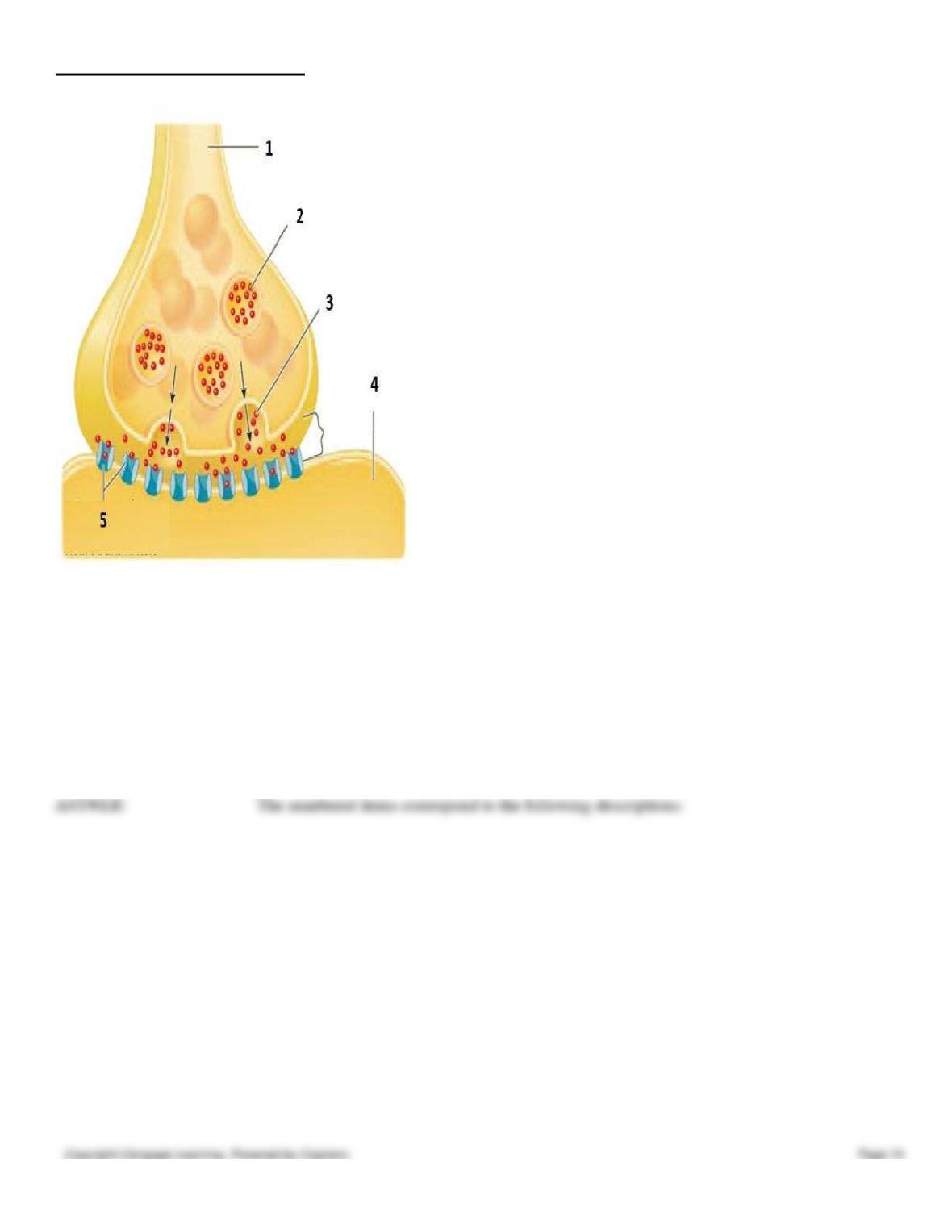
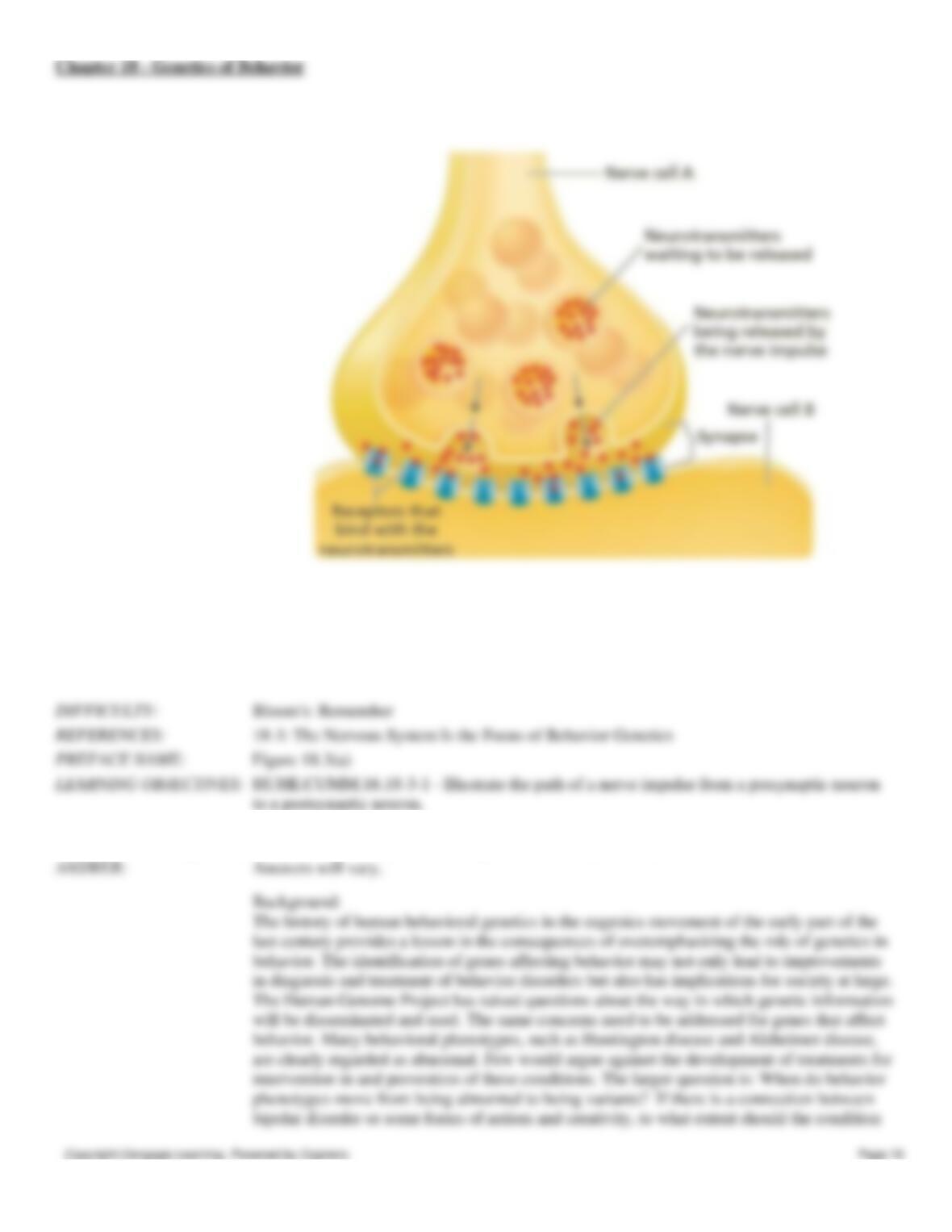
Figure 18.3(a)
57. Identify the numbered items in the accompanying figure. Include the following terms in your description.
• presynaptic neuron
• postsynaptic neuron
• neurotransmitters waiting to be released
• neurotransmitters released by the nerve impulse
• synapse
• receptors with bound neurotransmitters
58. Discuss the dangers of placing too much emphasis on the genetic basis of personality and behavior.
59. Explain how genetic mutations that cause neurodegenerative disorders such as Huntington disease and Alzheimer
disease can also cause abnormal behavior.
60. Explain why mice are appropriate animal models for human behavioral genetics research.