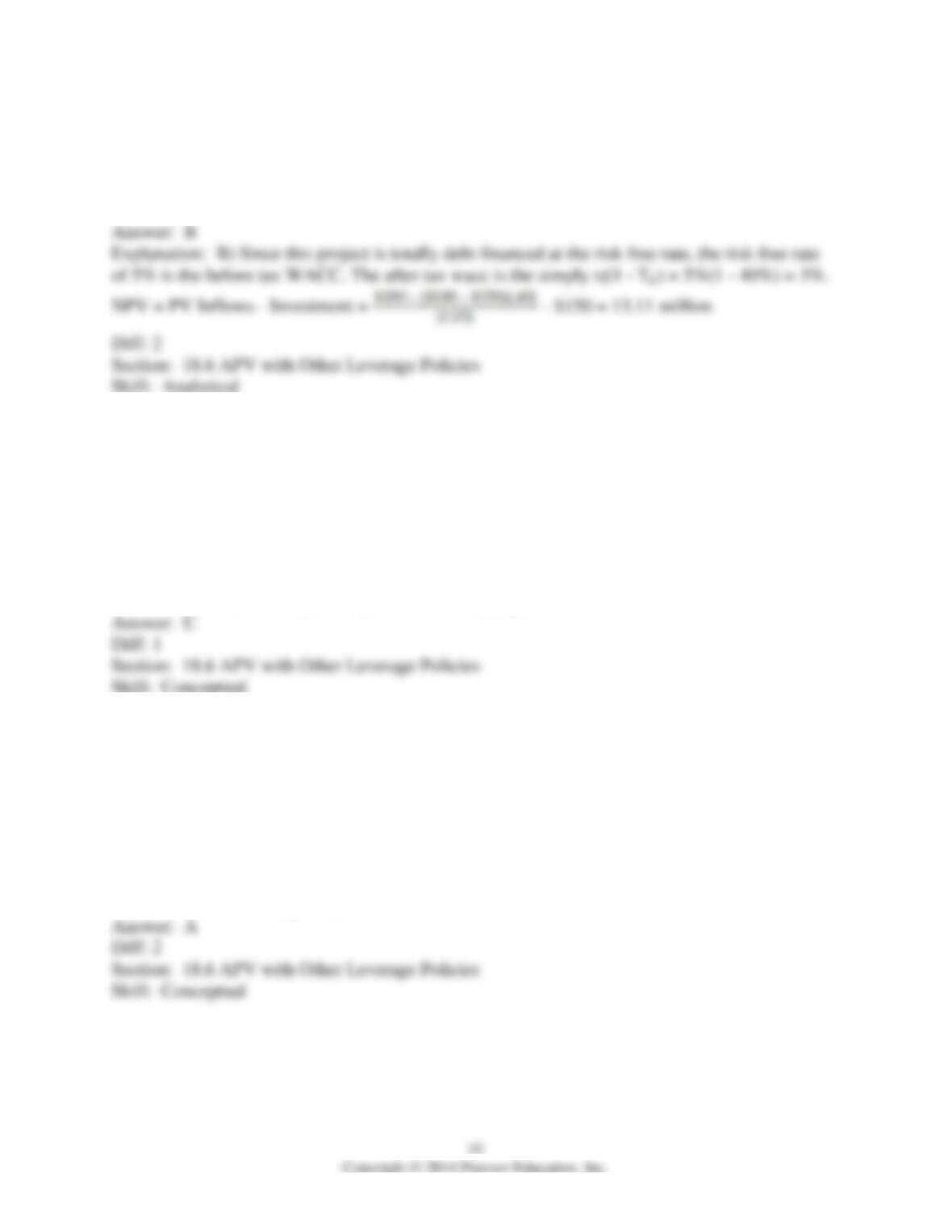
3) The NPV of this project using the WACC method is closest to:
A) $10 million
B) $13 million
C) $42 million
D) $71 million
4) Which of the following statements is FALSE?
A) Rather than set debt according to a target debt-equity ratio or interest coverage level, a firm
may adjust its debt according to a fixed schedule that is known in advance.
B) When we relax the assumption of a constant debt-equity ratio, the equity cost of capital and
WACC for a project will change over time as the debt-equity ratio changes.
C) When we relax the assumption of a constant debt-equity ratio, the APV and FTE methods are
difficult to implement.
D) If a firm is using leverage to shield income from corporate taxes, then it will adjust its debt
level so that its interest expenses grow with its earnings.
5) Which of the following statements is FALSE?
A) When we relax the assumption of a constant debt-equity ratio, the FTE method is relatively
straightforward to use and is therefore the preferred method with alternative leverage policies.
B) When debt levels are set according to a fixed schedule, we can discount the predetermined
interest tax shields using the debt cost of capital, rD.
C) With a constant interest coverage policy, the value of the interest tax shield is proportional to
the project’s unlevered value.
D) When the firm keeps its interest payments to a target fraction of its FCF, we say it has a
constant interest coverage ratio.

6) Which of the following statements is FALSE?
A) As a general rule, the WACC method is the easiest to use when the firm will maintain a fixed
debt-to-value ratio over the life of the investment.
B) The FTE method is typically used only in complicated settings for which the values of other
securities in the firm’s capital structure or the interest tax shield are themselves difficult to
determine.
C) For alternative leverage policies, the FTE method is usually the most straightforward
approach.
D) When used consistently, the WACC, APV, and FTE methods produce the same valuation for
the investment.
Use the information for the question(s) below.
Aardvark Industries is considering a project that will generate the following free cash flows:
Year
0
1
2
3
Free Cash Flows
($200)
$100
$80
$60
You are also provided with the following market value balance sheet and information regarding
Aardvark’s cost of capital:
Assets
Liabilities
Cost of Capital
Cash
0
Debt
400
Debt
7%
Other Assets
1000
Equity
600
Equity
12%
τc
35%
7) Aardvark’s unlevered cost of equity is closest to:
A) 10.0%
B) 10.4%
C) 9.5%
D) 9.0%
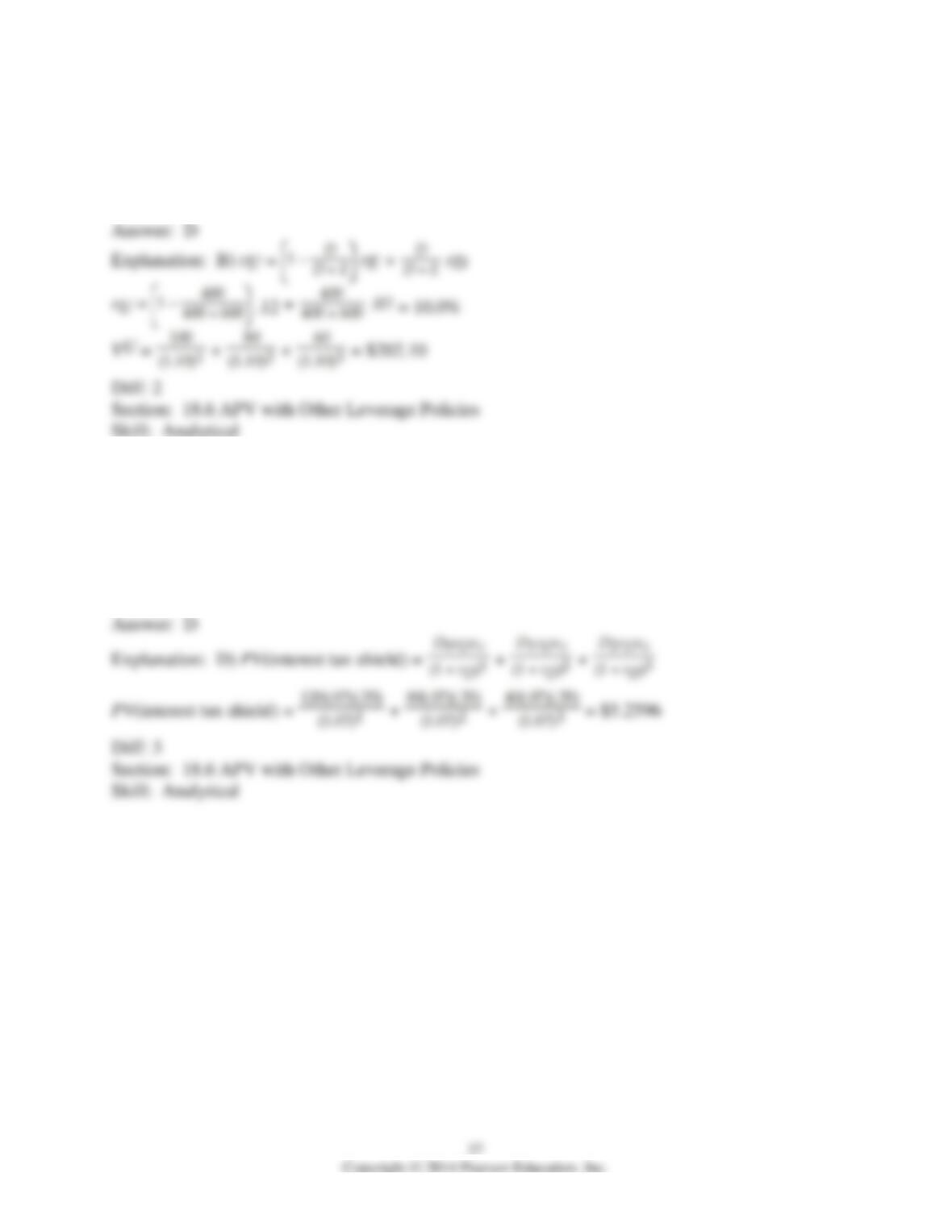
8) The unlevered value of Aardvark’s new project is closest to:
A) $205
B) $100
C) $164
D) $202
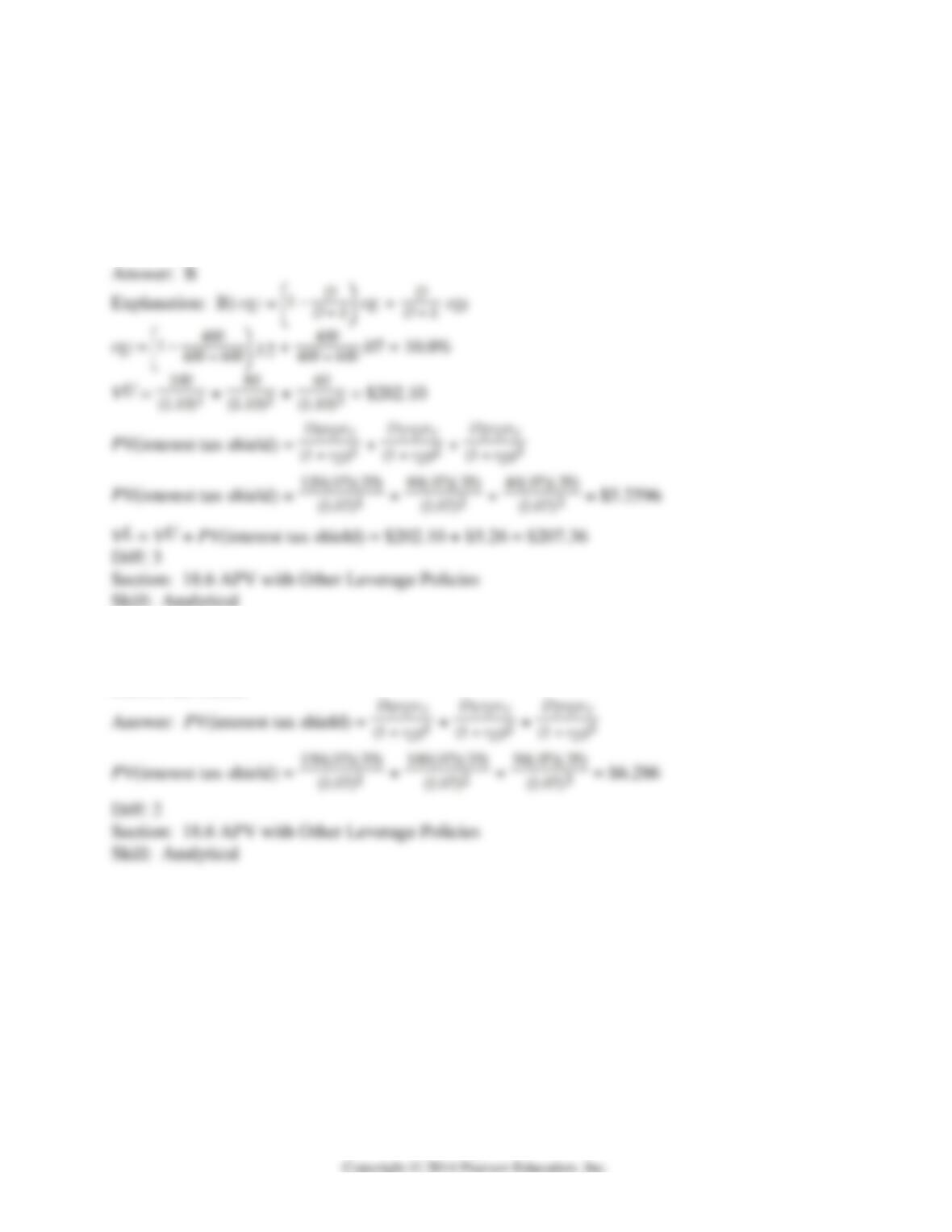
9) Suppose that to fund this new project, Aardvark borrows $120 with the principal to be paid in
three equal installments at the end each year. The present value of Aardvark’s interest tax shield
is closest to:
A) $5.15
B) $5.00
C) $5.90
D) $5.25
38
10) Suppose that to fund this new project, Aardvark borrows $120 with the principal to be paid
in three equal installments at the end each year. The levered value of Aardvark’s new project is
closest to:
A) $210.15
B) $207.35
C) $207.00
D) $210.50
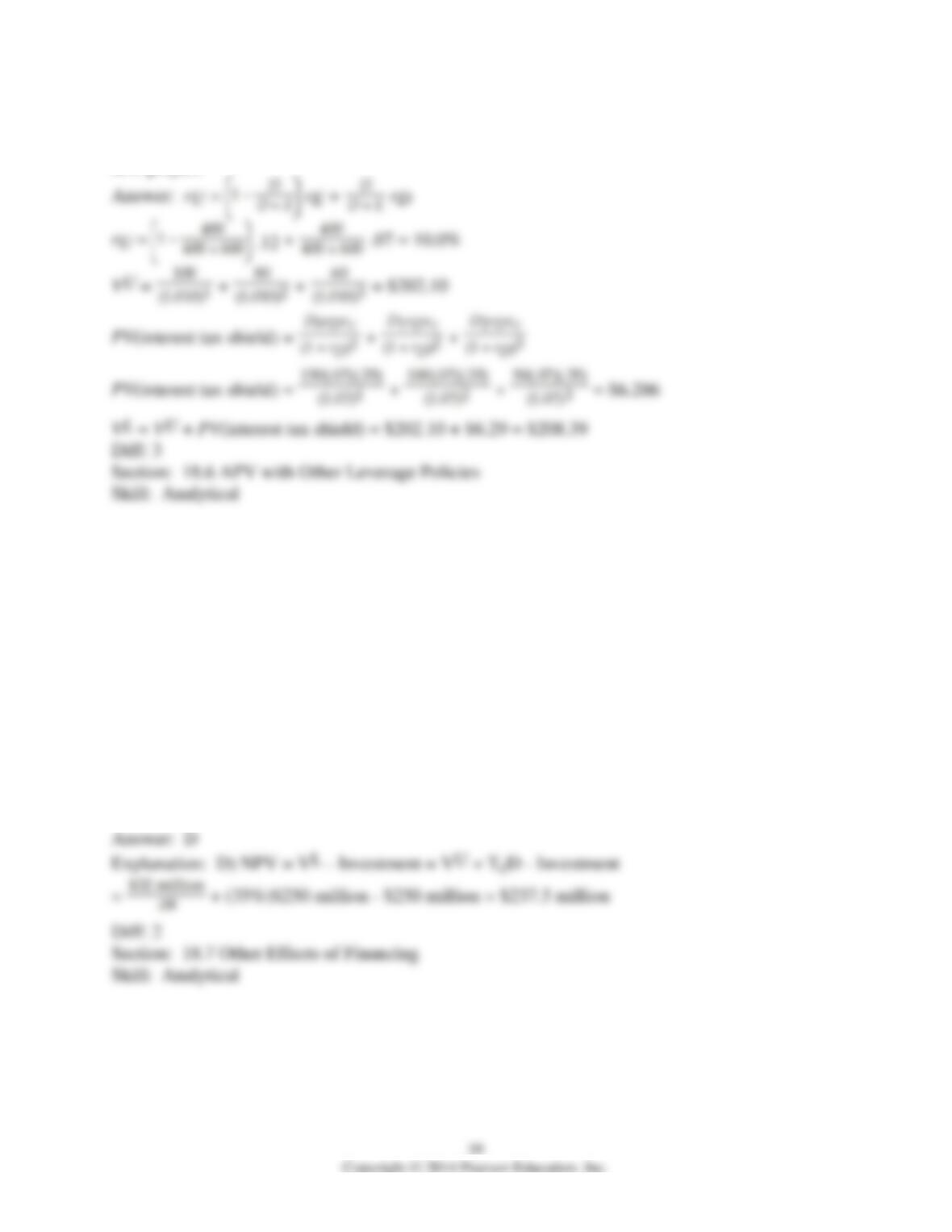
11) Suppose that to fund this new project, Aardvark borrows $150 with the principal to be paid
in three equal installments at the end each year. Calculate the present value of Aardvark’s
interest tax shield.
12) Suppose that to fund this new project, Aardvark borrows $150 with the principal to be paid
in three equal installments at the end each year. Calculate the The levered value of Aardvark’s
new project.
18.7 Other Effects of Financing
Use the following information to answer the question(s) below.
Taggart Transcontinental is considering a $250 million investment to launch a new rail line. The
project is expected to generate a free cash flow of $32 million per year, and its unlevered cost of
capital is 8%. Taggart’s marginal corporate tax rate is 35%.
1) Assuming that to fund the investment Taggart will take on $250 million in permanent debt and
ignoring issuance costs, the NPV of Taggart’s new rail line is closest to:
A) $195 million
B) $200 million
C) $235 million
D) $240 million
2) Assuming that to fund the investment Taggart will take on $250 million in permanent debt and
assuming Taggart will incur a 2% (after-tax) underwriting fee on the new debt issue, the NPV of
Taggart’s new rail line is closest to:
A) $195 million
B) $200 million
C) $235 million
D) $240 million
3) Assume that to fund the investment Taggart will take on $150 million in permanent debt with
the remainder of the investment funded by a cut in dividends. Assuming Taggart will incur a 2%
(after-tax) underwriting fee on the new debt issue, the NPV of Taggart’s new rail line is closest
to:
A) $195 million
B) $200 million
C) $235 million
D) $240 million
4) Assume that to fund the investment Taggart will take on $150 million in permanent debt with
the remainder of the investment funded through issuance of new equity. Assuming Taggart will
incur a 2% (after-tax) underwriting fee on the new debt issue and a 5% underwriting fee on the
issuance of new equity, the NPV of Taggart’s new rail line is closest to:
A) $195 million
B) $200 million
C) $235 million
D) $240 million
5) Assume that to fund the investment Taggart will take on $150 million in permanent debt with
the remainder of the investment funded through issuance of new equity. Assume Taggart will
incur a 2% (after-tax) underwriting fee on the new debt issue and a 5% underwriting fee on the
issuance of new equity. If management believes Taggart’s current share price of $25 is $3 less
than its true value, then the NPV of Taggart’s new rail line is closest to:
A) $185 million
B) $195 million
C) $200 million
D) $235 million

6) Which of the following questions is FALSE?
A) With perfect capital markets, all securities are fairly priced and issuing securities is a zero-
NPV transaction.
B) The fees associated with the financing of the project are independent of the project’s required
cash flows and should be ignored when calculating the NPV of the project.
C) When a firm borrows funds, a mispricing scenario arises if the interest rate charged differs
from the rate that is appropriate given the actual risk of the loan.
D) The WACC, APV, and FTE methods determine the value of an investment incorporating the
tax shields associated with leverage.
7) Which of the following questions is FALSE?
A) Sometimes management may believe that the securities they are issuing are priced at less than
(or more than) their true value. If so, the NPV of the transaction, which is the difference
between the actual money raised and the true value of the securities sold, should not be included
in the value of the project.
B) An alternative method of incorporating financial distress and agency costs is to first value the
project ignoring these costs, and then value the incremental cash flows associated with financial
distress and agency problems separately.
C) When the debt level—and, therefore, the probability of financial distress—is high, the
expected free cash flow will be reduced by the expected costs associated with financial distress
and agency problems.
D) If the financing of the project involves an equity issue, and if management believes that the
equity will sell at a price that is less than its true value, this mispricing is a cost of the project for
the existing shareholders.
8) Luther Industries is considering borrowing $500 million to fund a new product line. Given
investors’ uncertainty regarding its prospects, Luther will pay a 7% interest rate on this loan. The
firm’s management knows, that the actual risk of the loan is extremely low and that the
appropriate rate on the loan is 5%. Suppose the loan is for four years, with all principal being
repaid in the fourth year. If Luther’s marginal corporate tax rate is 35%, then the net effect of the
loan on the value of the new product line is closest to:
A) $22 million
B) $34 million
C) $35 million
D) $24 million
18.8 Advanced Topics in Capital Budgeting
Use the following information to answer the question(s) below.
Wyatt Oil is considering an investment in a new project with an unlevered cost of capital of 11%.
Wyatt’s marginal corporate tax rate is 35% and its debt cost of capital is 6%. The project has free
cash flows of $25 million per year which are expected to decline by 3% per year.
1) If Wyatt adjusts its debt continuously to maintain a constant debt-equity ratio of 50%, then the
appropriate WACC for this new project is closest to:
A) 7.5%
B) 8.6%
C) 10.3%
D) 10.8%
2) If Wyatt adjusts its debt once per year to maintain a constant debt-equity ratio of 50%, then
the appropriate WACC for this new project is closest to:
A) 7.5%
B) 8.67%
C) 10.27%
D) 10.8%
3) If Wyatt adjusts its debt continuously to maintain a constant debt-equity ratio of 50%, then the
value of this new project is closest to:
A) $188 million
B) $188.5 million
C) $320 million
D) $340 million
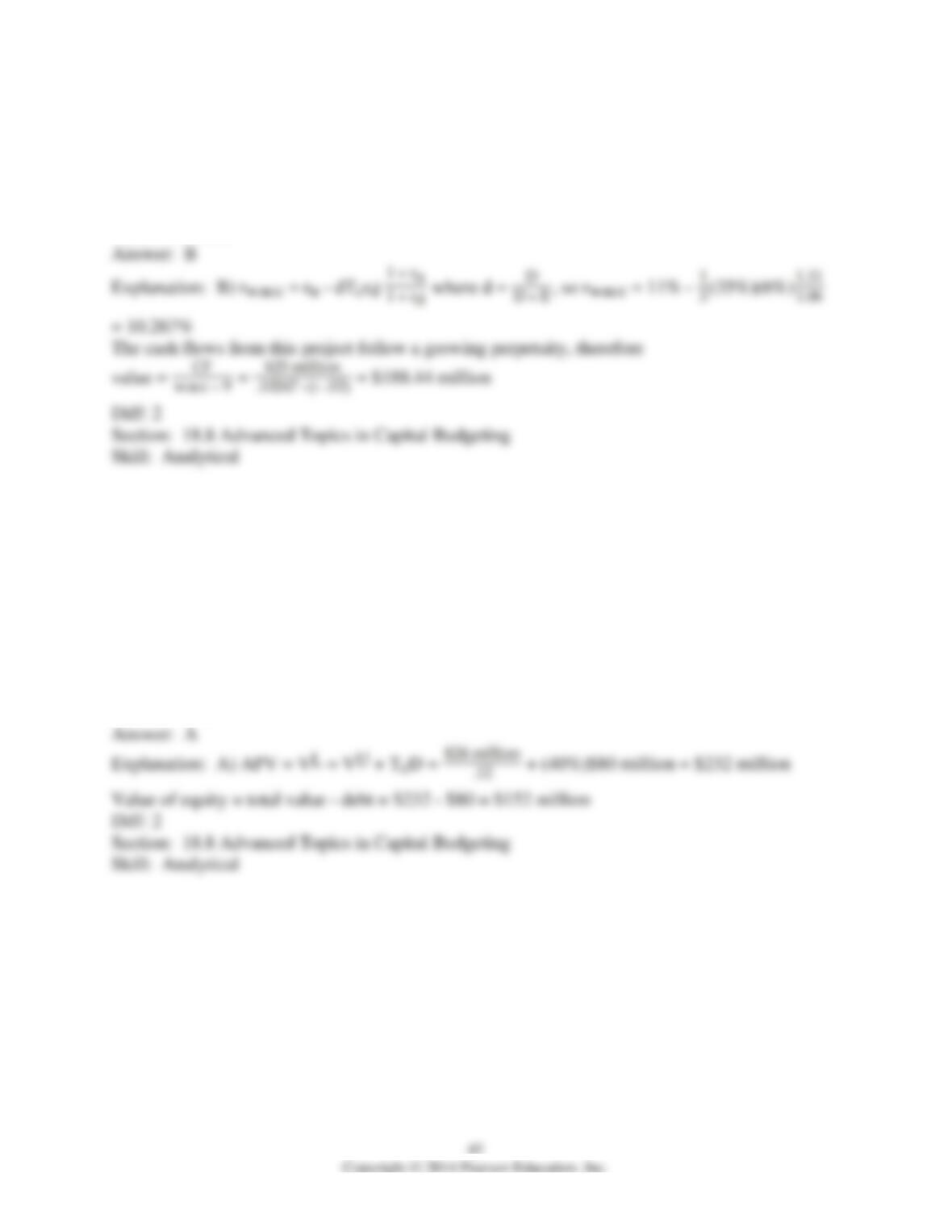
4) If Wyatt adjusts its debt once per year to maintain a constant debt-equity ratio of 50%, then
the value of this new project is closest to:
A) $188 million
B) $188.5 million
C) $320 million
D) $340 million
Use the following information to answer the question(s) below.
Galt Industries is expected to generate free cash flows of $24 million per year. Galt has
permanent debt of $80 million, a corporate tax rate of 40%, and an unlevered cost of capital of
12% and its cost of debt capital is 6%.
5) The value of Galt’s equity using the APV method is closest to:
A) $150 million
B) $180 million
C) $230 million
D) $240 million
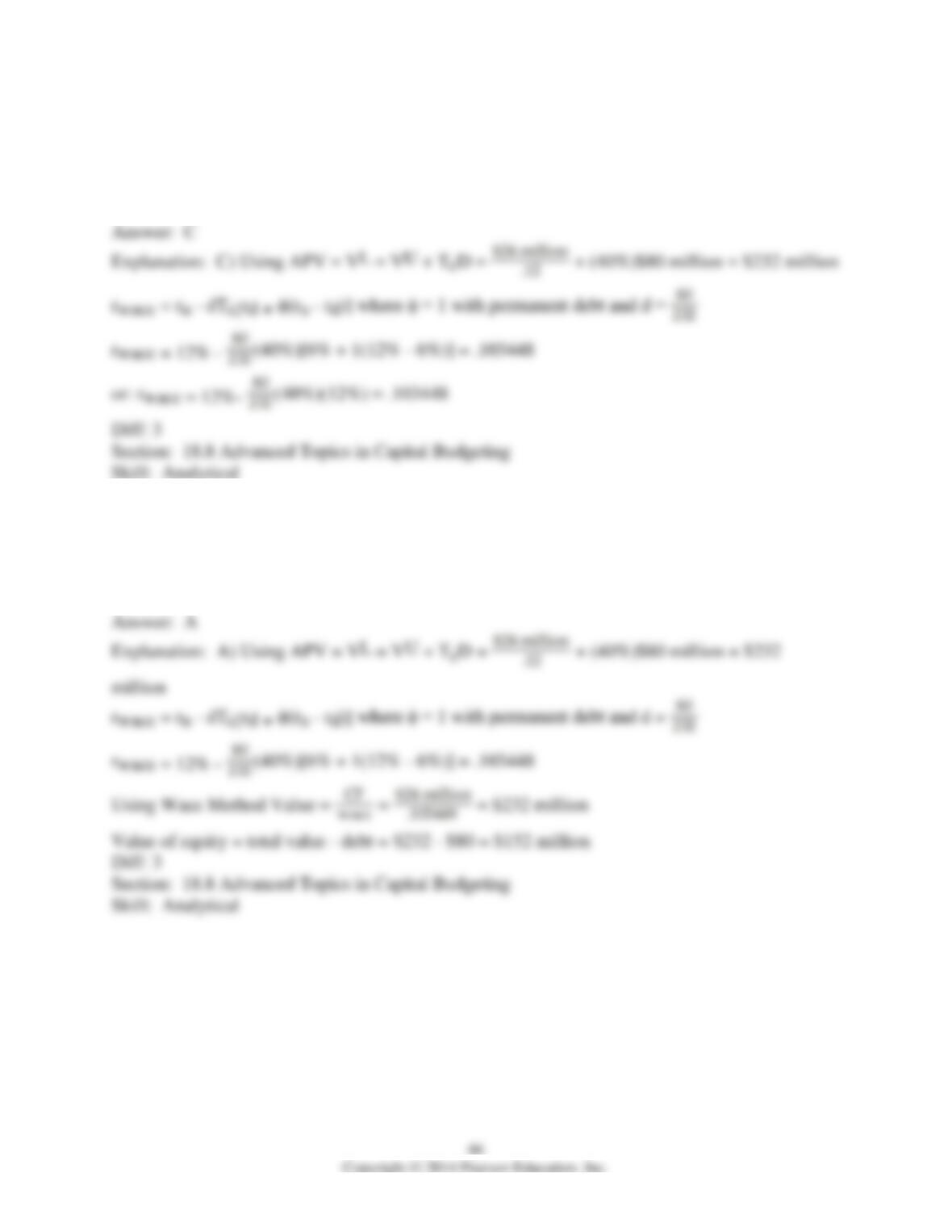
6) Galt’s WACC is closest to:
A) 6.0%
B) 9.6%
C) 10.3%
D) 10.7%
7) The value of Galt’s equity using the WACC method is closest to:
A) $150 million
B) $180 million
C) $230 million
D) $240 million
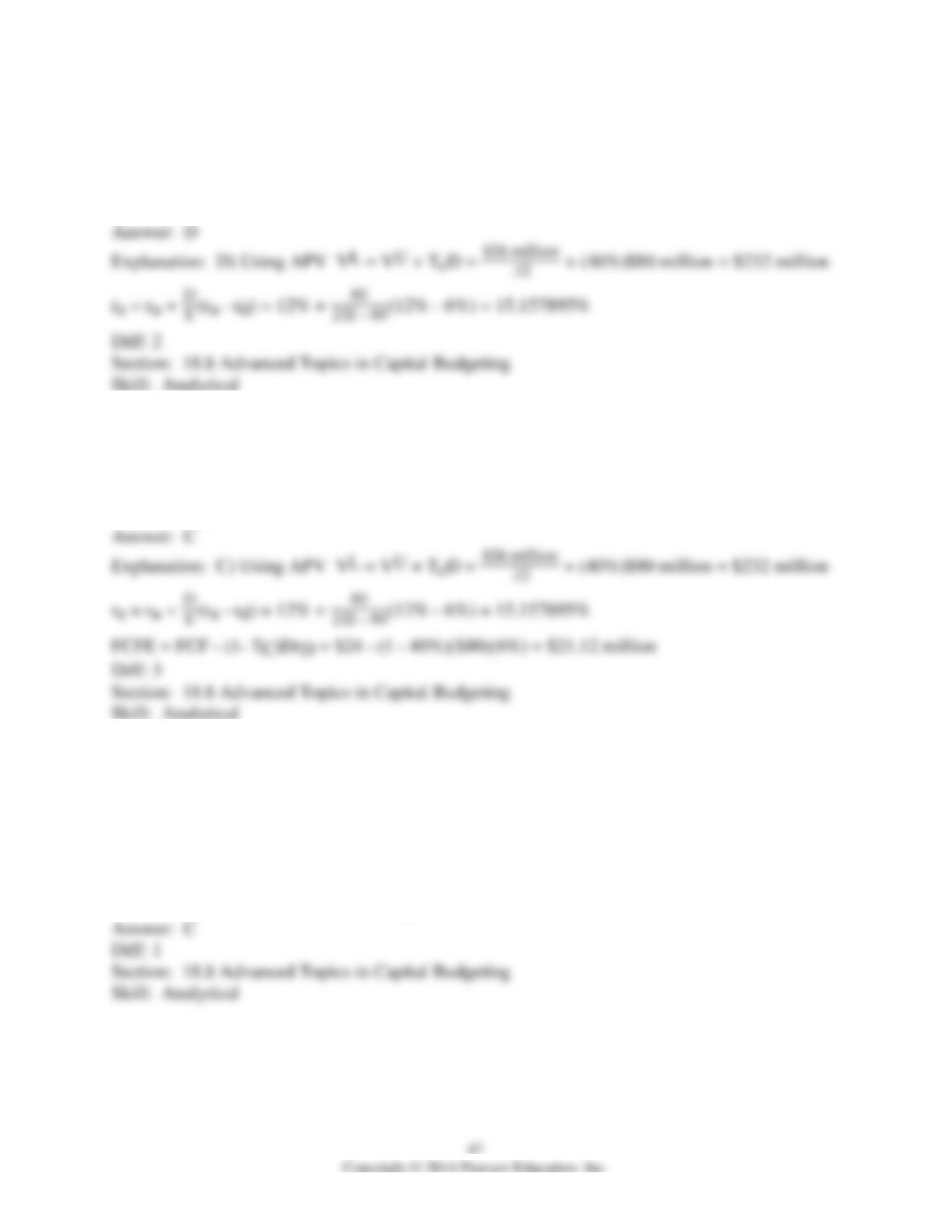
8) If Galt’s debt cost of capital is 6%, then Galt’s equity cost of capital is closest to:
A) 11.2%
B) 12.0%
C) 14.8%
D) 15.2%
9) Galt’s free cash flow to equity (FCFE) is closest to:
A) $19.2 million
B) $20.4 million
C) $21.2 million
D) $24.0 million
10) Consider the following equation for the Project WACC with a fixed debt schedule:
rwacc = rU – dτc[rD + f(rU – rD)]
The term d in this equations represents:
A) a measure of the permanence of the debt level.
B) the annual adjustment percentage to the amount of debt.
C) the debt-to-value ratio.
D) the dollar amount of debt outstanding.

11) Consider the following equation for the Project WACC with a fixed debt schedule:
rwacc = rU – dτc[rD + f(rU – rD)]
The term f in this equations represents:
A) the annual adjustment percentage to the amount of debt.
B) a measure of the permanence of the debt level.
C) the dollar amount of debt outstanding.
D) the debt-to-value ratio.