44. are high-ranking executives responsible for monitoring and protecting the private information held by frrrns
a. Verifrcation of Privacy
Officer
b. Chief Privacy
Officers
c. Officer of
Privacy
d. Privacy
Executive
45. The main law that protects the safety and health of workers in the United States is
the
a. Occidental Shore and Household Act
(OSHA).
b. Occupational Safety and Health Act
(OSHA).
c.
Offshore Security and Homeland Act
(OSHA).
d. Occupational Safety and Health Administration
(OSHA).
46. OSHA’s mission encompasses all of the following functions
except
a. setting and enforcing
standards.
b. providing training, outreach, and education.
c. promoting employer/employee cooperation.
d. establishing partnerships.

47. The regulations that codify employers’ duties to provide employees with information on the hazards of
workplace
chemicals and to make sure that they understand what that information means
are
a. employee education laws.
b. full disclosure regulations.
c. vital information acts.
d. right-to-know laws.
48. The Hazard
Communication
Standard requires that covered employers take certain steps to achieve
compliance,
including all of the following
except
a. update inventories of hazardous chemicals in the
workplace.
b. assemble material safety data sheets for all hazardous
chemicals.
c. instruct workers on the importance of using protective gear when handling hazardous
chemicals.
d. provide workers with training on the use of hazardous
chemicals.
49. All hazardous chemicals must be accompanied by to ensure proper use and
handling.
a. Child-Proof Safety Lids
(CPSL)
b. Material Safety Data Sheets
(MSDS)
c. Rubber Gloves
(RG)
d. Chemical Safety Data Guides
(MSDG)
50. Because OSHA does not have enough inspectors to monitor all of the businesses in the United
States,
a. businesses have a “free pass” to design their own safety
standards.
b. it attempts to make up for it by passing “nitpicking” rules.
c. it gets help from the Department of
Labor.
d. businesses have a heavy responsibility for safety in the
workplace.
51. Policy guidelines on the issue of privacy should include all of the following except
a. set controls to capture as much data as
possible
b. disclose the nature of surveillance that will occur
c. require reasonable suspicion before instituting drug tests
d. respect and preserve the boundary between work and
horne
52. Workers who are more likely to be exposed to workplace violence than their peers are ones
who
a. deliver things.
b. work in small towns.
c. work for the post
office.
d. work during the afternoon and early evening
hours.
53. Experts on workplace violence recommend that companies respond to this hazard
by
a. installing metal detection devices in their places of business.
b. Establishing a zero-tolerance policy toward workplace
violence.
c. developing a strong relationship with the local law enforcement officials.
d. instituting stringent pre-hiring filters.
54. OSHA’s guidelines for preventing workplace violence include all of the following
except
a. providing safety education for employees.
b. securing the workplace and minimizing access by outsiders.
c. hiring a security force to prevent
attacks.
d. providing drop safes to limit the amount of cash on
hand.
55. One main reason that business has turned its attention to employee health issues is
a. concern for their
well-being.
b. rising
costs.
c. reduced productivity.
d. the threat of contagious
diseases.
56. The issue of smoking in the
workplace
a. was the spur that started the antismoking sentiment in
society.
b. has been important since the
1950s.
c. is a result of antismoking sentiment in society at large.
d. grew out of the Prohibition era.
57. In the area of prevention, companies will be liable by OSHA
when
a. employers neglected to keep the workplace free from a
hazard
b.
the hazard was not recognizable by the
employer
c. the hazard was not causing serious
harm
d. the removal was not feasible or cost
effective
58. A secondary benefit of smoke-free workplace policies is
a. lower health insurance premiums.
b. support for smokers quitting the habit.
c. increased productivity.
d. reports of cleaner and more pleasant working envirornnents.
59. Employee Assistance Programs cover employee problem areas such as
a. workplace rights
b.
nausea
c. problems with youthfulness.
d.
AIDS.
60. EAPs are designed to affmn all of the following
except
a. employees are valuable members of the
organization
b. it is better to help troubled employees than to discipline or discharge
them
c. monitored employees are better
employees
d. recovered employees are better
employees
61. OSHA’s is to assure the safety and health of American’s workers by setting and enforcing standards,
etc
..
a. senrice
clause
b. standards
clause
C.
ffilSSlOll
d. public clause
62. Manufacturing companies especially those which manufacture chemicals or use chemicals must be in
compliance
with
a. construction
laws.
b. right to know laws.
c. workplace violence
concerns.
d. nitpicking rules.
63. A state of equilibrium where the demands of a person’s personal and professional life are equal is
called
a.
contentment.
b. harmony.
c. work/life
balance.
d. nirvana.
64. A background check practice having caused the most problems for the EEOC
includes
a. correlation of background check and
job.
b. blanket no-hire policies based on criminal records or negative credit scores.
c. hire policies based on credit
scores.
d. written
consents.
65. One provider of employment-related drug-testing services reports that drug
testing
a. . . g .
1s
growm
muse.
b. is more difficult to deceive.
c. shows a continuous decline in positive tests.
d. covers more
drugs.
66. With regard to employee monitoring, websites of concern to employers include all of the following
except
a. gorilla sites.
b. adult
sites.
c. gaming sites.
d. social networking sites.
67. An OSHA recommendation for preventing workplace violence include all of the following
except
a. providing safety education.
b. arming the
workplace.
c. secure the
workplace.
d. Develop policies and procedures covering visits of health care providers.
Provide
a
short answer
to each of
these questions.
Be
sure
to fully
explain
your
answer.
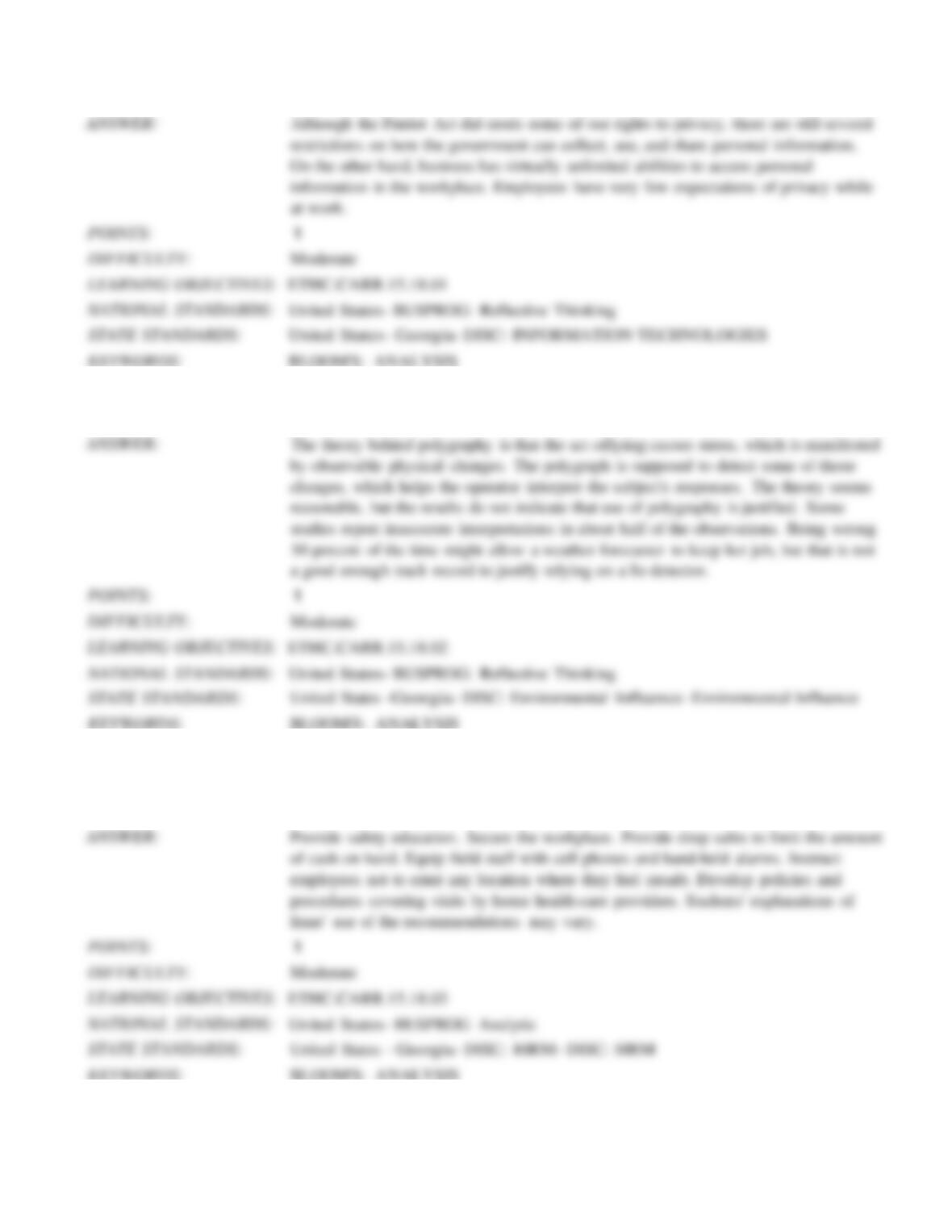
68. Compare the potential for invasion of individuals’ privacy from the USA Patriot Act and the average
business.
69. Describe the theory behind the polygraph. Does this theory provide an adequate basis for the use
oflie detectors?
70. The Workplace Violence Research Institute reports that each workday an estimated 16,400 threats are made,
723
workers are attacked, and 43,800 are harassed. Discuss OSHA’s
Recommendations
for preventing
workplace
violence and how firms can use the recommendations to protect their
employees.
71. Describe the pluses and minuses to the use of integrity
tests.
72. The textbook lists several benefits of employee assistance programs (EAPs). What are some potential drawbacks
of
EAPs?
73. Review the policy guidelines for ensuring employees’ right of privacy in the
workplace.
74. According to the American Lung Association, an employee who smokes costs the business at least an extra
$1,000
each year in added health care costs. Is cost a legitimate issue when considering the implications of smoking in
the
workplace?
75. Describe some of the best family-friendly benefits that are provided to
workers.
76. Describe the people who might be left out of family-friendly work policies because they do not fit the
stereotypical
”family”
mode.
77. Describe the rights of both employers and employees under the Family and Medical Leave Act
(FMLA).
78. Knowing the pros and cons of drug testing, is it justified? Make a case to support your
answer.
79. The textbook hints that concerns about terrorism have heightened demands for workplace safety. What, if
anything,
can individual businesses be expected to do to protect their workers from terrorist
activities?
80. Bans on smoking are starting to spread from workplaces to retail businesses like restaurants and bars.
Legislation
banning smoking has passed in Massachusetts and California localities. Research the effects of these bans.
Report
your fmdings.
81. The central questions of this chapter, privacy, safety, and health, are presented in terms of employees’ rights.
The
underlying assumption is that business should provide as many of these rights as possible. How much responsibility
should business shoulder for its employees‘ lives?