Exam
Name___________________________________
MULTIPLE CHOICE. Choose the one alternative that best completes the statement or answers the question.
1)
Sandstone strata and a mass of granite are observed to be in contact. Which of the following
statements is correct geologically?
1)
A)
The sandstone is younger if the granite contains sandstone inclusions.
B)
The granite is older if the sandstone contains pebbles of the granite.
C)
The granite is older if it contains inclusions of sandstone.
D)
The sandstone is younger if it shows evidence of contact metamorphism.
2)
Which of the following is an essential characteristic of an index fossil?
2)
A)
The fossils occur in deep–water marine sediments, but the organism actually lived in the
sunlit, surface layer of the ocean.
B)
The organism lived only in specific environments such as beaches or estuaries.
C)
The fossil ages can be determined through radiocarbon dating methods.
D)
The organism only lived for a short period of geologic time.
D
3)
What fundamental concept states that in a horizontal sequence of conformable sedimentary strata,
each higher bed is younger than the bed below it?
3)
A)
law of superposition
B)
theory of superstition
C)
theory of correlative deposition
D)
law of original correlation
A
4)
Which of the following is not a very long–lived, radioactive isotope?
4)
A)
K–40
B)
U–238
C)
Rb–87
D)
C–14
D
B
5)
Who is credited with formulating the doctrine of uniformitarianism?
5)
A)
Playfair
B)
Lyell
C)
Hutton
D)
Aristotle
6)
Which of the following refers to the investigative process by which geologists identify and match
sedimentary strata and other rocks of the same ages in different areas?
6)
A)
correlation
B)
strata indexing
C)
cross–access dating
D)
super matching
7)
An unconformity is a buried ________.
7)
A)
fault or fracture with older rocks above and younger rocks below
B)
fault or fracture with younger strata above and older strata below
C)
surface of erosion separating younger strata above from older strata below
D)
surface of erosion with older strata above and younger strata below
8)
The time period of “ancient life” is the ________ era.
8)
A)
Cenozoic
B)
Phanerozoic
C)
Mesozoic
D)
Paleozoic
9)
The half–life of carbon–14 is about 6000 years. Assume that a sample of charcoal formed by
burning of living wood 15,000 years ago. How much of the original carbon–14 would remain
today?
9)
A)
between 25% and 50%
B)
more than 50%
C)
between 33% and 50%
D)
between 12.5% and 25%
10)
Assume that man’s recorded history can be stretched back to 4600 years before the present. This is
approximately what fraction of geologic time?
10)
A)
one millionth
B)
one hundred–thousandth
C)
one billionth
D)
one ten–thousandth
11)
Which of the following geologic observations would not bear directly on working out the sequence
of geologic events in an area?
11)
A)
the feldspar and quartz contents of a granite
B)
inclusions of sandstone in a granite pluton
C)
an unconformity between a granite and sandstone
D)
a well–exposed dike of basalt in sandstone
12)
Who made the first clear statement of the law of superposition? When?
12)
A)
Nicolaus Steno, seventeenth century
B)
William Smith, eighteenth century
C)
John Stuart Priestly, nineteenth century
D)
John Wesley Powell, nineteenth century
13)
The ________ is the idea or concept that ancient life forms succeeded each other in a definite,
evolutionary pattern and that the contained assemblage of fossils can determine geologic ages of
strata.
13)
A)
principle of cross correlation
B)
law of correlative indexing
C)
law of fossil regression
D)
principle of faunal succession
14)
By applying the law of superposition ________ dates can be determined.
14)
A)
relative
B)
conventional
C)
radiometric
D)
both relative and radiometric
15)
When a radioactive isotope decays by electron capture, the electron ________.
15)
A)
makes the parent isotope into an ion with a charge of negative one
B)
combines with a neutron in the nucleus, raising the mass number of the daughter isotope by
one
C)
combines with a proton in the nucleus; the atomic number of the daughter is one less than the
parent
D)
makes the daughter isotope into an ion with a charge of positive one
16)
Which of the following denotes the divisions of the geologic time scale in correct order of
decreasing lengths of time beginning with the longest time interval and ending with the shortest?
16)
A)
era, period, epoch, eon
B)
eon, era, epoch, period
C)
eon, epoch, period, era
D)
eon, era, period, epoch
17)
Consider the names of the eras in the geologic time scale. What is meant by “zoic”?
17)
A)
time; recording of events
B)
places; geographic references
C)
life; living things
D)
rocks; lithified strata
18)
Assume that you have just examined several flat–lying sedimentary layers. After much study you
determine that there is a considerable span of time for which no sedimentary rock layer exists at
this site. You have just discovered a(n) ________.
18)
A)
example of cross–cutting relationships
B)
angular unconformity
C)
disconformity
D)
series of conformable strata
19)
Visualize five horizontal sedimentary strata exposed in a cliff or canyon wall identified by
consecutive numbers, 1 being the lowest bed and 5 being the highest. Which of the following
statements concerning the strata are TRUE?
19)
A)
bed 5 is the oldest
B)
bed 3 is older than beds 2 and 4
C)
bed 4 is older than bed 2
D)
beds l and 3 are older than bed 4
20)
Which of the following describes radioactive decay by beta particle emission?
20)
A)
The mass number of the daughter isotope is one more than the parent, and both isotopes have
the same atomic number.
B)
The daughter isotope has an atomic number two less than the parent and a mass number four
less.
C)
The daughter isotope has an atomic number one less than the parent and a mass number two
less.
D)
The atomic number of the daughter isotope is one more than the parent; the mass numbers
are the same.
21)
Which of the following best characterizes an angular unconformity?
21)
A)
Horizontal lava flows lie below the unconformity, and horizontal, sedimentary strata lie
above.
B)
Tilted strata lie below the unconformity, and bedding in younger strata above is parallel to
the unconformity.
C)
It is the discordant boundary between older strata and an intrusive body of granite.
D)
Tilted strata lie below the unconformity with loose, unconsolidated soil above.
22)
________ is an erosional contact between tilted, older strata below and horizontal, younger strata
above.
22)
A)
Cross cutting
B)
An angular unconformity
C)
Inverse bedding
D)
A disconformity

23)
About 88 percent of geologic time is represented by the time span called the ________.
23)
A)
Precambrian
B)
Phanerozoic
C)
Paleozoic
D)
Mesozoic
24)
The ratio of parent to daughter isotopes in a radioactive decay process is 0.40. How many half–lives
have elapsed since the material was 100% parent atoms?
24)
A)
more than 3
B)
less than l
C)
between 2 and 3
D)
between l and 2
25)
A worm would stand a poor chance of being fossilized because ________.
25)
A)
worms contain no carbon–14
B)
worms have no hard parts
C)
worms have been rare during the geologic past
D)
all of these
26)
What is the age of the Earth accepted by most scientists today?
26)
A)
4.5 million years
B)
6.4 million years
C)
6.4 billion years
D)
4.5 billion years
SHORT ANSWER. Write the word or phrase that best completes each statement or answers the question.
27)
The remains or traces of prehistoric life are called ________.
27)
28)
What process involves identifying and matching rocks of similar ages in different areas?
28)

29)
In an undeformed sequence of sedimentary rocks, each bed is older than the one above and
younger than the one below. The preceding is a statement of the law of ________.
29)
30)
For a radioactive isotope like Uranium–235, what does the 235 indicate?
30)
Word Analysis. Examine the words and/or phrases for each question below and determine the relationship among the
majority of words/phrases. Choose the option that does not fit the pattern.
31)
a. Uranium–238 b. Rubidium–87 c. Carbon–14 d.
Potassium–40
31)
32)
The phrase, “The present is the key to the past,” refers to the doctrine of ________.
32)
33)
What are the mass and charge of an alpha particle?
33)
Word Analysis. Examine the words and/or phrases for each question below and determine the relationship among the
majority of words/phrases. Choose the option that does not fit the pattern.
34)
a. electron capture b. alpha emission c. delta capture d. beta
emission
34)
35)
What term denotes blocks of older rock enclosed in a body of younger igneous rock?
35)
Word Analysis. Examine the words and/or phrases for each question below and determine the relationship among the
majority of words/phrases. Choose the option that does not fit the pattern.
36)
a. superposition b. correlation c. original horizontality d. inclusions
36)
37)
All of geologic time prior to the beginning of the Paleozoic era is commonly referred to as
the ________.
37)

38)
Isotopes of what element are the stable, end products of both uranium decay series?
38)
39)
We now live in the ________ era.
39)
40)
What kind of unconformity is produced when tilted, older strata are eroded and buried by
younger strata?
40)
Word Analysis. Examine the words and/or phrases for each question below and determine the relationship among the
majority of words/phrases. Choose the option that does not fit the pattern.
41)
a. Paleozoic b. Mesozoic c. Phanerozoic d. Cenozoic
41)
c
42)
What is the name of a Phanerozoic era that means ancient life?
42)
43)
The general term ________ denotes a buried, erosional surface where rock layers are
missing.
43)
44)
If the ratio of radioactive parent to stable daughter isotope is 1:3, how many half–lives
have elapsed?
44)
45)
What is the inert gas, daughter product of the radioactive isotope, K–40?
45)
TRUE/FALSE. Write ‘T’ if the statement is true and ‘F’ if the statement is false.
46)
After two half–lives there is no longer any of the original radioactive material remaining.
46)
47)
When a beta particle is emitted, the mass number of the isotope remains unchanged.
47)

48)
Numerical age dates based on radioactivity are very important for studying Precambrian geologic
history because fossils are rare or absent.
48)
49)
All of geologic time prior to the beginning of the Paleozoic era is termed the Phanerozoic eon.
49)
50)
Pebbles of granite in sandstone and conglomerate resting on the granite suggest that the granite
intruded the sedimentary beds.
50)
51)
Most sedimentary rocks are readily dated by radiometric methods.
51)
52)
Correlation of rock units between continents or widely separated areas is accomplished by using
physical features such as color, texture, and thickness of units.
52)
53)
The term Paleozoic describes the era of ancient life forms.
53)
54)
After three half–lives, one–ninth of an original, radioactive parent isotope remains and
eight–ninths has decayed into the daughter isotope.
54)
55)
An unconformity involving older metamorphic rocks and younger sedimentary strata is termed a
nonconformity.
55)
56)
Phanerozoic, marine, sedimentary strata of the same age on different continents can usually be
correlated by their fossil assemblages.
56)
57)
The percentage of radioactive atoms that decay during one half–life is always the same.
57)
58)
The geologic time scale was devised before numerical dating using radioactivity was invented.
58)
59)
Strata above an angular unconformity were tilted before the older strata were eroded.
59)
60)
Radiometric dating means placing events in their proper sequence.
60)
61)
A disconformity is an erosional unconformity with parallel beds or strata above and below.
61)
62)
Rapid burial and possession of hard parts are necessary conditions for the preservation of plant or
animal remains as fossils.
62)
63)
The radioactive isotope, potassium–40, has argon–40 as a daughter product.
63)
ESSAY. Write your answer in the space provided or on a separate sheet of paper.
Critical thinking and discussion questions. Use complete sentences, correct spelling, and the information presented in
chapter 18 to answer the questions below.
64)
Examine the geologic cross section below.
(a) Which feature is the youngest?
(b) Which feature is the oldest?
65)
You are asked to interpret the geologic history of a county in California where the geology is quite complex.
Aside from visiting various sites in the county for observing geologic sites firsthand, you are permitted to
request five different pieces of information or data to aid in your interpretation. List the five that you would
choose and explain why each is important for your study.
66)
In the chart of radioactive decay shown below:
(a) how many half–lives have elapsed by time?
(b) how many half–lives have elapsed by time?
67)
In a given area where you have little knowledge of the local geology (rocks types, fossils, etc.), what type of
unconformity would be the most difficult to recognize in an exposed sequence of rocks? Why?
68)
Compare and contrast relative age dating with radiometric age dating. What is a limitation (if any) of each?
69)
On the blank provided beside each geologic cross section below, write the name of the specific type of
unconformity that is labeled with an arrow. The v–pattern indicates igneous rocks. All other patterns are
different types of sedimentary rocks.
(a) ________
(b) ________
(c) ________
70)
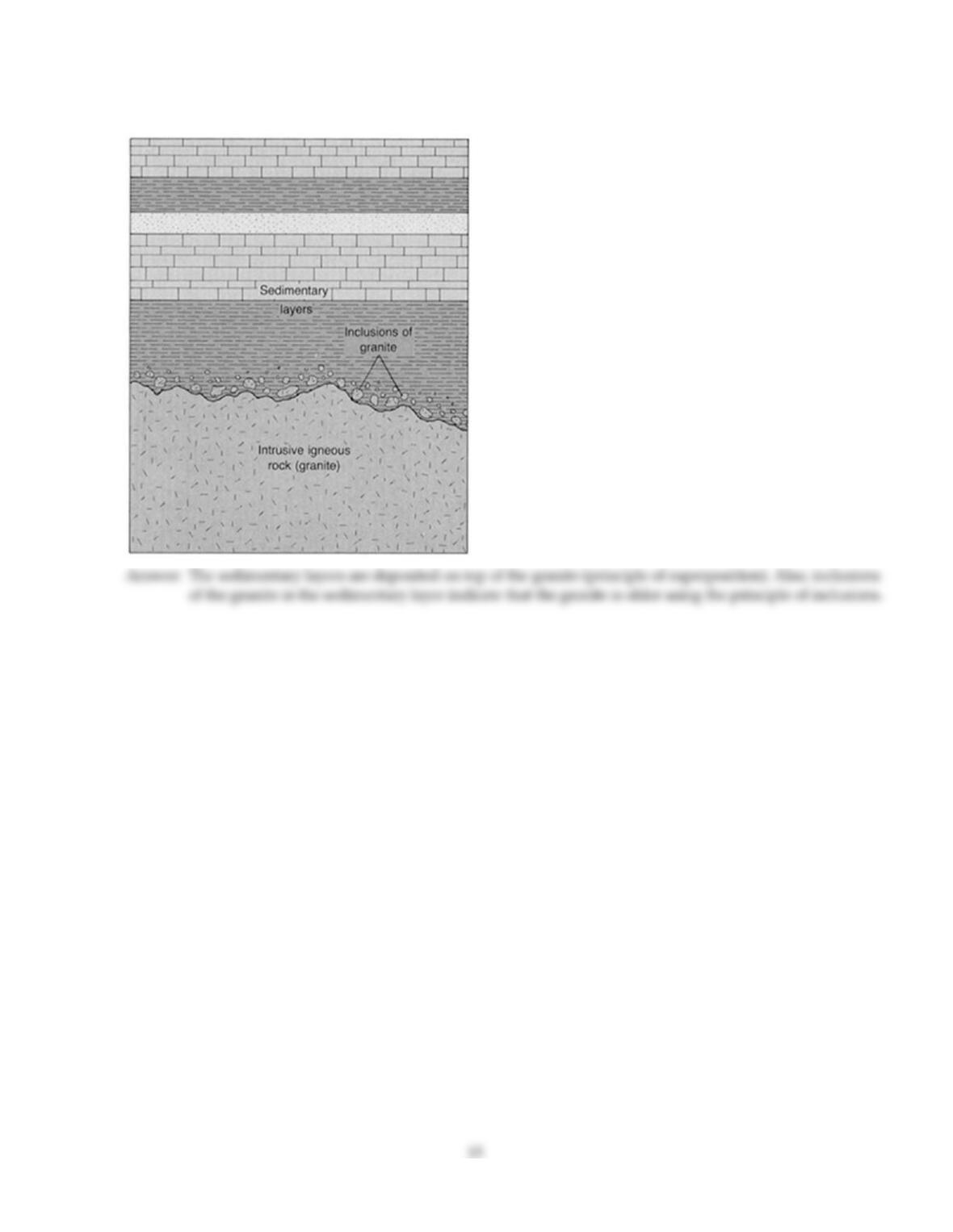
Examine the illustration below (a cross section through the Earth as you might observe on the wall of a quarry
or a road cut). Give two reasons why the granite must be older than the sedimentary layers.
Answer Key
Testname: C18
Answer Key
Testname: C18