Cost Accounting: A Managerial Emphasis, 6e
Chapter 18 – Spoilage, Rework, and Scrap
7) Boss Manufacturing generally has spoiled goods during each job. Costs are assigned to normal
spoilage at $10.00 per unit and abnormal spoilage at $20.00 per unit. Disposal fees typically run $5.00 per
item. Boss has a policy never to rework spoiled units. Management believes that once a unit is damaged it
cannot be reworked into a quality product.
What is the appropriate journal entry if 500 units are considered abnormal spoilage in a job costing
system?
A)
Work in Process
$10,000
Work in Process Control
$10,000
B)
Work in Process Control
$2,500
Loss from Abnormal Spoilage
$2,500
C)
Loss from Abnormal Spoilage
$10,000
Cost of Goods Sold
$10,000
D)
Loss from Abnormal Spoilage
$2,500
Work in Process
$2,500
E)
Loss from Abnormal Spoilage
$10,000
Work in Process Control
$10,000
Cost Accounting: A Managerial Emphasis, 6e
Chapter 18 – Spoilage, Rework, and Scrap
8) The Hawg Manufacturing Shop produces motorcycle parts. Typically, 20 pieces out of a job lot of 2,000
parts are normally spoiled. Costs are assigned at the inspection point, $100.00 per unit. Spoiled pieces
may be disposed of for proceeds of $20.00 per unit. When the normal spoilage is detected, the spoiled
goods must be inventoried appropriately. The current job requires the production of 5,000 good parts.
Which of the following journal entries would be correct if the spoilage occurred due to specifications
required for Job 101?
A)
Work in Process Control
$400
Materials Control
$400
B)
Materials Control
$400
Work in Process Control
$400
C)
Work in Process Control
$1,000
Materials Control
$1,000
D)
Materials Control
$1,000
Work in Process Control
$1,000
E)
Work in Process Control
$1,400
Materials Control
$1,400
Cost Accounting: A Managerial Emphasis, 6e
Chapter 18 – Spoilage, Rework, and Scrap
9) The Hawg Manufacturing Shop produces motorcycle parts. Typically, 20 pieces out of a job lot of 2,000
parts are normally spoiled. Costs are assigned at the inspection point, $100.00 per unit. Spoiled pieces
may be disposed of for proceeds of $20.00 per unit. The spoiled goods must be inventoried appropriately
when the normal spoilage is detected. The current job requires the production of 5,000 good parts.
Which of the following journal entries properly reflects the recording of spoiled goods?
A)
Materials Control
$400
Mfg. Dept. Overhead Control
1,600
Work in Process Control
$2,000
B)
Materials Control
$1,000
Manufacturing Overhead Control
4,000
Work in Process Control
$5,000
C)
Work in Process Control
$5,000
Materials Control
$1,000
Manufacturing Overhead Control
4,000
D)
Manufacturing Overhead Control
$2,000
Materials Control
$400
Work in Process Control
1,600
E)
Manufacturing Overhead Control
$1,000
Materials Control
$400
Work in Process Control
600
Cost Accounting: A Managerial Emphasis, 6e
Chapter 18 – Spoilage, Rework, and Scrap
10) A company manufactures draperies. Because of strict production specifications, the manufacturing
department often has spoiled items. If the spoiled items are under 10 percent of a job’s total items they are
treated as normal spoilage. During February job #101 for 200 draperies had 16 spoiled items. The spoiled
items were detected immediately before they were packaged. They had already passed the safety
inspection. The marketing manager believes the items can be sold for $280 each. They had a cost at point
of detection of $600 each. These costs included $300 for direct manufacturing labour, $200 for direct
materials, and $100 for factory overhead.
Required:
a. Make the necessary journal entry, or entries, to record the spoiled units if the spoilage is normal and
assigned to an overhead control account.
b. Make the necessary journal entry, or entries, to record the spoiled units if the spoilage is assigned to
job #101.
18.5 Apply cost allocation procedures to account for reworked units and scrap.
1) An example of rework is when a shoe manufacturer uses leftover leather from shoes to make leather
watch bands.
2) Accounting for rework in process-costing only requires that abnormal rework be distinguished from
normal rework.
Cost Accounting: A Managerial Emphasis, 6e
Chapter 18 – Spoilage, Rework, and Scrap
3) One of the major aspects of accounting for scrap is inventory costing, which includes when and how
scrap affects operating income.
4) There is no cost attached to scrap.
5) Scrap has no value (or minimal value) therefore it is not traced back to specific jobs.
6) Reworked goods are unacceptable units of production usually not capable of being repaired or
converted into a salable product.
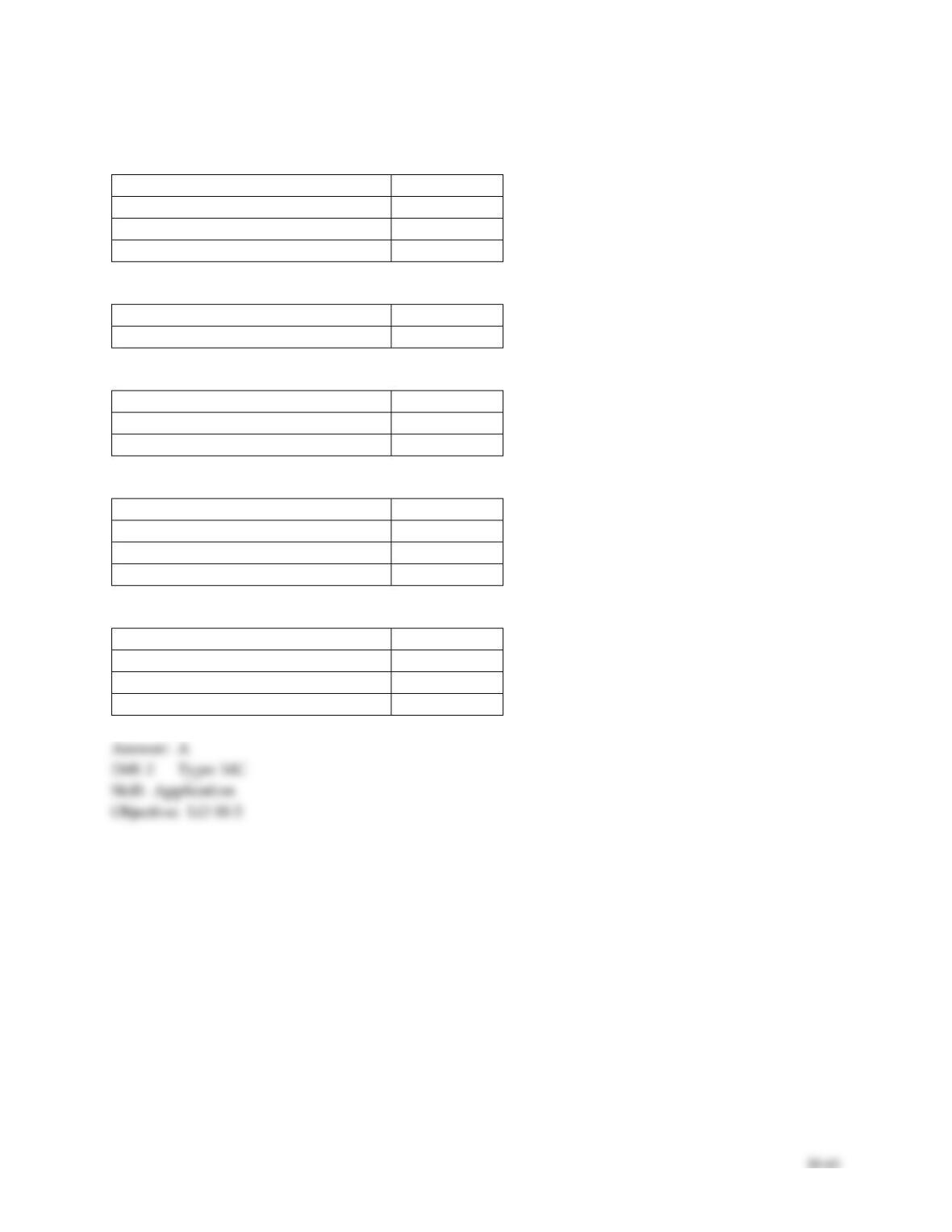
7) What is the effect of the following journal entry?
manufacturing overhead control (rework)
125
materials control
30
work-in-process
80
manufacturing overhead control allocated
15
A) to allocate $15 of overhead as rework costs
B) to expense $125 of overhead as rework costs
C) to set up rework costs on the balance sheet
D) to allocate $15 of overhead as rework costs, and to expense $125 of overhead as rework costs
E) to accumulate rework costs so they can be assigned to a specific job
Cost Accounting: A Managerial Emphasis, 6e
Chapter 18 – Spoilage, Rework, and Scrap
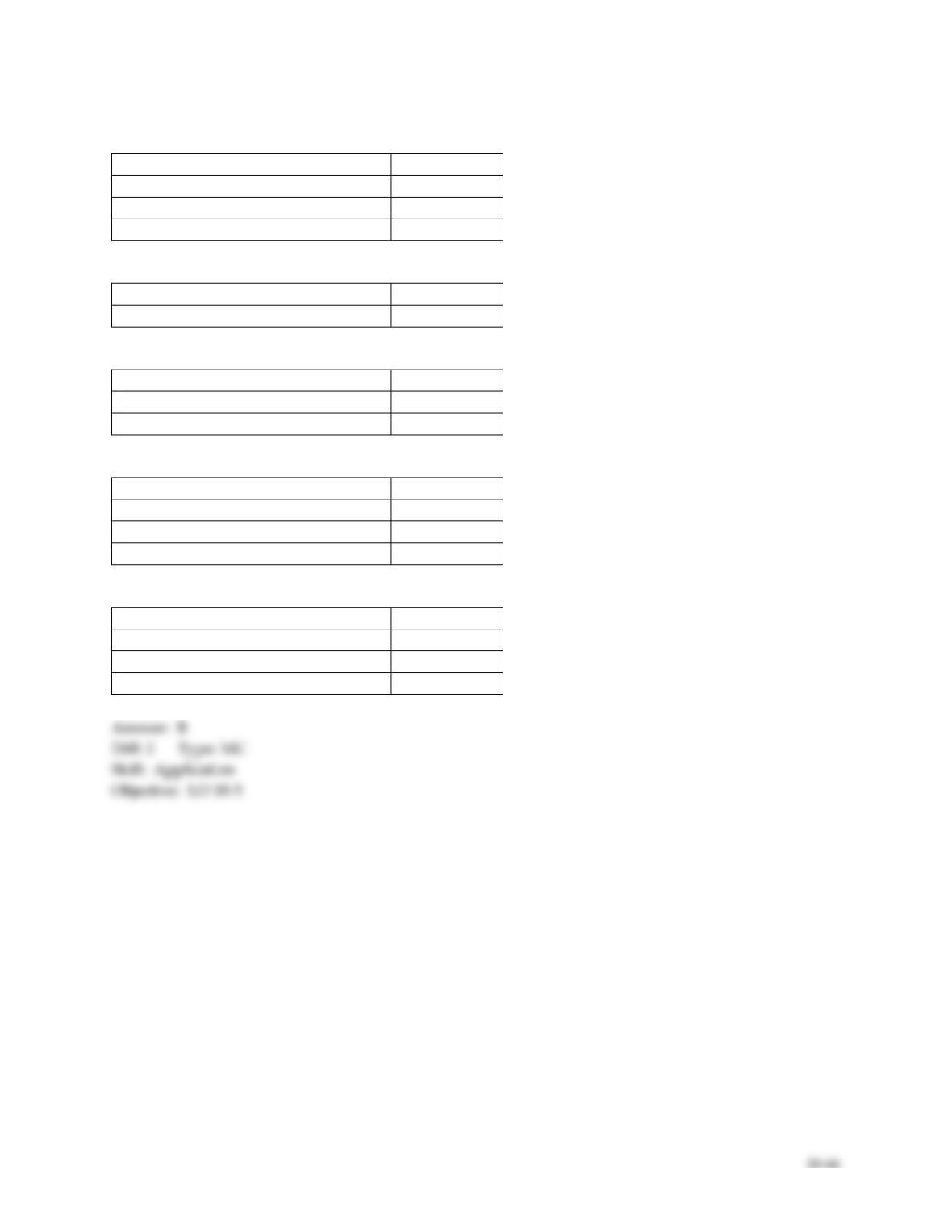
8) Which of the following entries reflects the original cost assignment before production items are
reworked?
A)
Work in Process Control
XXX
Materials Control
XXX
Wages Payable Control
XXX
Mfg. Overhead Allocated
XXX
B)
Finished Goods Control
XXX
Work in Process Control
XXX
C)
Mfg. Overhead Allocated
XXX
Materials Control
XXX
Work in Process Control
XXX
D)
Materials Control
XXX
Wages Payable Control
XXX
Work in Process Control
XXX
Mfg. Overhead Allocated
XXX
E)
Work in Process Control
XXX
Materials Control
XXX
Wages Payable Control
XXX
Mfg. Overhead Allocated
XXX
Cost Accounting: A Managerial Emphasis, 6e
Chapter 18 – Spoilage, Rework, and Scrap
9) Which of the following entries would correctly record costs associated with reworked items?
A)
Work in Process Control
XXX
Materials Control
XXX
Wages Payable Control
XXX
Mfg. Overhead Allocated
XXX
B)
Finished Goods control
XXX
Work in Process Control
XXX
C)
Mfg. Overhead Allocated
XXX
Materials Control
XXX
Work in Process Control
XXX
D)
Materials Control
XXX
Wages Payable Control
XXX
Work in Process Control
XXX
Mfg. Overhead Allocated
XXX
E)
Work in Process Control
XXX
Materials Control
XXX
Wages Payable Control
XXX
Mfg. Overhead Allocated
XXX
Cost Accounting: A Managerial Emphasis, 6e
Chapter 18 – Spoilage, Rework, and Scrap
10) When abnormal rework is distinguished from normal rework, and charged to a separate loss account,
which of the following is a likely result?
A) Prices will have to increase on the company’s products accordingly.
B) If responsibility for normal spoilage expense is penalized less heavily than the unfavourable efficiency
variances arising from rework, then managers will tend to rework too many spoiled units.
C) If responsibility for abnormal spoilage expense is penalized less heavily than the unfavourable
efficiency variances arising from rework, then managers will tend to rework too many spoiled units.
D) If responsibility for normal spoilage expense is penalized more heavily than the unfavourable
efficiency variances arising from rework, then managers will tend to rework too many spoiled units.
E) If responsibility for abnormal spoilage expense is penalized more heavily than the unfavourable
efficiency variances arising from rework, then managers will tend to rework too many spoiled units.
11) Which of the following is NOT a consideration when accounting for scrap?
A) possibility of theft
B) inventory costing
C) planning and control includes physical tracking
D) decisions as to whether to group scrap with reworked units
E) to assist in measuring efficiency
Cost Accounting: A Managerial Emphasis, 6e
Chapter 18 – Spoilage, Rework, and Scrap
12) Which of the following journal entries could appropriately record the cash sale of scrap?
A)
Cash
XXX
Materials control
XXX
B)
Sales of Scrap
XXX
Accounts Receivable
XXX
C)
Manufacturing Dept. Overhead Control
XXX
Accounts Payable
XXX
D)
Cash
XXX
Accounts Payable
XXX
E)
Cash
XXX
Manufacturing Overhead Allocated
XXX
13) When scrap is insignificant in value,
A) it is recorded when discovered.
B) it may not be recognized until the point of sale.
C) it is recognized at the point of production.
D) it is recorded at its fair market value.
E) it is not necessary to recognize it in the accounting records.
14) Sales of scrap may be traced to the individual jobs in which it occurred when the ________ system is
used.
A) budgeted costing
B) job-costing
C) process costing
D) revenue costing
E) weighted-average costing
Cost Accounting: A Managerial Emphasis, 6e
Chapter 18 – Spoilage, Rework, and Scrap
15) Which account is debited when scrap is reused as direct material?
A) work-in-process-control
B) materials control
C) manufacturing overhead control
D) scrap inventory
E) manufacturing overhead allocated
16) When scrap is returned to the storeroom, so that it may be used as direct material, which account is
debited?
A) work-in-process-control
B) materials control
C) manufacturing overhead control
D) scrap inventory
E) sales of scrap

Cost Accounting: A Managerial Emphasis, 6e
Chapter 18 – Spoilage, Rework, and Scrap
17) Assume the amount of scrap is material and the scrap is sold immediately after it is produced. If the
scrap attributable to a specific job is sold on account, the journal entry is:
A)
Work-in-Process Control
Cash
B)
Work-in-Process Control
Accounts Receivable
C)
Accounts Receivable
Work-in-Process Control
D)
Work-in-Process Control
Accounts Payable
E)
Cash
Work-in-Process Control

Cost Accounting: A Managerial Emphasis, 6e
Chapter 18 – Spoilage, Rework, and Scrap
18) If scrap, common to all jobs, is returned to the storeroom and the time between the scrap being
inventoried and its disposal is quite lengthy, the journal entry is:
A)
Work-in-Process Control
Materials Control
B)
Materials Control
Work-in-Process Control
C)
Manufacturing Overhead Control
Materials Control
D)
Materials Control
Manufacturing Overhead Control
E)
Materials Control
Manufacturing Overhead Allocated
Cost Accounting: A Managerial Emphasis, 6e
Chapter 18 – Spoilage, Rework, and Scrap
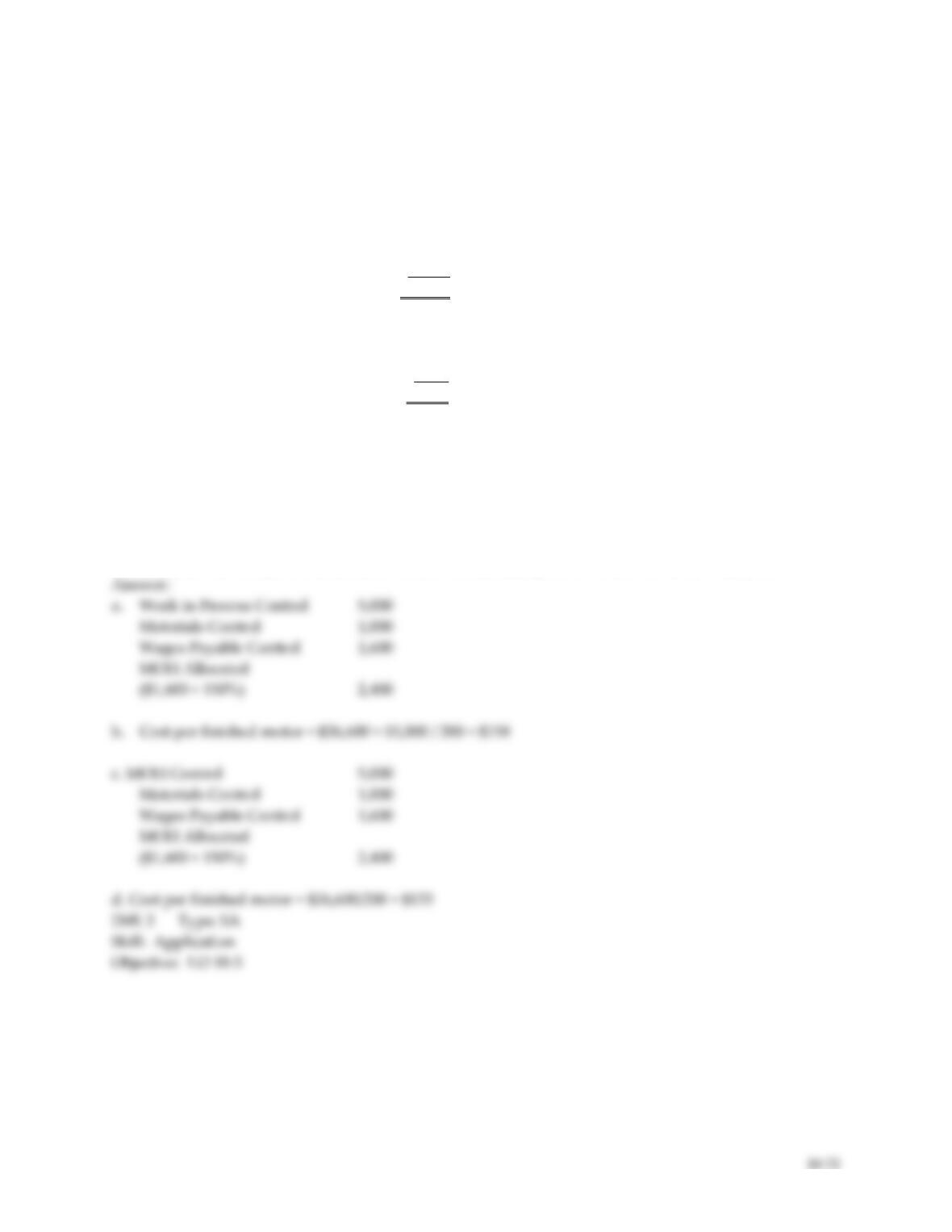
19) Boutin Company uses a job costing system. During October, the following costs are incurred on Job
110 to manufacture 200 motors:
Original costs:
Direct materials $6,600
Direct manufacturing labour 8,000
Manufacturing overhead allocated
(150% of direct manufacturing labour) 12,000
Total $26,600
Direct cost of reworking 10 motors:
Direct materials $1,000
Direct manufacturing labour 1,600
Total $2,600
Required:
a. Prepare the journal entry to record the rework costs, assuming the rework is attributable specifically
to Job 110.
b. Compute the cost per finished motor for Job 110, assuming the rework is attributable specifically to
this job.
c. Prepare the journal entry to record the rework costs, assuming the rework is common to all jobs.
d. Compute the cost per finished motor for Job 110, assuming the rework is common to all jobs.
Cost Accounting: A Managerial Emphasis, 6e
Chapter 18 – Spoilage, Rework, and Scrap
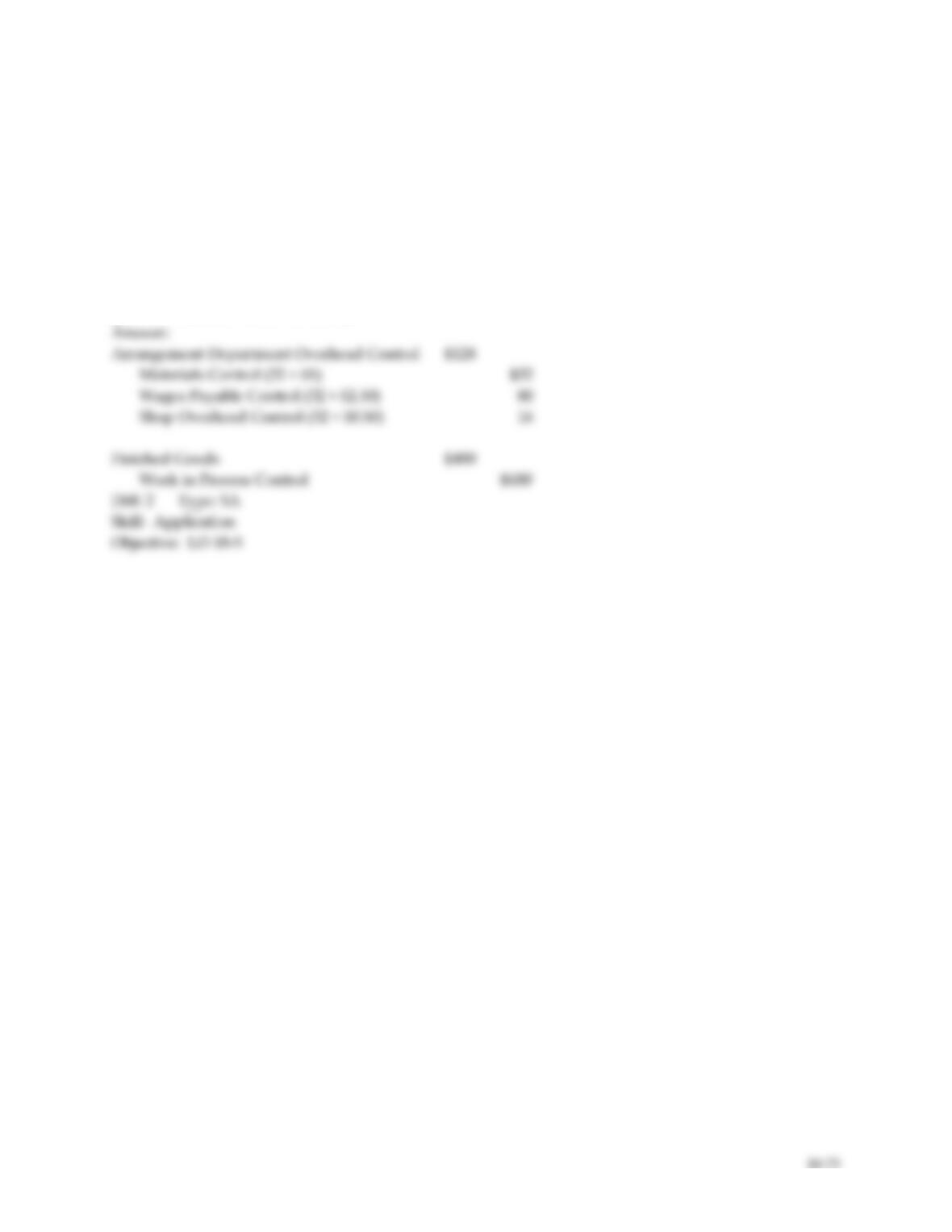
20) Carriage Florists operate a flower shop. Because most of the orders are via telephone, fax or email,
numerous orders have to be reworked. The average cost of the reworked orders is $4: $2.50 for labour, $1
for more flowers, and $0.50 for overhead. This ratio of costs holds for the average original order. On a
recent day the shop reworked 32 orders out of 166. The original cost of the 32 orders totalled $480. The
average cost of all orders is $12.50, including rework, with an average selling price of $20.
Required:
Prepare the necessary journal entry, or entries, to record the rework for the day if the shop charges such
activities to Arrangement Department Overhead Control. Prepare a journal entry to transfer the finished
goods to Finished Goods Inventory.
Cost Accounting: A Managerial Emphasis, 6e
Chapter 18 – Spoilage, Rework, and Scrap
21) Dad’s Bottling Company often has bottles that do not meet customer specifications although it does
not allow for spoilage. Some of the rejects are immediately crushed and recycled while others are held for
future use in other jobs. During May the company had bottles costing $1,000 that were recycled and
$1,600 worth of bottles that were placed in inventory for later use. These bottles were sold in June for
$2,000.
Required:
Record the journal entries associated with the above activities. Assume saleable scrap items are returned
to inventory when rejected during inspection.
Cost Accounting: A Managerial Emphasis, 6e
Chapter 18 – Spoilage, Rework, and Scrap
22) Robotoys Incorporated manufactures and distributes small robotic toys. Reworked units are common.
The average cost of the reworked orders is $11.30: $4.15 for labour, $5.00 for more materials, and $2.15 for
overhead. This ratio of costs holds for the average original order. On a recent day, the shop reworked 83
orders out of 700. The original cost of the 83 orders totaled $1,909. The average cost of all orders is $24.34,
including rework, with an average selling price of $34.50.
Required:
Prepare the necessary journal entry to record the rework for the day if the shop charges such activities to
Robo Department Overhead Control. Prepare journal entries to record all relevant rework charges as well
as to transfer the reworked items finished goods to Finished Goods Inventory.
Cost Accounting: A Managerial Emphasis, 6e
Chapter 18 – Spoilage, Rework, and Scrap
18–76
23) Marvin Randall had a background in the manufacturing of building bricks. The building brick
industry used clay and other material which were first mixed, then aged. After aging, they were molded
into shapes, retouched and fired in kilns. The materials were fairly durable and spoilage was not
significant. As a result, any spoilage that did occur was not specifically accounted for. Marvin saw the
similarities between brick and tile manufacturing and felt that he could apply his knowledge successfully
in tile manufacturing and started his business, Randall Tile Ltd. on July 1.
In tile manufacturing, as it brick manufacturing, the process starts with the selection of the raw materials
including clays. However feldspar, sand, and other materials are used. In the initial stages, it is important
that all materials are homogenized; this is done through a wet grinding process. The material output of
this process is known as slip.
Water content is then removed from the slip through spray-drying . After, the material is moulded ,
pressed and dried before the tiles are fired. Hydraulic presses are used to guarantee maximum
compaction. Consistency in the press cycle time is critical to ensure the tiles have the correct moisture
content. If the water content is too high, the tiles will crack or break.
Unglazed tiles proceed to firing, whereas glazed tiles must first be covered with one or more layers of
glaze. Firing time and temperature are important in the firing process to ensure the resulting product
meets required specifications for strength, stability, resistance and easy cleaning.
After firing, tiles are inspected for quality. Irregularities in size, shape or colouring will lead to spoiled
units. The final step is packing the ceramic tiles.
Randall Tile was organized into 4 main departments.: 1) Mixing & Grinding, 2) Moulding & Pressing, 3)
Glazing & Firing and 4) Inspecting & Packing. Randall was not manufacturing many glazed tiles, so any
glazing that was required was done in the Firing department. The weighted average method of process
costing was used in each department, however spoilage was not tracked. Marvin quickly realized that,
although the processes in brick and tile manufacturing processes were similar, tile manufacturing
required much more precision. After 3 months of operations, he estimated that he had a 50% defect rate
when considering all stages of manufacturing. Employees were frustrated by the constant changes in
manufacturing as pressing times, firing times, and temperatures were all altered in attempts to improve
quality. Furthermore, Marvin believed that both frustration and nervousness led to high spoilage in the
packing process.
Required:
What factors might have contributed to the high defect rate that Marvin noted? What steps might Marvin
have taken prior to starting production to minimize defects? What recommendations would you make to
Marvin regarding the management accounting system at Randall Tile?
Cost Accounting: A Managerial Emphasis, 6e
Chapter 18 – Spoilage, Rework, and Scrap
18–77
Cost Accounting: A Managerial Emphasis, 6e
Chapter 18 – Spoilage, Rework, and Scrap
24) When a unit has to be reworked, the rework may be classified in three ways. What are those ways,
and how does the accounting for each differ?
25) There are two alternative points in time for recognizing scrap in the accounting records. What are
these two points in time? Explain why a company might choose one over the other.