
Biology: A Guide to the Natural World, 5e (Krogh)
Chapter 18 The Outcomes of Evolution: Macroevolution
1) The biological species concept is based on:
A) differences among populations.
B) geographic isolation.
C) reproductive isolation.
D) DNA sequences.
2) The biological species concept cannot be applied to bacteria because:
A) their DNA is too similar.
B) their features are too small to be able to distinguish one kind from another.
C) they do not reproduce sexually.
D) they never exchange genes that would allow for speciation.
3) Which of these definitions of species most closely fits the biological species concept?
A) For asexually reproducing organisms, members of the same species are based on DNA and
RNA base sequence analysis.
B) Members of the same species look almost exactly alike.
C) Members of the same species are all morphologically similar.
D) Members of the same species can mate and produce fertile offspring.
4) Interbreeding two different species of lovebirds produces offspring unable to build a nest after
they mature because they lack the innate knowledge needed to carry the nesting materials. The
hybrid offspring do not reproduce, and this limits genetic mixing of the two species. This is an
example of:
A) sympatric speciation.
B) gametic inviability.
C) behavioral isolation.
D) hybrid infertility.

5) A population of mountain-dwelling salamanders migrates and splits into two populations
separated by a valley they can not cross. The speciation process that may occur is:
A) allopatric.
B) temporal.
C) behavioral.
D) sympatric.
6) A population becomes isolated from other populations of the same species, and then genetic
divergence occurs that prevents them from breeding with other populations. What has happened?
A) speciation
B) formation of genetic drifts
C) directional selection
D) mechanical incompatibility
7) Two different species of pines release their pollen at different times. This is an example of:
A) behavioral isolation.
B) geographic isolation.
C) mechanical isolation.
D) temporal isolation.
8) Which of these is not gametic isolation?
A) Female stigma destroys germinating pollen grain.
B) Lily sperm cannot fertilize tulip eggs.
C) Pollen grain does not germinate on stigma (female structure).
D) Male and female sex organs do not fit together.

9) The Great Dane and Chihuahua are both domestic dogs, the same species. However, mating
between them is limited by:
A) behavioral isolation.
B) heterozygote disadvantage.
C) mechanical incompatibility.
D) hybrid infertility.
10) The many species of tree frogs that inhabit forests in the eastern United States maintain their
genetic isolation from other species by several mechanisms, including “singing” slightly different
songs. Which type of isolating mechanism does this represent?
A) temporal isolation
B) behavioral isolation
C) ecological isolation
D) mechanical isolation
11) If a hybrid is unable to produce sperm because meiosis does not proceed correctly, gene flow
between the populations is restricted by:
A) ecological isolation.
B) gametic isolation.
C) temporal isolation.
D) hybrid infertility.
12) One method of protecting the genetic identity of a population is the inability of sperm to
fertilize eggs of a different species. This isolating mechanism is called:
A) behavioral isolation.
B) gametic isolation.
C) ecological isolation.
D) temporal isolation.

13) Where would a researcher most likely find examples of allopatric speciation?
A) in the surface waters of Lake Michigan
B) in a forest on the west side of Lake Michigan
C) in a forest on the east side of Lake Michigan
D) in forests on the east and west sides of Lake Michigan
14) Moss A produces gametes in May, and moss B produces gametes in June. This is an example
of a/an ________ isolating mechanism.
A) temporal
B) behavioral
C) post-mating
D) geographic
15) If hybrid organisms result from the mating of two different species, they may not live long.
This is an example of:
A) temporal isolation.
B) hybrid inviability.
C) hybrid infertility.
D) hybrid vigor.
16) In the absence of geographic barriers, ________ speciation may occur when reproductive
isolating mechanisms develop between two populations.
A) sympatric
B) allopatric
C) ecological
D) extrinsic

17) Pollen of one plant species will not germinate on the flower of another species. This is an
example of:
A) temporal isolation.
B) hybrid inviability.
C) hybrid infertility.
D) gametic isolation.
18) Organisms come into sexual maturity at different times of the year. This is an example of:
A) temporal isolation.
B) hybrid inviability.
C) hybrid infertility.
D) hybrid vigor.
19) Which reproductive isolating mechanism is mostly restricted to animals?
A) ecological
B) hybrid infertility
C) temporal
D) behavioral
E) geographic
20) Which of the following would be an example of mechanical isolation?
A) Mating and courtship displays are different.
B) Sperm cannot survive in the female reproductive tract.
C) Organisms breed at different times.
D) Male and female genitalia are incompatible.

21) Species A is divided by a newly formed river to become two populations. These populations
diverge to become two different species, B and C. If the river is dammed upstream, eliminating
an isolating mechanism between B and C, what will happen?
A) Gene flow will resume.
B) Species B and C will be considered subspecies.
C) Species B and C will remain genetically isolated.
D) Species will unite to form a hybrid species, D.
22) ________ isolating mechanisms are outside factors that prevent interbreeding.
A) Intrinsic
B) Extrinsic
C) Behavioral
D) Mechanical
23) Horses and donkeys mate successfully to produce mules, which are always sterile. Which
genetic isolating mechanism is involved here to prevent horses and donkeys from becoming a
single species?
A) hybrid infertility
B) behavioral isolation
C) mechanical isolation
D) gametic isolation
24) Blue-footed boobies of the Galapagos will mate only after a very specific courtship display
on the part of the male. He high-steps to advertise his bright blue feet. What isolating mechanism
discourages mating outside the species?
A) temporal isolation
B) ecological isolation
C) gametic isolation
D) behavioral isolation

25) Two species of garter snakes live in the same geographic area. One mainly lives in water,
and the other mainly on land, so they rarely encounter each other and do not interbreed. This is
an example of what type of isolating mechanism?
A) directional
B) temporal
C) mechanical
D) ecological
26) Two species of pines, Pinus radiata and Pinus muricota, live together in California and are
capable of forming hybrids under laboratory conditions. However, they do not interbreed
because one releases pollen in February and the other in April. What is the genetic isolating
mechanism involved?
A) gametic
B) ecological
C) geographic
D) temporal
27) In order for allopatric speciation to occur, first there must be a geographic separation of two
populations of the same species. The second step requires:
A) additional extrinsic isolating mechanisms to become involved.
B) an increase in gene flow between the populations.
C) physical and behavioral changes that keep them from interbreeding.
D) physical and behavioral changes that permit occasional hybridization.
28) There are currently many similar but different species on either side of the isthmus of
Panama. They probably resulted from:
A) large rapid changes in their gene frequencies.
B) hybridization.
C) sympatric speciation.
D) allopatric speciation.

29) In many species of fireflies, males flash to attract females. Each species has a different
flashing pattern. This is an example of:
A) behavioral isolation.
B) allopatric speciation.
C) geographic isolation.
D) natural selection.
30) Eastern and western meadowlarks look almost identical and sometimes inhabit the same
areas of prairies. They recognize members of their own species by distinctive songs and thus do
not breed with each other. This is an example of:
A) geographic isolation.
B) ecological isolation.
C) no isolation mechanism.
D) behavioral isolation.
31) Which of the following situations describes a scenario in which allopatric speciation might
occur?
A) A mutation makes certain frogs mate two days earlier in the season.
B) A mutation changes the pollinator a plant can utilize.
C) An earthquake separates a lizard population into two groups.
D) A pair of birds colonizes an island with numerous empty niches.

9
Refer to the scenario below, and then answer the following question(s).
Species of fruit fly larvae in the genus Rhagoletis each feed on a particular kind of fruit.
Rhagoletis pomonella feeds on the small red fruit of the hawthorn tree. In 1865, farmers in the
Hudson River valley found that R. pomonella flies had begun attacking their apples and then
spread to apple orchards in adjacent areas of Massachusetts and Connecticut. These now separate
varieties of flies, the apple and haw flies, usually don’t interbreed with each other because their
periods of mating coincide with the different ripening times of apples and hawthorn fruit. Each
variety is becoming specialized to feed and reproduce in its own particular microhabitat and may
be transitioning to separate species.
32) If the apple and haw flies become distinct enough to be separate species, their evolution is an
example of:
A) gametic isolation.
B) behavioral isolation.
C) sympatric speciation.
D) allopatric speciation.
33) If the apple and haw flies no longer interbreed due to the different ripening times of apples
and hawthorns, this would be an example of what kind of reproductive isolating mechanism?
A) ecological isolation
B) temporal isolation
C) behavioral isolation
D) mechanical isolation
E) gametic isolation
34) When the London underground (subway) system was built in the nineteenth century,
mosquitoes moved into the tunnels and became adapted to biting the customers and small
animals that inhabit the subway system. Like people, mosquitoes can freely enter and leave
through the tunnel entrances. Recently, DNA analysis and attempts to cross-breed above-ground
mosquitoes with underground mosquitoes indicate that there are now two different species. The
underground insects are visibly larger. Which term best describes what has happened?
A) sympatric speciation
B) behavioral incompatibility
C) temporal isolation
D) population bottleneck
35) Thinking of the examples in your book of adaptive radiation, in which of the following
environments might you be most likely to find adaptive radiation?
A) among houseflies living in a garbage dump

B) in fruit flies that feed on different yeast strains specific to different species of cacti in the
desert
C) in earthworms feeding on detritus
D) among insects that are generalist feeders
36) Since the Pleistocene ice age, deserts have been gradually forming in the southwestern
United States. As the original lakes and rivers of this area shrank into isolated streams and
springs, the fishes living in them developed a strong potential for:
A) hybrid sterility.
B) speciation.
C) hybrid inviability.
D) temporal isolation.
37) When a species invades a new habitat and evolves rapidly into several new species, what has
occurred?
A) divergent speciation
B) polyploidy
C) adaptive radiation
D) phyletic speciation
38) Which of these taxonomic categories is more inclusive than family and less inclusive than
class?
A) genus
B) order
C) kingdom
D) domain

39) Which of these is a correct order of taxonomic categories from most inclusive to least
inclusive?
A) kingdom, domain, phylum, order, class, family, genus
B) domain, phylum, kingdom, order, class, family, genus
C) domain, kingdom, phylum, class, order, family, genus
D) domain, kingdom, class, phylum, order, family, genus
40) Which field of biology is concerned with the diversity and relatedness of organisms?
A) evolution
B) morphology
C) systematics
D) phylogeny
41) A hypothesis about the evolutionary relatedness of a group of organisms is known as a:
A) taxon.
B) analogy.
C) homology.
D) phylogeny.
42) Insect wings, bat wings, and the flaps of tissue between the limbs and body of “flying”
squirrels are:
A) homozygous.
B) homologous.
C) analogous.
D) abrupt.

43) In an organism’s binomial scientific name, the first of the two names is the
A) species.
B) family.
C) order.
D) genus.
44) It has been decided, by a group of scientific experts, that lack of internal temperature
regulation, presence of waterproof skin made of scales, and a waterproof egg are the three main
characteristics that should be used to classify organisms as reptiles. This decision is most
consistent with:
A) adaptive radiation.
B) cladistic taxonomy.
C) natural selection.
D) classical taxonomy.
45) Which pair of animals is probably most closely related evolutionarily?
A) animals in the same class
B) animals in the same phyla
C) animals in the same family
D) animals in the same genus
46) Which of the following pairs of traits represents analogous characteristics?
A) trout fins and frog legs
B) sparrow wings and penguin wings
C) bat wings and whale fins
D) bat wings and dragonfly wings

47) Analogous features in different organisms have nothing to do with common descent. These
are produced by:
A) convergent evolution.
B) divergent evolution.
C) reproductive isolation.
D) adaptive radiation.
48) About 50,000 animal species are vertebrates, yet only some vertebrates then went on to
evolve four limbs. This tetrapod feature is considered to be a/an ________ of vertebrates.
A) ancestral character
B) homologous character
C) analogous character
D) derived character
49) Even through they are separate species, lions and tigers can interbreed.
50) What causes geographic isolation for one kind of organism may not be isolating for another
kind of organism.
51) Speciation can occur without dramatic anatomical or genetic change.
52) Speciation can never occur unless populations become separated by a geographic barrier.

53) It is desirable for a classification system to be based on the evolutionary history of the
organisms being studied.
15
Match the following.
A) intrinsic isolating mechanisms
B) gametic isolation
C) adaptive radiation
D) hybrid infertility
E) sympatric speciation
F) temporal isolation
G) behavioral isolation
H) extrinsic isolating mechanisms
I) ecological isolation
J) reproductive isolating mechanisms
K) allopatric speciation
54) Gene flow between species is restricted because their habitats are separate.
Topic: Section 18.2
Skill: Knowledge/Comprehension
55) Geographic separation prevents interbreeding.
Topic: Section 18.2
Skill: Knowledge/Comprehension
56) Courtship and mating displays keep organisms breeding within their own species.
Topic: Section 18.2
Skill: Knowledge/Comprehension
57) Natural factors prevent interbreeding between closely related species.
Topic: Section 18.2
Skill: Knowledge/Comprehension L) mechanical isolation
58) Members of one species mate at dusk, while members of a closely related species mate at
dawn.
Topic: Section 18.2
Skill: Knowledge/Comprehension
59) A population evolves into separate species when separated by a geographic barrier.
Topic: Section 18.2
Skill: Knowledge/Comprehension
60) One species of plant has a long flower tube and can only be pollinated by bumblebees,
whereas another similar species has short flower tubes and can only be pollinated by honeybees.
Topic: Section 18.2
Skill: Knowledge/Comprehension

61) Horses and donkeys can interbreed, but the mules that result are sterile.
Topic: Section 18.2
Skill: Knowledge/Comprehension
62) Differences in anatomy, physiology, or behavior prevent interbreeding of closely related
species.
Topic: Section 18.2
Skill: Knowledge/Comprehension
63) The sperm of one bird species cannot reach or fertilize the egg of a related bird species.
Topic: Section 18.2
Skill: Knowledge/Comprehension
64) A plant arises within a population that has a different number of chromosome sets than other
members of its population. It can self-fertilize but cannot interbreed with any other members of
its population.
Topic: Section 18.2
Skill: Knowledge/Comprehension
65) The introduction of a single species into a new environment produces rapid evolution of
many new species.
Topic: Section 18.3
Skill: Knowledge/Comprehension
66) A natural population of organisms that can produce fertile offspring belong to the same
________.
67) Two species of birds that are kept from interbreeding by the differences in their mating songs
are experiencing ________ isolation.
68) When an insect arrives on an island and evolves into a new species that is different from its
ancestor on the mainland, the two species are kept apart by ________ isolation.

69) Any speciation that does not involve geographic isolation is a type of ________ speciation.
70) The development of hundreds of new species of fruit flies in Hawaii from a single ancestor is
a good example of ________.
71) The practice of giving a two-part scientific name to every distinct organism is called
________.
72) Structural features that serve the same function in completely unrelated organisms are said to
be ________ structures.
73) Structures present in two different species that both have been inherited from a common
ancestor are said to exhibit ________.
74) The wings of a bird and the wings of a butterfly are the result of ________ evolution.
75) The taxonomic science that stresses the presence of shared derived characters in related
organisms is called ________.
76) Describe the difference between homologous and analogous structures in organisms, and
give an example of each.
77) Temporal and behavioral isolation are examples of premating isolating mechanisms.
Mechanical isolation, gametic isolation, and hybrid inviability are examples of postmating
isolating mechanisms. Premating isolating mechanisms are considered much more important in
keeping closely related species genetically separate than are postmating isolating mechanisms.
Do you agree? Why or why not?
78) In the early nineteenth century, the French scientist Georges Cuvier provided conclusive
evidence of the extinction of species on Earth. Although Cuvier correctly asserted that a series of
catastrophes led to these extinctions, he could not provide a testable explanation of the source of
the new animals and plants that appeared after the extinction of older forms. How would you
argue that modern evolutionary theory provides an explanation for the proliferation of new forms
of life after mass extinctions?
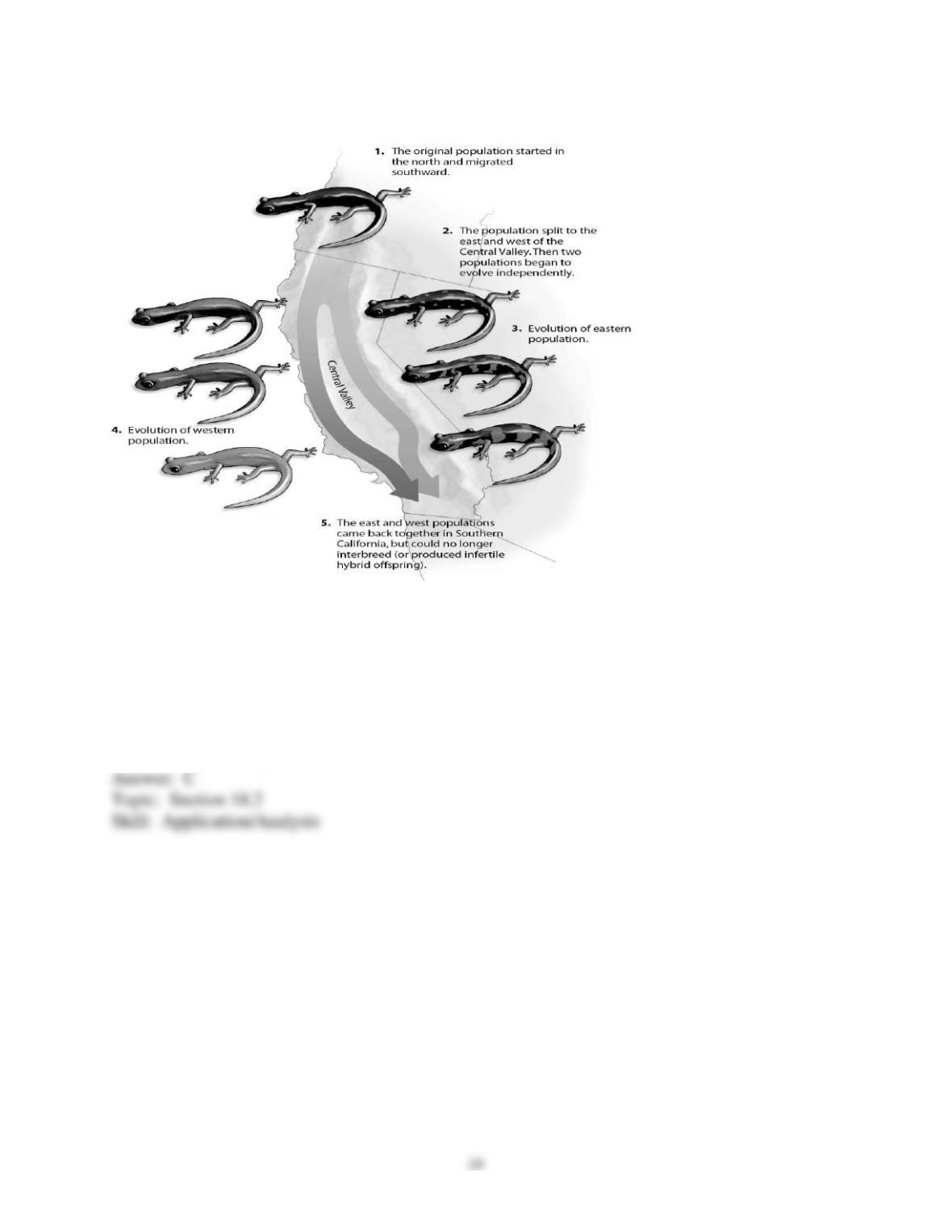
Refer to the figure below, and then answer the question that follows.
79) Migration of the salamander Ensatina eschscholtzii separated an original population as they
moved either west or east of the Central Valley of California. Eastern and western species then
evolved. The Central Valley is an example of a/an:
A) temporal isolating mechanism.
B) mechanical isolating mechanism.
C) extrinsic isolating mechanism.
D) intrinsic isolating mechanism.
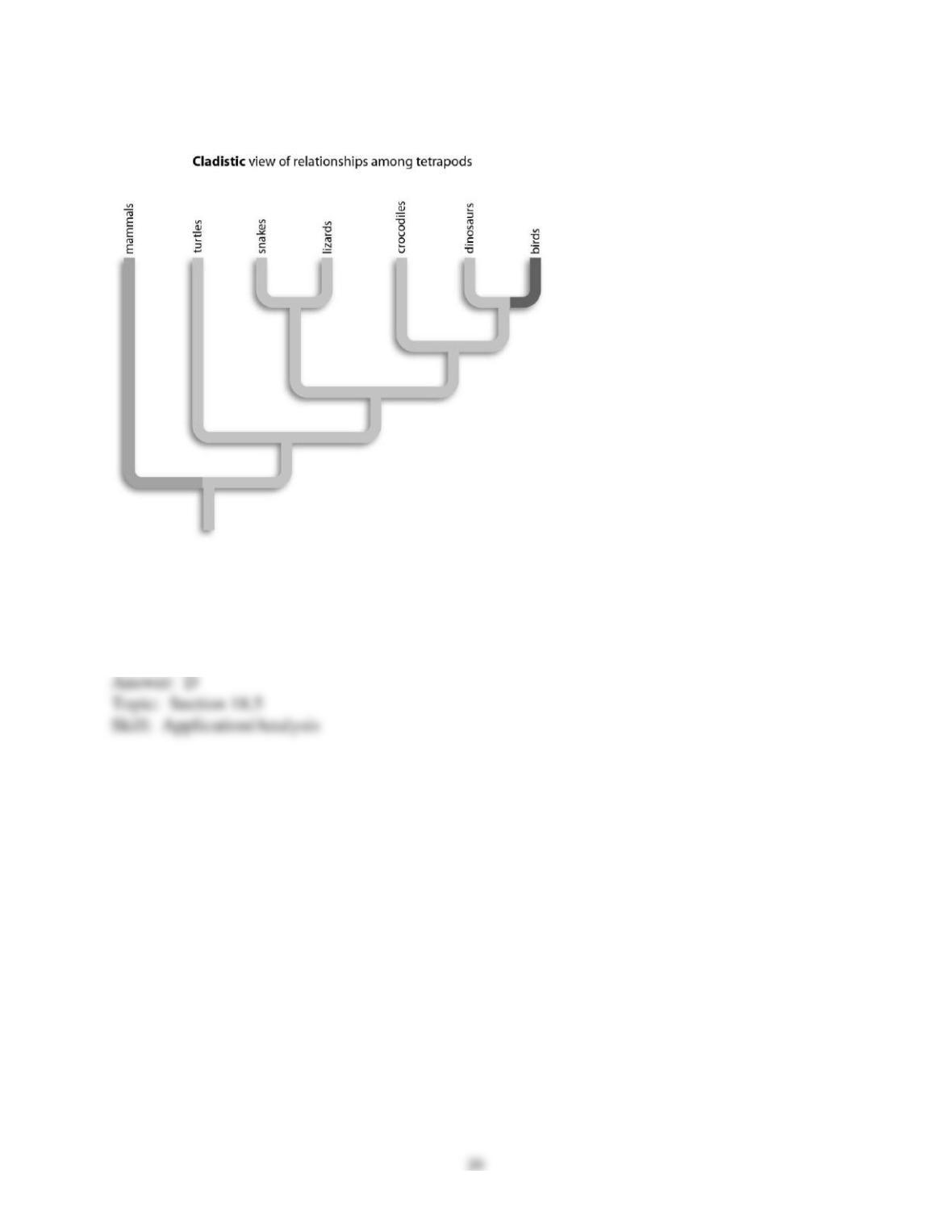
Refer to the figure below, and then answer the question that follows.
80) Which of the following pairs are most closely related?
A) crocodiles and dinosaurs
B) turtles and snakes
C) mammals and birds
D) dinosaurs and birds