
Chapter 18: Pricing and Profitability Analysis
132. The market share variance is calculated by
a. [(Actual industry sales in units – Budgeted industry sales in units) × (Budgeted market share percentage)] ×
(Budgeted average unit contribution margin).
b. [(Actual market share percentage – Budgeted market share percentage) × Actual industry sales in units] ×
Budgeted average unit contribution margin.
c. (Actual quantity sold – Budgeted quantity sold) × Budgeted average unit contribution margin.
d. (Actual quantity sold – Budgeted quantity sold) × Actual average unit contribution margin.
133. The market share and market size variances allow firms to compare their performance with the:
a. market as a whole
b. previous year’s results
c. upcoming year’s projections
d. inner workings of the company
134. The market size variance is the difference between actual and budgeted industry sales in units, multiplied by the
budgeted market share percentage, times the:
a. actual market share percentage
b. budgeted market share percentage
c. actual average unit contribution margin
d. budgeted average unit contribution margin
135. When the market share variance is unfavorable, it means that the budgeted share of the market is:
a. less than the actual market share
b. more than the market share percentage
c. more than the actual market share
d. less than market the market share percentage
136. The market size variance is favorable when the budgeted industry sales in units is:
a. more than the actual units sold
b. less than the actual units sold
c. more than the actual market share percentage
d. less than the budgeted market share percentage

Chapter 18: Pricing and Profitability Analysis
137. According to Hansen and Mowen, which of the following product life cycle stages comes first?
a. Introduction
b. Growth
c. Development
d. Decline
138. Which of the following product life cycle stages is characterized by rapid increases in sales and production?
a. Introduction
b. Growth
c. Maturity
d. Decline
139. The majority of the product cost is “locked in” during which of the following life–cycle stages?
a. Introduction
b. Growth
c. Development
d. Decline
140. Which of the following product life cycle stages has revenues for the entire industry decreasing?
a. Introduction
b. Growth
c. Maturity
d. Decline
141. Which of the following is NOT a limitation of profit management?
a. the emphasis on quantifiable measures
b. emphasis on volume variances
c. the focus on past performance
d. a higher emphasis on short-run optimization

Chapter 18: Pricing and Profitability Analysis
142. What are the ways employee behavior changes in relation to a profit emphasis?
a. desire to avoid losses may result in short-run decisions
b. unethical behavior may take place if rewards or bonuses are based on profits
c. ignoring the less measurable outcomes that may benefit the company
d. all of the above are potential changes
143. A successful firm
a. places appropriate emphasis on profit, is aware of economic and environmental trends outside the company, and
measures impact on the community and employees.
b. values numeric profit and encourage employees to do what is in their power to increase profits.
c. ensures there are always monthly, quarterly, and annual profit and lost statements as the sole measure of
success so that all employees are aware of the success or failure of a period.
d. none of the above
144. An alternative to the limitation of focusing on profits would be
a. communicating other measures are important but continue to base rewards on profits.
b. overstate the value of ending inventory in order to reduce cost of goods sold and improve operating income
performance.
c. focus on long-term objectives and appropriate emphasis on profit.
d. analyze the product mix.
145. Answer the following:
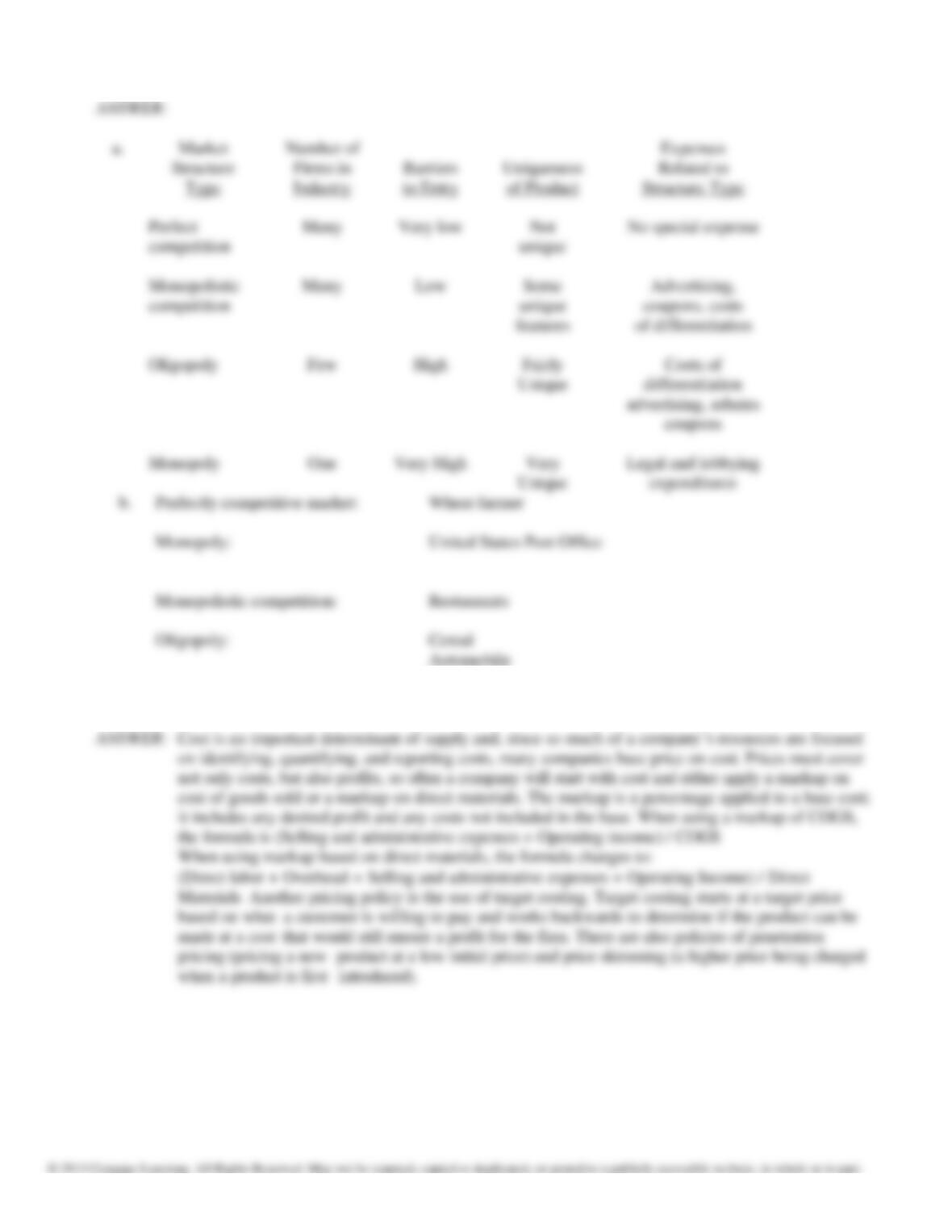
a. Discuss each of the following economic market structures (i.e., number of firms in industry, barriers to
entry, uniqueness of product):
1. Perfectly competitive market
2. Monopolistic competition
3. Oligopoly
4. Monopoly
b. Match the following industries with the appropriate economic market:
Restaurants
United States Post Office Cereal
Wheat farmer Automotive
Chapter 18: Pricing and Profitability Analysis
146. Compare and contrast the various pricing policies used by companies.
Chapter 18: Pricing and Profitability Analysis
147. The Furthur Phish Company has recorded the following data for three of their products:
Product
Old Price
New Price
Old Quantity
NewQuantity
X
$14.75
$14.25
2,000
2,200
Y
19.25
18.50
3,000
3,300
Z
Required:
24.50
27.50
4,000
3,600
a. Determine the price elasticity of demand for each of the products.
b. Which products have an elastic demand? Inelastic demand?
148. Lilah Fabulous operates a catering company. Lilah provides food and servers for parties. She also rents tables,
chairs, dinnerware, glassware, and linens. Jeff and Jessica Mantooth contacted Lilah about catering for their
daughter’s wedding. They have requested an open bar, hors d’oeuvres (enough for 300 people), a large wedding
cake, and forty tables with linens, dinnerware, and glassware. Lilah put together the following bid:
Food (300 × $7.50)
$2,250
Wedding cake ($150)
150
Beverages (300 × $5)
1,500
Servers (12 × 4 hours × $10)
480
Bartender (1 × 3 hours × $12)
36
Rental of:
Linens
80
Tables
200
Dinnerware
80
Glassware
80
Total
$4,856
Required:
Suppose that the Mantooths blanch when they see the bid. Mr. Mantooth suggests that they had hoped to spend no
more than $3,750 or so on the party. How could Lilah work with the Holmses to achieve a target cost of that
amount?
Chapter 18: Pricing and Profitability Analysis
149. Corlis Construction Company builds houses. Each job requires a bid. Corlis‘ bidding policy is to estimate the costs of
materials, direct labor, and subcontractor’s costs. These are totaled and a markup is applied to cover overhead and
profit. In the coming year, Corlis believes it will be the successful bidder on ten jobs with the following total
revenues and costs:
Revenues
$648,000
Materials
$200,000
Direct labor
250,000
Subcontractors
150,000
600,000
Residual
$48,000
The residual will cover overhead and profits.
Required:
a. What is the markup percentage on total direct costs?
b. Suppose Corlis is asked to bid on a job with estimated direct costs of $57,500. What is the bid?
If the customer complains that the profit seems pretty high, how might Corlis counter that?
150. What are some of the pricing practices regulated by law?
Chapter 18: Pricing and Profitability Analysis
151. The variable costing income statement for Vamonos Company for 2016 is as follows:
Sales (5,000 units)
Variable expenses:
$100,000
Cost of goods sold
$30,000
Selling (10% of sales)
10,000
40,000
Contribution margin
$ 60,000
Fixed expenses:
Manufacturing overhead
$24,000
Administrative
14,400
38,400
Operating income
$ 21,600
Selected data for 2016 concerning the operations of the company are as follows:
Beginning inventory –0- units
Units produced 8,000 units
Manufacturing costs:
Direct labor $3.00 per unit
Direct materials 1.60 per unit
Variable overhead 1.40 per unit
Required:
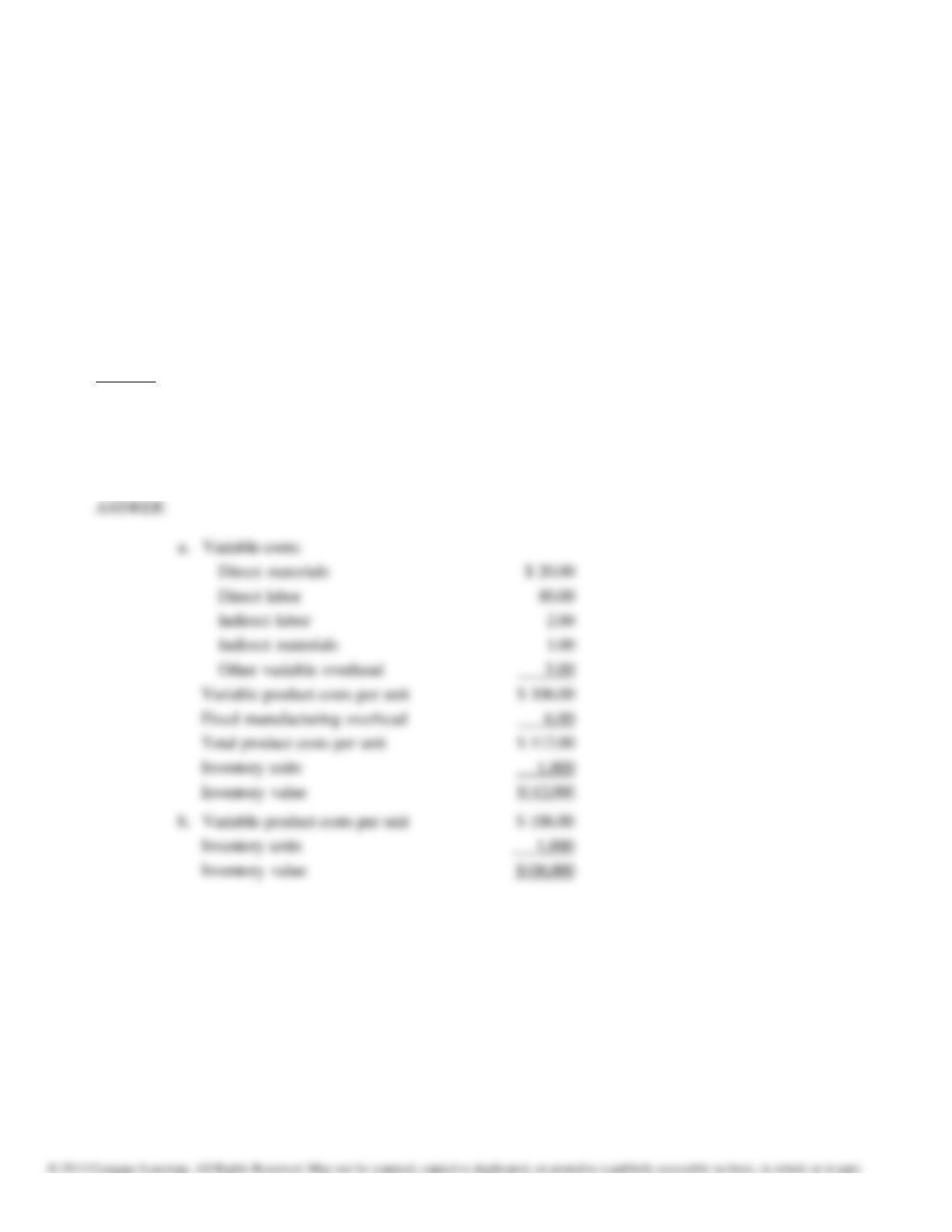
Prepare an absorption costing income statement for 2016.
Sales
{5,000 × [$3.00 + $1.60 + $1.40 + ($24,000/8,000)]}
Gross profit
Less operating expenses:
Selling expenses
Administrative expenses
Operating income
Chapter 18: Pricing and Profitability Analysis
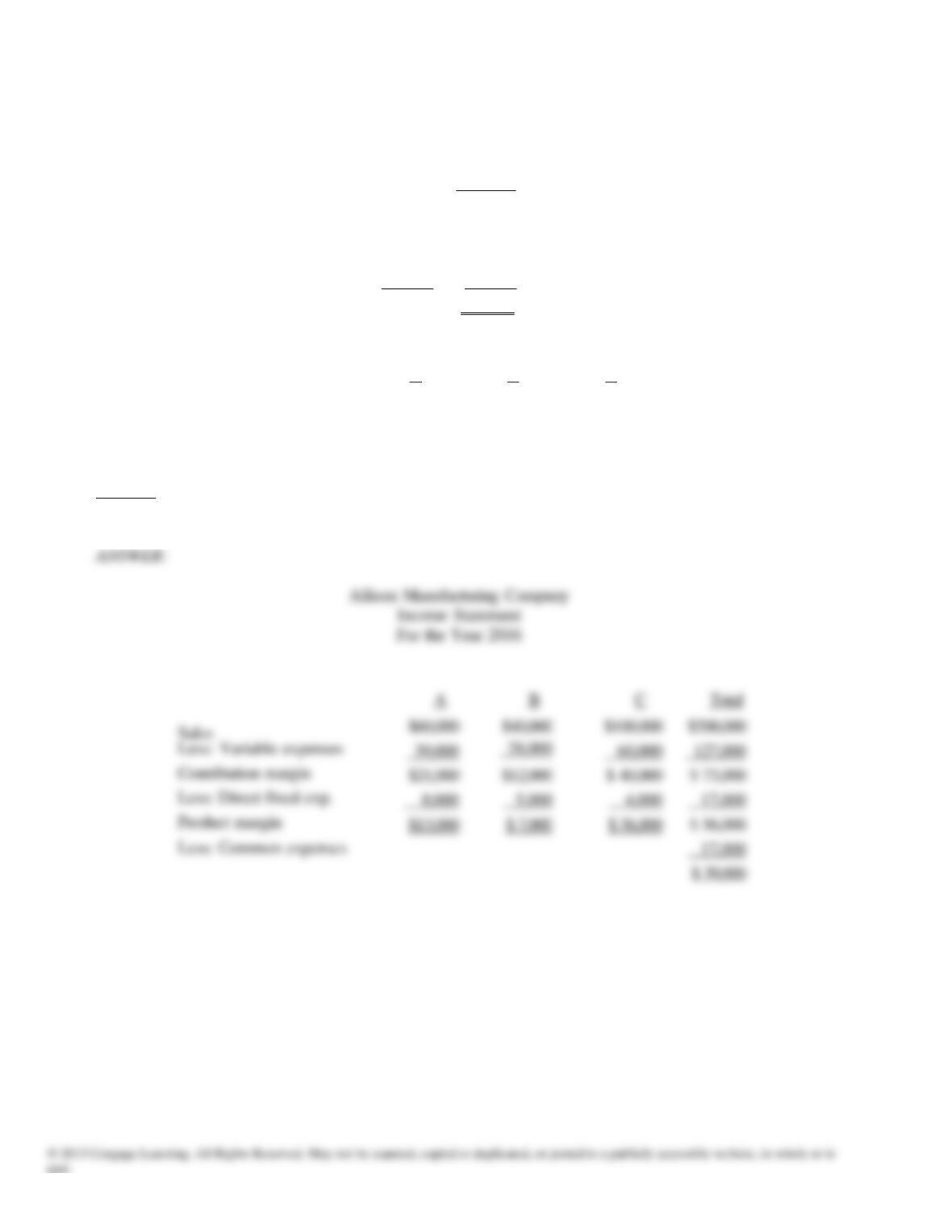
152. Hornitos Company produced 30,000 units and sold 29,000 units in 2016. Beginning inventory was zero. During the
period, the following costs were incurred:
Indirect labor
$ 60,000
Indirect materials
30,000
Other (variable overhead)
90,000
Fixed manufacturing overhead
180,000
Fixed administrative expenses
150,000
Fixed selling expenses
120,000
Variable selling expenses, per unit
40
Direct labor, per unit
80
Direct materials, per unit
Required:
20
Compute the dollar amount of ending inventory using:
a. Absorption costing
b. Variable costing
Chapter 18: Pricing and Profitability Analysis
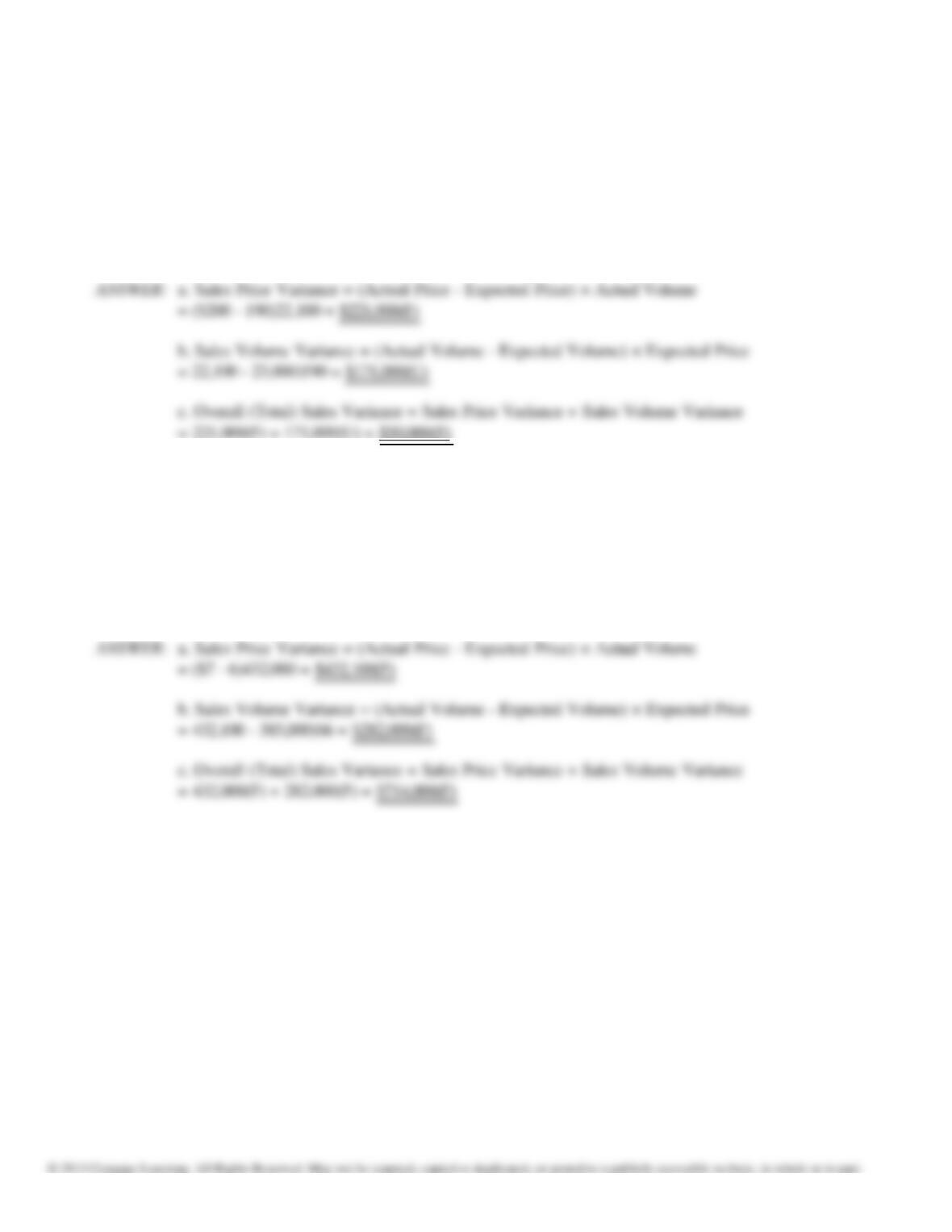
153. Allison Manufacturing Company produces three products: A, B, and C. The income statement for 2016 is as
follows:
Sales
$200,000
Less: Variable expenses
127,000
Contribution margin
$ 73,000
Less fixed expenses:
Manufacturing
$20,000
Selling and administrative
14,000
34,000
Net income
$ 39,000
The sales, contribution margin ratios, and direct fixed expenses for the three types of products are as follows:
A
B
C
Sales
$60,000
$40,000
$100,000
Contribution margin ratio
35%
30%
40%
Direct fixed expenses of products
Required:
$8,000
$5,000
$4,000
Prepare income statements segmented by products. Include a column for the entire firm in the statement.
$ 7,000
Chapter 18: Pricing and Profitability Analysis
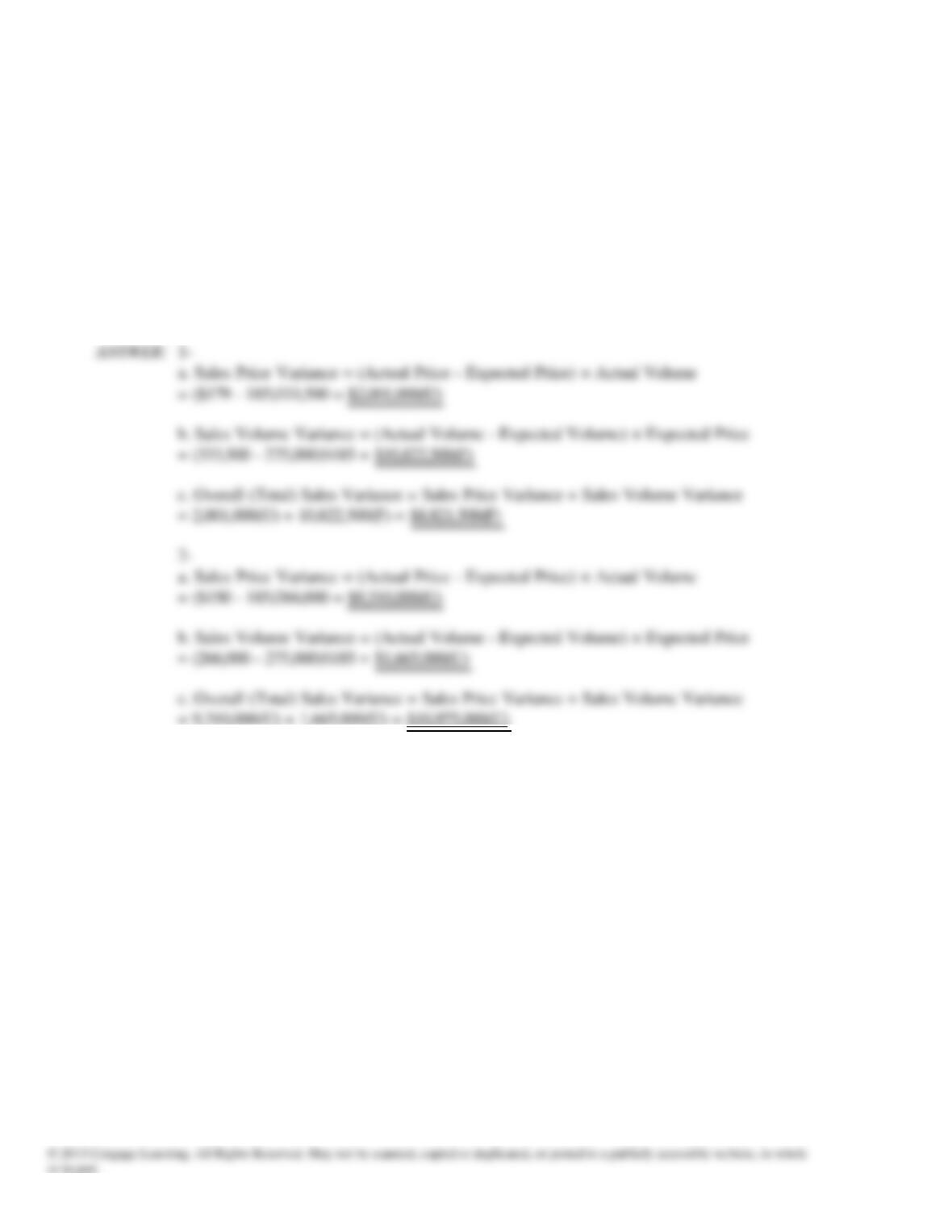
154. The Levinson Company expected to produce 23,000 units at $190 per unit. The 2016 actual figures were 22,100
units which sold at $200 each.
Compute:
a. The Sales Price Variance
b. The Sales Volume Variance
c. The Overall (total) Sales Variance
Indicate whether Favorable or Unfavorable
155. The San Quintin Corporation manufactures automobile hub caps. In 2016, it expected to produce 385,000 hub caps
at $6 per unit. The 2016 actual figures were 432,100 units which sold at $7 each.
Compute:
a. The Sales Price Variance
b. The Sales Volume Variance
c. The Overall (Total) Sales Variance
Indicate whether Favorable or Unfavorable
Chapter 18: Pricing and Profitability Analysis
156. Custom Chrome Enterprises produces mag wheels for motorcycles. During 2016, Custom Chrome
expected to sell 275,000 mag wheels at $185 each. The actual sales for 2016 were 333,500 mag wheels
at $179 each.
1- Calculate:
a. Sales Price Variance
b. Sales Volume Variance
c. Overall (Total) Sales Variance
Indicate whether Favorable or Unfavorable.
2- Calculate the variances if actual sales had been 266,000 mag wheels at $150 each.