Chapter 18—Options Basics
MULTIPLE CHOICE
1. An option is called a derivative security because:
a.
its value is derived from that of another asset
b.
to calculate its worth requires extensive derivations
c.
it is the basic building block security we use to value all other derivative securities
d.
its value is derived from the existence of a convex payoff around an exercise value
e.
none of the above
2. European options are differentiated from American options by:
a.
the location of where they trade
b.
the timing of the holder’s right to exercise the option
c.
the routine adjustment of exercise price to changes in interest rates
d.
a and b
e.
b and c
3. You purchase a European call option with one year to expiration for $pc. The exercise price is $ep per
share and the current stock price is $csp. You also purchase a put option on the same stock with the
same exercise price and the same expiration date for $pp. If the stock price rises to $sp at the end of
the year the call option payoff is __________ and the put option payoff is __________.
a.
$d; −$d
b.
–$d; $d
c.
$0; $d
d.
$d; $0
e.
none of the above
4. You have purchased n call options on Up-up-and-away, a local balloon manufacturer. The total option
premium was $top. The exercise price is $ep per share and the current stock price is $csp per share.
Two months later the options expire with a share price of $sp per share. Your total payoff is
__________ and your total profit is __________.
a.
$tpo; –$tp
b.
$tpo; $0
c.
$w; –$tp
d.
$w; $0
e.
none of the above
5. The value of MotoGoto stock is $s per share. Call options with one year to expiration and a strike price
of $pv have a value of $c. If the risk free rate of interest is r%, what is the value of a put option with
the same strike price and maturity?
a.
$w1
b.
$p
c.
$w2
d.
$w3
e.
cannot be determined with the information provided
6. The hedge ratio is based on:
a.
the combination of stocks and bonds that eliminates most risk
b.
the combination of stocks and bonds that eliminates all risk
c.
the combination of stocks and calls that eliminates all risk
d.
the combination of bonds and calls that eliminates most risk
e.
none of the above
7. A(n) __________ occurs when an investor buys or sells an option without already owning the
underlying stock.
a.
American call option
b.
at the money option
c.
naked option position
d.
European option
e.
synthetic option position
8. Generally speaking, option prices __________ as time to expiration __________ and as the risk of the
underlying asset __________.
a.
decrease; increases; increases
b.
increase; increases; increases
c.
increase; decreases; increases
d.
increase; increases; decreases
e.
decrease; increases; decreases
9. The __________ recognizes that investors can combine options with shares of the underlying assets to
construct a portfolio with a risk-free payoff.
a.
American option
b.
European option
c.
naked option
d.
at the money option
e.
binomial model
10. If a combination of stock and options is risk-free, then that combination must sell for the same price as
__________.
a.
a risk-free bond
b.
the underlying stock
c.
the call option
d.
the synthetic put option
e.
none of the above
11. Put-call parity establishes a link between the market prices of __________, provided certain conditions
hold.
a.
calls
b.
puts
c.
shares
d.
bonds
e.
all of the above
12. Suppose an individual sells short shares of stock. Which of the following would be the best hedge
against the short position?
a.
buying a put
b.
buying a bond
c.
buying a call
d.
writing a call
e.
writing a covered call
13. The price paid for an option contract is known as:
a.
Exercise price
b.
Parity value
c.
Strike price
d.
Premium
e.
Cash settlement
14. A stock is worth $sw today. In the next six months it may increase to $si or decrease to $sd. The risk-
free rate of interest is r% per year. Use the binomial model to determine the price of a put option with
a strike price of $sp and an expiration date in six months.
a.
w1
b.
ans
c.
w2
d.
w3
e.
w4
15. A stock is worth $sw today. In the next six months it may increase to $si or decrease to $sd. The risk-
free rate of interest is r% per year. Use the binomial model to determine the price of a call option with
a strike price of $sp and an expiration date in six months.
a.
ans
b.
w1
c.
w2
d.
w3
e.
w4
16. A stock is worth $sw today. In the next six months it may increase to $si or decrease to $sd. The risk-
free rate of interest is r% per year. Use the binomial model to determine the price of a call option with
a strike price of $sp and an expiration date in six months.
a.
w1
b.
w2
c.
w3
d.
ans
e.
w4
17. A stock is worth $sw today. In the next six months it may increase to $si or decrease to $sd. The risk-
free rate of interest is r% per year. Use the binomial model to determine the price of a put option with
a strike price of $sp and an expiration date in six months.
a.
w1
b.
w2
c.
ans
d.
w3
e.
w4
18. Bavarian Brew, Inc. stock currently sells for $s per share. Put and call options on Bavarian are
available with a strike price of $sp with an expiration date of one year. Currently a Bavarian call
option is selling at $co and the risk-free rate is r%. What is the price of the Bavarian put option?
a.
$w1
b.
$p
c.
$w2
d.
$w3
19. Bavarian Brew, Inc. stock currently sells for $cs per share. Put and call options on Bavarian are
available with a strike price of $sp with an expiration date of one year. Currently a Bavarian put option
is selling at $pos and the risk-free rate is r%. What is the price of the Bavarian call option?
a.
$w1
b.
$w2
c.
$c
d.
$w3
20. Call options are being traded on stock of companies A and B. Both options have the same strike price
and expiration date, and both stocks currently trade at the same price. However, company A’s stock is
more volatile than company B’s stock. Based on that information the price for the call option on A
should be
a.
the same as the price for the call option on B
b.
higher than the price for the call option on B
c.
lower than the price for the call option on B
d.
need more information to answer the question
21. You believe that the volatility of a particular stock will increase, the option strategy appropriate to
profit from this belief is
a.
A long straddle
b.
A short straddle
c.
A long call
d.
A short call
22. Which synthetic position replicates a long call?
a.
Long stock, short put
b.
Short stock, short put
c.
Long stock, long put
d.
Short stock, long put
23. Which synthetic position replicates a long put?
a.
Short stock, long call
b.
Short stock, short call
c.
Long stock, long call
d.
Long stock, short call
24. A wheat farmer is naturally long wheat (she has wheat growing in the field) and wants to protect
against declines in wheat prices but what to participate in increases in wheat prices. She should
a.
Buy puts
b.
Buy calls
c.
Sell puts
d.
Sell calls
25. Which of the following algebraically represents put call parity?
a.
P=PV(X) +C-S
b.
S-P=PV(X) +C
c.
S+P=PV(X)-C
d.
P=PV(X)-C+S
26. Susan is using the binomial model, she observes a stock currently selling for $cs and estimates it will
either go up to $si or down to $sd. If the strike price is $sp, the risk-free rate of interest is r% a year
and options will expire in a year, what is the value of the call option?
a.
$w1
b.
$c
c.
$w2
d.
$w3
27. Michelle is using the binomial model, she observes a stock currently selling for $cs and estimates it
will either go up to $si or down to $sd. If the strike price is $sp, the risk-free rate of interest is r% a
year and options will expire in a year, what is the value of the put option?
a.
$w1
b.
$w2
c.
$p
d.
$w3
28. Tracy is using the binomial model, she observes a stock currently selling for $cs and estimates it will
either go up to $si or down to $sd. If the strike price is $sp, the risk-free rate of interest is r% a year
and options will expire in a year, what is the value of the call option?
a.
$w1
b.
$w2
c.
$w3
d.
$c
29. Lietzel is using the binomial model, she observes a stock currently selling for $cs and estimates it will
either go up to $si or down to $sd. If the strike price is $sp, the risk-free rate of interest is r% a year
and options will expire in a year, what is the value of the put option?
a.
$w1
b.
$w2
c.
$w3
d.
$p
30. Leah is using the binomial model, she observes a stock currently selling for $cs and estimates it will
either go up to $si or down to $sd. If the strike price is $sp, the risk-free rate of interest is r% a year
and options will expire in a year, what is the value of the call option?
a.
c
b.
w1
c.
w2
d.
w3
MATCHING
Match the following terms to their best descriptions:
a.
call option
b.
European call option
c.
American call option
d.
put option
e.
short position
f.
long position
1. grants the rights only on the expiration date
2. grants the rights on or before the expiration date
3. grants the right to purchase a share of stock
4. seller of the option
5. grants the right to sell a share of stock
6. option buyer
Match the following terms to the appropriate descriptions:
a.
Synthetic Put
b.
Covered Call
c.
Protective Put
d.
European Put Option
e.
American Call Option
7. Owning shares of stock and selling a call option
8. Owning shares of stock and buying a put option
9. Purchasing a bond and a call option while simultaneously short-selling the stock
10. The right to buy the underlying stock any time prior to expiration
11. The right to sell the underlying stock at expiration
SHORT ANSWER
1. If the stock of a company is selling for $c and you own a call option with a strike price of $a would
options traders say that your option is in-the-money, out-of-the-money, or at-the-money? Explain.
2.
a.
Jack purchases an at-the-money August call with a $pc strike price for $sp. What would the
option be worth at the expiration date if the stock price equals $esp?
b.
What is the percent increase in the stock price and option value in a.?
3.
a.
Jack purchases a call option with a strike price of $a for $b. Jack wants to know what the
option will be worth when it expires. What additional information does Jack need?
b.
Will the option in question a. be worth more or less than $10 if the underlying stock is selling
for $c before the expiration date?
selling for $c the option is worth $10 on its expiration date.
dividends to be paid prior to expiration). If exercise is uncertain, the flexibility offered by the
call results in an even higher value.
4. What is meant by the statement, options are a zero-sum game?
5.
a.
If Jack purchases a call and a put option with strike prices of $55 on ABC stock, how must the
price of ABC stock change if Jack is to make a profit??
b.
What is the type of position Jack takes in a.?
1.
Put-call parity tells you how the prices of puts, calls, stocks, and bonds should be interrelated.
When the prices of these securities become misaligned, an arbitrage opportunity exists.
2.
Put-call parity tells you how to create synthetic positions.
6. If you own s shares of XYZ stock with a current value of $cv ($sp a share), what kind of position
could you take to protect your stock value without selling the s shares today?
7. Jack purchases put and call options on New Age corporation stock, each with a strike price of $pv1.
The current stock price is $s, and the options have an expiration date of one year. If the price of the
call option is $c, and the risk free rate of interest is r%, what is the appropriate price for the New Age
put option?
8. What two types of useful information does put-call parity provide?
a.
Jack will make money if the price of ABC stock moves away from $55, either up or down, by
more than the cost of the options.
b.
Jack is doing a long straddle which is a portfolio consisting of long positions in calls and puts
on the same stock with the same strike price and expiration date.
9.
a.
The stock price of Jackson Corporation is currently $csp a share. It may increase to $spi or fall
to $spd in a year. If the risk-free rate equals r% and if investors are risk neutral, what is the
probability of an up move in the stock and the probability of a down move in the stock?
b.
What is the call option value if the strike price is $csp in a?
Using the risk-neutral method
spiP + (1 – P)$spd = csp(1 + r0)
spiP + spd – spdP = l
aP = b
P = p0 rounded
1 – P = p10
b.
Calculate the expected cash flow of the option in one year.
p0(c)
$d
10. What is the lowest possible market price for a put option or a call option? Explain why this result
cannot be violated.
11. You are considering an investment in a new project that requires a large investment in a new machine.
The project initial outlay is $io. The future cash flows are heavily dependent on the price of oil. The
project offers the opportunity to spend an additional $sa one year from now. If the expenditure is
made, the value (as of that time) of net revenues will be nr times the price of oil per barrel. If the
additional investment is not made, the project can be unwound for a negligible salvage value. Describe
this project as a call option using option terminology from the chapter.
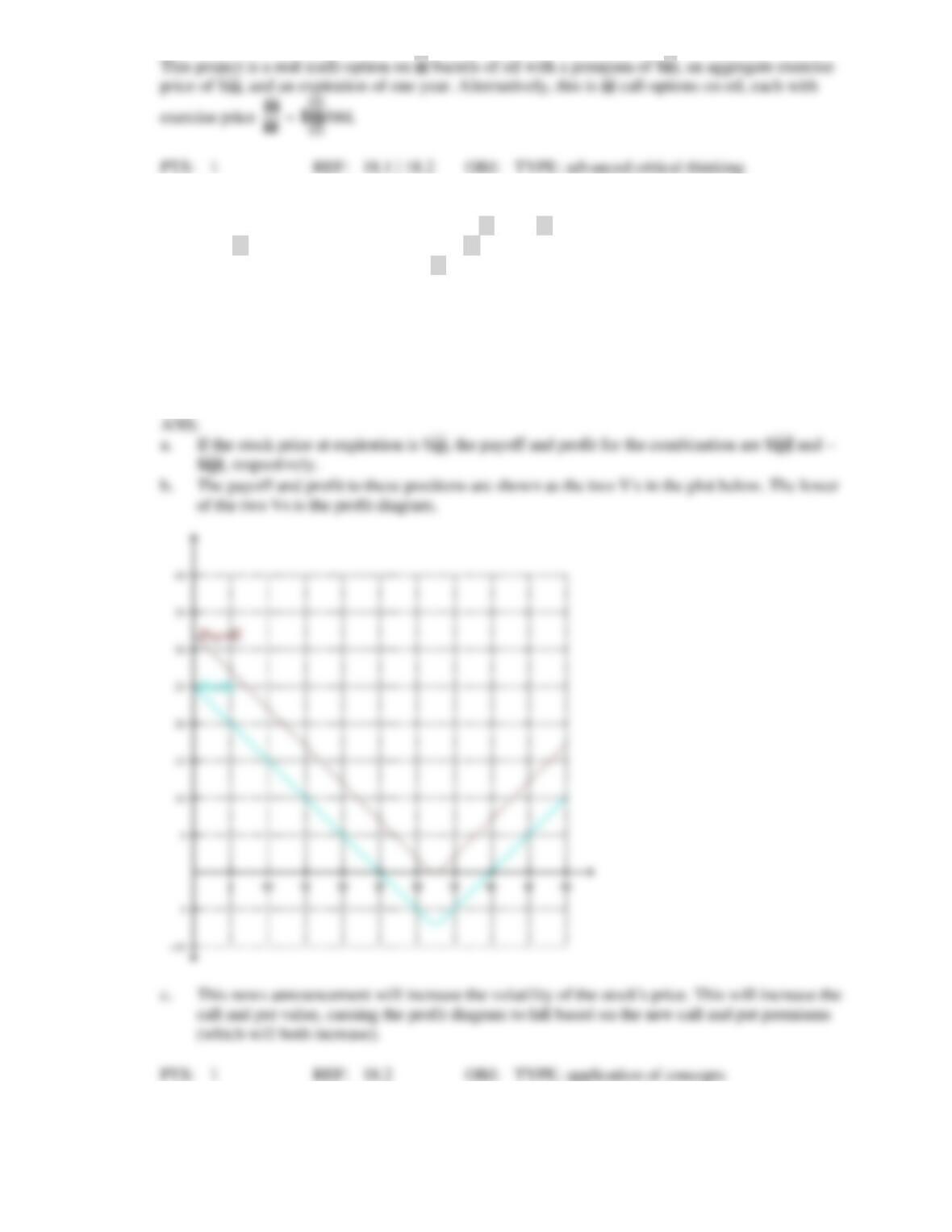
12. You are considering the purchase of both a put and a call on a new firm called Wich-Waywillit-Go.
The premium for the call and put options are $cc and $cp, respectively. The exercise price for each
option is $co and the current stock price is $po.
a.
If the stock price at expiration is $sp, what will be your total combined payoff and profit for
the combination of the put and call?
b.
Draw a sketch of the payoff and profit for various possible ending stock prices between $0 and
$50 per share.
c.
If a major news announcement was made that the future of Wich-Waywillit-Go was more
uncertain, how would the payoff and profit diagrams for a newly purchased put and call
compare to those you drew for part b?
b.
The payoff and profit to these positions are shown as the two V’s in the plot below. The lower
of the two Vs is the profit diagram.
call and put value, causing the profit diagram to fall based on the new call and put premiums
(which will both increase).
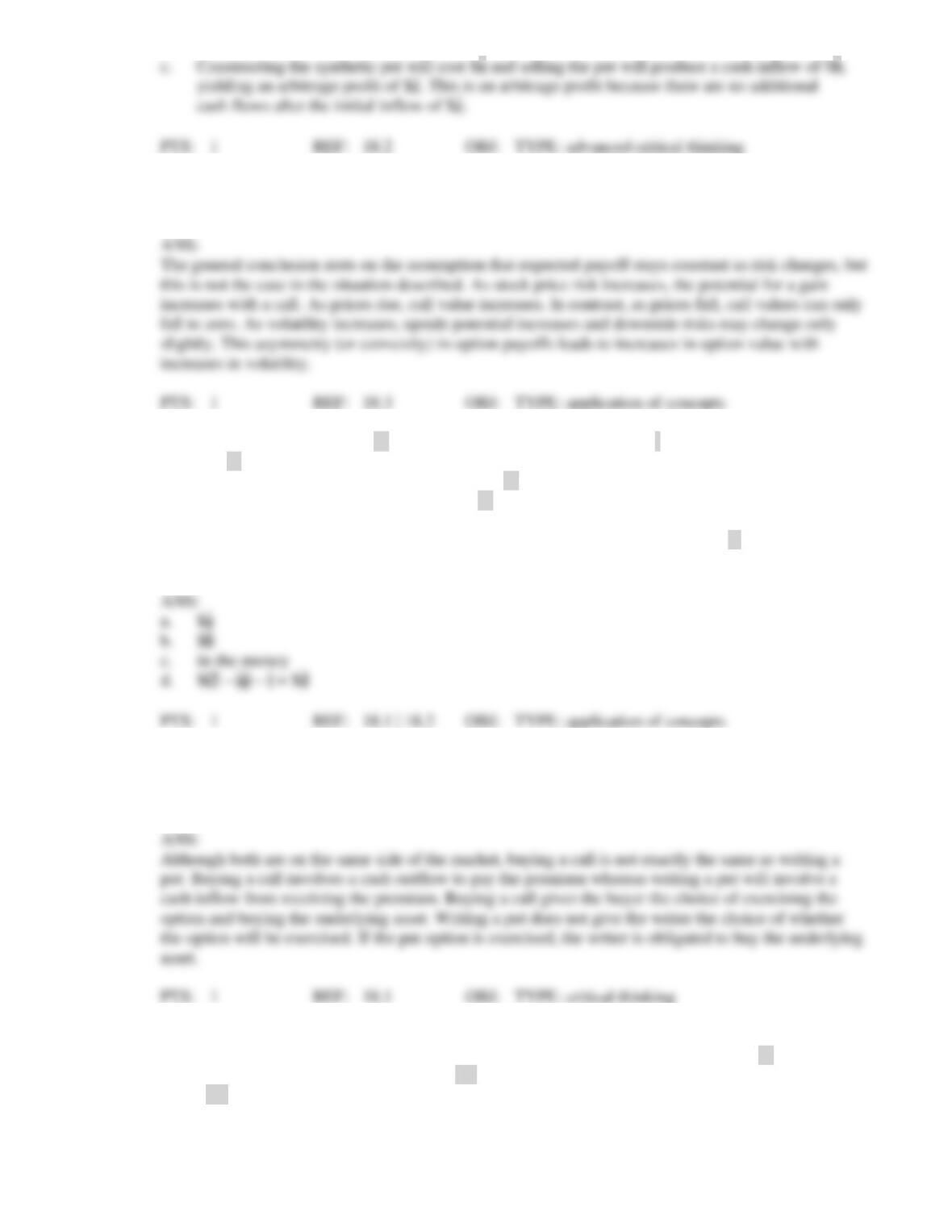
13. You own 100 shares of Worry-Wart Inc. Your friend suggests you consider a covered call writing
strategy because he expects the stock price to show little price variability in the next few weeks. A
covered call writing strategy involves writing (selling) calls on a stock that you own.
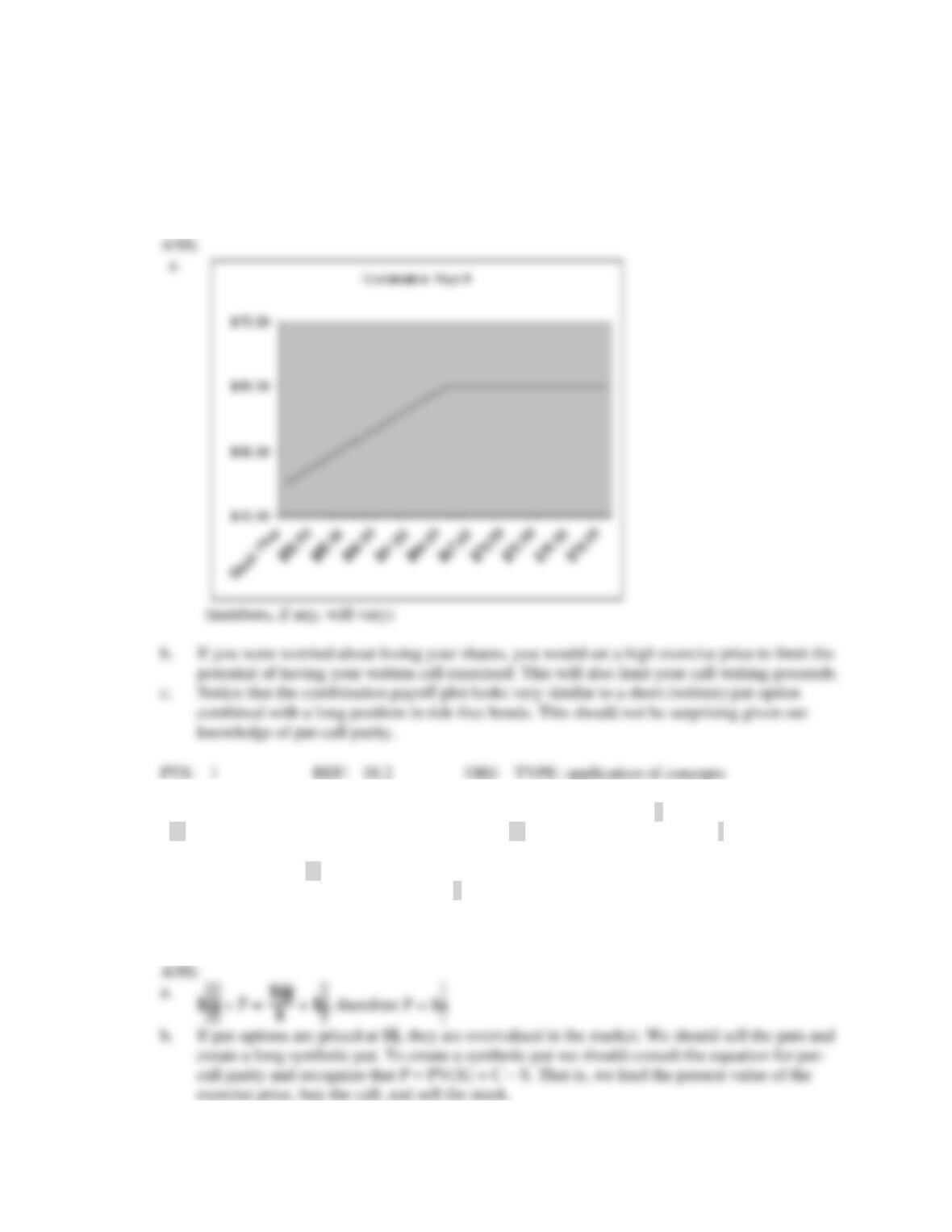
a.
Make a plot showing the payoff you will receive when combining a short call position with a
long stock position.
b.
If you were worried about having your shares called, but still wanted to use this strategy, how
would you structure the exercise price of the option you are writing?
c.
What other option payoff diagram looks like your combination payoff?
14. Call options with one year to expiration on Gesshu 4Heis are priced at $p with an exercise price of
$ep. Stock of Gesshu 4Heis is currently priced at $cp. The current riskless rate is r percent.
a.
What should be the value of a put option on Gesshu 4Heis with one year to expiration and a
strike price of $ep?
b.
If you find put options are priced at $b, what should you do to take advantage of the market
mispricing?
c.
How much arbitrage profit will you earn by following this strategy?
exercise price, buy the call, and sell the stock.
b.
If you were worried about losing your shares, you would set a high exercise price to limit the
potential of having your written call exercised. This will also limit your call writing proceeds.
combined with a long position in risk-free bonds. This should not be surprising given our
knowledge of put-call parity.
15. In our discussions of risk and return, we generally conclude that as risk increases, value falls. Discuss
why a call option value increases as stock price volatility increases.
16. A Cisco call with strike price $sp and expiration February is trading at $t while the underlying stock
value is $sv.
a.
What is the intrinsic value of the Cisco FEB sp call?
b.
What is the time value of the Cisco FEB sp call?
c.
Is the option in-the-money, out-of-the-money, or at-the-money?
d.
If you purchased this call today and at expiration Cisco stock was trading at $t2, what would
be your net payoff?
a.
$a
b.
$b
d.
17. If you buy a call, you would buy the underlying asset if the option is exercised. If you short a put, you
would buy the underlying asset if the option is exercised. Discuss whether buying a call, therefore,
would be exactly the same as writing a put.
18. For each scenario, identify which option is more valuable.
a.
Two calls on different stocks each have 1 year to expiration and a strike price of $sp. The first
call has an underlying asset price of $apf and the second call has an underlying asset price of
$aps. Other things equal, which call option is more valuable?
cash flows after the initial inflow of $c.
b.
Two put options each have an underlying asset price of $apf per share and exercise price of
$sp. The first put option has half a year to expiration while the second put has 1 year to
expiration. Which put option is more valuable?
c.
Two call options each have an underlying asset price of $as and expire in one year. The first
call has a strike price of $spf and the second call has a strike price of $sps. Which call option
is more valuable?
19. A call has an exercise price of $sp and the underlying stock price is $sp The call matures in 1 year.
The stock price will either go up to $spi or down to $spd. The risk-free rate is r%.
a.
Use a one period Binomial Option Pricing Model to determine the theoretical value of this call
option.
b.
Use the risk-neutral option pricing method to determine the theoretical value of this call
option.
c.
If you had been valuing a put, how would the hedge ratio, h, differ and why?
a.
The hedge ratio, h, must be:
spi + dh =spd + 0h
h = –2
The cash flows one year from today are:
Two short options are worth
The present value of the portfolio is:
Today the total portfolio cost = $sp – 2C = $pv
Therefore the call value is $cva
b.
Using the risk-neutral method and first solving for the probability of an up move:
p = p
The expected cash flow from a call option in one year is:
Expected cash flow = p(d) + (1 – p)(0) = $ecf
a.
the second call is more valuable
b.
the second put is more valuable
the first call is more valuable
20. Square Wheel, Inc. stock currently sells for $scs per share. Put and call options on Square are available
with a strike price of $sp with an expiration date of one year. Currently a Square put option is selling at
$o, a call option is selling at $o, and the risk-free rate is r%. Is the call option accurately priced? If not,
what could you do to exploit the mispricing?
21. Dover Dairy, Inc. stock currently sells for $cs per share. Put and call options on Dover are available
with a strike price of $cs with an expiration date of one year. Currently a Dover call option is selling at
$os, a put option is selling at $os and the risk-free rate is r%. Is the put option accurately priced? If not,
what could you do to exploit the mispricing?
ESSAY
1. Define how counterparty risk differs in an exchange-traded option contract versus an over-the-counter
options contract.
2. A common criticism of the binomial option-pricing model is that it is unrealistic to assume that the
future value of a random variable will take on only two possible values. Discuss how the use of a
multi-stage binomial model can lessen our concern regarding this assumption.
3. Although we typically assume investors are risk-averse, risk-neutral valuation is a common tool in
option pricing. How can we justify a valuation method based on an assumption that seems clearly
violated?
4. Suppose a stock is currently selling for $s per share in the market. You find a call on this stock with an
$s strike price and one year to expiration and a put with $s strike price and one year to expiration. The
call is selling for $c and the put for $p. The current risk-free rate of interest is r%. Using put-call parity
develop an arbitrage strategy and show how the arbitrage profits are obtained whether the stock price
at expiration has increased or decreased
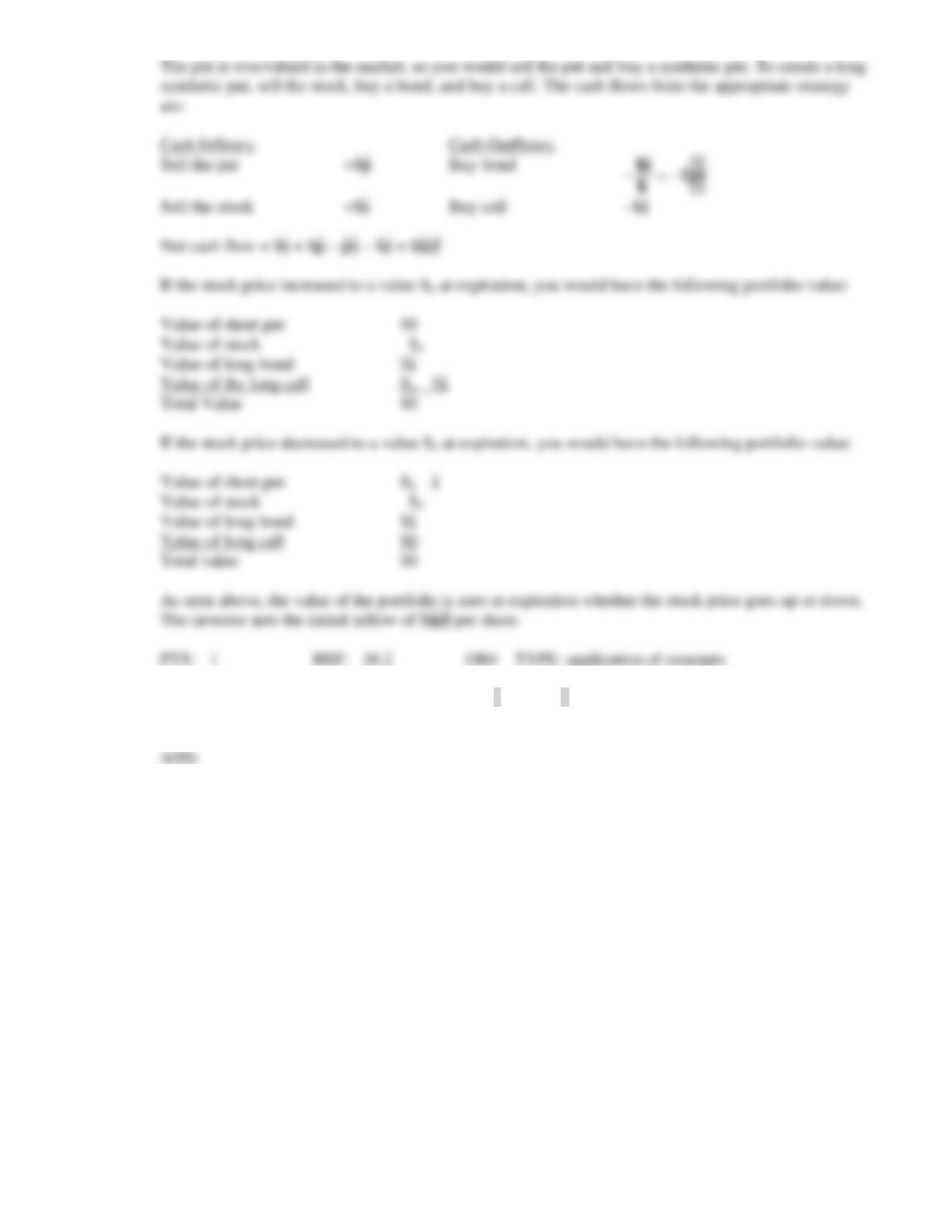
5. Assume you are short a put with exercise price $a with a $b premium. Draw and discuss the net payoff
diagram.
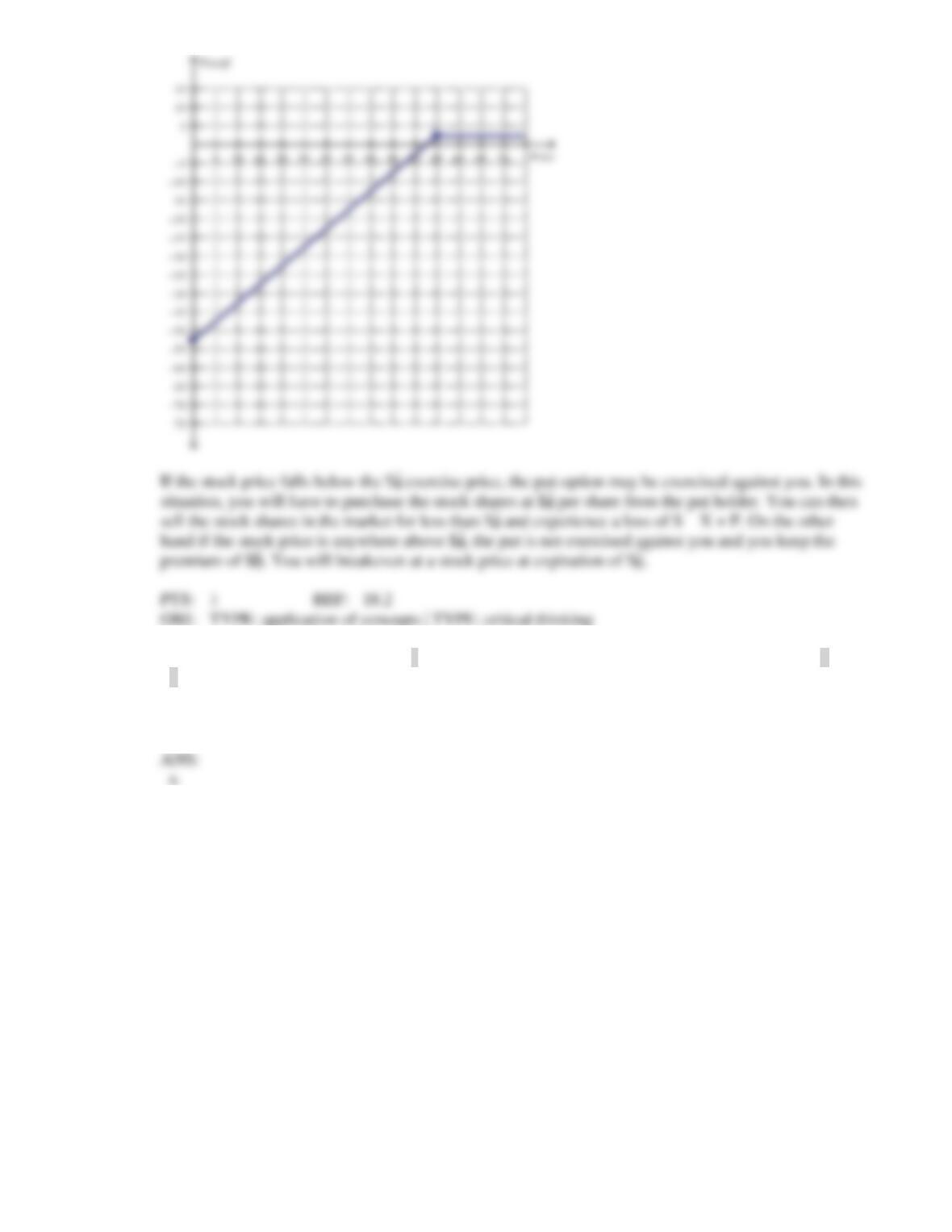
6. You purchased shares of a stock at $s per share and then later sold a call with exercise price of $p at a
$b premium.
a.
Draw the net payoff diagram.
b.
What is the name of this type of position and how does it work?
7. I wish to value an option on a stock. Discuss the information that I need and how I can use it, as well
as the information that I don’t need (but might have thought was of use), to implement the binomial
method.