Chapter 18: Accounting for Income Taxes
86. Fairfax Company had a balance in Deferred Tax Liability of $840 on December 31, 2016, resulting from depreciation
timing differences. Differences in tax and accounting depreciation for assets purchased on January 1, 2016, are as
follows:
Financial
Tax
Year
Depreciation
Depreciation
2016
$ 4,000
$ 6,800
2017
4,000
5,200
2018
4,000
2,400
2019
4,000
1,600
$16,000
$16,000
In addition to the 2016 depreciation timing difference, Fairfax Company expensed $2,000 of warranty costs that will
be deducted for tax purposes when paid in future years. Fairfax’s taxable income in 2016 was $35,000. The 2016
income tax rate was 35%, and no changes in the tax rate for future years have been enacted.
Required:
Prepare the income tax journal entry for the Fairfax Company for December 31, 2016.
87. Delmarva Company, during its first year of operations in 2016, reported taxable income of $170,000 and pretax
financial income of $100,000. The difference between taxable income and pretax financial income was caused by two
timing differences: excess depreciation on tax return, $70,000; and warranty expenses in excess of warranty
payments, $40,000. These two timing differences will reverse in the next three years as follows:
Warranty
Year
Depreciation
Expenses
2017
$10,000
$20,000
2018
20,000
16,000
2019
40,000
4,000
Enacted tax rates are 30% for 2016, 35% for 2017 and 2018, and 40% for 2019.
Required:
Prepare the income tax journal entry for Delmarva Company for December 31, 2016.
88. Thorn Corporation has deductible and taxable temporary differences. At the beginning of 2016, its deferred tax asset
was $12,000, and its deferred tax liability was $17,500. The company expects its future deductible amounts to be
“deductible” in 2017 and its future taxable amount to be “taxable” in 2018. In 2015, Congress enacted revised tax
rates for future years as follows: 2016, 30%, 2017, 32%, and 2018, 35%. At the end of 2016 Thorn had income taxes
payable of $23,500, and increase in deferred tax liability of $3,000, and an ending balance in its deferred tax asset of
$13,300.
Item
Amount
a.
Taxable income for 2016
______
b.
Future taxable amount, 12/31/2016
______
c.
Increase in future deductible amount during 2016
______
d.
Income tax expense for 2016
______
Required:
Assist Thorn in completing the schedule by filling in the blanks for items related to its income taxes for 2016. Show
your computation.
a.
a.
$ 78,333
c.
$ 4,063
d.
$ 25,200
89. Rehobeth Company’s taxable income and other financial data for 2016 are presented below:
Taxable income
$500,000
Interest received on municipal bonds
75,000
Estimated bad debt expense (not written off)
40,000
Cash expenditures for product warranty expenses
108,000
Product warranty expense for accounting purposes
142,000
Gross profit on installment sales for 2016
180,000
Gross profit recognized in 2016 for tax purposes based on installment
sales in 2016
160,000
Required:
a.
Calculate Rehobeth Company’s 2016 pretax financial income.
b.
For each item, explain why there is a difference, if any exists, between how it is
treated for taxable income purposes and pretax financial income.
Taxable income
$500,000
Interest received on municipal bonds
75,000
Estimated bad debt expense
Excess of gross profit on installment sales recognized for
accounting purposes
Pretax financial income
$521,000
that will never be taxed.
Challenging
ACCT.WHAL.16.18.2 – LO: 18.2
United States – OH – Default City – AICPA: FN-Measurement
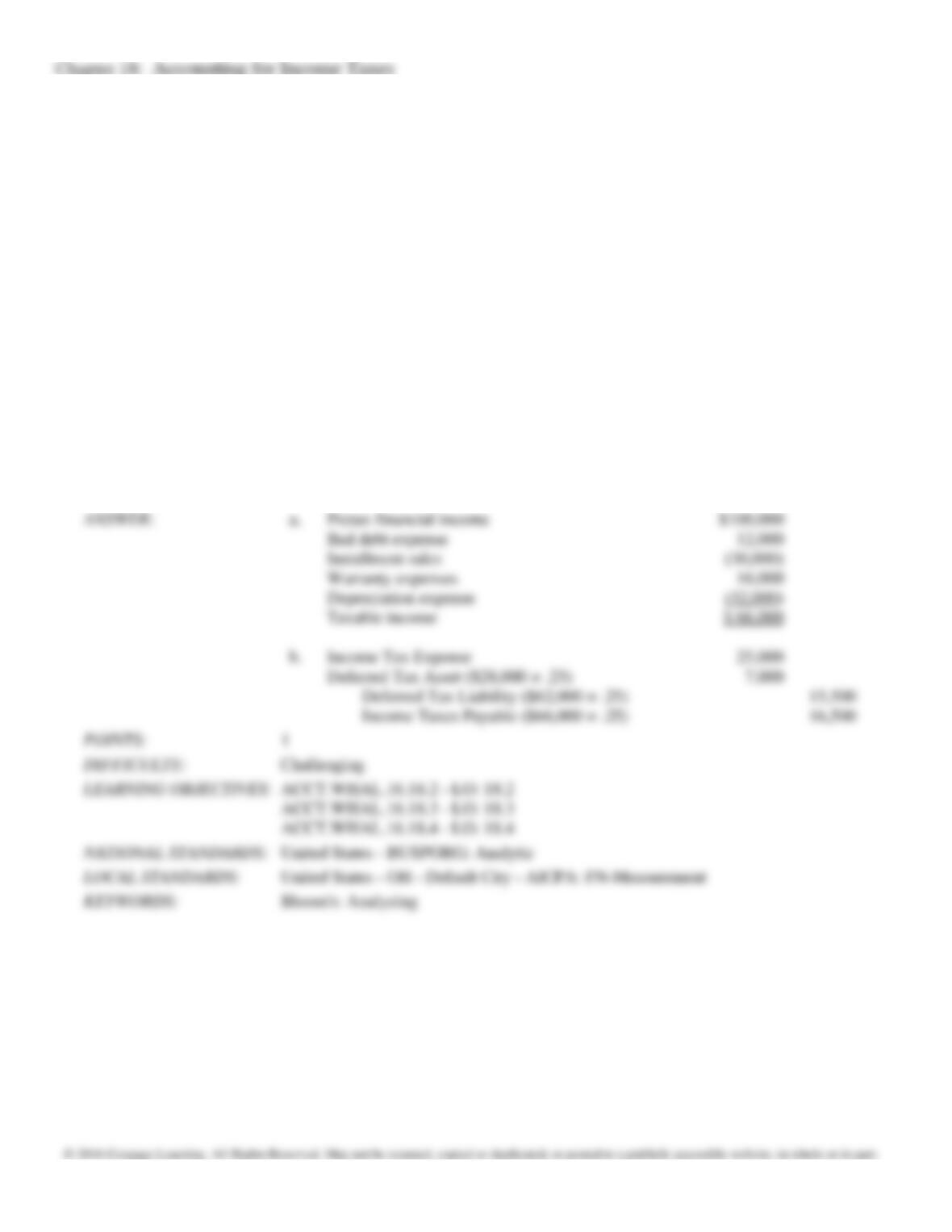
90. At the end of its first year of operations on December 31, 2016, the Mojave Company reported pretax financial income
of $100,000. An investigation of that income revealed the following items:
·
Bad debts expense of $12,000 was recognized. The accounts will be written
off in 2017.
·
Installment sales of $50,000 were recognized in financial income. These
sales were accounted for by the installment sales method for income tax
purposes. Only $20,000 was reported on the tax return.
·
Warranty expenses of $16,000 were accrued for financial reporting
purposes, but were not expected to result in a cash payment until 2017.
·
Depreciation on the tax return exceeded depreciation for financial reporting
purposes by $32,000.
Assume that any deferred tax assets are considered more likely than not to be realized. The enacted income tax rate for
all years is 25%.
Required:
a.
Compute taxable income.
b.
Prepare the entry to record income tax expense and any related assets and liabilities for
Mojave on December 31, 2016.
Bad debt expense
Warranty expenses
Depreciation expense
Deferred Tax Asset ($28,000 × .25)
Deferred Tax Liability ($62,000 × .25)
Challenging
ACCT.WHAL.16.18.2 – LO: 18.2
ACCT.WHAL.16.18.3 – LO: 18.3
ACCT.WHAL.16.18.4 – LO: 18.4
United States – OH – Default City – AICPA: FN-Measurement
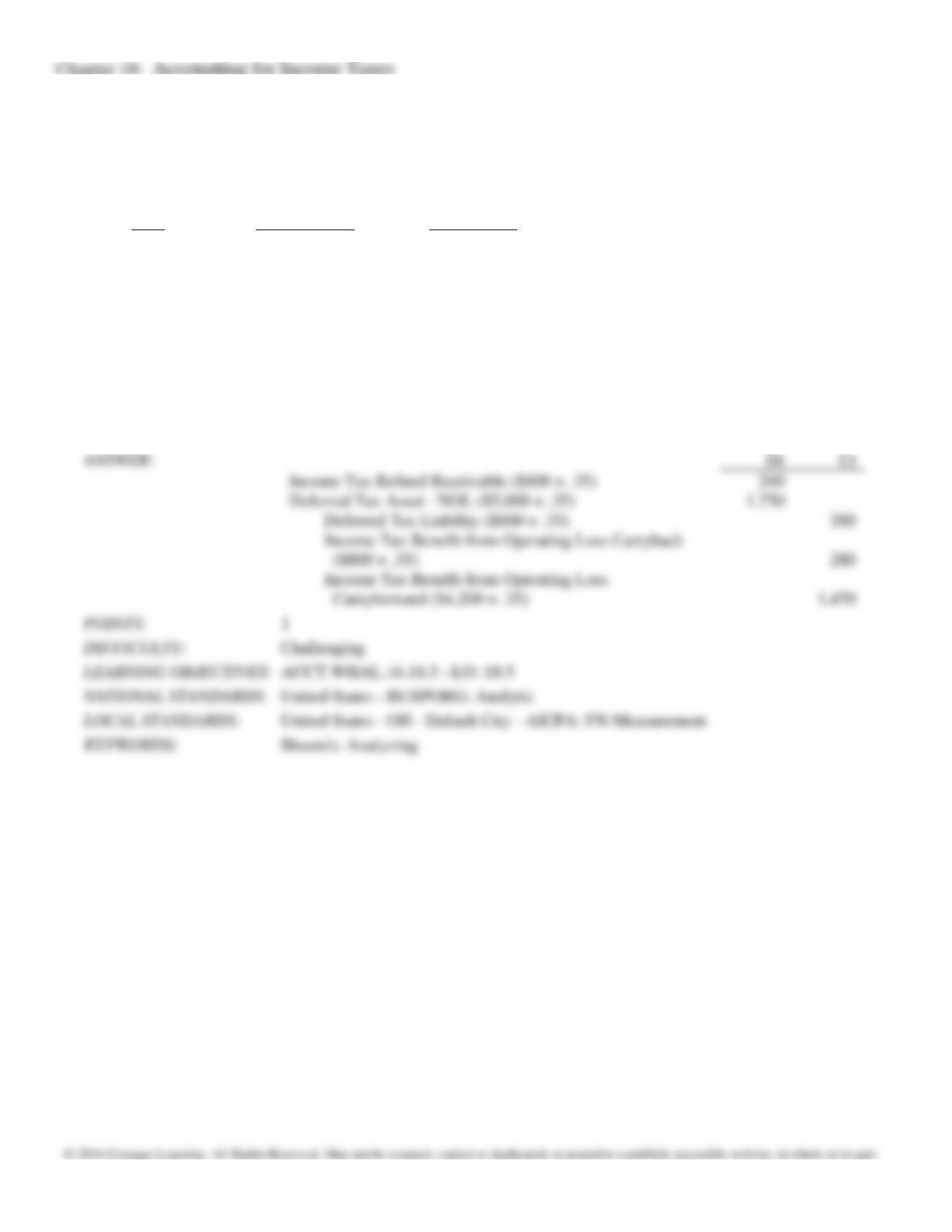
91. Rice, Inc. began operations on January 1, 2016. Depreciation temporary differences were the only differences between
pretax financial income (loss) and taxable income (loss) in any year. The income tax rate was 35% in each year and
no changes in income tax rates were expected. Pretax financial income (loss) and the temporary differences due to
depreciation were as follows:
Pretax Financial
Excess Tax
Year
Income (Loss)
Depreciation
2016
$1,000
$ 600
2017
3,000
2,600
2018
3,000
2,600
2019
(5,000)
800
2020
3,000
1,000
2021
6,000
800
Required:
Prepare the income tax journal entry for Rice, Inc. for December 31, 2019; assuming no valuation allowance is
required for Rice’s deferred tax assets.
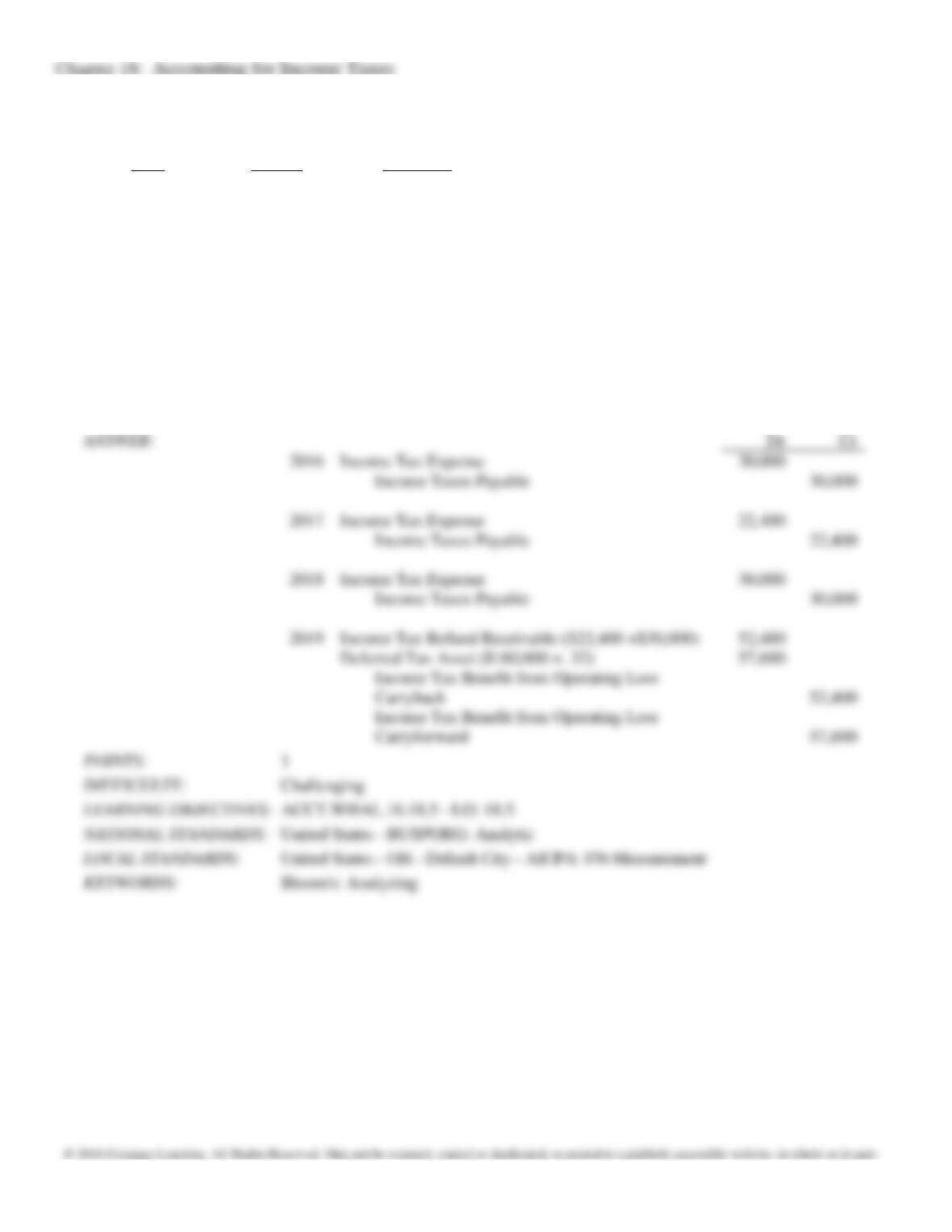
92. The Mishka Corporation reported the following income for both accounting and tax purposes:
Pretax
Enacted
Year
Income
Tax Rates
2016
$ 120,000
25%
2017
80,000
28%
2018
100,000
30%
2019
(360,000)
30%
Mishka Corporation uses the carryback provision for net operating losses when possible. The enacted tax rate for
2020 and future years is 32%. Mishka believes that sufficient verifiable positive evidence exists so that a valuation
allowance is not necessary at the end of 2019.
Required:
Prepare the entries for income tax expense and related assets and liabilities for the Mishka Corporation for the years
2016 through 2019.
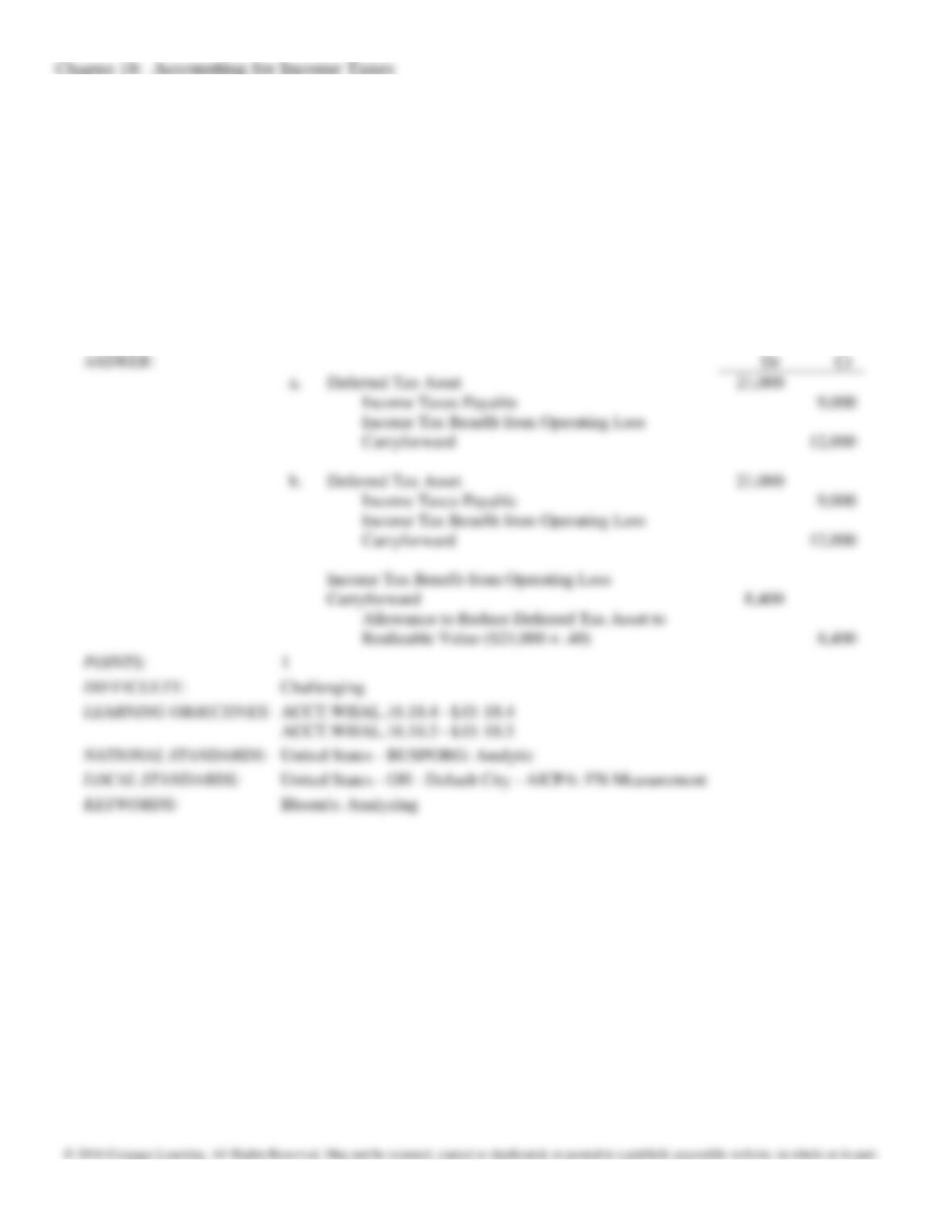
93. At the end of its first year of operations on December 31, 2016, the GAC Company reported taxable income of
$30,000 and a pretax financial loss of $40,000. Differences between taxable income and pretax financial income
included estimated bad debt expense for which accounts were expected to be written off in 2017, $20,000, and
warranty costs expensed for accounting purposes in excess of cash paid for warranty claims, $50,000. The warranty
costs are expected to be paid in 2017. The enacted tax rate for 2016 and 2017 is 30%.
Required:
a.
Prepare the income tax journal entry for the GAC Company on December 31, 2016,
assuming that it is more likely than not that the deferred tax asset will be realized.
b.
Prepare the income tax journal entry for the GAC Company on December 31, 2016,
assuming that it is more likely than not that 40% of the deferred tax asset from the
warranty costs will not be realized.
1
ACCT.WHAL.16.18.4 – LO: 18.4
United States – OH – Default City – AICPA: FN-Measurement
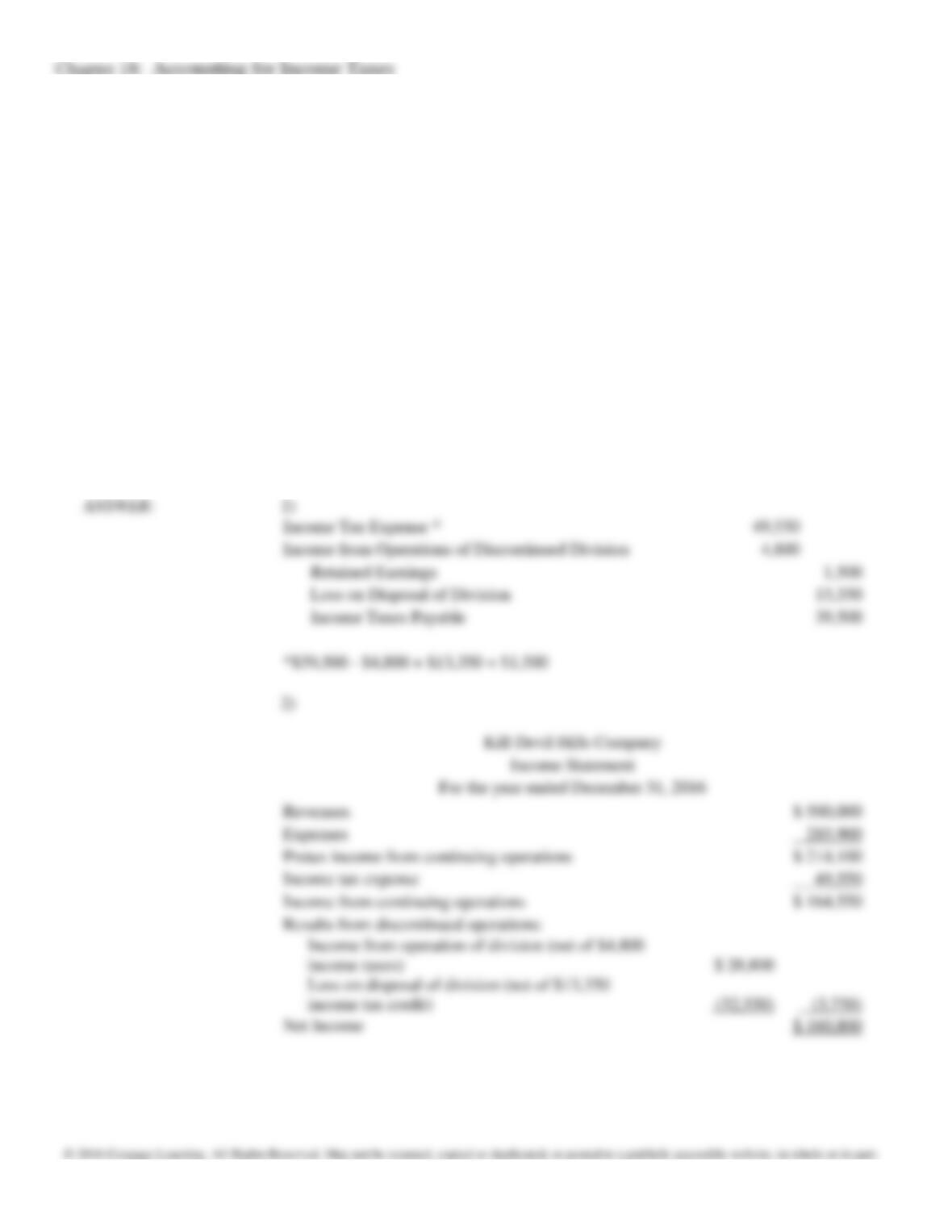
94. The following information relates to the Kill Devil Hills Company for the year ending December 31, 2016:
Cash dividends 2016
$ 35,000
Expenses
285,900
* Income tax payable
39,500
Pretax correction of error in understating depreciation in 2015
(7,500)
Pretax income from continuing operations
214,100
Pretax income from operations of discontinued division
33,600
Pretax loss on disposal of division
(45,900)
Retained Earnings, January 1, 2016
734,000
Revenues
500,000
* Of this amount $4,800 relates to the pretax income from the operations of discontinued division; pretax loss on the
disposal of division resulted in a tax savings of $13,350; and pretax correction of the depreciation error resulted in a
tax savings of $1,500.
Required:
1) Prepare the year end journal entry necessary to record the 2016 intraperiod income tax allocation.
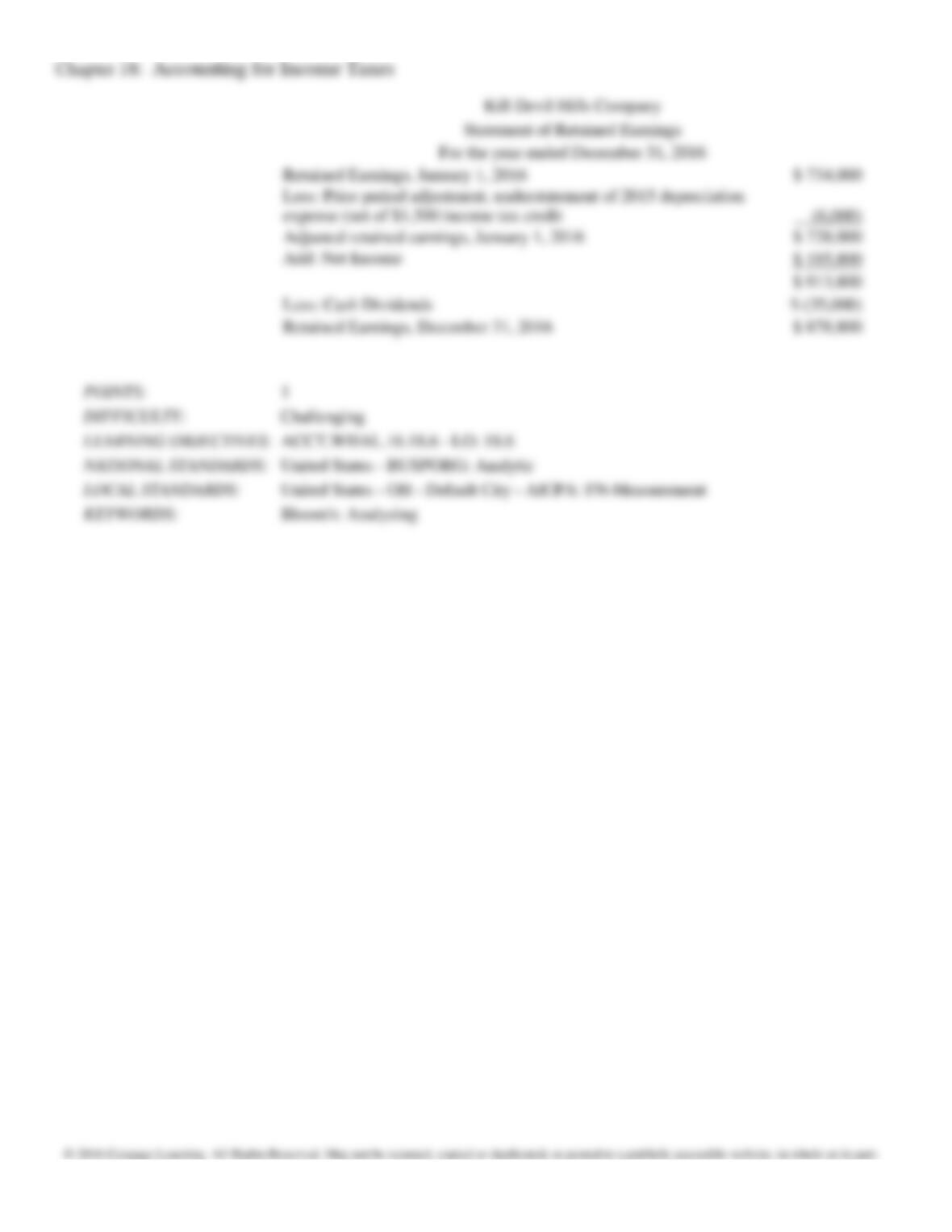
2) Prepare Kill Devil Hill’s 2016 income statement and statement of retained earnings.
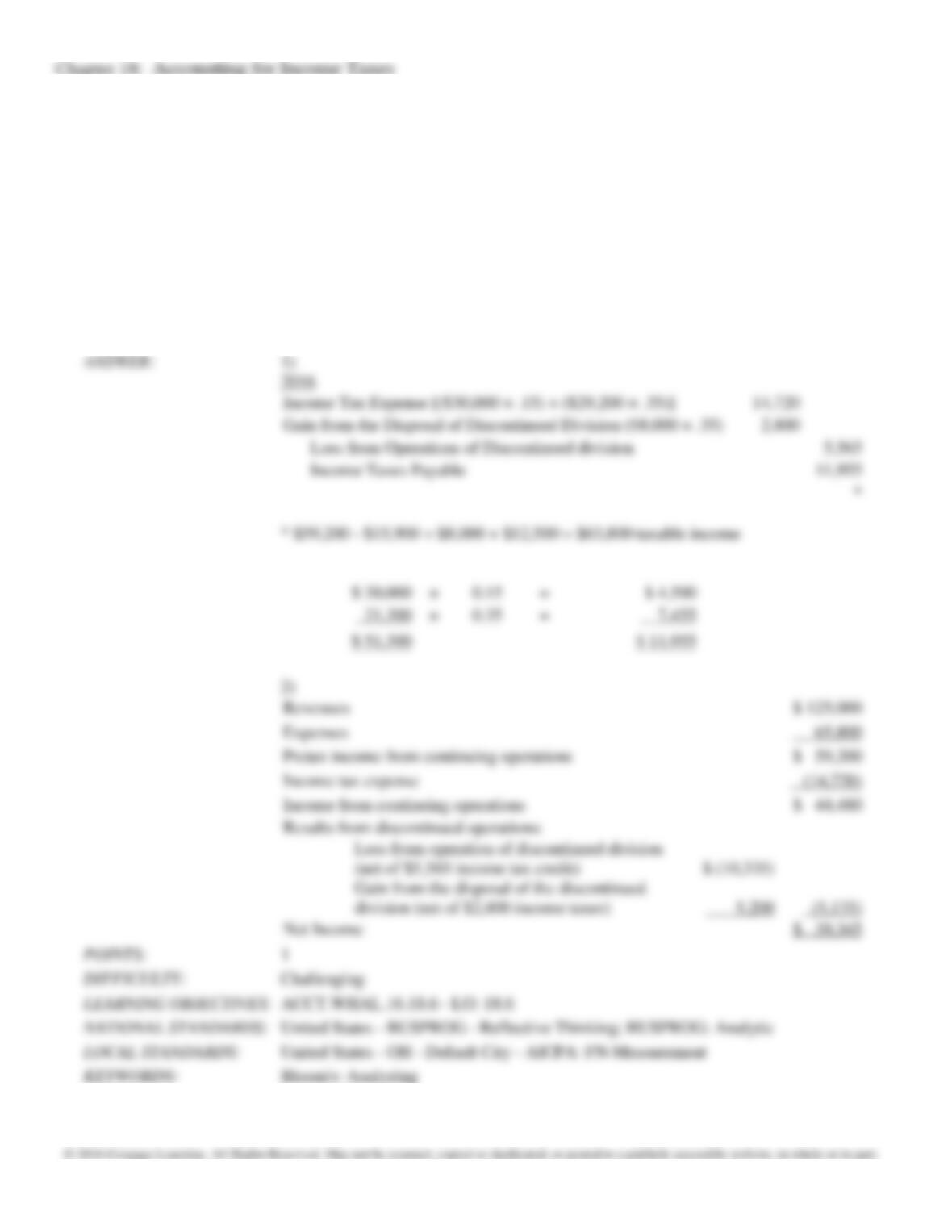
95. Jefferson Corporation reported the following pretax and taxable income items from 2016:
Expenses
$ 65,800
Gain from the disposal of the discontinued division
8,000
Income from continuing operations
59,200
Loss from discontinued division
(15,900)
Revenues
125,000
Required:
1) Prepare the journal entries for 2016 to record the intraperiod income tax allocation. The tax rate for the first
$30,000 of income is 15%; the tax rate thereafter is 35%.
2) Prepare the 2016 income statement for Jefferson Corporation. (Heading is not necessary)
division (net of $2,800 income taxes)