18.5 Fixed and Flexible Exchange Rates
1) If a country’s currency depreciates, the country will experience a ________ in exports and a
________ in imports.
A) rise; rise
B) fall; fall
C) rise; fall
D) fall; rise
2) If a country’s currency appreciates, the country will experience a ________ in exports and a
________ in imports.
A) rise; rise
B) fall; fall
C) rise; fall
D) fall; rise
3) If the value of the U.S. dollar changes from 1.4 euros to 1.2 euros, we would expect that the
United States would experience a ________ in exports and a ________ in imports.
A) rise; rise
B) fall; fall
C) rise; fall
D) fall; rise
4) If the value of the U.S. dollar changes from 1.2 euros to 1.4 euros, we would expect that the
United States would experience a ________ in exports and a ________ in imports.
A) rise; rise
B) fall; fall
C) rise; fall
D) fall; rise
5) The efforts of nations to influence exchange rates are known as
A) open market operations.
B) foreign exchange market intervention.
C) rate discrimination.
D) establishing terms of trade.
6) In the United States, the ________ has the official responsibility for foreign exchange
intervention.
A) State Department
B) Treasury Department
C) International Trade Commission
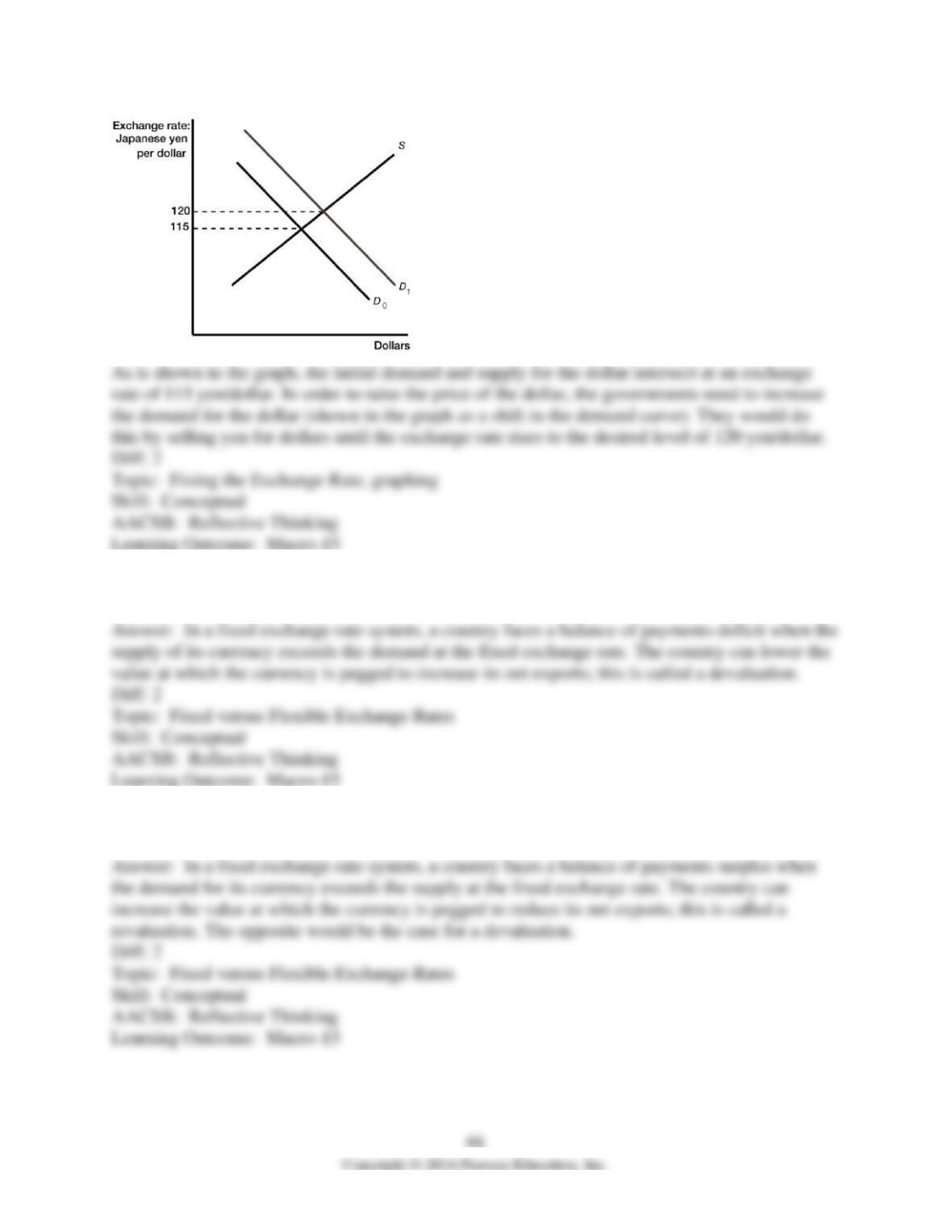
D) Department of Commerce
7) If the U.S. government enters the foreign exchange market and purchases dollars to maintain a
specific exchange rate with the yen, the dollar will ________ and the yen will ________.
A) depreciate; depreciate
B) depreciate; appreciate
C) appreciate; depreciate
D) appreciate; appreciate
8) If the U.S. government enters the foreign exchange market and sells dollars to maintain a
specific exchange rate with the yen, the dollar will ________ and the yen will ________.
A) depreciate; depreciate
B) depreciate; appreciate
C) appreciate; depreciate
D) appreciate; appreciate
9) If the Japanese government enters the foreign exchange market and purchases yen to maintain
a specific exchange rate with the dollar, the dollar will ________ and the yen will ________.
A) depreciate; depreciate
B) depreciate; appreciate
C) appreciate; depreciate
D) appreciate; appreciate
10) If the Japanese government enters the foreign exchange market and sells yen to maintain a
specific exchange rate with the dollar, the dollar will ________ and the yen will ________.
A) depreciate; depreciate
B) depreciate; appreciate
C) appreciate; depreciate
D) appreciate; appreciate
11) A currency system in which governments try to keep constant the values of their currencies
against another is called a ________ exchange rate system.
A) fixed
B) stable
C) consistent
D) flexible
12) A balance of payments deficit occurs if
A) exports exceed imports.
B) the supply of a nation’s currency exceeds the demand for the currency at the current exchange
rate.
C) the demand for a nation’s currency exceeds the supply of the currency at the current exchange
rate.
D) the supply of a nation’s currency is equal to the demand for the currency at the current
exchange rate.
13) A balance of payments surplus occurs if
A) exports exceed imports.
B) the supply of a nation’s currency exceeds the demand for the currency at the current exchange
rate.
C) the demand for a nation’s currency exceeds the supply of the currency at the current exchange
rate.
D) the supply of a nation’s currency is equal to the demand for the currency at the current
exchange rate.
14) Suppose the United States is experiencing a balance of payments deficit. To prevent the
exchange rate from depreciating, the U.S. Treasury must
A) sell foreign currency and buy dollars.
B) sell dollars and buy foreign currency.
C) sell both dollars and foreign currency.
D) buy both dollars and foreign currency.
15) Suppose the United States is experiencing a balance of payments surplus. To prevent the
exchange rate from appreciating, the U.S. Treasury must
A) sell foreign currency and buy dollars.
B) sell dollars and buy foreign currency.
C) sell both dollars and foreign currency.
D) buy both dollars and foreign currency.
16) In a fixed exchange rate system, a decrease in the exchange rate at which a currency is
pegged is called a(n)
A) appreciation.
B) devaluation.
C) revaluation.
D) depreciation.
17) In a fixed exchange rate system, an increase in the exchange rate at which a currency is
pegged is called a(n)
A) appreciation.
B) devaluation.
C) revaluation.
D) depreciation.
18) A country undertakes a devaluation in order to
A) increase its net exports.
B) decrease its net exports.
C) raise the value at which its currency is pegged.
D) move to a flexible exchange rate system.
19) A country undertakes a revaluation in order to
A) increase its net exports.
B) decrease its net exports.
C) lower the value at which its currency is pegged.
D) move to a flexible exchange rate system.
20) A currency system in which exchange rates are determined in free markets is called a
A) fixed exchange rate system.
B) gold standard.
C) flexible exchange rate system.
D) all of the above
21) Under the Bretton Woods system
A) all nations fixed the value of their currencies against the dollar.
B) the United States was the only nation with a fixed exchange rate.
C) the United States was the only nation with floating exchange rates.
D) all nations allowed the value of their currencies to be determined by the free market.
22) Under a fixed exchange rate system, if the inflation rate in the United States is 5% a year and
the inflation rate in Australia is 0% a year, then the U.S. real exchange rate will
A) remain constant.
B) increase 5% a year.
C) decrease 5% a year.
D) possibly increase or decrease.
23) Under a fixed exchange rate system, if the inflation rate in the United States is 0% a year and
the inflation rate in Australia is 5% a year, then the U.S. real exchange rate will
A) remain constant.
B) increase 5% a year.
C) decrease 5% a year.
D) may increase or decrease.
24) Under a fixed exchange rate system, if the inflation rate of the United States exceeds the
inflation rate of other nations, the
A) dollar will depreciate.
B) dollar will appreciate.
C) United States will develop a trade deficit.
D) United States will develop a trade surplus.
25) Under a fixed exchange rate system, if the inflation rate of the United States is less than the
inflation rate of other nations, the
A) dollar will depreciate.
B) dollar will appreciate.
C) United States will develop a trade deficit.
D) United States will develop a trade surplus.
Recall the Application about how the collapse of the housing boom and the worldwide
recession of 2007 led to problems for some countries in the Euro-zone to answer the
following question(s). When the euro was launched in 1999, the vision of its founders was to
use the monetary union to further unify Europe economically and politically. They
envisioned a large economic market, comparable to the United States with integrated goods
and financial markets. They believed that by moving to a single currency with
agreements on a number of fiscal rules that they could achieve economic stability and
growth.
26) Recall the Application. Unlike the Euro-zone, the United States does not just have a single
currency, but also has a ________ that provides transfers to areas in economic distress.
A) single central bank
B) national trade agreement
C) unified fiscal system
D) federally funded emergency account
27) Recall the Application. The European nations that adopted the euro as a common currency
no longer have their own central banks and are therefore no longer able to conduct their own
independent
A) fiscal policy.
B) monetary policy.
C) international investment.
D) trade policy.
28) Recall the Application. Greece faced a major financial crisis in 2010 as its budgetary
imbalance became quite severe. Since Greece is a member of the Euro-zone, it could no longer
________ as a potential solution to its financial problems.
A) depreciate its currency
B) cut spending
C) raise taxes
D) reduce wages and prices
29) Foreign exchange market intervention involves the purchase or sale of currencies by
governments to influence the market exchange rate.
30) If the U.S. government wants to increase the price of the dollar relative to the euro, it could
buy euros with dollars in the foreign exchange market.
31) Under a flexible exchange rate system, exchange rates are determined by free markets.
32) An exchange rate system in which governments try to keep currency values from fluctuating
against one another is a fixed exchange rate system.
33) A country facing a balance of payments deficit will change the pegged value of its currency;
this is called a revaluation.
34) The Bretton Woods exchange rate system was replaced by a gold standard.
35) Suppose that the free market exchange rate for the dollar is 115 yen, but the U.S. and
Japanese governments want it to be 120 yen/dollar. What can the governments do? Illustrate
your answer with a graph.
36) Explain what is meant by a devaluation of a currency. Under what circumstances would a
country devalue its currency?
37) Explain what is meant by a revaluation of a currency. Under what circumstances would a
country devalue its currency?
38) Distinguish between fixed and flexible exchange rate systems.
39) Explain when a country would face a balance of payments deficit and when it would face a
balance of payments surplus if it was operating under a fixed exchange rate system.