31) A galvanic cell consists of a Al3+/Al half-cell and a standard hydrogen electrode. If the Al3+/Al half-
cell standard cell functions as the anode, and the standard cell potential is 1.66 V, what is the standard
reduction potential for the Al3+/Al half-cell?
A) -1.66 V
B) -0.55 V
C) +0.55 V
D) +1.66 V
32) What is the relationship between the standard cell potentials, E°, for the following two galvanic cell
reactions?
I. 3 Cu2+(aq) + 2 Al(s) → 3 Cu(s) + 2 Al3+(aq)
II. 30 Cu2+(aq) + 22 Al(s) → 30 Cu(s) + 22 Al3+(aq)
A) E°(I) = E°(II)
B) E°(I) = E°(II)
C) E°(I) = 10E°(II)
D) E°(I) = E°(II)
10
33) What is the relationship between the standard cell potentials, E°, for the following two galvanic cell
reactions?
I. 2 Ag+(aq) + Sn2+(aq) → Sn4+(aq) + 2 Ag(s)
II. 2 Ag(s) + Sn4+(aq) → Sn2+(aq) + 2 Ag+(aq)
A) E°(I) = E°(II)
B) E°(I) = E°(II)
C) E°(I) = – E°(II)
D) E°(I) = – E°(II)

60
34) What is the standard cell potential for the reaction below?
Pb(s) + Br2(l) → Pb2+(aq) + 2 Br–(aq)
The standard reduction potential is –0.13 V for the Pb2+/Pb half-cell and +1.09 V for the Br2/Br– half-cell.
A) -1.22 V
B) -0.95 V
C) +0.95 V
D) +1.22 V
35) A galvanic cell consists of one half-cell that contains Ag(s) and Ag+(aq), and one half-cell that contains
Pb(s) and Pb2+(aq). What species are produced at the electrodes under standard conditions?
Ag+(aq) + e– → Ag(s) E° = +0.80 V
Pb2+(aq) + 2 e– → Pb(s) E° = -0.13 V
A) Ag(aq) is formed at the cathode and, Pb(s) is formed at the anode.
B) Ag(s) is formed at the cathode, and Pb2+(aq) is formed at the anode.
C) Pb(s) is formed at the cathode, and Ag+(aq) is formed at the anode.
D) Pb2+(aq) is formed at the cathode, and Cu(s) is formed at the anode.
36) Consider the following standard reduction potentials,
Zn2+(aq) + 2 e– → Zn(s) E° = -0.76 V
I2(s) + 2 e– → 2 I–(aq) E° = +0.54 V
Under standard conditions,
A) Zn2+(aq) is a stronger oxidizing agent than I2(s) and I–(aq) is a stronger reducing agent than Zn(s).
B) I2(s) is a stronger oxidizing agent than Zn2+(aq) and Zn(s) is a stronger reducing agent than I–(aq).
C) Zn(s) is a stronger oxidizing agent than I–(aq) and Zn2+(aq) is a stronger reducing agent than I2(s).
D) I–(aq) is a stronger oxidizing agent than Zn(s) and I2(s) is a stronger reducing agent than Zn2+(aq).
37) Based on the following information,
F2(g) + 2 e– → 2 F–(aq) E° = +2.87 V
Mg2+(aq) + 2 e– → 2 Mg(s) E° = -2.37 V
which of the following chemical species is the strongest reducing agent?
A) F2(g)
B) Mg2+(aq)
C) F–(aq)
D) Mg(s)

38) Using the following standard reduction potentials,
Fe3+(aq) + e– → Fe2+(aq) E° = +0.77 V
Cd2+(aq) + 2 e– →Cd(s) E° = -0.40 V
calculate the standard cell potential for the cell reaction given below, and determine whether or not this
reaction is spontaneous under standard conditions.
Cd2+(aq) + 2 Fe2+(aq) → 2 Fe3+(aq) + Cd(s)
A) E° = -1.17 V, nonspontaneous
B) E° = -1.17 V, spontaneous
C) E° = +1.17, nonspontaneous
D) E° = + 1.17, spontaneous
39) Based on the half-reactions and their respective standard reduction potentials below, the strongest
reducing agent is ________, and the strongest oxidizing agent is ________.
Ag+(aq) + e– → Ag(s) 0.80 V
2 H+(aq) + 2 e– → H2(g) 0.00 V
Pb2+(aq) + 2 e– → Pb(s) -0.13 V
A) Ag, Pb2+
B) Ag+, Pb
C) Pb, Ag+
D) Pb2+, Ag
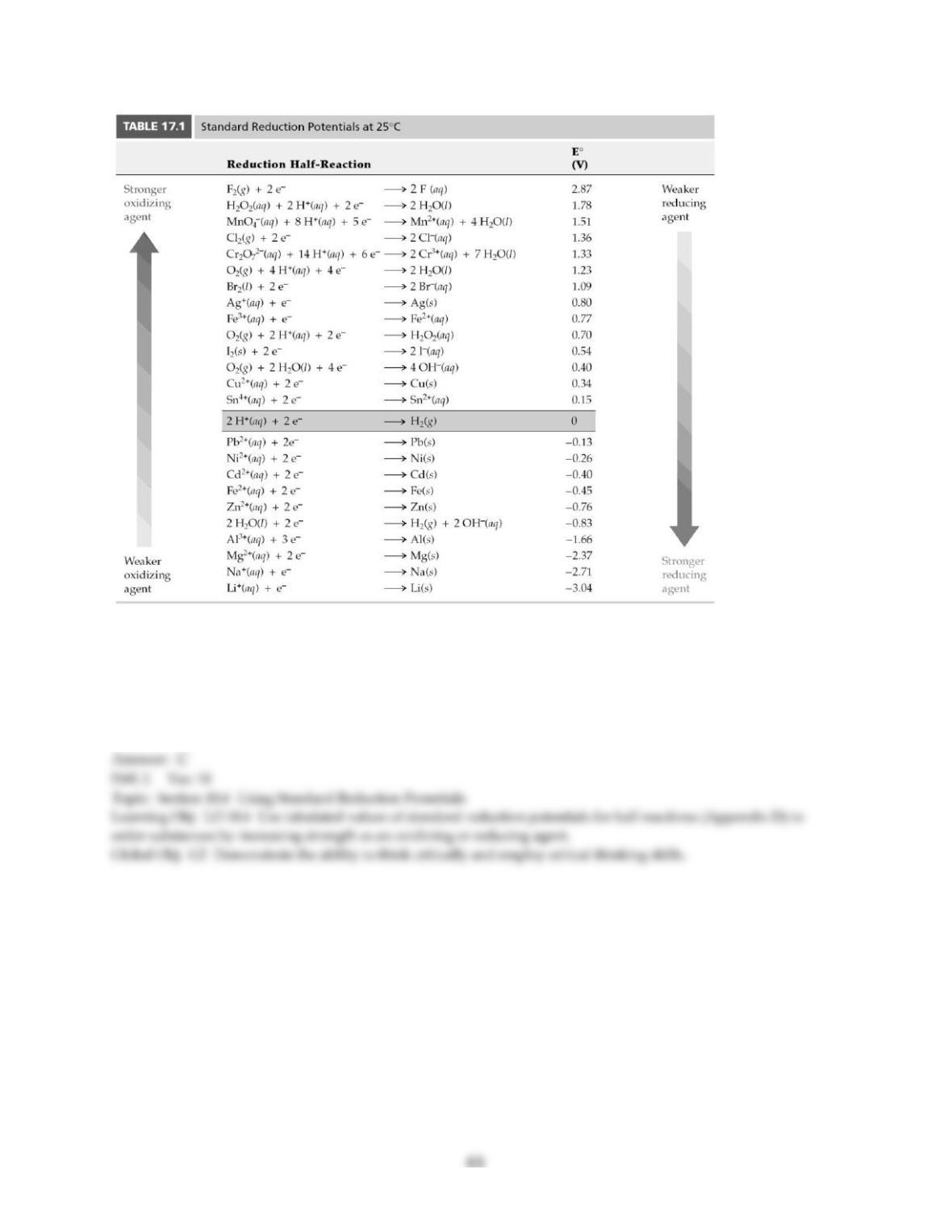
40) Use Table 17.1 to determine which of the following is the best oxidizing agent.
A) Fe3+
B) Cl2
C) MnO4–
D) Zn2+

41) Consider the following table of standard half-cell potentials:
A2 + 2 e– → 2 A– E° = + 1.12 V
B4+ + 2 e– → B2+ E° = +0.30 V
C3+ + 3 e– → C E° = -1.66 V
D2+ + 2 e– → D E° = -2.77 V
Which substance is the strongest oxidizing agent?
A) A2
B) B4+
C) C3+
D) D2+
42) Based on the following information,
Cl2(g) + 2 e– → 2 Cl–(aq) E° = 1.36 V
Zn2+(aq) + 2 e– → 2 Zn(s) E° = -0.76 V
which of the following chemical species is the strongest reducing agent?
A) Cl2(g)
B) Zn2+(aq)
C) Cl–(aq)
D) Zn(s)
43) Consider the galvanic cell, Which one of the following changes to the
cell would cause the cell potential to increase (i.e., become more positive)?
A) increase the [Fe2+] concentration
B) increase the [Pb2+] concentration
C) increase the mass of Fe(s)
D) decrease the mass of Fe(s)

44) Calculate the value of the reaction quotient, Q, for the galvanic cell expressed using shorthand
notation below. Use the balanced chemical equation that has the smallest whole number stoichiometric
coefficients.
Zn(s) ∣ Zn2+(aq, 0.0100 M) ∣∣ Ag+(aq, 1.10 M) ∣ Ag(s)
A) 121
B) 110
C) 9.09 × 10⁻³
D) 8.26 × 10⁻³
45) Calculate the value of the reaction quotient, Q, for the galvanic cell expressed using shorthand
notation below. Use the balanced chemical equation that has the smallest whole number stoichiometric
coefficients.
Zn(s) ∣ Zn2+(aq, 0.0.0400 M) ∣∣ Ag+(aq, 1.25 M) ∣ Ag(s)
A) 39.0
B) 31.2
C) 3.20 × 10⁻²
D) 2.56 × 10⁻²
46) Consider a cell based on the following reaction:
GeO(s) + H2O(l) + 2 Ag+(aq) → GeO2(s) + 2 H+(aq) + 2 Ag(s)
If [Ag+] = 1 M, at 25°C,
A) pH = 1/2(E° – E)x0.0592 V.
B) pH = (E° – E)x0.0592 V.
C) pH = (E – E°)/0.0592 V.
D) pH = 1/2(E – E°)x0.0592 V.

66
47) Calculate the equilibrium constant, K, at 25°C for the galvanic cell reaction shown below:
8 H+(aq) + 5 Fe2+(aq) + MnO4–(aq) → Mn2+(aq) + 5 Fe3+(aq) + 4 H2O(l) E° = +0.74 V
A) 3.2 × 10–59
B) 3.2 × 10⁻¹⁰
C) 3.2 × 10¹⁰
D) 3.2 × 1062
48) What is the value of the equilibrium constant, K for a redox reaction involving the transfer of 6 mol of
electrons if its standard potential is 0.043?
A) 4.384 × 10⁵
B) 2.28 × 10⁴
C) 1.70
D) 5.90 × 10⁻¹
49) A particular 12V battery is based on a reaction having a standard cell potential, E° = +1.92 V. What
happens when the battery “dies”?
A) E° = 12 V and E = 0 V
B) E° = 0 V and E = 12 V
C) E° = +1.92 V and E = 0 V
D) E° = +1.92 V and E = 12 V
50) Which battery does not use MnO2(s) as a cell reactant?
A) an alkaline cell
B) an alkaline dry cell
C) a lithium battery
D) a nickel-metal hydride battery
51) Galvanized steel is steel coated with a layer of
A) Fe2O3.
B) Ag.
C) Pb.
D) Zn.
52) For an electrolytic cell,
A) E is negative and ΔG is negative for the cell reaction.
B) E is negative and ΔG is positive for the cell reaction.
C) E is positive and ΔG is negative for the cell reaction.
D) E is zero and ΔG is positive for the cell reaction.
53) For a dead battery,
A) E is positive and ΔG is positive for the cell reaction.
B) E is negative and ΔG is positive for the cell reaction.
C) E is zero and ΔG is negative for the cell reaction.
D) E is zero and ΔG is zero for the cell reaction.

54) The gas OF2 can be produced from the electrolysis of an aqueous solution of KF, as shown in the
equation below.
OF2(g) + 2 H+(aq) + 4 e– → H2O(l) + 2 F–(aq) E° = +2.15 V
Using the given standard reduction potential, calculate the amount of OF2 that is produced, and the
electrode at which the OF2 is produced, upon the passage of 0.240 faradays through an aqueous KF
solution.
A) 3.24 g of OF2 at the anode
B) 13.0 g of OF2 at the anode
C) 3.24 g of OF2 at the cathode
D) 13.0 g of OF2 at the cathode
55) How many grams of chromium metal are plated out when a constant current of 8.00 A is passed
through an aqueous solution containing Cr3+ ions for 160. minutes?
A) 13.8 g
B) 24.6 g
C) 41.2 g
D) 124 g
56) How many grams of nickel metal are plated out when a constant current of 15.0 A is passed through
aqueous NiCl2 for 80.0 minutes?
A) 14.7 g
B) 21.9 g
C) 43.8 g
D) 48.4 g

69
57) How long must a constant current of 50.0 A be passed through an electrolytic cell containing aqueous
Cu2+ ions to produce 3.50 moles of copper metal?
A) 0.267 hours
B) 0.533 hours
C) 1.88 hours
D) 3.75 hours
58) A fuel cell is a galvanic cell in which the reactant is a fuel such as
A) hydrogen.
B) gasoline.
C) ethane.
D) propanol.
18.3 Short Answer Questions
1) Redox reactions occurring in acid are evident by the appearance of ________ in the balanced equation,
and redox reactions occurring in base are evident by the appearance of ________ in the balanced
equation.
2) When the equation MnO4–(aq) + C2O42-(aq) → Mn2+(aq) + CO2(g) is balanced in acidic solution using
the smallest whole numbers, the coefficient in front of the CO2(g) is ________.

3) When the equation below is balanced in acidic solution using the smallest whole numbers, the
coefficient in front of the H2O(l) is ________.
Fe2+(aq) + BrO3–(aq) → Fe3+(aq) + Br–(aq)
4) When the equation below is balanced in basic solution using the smallest whole numbers, the
coefficient in front of the OH–(aq) is ________.
CN–(aq) + MnO4–(aq) → CNO–(aq) + MnO2(s)
5) In the redox reaction 2 S2O32-(aq) + I3–(aq) → S4O62-(aq) + 3 I–(aq), if 18.75 mL of 0.2500 M Na2S2O3 is
needed for complete reaction with 15.00 mL of the I3– solution, what is the molar concentration of I3–?
6) A galvanic cell uses the reaction
Mg(s) + Pb2+(aq) → Mg2+(aq) + Pb(s).
Mg(s) → Mg2+(aq) + 2 e– is the ________ half-reaction, which occurs at the ________.
7) In the galvanic cell represented by the shorthand notation
Al(s)|Al3+(aq)||Fe3+(aq)|Fe(s)
the anode is ________ and the cathode is ________.
8) In the galvanic cell represented by the shorthand notation shown below,
Cd(aq)|Cd2+(aq)|| I2(g)|I–(aq)|Pt(s)
the inert electrode is ________, and the balanced cathode half-reaction reaction is ________.
9) In the shorthand notation for a galvanic cell, a single vertical line (|) represents a ________, and a
double vertical line (|| ) represents a ________.
10) In the galvanic cell represented by the shorthand notation below, electrons are lost by ________ and
gained by ________.
Pt(s)|Sn2+(aq)|Sn4+(aq)|| Br2(l)|Br–(aq)|Pt(s)

72
11) The galvanic cell represented by the shorthand notation below contains KNO3(aq) in the salt bridge.
During the reaction ________ ions flow into the anode compartment, and ________ ions flow into the
cathode compartment.
Pt(s)|H2(g)|H+(aq)|| Sn4+(aq)|Sn2+(aq)|Pt(s)
12) For the galvanic cell that uses the reaction
2 Al(s) + 3 Ni2+(aq) → 2 Al3+(aq) + 3 Ni(s)
the value of n in the relationship ΔG° = -nFE° is ________.
13) For the hypothetical reaction A + Bx → Ax + B, E° = 1.30 V and ΔG° = -251 kJ. For this reaction the
value of x = ________.
14) For the hypothetical reaction 3 A + 2 Bx → 3 Ay + 2 B, E° = 0.85 V and G° = -495 kJ. For this reaction the
values of x and y are ________ and ________.

15) In order for a cell potential to be a standard cell potential, the concentration of all ions in solution
must be ________ M, the partial pressures of all gaseous species must be ________ atm, and the
temperature must be ________ K.
16) Reduction half-reactions with corresponding standard half-cell potentials are shown below.
Zn2+(aq) + 2 e– → Zn(s) E° = – 0.76 V
Al3+(aq) + 3 e– → Al(s) E° = – 1.66 V
The standard potential for the galvanic cell that uses these two half-reactions is ________ V.
17) Based on the half-reactions and their respective standard reduction potentials below, the standard cell
potential for the reaction that is expected to occur is ________ V.
Ag+(aq) + e– → Ag(s) 0.80 V
2 H+(aq) + 2 e– → H2(g) 0.00 V
Cd2+(aq) + 2 e– → Cd(s) -0.40 V

18) Reduction half-reactions with corresponding standard half-cell potentials are shown below.
Ag+(aq) + 1 e– → Ag(s) E° = +0.80 V
Zn2+(aq) + 2 e– → Zn(s) E° = -0.76 V
Mg2+(aq) + 2 e– → Mg(s) E° = -2.37 V
Of the species above, the strongest oxidizing agent is ________, and the strongest reducing agent is
________.
19) Based on the half-reactions and their respective standard reduction potentials below, the strongest
reducing agent is ________, and the strongest oxidizing agent is ________.
Fe3+(aq) + e– → Fe2+(aq) 0.77 V
Cu2+(aq) + 2 e– → Cu
(aq) 0.15 V
Zn2+(aq) + 2 e– → Zn(s) -0.76 V
20) The standard cell potential for the following galvanic cell is 1.21 V.
Al(s)|Al3+(aq)||Fe2+(aq)|Fe(s)
When [Al3+] = 0.10 M and [Fe2+] = 0.10 M, will the cell potential at 25°C be less than, the same as, or
greater than 1.21 V?

21) The standard reduction potential E° = -0.45 V for the half-reaction Fe2+ + 2 e– → Fe. If the measured
cell potential at 25°C is 0.35 V, the pH in the anode compartment of the following cell is ________.
Pt(s)|H2(1 atm)|H+(? M)||Fe2+(1 M)|Fe(s)
22) The standard cell potential for the following galvanic cell is 0.71 V.
Pb(s)|Pb2+(aq)||Al3+(aq)|Al
This reaction has an equilibrium constant, K = ________.
23) The two half-reactions that are used in the direct methanol fuel cell are shown below.
I. 2 CH3OH(aq) + 2 H2O(l) → 2 CO2(g) + 12 H+(aq) + 12 e–
II. 3 O2(g) + 12 H+(aq) + 12 e– → 6 H2O(l)
The electrode at which half–reaction I occurs is the ________ at which ________ is oxidized, and half–
reaction II occurs at the ________ at which ________ is reduced.
24) If a constant current of 1.50 × 10⁸ A is passed through a molten mixture of aluminum oxide and
cryolite for 4.00 hour ________ kg of aluminum can be produced.
25) Electrolysis of a metal nitrate solution M(NO3)2(aq) for 3.00 hours with a constant current of 20.0 A
gives 119 g of the metal M. The identity of the metal M in the metal ion M2+ is ________.