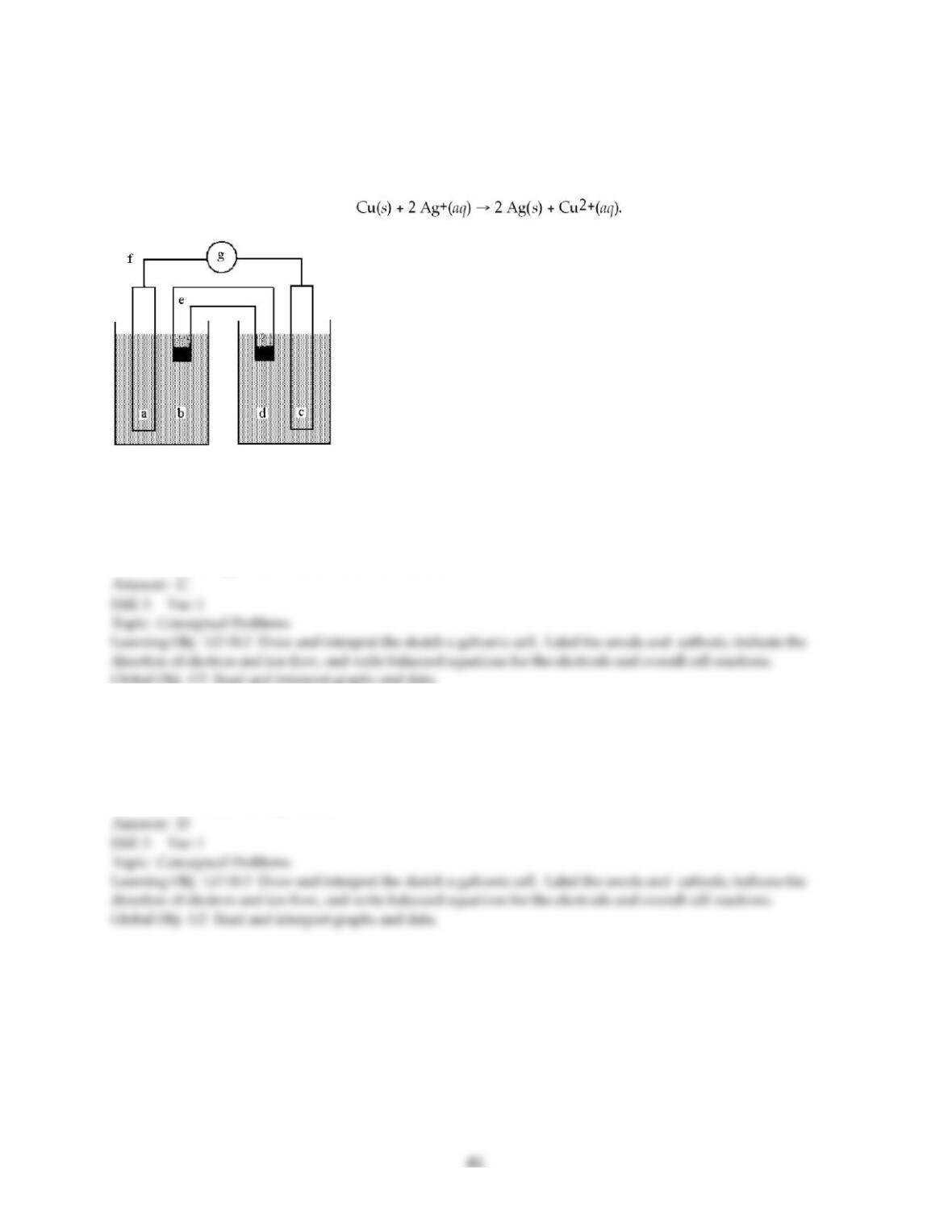
Shown below is a galvanic cell with anode compartment b containing anode a and cathode compartment
d containing cathode c. Electrons flow through wire f, ions flow through salt bridge e, and the cell
potential is read using voltmeter g.
This galvanic cell uses the reaction:
114) Identify the electrodes and the direction of electron flow.
A) a is Ag, c is Cu and electrons flow from a to c.
B) a is Ag, c is Cu and electrons flow from c to a.
C) a is Cu, c is Ag and electrons flow from a to c.
D) a is Cu, c is Ag and electrons flow from c to a.
115) Identify and give the sign of each electrode.
A) a is Ag and (+), c is Cu and (-).
B) a is Ag and (-), c is Cu and (+).
C) a is Cu and (+), c is Ag and (-).
D) a is Cu and (-), c is Ag and (+).
116) NaNO3(aq) is employed in the salt bridge. Give the direction of electron flow and the direction of ion
flow from the salt bridge.
A) Electrons flow from a to c; Na+ flows into b and NO3– flows into d.
B) Electrons flow from a to c; NO3– flows into b and Na+ flows into d.
C) Electrons flow from c to a; Na+ flows into b and NO3– flows into d.
D) Electrons flow from c to a; NO3– flows into b and Na+ flows into d.
117) Identify the anode and cathode half-reactions and categorize each as either oxidation or reduction.
A) Anode reaction: Ag+(aq) + e– → Ag(s) (oxidation)
Cathode reaction: Cu(s) → Cu2+(aq) + 2e– (reduction)
B) Anode reaction: Ag+(aq) + e– → Ag(s) (reduction)
Cathode reaction: Cu(s) → Cu2+(aq) + 2e– (oxidation)
C) Anode reaction: Cu(s) → Cu2+(aq) + 2e– (oxidation)
Cathode reaction: Ag+(aq) + e– → Ag(s) (reduction)
D) Anode reaction: Cu(s) → Cu2+(aq) + 2e– (reduction)
Cathode reaction: Ag+(aq) + e– → Ag(s) (oxidation)
118) What is the shorthand notation for this cell?
A) Cu2+(aq) ∣ Cu(s) ∣∣ Ag+(aq) ∣ Ag(s)
B) Cu(s) ∣ Cu2+(aq) ∣∣ Ag(s) ∣ Ag+(aq)
C) Cu2+(aq) ∣ Cu(s) ∣∣ Ag(s) ∣ Ag+(aq)
D) Cu(s) ∣ Cu2+(aq) ∣∣ Ag+(aq) ∣ Ag(s)

43
119) Given the half-cell potentials below, calculate the cell potential.
Ag+(aq) + e– → Ag(s) 0.80 V
Cu2+(aq) + 2 e– → Cu(s) 0.34 V
A) 0.46 V
B) 1.14 V
C) 1.26 V
D) 1.94 V
120) If the concentrations of Ag+(aq) and Cu2+(aq) are varied in this galvanic cell, which of the following
four cells has the largest cell potential?
A) [Ag+] = 0.10 M and [Cu2+] = 0.10 M
B) [Ag+] = 1.0 M and [Cu2+] = 0.10 M
C) [Ag+] = 0.10 M and [Cu2+] = 1.0 M
D) [Ag+] = 1.0 M and [Cu2+] = 1.0 M
121) The initial concentrations of Ag+(aq) and Cu2+(aq) are both 1.0 M. What will happen to the cell
voltage if Cu(NO3)2 is added to the compartment containing the 1.0 M Cu2+(aq)? The cell voltage
will
A) decrease.
B) increase.
C) remain the same.
D) can’t tell from the information given

44
122) The initial concentrations of Ag+(aq) and Cu2+(aq) are both 1.0 M. What will happen to the cell
voltage if Cu(NO3)2 is added to the compartment containing the 1.0 M Cu2+(aq)? The cell voltage
will
A) decrease.
B) increase.
C) remain the same.
D) can’t tell from the information given
123) The initial concentrations of Ag+(aq) and Cu2+(aq) are both 1.0 M. What will happen to the cell
voltage if 5.0 M AgNO3 is added to the compartment containing the 1.0 M Ag+(aq)? The cell voltage will
A) decrease.
B) increase.
C) remain the same.
D) can’t tell from the information given
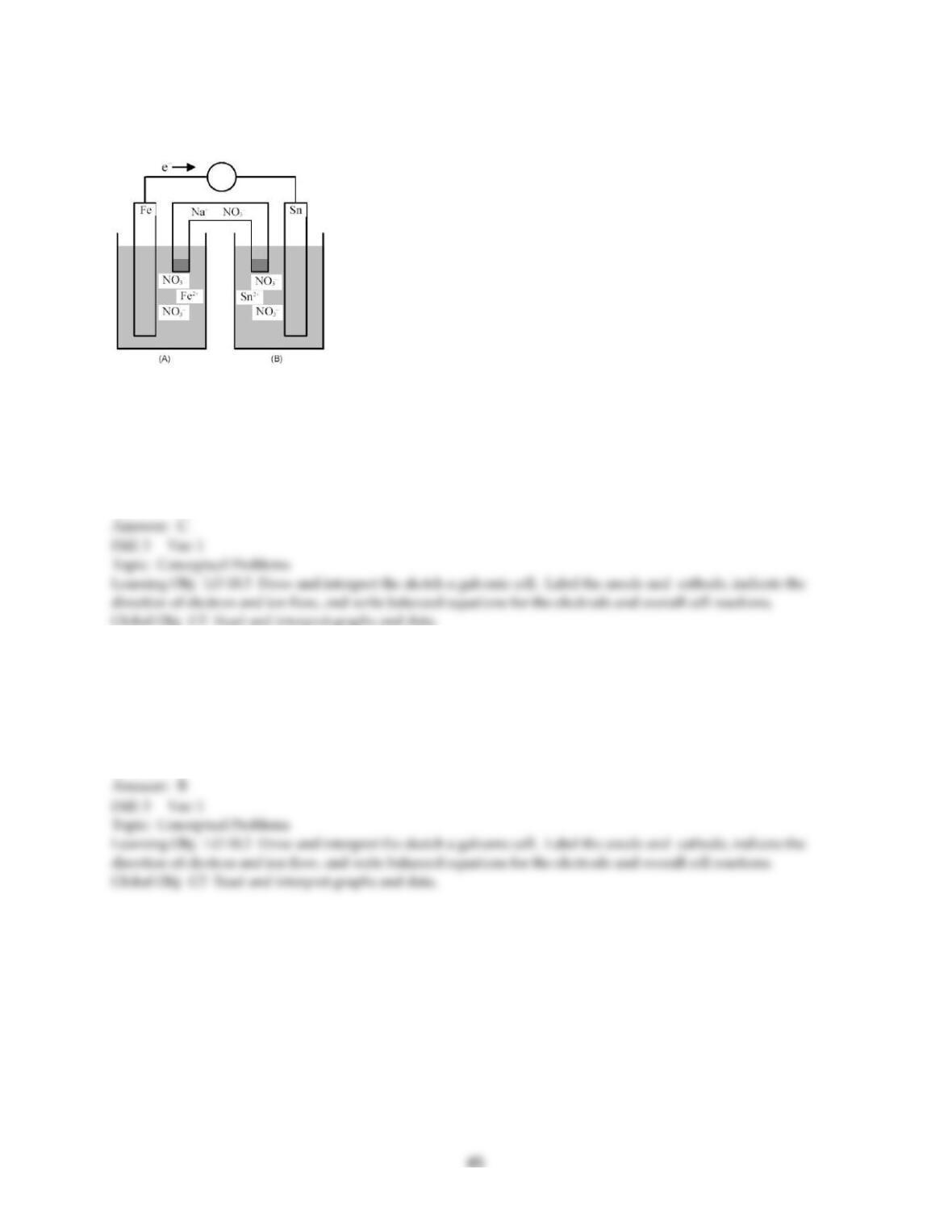
Consider the following galvanic cell.
124) What is the quantitative change in the cell voltage on increasing the ion concentration in the anode
compartment by a factor of 10?
A) +0.06 V
B) +0.03 V
C) -0.03 V
D) -0.06 V
125) What is the quantitative change in the cell voltage on increasing the ion concentration in the cathode
compartment by a factor of 10?
A) +0.06 V
B) +0.03 V
C) -0.03 V
D) -0.06 V
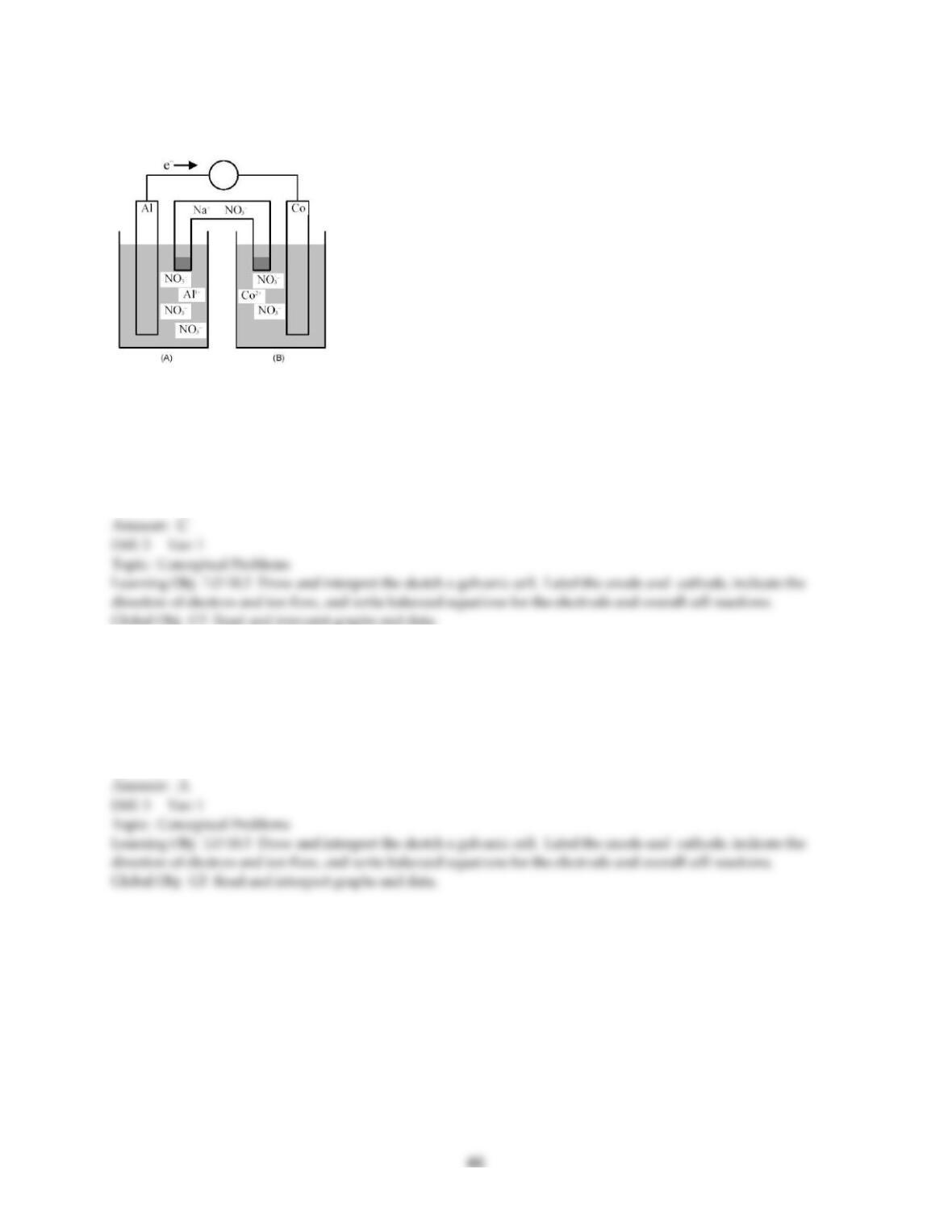
Consider the galvanic cell shown below.
126) What is the quantitative change in the cell voltage on increasing the ion concentration in the anode
compartment by a factor of 10?
A) +0.03 V
B) +0.02 V
C) -0.02 V
D) -0.03 V
127) What is the quantitative change in the cell voltage on increasing the ion concentration in the cathode
compartment by a factor of 10?
A) +0.03 V
B) +0.02 V
C) -0.02 V
D) -0.03 V
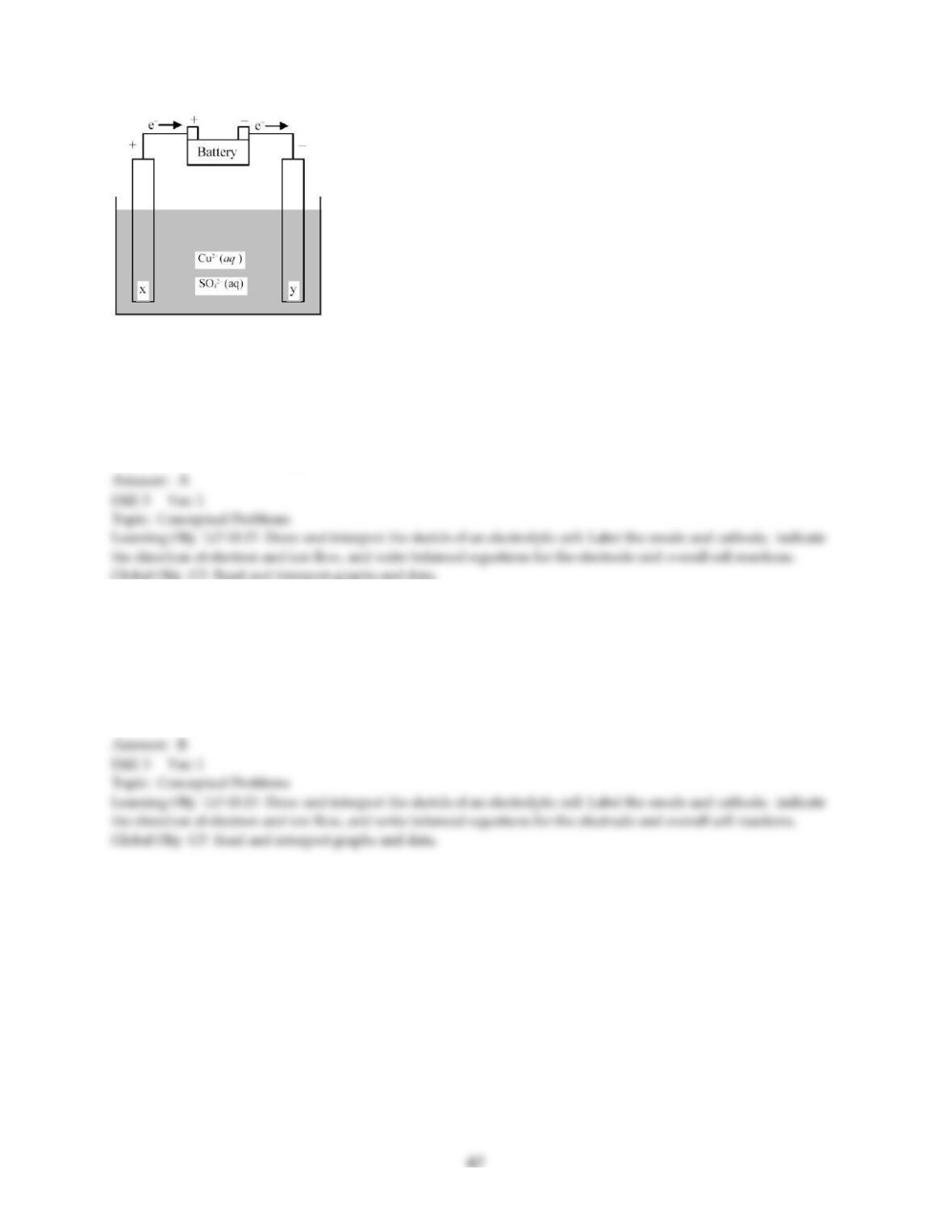
128) Is the cell shown above a galvanic or an electrolytic cell? Which is the anode and which is the
cathode?
A) Electrolytic cell; electrode x is the anode and electrode y is the cathode.
B) Electrolytic cell; electrode y is the anode and electrode x is the cathode.
C) Galvanic cell; electrode x is the anode and electrode y is the cathode.
D) Galvanic cell; electrode y is the anode and electrode x is the cathode.
129) Is the cell shown above a galvanic or an electrolytic cell? What is the direction of ion flow?
A) Electrolytic cell; Cu2+ ions flow toward electrode x and SO42- ions flow toward electrode y.
B) Electrolytic cell; Cu2+ ions flow toward electrode y and SO42- ions flow toward electrode x.
C) Galvanic cell; Cu2+ ions flow toward electrode x and SO42- ions flow toward electrode y.
D) Galvanic cell; Cu2+ ions flow toward electrode y and SO42- ions flow toward electrode x.
48
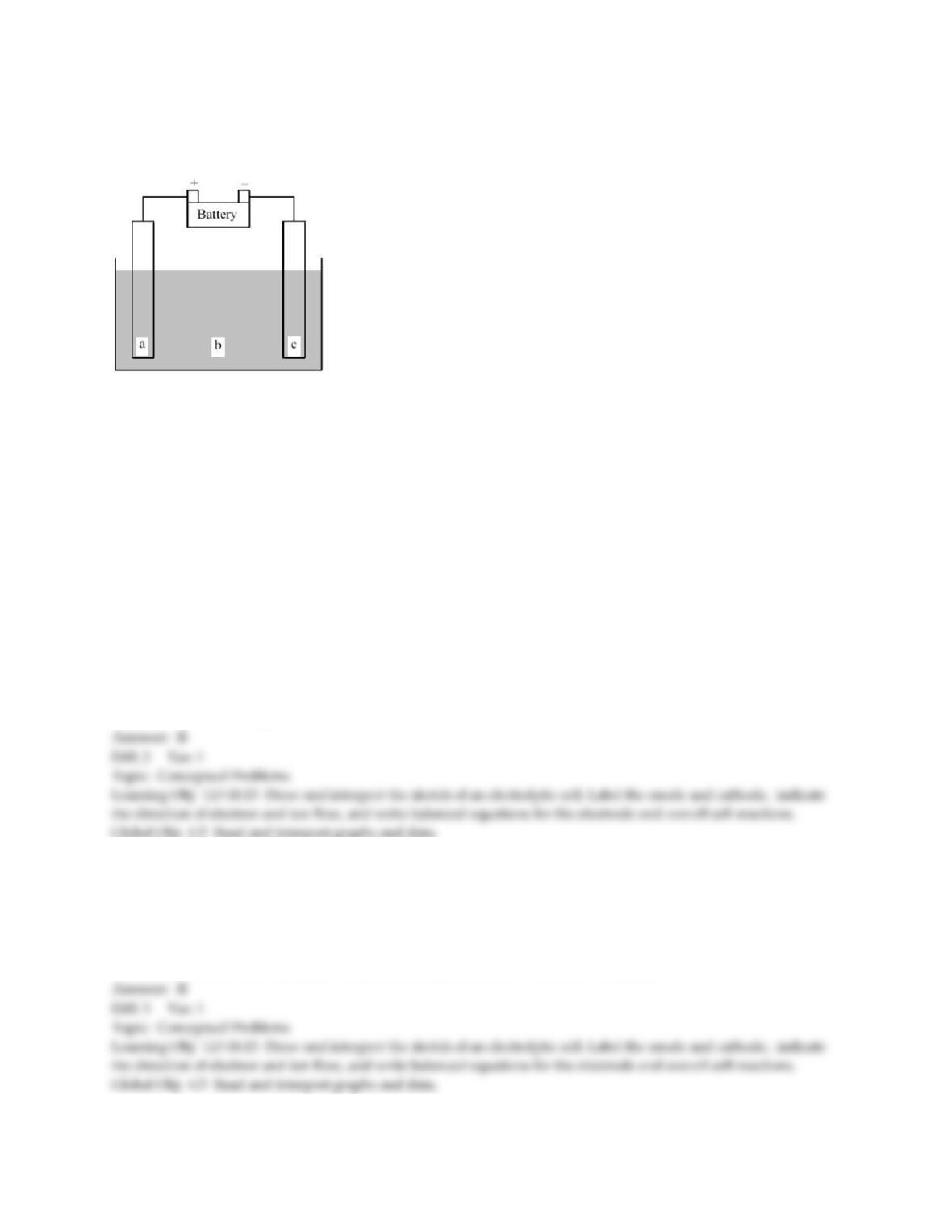
Shown below is an electrochemical cell with anode a and cathode c. Both the anode and the cathode are
inert electrodes. The liquid shown in compartment b of the cell is molten potassium chloride, KCl(l).
130) Determine whether this is a galvanic or an electrolytic cell and give the reaction occurring at the
anode and the reaction occurring at the cathode.
A) Electrolytic cell
Anode reaction: K(s) → K+(l) + e–
Cathode reaction: Cl2(g) + 2e– → 2 Cl–(l)
B) Electrolytic cell
Anode reaction: 2 Cl–(l) → Cl2(g) + 2e–
Cathode reaction: K+(l) + e– → K(s)
C) Galvanic cell
Anode reaction: K(s) → K+(l) + e–
Cathode reaction: Cl2(g) + 2e– → 2 Cl–(l)
D) Galvanic cell
Anode reaction: K(s) → K+(l) + e–
Cathode reaction: Cl2(g) + 2e– → 2 Cl–(l)
131) Determine the direction of electron flow and the direction of ion flow.
A) Electrons flow from a to c; K+ ions flow toward a and Cl– ions flow toward c.
B) Electrons flow from a to c; Cl– ions flow toward a and K+ ions flow toward c.
C) Electrons flow from c to a; K+ ions flow toward a and Cl– ions flow toward c.
D) Electrons flow from c to a; Cl– ions flow toward a and K+ ions flow toward c.
18.2 Algorithmic Questions
1) What are the coefficients in front of NO3–(aq) and Mg(s) when the following redox equation is balanced
in an acidic solution?
________ NO3–(aq) + ________ Mg(s) → ________ NO(g) + ________ Mg2+(aq)
A) 2, 3
B) 2, 6
C) 3, 4
D) 3, 6
2) According to the balanced equation shown below, 3.00 mole of oxalic acid, H2C2O4, reacts with
________ moles of permanganate, MnO4–.
5 H2C2O4(aq) + 2 MnO4–(aq) + 6 H+(aq) → 10 CO2(g) + Mn2+(aq) + 8 H2O(l)
A) 1.20
B) 3.00
C) 6.00
D) 7.75
3) Based on the balanced chemical equation shown below, what volume of 0.250 M K2S2O3(aq), is needed
to completely react with 12.44 mL of 0.125 M KI3(aq)?
2 S2O32-(aq) + I3–(aq) → S4O62-(aq) + 3 I–(aq)
A) 3.11 mL
B) 6.22 mL
C) 12.4 mL
D) 49.8 mL

50
4) What is the molarity of a potassium triiodide solution, KI3(aq), if 30.00 mL of the solution is required to
completely react with 25.00 mL of a 0.500 M thiosulfate solution, K2S2O3(aq)? The chemical equation for
the reaction is:
2 S2O32-(aq) + I3–(aq) → S4O62-(aq) + 3 I–(aq).
A) 0.208 M
B) 0.300 M
C) 0.417 M
D) 0.833 M
5) Based on the balanced chemical equation shown below, determine the molarity of a solution containing
Fe2+(aq), if 40.00 mL of the Fe2+(aq) solution is required to completely react with 30.00 mL of a 0.500 M
potassium bromate, KBrO3(aq), solution. The chemical equation for the reaction is:
6 Fe2+(aq) + BrO3–(aq) + 6 H+(aq) → 6 Fe3+(aq) + Br–(aq) + 3 H2O(l).
A) 0.0625 M
B) 0.375 M
C) 2.25 M
D) 4.00 M
6) Based on the balanced chemical equation shown below, determine the mass percent of Fe3+ in a
sample of iron ore, if 22.40 mL of a 0.1000 M stannous chloride, SnCl2(aq), solution is required to
completely react with the Fe3+ present in the ore sample. The chemical equation for the reaction is:
2 Fe3+(aq) + Sn2+(aq) → 2 Fe2+(aq) + Sn4+(aq).
A) 8.982%
B) 14.06%
C) 28.11%
D) 56.22%
7) In the unbalanced equation shown below how many moles of electrons are transferred per mole of
reducing agent?
C2O42- (aq) + MnO4–(aq) → CO2(aq) + Mn2+(aq)
A) 3
B) 2
C) 5
D) 12
8) What are the coefficients in front of NO3–(aq) and Zn(s) when the following equation is balanced in a
basic solution?
________ NO3–(aq) + ________ Ni(s) → ________ Ni2+(aq) + ________ NO(g)
A) 2, 3
B) 2, 5
C) 3, 2
D) 3, 4
9) What are the coefficients in front of Ni(s) and O3(g) when the following equation is balanced in a basic
solution?
________ Ni(s) + ________ O3(g) → ________ Ni2O3(s) + ________ O2(g)
A) 2, 2
B) 2, 3
C) 3, 2
D) 3, 4
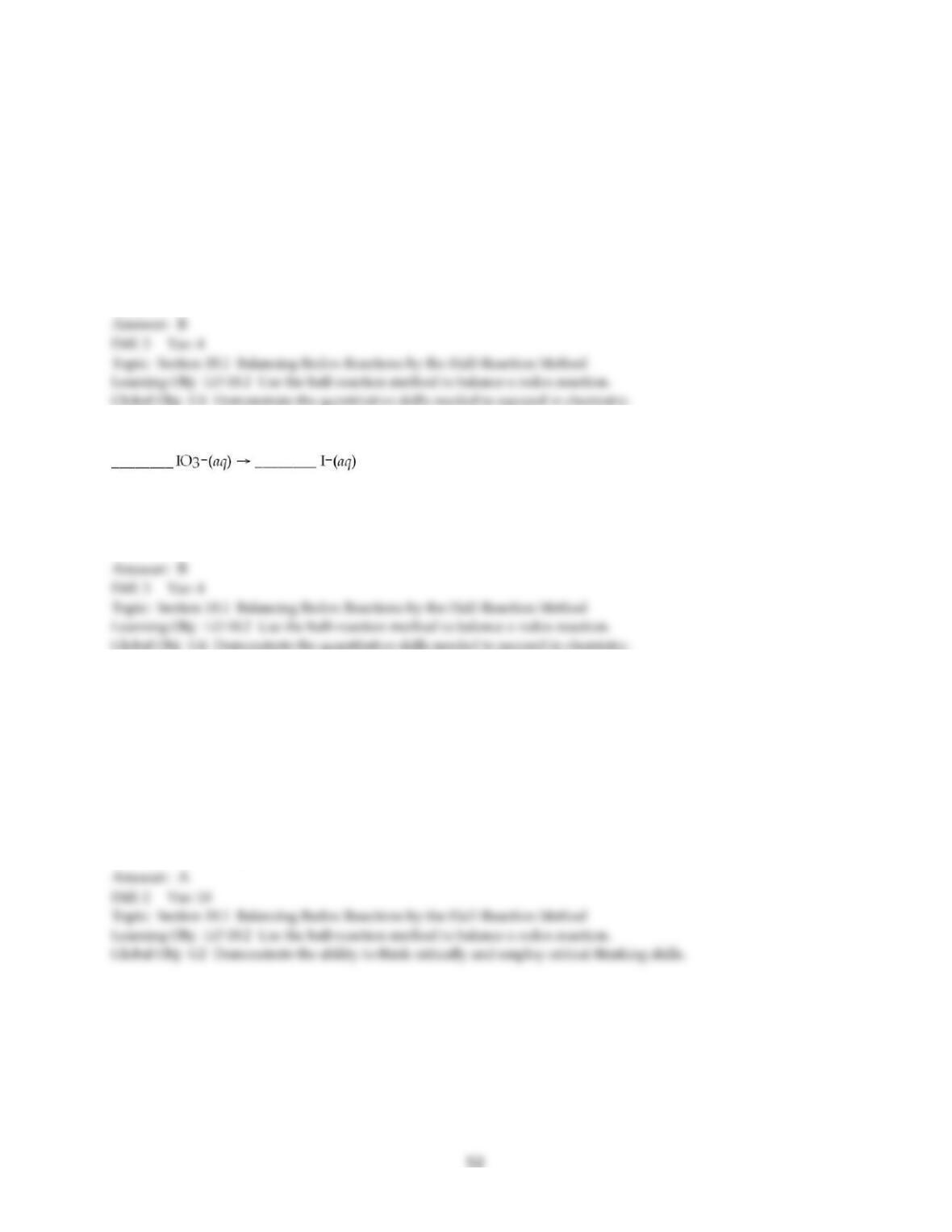
10) What are the coefficients in front of IO3–(aq) and I–(aq) when the following equation is balanced in an
acidic solution?
________ IO3–(aq) + ________ I–(aq) → ________ I2(aq)
A) 1, 3
B) 1, 5
C) 2, 3
D) 2, 5
11) Determine the number of water molecules necessary to balance the reduction half reaction of
that occurs in an acidic solution.
A) 1
B) 3
C) 5
D) 7
12) What is the oxidation half reaction in the following chemical reaction?
Mn(s) + 2 H+(aq) → Mn2+(aq) + H2(g)
A) Mn(s) → Mn2+(aq) + 2e–
B) Mn2+(aq) + 2e– → Mn(s)
C) 2 H+(aq) + 2e– → H2(g)
D) H2(g) → 2 H+(aq) + 2e–
13) What is the reduction half reaction for the following chemical reaction in a basic solution?
Ge2+(aq) + 2 ClO3–(aq) + OH–(aq) → GeO2(s) + 2 ClO2(aq) + H2O(l)
A) Ge2+(aq) + 4 OH–(aq) → GeO2(s) + 2 H2O(l) + 2e–
B) Ge2+(aq) + 2 H2O(l) → GeO2(s) + 4 H+(aq) + 2e–
C) ClO3–(aq) + H2O(l) + e– → ClO2(aq) + 2 OH–(aq)
D) ClO3–(aq) + 2 H+(aq) + e– → ClO2(aq) + H2O(l)
14) According to the balanced chemical equation
5 H2C2O4(aq) + 2 MnO4–(aq) + 6 H+(aq) → 10 CO2(g) + 2 Mn2+(aq) + 8 H2O(l)
0.875 grams of oxalic acid, H2C2O4 will react with ________ moles of permanganate, MnO4–.
A) 0.003885
B) 0.009717
C) 0.019435
D) 0.024295
15) For a galvanic cell that uses the following two half-reactions,
Cr2O72-(aq) + 14 H+(aq) + 6 e– → 2 Cr3+(aq) + 7 H2O(l)
Pb(s) → Pb2+(aq) + 2 e–
how many moles of Pb(s) are oxidized by one mole of Cr2O72-?
A) 1
B) 2
C) 3
D) 6

54
16) What is the reduction half-reaction for the following overall cell reaction?
Pb2+(aq) + 2 Ag(s) → Pb(s) + 2 Ag+(aq)
A) Ag(s) + e– → Ag+(aq)
B) Ag+(aq) + e– → Ag(s)
C) Pb2+(aq) + 2 e– → Pb(s)
D) Pb2+(aq) + e– → Pb(s)
17) A salt bridge is used to
A) provide reactants in a fuel cell.
B) determine the direction of the cell reaction.
C) control whether the cell is electrolytic.
D) allow the ion flow necessary for cell neutrality.
18) Given that Br2(g) + 2 e– → 2 Br–(aq) is the reduction half-reaction for the overall reaction
what is the oxidation half reaction?
A) Ag(s) → Ag+(aq) + e–
B) Ag(s) + Br–(aq) → AgBr(s) + e–
C) Ag(s) + Br2(g) + e– → AgBr(s) + Br–(aq)
D) 2 Br–(aq) → Br2(g) + 2 e–
19) A galvanic cell employs the reaction
Ni2+(aq) + Cu(s) → Ni(s) + Cu2+(aq)
and KNO3 is the salt used in the salt bridge. During the course of the reaction
A) K+ leaves the salt bridge and enters the anode compartment.
B) KNO3 leaves the salt bridge and enters the anode compartment.
C) K+ leaves the salt bridge and enters the cathode compartment.
D) KNO3 leaves the salt bridge and enters the cathode compartment.
20) What is the shorthand notation that represents the following galvanic cell reaction?
Fe(s) + Cu(NO3)2(aq) → Fe(NO3)2(aq) + Cu(s)
A) Fe(s) ∣ Fe2+(aq) ∣∣ Cu2+(aq) ∣ Cu(s)
B) Cu(s) ∣ Cu2+(aq) ∣∣ Fe2+(aq) ∣ Fe(s)
C) Fe(s) ∣ NO3–(aq) ∣∣ NO3–(aq) ∣ Cu(s)
D) Cu(s) ∣ Cu(NO3)2(aq) ∣∣ Fe(NO3)2(aq) ∣ Fe(s)
21) What is the shorthand notation that represents the following galvanic cell reaction?
2 Fe2+(aq) + Cl2(g) → 2 Fe3+(aq) + 2 Cl–(aq)
A) Fe2+(aq) ∣ Fe3+(aq) ∣∣ Cl2(g) ∣ Cl–(aq)
B) Fe(s) ∣ Fe2+(aq) ∣∣ Fe3+(aq) Cl2(g) ∣ Cl–(aq) ∣ C(s)
C) Pt(s) ∣ Fe3+(aq), Fe2+(aq), Cl2(g) ∣∣ Cl–(aq) ∣ C(s)
D) Pt(s) ∣ Fe2+(aq), Fe3+(aq) ∣∣ Cl2(g) ∣ Cl–(aq) ∣ C(s)
22) For the galvanic cell reaction, expressed below using shorthand notation, what half-reaction occurs at
the cathode?
Zn(s) ∣ Zn2+(aq) ∣∣ Pb2+(aq) ∣ Pb(s)
A) Zn(s) → Zn2+(aq) + 2 e–
B) Zn2+(aq) + 2 e– → Zn(s)
C) Pb(s) → Pb2+(aq) + 2 e–
D) Pb2+(aq) + 2 e– → Pb(s)
23) What is the balanced chemical equation for the galvanic cell reaction expressed using shorthand
notation below?
Al(s) ∣ Al3+(aq) ∣∣ Cd2+(aq) ∣ Cd(s)
A) 2 Al(s) + 3 Cd2+(aq) → 2 Al3+(aq) + 3 Cd(s)
B) 3 Al(s) + 2 Cd2+(aq) → 3 Al3+(aq) + 2 Cd(s)
C) 2 Cd(s) + 3 Al3+(aq) → 2 Cd2+(aq) + 3 Al(s)
D) 3 Cd(s) + 2 Al3+(aq) → 3 Cd2+(aq) + 2 Al(s)
24) What is the balanced equation for the galvanic cell reaction expressed using shorthand notation
below?
Cu(s) ∣ Cu2+(aq) ∣∣ Cl2(g) ∣ Cl–(aq) ∣ C(s)
A) Cu(s) + 2 Cl–(aq) → Cu2+(aq) + Cl2(g)
B) Cu(s) + Cl2(g) → Cu2+(aq) + 2 Cl–(aq)
C) Cu2+(aq) + 2 Cl–(aq) → Cu(s) + Cl2(g)
D) Cu2+(aq) + 2 Cl–(aq) → CuCl2(s)
25) What is the balanced equation for the galvanic cell reaction expressed using shorthand notation
below?
Pt(s)|Sn2+(aq)|Sn4+(aq)∣∣Cl2(l)|Cl–(aq)|Pt(s)
A) Sn2+(aq) + Cl2(l) → Sn4+(aq) + 2 Cl–(aq)
B) Sn2+(aq) + 2 Cl–(aq) → Sn4+(aq) + Cl2(l)
C) Sn4+(aq) + Cl2(l) → Sn2+(aq) + 2 Cl–(aq)
D) Sn4+(aq) + 2 Cl–(aq) → Sn2+(aq) + Cl2(l)
26) In the shorthand notation for a galvanic cell, a double vertical line (∣∣) represents
A) a single phase boundary
B) a cathode
C) a gas
D) a salt bridge
27) For the galvanic cell reaction, expressed below using shorthand notation, what half-reaction occurs at
the anode?
Fe(s) ∣ Fe2+(aq) ∣∣ Cd2+(aq) ∣Cd(s)
A) Fe(s) → Fe2+(aq) + 2 e–
B) Fe2+(aq) + 2 e– → Fe(s)
C) Cd(s) → Cd2+(aq) + 2 e–
D) Cd2+(aq) + 2 e– → Cd(s)
28) For the galvanic cell Pt(s) ∣ Sn2+(aq), Sn4+(aq) ∣∣ Cd2+(aq) ∣ Cd(s), what is the function of the Pt(s)?
A) Pt is the anode and is a reactant in the overall cell reaction.
B) Pt is the anode and does not appear in the overall cell reaction.
C) Pt is the cathode and is a product in the overall cell reaction.
D) Pt is the cathode and does not appear in the overall cell reaction.
29) In the relationship ΔG = –nFE°, what is the value of n for the reaction shown below?
3 Fe2+(aq) + 2 Al(s) → 3 Fe(s) + 2 Al3+(aq)
A) 1
B) 2
C) 3
D) 6
30) What is the relation between ΔG° and E° for the cell reaction below?
Ni2+(aq) + Fe(s) → Fe2+(aq) + Ni(s)
A) ΔG° = F E°
B) ΔG° = 2 F E°
C) ΔG° = –F E°
D) ΔG° = –2 F E°