Revenue Recognition
18 – 37
Solution 18-123 (cont.)
EXERCISES
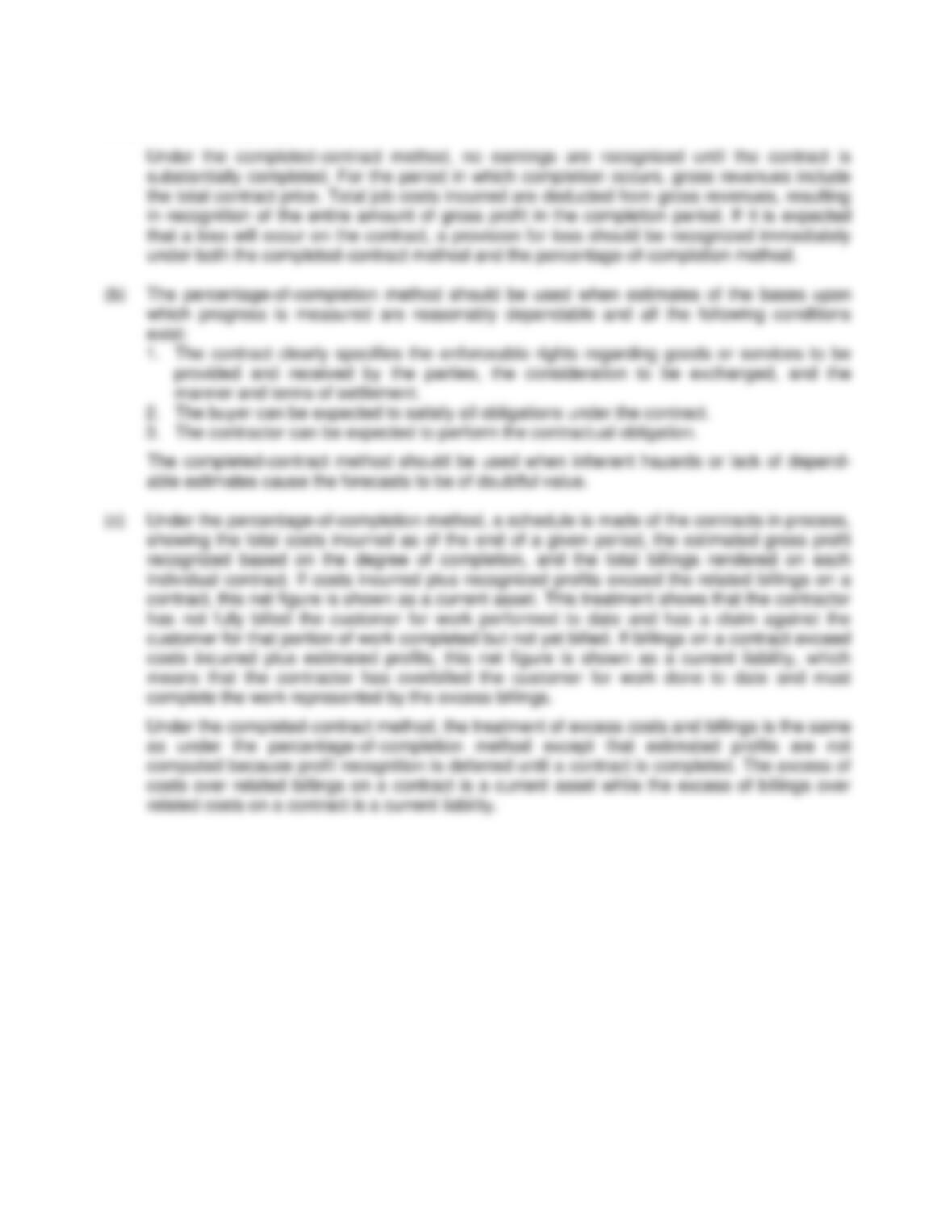
Ex. 18-124—Journal entries—percentage-of-completion.
Dixon Construction Company was awarded a contract to construct an interchange at the junction
of U.S. 94 and Highway 30 at a total contract price of $12,000,000. The estimated total costs to
complete the project were $9,000,000.
Instructions
(a) Make the entry to record construction costs of $5,400,000, on construction in process to date.
(b) Make the entry to record progress billings of $3,000,000.
(c) Make the entry to recognize the profit that can be recognized to date, on a percentage-of–
completion basis.
Test Bank for Intermediate Accounting, Fifteenth Edition
18 – 38
Solution 18-124
Ex. 18-125—Percentage-of-completion method.
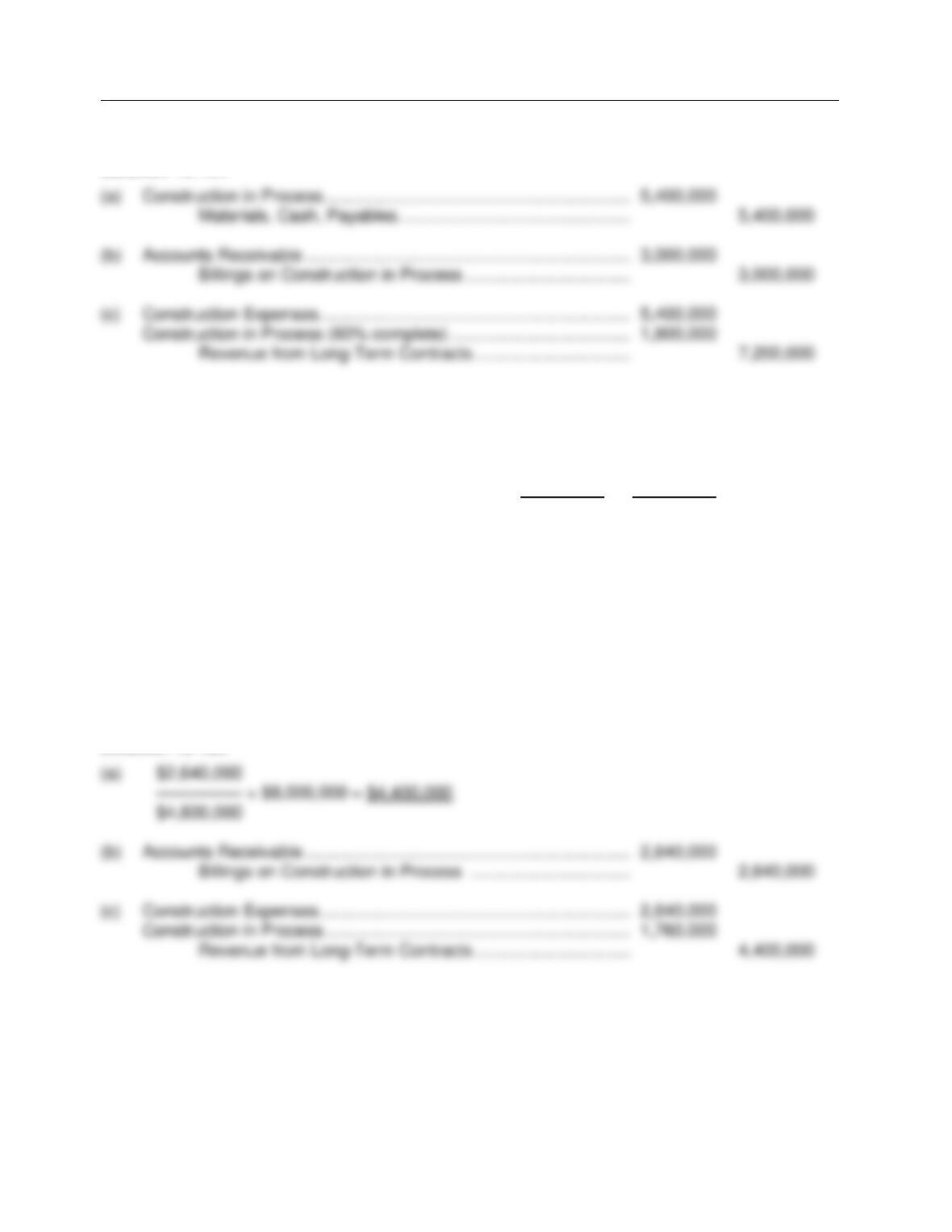
Dalton Construction Co. contracted to build a bridge for $8,000,000. Construction began in 2014
and was completed in 2015. Data relating to the construction are:
2014 2015
Costs incurred $2,640,000 $2,200,000
Estimated costs to complete 2,160,000 —
Dalton uses the percentage-of-completion method.
Instructions
(a) How much revenue should be reported for 2014? Show your computation.
(b) Make the entry to record progress billings of $3,300,000 during 2014.
(c) Make the entry to record the revenue and gross profit for 2014.
(d) How much gross profit should be reported for 2015? Show your computation.
Solution 18-125
Revenue Recognition
18 – 39
Solution 18-125 (cont.)
Ex. 18-126—Percentage-of-completion method.
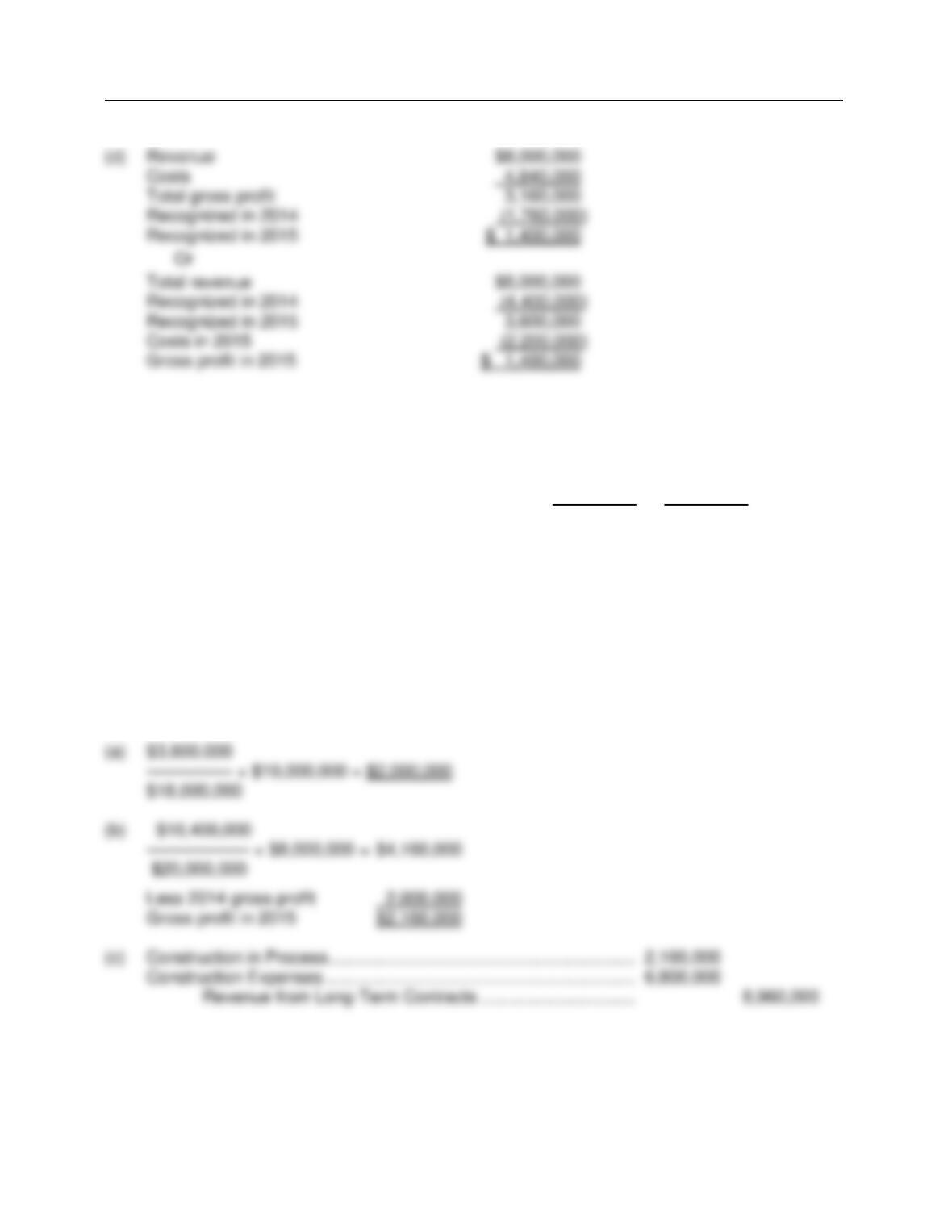
Penner Builders contracted to build a high-rise for $28,000,000. Construction began in 2014 and is
expected to be completed in 2017. Data for 2014 and 2015 are:
2014 2015
Costs incurred to date $3,600,000 $10,400,000
Estimated costs to complete 14,400,000 9,600,000
Penner uses the percentage-of-completion method.
Instructions
(a) How much gross profit should be reported for 2014? Show your computation.
(b) How much gross profit should be reported for 2015?
(c) Make the journal entry to record the revenue and gross profit for 2015.
Solution 18-126
Test Bank for Intermediate Accounting, Fifteenth Edition
18 – 40
Ex. 18-127—Percentage-of-completion and completed-contract methods.
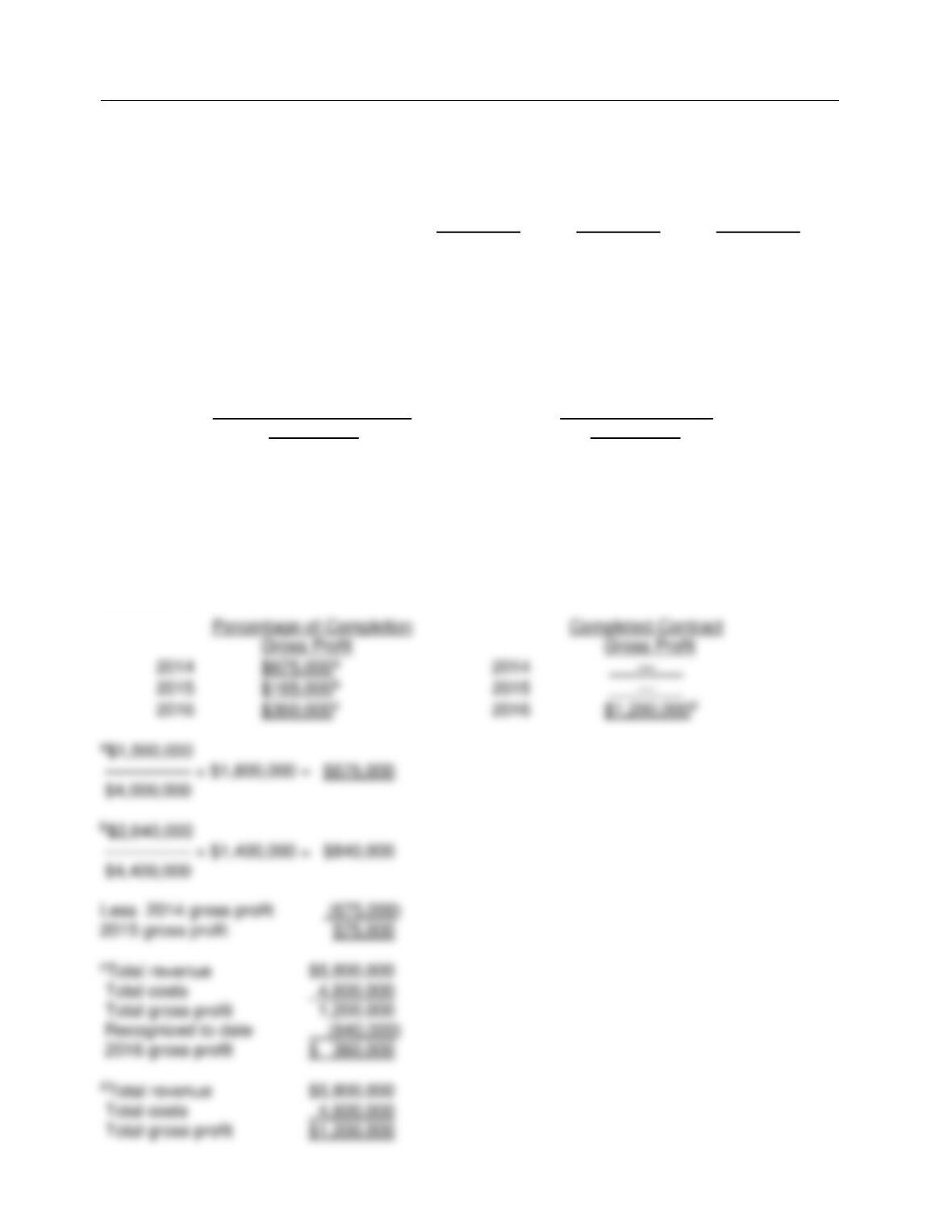
On February 1, 2014, Marsh Contractors agreed to construct a building at a contract price of
$5,800,000. Marsh estimated total construction costs would be $4,000,000 and the project would
be finished in 2016. Information relating to the costs and billings for this contract is as follows:
2014 2015 2016
Total costs incurred to date $1,500,000 $2,640,000 $4,600,000
Estimated costs to complete 2,500,000 1,760,000 -0-
Customer billings to date 2,200,000 4,000,000 5,600,000
Collections to date 2,000,000 3,500,000 5,500,000
Instructions
Fill in the correct amounts on the following schedule. For percentage-of-completion accounting
and for completed-contract accounting, show the gross profit that should be recorded for 2014,
2015, and 2016.
Percentage-of-Completion Completed-Contract
Gross Profit Gross Profit
2014 __________ 2014 __________
2015 __________ 2015 __________
2016 __________ 2016 __________
Solution 18-127
Revenue Recognition
18 – 41
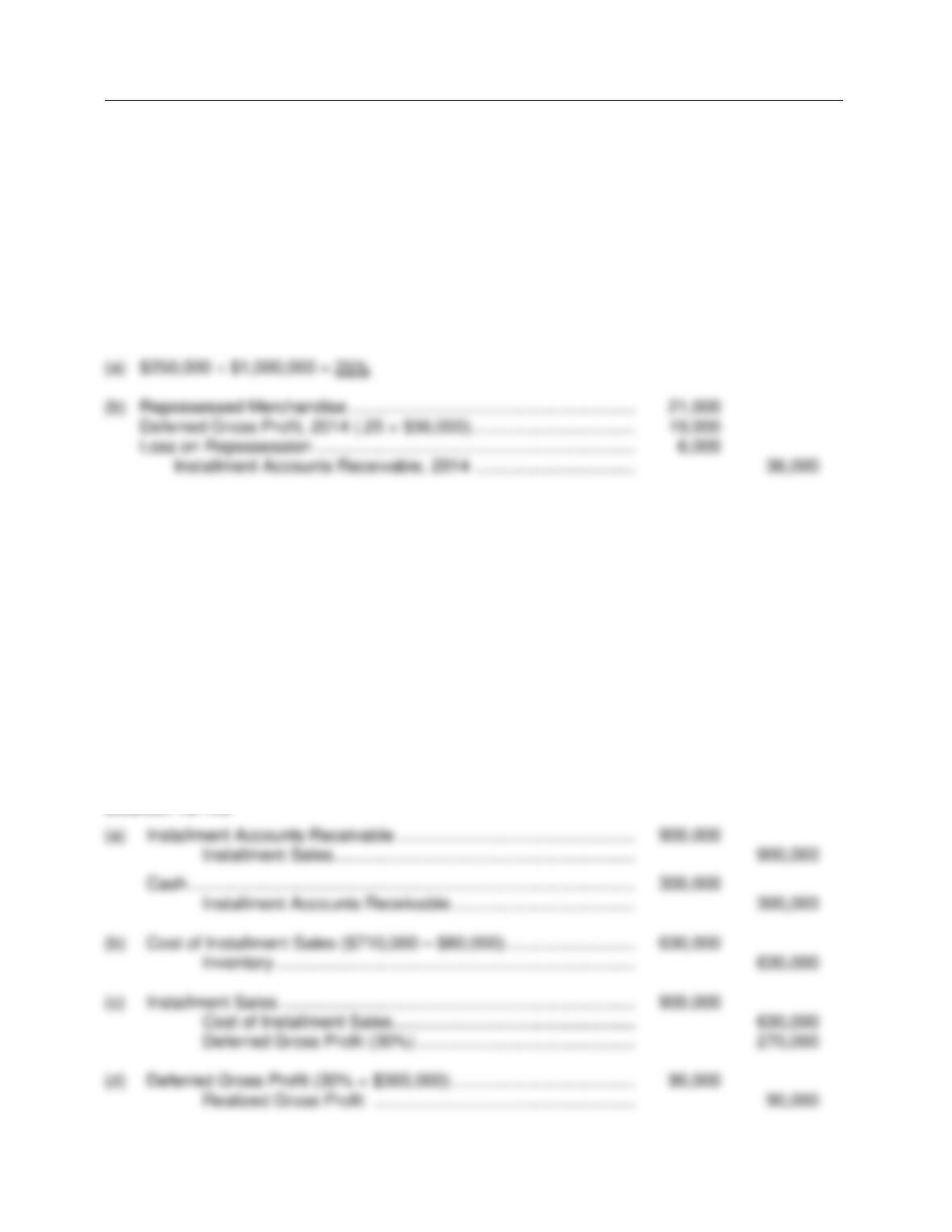
Ex. 18-128—Installment sales.
Newton Co. had installment sales of $1,000,000 and cost of installment sales of $750,000 in 2014.
A 2014 sale resulted in a default in 2016, at which time the balance of the installment receivable
was $36,000. The repossessed merchandise had a fair value of $21,000.
Instructions
(a) Calculate the rate of gross profit on 2014 installment sales.
(b) Make the entry to record the repossession.
Solution 18-128
Ex. 18-129—Installment sales.
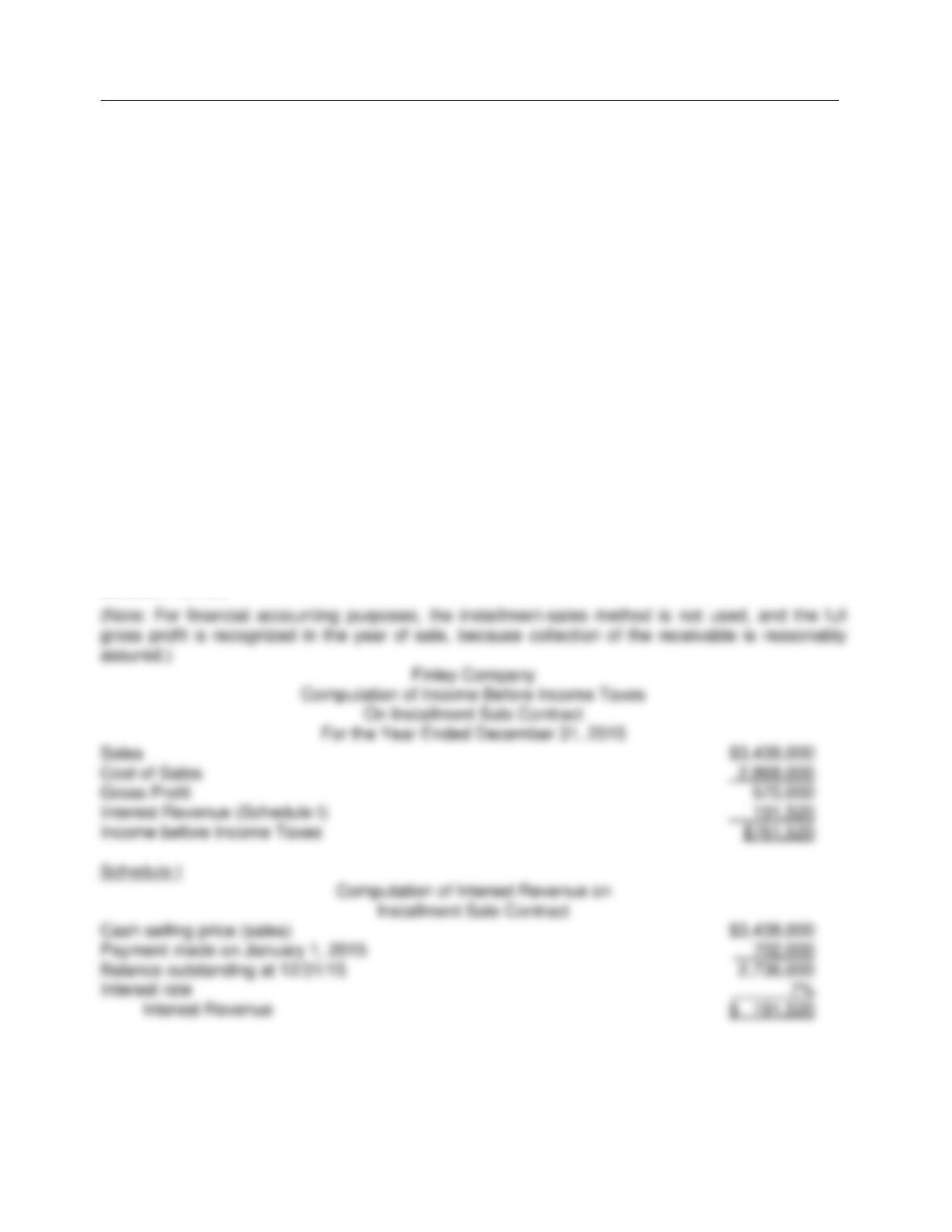
Sawyer Furniture Company concluded its first year of operations in which it made sales of
$900,000, all on installment. Collections during the year from down payments and installments
totaled $300,000. Purchases for the year totaled $710,000; the cost of merchandise on hand at
the end of the year was $80,000.
Instructions
Using the installment-sales method, make summary entries to record:
(a) the installment sales and cash collections;
(b) the cost of installment sales;
(c) the unrealized gross profit;
(d) the realized gross profit.
Solution 18-129
Test Bank for Intermediate Accounting, Fifteenth Edition
18 – 42
Ex. 18-130—Installment sales.
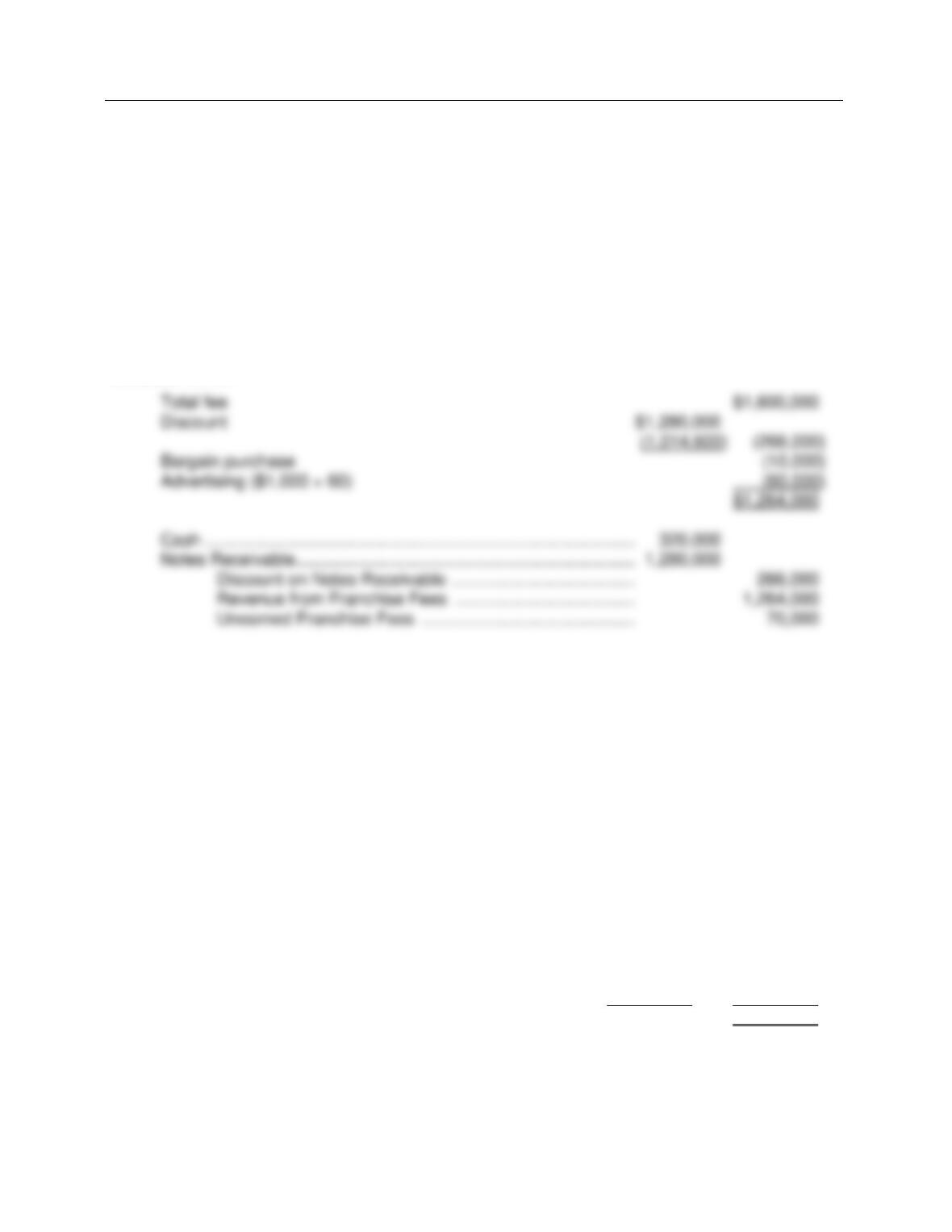
Finley Company sells office equipment. On January 1, 2015, Finley entered into an installment
sale contract with Miller Company for a six-year period expiring January 1, 2021. Equal annual
payments under the installment sale are $702,000 and are due on January 1. The first payment
was made on January 1, 2015.
Additional information is as follows:
The cash selling price of the equipment, i.e., the amount that would be realized on an
outright sale, is $3,438,000.
The cost of sales relating to the equipment is $2,868,000.
The finance charges relating to the installment period are $774,000 based on a stated
interest rate of 7% which is appropriate. For tax purposes, Finley appropriately uses the
accrual basis for recording finance charges.
Circumstances are such that the collection of the installment sale is reasonably assured.
The installment sale qualified for the installment method of reporting for tax purposes.
Assume that the income tax rate is 30%.
Instructions
What income (loss) before income taxes should Finley appropriately record as a result of this
transaction for the year ended December 31, 2015? Show supporting computations in good form.
Solution 18-130
Revenue Recognition
18 – 43
*Ex. 18-131—Franchises.
Pasta Inn charges an initial fee of $1,600,000 for a franchise, with $320,000 paid when the
agreement is signed and the balance in four annual payments. The present value of the annual
payments, discounted at 10%, is $1,014,000. The franchisee has the right to purchase $60,000 of
kitchen equipment and supplies for $50,000. An additional part of the initial fee is for advertising to
be provided by Pasta Inn during the next five years. The value of the advertising is $1,000 a
month. Collectibility of the payments is reasonably assured and Pasta Inn has performed all the
initial services required by the contract.
Instructions
Prepare the entry to record the initial franchise fee. Show supporting computations in good form.
*Solution 18-131
PROBLEMS
Pr. 18-132—Long-term construction project accounting.
Dobson Construction specializes in the construction of commercial and industrial buildings. The
contractor is experienced in bidding long-term construction projects of this type, with the typical
project lasting fifteen to twenty-four months. The contractor uses the percentage-of-completion
method of revenue recognition since, given the characteristics of the contractor’s business and
contracts, it is the most appropriate method. Progress toward completion is measured on a cost-
to-cost basis. Dobson began work on a lump-sum contract at the beginning of 2015. As bid, the
statistics were as follows:
Lump-sum price (contract price) $4,000,000
Estimated costs
Labor $ 850,000
Materials and subcontractor 1,750,000
Indirect costs 400,000 3,000,000
$1,000,000
Test Bank for Intermediate Accounting, Fifteenth Edition
18 – 44
Pr. 18-132 (cont.)
At the end of the first year, the following was the status of the contract:
Billings to date $2,250,000
Costs incurred to date
Labor $ 464,000
Materials and subcontractor 648,000
Indirect costs 193,000 1,305,000
Latest forecast total cost 3,000,000
It should be noted that included in the above costs incurred to date were standard electrical and
mechanical materials stored on the job site, but not yet installed, costing $105,000. These costs
should not be considered in the costs incurred to date.
Instructions
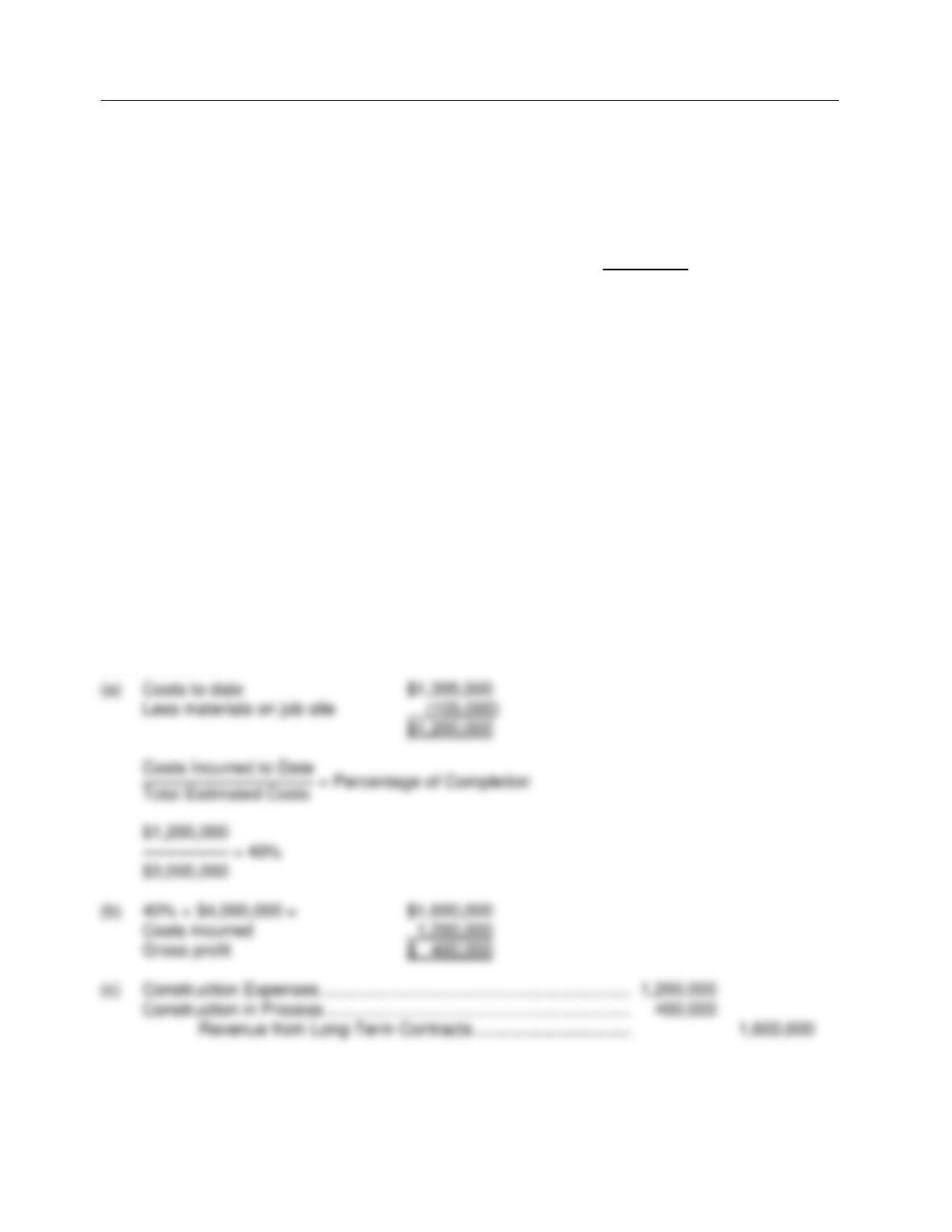
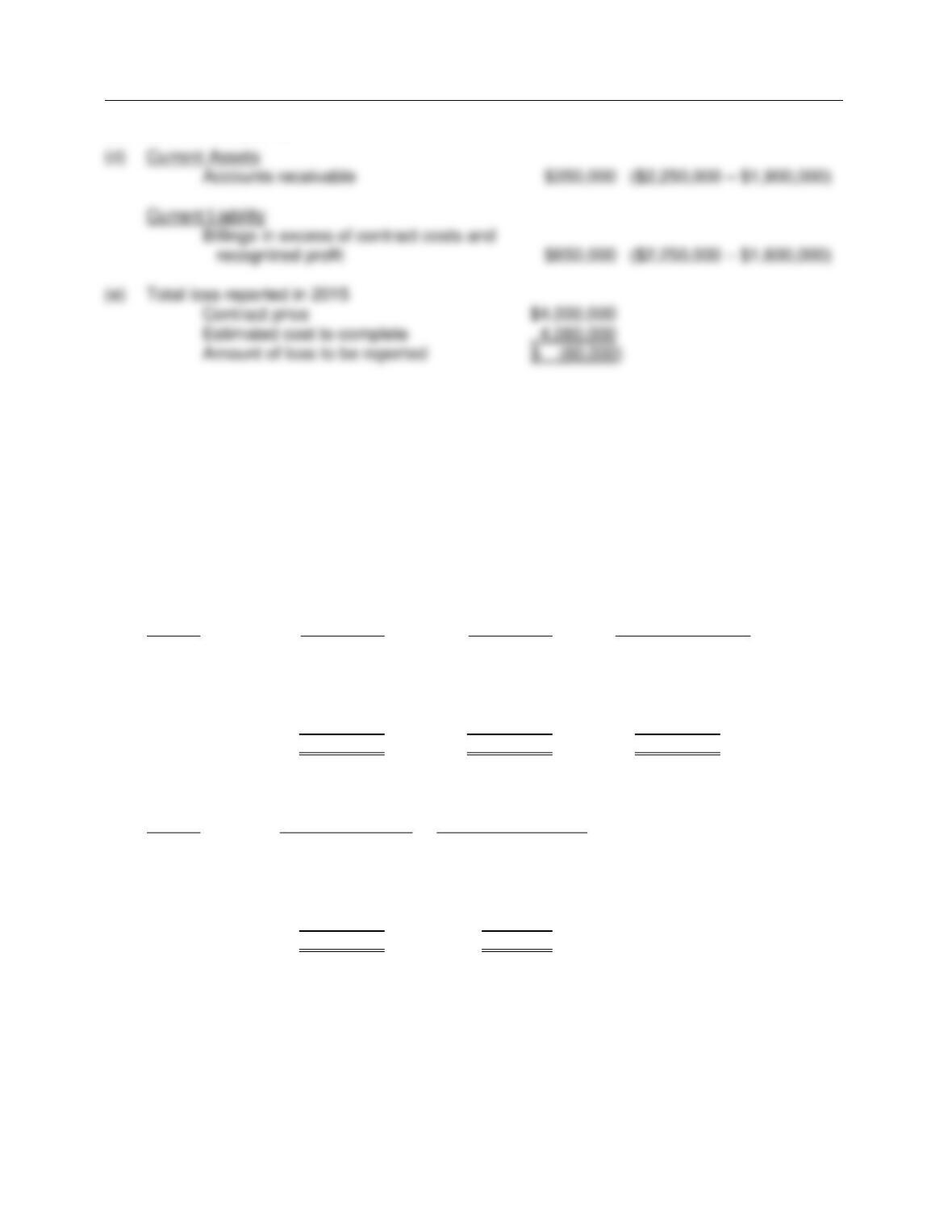
(a) Compute the percentage of completion on the contract at the end of 2015.
(b) Indicate the amount of gross profit that would be reported on this contract at the end of 2015.
(c) Make the journal entry to record the income (loss) for 2015 on Dobson‘s books.
(d) Indicate the account(s) and the amount(s) that would be shown on the balance sheet of
Dobson Construction at the end of 2015 related to its construction accounts. Also indicate
where these items would be classified on the balance sheet. Billings collected during the year
amounted to $1,900,000.
(e) Assume the latest forecast on total costs at the end of 2015 was $4,060,000. How much
income (loss) would Dobson report for the year 2015?
Solution 18-132
Revenue Recognition
18 – 45
Solution 18-132 (cont.)
Pr. 18-133—Accounting for long-term construction contracts.
The board of directors of Ogle Construction Company is meeting to choose between the
completed-contract method and the percentage-of-completion method of accounting for long-term
contracts in the company’s financial statements. You have been engaged to assist Ogle’s
controller in the preparation of a presentation to be given at the board meeting. The controller
provides you with the following information:
1. Ogle commenced doing business on January 1, 2015.
2. Construction activities for the year ended December 31, 2015, were as follows:
Total Contract Billings Through Cash Collections
Project Price 12/31/15 Through 12/31/15
A $ 500,000 $ 340,000 $ 310,000
B 720,000 210,000 210,000
C 475,000 475,000 390,000
D 200,000 100,000 65,000
E 450,000 400,000 400,000
$2,345,000 $1,525,000 $1,375,000
Contract Costs Estimated
Incurred Through Additional Costs to
Project 12/31/15 Complete Contracts
A $ 424,000 $101,000
B 195,000 455,000
C 350,000 -0-
D 123,000 97,000
E 320,000 80,000
$1,412,000 $733,000
3. Each contract is with a different customer.
4. Any work remaining to be done on the contracts is expected to be completed in 2016.
Test Bank for Intermediate Accounting, Fifteenth Edition
18 – 46
Instructions
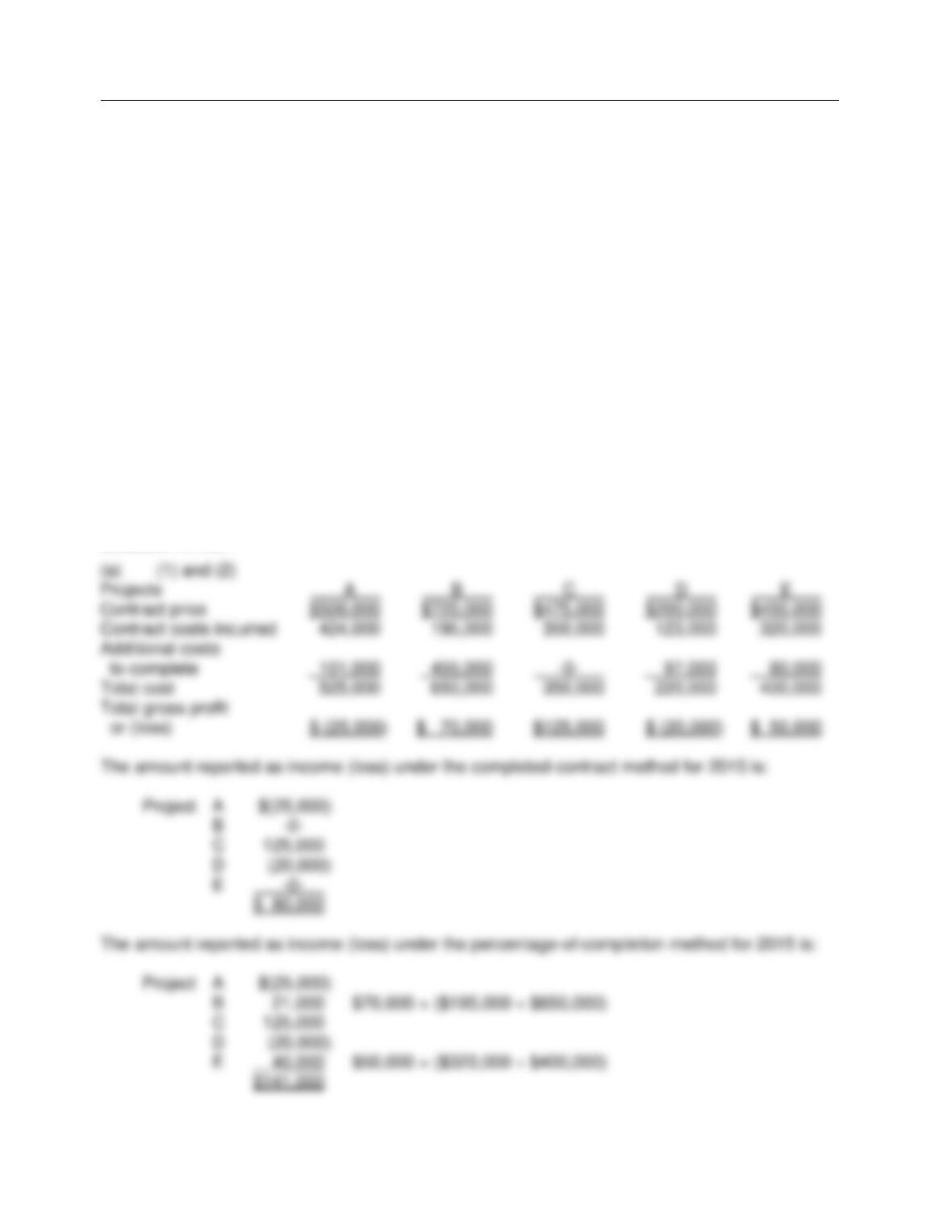
(a) Prepare a schedule by project, computing the amount of income (or loss) before selling,
general, and administrative expenses for the year ended December 31, 2015, which would
be reported under:
(1) The completed-contract method.
(2) The percentage-of-completion method (based on estimated costs).
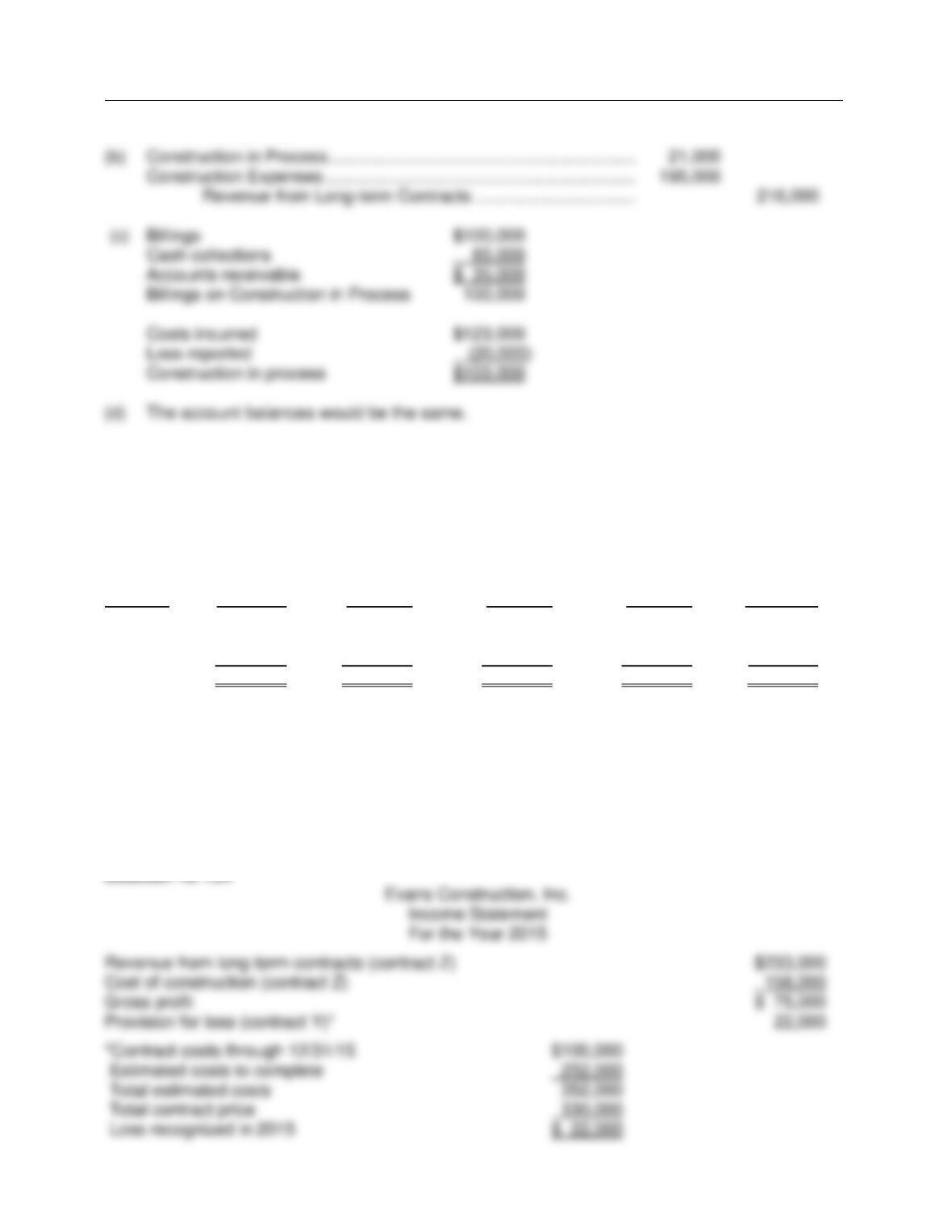
(b) Prepare the general journal entry(ies) to record revenue and gross profit on project B (second
project) for 2015, assuming that the percentage-of-completion method is used.
(c) Indicate the balances that would appear in the balance sheet at December 31, 2015 for the
following accounts for Project D (fourth project), assuming that the percentage-of-completion
method is used.
Accounts Receivable
Billings on Construction in Process
Construction in Process
(d) How would the balances in the accounts discussed in part (c) change (if at all) for Project D
(fourth project), if the completed-contract method is used?
Solution 18-133
Revenue Recognition
18 – 47
Solution 18-133 (cont.)
Pr. 18-134—Long-term contract accounting (completed-contract).
Evans Construction, Inc. experienced the following construction activity in 2015, the first year of
operations.
Cash Cost Estimated
Total Billings Collections Incurred Additional
Contract through through through Costs to
Contract Price 12/31/15 12/31/15 12/31/15 Complete
X $260,000 $170,000 $155,000 $182,000 $ 63,000
Y 330,000 115,000 115,000 100,000 252,000
Z 233,000 233,000 198,000 158,000 -0-
$823,000 $518,000 $468,000 $440,000 $315,000
Each of the above contracts is with a different customer, and any work remaining at December 31,
2015 is expected to be completed in 2016.
Instructions
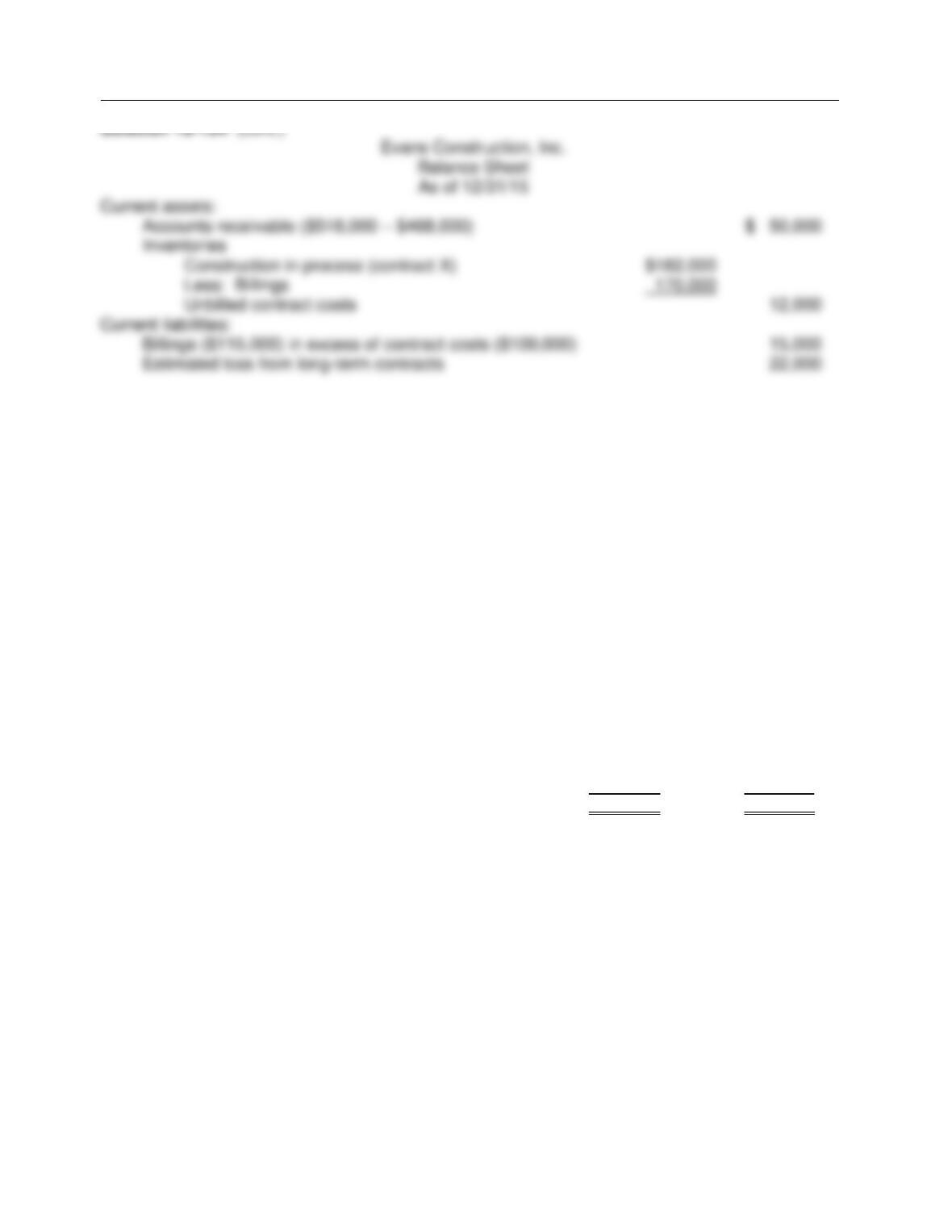
Prepare a partial income statement and a partial balance sheet to indicate how the above contract
information would be reported. Evans uses the completed-contract method.
Test Bank for Intermediate Accounting, Fifteenth Edition
18 – 48
Pr. 18-135—Installment sales.
Houser Appliances accounts for all sales of its merchandise on the installment basis. Following is
the unadjusted trial balance at 12/31/16.
Cash $38,000
Installment accounts receivable—2014 20,000
Installment accounts receivable—2015 50,000
Installment accounts receivable—2016 90,000
Inventory 27,800
Repossessed merchandise 4,600
Accounts payable $ 37,400
Deferred gross profit—2014 15,000
Deferred gross profit—2015 26,600
Common stock 117,000
Retained earnings 10,000
Installment sales 125,000
Cost of installment sales 85,000
Loss on repossessions 2,600
Operating expenses 13,000
$331,000 $331,000
Additional information:
2014 gross profit rate: 30%
Total cash receipts during 2016: $110,000
Merchandise sold in 2015 was repossessed in 2016 and the following entry was prepared:
Deferred Gross Profit—2015…………………………………………….. 2,800
Repossessed Merchandise ………………………………………………. 4,600
Loss on Repossessions …………………………………………………… 2,600
Installment Accounts Receivable—2015 ………………….. 10,000
Revenue Recognition
18 – 49
Pr. 18-135 (cont.)
Instructions
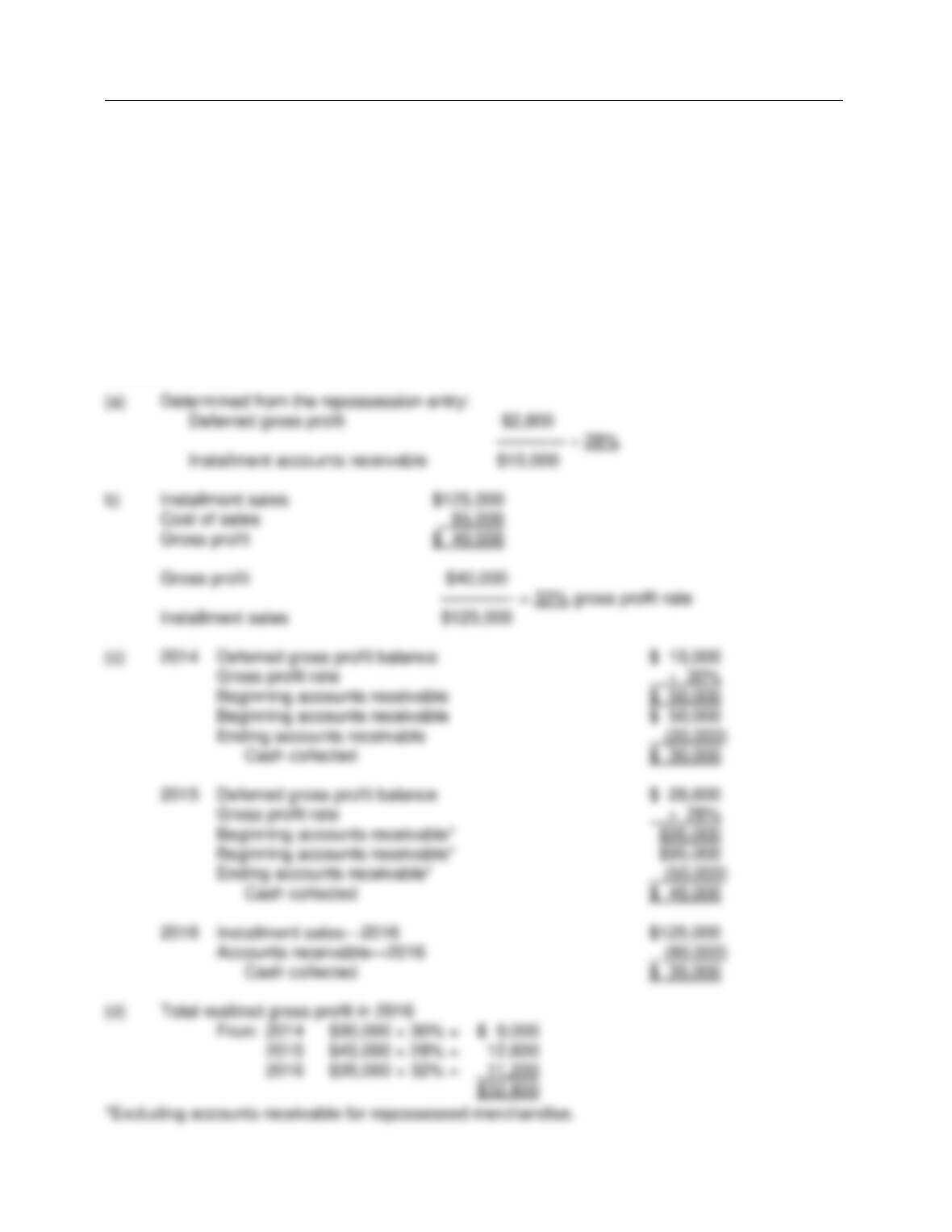
(a) What is the gross profit rate for 2015? Show supporting computations.
(b) What is the gross profit rate for 2016? Show supporting computations.
(c) Of the total cash receipts in 2016, how much represents collections from installment sales of:
(Show supporting computations.)
(1) 2014?
(2) 2015?
(3) 2016?
(d) What is the total realized gross profit in 2016? Show supporting computations.
Solution 18-135

Test Bank for Intermediate Accounting, Fifteenth Edition
18 – 50
IFRS QUESTIONS
True/False
1. The International Accounting Standards Board (IASB) defines revenue to include both
revenues and gains.
2. IFRS bases revenue recognition on the concepts of “earned” and “realized or realizable.”
3. IFRS prohibits use of the percentage-of-completion method of accounting for long-term
construction contracts.
4. IFRS requires immediate recognition of a loss if the overall contract is going to be unprofitable.
5. Terry Company is unable to reliably estimate revenues and costs associated with its only long-
term construction contract. Under IFRS, Terry Company must use the completed-contract
method to account for this contract.
Answers to True/False:
Multiple Choice
6. The joint project of the Financial Accounting Standards Board (FASB) and the International
Accounting Standards Board (IASB) related to revenue recognition includes
I. Evaluating a “customer–consideration” model
II. Eliminating inconsistencies in the existing conceptual guidance
III. Establishing a single, comprehensive standard
a. II and III only.
b. I and II only.
c. I, II, and III.
d. Neither I, II, nor III are currently included in the joint project of the FASB and IASB.
7. Belgium Co. is constructing a tunnel for $600 million. Construction began in 2013 and is
estimated to be completed in 2018. At December 31, 2015, Belgium has incurred costs totaling
$267 million with $64 million of that incurred in 2015, $107 million in 2014, and the remainder
during 2013. Belgium believes that it completed 30% of the tunnel during 2015, although that
may change based on future activity. Belgium Co. uses IFRS for its accounting and regards its
cost numbers as very uncertain. What amount of revenue should Belgium Co. recognize for
the year ended December 31, 2016?
a. No revenue should be recognized until the contract is completed in 2018.
b. $267 million
c. $180 million
d. $64 million
Revenue Recognition
18 – 51
8. Portugal, Inc. has the following amounts related to its activities for the year ended December
31, 2015:
Sales to customers $6,250,000
Gain on sale of equipment $ 450,000
Gain on sale of investments $ 950,000
Loss on sale of land $ 300,000
Portugal, Inc. uses IFRS for its external financial reporting. How much revenue should
Portugal, Inc. report on its income statement for the year ended December 31, 2015?
a. $6,250,000
b. $7,200,000
c. $7,650,000
d. $7,350,000
9. Under IFRS, the standard for revenue recognition states that the
I. Revenue be realized or realizable.
II. Economic benefits associated with the transaction will flow to the company selling the
goods.
III. Costs must be capable of being reliably measured.
a. I, II, and III.
b. I and III only.
c. II only.
d. II and III only.
10. IFRS for revenue recognition
a. is enforced by an international enforcement body, the IASB, which is comparable to the
U.S. SEC.
b. bases revenue recognition on the concepts of “earned” and “realized or realizable.”
c. permits use of the completed-contract method when costs are difficult to estimate.
d. contains limited industry-specific guidance.
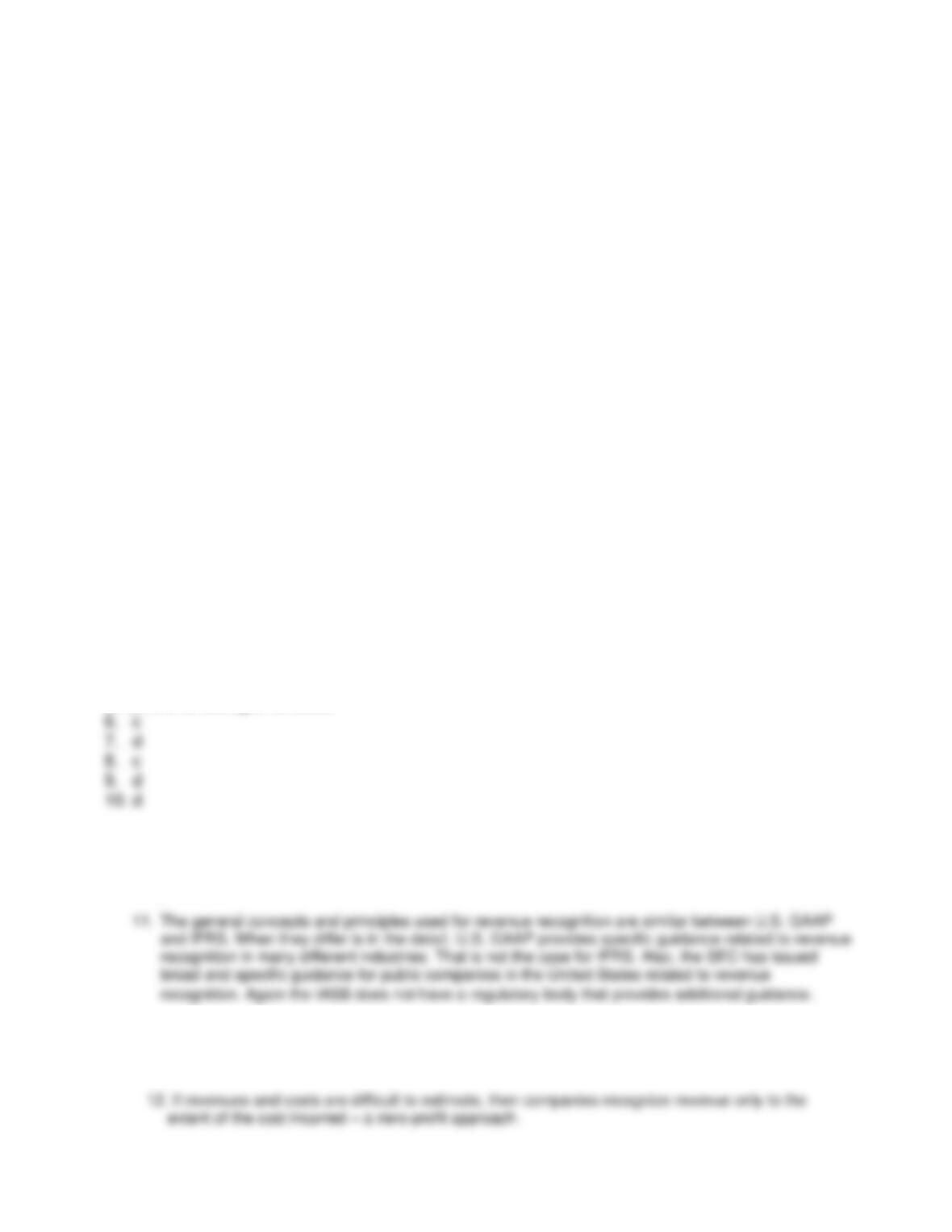
Answers to Multiple Choice:
Short Answer:
11. What is a major difference between IFRS and U.S. GAAP as regards revenue recognition
practices?
12. IFRS prohibits the use of the completed-contract method in accounting for long-term
contracts. If revenues and costs are difficult to estimate, how must companies account for
long-term contracts?