10) If you pay $2,000 in taxes on an income of $20,000, and a tax of $3,500 on an income of
$30,000, then over this range of income the tax is
A) regressive.
B) proportional.
C) progressive.
D) There is insufficient information to answer the question.
11) A tax bracket is
A) the percent of taxable income paid in taxes at a specific income bracket.
B) the income range within which a particular tax rate applies.
C) the type of tax structure for which a range of taxes applies.
D) the range, from the high to the low tax rate, of a particular type of tax.
12) A personal exemption refers to
A) the tax rate that applies to a particular tax bracket.
B) the tax bracket that represents basic living expenses.
C) an amount representing basic living expenses that can be subtracted from income.
D) a dispensation that allows certain qualifying individuals not to pay federal taxes.
13) Exemptions and deductions are used
A) to add to taxes that must be paid.
B) by taxpayers to reduce the amount of income subject to tax.
C) to determine the type of tax structure.
D) to determine what items are subject to sales taxes.
Table 18-3
Taxable Income
Tax Payments
$20,000
$2,000
25,000
2,250
32,000
2,560
42,000
2,940
Table 18-3 shows the amount of taxes paid on various levels of income.
14) Refer to Table 18-3. The tax system is
A) progressive throughout all levels of income.
B) proportional throughout all levels of income.
C) regressive throughout all levels of income.
D) regressive between $20,000 and $25,000 of income and progressive between $32,000 and
$42,000.
Table 18-4
Income Tax Bracket
Marginal Tax
Rate
$0 – 8,000
12%
8,001 – 22,000
17%
22,001 – 48,000
25%
48,001 and over
38%
Table 18-4 shows the income tax brackets and tax rates for single taxpayers in Calpernia.
15) Refer to Table 18-4. Calculate the income tax paid by Sasha, a single taxpayer with an
income of $60,000.
A) $22,800
B) $14,399
C) $13,800
D) $13,642
16) Refer to Table 18-4. Sasha is a single taxpayer with an income of $60,000. What is his
marginal tax rate and what is his average tax rate?
A) marginal tax rate = 38%; average tax rate = 23%
B) marginal tax rate = 17%; average tax rate = 21%
C) marginal tax rate = 38%; average tax rate = 24%
D) marginal tax rate = 23%; average tax rate = 38%
17) The largest percentage of federal income tax revenue in the United States is paid by the
A) lowest income taxpayers.
B) middle income taxpayers.
C) highest income taxpayers.
D) All groups of taxpayers low income, high income and middle income pay the same percent
of federal income taxes.
18) An average tax rate is calculated as
A) total taxable income × taxes paid.
B) total taxable income ÷ taxes paid.
C) taxes paid ÷ total taxable income.
D) (total taxable income – taxes paid) ÷ taxable income.
19) A marginal tax rate is calculated as
A) total taxable income ÷ by taxes paid.
B) taxes paid ÷ total taxable income.
C) change in taxes paid ÷ the change in total taxable income.
D) change in taxable income ÷ change in taxes paid.
20) A marginal tax rate is
A) the fraction of income that must be paid in taxes.
B) the fraction of each additional dollar of income that must be paid in taxes.
C) the incremental income one must earn to offset each additional dollar of tax.
D) the ratio of a change in income to a change in taxes paid.
21) If the marginal tax rate is less than the average tax rate as taxable income increases, the tax
structure is
A) regressive.
B) proportional.
C) progressive.
D) unfair.
22) If the marginal tax rate is equal to the average tax rate as taxable income increases, the tax
structure is
A) regressive.
B) proportional.
C) progressive.
D) unfair.
23) Policymakers focus on marginal tax rate changes when making changes in the tax code
because the marginal tax rate
A) determines how tax revenue will change as national income increases.
B) affects people’s willingness to work, save, and invest.
C) always equals the average tax rate which is harder to measure.
D) determines how much revenue the government will have to spend.
24) The federal corporate income tax is
A) regressive.
B) proportional.
C) progressive.
D) unfair.
25) All of the following occur whenever a government taxes a product except
A) the quantity consumed of that product falls.
B) the price of that product rises.
C) the marginal benefit of the last unit sold exceeds the marginal cost of producing it.
D) there will be no excess burden if the government’s tax revenue is sufficiently large to offset
the deadweight loss.
26) The “ability-to-pay” principle of taxation is the normative idea that
A) an equitable tax system is one in which high income individuals should bear a greater burden
of taxes than low income individuals.
B) each individual should voluntarily contribute according to her ability to pay taxes.
C) progressive taxes are more equitable than regressive taxes.
D) two individuals earning the same income should have equal ability to pay, all else constant.
27) The idea that two taxpayers in the same economic circumstances should pay the same level
of taxes is known as the
A) ability-to-pay principle.
B) vertical-equity principle.
C) horizontal-equity principle.
D) benefits-received principle.
28) Gasoline taxes that are typically used for highway construction and maintenance are
consistent with which of the following principles of taxation?
A) the ability-to-pay principle
B) the horizontal-equity principle
C) the vertical-equity principle
D) the benefits-received principle
29) The idea that individuals should be taxed in proportion to the marginal benefits that they
receive from public goods is called
A) the ability-to-pay principle.
B) the horizontal-equity principle.
C) the vertical-equity principle.
D) the benefits-received principle.
30) The government of Silverado raises revenue through a general income tax paid by all its
residents to operate the city’s marina. The marina is used by private boat owners. This method of
raising revenue to operate the marina is
A) consistent with the benefits-received principle.
B) consistent with the ability-to-pay principle.
C) inconsistent with the benefits-received principle.
D) inconsistent with the ability-to-pay principle.
31) The sales tax
A) is consistent with the benefits-received principle because low-income individuals spend less
on goods and services than do high-income people.
B) is not consistent with the ability-to-pay principle because low-income individuals tend to
spend a larger fraction of their income than do high-income individuals.
C) is not consistent with the ability-to-pay principle because low-income individuals tend to
purchase a smaller bundle of goods and services compared to high-income individuals.
D) is not consistent with the benefits-received principle because low-income individuals spend
less on goods and services than do high-income individuals, yet pay the same sales tax rate.
32) Consider a public good such as fire protection services. Rich people may benefit more than
the poor from such a service because rich people stand to lose more from a fire that destroys
property. In this case,
A) the ability-to-pay principle may support the rich paying more taxes than the poor, but not the
benefits-received principle.
B) the benefits-received principle may support the rich paying more taxes than the poor, but not
the ability-to-pay principle.
C) both the benefits-received and the ability-to-pay principles may support the rich paying more
taxes than the poor.
D) neither the benefits-received nor the ability-to-pay principles may support the rich paying
more taxes than the poor.
33) “Sin taxes”, such as taxes on alcoholic beverages, are intended to
A) increase the amount of the products supplied.
B) generate money to subsidize production of the products taxed.
C) reduce the quantity demanded.
D) generate funds to aid in the medical care of those harmed by the product.
34) Under a consumption tax, households
A) are exempt from taxes on interest earned on savings.
B) pay taxes only on the part of income they spend.
C) pay higher taxes on the part of income they spend and lower taxes on the part of income they
save.
D) pay taxes only on their purchases of luxury items.
35) Which of the following statements about a consumption tax is false?
A) Compared to an income tax, a consumption tax would necessarily produce lower revenues for
the government in a given year because the portion of income saved is not taxed.
B) A consumption tax encourages saving, which when invested could lead to increased economic
activity.
C) Under a consumption tax, current consumption is taxed at a lower rate than future
consumption
D) A consumption tax could favor high-income individuals who are likely to save more than
low-income individuals.
36) If the marginal tax rate is greater than the average tax rate, the tax structure is described as
regressive.
37) Horizontal equity means that two people in identical economic situations should pay the
same amount of taxes.
38) The government of Silverado raises revenue to operate the city’s hospital, open to all
residents, through a general income tax paid by its residents. This method of raising revenue is
consistent with the benefits-received principle.
39) Exempting food purchases from sales tax is consistent with the ability-to-pay principle,
although not necessarily consistent with vertical equity.
40) If you pay $3,000 in taxes on an income of $28,000, and $4,450 in taxes on an income of
$38,000, what is your marginal tax rate? Show your work.
41) If your income is $40,000 and you pay taxes of $4,650, what is your average tax rate? Show
your work.
Table 18-5
Income Tax Bracket
Tax Rate
on the first $6,000 of taxable income
10%
on the next $14,000 of taxable income
15%
on the next $24,500 of taxable income
25%
on the next $30,500 of taxable income
30%
Table 18-5 shows the income tax brackets and tax rates for single taxpayers in Bauxhall.
42) Refer to Table 18-5. A tax exemption is granted for the first $10,000 earned per year.
Suppose you earn $75,000.
a. What is the amount of taxes you will pay?
b. What is your average tax rate?
c. What is your marginal tax rate?
43) Suppose, on average, a family in Church Falls earning $60,000 per year paid 6 percent of its
income in state taxes. A family earning $80,000 paid, on average, $4,760 in state income taxes.
Are state taxes in Church Falls progressive or regressive? Be sure to explain the difference
between a progressive tax and a regressive tax.
44) What is the difference between a marginal tax rate and an average tax rate? Which is more
important in determining the impact of the tax system on economic behavior?
45) Describe each of the principles governments consider when deciding which taxes to use.
18.3 Tax Incidence Revisited: The Effect of Price Elasticity
1) The actual division of the burden of a tax is called
A) tax credit.
B) tax incidence.
C) excess burden.
D) tax dispersion.
2) Suppose the government imposes an 8 percent sales tax on clothing items and the tax is levied
on sellers. Who pays for the tax in this situation? (Assume that the demand curve is downward-
sloping and that the supply curve is upward-sloping.)
A) The tax is borne entirely by the sellers.
B) The sellers will pass on the entire sales tax to consumers and therefore the consumers bear the
tax.
C) The tax will be borne partly by consumers and partly by sellers.
D) It is not possible to answer the question without information on price elasticities.
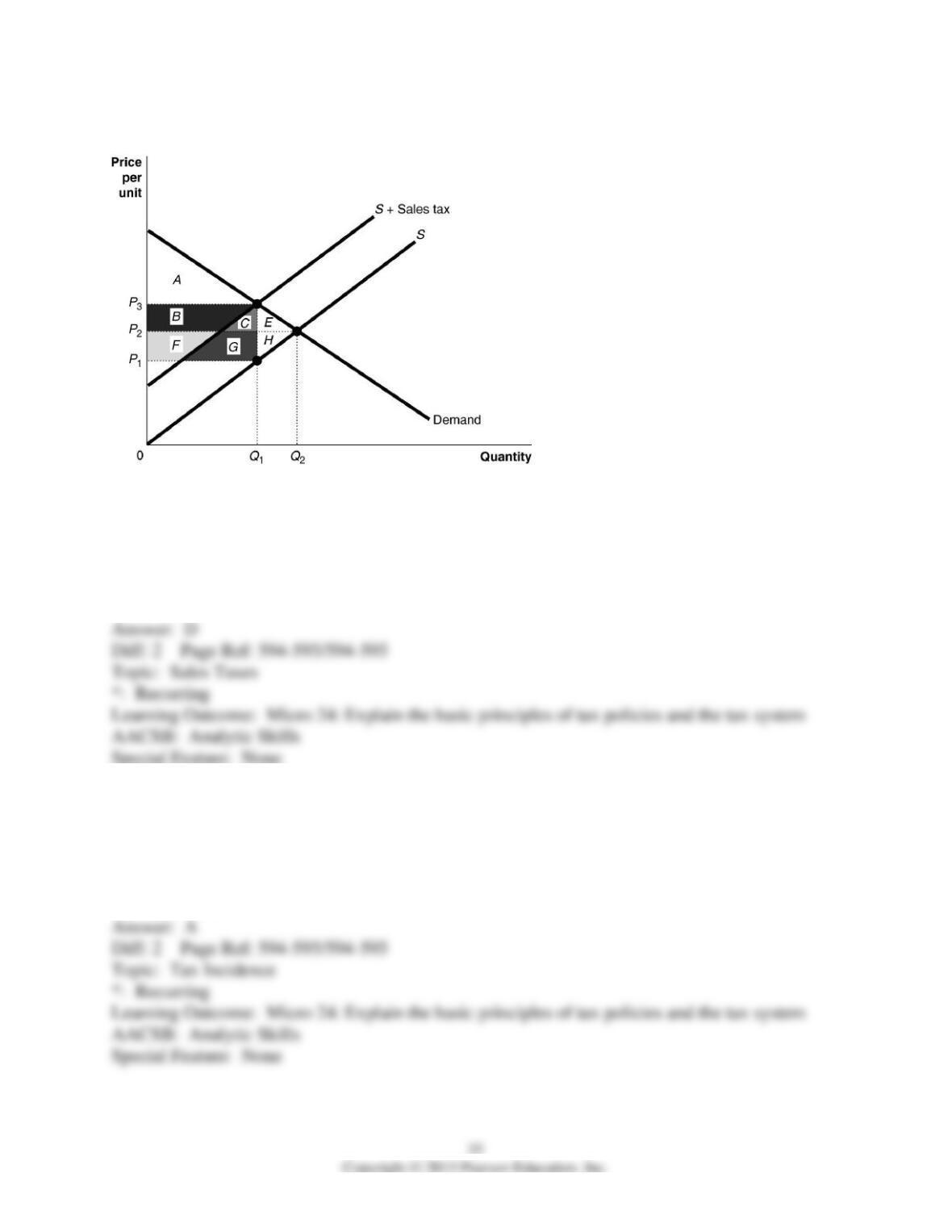
Figure 18-1
3) Refer to Figure 18-1. The sales tax revenue collected by the government is represented by the
area
A) B+C.
B) F+G.
C) E+H.
D) B+C+F+G.
4) Refer to Figure 18-1. Of the tax revenue collected by the government, the portion borne by
consumers is represented by the area
A) B+C.
B) F+G.
C) E+H.
D) B+C+F+G.
5) Refer to Figure 18-1. Of the tax revenue collected by the government, the portion borne by
producers is represented by the area
A) B+C.
B) F+G.
C) E+H.
D) B+C+F+G.
6) Refer to Figure 18-1. The excess burden of the tax is represented by the area
A) B+C.
B) F+G.
C) E+H.
D) B+C+F+G.
7) Economists argue that the corporate income tax is an example of a tax with a high deadweight
loss because
A) some of the burden of the tax is passed on to consumers in the form of higher prices.
B) it discourages corporations from undertaking capital investments to enhance market
competitiveness.
C) taxing a corporation’s income amounts to double taxing the earnings on individual
shareholders’ investments in corporations.
D) it encourages corporations to seek ways to evade taxes.
8) The corporate income tax is ultimately paid by all of the following except
A) owners of the corporation.
B) the corporation’s debtors in the form of lower rates of return on the corporation’s bonds.
C) customers in the form of higher prices.
D) employees in the form of lower wages.
9) Consider the following methods of taxing a corporation’s income:
a. A flat tax, as opposed to a progressive tax, is levied on corporate profits.
b. A system whereby a corporation calculates its annual profit and notifies each shareholder of
her portion of the profits. The shareholder would then be required to include this amount as
taxable income for her personal income tax. The corporation does not pay a tax.
c. A system where the federal government continues to tax corporate income through the
corporate income tax but allows individual taxpayers to receive, tax free, corporate dividends
and capital gains.
Which of the methods above would avoid double taxation?
A) a, b, and c
B) a and b only
C) a and c only
D) b and c only
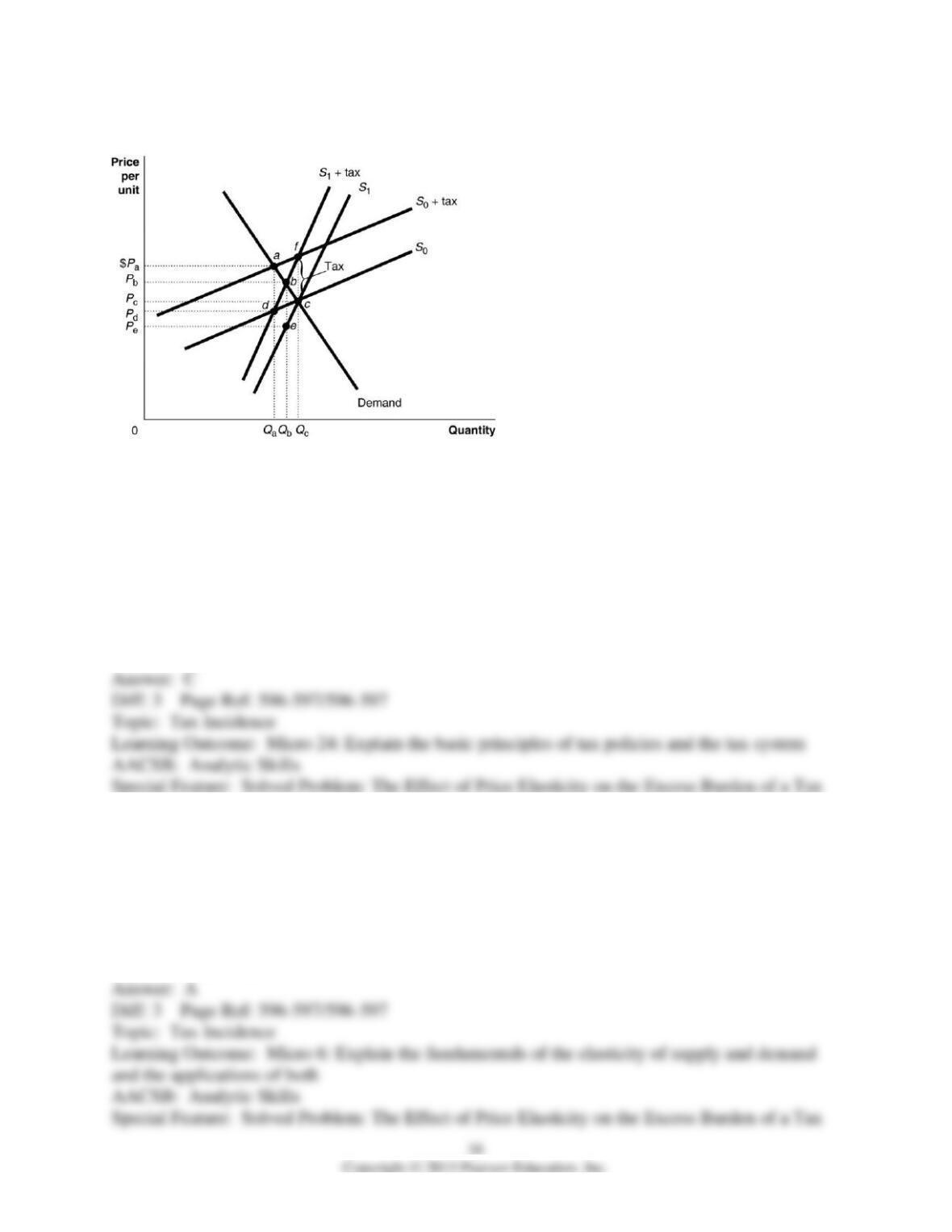
Figure 18-2
Figure 18-2 shows a demand curve and two sets of supply curves, one set more elastic than the
other.
10) Refer to Figure 18-2. If the government imposes an excise tax of $1.00 on every unit sold,
the consumer’s burden of the tax
A) is Pa – Pc under either supply curve.
B) is Pb – Pc under either supply curve.
C) is Pa – Pc if the supply curve is S0 and Pb – Pc if the supply curve is S1.
D) is Pa – Pd if the supply curve is S0 and Pb – Pe if the supply curve is S1.
11) Refer to Figure 18-2. If the government imposes an excise tax of $1.00 on every unit sold,
the consumer’s burden of the tax
A) is greater under the more elastic supply curve S0.
B) is greater under the less elastic supply curve S0.
C) is greater under the less elastic supply curve S1.
D) is the same under either supply curve because there is a single demand curve that captures
buyers’ market behavior.