
Revenue Recognition
18 – 21
85. Hiser Builders, Inc. is using the completed-contract method for a $9,800,000 contract that
will take two years to complete. Data at December 31, 2015, the end of the first year, are
as follows:
Costs incurred to date $4,480,000
Estimated costs to complete 5,740,000
Billings to date 4,200,000
Collections to date 3,500,000
The gross profit or loss that should be recognized for 2015 is
a. $0.
b. a $420,000 loss.
c. a $210,000 loss.
d. a $184,800 loss.
Use the following information for questions 86 through 88.
Gorman Construction Co. began operations in 2015. Construction activity for 2015 is shown
below. Gorman uses the completed-contract method.
Billings Collections Estimated
Contract Through Through Costs to Costs to
Contract Price 12/31/15 12/31/15 12/31/15 Complete
1 $4,800,000 $4,725,000 $3,900,000 $3,225,000 —
2 3,600,000 1,500,000 1,000,000 820,000 $1,880,000
3 3,300,000 1,900,000 1,800,000 2,250,000 1,200,000
86. Which of the following should be shown on the income statement for 2015 related to
Contract 1?
a. Gross profit, $675,000
b. Gross profit, $1,500,000
c. Gross profit, $1,575,000
d. Gross profit, $900,000
87. Which of the following should be shown on the balance sheet at December 31, 2015
related to Contract 2?
a. Inventory, $680,000
b. Inventory, $820,000
c. Current liability, $680,000
d. Current liability, $1,500,000
88. Which of the following should be shown on the balance sheet at December 31, 2015
related to Contract 3?
a. Inventory, $200,000
b. Inventory, $350,000
c. Inventory, $2,100,000
d. Inventory, $2,250,000

Test Bank for Intermediate Accounting, Fifteenth Edition
18 – 22
89. Oliver Co. uses the installment-sales method to record the sale of dining room sets. When
an account had a balance of $14,000, no further collections could be made and the dining
room set was repossessed. At that time, it was estimated that the dining room set could be
sold for $4,000 as repossessed, or for $5,000 if the company spent $500 reconditioning it.
The gross profit rate on this sale was 70%. The gain or loss on repossession was a
a. $9,800 loss.
b. $10,000 loss.
c. $1,000 gain.
d. $300 gain.
90. Spicer Corporation has a normal gross profit on installment sales of 30%. A 2013 sale
resulted in a default early in 2015. At the date of default, the balance of the installment
receivable was $32,000, and the repossessed merchandise had a fair value of $18,000.
Assuming the repossessed merchandise is to be recorded at fair value, the gain or loss on
repossession should be
a. $0.
b. a $4,400 loss.
c. a $4,400 gain.
d. a $10,000 loss.
91. Fryman Furniture uses the installment-sales method. No further collections could be made
on an account with a balance of $24,000. It was estimated that the repossessed furniture
could be sold as is for $7,200, or for $8,400 if $400 were spent reconditioning it. The gross
profit rate on the original sale was 40%. The loss on repossession was
a. $6,400.
b. $6,000.
c. $16,000.
d. $16,800.
92. Melton Company sold some machinery to Addison Company on January 1, 2014. The
cash selling price would have been $947,700. Addison entered into an installment sales
contract which required annual payments of $250,000, including interest at 10%, over five
years. The first payment was due on December 31, 2014. What amount of interest income
should be included in Melton’s 2015 income statement (the second year of the contract)?
a. $25,000
b. $79,247
c. $50,000
d. $69,770

Revenue Recognition
18 – 23
93. Carperter Company has used the installment method of accounting since it began
operations at the beginning of 2015. The following information pertains to its operations for
2015:
Installment sales $ 2,800,000
Cost of installment sales 1,960,000
Collections of installment sales 1,120,000
General and administrative expenses 280,000
The amount to be reported on the December 31, 2015 balance sheet as Deferred Gross
Profit should be
a. $ 336,000.
b. $ 504,000.
c. $ 672,000.
d. $1,680,000.
94. Daily, Inc. appropriately used the installment method of accounting to recognize income in
its financial statement. Some pertinent data relating to this method of accounting include:
2014 2015
Installment sales $750,000 $900,000
Cost of sales 450,000 630,000
Gross profit $300,000 $270,000
Collections during year:
On 2014 sales 200,000 200,000
On 2015 sales 240,000
What amount to be realized gross profit should be reported on Daily’s income statement for
2015?
a. $132,000
b. $152,000
c. $176,000
d. $216,000
95. Sutton Company sells plasma-screen televisions on an installment basis and appropriately
uses the installment-sales method of accounting. A customer with an account balance of
$2,400 refuses to make any more payments and the merchandise is repossessed. The
gross profit rate on the original sale is 40%. Sutton estimates that the television can be
sold as is for $750, or for $900 if $60 is spent to refurbish it. The loss on repossession is
a. $1,650.
b. $960.
c. $ 690.
d. $ 600.
Use the following information for questions 96-98.
During 2014, Vaughn Corporation sold merchandise costing $2,250,000 on an installment basis
for $3,000,000. The cash receipts related to these sales were collected as follows: 2014,
$1,200,000; 2015, $1,050,000; 2016, $750,000.

Test Bank for Intermediate Accounting, Fifteenth Edition
18 – 24
96. What is the rate of gross profit on the installment sales made by Vaughn Corporation
during 2014?
a. 75%
b. 60%
c. 40%
d. 25%
97. If expenses, other than the cost of the merchandise sold, related to the 2014 installment
sales amounted to $135,000, by what amount would Vaughn’s net income for 2014
increase as a result of installment sales?
a. $ 165,000
b. $ 266,250
c. $ 300,000
d. $1,065,000
98. What amount would be shown in the December 31, 2015 financial statement for realized
gross profit on 2014 installment sales, and deferred gross profit on 2014 installment sales,
respectively?
a. $262,500 and $562,500
b. $487,500 and $262,500
c. $562,500 and $187,500
d. $262,500 and $187,500
Use the following information for questions 99 – 101.
During 2014, Martin Corporation sold merchandise costing $3,500,000 on an installment basis for
$5,000,000. The cash receipts related to these sales were collected as follows: 2014, $2,000,000;
2015, $1,750,000; 2016, $1,250,000.
99. What is the rate of gross profit on the installment sales made by Martin Corporation during
2014?
a. 30%
b. 40%
c. 60%
d. 70%
100. If expenses, other than the cost of the merchandise sold, related to the 2014 installment
sales amounted to $200,000, by what amount would Martin’s net income for 2014 increase
as a result of installment sales?
a. $1,800,000
b. $ 600,000
c. $ 450,000
d. $ 400,000
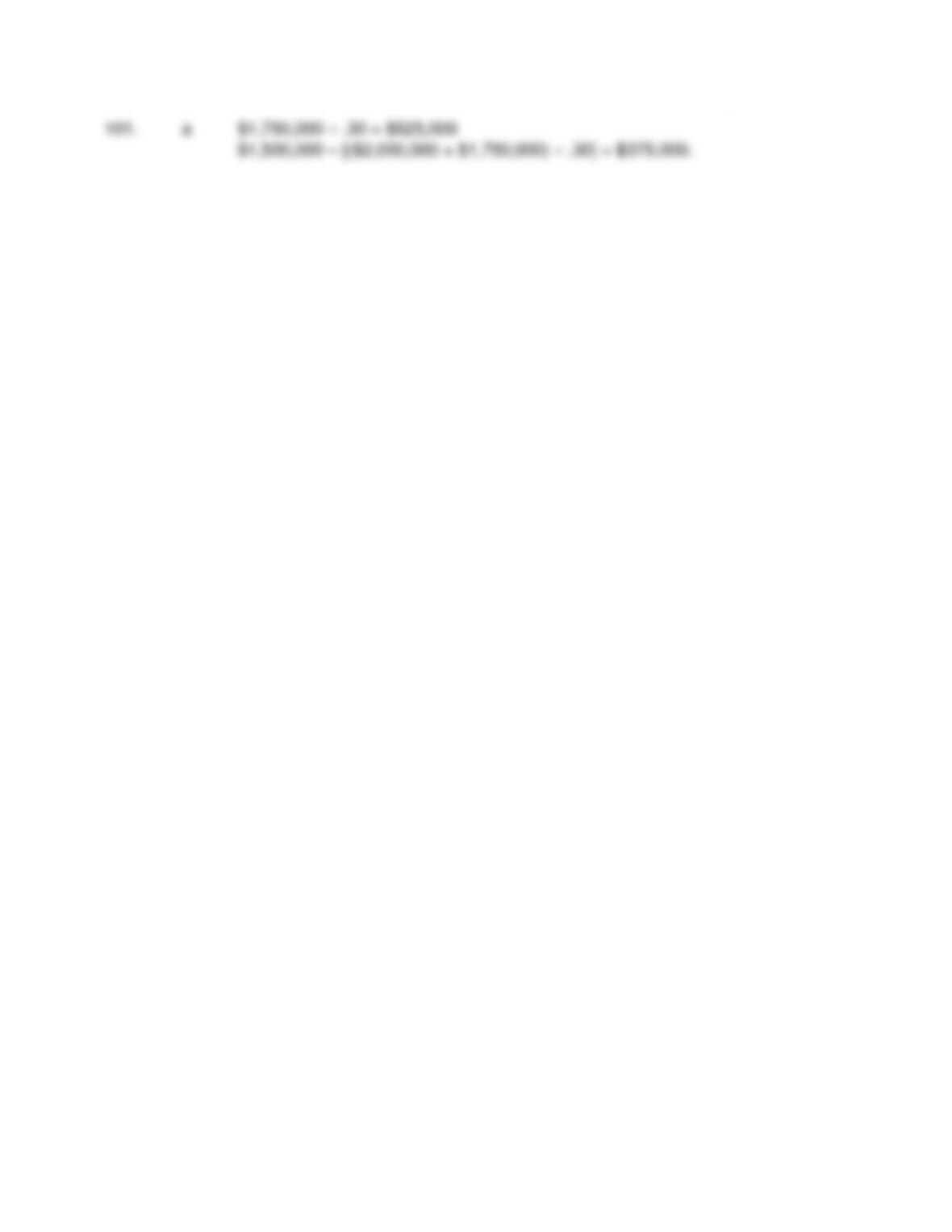
101. What amount would be shown in the December 31, 2015 financial statements for realized
gross profit on 2014 installment sales, and deferred gross profit on 2014 installment sales,
respectively?
a. $525,000 and $375,000
b. $975,000 and $525,000
c. $375,000 and $1,125,000
d. $525,000 and $1,125,000

Revenue Recognition
18 – 25
Use the following information for questions 102 and 103.
Coaster manufactures and sells logging equipment. Due to the nature of its business, Coaster is
unable to reliably predict bad debts. During 2014, Coaster sold equipment costing $4,800,000 for
$7,200,000. The terms of the sale were 20% down, with equal payments due quarterly over the
next 3 years. All payments for 2014 were made on schedule. Round answers to two places.
102. Assuming that Coaster uses the installment-sales method of accounting for its installment
sales, what amount of realized gross profit will Coaster report in its income statement for
the year ended December 31, 2014?
a. $3,360,000
b. $2,240,000
c. $1,120,000
d. $ 739,200
103. Assuming that Coaster uses the cost-recovery method of accounting for its installment
sales, what amount of realized gross profit will Coaster report in its income statement for
the year ended December 31, 2015?
a. $0
b. $ 480,000
c. $ 633,600
d. $1,920,000
104. On January 1, 2015, Shaw Co. sold land that cost $840,000 for $1,120,000, receiving a
note bearing interest at 10%. The note will be paid in three annual installments of $450,380
starting on December 31, 2015. Because collection of the note is very uncertain, Shaw will
use the cost-recovery method. How much revenue from this sale should Shaw recognize in
2015?
a. $0
b. $84,000
c. $112,000
d. $280,000
105. In 2012, Concord Inc. sells inventory with a cost of $32,000 for $50,000. Concord will
receive payments of $14,000 in 2012, $26,000 in 2013, and $10,000 in 2014. If the cost-
recovery method applies to this transaction, what would be the journal entry to recognize
gross profit at the end of 2013?
a. Deferred Gross Profit …………………………………………………. 10,000
Realized Gross Profit ……………………………………….. 10,000
b. Realized Gross Profit …………………………………………………. 18,000
Deferred Gross Profit ……………………………………….. 18,000
c. Sales Revenue ………………………………………………………….. 50,000
Cost of sales …………………………………………………… 32,000
Deferred Gross Profit ……………………………………….. 18,000
d. Deferred Gross Profit …………………………………………………. 8,000
Realized Gross Profit ……………………………………….. 8,000
*106. On January 1, 2015 Dairy Treats, Inc. entered into a franchise agreement with a company
allowing the company to do business under Dairy Treats’s name. Dairy Treats had performed
substantially all required services by January 1, 2015, and the franchisee paid the initial franchise
fee of $840,000 in full on that date. The franchise agreement specifies that the franchisee must
pay a continuing franchise fee of $72,000 annually, of which 20% must be spent on advertising by

Test Bank for Intermediate Accounting, Fifteenth Edition
18 – 26
Dairy Treats. What entry should Dairy Treats make on January 1, 2015 to record receipt of the
initial franchise fee and the continuing franchise fee for 2015?
a. Cash ……………………………………………………………………….. 912,000
Franchise Fee Revenue …………………………………… 840,000
Revenue from Franchise Fees ………………………….. 72,000
b. Cash ……………………………………………………………………….. 912,000
Unearned Franchise Fees ………………………………… 912,000
c. Cash ……………………………………………………….………………. 912,000
Franchise Fee Revenue …………………………………… 840,000
Revenue from Franchise Fees ………………………….. 57,600
Unearned Franchise Fees ………………………………… 14,400
d. Prepaid Advertising ……………………………………………………. 14,400
Cash ……………………………………………………….………………. 912,000
Franchise Fee Revenue …………………………………… 840,000
Revenue from Franchise Fees ………………………….. 72,000
Unearned Franchise Fees ………………………………… 14,400
*107. Wynne Inc. charges an initial franchise fee of $1,840,000, with $400,000 paid when the
agreement is signed and the balance in five annual payments. The present value of the
future payments, discounted at 10%, is $1,091,744. The franchisee has the option to
purchase $240,000 of equipment for $192,000. Wynne has substantially provided all initial
services required and collectibility of the payments is reasonably assured. The amount of
revenue from franchise fees is
a. $ 400,000.
b. $1,443,744.
c. $1,491,744.
d. $1,840,000.
Use the following information for questions 108 and 109.
On May 1, 2015, TV Inc. consigned 80 TVs to Ed’s TV. The TVs cost $450. Freight on the
shipment paid by Ed’s TV was $1,000. On July 10, TV Inc. received an account sales and $21,500
from Ed’s TV. Thirty TVs had been sold and the following expenses were deducted:
Freight $1,000
Commission (20% of sales price) ?
Advertising 650
Delivery 350
*108. The total sales price of the TVs sold by Ed‘s TV was
a. $25,625.
b. $26,875.
c. $27,313.
d. $29,375.
Revenue Recognition
18 – 27
*109. The inventory of TVs will be reported on whose balance sheet and at what amount?
Balance Sheet of Amount of Inventory
a. TV Inc. $23,125
b. TV Inc. $22,500
c. Ed’s TV $23,125
d. Ed’s TV $22,500
Multiple Choice Answers—Computational
Item
Ans.
Item
Ans.
Item
Ans.
Item
Ans.
Item
Ans.
Item
Ans.
MULTIPLE CHOICE—CPA Adapted
110. According to the FASB’s conceptual framework, the process of reporting an item in the
financial statements of an entity is
a. recognition.
b. realization.
c. allocation.
d. matching.
111. Green Construction Co. has consistently used the percentage-of-completion method of
recognizing revenue. During 2014, Green entered into a fixed-price contract to construct an
office building for $24,000,000. Information relating to the contract is as follows:
At December 31
2014 2015
Percentage of completion 15% 45%
Estimated total cost at completion $18,000,000 $19,200,000
Gross profit recognized (cumulative) 1,200,000 2,880,000
Contract costs incurred during 2015 were
a. $5,760,000.
b. $5,940,000.
c. $6,300,000.
d. $8,640,000.

Test Bank for Intermediate Accounting, Fifteenth Edition
18 – 28
112. Bruner Constructors, Inc. has consistently used the percentage-of-completion method of
recognizing income. In 2014, Bruner started work on a $42,000,000 construction contract
that was completed in 2015. The following information was taken from Bruner’s 2014
accounting records:
Progress billings $13,200,000
Costs incurred 12,600,000
Collections 8,400,000
Estimated costs to complete 25,200,000
What amount of gross profit should Bruner have recognized in 2014 on this contract?
a. $4,200,000
b. $2,800,000
c. $2,100,000
d. $1,400,000
113. During 2014, Gates Corp. started a construction job with a total contract price of
$14,000,000. The job was completed on December 15, 2015. Additional data are as follows:
2014 2015
Actual costs incurred $5,400,000 $6,100,000
Estimated remaining costs 5,400,000 —
Billed to customer 4,800,000 9,200,000
Received from customer 4,000,000 9,600,000
Under the completed-contract method, what amount should Gates recognize as gross
profit for 2015?
a. $900,000
b. $1,250,000
c. $1,900,000
d. $2,500,000
114. Hogan Farms produced 1,600,000 pounds of cotton during the 2015 season. Hogan sells
all of its cotton to Ott Co., which has agreed to purchase Hogan’s entire production at the
prevailing market price. Recent legislation assures that the market price will not fall below
$.70 per pound during the next two years. Hogan’s costs of selling and distributing the
cotton are immaterial and can be reasonably estimated. Hogan reports its inventory at
expected exit value. During 2015, Hogan sold and delivered to Ott 1,200,000 pounds at the
market price of $.70. Hogan sold the remaining 400,000 pounds during 2016 at the market
price of $.72. What amount of revenue should Hogan recognize in 2015?
a. $840,000
b. $864,000
c. $1,120,000
d. $1,152,000

Revenue Recognition
18 – 29
115. Braun, Inc. appropriately uses the installment-sales method of accounting to recognize
income in its financial statements. Some pertinent data relating to this method of
accounting include:
2014 2015
Installment sales $750,000 $720,000
Cost of installment sales 570,000 504,000
Gross profit $180,000 $216,000
Rate of gross profit 24% 30%
Balance of deferred gross profit at year end:
2014 $108,000 $ 36,000
2015 198,000
Total $108,000 $234,000
What amount of installment accounts receivable should be presented in Braun’s December
31, 2015 balance sheet?
a. $720,000
b. $810,000
c. $780,000
d. $866,666
116. Hartz Co., which began operations on January 1, 2015, appropriately uses the installment-
sales method of accounting. The following information pertains to Hartz’s operations for the
year 2015:
Installment sales $2,400,000
Regular sales 960,000
Cost of installment sales 1,440,000
Cost of regular sales 576,000
General and administrative expenses 192,000
Collections on installment sales 576,000
The deferred gross profit account in Hartz’s December 31, 2015 balance sheet should be
a. $230,400.
b. $384,000.
c. $729,600.
d. $960,000.
117. On January 1, 2014, Orton Co. sold a used machine to King, Inc. for $1,050,000. On this
date, the machine had a depreciated cost of $735,000. King paid $150,000 cash on
January 1, 2014 and signed a $900,000 note bearing interest at 10%. The note was
payable in three annual installments of $300,000 plus interest beginning January 1, 2015.
Orton appropriately accounted for the sale under the installment-sales method. King made
a timely payment of the first installment on January 1, 2015 of $390,000, which included
interest of $90,000 to date of payment. At December 31, 2015, Orton has deferred gross
profit of
a. $210,000.
b. $198,000.
c. $180,000.
d. $153,000.
Test Bank for Intermediate Accounting, Fifteenth Edition
18 – 30
118. Piper Co. began operations on January 1, 2015 and appropriately uses the installment-
sales method of accounting. The following information pertains to Piper‘s operations for
2015:
Installment sales 3,600,000
Cost of installment sales 2,160,000
General and administrative expenses 360,000
Collections on installment sales 1,650,000
The balance in the deferred gross profit account at December 31, 2015 should be
a. $660,000.
b. $990,000.
c. $780,000.
d. $1,440,000.
119. Moon Co. records all sales using the installment-sales method of accounting. Installment
sales contracts call for 36 equal monthly cash payments. According to the FASB’s
conceptual framework, the amount of deferred gross profit relating to collections 12 months
beyond the balance sheet date should be reported in the
a. current liabilities section as a deferred revenue.
b. noncurrent liabilities section as a deferred revenue.
c. current assets section as a contra account.
d. noncurrent assets section as a contra account.
120. Crane, Inc. is a retailer of home appliances and offers a service contract on each appliance
sold. Crane sells appliances on installment contracts, but all service contracts must be paid
in full at the time of sale. Collections received for service contracts should be recorded as
an increase in a
a. deferred revenue account.
b. sales contracts receivable valuation account.
c. stockholders’ valuation account.
d. service revenue account.
Multiple Choice Answers—CPA Adapted
Item
Ans.
Item
Ans.
Item
Ans.
Item
Ans.
Item
Ans.
Item
Ans.
DERIVATIONS — Computational
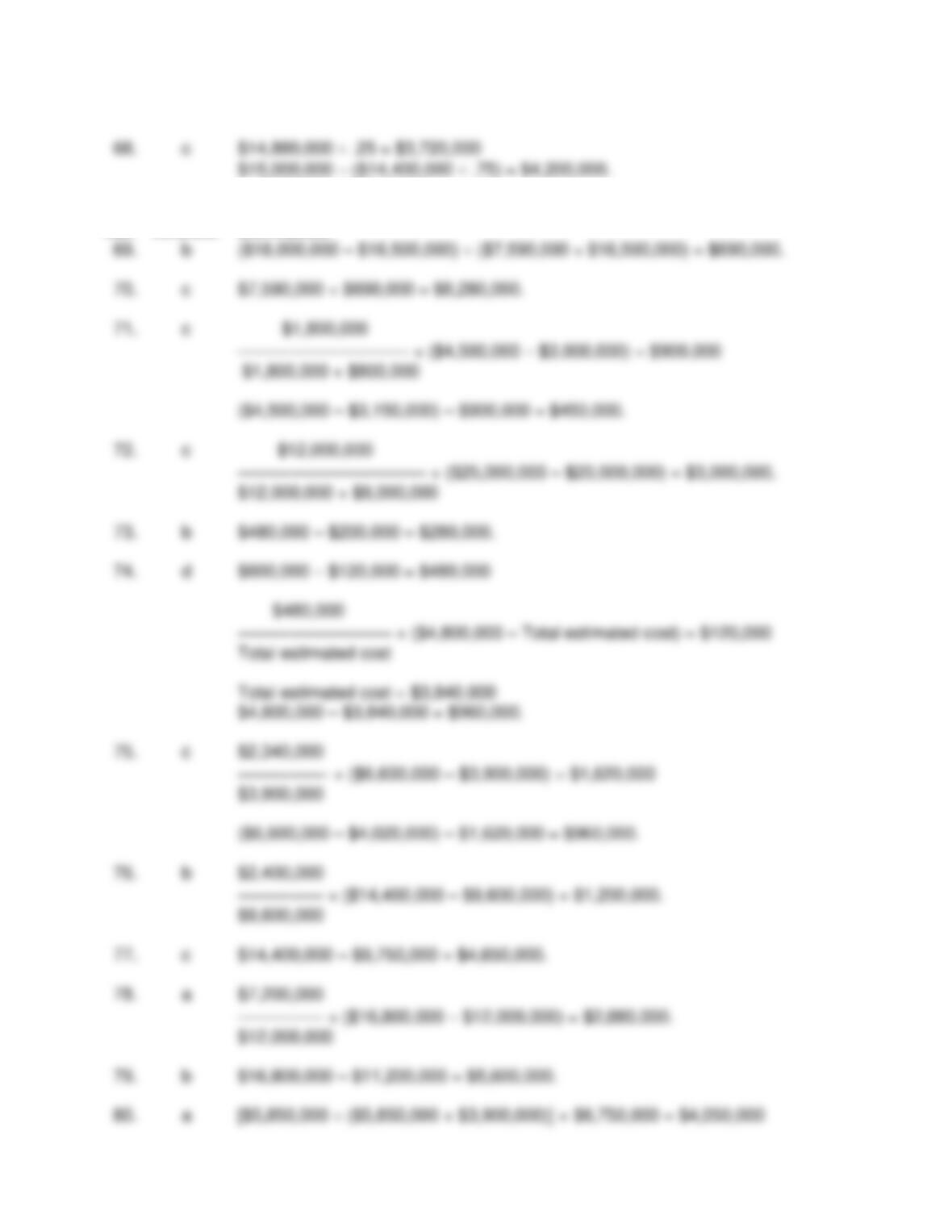
No. Answer Derivation
Revenue Recognition
18 – 31
DERIVATIONS — Computational (cont.)
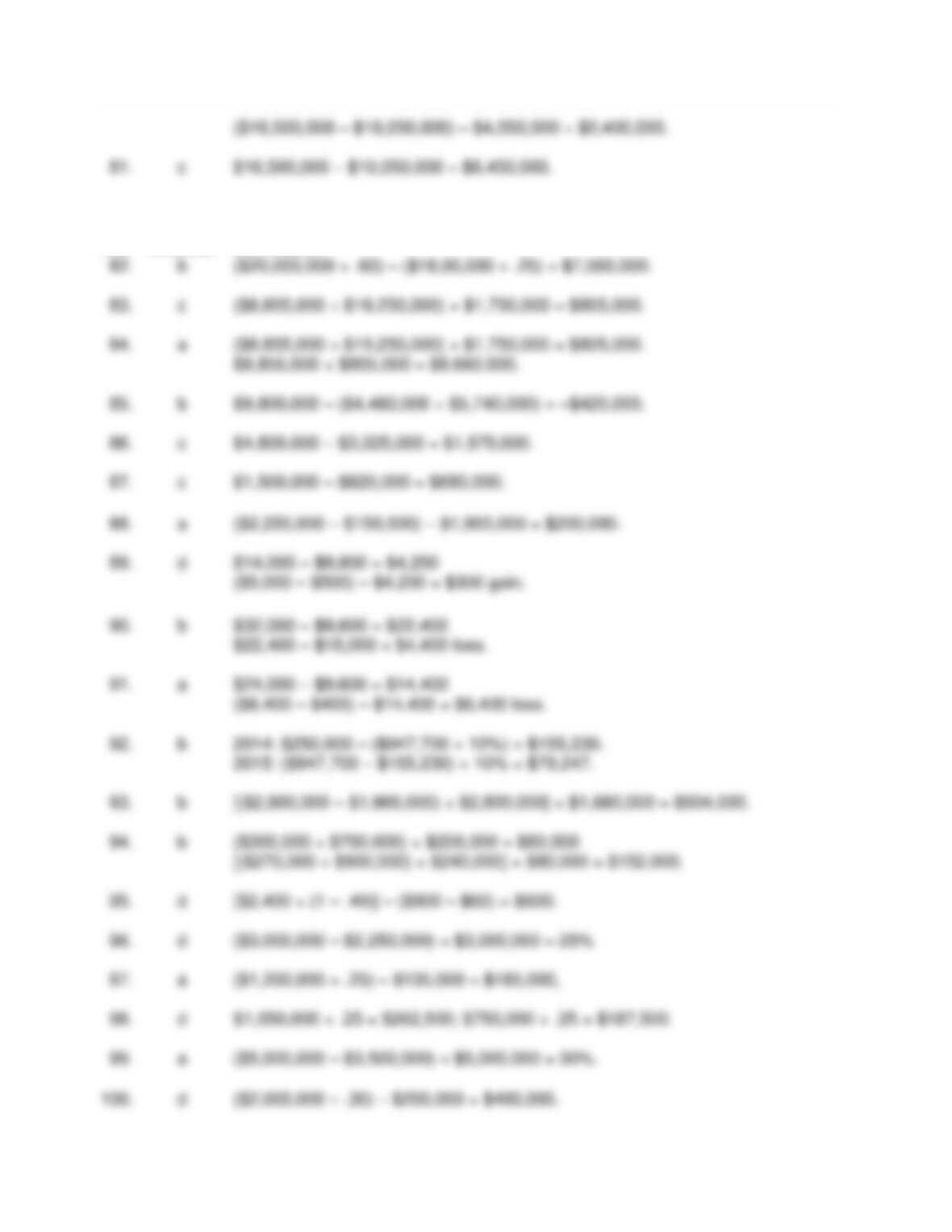
No. Answer Derivation
Test Bank for Intermediate Accounting, Fifteenth Edition
18 – 32
DERIVATIONS — Computational (cont.)
No. Answer Derivation
Revenue Recognition
18 – 33
Test Bank for Intermediate Accounting, Fifteenth Edition
18 – 34
DERIVATIONS — Computational (cont.)
No. Answer Derivation
DERIVATIONS — CPA Adapted
No. Answer Derivation
Revenue Recognition
18 – 35
DERIVATIONS — CPA Adapted (cont.)
No. Answer Derivation
BRIEF EXERCISES
BE. 18-121— Revenue recognition (essay).
The revenue recognition principle provides that revenue is recognized when (1) it is realized or
realizable and (2) it is earned.
Instructions
Explain when revenues are (a) realized, (b) realizable, and (c) earned.
Solution 18-121
BE. 18-122—Revenue recognition (essay).
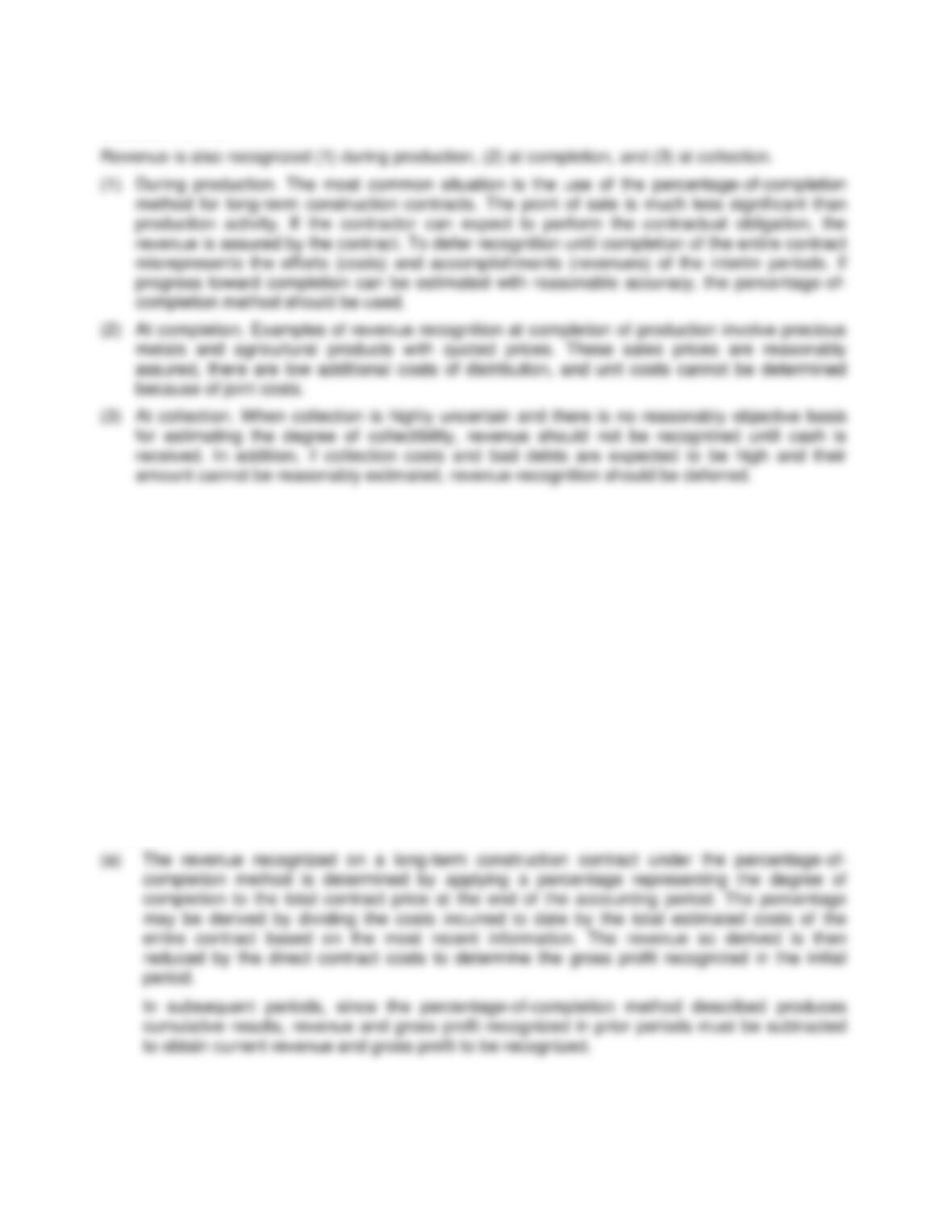
The earning of revenue by a business is recognized for accounting purposes when the transaction
is recorded. Revenue is often recognized at time of sale.
Instructions
At what times, other than at time of sale, may it be appropriate to recognize revenue? Explain and
justify each of these times.
Test Bank for Intermediate Accounting, Fifteenth Edition
18 – 36
Solution 18-122
BE. 18-123—Long-term construction contracts (essay).
In accounting for long-term construction contracts (those taking longer than one year to complete),
the two methods commonly followed are the percentage-of-completion and completed-contract
methods.
Instructions
(a) Discuss how earnings on long-term construction contracts are recognized and computed
under these two methods.
(b) Under what circumstances should one method be used over the other?
(c) How are job costs and interim billings reflected on the balance sheet under the percentage-of–
completion method and the completed-contract method?
Solution 18-123