18.2 Protectionist Policies
1) An import ban results in
A) a decrease in the supply of the product.
B) an increase in the product’s price.
C) a decrease in the quantity of the product bought and sold.
D) all of the above.
2) An import quota
A) limits the amount of a good that can be imported, thus decreasing prices.
B) limits the amount of a good that can be imported, thus increasing prices.
C) increases the amount of a good imported, thus decreasing prices.
D) increases the amount of a good imported, thus increasing prices.
3) A(n) ________ is a trade policy by which a nation agrees to limit its exports of a good in order
to avoid more restrictive trade policies.
A) tariff
B) voluntary export restraint
C) import quota
D) import ban
4) Exporting nations often agree to voluntary export restraints in an attempt to
A) employ more workers in the importing nation.
B) avoid more restrictive trade policies.
C) increase global welfare.
D) decrease inflation.
5) Voluntary export restraints
A) have the same effect as an import ban.
B) are illegal under the international trading rules.
C) violate the spirit of international trade agreements.
D) all of the above.
6) Which of the following benefits from a quota or VER?
A) consumers
B) domestic producers
C) the government
D) all of the above
7) A(n) ________ is a tax on an imported good.
A) tariff
B) import quota
C) voluntary export restraint
D) export quota
8) Import bans, import quotas, voluntary export restraints, and tariffs on goods all
A) increase equilibrium quantity and prices.
B) decrease equilibrium quantity and prices.
C) increase equilibrium quantities, but decrease prices.
D) decrease equilibrium quantities, but increase prices.
9) Import bans, import quotas, voluntary export restraints, and tariffs on goods all
A) increase imports and raise prices for consumers.
B) reduce imports and prices for consumers.
C) reduce imports and raise prices for consumers.
D) increase imports and reduce prices for consumers.
10) Which of the following situations will arise in the domestic market following the imposition
of a tariff?
A) imports decrease, domestic production increases, prices increase
B) imports increase, domestic production increases, prices increase
C) imports increase, domestic production decreases, prices decrease
D) imports decrease, domestic production increases, prices decrease
11) Which of the following situations will arise in the domestic market following the imposition
of an import ban?
A) imports increase, domestic production increases, prices increase
B) imports increase, domestic production decreases, prices decrease
C) imports decrease, domestic production increases, prices increase
D) imports decrease, domestic production increases, prices decrease
12) Which of the following situations will arise in the domestic market following the imposition
of an import quota?
A) imports increase, domestic production decreases, prices decrease
B) imports decrease, domestic production increases, prices decrease
C) imports decrease, domestic production decreases, prices increase
D) imports decrease, domestic production increases, prices increase
13) Which of the following situations will arise in the domestic market following the imposition
of a voluntary export restraint?
A) imports increase, domestic production increases, prices increase
B) imports decrease, domestic production increases, prices increase
C) imports increase, domestic production decreases, prices decrease
D) imports decrease, domestic production increases, prices decrease
14) Which of the following situations will arise in the domestic market following the removal of
an import quota?
A) imports increase, domestic production increases, prices increase
B) imports increase, domestic production decreases, prices decrease
C) imports decrease, domestic production increases, prices decrease
D) imports decrease, domestic production decreases, prices increase
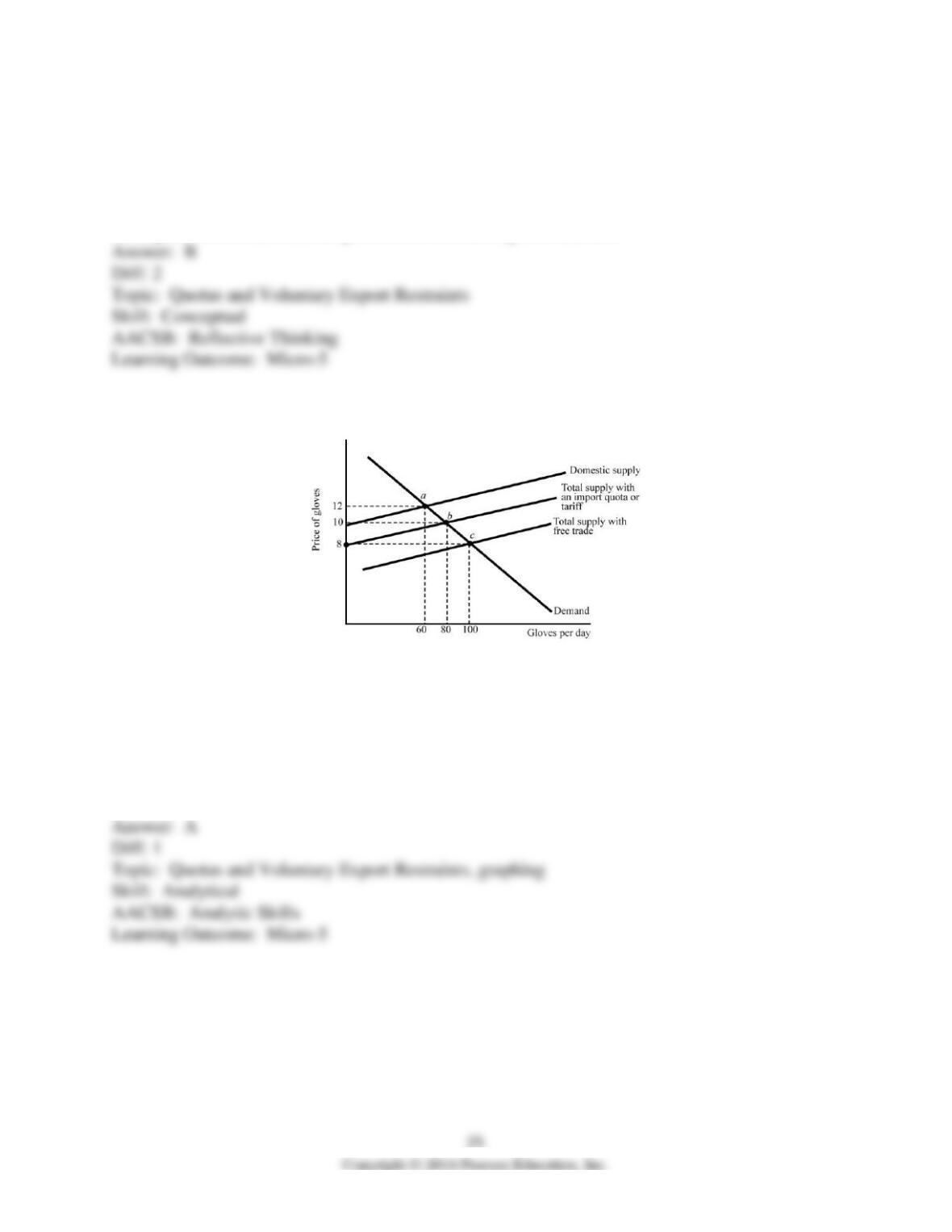
Figure 18.1
15) Refer to Figure 18.1. With free trade, what is the equilibrium quantity of gloves in
Duckland?
A) 100
B) 80
C) 60
D) 40
16) Refer to Figure 18.1. With free trade, what is the equilibrium price of gloves in Duckland?
A) $0
B) $8
C) $9
D) $11
17) Refer to Figure 18.1. With an import ban, what is the equilibrium quantity of gloves in
Duckland?
A) 100
B) 80
C) 60
D) 40
18) Refer to Figure 18.1. With an import ban, what is the equilibrium price of gloves in
Duckland?
A) $0
B) $8
C) $9
D) $12
19) Refer to Figure 18.1. With free trade, how many gloves are produced domestically in
Duckland?
A) 100
B) 80
C) 60
D) 0
20) Refer to Figure 18.1. With an import ban, how many gloves are produced domestically in
Duckland?
A) 100
B) 80
C) 60
D) 0
21) Refer to Figure 18.1. With a tariff or quota, what is the equilibrium quantity of gloves in
Duckland?
A) 100
B) 80
C) 60
D) 40
22) Refer to Figure 18.1. With a tariff or quota, what is the equilibrium price of gloves in
Duckland?
A) $8
B) $9
C) $10
D) $11
23) Refer to Figure 18.1. With a tariff, how much does the government collect for each glove
imported into Duckland?
A) $0
B) between $2 and $3
C) between $8 and $10
D) more than $10
24) Tariffs ________ prices for domestic consumers and import quotas ________ prices for
domestic consumers.
A) raise; lower
B) lower; raise
C) raise; also raise
D) lower; also lower
25) Importers collect additional revenues from a ________, and governments collect additional
revenues from ________.
A) tariff; voluntary export restraints
B) quota; import bans
C) quota; tariffs
D) voluntary export restraint; quotas
26) Which of the following tariffs resulted in worldwide retaliation against the United States
during the Great Depression?
A) the Pasta Tariff
B) the Chicken tariff
C) the Smoot-Hawley tariff
D) the Tariff of Abominations
27) In 1995, the United States threatened to impose 100% tariffs on ________ from ________ if
it didn’t loosen its protectionist policies.
A) luxury cars; Japan
B) auto parts; Japan
C) brandies; France
D) light trucks; Germany
Recall the Application about the impact tariffs have on lower income households to answer
the following question(s). Economists have found that tariffs in the United States fall most
heavily on lower-income consumers. In the United States, tariffs are very high on textiles,
apparel items and footwear, and within these categories the highest tariffs fall on the
cheapest products. In general, to protect U.S. industries, tariffs are highest on labor–
intensive goods.
28) Recall the application. Tariffs in the United States are very high on textiles, apparel items
and footwear. These tariffs disproportionately impact lower-income households because
A) lower-income households tend to purchase more of these items than do higher-income
households.
B) these products represent a higher fraction of consumption of lower-income households than
higher-income households.
C) the tariffs are only applicable to lower-income households.
D) higher-income households tend to purchase products produced in the United States, which are
not subject to tariffs.
29) Recall the application. Tariffs in the United States are very high on textiles, apparel items
and footwear, and within these categories tariffs are highest on the cheapest products. These
tariffs disproportionately impact lower-income households because
A) higher-income consumers tend to refuse to purchase products with tariffs.
B) only lower-income consumers buy cheap, imported products.
C) these cheaper products tend to be purchased by lower-income consumers.
D) higher-income consumers can deduct the tariff from their income taxes.
30) If the tariffs on the textiles, apparel items and footwear mentioned in the Application were
replaced by equivalent voluntary export restraints (VERs), low-income consumers would
probably
A) be better off.
B) be worse off.
C) be no better nor worse off.
D) not be subject to the VERs.
31) If the tariffs on the textiles, apparel items and footwear mentioned in the Application were
replaced by equivalent voluntary export restraints (VERs), who would benefit the most?
A) low-income consumers
B) high-income consumers
C) the U.S. government
D) the foreign manufacturer
32) A voluntary export restraint occurs when one country prevents a specific product from being
imported from another country.
33) If a country bans the importation of a particular good, the market equilibrium is shown by the
intersection of the foreign demand curve and the domestic supply curve.
34) An import quota is the same as an import ban.
35) The equilibrium price under an import quota is below the price that occurs with an import
ban.
36) The equilibrium price under an import quota is below the price that occurs with free trade.
37) Voluntary export restraints are illegal under international trading rules.
38) From the perspective of consumers, a quota is preferred to a tariff.
39) A restriction on imports is likely to reduce further restrictions on trade.
40) Import restrictions create an incentive to smuggle.
41) List four protectionist policies.
42) What is an import quota?
43) What is a voluntary export restraint?
34
44) What is a tariff?
45) Would consumers benefit more from a tariff or a quota on imports?
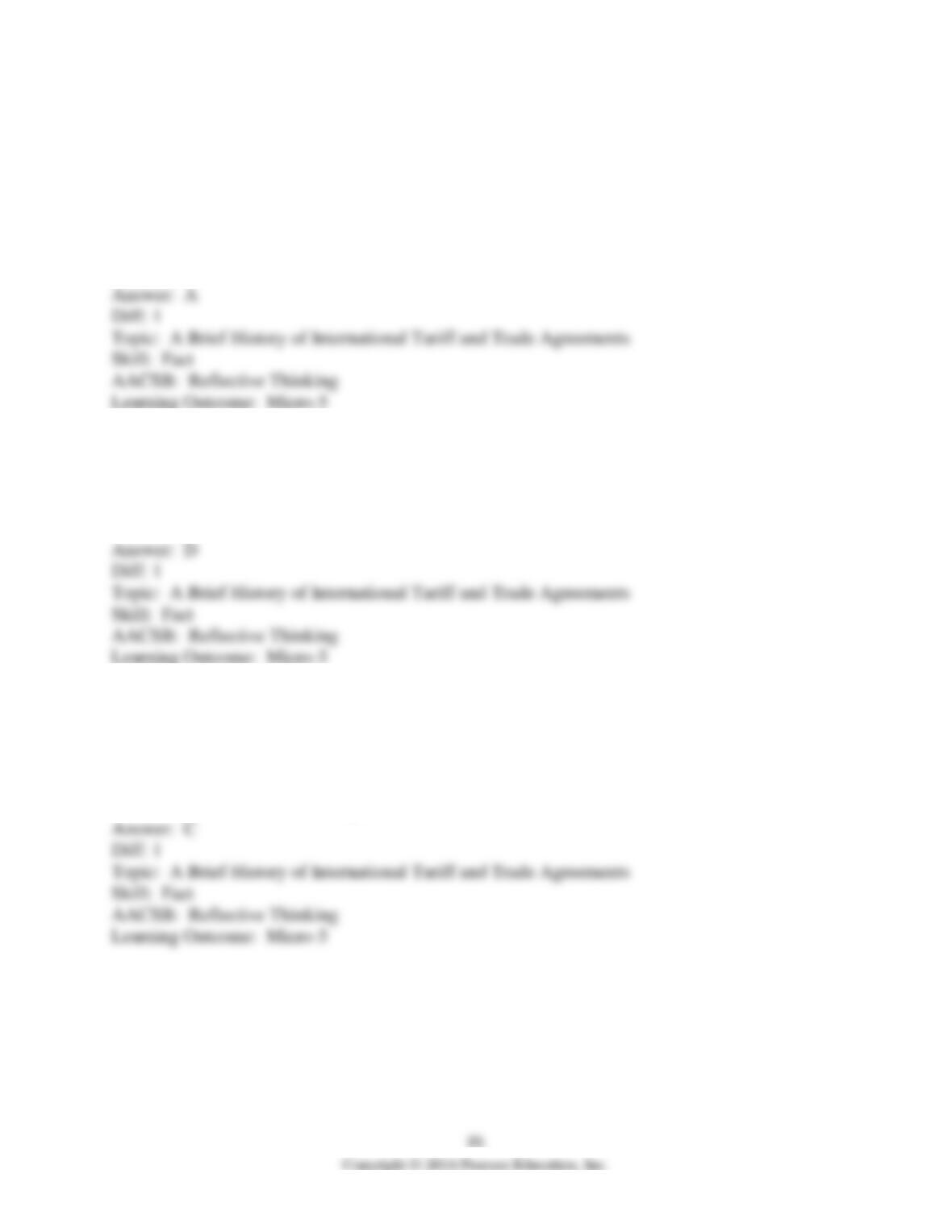
46) Using a graph, illustrate what the market effects of a quota, a tariff, or a complete ban on
imports would be.
18.3 A Brief History of International Tariff and Trade Agreements
1) Which of the following trade agreements, which took effect in 1994 and was implemented
over a 15-year period, eliminates all tariffs and other trade barriers between its members?
A) North American Free Trade Agreement
B) World Trade Organization
C) Asian Pacific Economic Cooperation
D) GATT
2) Which of the following groups of countries are members of NAFTA?
A) Japan, Canada, and Mexico
B) the United States, Japan, and Mexico
C) the United States, France, and Germany
D) the United States, Canada, and Mexico
3) Which of the following trade agreements provides for the development of a single market
among its members?
A) North American Free Trade Agreement
B) World Trade Organization
C) European Union
D) Asian Pacific Economic Cooperation
4) The WTO and GATT promote trade by
A) reducing tariffs.
B) eliminating quotas.
C) reducing agricultural subsidies.
D) all of the above.
5) Today, the average U.S. tariff is 4.6% of the value of imported goods, which is very low by
historical standards.
6) The first major international trade agreement following World War II was the North American
Free Trade Agreement (NAFTA).
7) What are GATT and the WTO?
18.4 How Exchange Rates Are Determined
1) The rate at which one currency can be traded for another is called the
A) terms of trade.
B) transfer rate.
C) exchange rate.
D) coupon rate.
2) If the price of smoothies is $3.50 in the United States and the exchange rate is 110 yen per
dollar, then what is the yen price of smoothies?
A) 110 yen
B) 240 yen
C) 318 yen
D) 385 yen
3) If the price of watermelons is 5 pesos in Argentina and the exchange rate is 4 pesos per dollar,
then what is the dollar price of watermelons?
A) $0.75
B) $0.80
C) $1.25
D) $2.00
4) If the price of papayas is 12 baht in Thailand and the exchange rate is 30 baht per dollar, then
what is the dollar price of papayas?
A) $0.40
B) $2.50
C) $2.90
D) $26.00
5) If the yen to dollar exchange rate moves from 105 to 115 yen per dollar, then the dollar has
________ and the yen has ________.
A) depreciated; depreciated
B) depreciated; appreciated
C) appreciated; depreciated
D) appreciated; appreciated
6) If the dollar to euro exchange rate moves from 1.1 to 0.9 dollars per euro, then the dollar has
________ and the euro has ________.
A) depreciated; depreciated
B) depreciated; appreciated
C) appreciated; depreciated
D) appreciated; appreciated
7) An appreciation is
A) a decrease in the value of currency.
B) a decrease in the trade deficit.
C) an increase in the trade surplus.
D) an increase in the value of currency.
8) A depreciation is
A) a decrease in the value of currency.
B) a decrease in the trade deficit.
C) an increase in the trade surplus.
D) an increase in the value of currency.
9) If the dollar depreciates against the British pound, U.S. goods sold in ________ would
become less expensive and British goods sold in ________ would become more expensive.
A) the United States; the United States
B) the United States; Great Britain
C) Great Britain; Great Britain
D) Great Britain; the United States
10) If the dollar depreciates against the yen, U.S. goods sold in ________ would become less
expensive and Japanese goods sold in ________ would become more expensive.
A) the United States; the United States
B) the United States; Japan
C) Japan; Japan
D) Japan; the United States
11) As the Indian rupee depreciates relative to the dollar, total spending on Indian goods and
assets will increase. Therefore, in the foreign exchange market, the
A) supply curve of dollars is upward sloping.
B) demand curve for dollars is upward sloping.
C) supply curve of euros is downward sloping.
D) demand curve for euros is upward sloping.
12) As the dollar depreciates relative to the Russian ruble, U.S. goods become cheaper for
Russians to purchase. Therefore, in the foreign exchange market, the
A) supply curve of dollars is downward sloping.
B) demand curve for dollars is downward sloping.
C) supply curve of euros is downward sloping.
D) demand curve for euros is upward sloping.