
24) A light ray enters a glass enclosed fish tank. From air it enters the glass at 20° with respect to
the plane of the surface and then emerges into the water. The index for the glass is 1.50 and for
water 1.33.
(a) What is the angle of refraction in the glass?
(b) What is the angle of refraction in the water?
(c) Is there any incident angle in air for which the ray will not enter the water due to total internal
reflection? If so, find it.
25) Light in a transparent material that has an index of refraction of 1.333 strikes the boundary
with another transparent material for which the index of refraction is 1.010. What is the critical
angle for total internal reflection between these two materials?
26) The critical angle for a substance in air is measured at 53.7°. If light enters this substance
from air at 45.0° with the normal, at what angle with the normal will it continue to travel?
A) 34.7°
B) 45.0°
C) 53.7°
D) It will not continue, but will be totally reflected.
27) Light enters a substance from air at 30.0° to the normal. It continues within the substance at
23.0° to the normal. What is the critical angle for this substance when it is surrounded by air?
A) 53°
B) 51.4°
C) 36.7°
D) 12.6°
28) Light travels from crown glass, with a refractive index of 1.52, into water, having a refractive
index of 1.33? The critical angle for this interface is closest to which one of the following
angles?
A) 42°
B) 48°
C) 53°
D) 57°
E) 61°

29) Lucite has an index of refraction of 1.50. What is its critical angle if it is in air?
A) 1.16°
B) 15°
C) 41.8°
D) 65.2°
E) 87.4°
30) An optic fiber is made of clear plastic with an index of refraction of 1.50. For what range of
angles of incidence θ with the lateral surface of the fiber will light remain inside the plastic
“guide” if it is surrounded by air?
A) 21.1° < θ < 90°
B) 23.4° < θ < 90°
C) 38.3° < θ < 90°
D) 40.3° < θ < 90°
E) 41.8° < θ < 90°
31) A glass plate having an index of refraction is 1.66 is immersed in a certain alcohol. The
surface of the glass is inclined at an angle of 44° with the vertical. When a horizontal ray in the
glass strikes the interface, you observe that it is at the critical angle. What is the index of
refraction of the alcohol?
A) 1.15
B) 1.13
C) 1.11
D) 1.09
E) 1.17
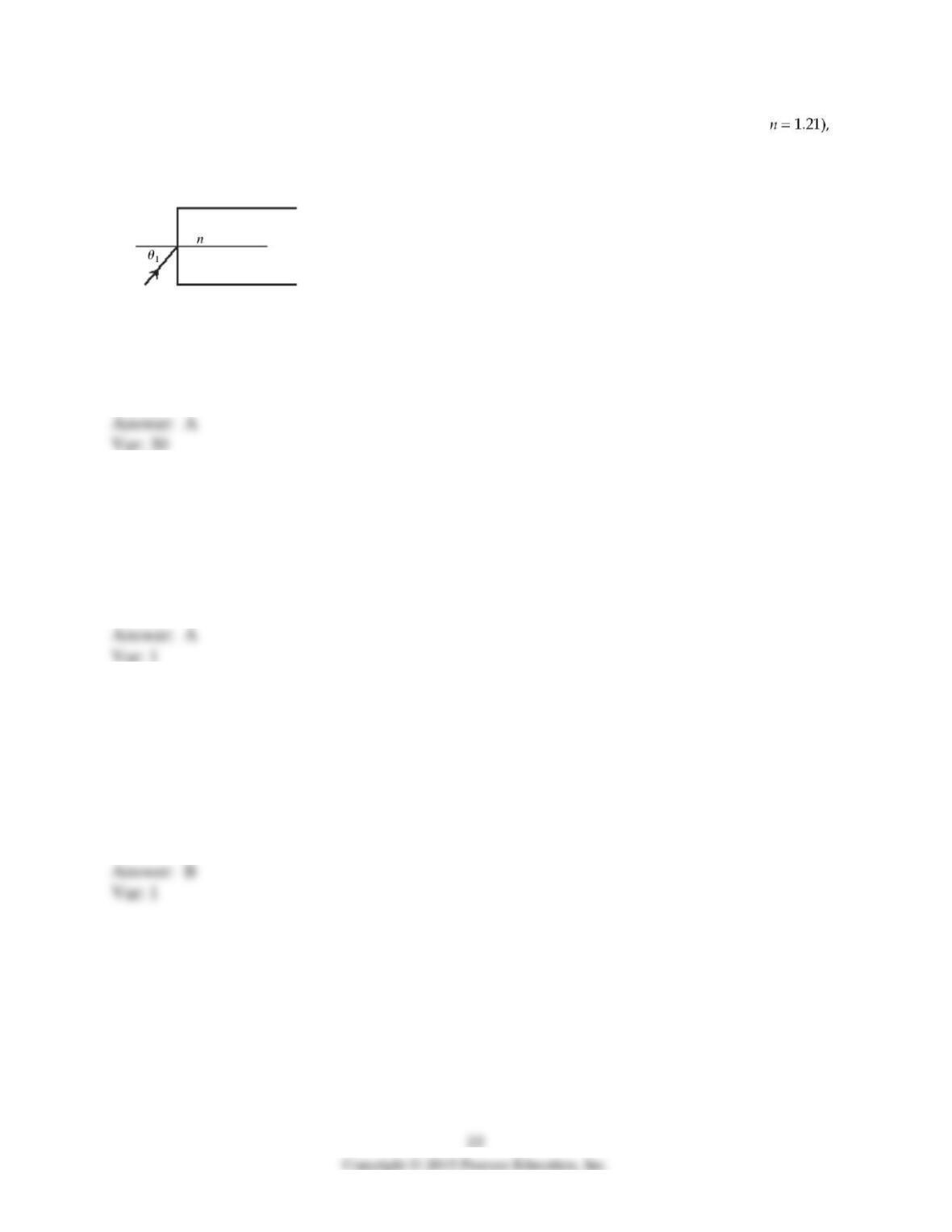
32) During the investigation of a new type of optical fiber having an index of refraction a
laser beam is aimed at the flat end of a straight fiber, as shown in the figure. What is the
maximum angle of incidence θ1 if the beam is not to escape from the sides of the fiber if it is
surrounded by air?
A) 42.9°
B) 39.8°
C) 36.7°
D) 33.6°
E) 30.5°
33) A light beam is traveling inside a glass block that has an index of refraction of 1.46. As this
light arrives at the surface of the block, it makes an angle of 53.0° with the normal. At what
angle with the normal in the air will it leave the block?
A) It will not leave.
B) 59.1°
C) 43.2°
D) 33.2°
34) A scuba diver is 1.2 m beneath the surface of a still pond of water. At what angle relative to
the normal at the surface must the diver shine a beam of light toward the surface in order for a
person on a distant bank to be able to see it? The index of refraction for water is 1.33.
A) 41°
B) 48°
C) 59°
D) 90°
E) 0°
35) A ray of light in glass strikes a water-glass interface at an angle of incidence equal to one-
half the critical angle for that interface. The index of refraction for water is 1.33, and for the
glass it is 1.43. What angle does the refracted ray in the water make with the normal?
A) 37°
B) 42°
C) 47°
D) 32°
E) 27°
36) The speed of light in a material is What is the critical angle of a light ray at the
interface between the material and a vacuum?
A) 24°
B) 17°
C) 19°
D) 22°
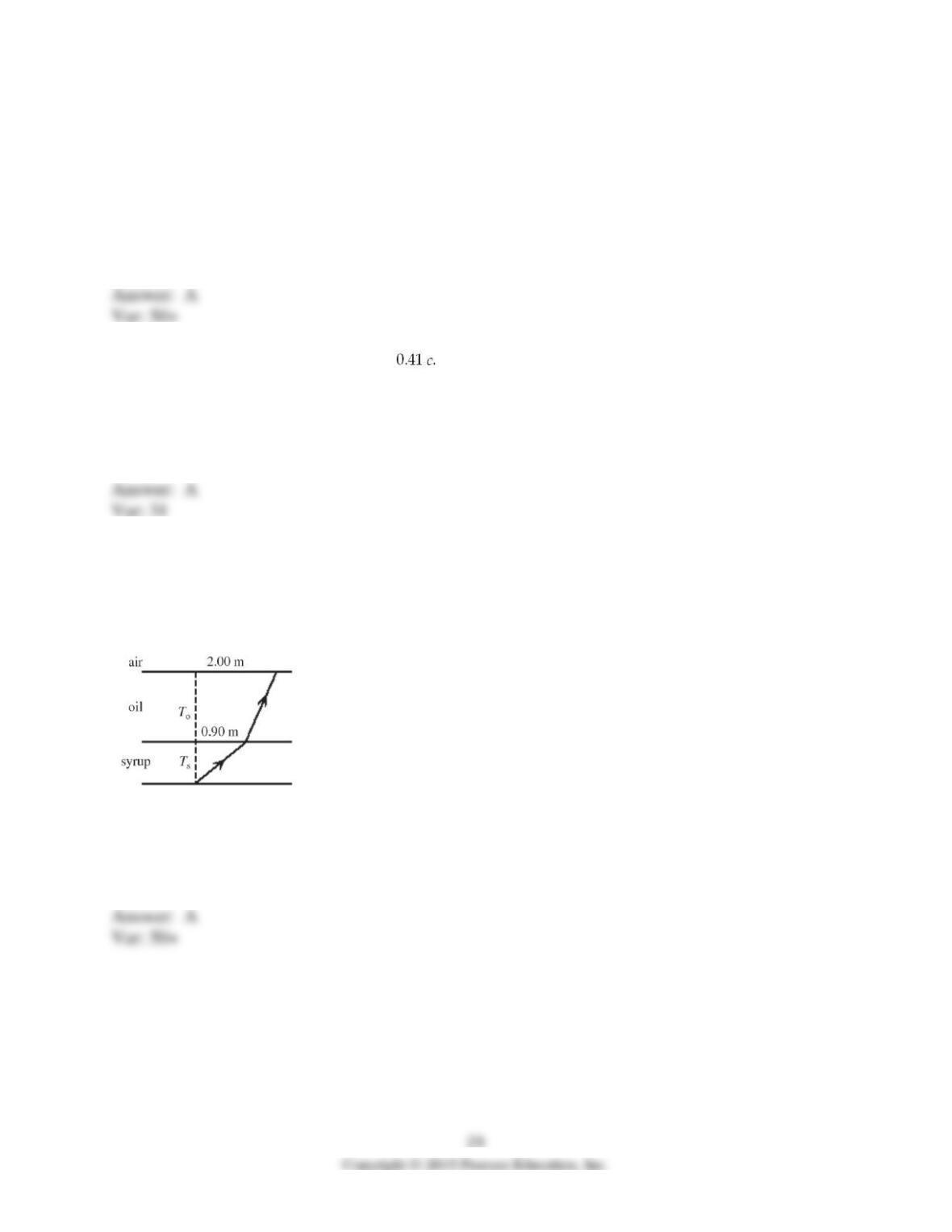
37) A tank holds a layer of oil, of thickness To = 1.43 m, that floats on a layer of syrup of
thickness Ts = 0.640 m, as shown in the figure. Both liquids are clear and do not mix together. A
light ray, originating at the bottom of the tank at point P, crosses the oil-syrup interface at a point
0.900 m from the axis. The ray continues and arrives at the oil-air interface, 2.00 m to the right
of P and at the critical angle. What is the index of refraction of the oil?
A) 1.64
B) 1.62
C) 1.60
D) 1.66
E) 1.68
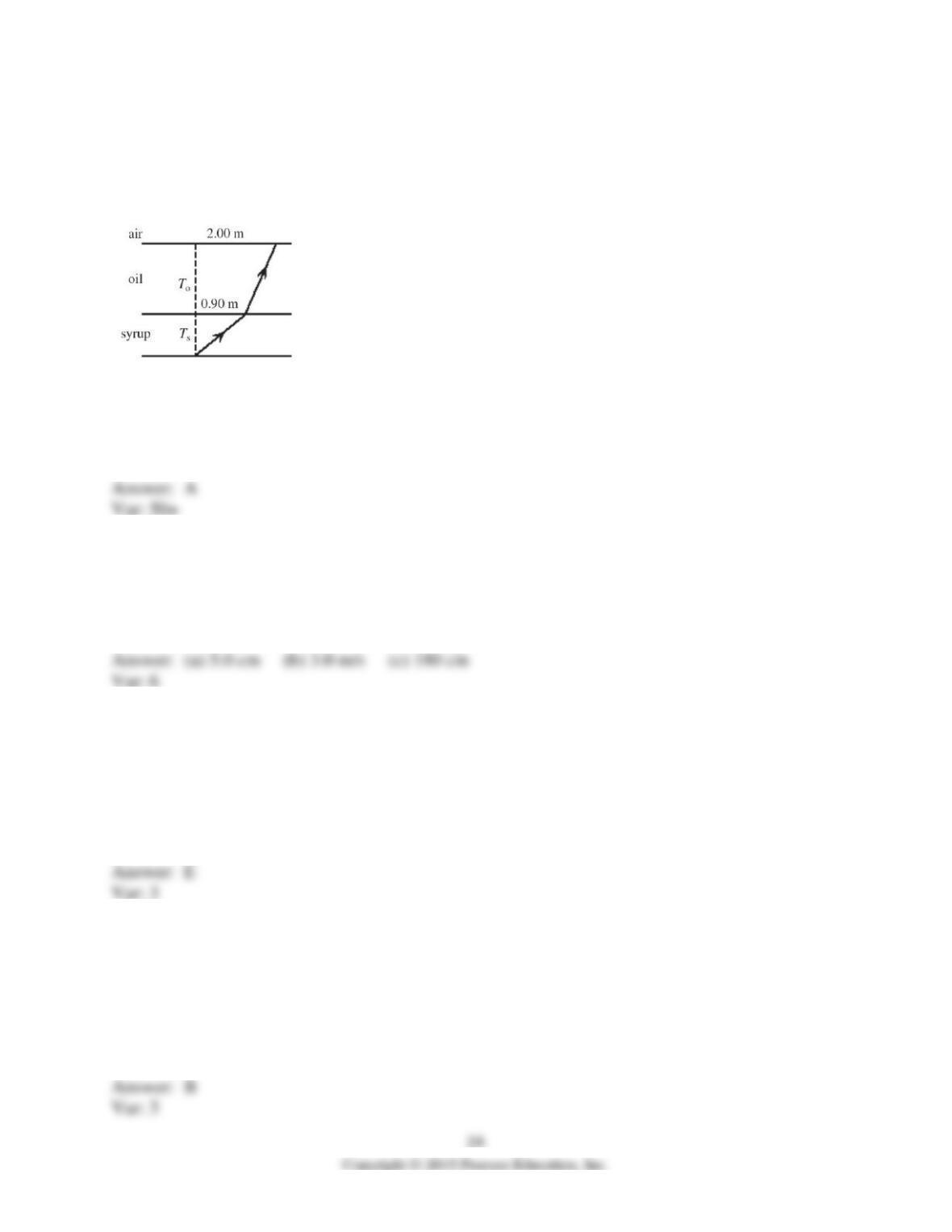
38) A tank holds a layer of oil, of thickness To = 1.65 m, that floats on a layer of syrup of
thickness Ts = 0.830 m, as shown in the figure. Both liquids are clear and do not mix together. A
light ray, originating at the bottom of the tank at point P, crosses the oil-syrup interface at a point
0.900 m from the axis. The ray continues and arrives at the oil-air interface, 2.00 m to the right
of P and at the critical angle. What is the index of refraction of the syrup?
A) 1.36
B) 1.25
C) 1.94
D) 1.75
E) 1.54
39) David stands 2.5 m in front of a plane mirror.
(a) How far from David is his image in the mirror?
(b) If David moves away from the mirror at 1.5 m/s, how fast are David and his image moving
apart from each other?
(c) If David is 180 cm tall, how tall is his image in the mirror?
40) An object that is 75 cm tall is located 3.8 m in front of a plane mirror. The image formed by
the mirror appears to be
A) 1.9 m in front of the mirror.
B) on the mirror’s surface.
C) 1.9 m behind the mirror’s surface.
D) 3.8 m in front of the mirror.
E) 3.8 m behind the mirror’s surface.
41) A laser beam strikes a plane mirror’s reflecting surface with an angle of incidence of 43°.
What is the angle between the incident ray and the reflected ray?
A) 43°
B) 86°
C) 45°
D) 90°
E) 0°

42) A person jogs toward a plane mirror at a speed of 3 m/s. How fast is he approaching his
image in the mirror?
A) 1 5 m/s
B) 3 m/s
C) 4 m/s
D) 5 m/s
E) 6 m/s
43) Two plane mirrors make an angle of with each other. A light ray enters the system and is
reflected once off of each mirror. Through what angle is the ray turned?
A) 60°
B) 90°
C) 120°
D) 150°
44) An object that is 3.4 mm tall is placed 25 cm from the vertex of a convex spherical mirror.
The radius of curvature of the mirror has magnitude 73 cm.
(a) How far is the image from the vertex of the mirror?
(b) What is the height of the image?
45) A statue that is 2.3 cm tall is placed 15 cm in front of a convex mirror. The magnitude of the
radius of curvature of the mirror is 18 cm.
(a) Is the image real or virtual?
(b) How far is the image from the mirror?
(c) Is the image upright or inverted?
(d) How tall is the image?
46) A stature that is 3.0 cm tall statue is 24 cm in front of a concave mirror. The magnitude of
the radius of curvature of the mirror is 20 cm.
(a) Is the image real or virtual?
(b) How far is the image from the mirror?
(c) Is the image upright or inverted?
(d) How tall is the image?

47) An object 2.0 cm tall is placed 24 cm in front of a convex mirror having a focal length of
magnitude 30 cm.
(a) Where is the image formed and how far is it from the mirror?
(b) How tall is the image?
48) An object that is 4.0 cm tall is placed 15 cm in front of a concave mirror of focal length 20
cm.
(a) Where is the image formed and how far is it from the mirror?
(b) How tall is the image?
49) When an object is 12 cm in front of a concave mirror, the image is 3.0 cm in front of the
mirror? What is the focal length of the mirror?
A) -0.25 cm
B) 15 cm
C) 4.0 cm
D) 2.4 cm
E) -1.3 cm
50) An object that is 4.00 cm tall is placed 18.0 cm in front of a concave mirror having a focal
length of 20.0 cm. What is the location of its image in relation to the mirror and what are its
characteristics?
A) 180 cm on the other side of mirror, real, 6.00 times bigger
B) 10 cm on the other side of mirror, virtual, 10.0 times bigger
C) 18 cm on the same side of mirror, virtual, 2.25 times bigger
D) 20 cm on the same side of mirror, real, 10.0 times bigger
E) 180 cm on the other side of mirror, virtual, 10.0 times bigger
51) An object that is 2.0 cm tall is placed at the center of curvature in front of a concave mirror.
How tall is its image?
A) 0.50 cm
B) 1.0 cm
C) 1.5 cm
D) 2.0 cm
E) infinite

52) An object is placed 50 cm in front of a concave mirror with a focal length of 25 cm. What is
the magnification produced by the mirror?
A) -0.50
B) -1.0
C) +1.5
D) -2.0
E) +1.0
53) An object that is 10.0 cm tall is placed 37.0 cm in front of a concave mirror of focal length
18.5 cm. How tall is the image?
A) 2.5 cm
B) 5.0 cm
C) 7.5 cm
D) 20.0 cm
E) 10.0 cm
54) Tan’s face is 20 cm in front of a concave shaving mirror. If he observes his image to be twice
as big and upright, what is the focal length of the mirror?
A) 10 cm
B) -40 cm
C) -50 cm
D) 40 cm
E) 50 cm
55) Reza’s face is 20 cm in front of a concave shaving mirror having a focal length of magnitude
30 cm. How large is the image of his face?
A) half as large as his face
B) of the same size as his face
C) twice as large as his face
D) three times as large as his face
E) four times as large as his face

56) A concave mirror having a focal length of magnitude 5.0 cm forms an image 4.0 cm behind
the mirror. Where is the object for this image?
A) 2.2 cm in front of the mirror
B) 2.2 cm behind the mirror
C) 9.0 cm in front of the mirror
D) 1.0 cm behind the mirror
E) 20 cm behind the mirror
57) A concave spherical mirror with a radius of curvature of 20 cm creates a real image 30 cm
from the mirror. How far is the object from the mirror?
A) 20 cm
B) 15 cm
C) 7.5 cm
D) 5.0 cm
58) When an object is 12 cm in front of a concave spherical mirror, the image is formed 3.0 cm
in front of the mirror. What is the focal length of the mirror?
A) 15 cm
B) 4.0 cm
C) 2.4 cm
D) 1.3 cm
59) An object is 10 cm in front of a concave spherical mirror with a focal length of magnitude
3.0 cm. Where is the image?
A) 13 cm from the mirror
B) 7.0 cm from the mirror
C) 4.3 cm from the mirror
D) 3.3 cm from the mirror
60) A concave spherical mirror has a focal length of magnitude 20 cm. An object is placed 10
cm in front of the mirror on the mirror’s axis. Where is the image located?
A) 20 cm behind the mirror
B) 20 cm in front of the mirror
C) 6.7 cm behind the mirror
D) 6.7 cm in front of the mirror

61) A concave spherical mirror has a focal length of magnitude 20 cm. An object is placed 30
cm in front of the mirror on the mirror’s axis. Where is the image located?
A) 12 cm behind the mirror
B) 12 cm in front of the mirror
C) 60 cm behind the mirror
D) 60 cm in front of the mirror
62) An object is 5.7 cm from a spherical concave mirror. If the image is 4.7 cm tall and 10 cm
from the mirror, how tall is the object?
A) 12 cm
B) 11 cm
C) 8.2 cm
D) 2.7 cm
63) An object is placed 15 cm from a spherical concave mirror with a focal length of magnitude
20 cm. If the object is 4.0 cm tall, how tall is the image?
A) 1.0 cm
B) 2.0 cm
C) 8.0 cm
D) 16 cm
64) An object that is 47.5 cm tall forms an image that is 38.6 cm tall and 14.8 cm from a
spherical mirror. How far is the object from the mirror?
A) 124 cm
B) 47.6 cm
C) 18.2 cm
D) 12.0 cm
65) A 1.4-cm tall flower is 4.0 cm from a spherical concave mirror. If the image of the flower is
4.0 cm tall, how far is the image from the mirror?
A) 11 cm
B) 9.4 cm
C) 1.4 cm
D) 0.090 cm

66) A plant that is 4.0 cm tall is placed 15 cm from a concave spherical mirror having a focal
length of magnitude 20 cm. Where is the image located?
A) 12 cm behind the mirror
B) 12 cm in front of the mirror
C) 60 cm behind the mirror
D) 60 cm in front of the mirror
67) When a person stands 40 cm in front of a cosmetic (concave) spherical mirror, the upright
image is twice the size of the object. What is the focal length of the mirror?
A) 27 cm
B) 40 cm
C) 80 cm
D) 160 cm
68) A person’s face is 30 cm in front of a concave spherical shaving mirror. If the image is an
erect image that is 1.5 times as large as the object, what is the focal length mirror?
A) 20 cm
B) 50 cm
C) 70 cm
D) 90 cm
69) An object is in front of a concave spherical mirror, and its image is 4.0 cm behind the mirror.
If the focal length of the mirror has a magnitude of 5.0 cm, where is the object?
A) 2.2 cm in front of the mirror
B) 2.2 cm behind the mirror
C) 9.0 cm in front of the mirror
D) 1.0 cm behind the mirror
70) A convex spherical mirror has a focal length of magnitude 20 cm. If an object is placed 10
cm in front of the mirror on the mirror’s axis, where is the image located?
A) 20 cm behind the mirror
B) 20 cm in front of the mirror
C) 6.7 cm behind the mirror
D) 6.7 cm in front of the mirror

71) A toy is 14 cm in front of a convex spherical mirror. If the image of the toy is 5.8 cm behind
the mirror, what is the focal length of the mirror?
A) -4.1 cm
B) +20 cm
C) -9.9 cm
D) -20 cm
E) +9.9 cm
72) A cell phone that is 8.90 cm tall is placed in front of a convex mirror. The image of the
phone is 7.80 cm tall and is located 14.8 cm from a mirror. What is the mirror’s focal length?
A) -120 cm
B) -105 cm
C) +16.9 cm
D) -13.0 cm
E) +120 cm
73) An object is 50 cm from a concave mirror of radius of curvature of magnitude 60 cm. How
far is the image from the mirror?
A) 19 cm
B) 35 cm
C) 60 cm
D) 75 cm
E) 120 cm
74) An object is 50 cm from a concave mirror with radius of curvature of magnitude 60 cm.
What is the lateral magnification produced by the mirror?
A) +0.40
B) +0.70
C) +1.5
D) -0.70
E) -1.5

75) An object is placed near a concave mirror having a radius of curvature of magnitude 60 cm.
How far should you place the object from the mirror so that the lateral magnification produced
by the mirror will be +2.5?
A) 18 cm
B) 24 cm
C) 30 cm
D) 36 cm
E) 42 cm
76) When an object is placed 118 cm from a thin diverging lens, its image is found to be 59 cm
from the lens. The lens is removed, and replaced by a thin converging lens whose focal length
has the same magnitude as the diverging lens. This second lens is at the original position of the
first lens. Where is the image of the object now?
77) A 3.0-cm tall statue is 48 cm in front of a convex lens having a focal length of magnitude 20
cm.
(a) Is the image of the statue real or virtual?
(b) How far is the image from the lens?
(c) Is the image upright or inverted?
(d) How tall is the image?
78) A slide projector is set up with its lens 6.0 m from the screen. The projected image on the
screen is 1.5 m square for a slide (the object) that is 2.5 cm square.
(a) How far is the slide from the lens?
(b) What is the focal length of the projector lens?
79) A certain slide projector has a lens of focal length 15.0 cm. This lens forms an image
measuring 100 cm × 100 cm on the screen when a slide whose dimensions are 50.0 mm × 50.0
mm is being magnified. How far from the lens should the screen be placed?
80) How far from a converging lens of focal length 30 cm must an object be placed so the image
will be virtual and 3.0 times as large as the object?

81) An object is placed 9.5 cm in front of a convex lens with a focal length of magnitude 24 cm.
(a) Where is the image formed and how far is it from the lens?
(b) What is the magnification produced by the lens?
82) A 4.0-cm tall apple is 20 cm in front of a plano-convex lens of focal length 75 cm.
(a) Find the location of the image of the apple. Is it a real or a virtual image?
(b) How tall is the image of the apple? Is it upright or inverted?
83) A cell phone is placed 40 cm in front of a converging lens with a focal length of magnitude
20 cm. How far is the image of this phone from the lens?
A) 40 cm
B) 20 cm
C) 13 cm
D) 60 cm
E) 10 cm
84) A coin is 12 cm in front of a converging lens with focal length of magnitude 4.0 cm. Where
is the image?
A) 8.0 cm behind the lens
B) 6.0 cm in front of the lens
C) 6.0 cm behind the lens
D) 4.0 cm in front of the lens
85) A seed is 15 mm in front of a converging lens, and the image of the seed is 4.0 mm behind
the lens. What is the focal length of the lens?
A) 11 mm
B) 5.5 mm
C) 3.8 mm
D) 3.2 mm

86) A 14-mm tall postage stamp is 4.0 mm from a converging lens. If the image of the stamp is
4.0 mm tall, how far is it from the lens?
A) 14 mm
B) 8.7 mm
C) 1.4 mm
D) 1.1 mm
87) When a flower petal is 4.0 cm in front of a converging lens, the inverted image is half the
height of the petal. What is the focal length of this lens?
A) 1.3 cm
B) 2.0 cm
C) 4.0 cm
D) 5.3 cm
88) An image is 4.0 mm in front of a converging lens with focal length of magnitude 5.0 mm.
Where is the object for this image?
A) 2.2 mm in front of the lens
B) 2.2 mm behind the lens
C) 9.0 mm behind the lens
D) 20 mm in front of the lens
89) A plant that is 4.1 cm tall is 10.3 cm from a converging lens. You observe that the image of
this plant is virtual and 6.2 cm tall. What is the focal length of the lens?
A) 6.8 cm
B) -30 cm
C) 16 cm
D) 30 cm
E) -16 cm
90) A lab specimen is 15.2 mm from a converging lens. The image is 4.0 mm tall and 9.0 cm
from the lens. How tall is the specimen?
A) 6.8 mm
B) 5.4 mm
C) 1.7 mm
D) 0.68 mm

35
91) A wrench is placed at 30 cm in front of a diverging lens with a focal length of magnitude 10
cm. What is the magnification of the wrench?
A) 0.25
B) -0.25
C) 0.67
D) -0.67
E) 4.0
92) A statue that is 10.4 cm tall is placed 4.8 cm in front of a concave lens. The image is 4.0 cm
from the lens. How tall is the image?
A) 13 cm
B) 8.7 cm
C) 5.4 cm
D) 1.8 cm
93) A cup that is 6.0 cm tall is in front of a concave lens. The image of the cup is 2.5 cm tall and
7.5 cm from the lens. What is the focal length of the lens?
A) -6.0 cm
B) -7.5 cm
C) -13 cm
D) +18 cm
E) +6.0 cm
94) A drawing is placed 40 cm in front of a thin lens. If a virtual image forms at a distance of 50
cm from the lens, on the same side as the drawing, what is the focal length of the lens?
A) -45 cm
B) 75 cm
C) 90 cm
D) 200 cm
95) How far from a lens having a focal length of +50 mm must the object be placed if it is to
form a virtual image that is 3.0 times the size of the object?
A) 33 mm
B) 42 mm
C) 48 mm
D) 54 mm

96) How far from a +50-mm focal length lens, such as is used in many 35-mm cameras, must an
object be placed so it will form a real image that is 3.0 times the size of the object?
A) 46 mm
B) 52 mm
C) 58 mm
D) 67 mm
97) An object is placed 15 cm to the left of a double-convex lens of focal length 20 cm. Where is
the image of this object located?
A) 60 cm to the right of the lens
B) 60 cm to the left of the lens
C) 8.6 cm to the right of the lens
D) 8.6 cm to the left of the lens
E) 30 cm to the left of the lens
98) A 4.0-cm tall object is placed 60 cm in front of a converging lens of focal length of
magnitude 30 cm. What are the nature and location of the image?
A) The image is real, 2.5 cm tall, 30 cm on the same side as object.
B) The image is virtual, 2.5 cm tall, 30 cm on the other side of the lens.
C) The image is virtual, 2.0 cm tall, 15 cm on the other side of the lens.
D) The image is virtual, 4.0 cm tall, 60 cm on the same side as object.
E) The image is real, 4.0 cm tall, 60 cm on the other side of the lens.
99) An object is placed 10 cm from a convex lens with a focal length of magnitude 20 cm. What
is the magnification?
A) 0.50
B) -2.0
C) 1.5
D) 2.0
E) -2.5
100) An object is placed 60 cm from a convex lens with a focal length of magnitude 10 cm.
What is the magnification?
A) -0.10
B) 0.10
C) 0.15
D) 0.20
E) -0.20
101) A 4.0-cm-tall object is placed 50.0 cm from a diverging lens having a focal length of
magnitude 25.0 cm. What is the nature and location of the image?
A) A real image, 4.0 cm tall, 20 cm other side of the object
B) A virtual image, 4.0 cm tall, 20 cm other side of the object
C) A virtual image, 2.0 cm tall, 10 cm other side of the object
D) A virtual image, 1.3 cm tall, 16.7 cm same side as the object
E) A real image, 1.3 cm tall, 16.7 cm same side as the object
102) An object is placed 21 cm from a concave lens having a focal length of magnitude 25 cm.
What is the magnification?
A) -0.54
B) 0.54
C) -0.32
D) -0.22
E) 0.22
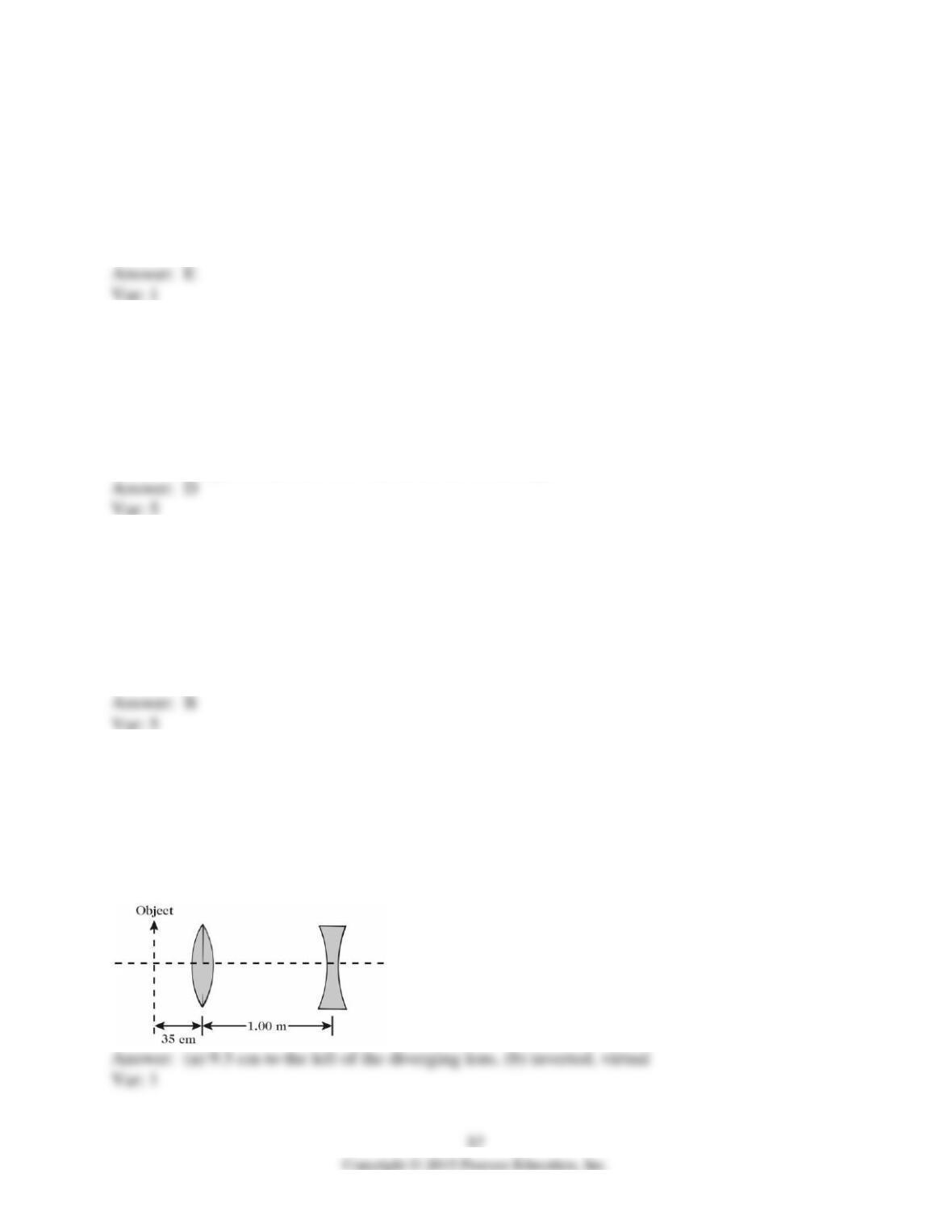
103) Two thin lenses, one a converging lens and the other a diverging lens, are separated by 1.00
m along the same principal axis, as shown in the figure. The magnitude of the focal length of the
converging lens is 25 cm, while the magnitude of the focal length of the diverging lens is 40 cm.
An object 8.25 cm tall is placed 35 cm to the left of the converging lens.
(a) Where is the final image produced by this combination of lenses? (Give your answer relative
to the diverging lens.)
(b) Compared to the object, is the final image upright or inverted? Is it real or virtual?