General Chemistry: Atoms First, 2e (McMurry and Fay)
Chapter 18 Hydrogen, Oxygen, and Water
18.1 Multiple Choice Questions
1) Which individual is generally given credit for the discovery of hydrogen gas?
A) Cavendish
B) Davy
C) Lavoisier
D) Priestley
2) The strongest homonuclear single bond is
A) H–H
B) C–C
C) N–N
D) O–O
3) Which is not an isotope of hydrogen?
A) hydrogen-1
B) hydrogen-2
C) hydrogen-3
D) hydrogen-4
4) Which isotope of diatomic hydrogen should have the highest heat of vaporization?
A) H2
B) D2
C) T2
D) The values are equal.
5) Differences in the physical properties of H2O and D2O are due to isotope effects. Which
comparison is not correct? Compared to H2O, D2O has a higher
A) boiling point.
B) density.
C) dissociation constant.
D) melting point.
6) The dissociation of D2O is shown below.
D2O ⇌ D+(aq) + OD–(aq) K = 1.95 × 10⁻¹⁵ at 25°C
In order to be acidic a D2O solution must have a pH (= pD) that is
A) greater than 7.00
B) greater than 7.35
C) less than 7.00
D) less than 7.35
7) If the molar mass of monoatomic deuterium (D) is 2.0141 grams then what is the density of
diatomic deuterium (D2) gas at 25.0°C and 1.00 atmosphere pressure?
A) 0.082 g/L
B) 0.165 g/L
C) 0.329 g/L
D) 12.2 g/L
8) What is not a commercial method for the preparation of hydrogen gas?
A) H2O(g) + CH4(g) → CO(g) + 3 H2(g)
B) 2 H2O(l) → 2 H2(g) + O2(g)
C) H2O(g) + C(s) → CO(g) + H2(g)
D) 4 H2O(g) + 3 Fe → Fe3O4(s) + 4 H2(g)
9) Write a chemical equation representing the water gas shift reaction.
A) H2O(g) + CH4(g) → CO(g) + 3 H2(g)
B) 2 H2O(l) → 2 H2(g) + O2(g)
C) CO(g) + H2O(g) → CO2(g) + H2(g)
D) 4 H2O(g) + 3 Fe → Fe3O4(s) + 4 H2(g)
10) The first step in the steam-hydrocarbon re-forming process is shown below.
H2O(g) + CH4(g) → CO(g) + 3 H2(g
What is the change in oxidation number of the atom undergoing oxidation in this reaction?
A) – 2
B) + 1
C) + 2
D) + 6
11) The largest single industrial use of hydrogen is
A) in the synthesis of methanol.
B) in the synthesis of ammonia.
C) in the hydrogenation of fats and oils.
D) as an automobile fuel.
12) What is the Lewis electron dot structure for the hydride ion?
A) H+
B) H: –
C) H ∙
D) H3O+
13) Which is an ionic binary hydride?
A) HCl
B) KH
C) both HCl and KH
D) neither HCl nor KH
14) In which set are all compounds considered to be ionic binary hydrides?
A) NaH, KH, CaH2, BaH2
B) MgH2, SrH2, AlH3, SiH4
C) BeH2, B2H6, CH4, NH3
D) MgH2, AlH3, SiH4, H2S
15) In which set are all compounds considered to be covalent binary hydrides?
A) NaH, KH, CaH2, BaH2
B) MgH2, SrH2, AlH3, SiH4
C) BeH2, B2H6, CH4, NH3
D) MgH2, AlH3, SiH4, H2S
16) Which of the following binary hydrides has the highest melting point?
A) AlH3
B) CaH2
C) NH3
D) SiH4
17) The net ionic reaction of solid CaH2 with water is
A) CaH2(s) + 2 H2O(l) → Ca(OH)2(aq) + 2 H2(g)
B) CaH2(s) + 2 H2O(l) → Ca2+(aq) + 2 OH–(aq) + 2 H2(g)
C) H–(aq) + H2O(l) → OH–(aq) + H2(g)
D) CaH2(s) + H2O(l) → CaO(s) + 2 H2(g)
18) Covalent hydrides of the type MH3 are likely to form with elements of what group?
A) 3A
B) 4A
C) 5A
D) 6A
19) What is the oxidation number of N in NH3?
A) -3
B) -1
C) +1
D) +3
20) Which transition metal hydride is commonly used in the purification of hydrogen gas?
A) Cu
B) Fe
C) Pt
D) Pd
21) Which element most readily forms nonstoichiometric hydrides?
A) Pd
B) Na
C) Sb
D) Si
22) Which will is least likely to form an interstitial hydride?
A) Si
B) Pd
C) Pt
D) Ti
23) Which is not true about elemental oxygen?
A) Oxygen exists in two allotropic forms.
B) Oxygen has a double bond.
C) Oxygen is a diamagnetic element.
D) Solid oxygen is pale blue in color
24) There are three isotopes of oxygen 16O, 17O and 18O. Indicate the number of different types
of isotopically substituted diatomic oxygen.
A) 3
B) 5
C) 6
D) 9
25) There are three different isotopes of hydrogen 1H, 2H, 3H and three different isotopes of
oxygen 16O, 17O, 18O. Indicate the number of different types of isotopically substituted water,
H2O, that could be formed.
A) 9
B) 12
C) 15
D) 18
26) Using the three different isotopes of oxygen 16O, 17O, 18O and the major isotope of
hydrogen, 1H. Determine the number of different types of isotopically substituted hydrogen
peroxide, H2O2, that could be formed.
A) 3
B) 5
C) 6
D) 9
27) Commercially oxygen is usually obtained by
A) decomposition of mercury(II) oxide.
B) decomposition of potassium chlorate.
C) electrolytic decomposition of water.
D) fractional distillation of air.
28) In the preparation of oxygen by the thermal decomposition of potassium chlorate shown
below, what is the oxidation number change of the atom undergoing reduction?
2 KClO3(s) → 2 KCl(s) + 3 O2(g)
A) – 8
B) – 6
C) + 1
D) + 2
29) At 25°C CO2 is a gas and SiO2 is a high-melting solid. In these compounds of oxygen
A) both carbon in CO2 and silicon in SiO2 are π-bonded to two oxygen atoms.
B) both carbon in CO2 and silicon in SiO2 are σ-bonded to four oxygen atoms.
C) carbon in CO2 is π-bonded to two oxygen atoms and silicon in SiO2 is σ-bonded to four
oxygen atoms.
D) silicon in SiO2 is π-bonded to two oxygen atoms and carbon in CO2 is σ-bonded to four
oxygen atoms.
30) Which is classified as an ionic binary oxide?
A) MgO
B) CO2
C) P2O5
D) SO3
31) Which is classified as an amphoteric binary oxide?
A) B2O3
B) CO2
C) Al2O3
D) SiO2
32) Which one of the following binary oxides is the most acidic?
A) Na2O
B) Al2O3
C) P2O5
D) Cl2O7
33) Which one of the following binary oxides is the most acidic?
A) P2O5
B) As2O5
C) Bi2O5
D) Cl2O7
34) Which of the following oxides has the highest melting point?
A) MgO
B) Na2O
C)
D) SO3
35) Which of the following oxides has the lowest melting point?
A)
B) Si
C)
D) MgO
36) Which of the following binary oxides is the most acidic?
A) Cr
B) C
C) CrO
D) MgO
37) Which one of the following binary oxides is the most basic?
A) Na2O
B) Al2O3
C) P2O5
D) SO3
38) Which one of the following binary oxides is the most basic?
A) B2O3
B) Al2O3
C) Ga2O3
D) In2O3
39) Which reaction is not consistent with the chemistry of binary oxides?
A) Na2O(s) + H2O(l) → 2 Na+(aq) + 2 OH–(aq)
B) SiO2(s) + 2 OH–(aq) → SiO32-(aq) + H2O(l)
C) Al2O3(s) + 6 H+(aq) → 2 Al3+(aq) + 3 H2O(l)
D) N2O5(aq) + 2 H+(aq) → 2 NO2+(aq) + H2O(l)
40) When sodium metal is heated in excess oxygen it tends to form
A) an oxide.
B) a peroxide.
C) a superoxide.
D) an oxide and a superoxide.
41) What is the chemical formula for the superoxide ion?
A) O–
B) O2-
C) O2–
D) O22-
42) Which of the following is a peroxide?
A) Li2O
B) K2O2
C) CaO
D) CsO2
43) What is the bond length trend for molecular oxygen, the peroxide ion, and superoxide ion?
A) O2 > O2– > O22-
B) O2 > O22- > O2–
C) O22- > O2– > O2
D) O22- > O2 > O2–
44) Which has the greatest number of unpaired electrons?
A) O2–
B) O2
C) O2–
D) O22–
45) What is the reaction of potassium peroxide in water?
A) 2 KO2(s) + H2O(l) → O2(g) + 2 K+(aq) + HO2–(aq) + OH–(aq)
B) K2O2(s) + H2O(l) → 2 K+(aq) + HO2–(aq) + OH–(aq)
C) 2 K2O2(s) + 2 H2O(l) → 4 K+(aq) + 4 OH–(aq) + O2(g)
D) K2O(s) + H2O(l) → 2 K+(aq) + 2 OH–(aq)
46) When KO2 is dissolved in water the evolution of oxygen takes place according to the
reaction In this reaction the O2– ion
undergoes
A) disproportionation.
B) isomerization.
C) only oxidation.
D) only reduction.
47) What is the oxidation number of oxygen in KO2?
A) 0
B) -1/2
C) -1
D) -2
48) What is the oxidation number of oxygen in BaO2?
A) 0
B) -1/2
C) -1
D) -2
49) In which compound does oxygen have a -1 oxidation state?
A) H2O
B) H2O2
C) O2
D) MgO
50) What is not a characteristic of the aqueous chemical reactions of hydrogen peroxide?
A) It is a strong oxidizing agent.
B) It is a reducing agent.
C) It behaves as a weak base.
D) It undergoes disproportionation.
51) Indicate the coefficient in front of H2O2 when the following redox equation is balanced in an
acidic medium.
H2O2(aq) + Cl–(aq) → H2O(l) + Cl2(aq)
A) 1
B) 2
C) 3
D) 4
52) Indicate the coefficient in front of H2O2 when the following redox equation is balanced in an
acidic medium.
H2O2(aq) + MnO4–(aq) → O2(g) + Mn2+(aq)
A) 2
B) 3
C) 5
D) 7
53) In which of the following reactions does hydrogen peroxide act as a reducing agent?
A) PbS(s) + 4 H2O2(aq) → PbSO4(s) + 4 H2O(l)
B) H2O2(aq) + 2 H+(aq) + 2I–(aq) → 2 H2O(l) + I2(aq)
C) 5 H2O2(aq) + 2 MnO4–(aq) + 6 H+(aq) → 8 H2O(l) + 5 O2(g) + 2 Mn2+(aq)
D) 2 Fe2+(aq) + H2O2(aq) + 2 H+(aq) → 2 Fe3+(aq) + 2 H2O(l)
54) What are the allotropes of oxygen?
A) O and O2
B) O2 and O3
C) O, O2 and O3
D) O2, O3 and O4
55) What is not a characteristic of ozone, O3?
A) It is a nonlinear triatomic system.
B) It has one single bond and one double bond.
C) It is an extremely powerful oxidizing agent.
D) It is made by passing an electrical discharge through oxygen.
56) In the reaction of ozone shown below, which of the following unbalanced half-reactions
shows the species undergoing reduction and the reduced product?
O3(g) + 2 I–(aq) + H2O(l) → O2(g) + I2(s) + 2 OH–(aq)
A) O3(g) → O2(g)
B) O3(g) → OH–(aq)
C) H2O(l) → O2(g)
D) H2O(l) → OH–(aq)
57) An estimated 1.35 × 10¹⁸ m3 of water is present in the earth’s oceans. Assuming water has a
density of 1 g/mL then how many kilograms of water does this volume contain?
A) 1.35 × 10⁹ kg
B) 1.35 × 10¹² kg
C) 1.35 × 10²¹ kg
D) 1.35 × 1034 kg
58) Water accounts for approximately two-thirds of the mass of the adult human body. If an
adult human has a mass of 145 pounds, how many water molecules are there in the adult human’s
body?
A) 96.7 molecules
B) 2.43 × 10³ molecules
C) 1.47 × 1027 molecules
D) 2.20 × 1027 molecules
59) Which of the following chemical reagents is not used in the purification of water?
A) NaNO3
B) Cl2
C) CaO
D) Al2(SO4)3
60) What are the four major ionic constituents of seawater?
A) Cl–, Na+, Mg2+, HCO3–
B) Cl–, Na+, SO42-, Mg2+
C) Cl–, Na+, SO42- , HCO3–
D) Na+, SO42-, Mg2+, Ca2+
61) What are the three major chemicals that are commercially obtained from seawater?
A) sodium chloride, magnesium, and bromine
B) sodium chloride, calcium carbonate, sodium sulfate
C) sodium chloride, sodium bromide, sodium carbonate
D) sodium chloride, calcium chloride, calcium carbonate
62) All of the following are reactions commonly associated with water except
A) 2 Na(s) + 2 H2O(l) → H2(g) + 2 Na+(aq) + 2 OH–(aq)
B) Ca(s) + 2 H2O(l) → H2(g) + Ca2+(aq) + 2 OH–(aq)
C) F2(g) + H2O(l) → HOF(aq) + HF(aq)
D) Cl2(g) + H2O(l) → HOCl(aq) + H+(aq) + Cl–(aq)
63) Which one of the following compounds is a hydrate?
A) H2O2
B) H2SO4
C) CoCl2 ∙ 6 H2O
D) Cu(OH)2
16
64) Which compound is not considered to be a hydrate?
A) [Mg(H2O)6](ClO4)2
B) [Al(H2O)6]Cl3
C) CuSO4 ∙ H2O
D) HOClO2
65) Compounds that absorb water from the atmosphere are said to be
A) hygroscopic.
B) macroscopic.
C) orthoscopic.
D) symbiotic.
66) When all water is removed from a hydrate the resulting product is said to be
A) androgenous.
B) anhydrous.
C) arable.
D) arid.
67) What is the anhydrous form of nitric acid, HNO3?
A) NO
B) NO2
C) N2O3
D) N2O5
68) What is the anhydrous form of sulfuric acid, H2SO4?
A) SO2
B) SO3
C) SO32-
D) SO42-
69) When 0.500 grams of CuSO4 ∙ 5H2O is heated at a temperature of 300°C for twenty minutes
it loses some water of hydration. If the resulting sample weighs 0.427 grams then what is the
formula of the compound?
A) CuSO4 ∙ H2O
B) CuSO4∙ 2H2O
C) CuSO4∙ 3H2O
D) CuSO4∙ 4H2O
70) When 3.600 grams of anhydrous magnesium chloride were exposed to moist air, water was
absorbed by the sample. If the resulting hydrated compound has a mass of 4.962 grams, what is
the chemical formula of the hydrate?
A) MgCl2∙ H2O
B) MgCl2∙ 2H2O
C) MgCl2∙ 3H2O
D) MgCl2∙ 4H2O
71) A 7.63-gram sample of hydrated magnesium sulfate MgSO4∙ xH2O is heated until all of the
water is driven off. If 3.72 grams of anhydrous MgSO4 is obtained, how many water molecules
combine with each formula unit of magnesium sulfate in the hydrate?
A) 5
B) 6
C) 7
D) 8
72) When 5.60 grams of anhydrous copper(II) sulfate is exposed to moist air, it absorbs water. If
the hydrated copper compound has a mass of 8.13 grams, what is the chemical formula of the
hydrate?
A) CuSO4∙ 2H2O
B) CuSO4∙ 3H2O
C) CuSO4∙ 4H2O
D) CuSO4∙ 5H2O
73) When 3.00 grams of the anhydrous blue colored CoCl2 is exposed to moist air it forms 5.50
grams of the red-violet hydrate. Determine the number of moles of water that
combine with one mole of CoCl2.
A) 4
B) 6
C) 8
D) 10
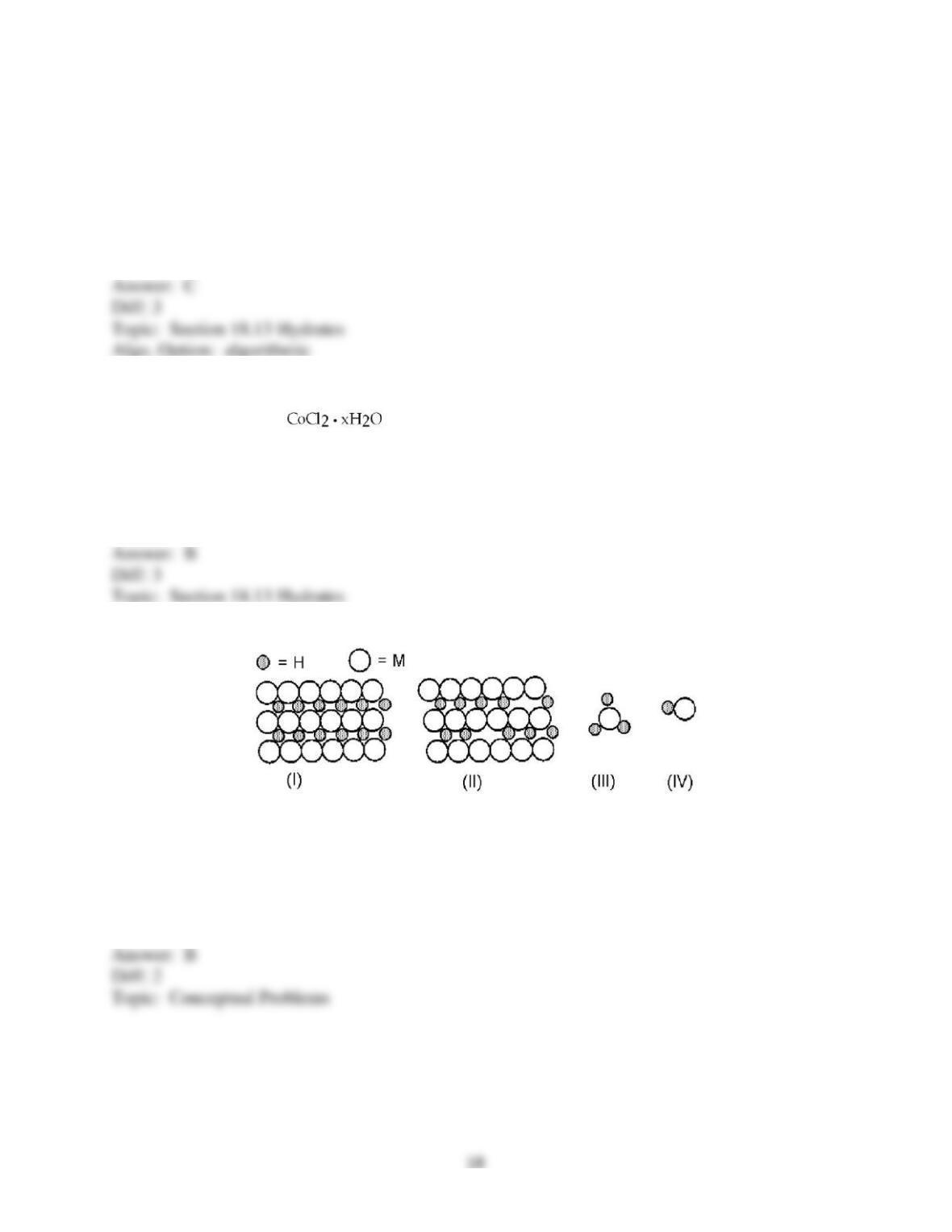
74) From the above models of hydrides, indicate the one most representative of an interstitial
metallic hydride.
A) I
B) II
C) III
D) IV
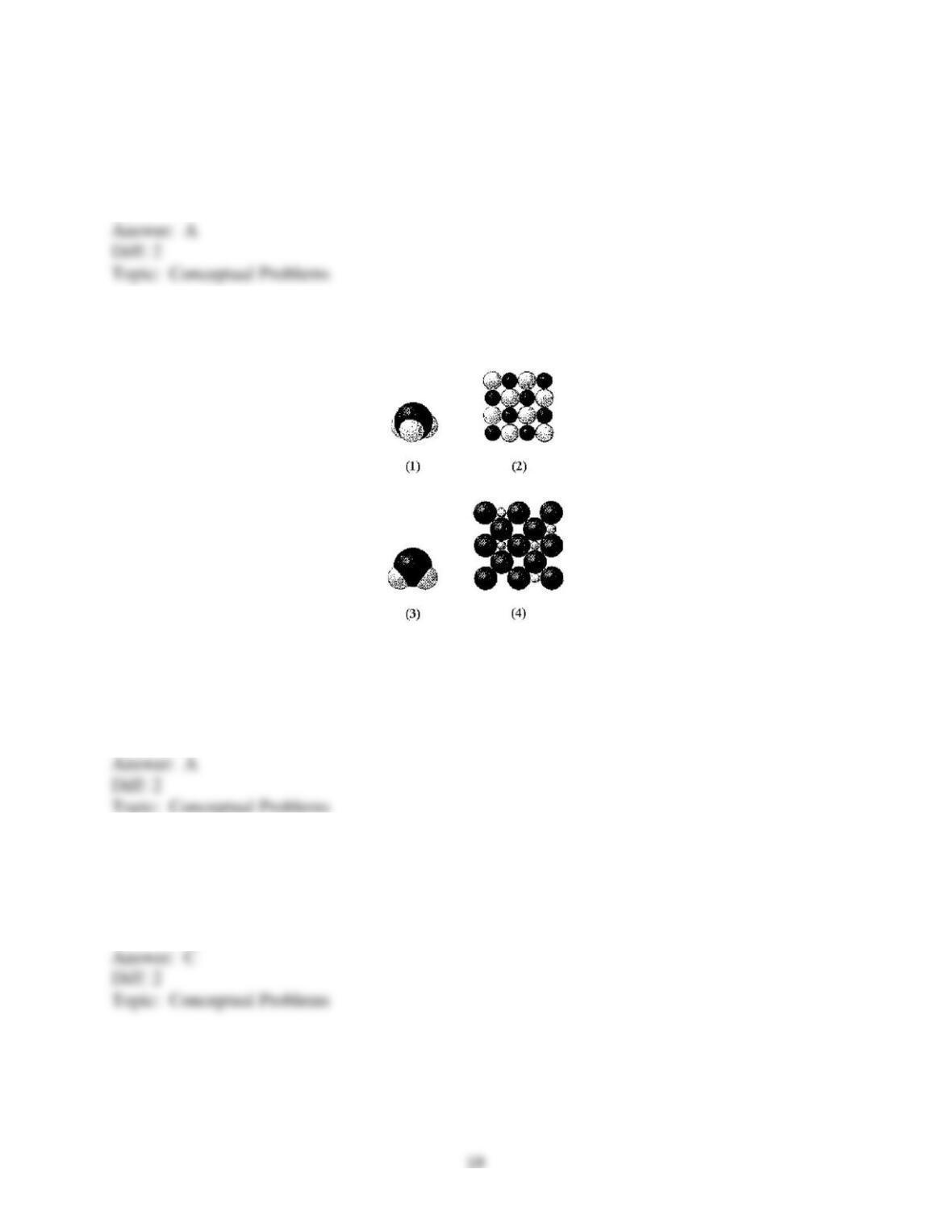
75) Using the above models of hydrides, indicate the one most representative of an ionic hydride.
A) I
B) II
C) III
D) IV
In the following pictures representing binary hydrides AHx, lightly-shaded spheres represent H
atoms or ions and darkly-shaded spheres represent atoms or ions of the other element, A.
76) The binary hydride shown in picture (1) is classified as
A) covalent.
B) interstitial (metallic).
C) ionic.
D) none of the above
77) The binary hydride shown in picture (2) is classified as
A) covalent.
B) interstitial (metallic).
C) ionic.
D) none of the above