Chemistry, 7e (McMurry/Fay)
Chapter 18 Electrochemistry
18.1 Multiple-Choice Questions
1) What are the coefficients in front of NO3–(aq) and Cu(s) when the following redox equation is balanced
in an acidic solution:
________ NO3–(aq) + ________ Cu(s) → ________ NO(g) + ________ Cu2+(aq)?
A) 2, 3
B) 2, 6
C) 3, 4
D) 3, 6
2) What is true when the following equation is balanced in basic solution?
P(s) + PO43-(aq) → HPO32-(aq)
A) H+ appears on the left side of the equation.
B) H+ appears on the right side of the equation.
C) OH– appears on the left side of the equation.
D) OH– appears on the right side of the equation.
3) Determine the number of water molecules necessary to balance the following chemical equation.
Cr2O72-(aq) + Cl–(aq) + H+(aq) → Cr3+(aq) + Cl2(g) + ________ H2O(l)
A) 3
B) 5
C) 7
D) 14
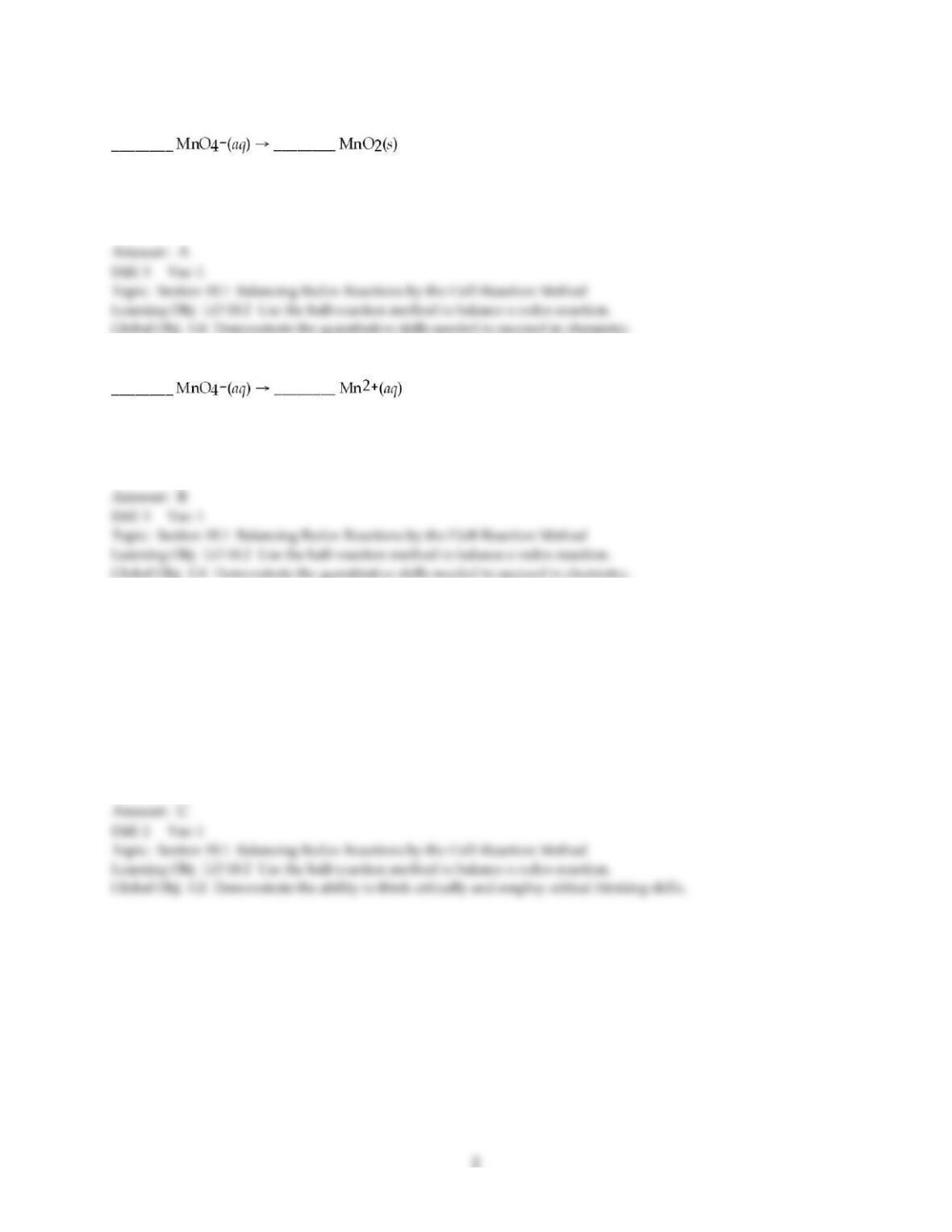
4) Determine the number of water molecules necessary to balance the reduction half reaction of
that occurs in a basic solution.
A) 2
B) 3
C) 4
D) 5
5) Determine the number of water molecules necessary to balance the reduction half reaction of
that occurs in an acidic solution.
A) 2
B) 4
C) 5
D) 7
6) What is the oxidation half reaction in the following chemical reaction?
Cr2O72-(aq) + 6 Cl–(aq) + 14 H+(aq) → 2 Cr3+(aq) + 3 Cl2(aq) + 7 H2O(l)
A) Cr2O72-(aq) + 14 H+(aq) + 6e– → 2 Cr3+(aq) + 7 H2O(l)
B) Cr2O72-(aq) + 14 H+(aq) → 2 Cr3+(aq) + 7 H2O(l) + 6e–
C) 2 Cl–(aq) → Cl2(aq) + 2e–
D) Cl2(aq) + 2e– → 2 Cl–(aq)
7) What is the reduction half reaction for the following chemical reaction in a basic solution?
ClO–(aq) + Cr(OH)4–(aq) → CrO42-(aq) + Cl–(aq)
A) ClO–(aq) + 2 H+(aq) + 2e– → Cl–(aq) + H2O(l)
B) ClO–(aq) + H2O(l) + 2e– → Cl–(aq) + 2 OH–(aq)
C) Cr(OH)4–(aq) + 4 OH–(aq) → CrO42-(aq) + 4 H2O(l) + 3e–
D) Cr(OH)4–(aq) → CrO42-(aq) + 4 H+(aq) + 3e–
8) According to the balanced equation shown below, 1.00 mole of oxalic acid, H2C2O4, reacts with
________ moles of permanganate ion, MnO4–.
5 H2C2O4(aq) + 2 MnO4–(aq) + 6 H+(aq) → 10 CO2(g) + 2 Mn2+(aq) + 8 H2O(l)
A) 0.400
B) 1.00
C) 2.00
D) 2.25
9) According to the balanced chemical equation
5 H2C2O4(aq) + 2 MnO4–(aq) + 6 H+(aq) → 10 CO2(g) + 2 Mn2+(aq) + 8 H2O(l)
0.3500 grams of oxalic acid, H2C2O4 will react with ________ mL of 0.100 M potassium permanganate,
KMnO4 solution.
A) 15.5 mL
B) 38.9 mL
C) 77.7 mL
D) 97.2 mL

10) Based on the balanced chemical equation shown below, what volume of 0.250 M K2S2O3(aq) is
needed to completely react with 12.44 mL of 0.125 M KI3(aq)?
2 S2O32-(aq) + I3–(aq) → S4O62-(aq) + 3 I–(aq)
A) 3.11 mL
B) 6.22 mL
C) 12.4 mL
D) 49.8 mL
11) What is the molarity of a potassium triiodide solution, KI3(aq), if 30.00 mL of the solution is required
to completely react with 25.00 mL of a 0.200 M thiosulfate solution, Na2S2O3(aq)? The chemical equation
for the reaction is:
A) 0.0833 M
B) 0.120 M
C) 0.167 M
D) 0.333 M
12) Based on the balanced chemical equation shown below, determine the molarity of a solution
containing Fe2+(aq), if 40.00 mL of the Fe2+(aq) solution is required to completely react with 30.00 mL of a
0.125 M potassium bromate, KBrO3(aq), solution.The chemical equation for the reaction is:
6 Fe2+(aq) + BrO3–(aq) + 6 H+(aq) → 6 Fe3+(aq) + Br–(aq) + 3 H2O(l).
A) 0.0156 M
B) 0.0938 M
C) 0.562 M
D) 1.00 M
13) Based on the balanced chemical equation shown below, determine the mass percent of Fe3+ in a
0.6450 gram sample of iron ore, if 22.40 mL of a 0.1000 M stannous chloride, SnCl2(aq), solution is
required to completely react with the Fe3+ present in the ore sample. The chemical equation for the
reaction is:
2 Fe3+(aq) + Sn2+(aq) → 2 Fe2+(aq) + Sn4+(aq).
A) 6.196%
B) 9.697%
C) 19.40%
D) 38.79%
14) Which of the following terms can be used to describe an electrochemical cell in which a spontaneous
chemical reaction generates an electric current?
I. an electrolytic cell
II. a galvanic cell
III. a voltaic cell
A) only I
B) only II
C) only III
D) II and III
15) Which cell involves a nonspontaneous redox reaction?
A) concentration cell
B) electrolytic cell
C) fuel cell
D) galvanic cell
6
16) During an electrochemical reaction, electrons move through the external circuit toward the ________
and positive ions in the cell move toward the ________.
A) anode, anode
B) anode, cathode
C) cathode, anode
D) cathode, cathode
17) For a galvanic cell, the cathode has a ________ sign and is the site of ________.
A) negative, oxidation
B) negative, reduction
C) positive, oxidation
D) positive, reduction
18) In a galvanic cell, the half-reaction MnO4–(aq) + 8 H+(aq) + 5 e– → Mn2+(aq) + 4 H2O(l) is
A) an oxidation half-reaction and occurs at the anode.
B) an oxidation half-reaction and occurs at the cathode.
C) a reduction half-reaction and occurs at the anode.
D) a reduction half-reaction and occurs at the cathode.
19) In a galvanic cell, the half-reaction H2(g) + 2 OH–(aq) → 2 H2O(l) + 2 e– is
A) an oxidation half-reaction and occurs at the anode.
B) an oxidation half-reaction and occurs at the cathode.
C) a reduction half-reaction and occurs at the anode.
D) a reduction half-reaction and occurs at the cathode.
20) What species is oxidized in the reaction: CuSO4(aq) + Mg(s) → MgSO4(aq) + Cu(s)?
A) CuSO4 (aq)
B) Mg (s)
C) MgSO4 (aq)
D) Cu (s)
21) What is the reduction half-reaction for the following overall cell reaction?
Ni2+(aq) + 2 Ag(s) → Ni(s) + 2 Ag+(aq)
A) Ag(s) + e– → Ag+(aq)
B) Ag+(aq) + e– → Ag(s)
C) Ni2+(aq) + 2 e– → Ni(s)
D) Ni2+(aq) + e– → Ni(s)
22) The iron content of foods can be determined by dissolving them in acid (forming Fe3+), reducing the
iron(III) to iron(II), and titrating with cerium(IV):
Fe2+(aq) + Ce4+(aq) → Fe3+(aq) + Ce3+(aq).
Identify the two half-reactions in the above reaction.
A) oxidation half-reaction reduction half-reaction
Fe2+(aq) + e–→ Fe3+(aq) Ce4+(aq) → Ce3+(aq) + e–
B) oxidation half-reaction reduction half-reaction
Fe2+(aq) → Fe3+(aq) + e– Ce4+(aq) + e– → Ce3+(aq)
C) oxidation half-reaction reduction half-reaction
Ce4+(aq) + e– → Ce3+(aq) Fe2+(aq) → Fe3+(aq) + e–
D) oxidation half-reaction reduction half-reaction
Ce4+(aq) → Ce3+(aq) + e– Fe2+(aq) + e– → Fe3+(aq)
23) For a galvanic cell that uses the following two half-reactions,
Cr2O72-(aq) + 14 H+(aq) + 6 e– → 2 Cr3+(aq) + 7 H2O(l)
Pb(s) → Pb2+(aq) + 2 e–
how many moles of Pb(s) are oxidized by one mole of Cr2O72-?
A) 1
B) 2
C) 3
D) 6
24) What is the shorthand notation that represents the following galvanic cell reaction?
Fe(s) + Cu(NO3)2(aq) → Fe(NO3)2(aq) + Cu(s)
A) Fe(s) ∣ Fe2+(aq) ∣∣ Cu2+(aq) ∣ Cu(s)
B) Cu(s) ∣ Cu2+(aq) ∣∣ Fe2+(aq) ∣ Fe(s)
C) Fe(s) ∣ NO3–(aq) ∣∣ NO3–(aq) ∣ Cu(s)
D) Cu(s) ∣ Cu(NO3)2(aq) ∣∣ Fe(NO3)2(aq) ∣ Fe(s)
25) What is the shorthand notation that represents the following galvanic cell reaction?
2 Fe2+(aq) + Cl2(g) → 2 Fe3+(aq) + 2 Cl–(aq)
A) Fe2+(aq) ∣ Fe3+(aq) ∣∣ Cl2(g) ∣ Cl–(aq)
B) Fe(s) ∣ Fe2+(aq) ∣∣ Fe3+(aq) Cl2(g) ∣ Cl–(aq) ∣ C(s)
C) Pt(s) ∣ Fe3+(aq), Fe2+(aq), Cl2(g) ∣∣ Cl–(aq) ∣ C(s)
D) Pt(s) ∣ Fe2+(aq), Fe3+(aq) ∣∣ Cl2(g) ∣ Cl–(aq) ∣ C(s)
26) What is the shorthand notation for a galvanic cell that represents the following galvanic cell reaction?
Br2(l) + 2 I–(aq) → 2 Br–(aq) + I2(s)
A) I–(aq)|I2(s) ∣∣Br2(l)|Br–(aq)
B) I–(aq)|I2(s) ∣∣Br2(l)|Br–(aq)|Pt(s)
C) Pt(s)|I–(aq)|I2(s) ∣∣Br2(l)|Br–(aq)
D) Pt(s)|I–(aq)|I2(s) ∣∣Br2(l)|Br–(aq)}Pt(s)
27) The shorthand notation for the galvanic cell reaction Fe3+(aq) + 2 I–(aq) → Fe2+(aq) + I2(s) requires an
inert electrode on
A) both sides of the salt bridge.
B) neither side of the salt bridge.
C) only on the left side of the salt bridge.
D) only on the right side of the salt bridge.
28) For the galvanic cell reaction, expressed below using shorthand notation, what half-reaction occurs at
the cathode?
Zn(s) ∣ Zn2+(aq) ∣∣ Ni2+(aq) ∣ Ni(s)
A) Zn(s) → Zn2+(aq) + 2 e–
B) Zn2+(aq) + 2 e– → Zn(s)
C) Ni(s) → Ni2+(aq) + 2 e–
D) Ni2+(aq) + 2 e– → Ni(s)
29) What is the balanced chemical equation for the galvanic cell reaction expressed using shorthand
notation below?
Al(s) ∣ Al3+(aq) ∣∣ Ni2+(aq) ∣ Ni(s)
A) 2 Al(s) + 3 Ni2+(aq) → 2 Al3+(aq) + 3 Ni(s)
B) 3 Al(s) + 2 Ni2+(aq) → 3 Al3+(aq) + 2 Ni(s)
C) 2 Ni(s) + 3 Al3+(aq) → 2 Ni2+(aq) + 3 Al(s)
D) 3 Ni(s) + 2 Al3+(aq) → 3 Ni2+(aq) + 2 Al(s)
11
30) What is the balanced equation for the galvanic cell reaction expressed using shorthand notation
below?
Mg(s) ∣ Mg2+(aq) ∣∣ Cl2(g) ∣ Cl–(aq) ∣ C(s)
A) Mg(s) + 2 Cl–(aq) → Mg2+(aq) + Cl2(g)
B) Mg(s) + Cl2(g) → Mg2+(aq) + 2 Cl–(aq)
C) Mg2+(aq) + 2 Cl–(aq) → Mg(s) + Cl2(g)
D) Mg2+(aq) + 2 Cl–(aq) → MgCl2(s)
31) Write the overall cell reaction for the galvanic cell given below.
Pt(s) ∣ H2(g) ∣ H+(aq) ∣∣ Cl2(g) ∣ Cl–(aq) ∣ Pt(s)
A) Pt(s) + H2(g) + Cl–(aq) → Pt(s) + 2 H+(aq) + 2 Cl2(g)
B) 2 H+(aq) + 2 Cl2(g) → 2 HCl(aq)
C) H2(g) + Cl2(g) → 2 H+(aq) + 2 Cl–(aq)
D) No reaction would occur because there is no salt bridge.
32) In a galvanic cell constructed from Pb(s) | Pb+2(aq) || Hg+1 | Hg(s), which of the electrodes will gain
mass?
A) the anode, Pb (s)
B) the cathode, Pb (s)
C) the anode, Hg (s)
D) the cathode, Hg (s)
12
33) What is the relation between joules (J), volts (V), and coulombs (C)?
A) 1 J = 1 V × 1 C
B) 1 J = 1 V ÷ 1 C
C) 1 J = 1 C ÷ 1 V
D) 1 J = 1 V × 1 C2
34) The cell reaction for a dry cell battery is
Zn(s) + 2 MnO2(s) + 2 NH4+(aq) → 2 NH3(aq) + Mn2O3(s) + Zn2+(aq) + H2O(l).
The standard cell potential for this cell is 1.56 V. What is the standard free energy change for this cell?
A) +151 kJ
B) -151 kJ
C) -301 kJ
D) -602 kJ
35) For the reaction 2 Al(s) + 3 Co2+(aq) → 2 Al3+(aq) + 3 Co(s), ΔG° is -799 kJ. What is E° for a standard
cell based on this reaction?
A) +1.38 V
B) +2.76 V
C) +4.14 V
D) +8.28 V
13
36) The nickel-cadmium battery cell has a standard potential of +1.20 V. The cell reaction is
2 NiO(OH)(s) + Cd(s) + 2 H2O(l) → 2 Ni(OH)2(s) + Cd(OH)2(s).
What is the standard free energy change for this reaction?
A) -38.7 kJ
B) -116 kJ
C) -232 kJ
D) -463 kJ
37) Doubling all the coefficients in the equation for the cell reaction
A) doubles both E° and ΔG°.
B) doubles E°, but does not change ΔG°.
C) doubles ΔG°, but does not change E°.
D) does not change E° or ΔG°.
38) For the hypothetical reaction A + Bx → Ax + B, E° = 1.19 V = and ΔG° = -115 kJ. For this reaction the
value of x = .
A) 1
B) 2
C) 3
D) 4
14
39) For the hypothetical reaction A + 2 Bx → Ay + 2 B, E° = 1.50 V = and ΔG° = –305 kJ. For this reaction, if
the value of x is 4, then the value of y = .
A) 1
B) 2
C) 3
D) 4
40) Which is not true for standard electrode potentials?
A) Cell constituents are in their standard states.
B) E° for oxidation is the negative of E° for reduction.
C) The half-reactions are written as reductions.
D) The potential for the standard hydrogen electrode is chosen to be +1.00 V.
41) The standard potential for the following galvanic cell is +0.90 V:
3 Cu2+(aq) + 2 Ga(s) ⇌ 3 Cu(s) + 2 Ga3+(aq)
Given that the standard reduction potential for the Cu2+/Cu half-cell is +0.34 V, what is the standard
reduction potential for the Ga3+/Ga half-cell?
A) -1.34 V
B) -0.56 V
C) +0.56 V
D) +1.36 V
42) A galvanic cell consists of a La3+/La half-cell and a standard hydrogen electrode. If the La3+/La half-
cell standard cell functions as the anode, and the standard cell potential is 2.52 V, what is the standard
reduction potential for the La3+/La half-cell?
A) -2.52 V
B) -0.84 V
C) +0.84 V
D) +2.52 V
43) A galvanic cell consists of one half-cell that contains Ag(s) and Ag+(aq), and one half-cell that contains
Cu(s) and Cu2+(aq). What species are produced at the electrodes under standard conditions?
Ag+(aq) + e– → Ag(s) E° = +0.80 V
Cu2+(aq) + 2 e– → Cu(s) E° = +0.34 V
A) Ag(s) is formed at the cathode, and Cu(s) is formed at the anode.
B) Ag(s) is formed at the cathode, and Cu2+ (aq) is formed at the anode.
C) Cu(s) is formed at the cathode, and Ag+(aq) is formed at the anode.
D) Cu2+(aq) is formed at the cathode, and Cu(s) is formed at the anode.
44) Consider the following standard reduction potentials,
Al3+(aq) + 3 e– → Al(s) E° = -1.66 V
I2(s) + 2 e– → 2 I–(aq) E° = +0.54 V
Under standard conditions,
A) Al3+(aq) is a stronger oxidizing agent than I2(s), and I–(aq) is a stronger reducing agent than Al(s).
B) I2(s) is a stronger oxidizing agent than Al3+(aq), and Al(s) is a stronger reducing agent than I–(aq).
C) Al(s) is a stronger oxidizing agent than I–(aq), and Al3+(aq) is a stronger reducing agent than I2(s).
D) I–(aq) is a stronger oxidizing agent than Al(s), and I2(s) is a stronger reducing agent than Al3+(aq).
16
45) Using the following standard reduction potentials
Fe3+(aq) + e– → Fe2+(aq) E° = +0.77 V
Pb2+(aq) + 2 e– → Pb(s) E° = -0.13 V
calculate the standard cell potential for the galvanic cell reaction given below, and determine whether or
not this reaction is spontaneous under standard conditions.
Pb2+(aq) + 2 Fe2+(aq) → 2 Fe3+(aq) + Pb(s)
A) E° = -0.90 V, nonspontaneous
B) E° = -0.90 V, spontaneous
C) E° = +0.90 V, nonspontaneous
D) E° = +0.90 V, spontaneous
46) Given: Ag+(aq) + e– → Ag(s) E° = +0.799 V
AgI(s) + e– → Ag(s) + I–(aq) E° = -0.152 V
Ni2+(aq) + 2 e– → Ni(s) E° = -0.267 V
Which of the following reactions should be spontaneous under standard conditions?
I. 2 AgI(s) + Ni(s) → 2 Ag(s) + 2 I–(aq) + Ni2+(aq)
II. Ag+(aq) + I–(aq) → AgI(s)
A) I and II are both nonspontaneous.
B) I is nonspontaneous and II is spontaneous.
C) I is spontaneous and II is nonspontaneous.
D) I and II are both spontaneous.
47) Based on the half-reactions and their respective standard reduction potentials below, what is the
standard cell potential for the reaction that is expected to occur?
Fe3+(aq) + e– → Fe2+(aq) 0.77 V
Sn4+(aq) + 2 e– → Sn2+(aq) 0.15 V
Pb2+(aq) + 2 e– → Pb(s) -0.13 V
A) 0.28 V
B) 0.64 V
C) 0.90 V
D) 1.03 V
48) Based on the half-reactions and their respective standard reduction potentials below, which addition
to an aqueous solution containing Fe(NO3)2 will result in a reaction under standard-state conditions?
O2(g) + 4 H+ +4 e– → 2 H2O(l) 1.23 V
Fe3+(aq) + e– → Fe2+(aq) 0.77 V
Cu2+(aq) + 2 e– → Cu(s) 0.34 V
2 H+(aq) + 2 e– → H2(g) 0.00 V
Ni2+(aq) + + 2 e– → Ni(s) -0.26 V
Fe2+(aq) + 2 e– → Fe(s) -0.45 V
A) aqueous copper(II) acetate
B) nickel wire
C) hydrogen gas
D) oxygen gas
18
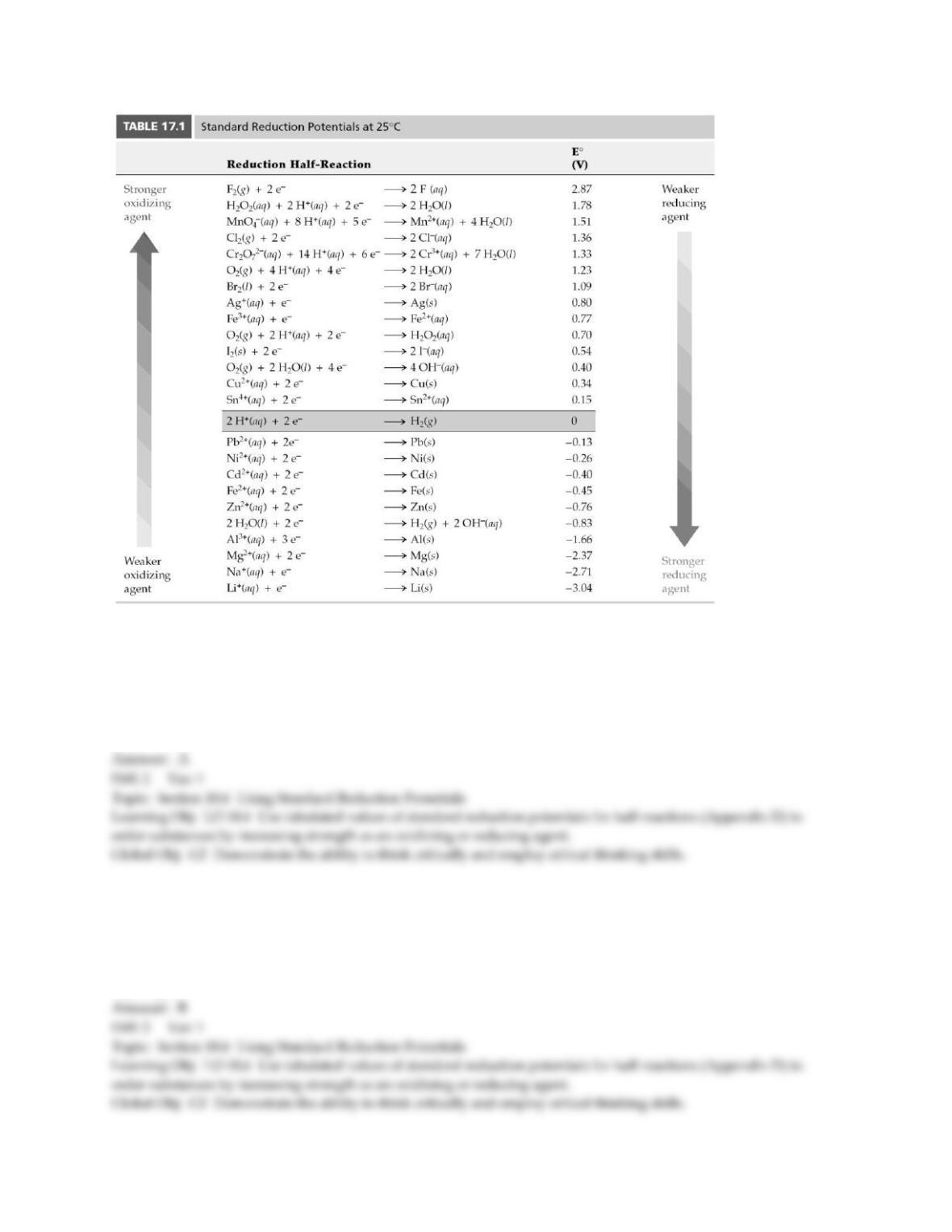
49) According to Table 17.1, which aqueous metal ion will reduce Ag+, but not Cu2+?
A) Fe2+
B) Fe3+
C) Mn2+
D) Sn2+
50) According to Table 17.1, which will reduce water but not Mg2+?
A) Al3+(aq)
B) Al(s)
C) Na+(aq)
D) Na(s)
51) Using Table 17.1, find E° for 2 H2O(l) → 2 H2(g) + O2(g).
A) -2.06 V
B) -1.23 V
C) -0.80 V
D) -0.40 V
52) Use Table 18.1 to calculate the standard potential for the reaction
O2(g) + 4 H+(aq) + 2 Cu(s) → 2 Cu2+(aq) + 2 H2O(l)
A) -1.57 V
B) -0.89 V
C) +0.89 V
D) +1.57 V
53) When suspected drunk drivers are tested with a Breathalyzer, the alcohol (ethanol) in the exhaled
breath is oxidized to acetic acid with an acidic solution of potassium dichromate:
3CH3CH2OH(aq) + 2Cr2O7-2 (aq) + 16H+(aq) 3CH3CO2H(aq) + 4Cr+3(aq) + 11H2O (l)
If Eº for this cell is 1.30V and the standard half-cell potential of Cr2O7-2(aq) to Cr+3 is 1.358 V, what is the
standard half-cell reduction potential for the conversion of acetic acid to ethanol?
A) 2.658 V
B) -2.658 V
C) + 0.058 V
D) -0.058 V
20
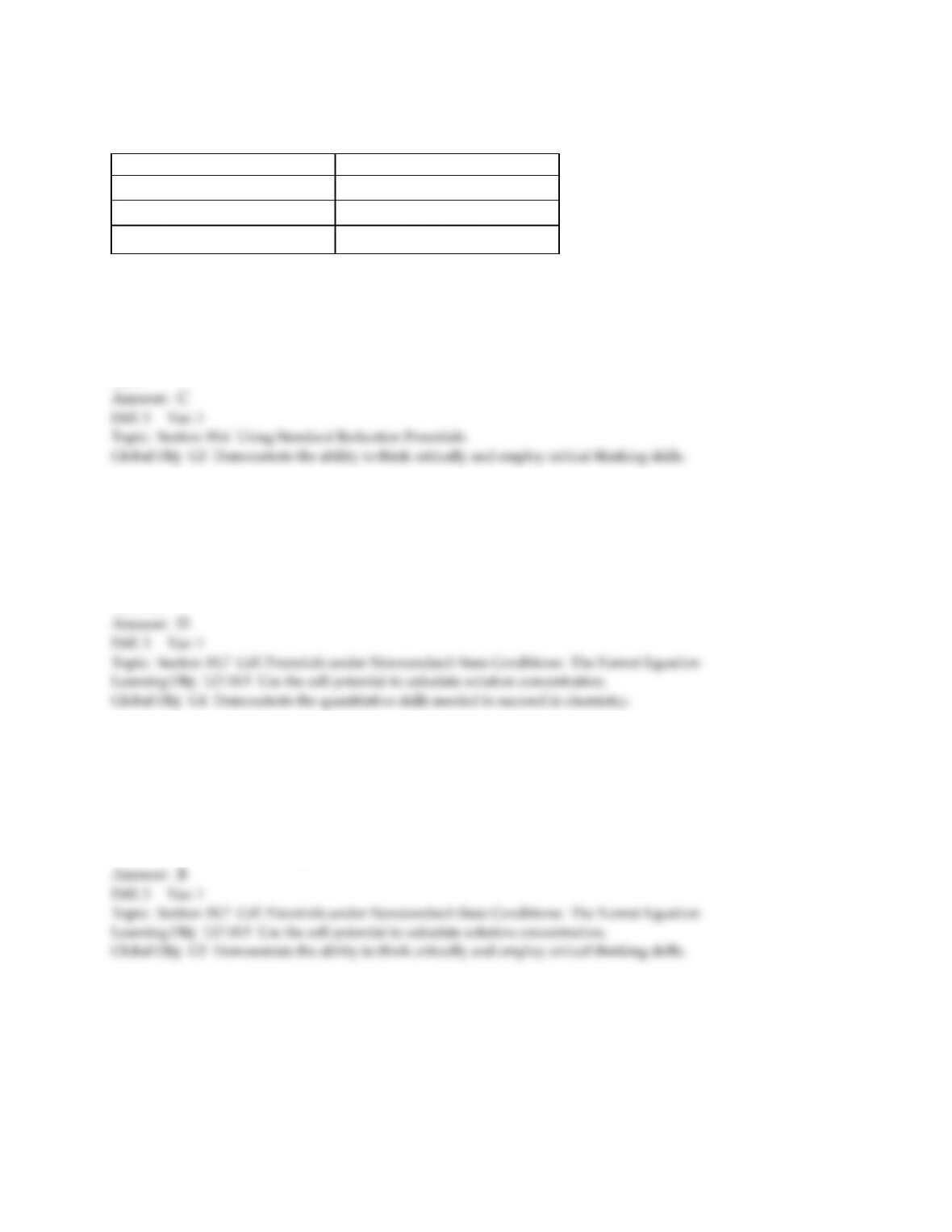
54) Consider the following table of standard reduction potentials:
Reduction Half-Reaction
Eᴼ (V)
A+2 + e– →A
0.70
B2+ + 2 e– → B
0.43
C3 + 3 e– → 3 C–
0.27
Which substance is the strongest reducing agent?
A) A
B) B
C) C3
D) C–
55) What is the Al3+:Ag+concentration ratio in the cell Al(s)|Al3+(aq) ∣∣ Ag+(aq)|Ag(s) if the measured cell
potential is 2.34 V?
A) 0.0094:1
B) 0.21:1
C) 4.7:1
D) 110:1
56) Consider the galvanic cell, Pb(s) ∣ Pb2+(aq) ∣∣ Cu2+(aq) ∣ Cu(s). Which one of the following changes to
the cell would cause the cell potential to increase (i.e., become more positive)?
A) increase the [Pb2+] concentration
B) increase the [Cu2+] concentration
C) increase the mass of Pb(s)
D) decrease the mass of Pb(s)