
ch18 Key
1. Responsibility accounting refers to the various concepts and tools used to measure the performance of people
and departments in order to foster goal or behavioral congruence.
2. Goal congruence results when the managers of subunits throughout an organization have incentives to
perform in the common interest.
3. The fundamental purpose of a responsibility accounting system is to help an organization reap the benefits of
decentralization while minimizing the costs.
4. The manager of an investment center is held accountable for the subunit‘s profits and the invested capital
used by the subunit to generate its profit.

5. A responsibility center is a subunit in an organization whose manager is held accountable for specified
financial and non-financial results of the subunit‘s activities.
6. A cost center is an organizational subunit whose manager is held accountable for costs, but the subunit‘s
input-output relationship is not well specified.
7. The check processing department in a bank might be called a cost center.
8. An airline’s reservation department is an example of a profit center.

9. A company–owned hotel in a hotel chain is an investment center.
10. The primary goals of any profit–making enterprise include maximizing its profitability and using its invested
capital as effectively as possible.
11. Under activity–based responsibility accounting management’s attention is directed not only to the cost
incurred in an activity, but also to the activity itself.
12. A performance report shows the budgeted and actual amounts of key financial results appropriate for the

13. The proper focus of a responsibility accounting system is an emphasis on blame.
14. In evaluating the investment center manager’s performance, only revenues and costs that the manager can
control or significantly influence should be included in the profit measure.
15. The economic value added (EVA) of an investment center is its after–tax operating income minus the
center’s total assets (net of its current liabilities) times the company’s ROI.
16. Residual income is the amount of an investment center’s profit that remains after subtracting an imputed
interest charge.

17. Residual income should not be used to compare the performance of different sized investment centers.
18. The incentives of an investment center manager are not affected by the tendency for net book value to
produce a misleading increase in return on investment over time.
19. For purposes of measuring invested capital, centrally controlled assets are allocated to the investment
centers.
20. The myopia of a single-period measure such as return on investment is avoided by evaluating periodic profit
through flexible budgeting and variance analysis coupled with a postaudit of major investment decisions.

21. When computing ROI, it is may be appropriate to use average total assets as the denominator.
22. The primary purpose of Responsibility Accounting is to access blame for suboptimal results.
23. In order to properly calculate the Residual Income for an investment center, it is necessary to know the
imputed interest rate.
24. When computing Residual Income, it is not correct to eliminate non-productive assets in the calculation.

25. Because the accounting department provides information necessary to improve profitability, it is an example
of a profit center.
26. A department that has responsibility for both sales and expense is an example of a cost center.
27. All other things remaining equal, increasing the imputed interest will increase residual income.

28. Bollwerk Company’s records for Department Q provided the following information for last year:
What is the return on investment if the division manager only utilizes the productive assets?
Use the following to answer questions 29-30:
McGowan Inc. has two divisions that operate as investment centers. The data for each follows:
Hilton – Chapter 18
29. What is the return on investment for the Trim Line Division?

30. What is the capital turnover for the Regular Division?
31. Which of the following actions will not increase the return on investment?
32. The Cherry Division of the Jolly Fruit Candies had profits of $618,000 last year while the Pineapple
Division had $176,000. Using this information, which division had the better return on investment.

Use the following to answer questions 33-35:
The records of the Barnholtz Division of Silberman Corporation showed the following for last year:
Hilton – Chapter 18
33. What is the sales margin for the Barnholtz Division?
34. What is the capital turnover for the Barnholtz Division?
35. What is the return on investment for the Barnholtz Division?
36. The _______is more likely to promote goal congruence when used as a performance measure.
Use the following to answer questions 37-38:
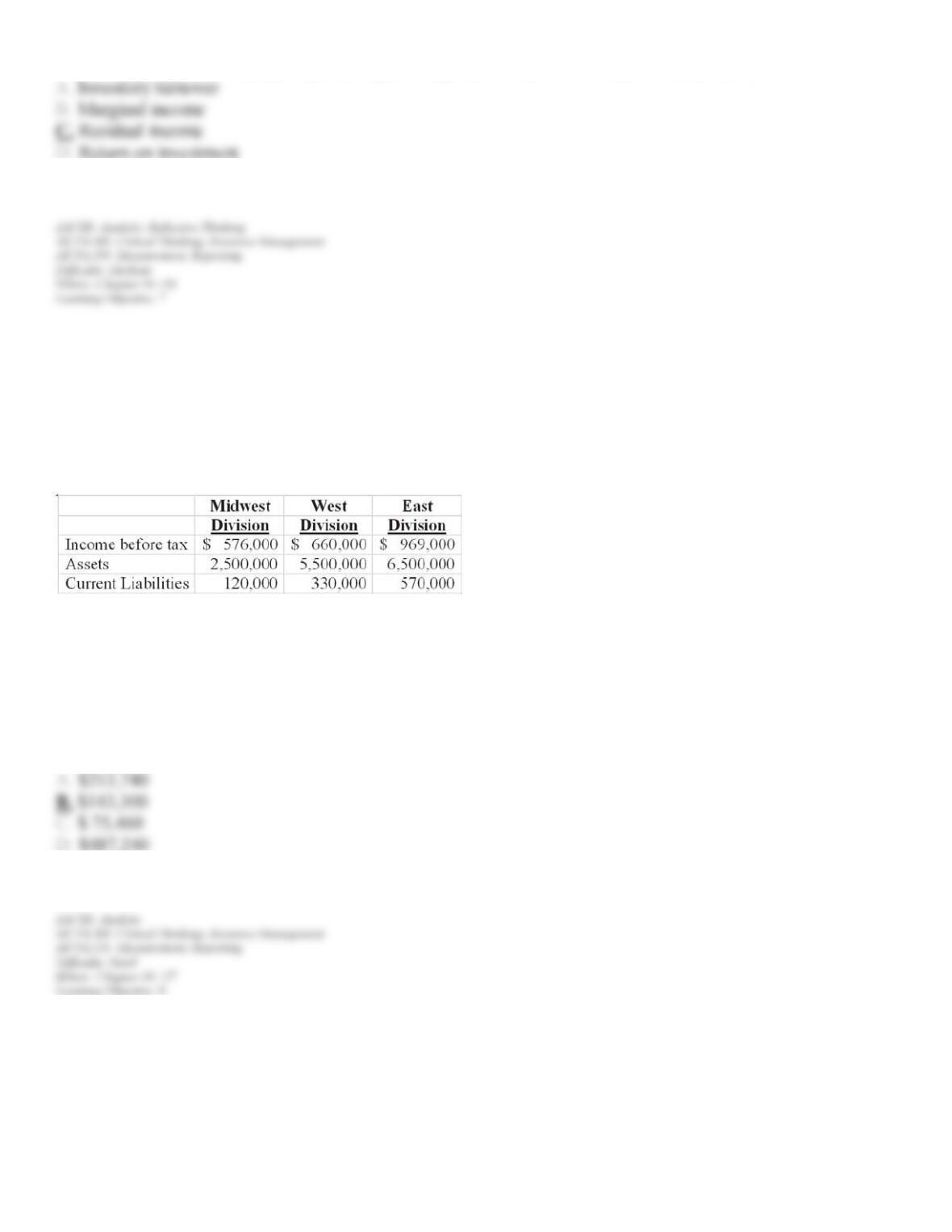
Daniels Co. uses long-term debt and equity capital as primary sources of funds. The long-term debt has a
market value and book value of $8.5 million and was issued at a 9 percent interest rate. The equity capital has a
book value of $3 million and a market value of $7.5 million. Daniels has 3 major centers located around the
country with the following operating income, total assets and current liabilities:
The cost of equity capital is 12 percent, with a 40 percent tax rate.
Hilton – Chapter 18
37. What is the EVA for the Midwest Division?

38. What is the EVA for the West Division?
39. Activity–based responsibility accounting attempts to
Use the following to answer questions 40-43:
Belsky Bay Inc. has two divisions. The company, in trying to develop performance measures has noted that
different accounting methods and inflation rates exist for the assets of the divisions. Because of the difference,
the company is considering the use of multiple performance measures. The following information for the
divisions for last year is below:
The company‘s required rate of return is 12 percent.
Hilton – Chapter 18

40. What are Division A and B’s ROIs based on net book values, respectively (round to two decimals)?
41. What are Division A and B’s ROIs based on gross book values, respectively (round to two decimals)?
42. What are Division A and B’s residual income, based on gross book values, respectively?
43. What are Division A and B’s residual income, based on net book values, respectively?
44. Which of the following must occur before one can calculate the return on investment ratios for the subunits
of an organization?
45. Where there is a lack of good performance measures, it is difficult to motivate managers by using
46. Which of the following is a true statement regarding performance evaluation?
47. A cost center is a subunit
48. ____________is the delegation of decision-making authority to lower management levels within the
organization.

49. The following is a summarized income statement for Royal Manor Co.‘s profit center 12608 for April
Which of the following amounts is most likely subject to the control of the profit center’s manager?
50. Which of the following departments would not be a cost center?
51. If the capital turnover increases by 20 percent and the sales margin decreases by the same percentage, the
return on investment will
52. In order to improve the return on investment, which of the following changes should be made?
53. One possible disadvantage that arises in a decentralized organization is that
54. Which of the following would not change the return on investment?
55. Revenue center and profit center managers are both responsible for meeting
56. Which of the following subunits is most likely to be considered an investment center?
57. Which of the following is considered a disadvantage of return on investment (ROI)?

58. Which of the following subunits would most likely be considered a only cost center?
59. If the sales margin of .4 percent remained unchanged and the capital turnover of 4.0 increased by 15 percent,
the return on investment would
60. Which of the following is considered a disadvantage of using residual income?