Microeconomics, 4e (Hubbard/O’Brien)
Chapter 18 Public Choice, Taxes, and the Distribution of Income
18.1 Public Choice
1) One argument advanced in favor of reducing the tax on dividends is that
A) dividends increase the wealth of shareholder‘s which contribute to increases in GDP.
B) reducing the tax on dividends will improve economic efficiency.
C) dividends accrue mostly to middle-income and low-income investors who are already paying
heavy income taxes.
D) the reduction will encourage corporations to plow back retained earning into capital
investments.
2) One argument advanced in favor of raising the tax on dividends is that
A) dividends increase the wealth of shareholder‘s which could lead to inflation.
B) the tax revenue gained will be used to help pay for the federal stimulus package.
C) dividends accrue mostly to low income individuals, thus increasing income inequality.
D) it increases the incentive for corporations to maximize shareholder value.
3) Tax laws affect
A) economic efficiency but not equity.
B) equity but not economic efficiency.
C) consumption and production, not efficiency and equity.
D) both efficiency and equity.
4) What are the two types of taxes that working individuals pay on their earnings?
A) individual income tax and sales tax
B) payroll tax and sales tax
C) individual income tax and social insurance taxes
D) property tax and payroll tax
5) According to public choice theory, policymakers
A) place the interests of the public above their own self-interest.
B) are likely to pursue their own self-interest, even if their self-interest conflicts with the public
interest.
C) act in ways to maximize economic efficiency.
D) act in ways to bring about an equitable distribution of society’s wealth.
6) The public choice model
A) examines the degree of market power that the public exerts in a market economy.
B) examines the public’s role in appointing politicians and ensuring that elected officials act in
ways to reflect the public’s preferences.
C) applies economic analysis to government decision making.
D) applies economic analysis to the collective decision making of consumers.

Table 18-1
Ivy
Jasmine
Rose
Subsidies for education
2nd
3rd
1st
Research on Alzheimer’s
3rd
1st
2nd
Increased border security
1st
2nd
3rd
Suppose $1 billion is available in the budget and Congress is considering allocating the funds to
one of the following three alternatives: 1) Subsidies for education, 2) Research on Alzheimer’s or
3) Increased border security. Table 18-1 shows three voters’ rankings of the alternatives.
7) Refer to Table 18-1. Suppose a series of votes are taken in which each pair of alternatives is
considered in turn. If the vote is between allocating funds to subsidies for education and research
on Alzheimer’s,
A) Ivy and Jasmine vote for education subsidies, Rose votes for Alzheimer’s research, and
education subsidies wins.
B) Ivy and Rose vote for education subsidies, Jasmine votes for Alzheimer’s research, and
education subsidies wins.
C) Jasmine and Rose vote for Alzheimer’s research, Ivy votes for education subsidies, and
Alzheimer’s research wins.
D) Jasmine and Ivy vote for Alzheimer’s research, Rose votes for education subsidies, and
Alzheimer’s research wins.
8) Refer to Table 18-1. Suppose a series of votes are taken in which each pair of alternatives is
considered in turn. If the vote is between allocating funds to research on Alzheimer’s and
increased border security,
A) Ivy and Jasmine vote for Alzheimer’s research, Rose votes for increased border security, and
Alzheimer’s research wins.
B) Ivy and Rose vote for increased border security, Jasmine votes for Alzheimer’s research, and
increased border security wins.
C) Jasmine and Rose vote for Alzheimer’s research, Ivy votes for increased border security, and
Alzheimer’s research wins.
D) Jasmine and Ivy vote for increased border security, Rose votes for Alzheimer’s research, and
increased border security wins.
9) Refer to Table 18-1. Suppose a series of votes are taken in which each pair of alternatives is
considered in turn. If the vote is between allocating funds to education subsidies and increased
border security,
A) Ivy and Jasmine vote for education subsidies, Rose votes for increased border security, and
education subsidies wins.
B) Ivy and Rose vote for increased border security, Jasmine votes for education subsidies, and
increased border security wins.
C) Jasmine and Rose vote for education subsidies, Rose votes for increased border security, and
education subsidies wins.
D) Jasmine and Ivy vote for increased border security, Rose votes for education subsidies, and
increased border security wins.
10) Refer to Table 18-1. Suppose a series of votes are taken in which each pair of alternatives is
considered in turn. The first pair considered is between subsidies for education and research on
Alzheimer’s. The second pair considered is between Alzheimer’s research and increased border
security. The third pair considered is between education subsidies and increased border security.
In this case, the collective preferences of the voters
A) turn out to be transitive and will yield a consistent outcome.
B) turn out to be transitive but will not result in a consistent outcome.
C) turn out not to be transitive and will not result in a consistent outcome.
D) turn out not to be transitive but will yield a consistent outcome.
11) Suppose $1 billion is available in the budget and Congress is considering allocating the funds
to one of the following three alternatives:
a. subsidies for education
b. research on Alzheimer’s
c. increased border security
If voters prefer a to b and b to c, then if preferences are transitive,
A) they should prefer a to c.
B) they should prefer c to a.
C) they should be indifferent between a and c.
D) it is not always possible to rank voters’ preferences between a and c.
12) The voting paradox suggests that the “voting market”, as represented by elections,
A) lead to a superior outcome in representing consumer preferences compared to the private
market for goods and services.
B) may often lead to an inefficient outcome in representing consumer preferences compared to
the private market for goods and services.
C) is no different from the private market for goods and services in terms of representing
consumer preferences.
D) may not lead to an efficient outcome but certainly leads to a more equitable outcome in terms
of distributing goods and services.
13) What is the voting paradox?
A) the observation that less than 60 percent of those eligible to vote actually vote
B) the observation that majority voting may not always result in consistent choices
C) the idea that wealthy corporations are able to sway politicians to act in ways contrary to the
desires of the majority
D) people are aware that their votes will not change the political outcome since these outcomes
are predetermined by a group of influential politicians
14) The median voter theorem states that the outcome of a majority vote
A) tends to favor the preferences of high income individuals and ignore the median voter.
B) is likely to represent the preferences of society’s middle-income voter.
C) is likely to represent the preferences of the voter who is in the political middle.
D) is determined by the average consumer and producer in an economy.
15) The Arrow impossibility theorem states that
A) no system of voting can be devised that will always consistently represent the underlying
preferences of voters.
B) it is impossible for a majority voting system not to consistently represent the preferences of
voters.
C) it is impossible to separate corporate desires from public bureaucracy.
D) no system of voting can be devised that will ensure a 100 percent voter turnout.
16) The median voter theorem will be an accurate predicator of the outcomes of elections
A) only when voter turnout is very high.
B) when a majority of voters have preferences very similar to those of the median voter.
C) when a majority of voters have preferences different from those of the median voter.
D) regardless of whether preferences among voters are similar or different from those of the
median voter.
17) Why is a typical person likely to gather more information when buying a new car than when
voting for a member of Congress?
A) because a person’s preferences are more likely to be met with little effort in the political
sphere but this is not the case when buying a car in the private marketplace
B) because it is less costly to acquire information about consumer items than it is about political
candidates
C) because buying a new car affects a person more immediately and personally compared to
voting for a member of Congress; in the latter, a person’s vote is only one of many voters and
therefore, not likely to have a large impact on the outcome
D) because the effects of buying a car are long term while a member of Congress has a relatively
short tenure
18) The median voter model implies that
A) many people will be satisfied with the amount of spending on government funded projects.
B) many people will be dissatisfied with the amount of spending on government funded projects.
C) people in the political middle will be dissatisfied with the amount of spending on government
funded projects.
D) spending on government funded projects reflects the preferences of only those far away from
the median.
19) Which of the following is not an example of rent seeking behavior?
A) competition for subsidies
B) lobbying the government to impose tariffs on certain imported products
C) competition for the exclusive right to import a product
D) engaging in aggressive advertising that slams a competitor’s product
20) Which of the following statements about rent seeking is false?
A) Rent seeking often involves governments because governments transfer huge amounts of
funds that economic agents must compete for.
B) A person is engaging in rent seeking behavior when he uses the political process to acquire
ownership of a resource that belongs to the public.
C) Because rent seeking redistributes society’s resources, anyone engaging in such behavior is
violating the law.
D) If a firm can benefit from government intervention in the economy, it is more likely to spend
resources attempting to secure this intervention than toward innovating its product to gain a
competitive edge in the market.
21) A situation where a member of Congress votes to approve a bill in exchange for favorable
votes from other members on other bills is called
A) rent seeking.
B) logrolling.
C) regulatory capture.
D) special interest legislation.
22) What is logrolling?
A) a situation where a policymaker votes to approve a bill in exchange for favorable votes from
his colleagues on other bills
B) a situation where policymakers transfer resources from those voters who are unlikely to have
a huge impact on the political outcome to those who contribute to political campaigns
C) a situation where a policymaker accepts bribes to prevent proposed legislation from coming to
a vote
D) a situation where a policymaker gets the government to fund a non-essential project
benefiting her family members
23) Logrolling may result in
A) legislation that yields economy-wide benefits, the funding for which is borne primarily by a
few of the smallest states.
B) a majority of Congress supporting legislation that benefits the economic interests of a few,
while harming the economic interests of a much larger group.
C) members of Congress selling their votes on proposed legislation to the highest bidder.
D) creating limited incentives for policymakers to consider the immediate consequences of their
proposed legislation.
24) What is meant by the term “rational ignorance”?
A) It refers to the absence of a negative incentive, for example, a fine for not voting, which
results in a low voter turnout.
B) It refers to a situation where one policymaker deliberately approves a bill he does not support
in exchange for a future favorable vote for his own cause.
C) It means the lack an economic incentive for voters to become informed about a pending
legislation.
D) It refers to the fact that policymakers and their constituents have different ideas of what it
means to behave rationally and each party deliberately ignores the other’s view.
25) Rational ignorance
A) explains why consumers ignore sunk costs when they vote.
B) explains the Arrow impossibility theorem.
C) refers to attempts by special interests to use government action to make themselves better off
at the expense of others.
D) helps to explain why rent seeking by special interest groups occurs.
26) One important difference between the political process and the market process is that
A) the political process results in collective actions in which not everyone is required to
participate, while in the market process individuals are obliged to participate.
B) the political process results in collective actions in which everyone is obliged to participate,
while in the market process individuals are free to participate or not.
C) the political process results in collective actions that maximize economic surplus, while the
market process may lead to efficiency losses.
D) the political process results in collective actions in which everyone is made better off, while
the market process results in actions that favor some groups only.
27) What is regulatory capture?
A) It is a situation in which a policy maker seeks to improve his election prospects by aligning
himself with a powerful special interest group which will finance his political campaign.
B) It is the exchange of political support between a regulatory agency and the regulated firm
resulting in both parties capturing economic rents.
C) It is a situation in which a firm being regulated successfully influences the regulatory agency’s
actions to benefit the interests of the firm, rather than the public interest.
D) It is a situation in which a regulatory agency uses its authority to force actions that are not
favored by the regulated firms but are in the public’s interest.
28) Some economists who use the public choice model to explain the ways government
intervenes in the economy believe that regulatory capture results when an agency or commission
is given authority over a particular industry or product. Which of the following is the best
example of regulatory capture?
A) The Food and Drug Administration (FDA) has increased the time and expense
pharmaceutical firms incur to receive approval to market a new drug.
B) A federal government agency hires more employees than it requires to regulate an industry
because it does not seek to minimize costs or maximize the agency’s profits.
C) The head of an agency is required to testify before Congress because Congress controls the
size of the agency’s budget. Congress “captures” the agency because of its budget authority.
D) Firms that were regulated by the Interstate Commerce Commission (ICC) attempted for many
years to influence the ICC’s actions.
29) The public choice model asserts that the self-interest of policymakers is likely to cause them
to take actions that are inconsistent with the preferences of voters, even where those preferences
are clear.
30) When the majority of voters have preferences very different from those of the median voter,
then the median voter theorem will lead to accurate predictions of the outcomes of elections.
31) If voters lack an economic incentive to become informed about pending legislation, then
their preferences become a constraint on legislators voting for rent-seeking legislation.
32) Unlike the market process, in the political market it is possible for some individuals to
receive very large benefits from the political process without any significant impact on their tax
bills.
33) What is the difference between the voting paradox and the Arrow impossibility theorem?
34) What is the relationship between market failure and government failure?
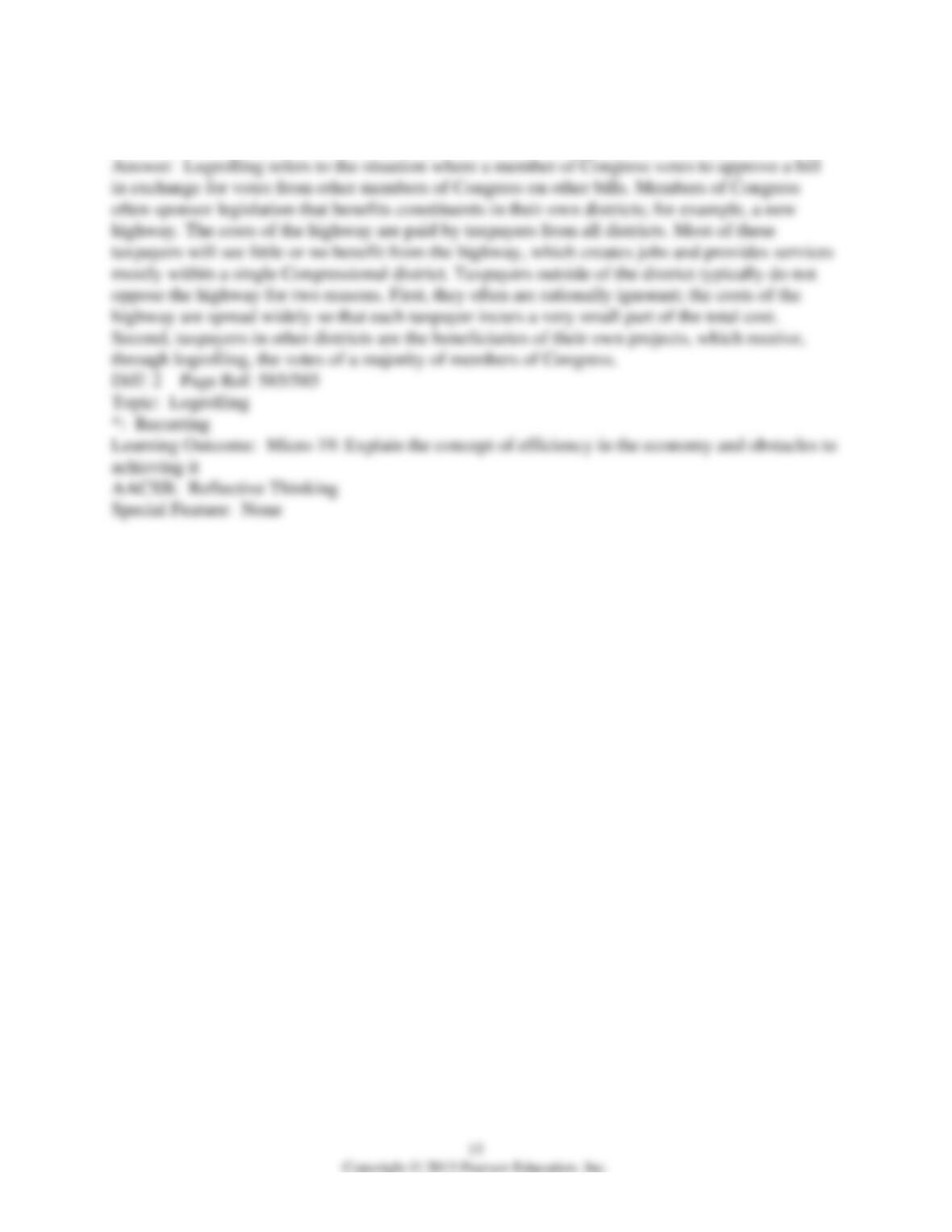
35) Define logrolling. Explain why logrolling often results in legislation that benefits the
economic interests of a few, while harming the interests of a larger group of people.
16
Table 18-2
Immigration
Reform
Unemployment
Benefits
Social
Security
Reform
Bart
1st
3rd
2nd
Lisa
2nd
1st
3rd
Maggie
3rd
2nd
1st
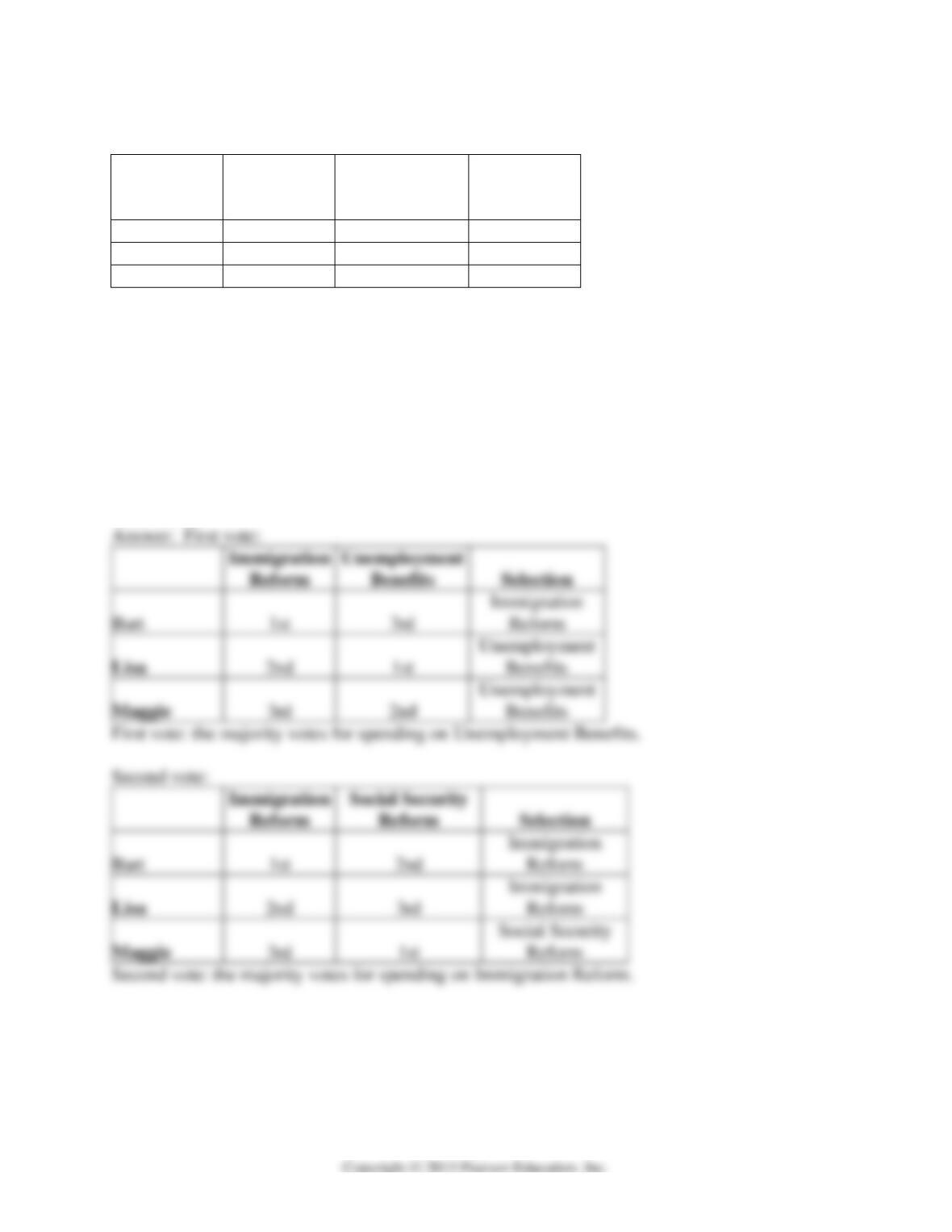
36) Refer to Table 18-2. The table above outlines the rankings of three members of the U.S.
Senate on three spending alternatives. Assume that Congress can spend additional revenue on
only one of the three spending alternatives and that Bart, Lisa, and Maggie, all members of the
Senate, participate in a series of votes in which they are to determine which of the spending
alternatives should receive funding. Three votes will be taken: (1) Immigration Reform and
Unemployment Benefits (2) Immigration Reform and Social Security Reform and (3)
Unemployment Benefits and Social Security Reform.
Show the results of each vote and determine whether the voting paradox will occur as a result of
these votes.
Immigration
Unemployment
Benefits
Bart
1st
Lisa
2nd
Maggie
3rd
2nd
Reform
Bart
1st
Reform
Lisa
2nd
Reform
Maggie
3rd
Reform
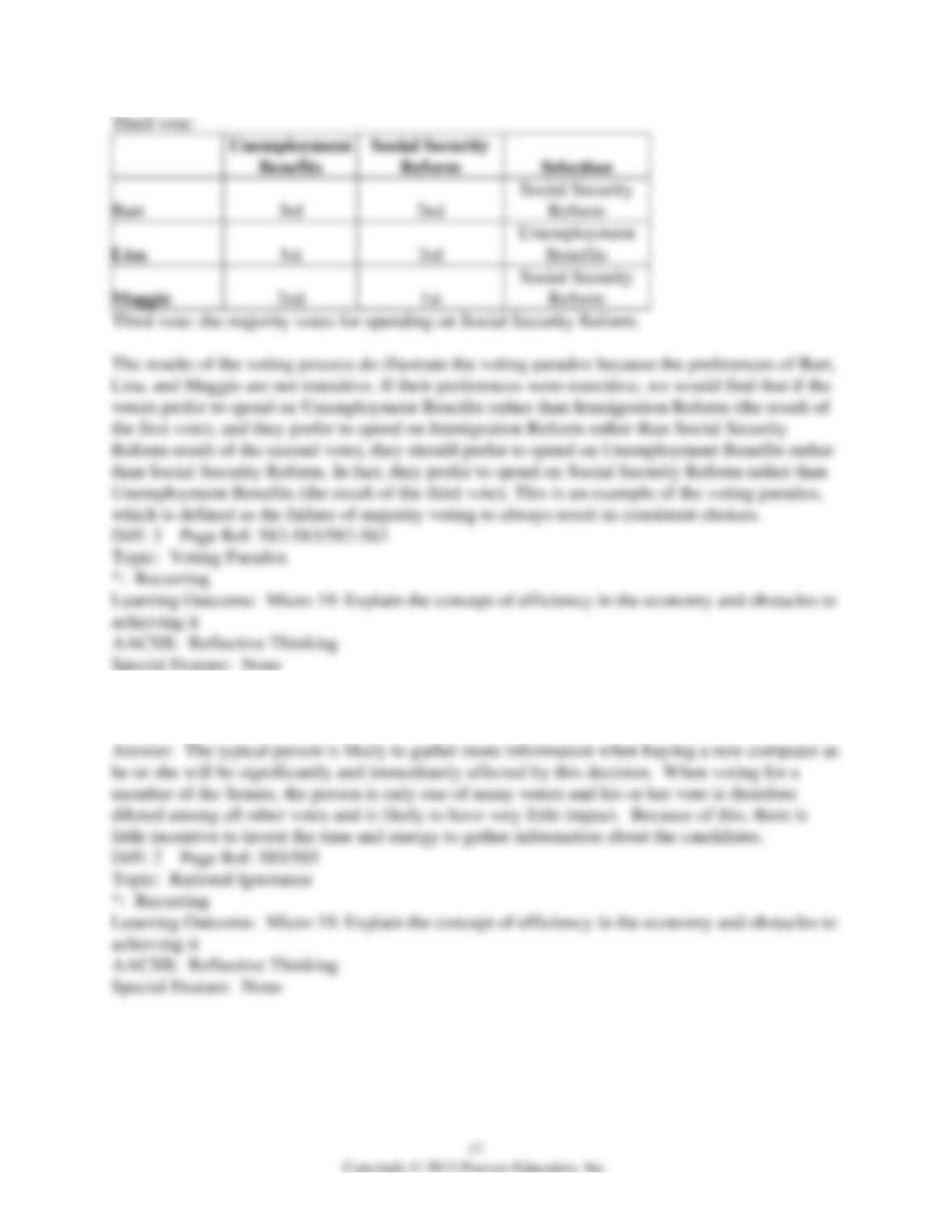
37) Is a typical person likely to gather more information when buying a new computer or when
voting for a member of the U.S. Senate? Why?
18.2 The Tax System
1) The largest source of revenue for the federal government of the United States is from
A) tariffs collected on imported goods.
B) property taxes imposed on private property.
C) sales taxes on items purchased for consumption.
D) individual income taxes.
2) At the state and local levels in the United States, the largest source of tax revenue is
A) individual income taxes.
B) property tax on real estate.
C) sales tax.
D) grants from the federal government.
3) An example of a payroll tax in the United States is
A) Social Security taxes.
B) taxes on corporate profit.
C) excise taxes on gasoline.
D) property taxes on real estate.
4) Public schools in the United States get most of their operating funds from
A) government production and subsidies.
B) income taxes on corporate profits.
C) local property taxes.
D) tariffs collected on imported goods.
5) If, as your taxable income decreases, you pay a smaller percentage of your taxable income in
taxes, then the tax is
A) regressive.
B) proportional.
C) progressive.
D) unfair.
6) If, as your taxable income decreases, you pay a larger percentage of your taxable income in
taxes, then the tax is
A) regressive.
B) proportional.
C) progressive.
D) unfair.
7) If you pay a constant percentage of your taxable income in taxes, the tax is
A) regressive.
B) proportional.
C) progressive.
D) random.
8) If you pay $2,000 in taxes on an income of $20,000, and a tax of $2,700 on an income of
$30,000, then over this range of income the tax is
A) regressive.
B) proportional.
C) progressive.
D) There is insufficient information to answer the question.
9) If you pay $2,000 in taxes on an income of $20,000, and a tax of $3,000 on an income of
$30,000, then over this range of income the tax is
A) regressive.
B) proportional.
C) progressive.
D) There is insufficient information to answer the question.