CHAPTER 18
Finding and Evaluating Published Assessments
ITEMS
1. Which of the following contains information on unpublished tests?
(a) Mental Measurement Yearbooks
(b) Tests: A Comprehensive Reference for Assessments in Psychology, Education, and
Business
(c) Test Critiques
(d) ETS Test Collection
2. An elementary school principal wants to identify an appropriate standardized achievement test for
use in the school. What should be the principal’s first source of information?
(a) Mental Measurements Yearbook
(b) Psychological Abstracts
(c) Tests in Print
(d) ETS Test Collection
3. You would like to know what reviewers say about the quality of a certain achievement test.
Which of the following sources is NOT an appropriate source of reviews?
(a) Mental Measurements Yearbook
(b) Test in Print
(c) Test Critiques
4. What is the best source for obtaining test publishers’ most recent addresses?
(a) Mental Measurements Yearbook
(b) Tests in Print
(c) Test Critiques
(d) Tests: A Comprehensive Reference for Assessments in Psychology, Education, and
Business
(e) Publishers’ websites
5. What is the best source for obtaining the most recent edition, cost, and scoring services for a
specific test whose title you know?
(a) Mental Measurement Yearbook
(b) Tests in Print
(c) the technical manual
(d) the publisher’s catalogue

6. Which of the following information can NOT be obtained from a test publisher’s catalogue?
(a) Technical data about the test
(b) The cost of score reports
(c) Examples of test items
(d) Description of the content and score of a test
7. The Standards for Educational and Psychological Testing are more understandable to school
officials than the Code of Fair Testing Practices in Education.
(a) True
(b) False
8. What is the best source to obtain information on a particular test’s reliability, validity, and norms?
(a) The test publisher’s catalogue
(b) The test’s administration manual
(c) The test’s technical manual
(d) The test’s specimen set
9. What is the first step one should undertake when trying to identify an appropriate standardized
test for a school district?
(a) Decide for what purpose one wants to use the test scores.
(b) Make a clear description of the type of community in which the district is located.
(c) Make a list of the external instruments already in use in the district.
(d) Survey neighboring districts to learn what standardized test they are using.
Question 10 refers to the information below.
A school district would like to review its existing testing program with an eye
toward adopting a new standardized test. Representatives from the following
groups are available to help in this process:
I.
Teachers
IV.
Parents
II.
Administrators
V.
Community business
owners
III.
School board
members
VI.
Testing specialists
10. Who, according to the Brookhart and Nitko text, should be on the review panel?
(a) I only.
(b) VI only.
(c) I, II, and III only.
(d) II and VI only.
(e) I, II, III, IV, V, and VI
11. A district wants to use standardized test results as part of an evaluation of its effectiveness.
Which of the following should be reported along with the test results?
(a) Absences of staff and students from school
(b) Types of parent-teacher collaborations and programs
(c) Diversity of teachers and staff
(d) All of the above should be reported with the test results
(e) None of the above should be reported with the test scores
12. The most important materials one should obtain from a publisher in order to review an
assessment instrument properly are the technical manual and the specimen sets.
(a) True
(b) False
13. Which of the following is the most important consideration when evaluating a particular
standardized test for use in a school district?
(a) The match of the test to the school district’s learning objectives.
(b) The ease of administering and scoring the test.
(c) How well the test’s norms represent the national school population.
(d) The cost of the test relative to other tests.
14. What step comes before item-writing when a standardized test is developed?
(a) Writing a manual
(b) Preparing test specifications
(c) Preparing a marketing plan
15. Which of the following is NOT involved when a standardized test developer tries out test items?
(a) Items are reviewed by content specialists.
(b) Items are targeted to the needs of local school administrators.
(c) Items are evaluated for sensitivity to ethnic and gender issues.
(d) Items are administered to samples of students.
16. Local teachers’ judgments about how well the results of a standardized test could be used for
improving instruction in the district have no place in decisions about selecting the test.
(a) True
(b) False
17. A major responsibility of a standardized test developer is to provide test users with the
qualifications needed for proper administration and interpretation of the test and test results.
(a) True
(b) False
18. What is a specimen set?
(a) A set of practice items for examinees.
(b) A complete collection of test materials for prospective test purchasers, typically including
technical manuals, scoring guidelines, and assessment booklets.
(c) A collection of materials prepared by the test publisher describing test content, the cost of
assessment materials and scoring service, and promotional material for use by
prospective test purchasers.
19. Which of the following sources would be most useful for finding computerized testing materials?
(a) Buros Mental Measurements Yearbook
(b) ETS Test Collection
(c) Internet searches
(d) Tests: A Comprehensive Reference for Assessments in Psychology, Education, and
Business
20. A state contracts with a test developer to construct state achievement tests. If this test developer
uses principles of Universal Design, and the previously contracted test developer did not, what
can the state expect with regard to the need for accommodations for students with disabilities?
(a) More students will need accommodations for this test than for the previous test.
(b) The need for accommodations will remain approximately the same.
(c) Fewer students will need accommodations for this test than for the previous test.
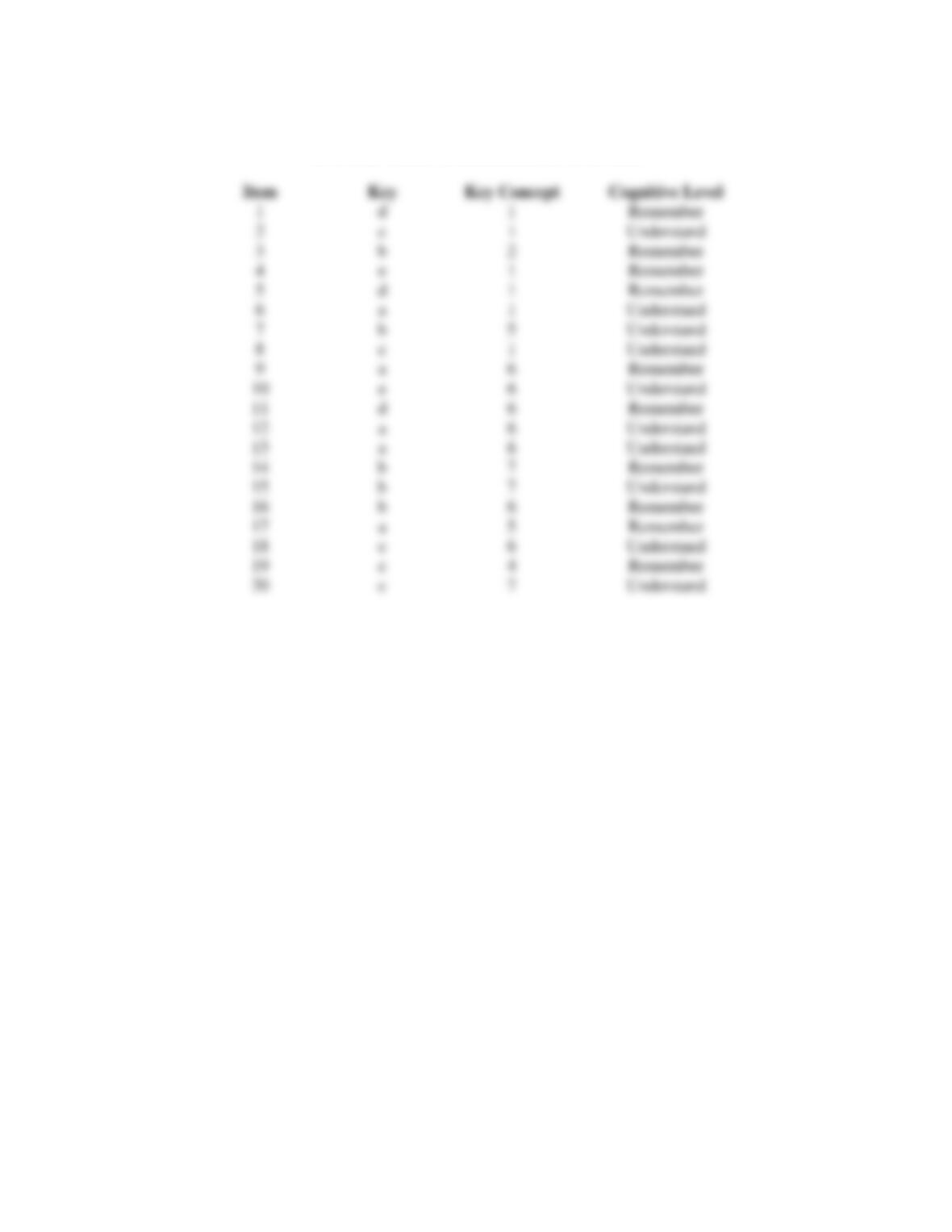
CHAPTER 18
Answers and Classification of Items