Chapter 18 – Accounting for decision making: with and without resource
constraints
TRUE/FALSE
1. Incremental or differential costs are the increases in costs or benefits between alternative
opportunities available to an entity.
2. Sunk costs are costs that have been incurred, or whose payment cannot be avoided; they are
irrelevant to future decisions.
3. Avoidable costs are those costs that will not be incurred if a particular decision is taken, therefore
avoidable costs are relevant to decision making.
4. Unavoidable costs will be incurred regardless of the decision made and are therefore relevant to
decision making.
5. Opportunity costs are economic measures and therefore not relevant to accounting decision making.
6. An opportunity cost is the maximum benefit that could be obtained from a resource if it were to be
used for some other purpose.
7. When making comparisons using relevant cost and benefit analysis with traditional analysis based
on actual costs, the result will depend on the particular circumstances of the firm making the
decision.
8. Relevant costs are those costs that relate to the future and are additional costs that will be incurred
or result from a decision.
9. Fixed costs are irrelevant to a decision if they remain the same regardless of the decision.
10. In deciding whether to close a department or division, the general rule to follow is that if the
department/division makes a positive contribution, then it should not be closed, where the
contribution is at least equal or greater than the income less the variable costs.
11. In a situation where a division has variable costs and avoidable fixed costs, and these costs
combined exceed income, then based only on the financials the division should be closed.
12. A department generates income of $20,000 and has variable costs of $14,000 and avoidable fixed
costs of $7500. This indicates that the costs directly attributable to the department exceed its
income and the department should be closed.
13. When there are resource constraints, the objective that should be applied is to establish the optimum
output within the constraints to maximise contribution and thus profits.
14. Where an entity faces resource constraints, the appropriate selection of what to produce should be
based on the contribution per unit of resource constraint, as this will optimise output and profits.
15. The contribution is also known as the internal opportunity cost, and reflects the cost of using the
resource within the organisation itself due to competing opportunities.
16. The potential to damage customer loyalty or employee morale is a qualitative factor that needs to
be considered in decision analysis.
MULTIPLE CHOICE
1. Sunk costs are:
A.
costs of replacing an item today.
B.
costs incurred and no longer recoverable.
C.
costs of an item discounted at an appropriate rate.
D.
equivalent to the historical cost of an item.
2. The selection of a special order will improve net profit when the order’s income exceeds:
A.
the direct labour cost of the order.
B.
the replacement cost of the order.
C.
the incremental cost of the order.
D.
the opportunity cost of the order.
3. Which of the following is not a relevant cost or benefit when determining a contribution margin?
A.
Income
B.
Cost of goods sold
C.
Unavoidable costs
D.
Net sales
4. James is considering replacing his worn-out machines. Which of the following is not a relevant
cost for James when considering various available options?
A.
Costs of electricity consumed by current machines.
B.
Changes in costs of labour needed to operate the new machines.
C.
Costs of delivering the new machine.
D.
Costs of replacing old machines.
5. With respect to a decision, a relevant cost is:
A.
one that does not change if the decision to go ahead is made.
B.
one that changes if the decision to go ahead is made.
C.
one that does not change if the decision not to go ahead is made.
D.
All costs currently incurred by the organisation are relevant.
6. The Jack received $560 from his grandmother. He decided to shop for a gift for himself and spent
$7 for his bus fares. Jack decided to purchase a new bike for $560. For the same amount, he could
have purchased a model GH-200 aeroplane that he adored and that would have provided $120
more benefit than the new bike. Jack was also considering a trip to Melbourne to visit his aunt,
although he was not too keen about it. He was also interested in pursuing a course leading to a
private pilot’s licence, although he is a bit scared of heights. One month later, the price of the bike
Jack purchased from Hut Ltd had gone down by $100. The bike had cost Hut Ltd $260 of labour
and $170 of plant and equipment.
The differential benefit of the aeroplane is:
A.
$7.
B.
$120.
C.
$430.
D.
$560.
7. The unavoidable cost is:
A.
$7.
B.
$120.
C.
$430.
D.
$560.
8. The opportunity cost is most likely to be the cost of:
A.
the aeroplane.
B.
the trip to Melbourne.
C.
Hut Ltd’s plant and equipment.
D.
the private pilot’s licence.
9. The replacement cost for the bike is:
A.
$100.
B.
$430.
C.
$460.
D.
$560.
10. The variable and fixed costs for producing the bike are:
A.
$560 and $260 respectively.
B.
$260 and $170 respectively.
C.
$170 and $560 respectively.
D.
$170 and $260 respectively.
11. The following information relates to the production cost of product PX 244.
Selling price
$55
Raw materials
$12
Labour
$18
Fixed overheads
$16
What is the contribution per unit of PX 244?
A.
$9
B.
$25
C.
$37
D.
$43
Consider the following information and answer the question(s) below.
Selling
Labour
Advertising
Machinery
Sales
price
cost
cost
costs
Product X
12,000 units
$5 per unit
$3 per unit
$400
$5000
Product Y
16,000 units
$4 per unit
$3.50 per unit
$200
$6200
12. Which of the following is true? Product X:
A.
contributes more to profit than Product Y.
B.
has higher variable costs than Product Y.
C.
produces lower profits than Product Y.
D.
has higher fixed costs that Product Y.
13. The contribution margins for Product X and Product Y are:
A.
$1.50 and $2.50 respectively.
B.
$2.00 and $0.50 respectively.
C.
$2.00 and $2.50 respectively.
D.
$3.00 and $3.50 respectively.
14. The breakeven in units for Product X and Product Y are:
A.
12,000 and 16,000 respectively.
B.
2700 and 12,800 respectively.
C.
2500 and 12,400 respectively.
D.
200 and 400 respectively.
15. Constraints restricting a manufacturing firm’s ability to meet the demand for its products or
services could include all of the following except shortage of:
A.
qualified sales staff.
B.
labour skills.
C.
space for machinery.
D.
raw materials.
16. Which of the following can be constraints for manufacturers?
I.
Market size for the firm’s product
II.
Current productive capacity of the firm
III.
Depreciation of buildings owned by the firm
A.
II only
B.
I and II only
C.
I and III only
D.
I, II and III
17. The following information has been provided for three products:
Product A
Product B
Product C
Estimated sales
200
200
200
Estimated labour hours per product
1
2
5
Contribution per product
$4
$8
$10
The labour availability is limited to 600 hours at these costs and before overtime payments are
necessary.
The optimum mix of these products given the constraints would be:
A.
120 units of C
B.
200 units of B + 40 units of C
C.
200 units of A and 200 units of B
D.
200 units of A and 80 units of C
18. Finefurniture Ltd has the opportunity to purchase componentry in sufficient quantities at $5.50 per
chair. Currently Finefurniture Ltd makes the components for 7000 chairs at the following costs:
Timber
$16,000
Labour
12,000
Variable overhead
8000
Fixed overhead
30,000
A saving of 20% of fixed overhead would occur if the components were bought in. Should the
component be bought in, and why?
A.
No, increased cost of $0.36 per chair.
B.
No, increased cost of $1.50 per chair.
C.
Yes, cost savings of $1 per chair.
D.
Yes, cost savings of $0.50 per chair.
19. X Ltd has the operating capacity to produce either product A or B:
Product A
Product B
Expected sales
10,000
15,000
Selling price/unit
$9
$7
Manufacturing cost
Variable/unit
$3
$2
Fixed
$30,000
$30,000
Labour cost
Variable/unit
$1
$1
From the information above, which product should X Ltd manufacture and why?
A.
Product A, lower breakeven
B.
Product B, lower breakeven
C.
Product B, higher profit
D.
Product A, higher profit
20. Company A prints and distributes licensed T-shirts, which wholesale at $16 each. A major retail
chain store has asked to be supplied with 3000 T-shirts at $14 each; these shirts would carry the
store’s brand name. To process the order, Company A would need to reconfigure the printing
program to print the brand name. This would cost $4000 and would not be reusable. There would be
no other additional costs. The current cost structure is:
T-shirts
$6
Labour
$3
Variable overhead
$2
Fixed overhead
$3
Should the special order be accepted, and why?
A.
Yes, additional profit of $3 per shirt is made.
B.
Yes, new equipment is purchased.
C.
Yes, additional profit of $1.67 per shirt is made.
D.
No, a loss of $4000 is incurred.
Apply the following information provided by Ausco Products to questions 21 and 22.
Product X
Product Y
Product Z
Estimated sales (units)
200
400
200
Estimated labour hours per unit
1
2
5
Contribution per unit
$4
$8
$10
21. The total labour availability is limited to 1000 hours at these costs. Which products should Ausco
Products produce?
A.
Product X only.
B.
Product Y only.
C.
Product Z only.
D.
Product X and Y.
22. If the market will only accept a total of 400 units of any of the 3 products, which product should
Ausco Products produce?
A.
Product X and Z.
B.
Product Y only.
C.
300 units of Product Y and 100 units of Product Z.
D.
200 units of Product Y and 200 units of Product Z.
23. The following information has been supplied regarding three products.
A
B
C
Total
$
$
$
$
Sales
24
48
13
85
Variable costs
Materials
3
2
3
8
Labour (@$1 per hour)
7
10
2
19
Total variable costs
10
12
5
27
Contribution per unit
14
36
8
58
Estimated demand per unit
700
800
600
200
Labour hours per unit
7
10
2
19
Assuming that the current restriction on labour is 7000 hours, what is the total cost of labour per
unit that needs to be considered before management can decide whether to employ additional
labour or not? (Hint: First calculate the contribution per unit of labour and determine which
products will be produced at the current available hours.)
A.
$1
B.
$4.60
C.
$3.60
D.
$2
24. The Northern Division of CPP Corporation supplies parts to its Southern Division. These parts are
also available in the market from other suppliers. Northern Division is operating at 80% capacity,
with a variable cost per unit of $6. Because of a personality conflict between the two division
managers, however, Southern has elected to buy the part from outside suppliers at $7 per unit. As a
result of this action, CPP Corporation will be:
A.
better off.
B.
worse off.
C.
forced to close Northern Division.
D.
forced to close Southern Division.
25. A supplier of components for the automotive industry has the opportunity to purchase a job lot of
parts which it would normally manufacture. The purchase price is $80,000. The production costs
for the same number of units are:
Materials
$20,000
Labour
$24,000
Variable overheads
$16,000
Fixed overheads
$100,000
Should the parts be purchased and why?
A.
Yes, because it saves $80,000.
B.
Yes, because it saves $20,000.
C.
No, because it costs $100,000.
D.
No, because it costs $20,000.
Pronto Ltd manufactures photo frames and photo albums. 15,000 units of photo frames could be
purchased for $5.00 each. The per-unit costs of production for these frames are:
Materials
$2.00
Labour
$3.50
Variable overheads
$1.50
Fixed overheads
$3.00
26. Should the frames be purchased instead of being made?
A.
No, because it saves $1.50 per unit.
B.
No, because it saves $0.50 per unit.
C.
Yes, because it saves $2.00 per unit.
D.
Yes, because it saves $5.00 per unit.
27. Pronto is considering whether to make or buy the photo frames. The costs that are irrelevant to this
decision are:
A.
opportunity costs.
B.
variable costs.
C.
available costs.
D.
fixed costs.
28. If the frames were purchased and later sold by Pronto at normal prices, the overall profits would:
A.
decrease relative to those from making the frames.
B.
increase relative to those from making the frames.
C.
remain the same as those from making the frames.
D.
increase for the first 3 months and decrease thereafter.
29. The following information is available for the three products produced by Pitts Ltd:
Product A
Product B
Product C
Estimated sales
200
200
200
Estimated labour hours per
product
1
2
2
Contribution per product
$4
$8
$10
The labour availability is limited to 400 hours at these costs and before overtime payments are
necessary.
If the market will only accept a total of 200 units of any of the three products, which product should
Pitts produce?
A.
Product A and C
B.
Products A and B
C.
Product B
D.
Product C
30. Which of the following is not a qualitative factor considered by an organisation?
A.
Employee wages
B.
Employee–employer relations
C.
Long-term retainability of employees
D.
Employee-related benefits
31. Qualitative factors in the make or buy decisions include:
A.
quality.
B.
reliability of supplies.
C.
after-sales service.
D.
all of the above.
32. Which of the following statements about qualitative factors is not true?
A.
Qualitative factors are easily quantified in terms of costs and revenue.
B.
The natures of qualitative factors in decision making vary with circumstances related to
the opportunities under consideration.
C.
Qualitative factors stem from non-financial objectives.
D.
Qualitative factors should be considered by management when making a decision.
SHORT ANSWER
1. How might a manager identify the relevant costs or revenue for a particular decision?
2. What are incremental costs, and when are they relevant costs?
3. What are avoidable costs, and when are they relevant costs?
4. What are opportunity costs, and when are they relevant costs?
PROBLEM
1. The Transporter Company produces material-handling equipment for use in commercial
manufacturing. As part of its operations, Transporter has three distinct product lines: belts,
conveyors, and elevators. The company is currently considering the elimination of the belt product
line. The belt line’s sales average $850,000 annually. Annual variable manufacturing costs and
variable selling costs total $320,000 and $140,000, respectively. Annual fixed costs total $450,000,
of which $120,000 are considered to be unavoidable.
(a)
Prepare an analysis to determine the profit increase or decrease that would result if
production of belts is discontinued.
(b)
Should the company drop the belt line?
Sales revenue
Avoidable costs:
Variable manufacturing
Variable selling
Fixed costs
Total avoidable costs
Profit
2. The Multiproducts Company currently purchases a component for $30 each. The company has
excess capacity and is considering the possibility of making the component. The Cost Accounting
Department estimates that the following costs would be incurred to make each unit of the
component:
Direct materials
$8
Direct labor
10
Variable overhead
8
Total manufacturing cost
$26 per unit
Additionally, if Multiproducts decides to make the component, additional foremen, custodial
personnel, and material handlers are required at a total cost of $150,000 per year.
(a)
Assuming the company uses 40,000 components annually, prepare an analysis to
determine if the company should make or buy the component.
(b)
At what annual volume of components would the company change its make or buy
decision?
Annual volume
Relevant costs:
Direct materials
Direct labour
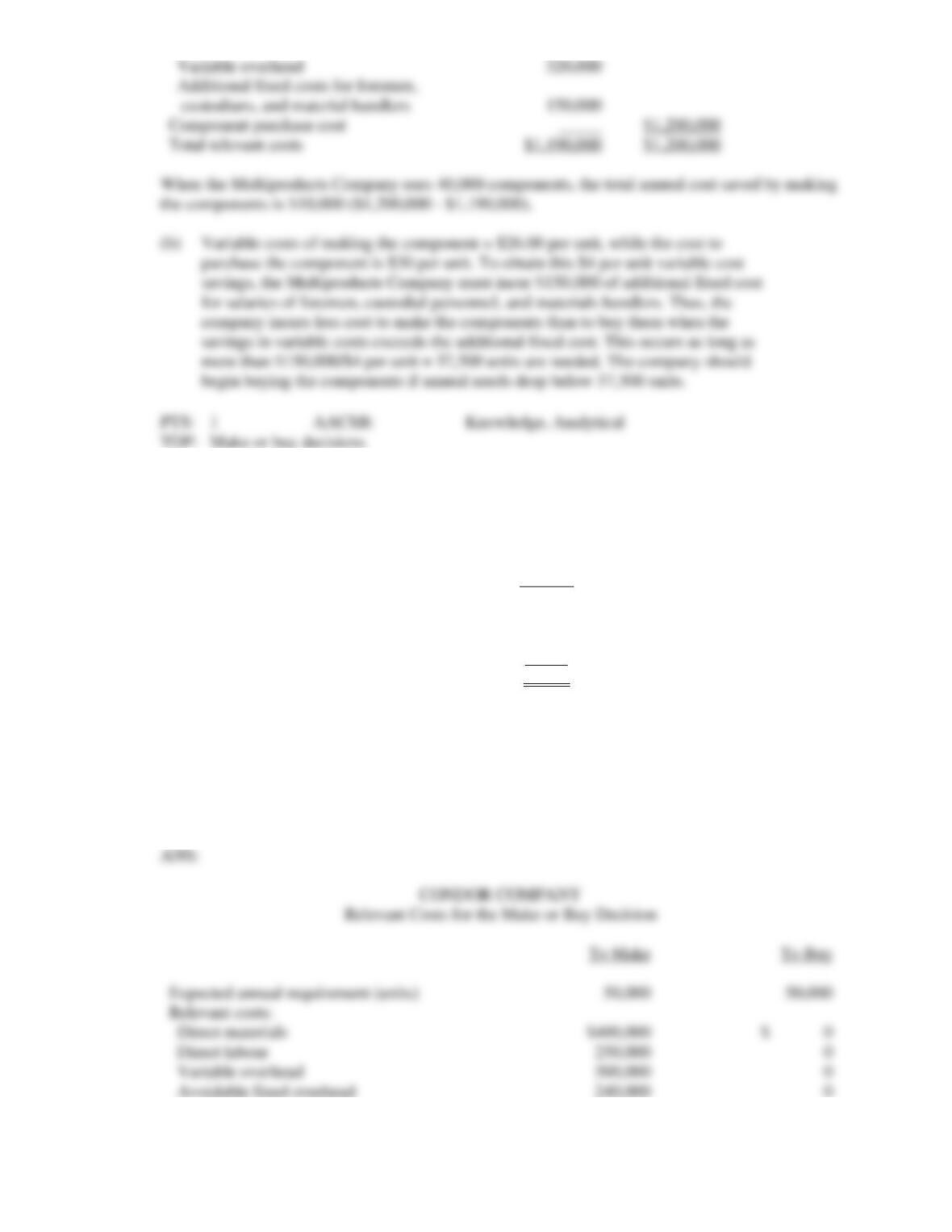
Variable overhead
Additional fixed costs for foremen,
custodians, and material handlers
Component purchase cost
Total relevant costs
3. For many years, Condor Company has produced a small part that it uses in the production of its
standard line of equipment. The company’s cost of producing one part, based on a production level
of 50,000 parts per year, is:
Cost
Per Part
Direct materials
$8.00
Direct labour
5.00
Variable overhead
10.00
Fixed overhead
12.00
Total
$35.00
An outside supplier has offered to supply the part to Condor for $29 per part. Condor has
determined that 40% of the fixed overhead represents salaries and other costs which can be
eliminated if the parts are purchased.
Required:
Prepare an analysis to determine whether Condor should accept the supplier’s offer.
Expected annual requirement (units)
Relevant costs:
Direct materials
Direct labour
Variable overhead
Avoidable fixed overhead
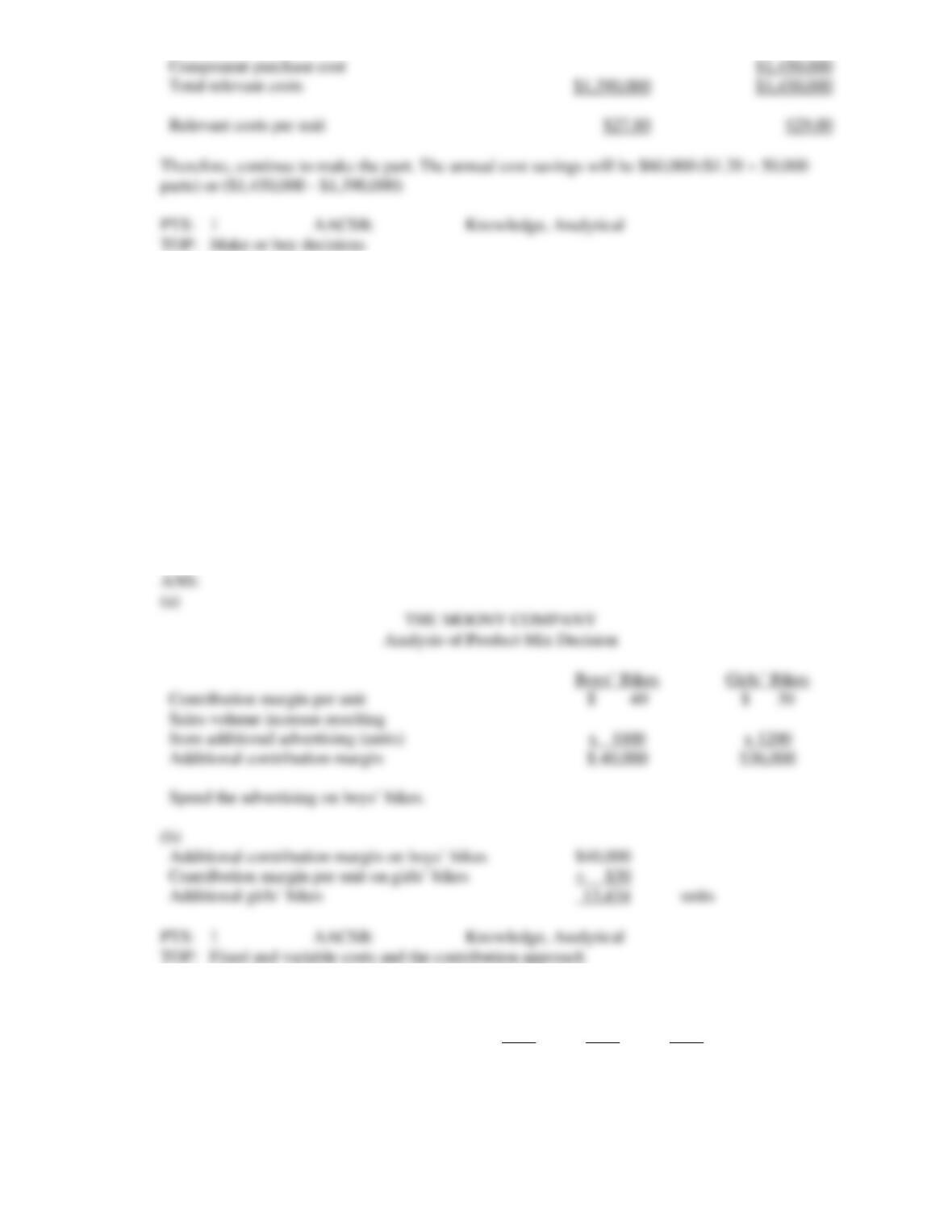
Component purchase cost
Total relevant costs
Relevant costs per unit
4. The Moony Company, which makes and sells two products, boys’ and girls’ bikes, has $30,000 to
spend on advertising. The company has estimated that using the $30,000 to advertise boys’ bikes
would increase sales of that product by 1000 units. Moony is uncertain, however, how many
additional girls’ bikes could be sold by spending $30,000 on that product. Boys’ bikes have a
contribution margin of $40 per unit and girls’ bikes have a contribution margin of $30 per unit.
Required:
Prepare an analysis to answer each of the following independent questions.
(a)
If spending $30,000 on girls’ bikes would increase its sales by 1200 units, which
product should be advertised?
(b)
By how many units would sales of girls’ bikes have to increase to justify spending
the $30,000 on girls’ bikes instead of boys’ bikes?
Contribution margin per unit
Sales volume increase resulting
from additional advertising (units)
Additional contribution margin
Spend the advertising on boys’ bikes.
Additional contribution margin on boys’ bikes
Contribution margin per unit on girls’ bikes
Additional girls’ bikes
units
5. Hartly Company manufactures three products: A, B, and C.
A
B
C
Selling price
$180
$270
$240
Less variable expenses:
Direct materials
24
72
32
Direct lab or
97
86
140
Variable overhead
5
4
8
Total variable expenses
126
162
180
Contribution margin
$ 54
$108
$ 60
The same raw material is used in all three products. The company has only 5000 pounds of
material on hand and will not be able to obtain any more for several weeks. Management is trying
to decide on which products to concentrate on next week to fill its backlog of orders. Material cost
is $8.00 per pound. There are no beginning or ending inventories except the raw materials on hand
mentioned above.
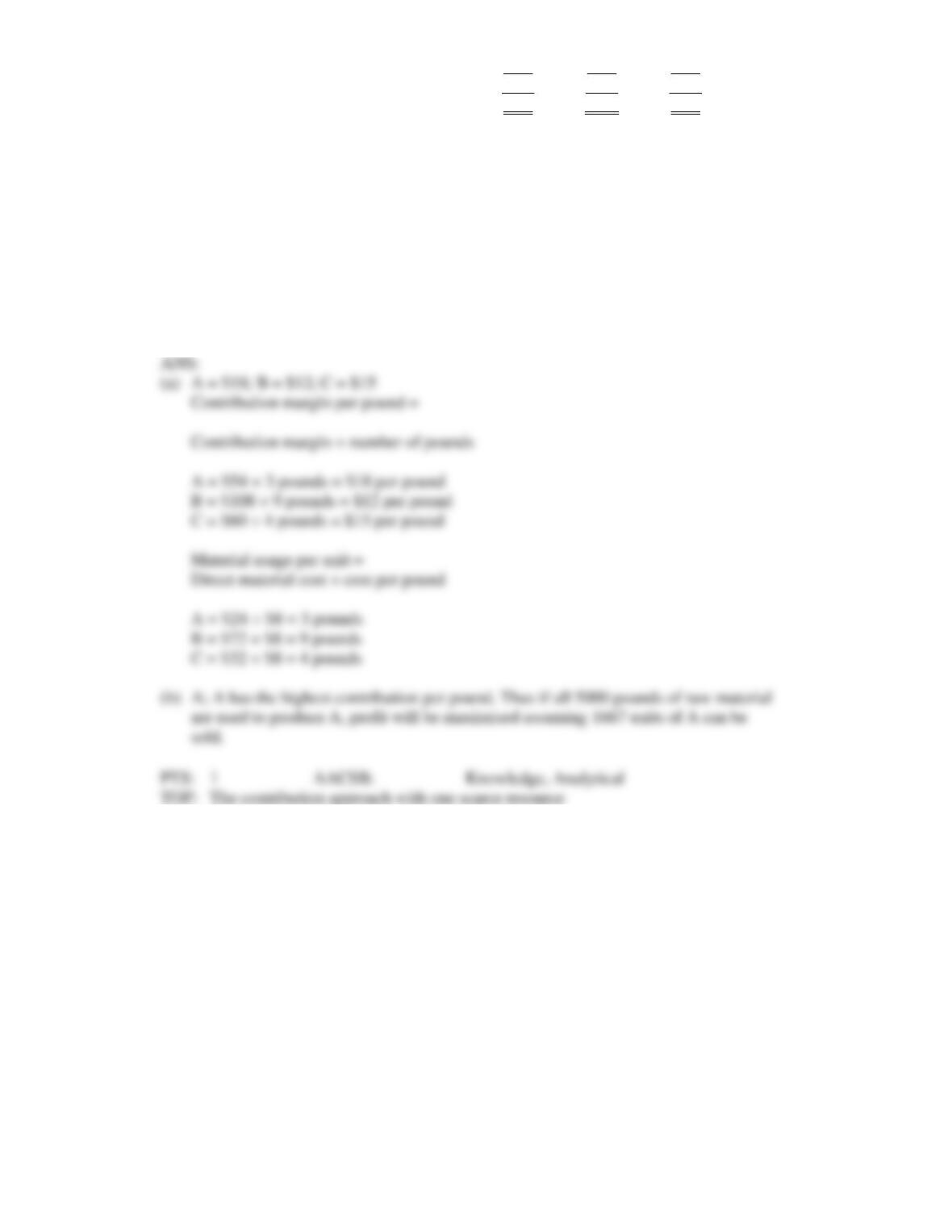
(a)
Compute the amount of contribution margin that will be obtained per pound of
materials used for each product.
(b)
Which orders would you recommend that the company work on next week, the
orders for A, B, or C? Show your computations.
Contribution margin per pound =
C = $60 ÷ 4 pounds = $15 per pound
Material usage per unit =
A = $24 ÷ $8 = 3 pounds
C = $32 ÷ $8 = 4 pounds
are used to produce A, profit will be maximised assuming 1667 units of A can be