11) Competitive markets tend to eliminate economic discrimination, but there are many
historical examples of firms that hired few, or no, black or female workers. Which of the
following is not a reason for the persistence of this form of discrimination?
A) In many cases, white workers refused to work with black workers.
B) Some white consumers were unwilling to buy from companies that employed black workers.
C) If discrimination makes it difficult for a member of a group to be hired in a particular
occupation, there is less incentive for members of the group to be trained to enter that
occupation.
D) Laws passed by the federal government made it more expensive to hire black or female
workers. As a result, it was less expensive for employers to hire mostly white male workers.
12) Paying a person a lower wage or excluding a person from an occupation on the basis of an
irrelevant characteristic such as race or gender
A) is economic discrimination.
B) violates federal comparable worth laws.
C) can be explained by negative feedback loops.
D) creates differences in wages that economists call “compensating differentials.”
13) Larry and Mike are equally skilled construction workers employed by the Brown and Root
Company. Larry’s job is riskier because he typically works on a scaffold 1,000 feet above
ground. Larry’s higher wage rate is the result of
A) economic discrimination.
B) a compensating differential.
C) a negative feedback loop.
D) a higher marginal revenue product.
14) Wage differences can be explained by all of the following except
A) compensating differentials.
B) differences in marginal revenue products.
C) economic discrimination.
D) comparable worth.
15) According to two economists, George Ackerlof and William Dickens, how can cognitive
dissonance affect workers’ perceptions of their jobs?
A) Cognitive dissonance makes workers believe that measures to improve their health and safety
in the workplace are ineffective.
B) Cognitive dissonance causes workers to perceive they are victims of discrimination when, in
fact, they are not.
C) Cognitive dissonance might cause workers to underestimate the true risks of their jobs.
D) Cognitive dissonance causes a worker to believe his marginal revenue product is greater than
it really is.

16) One implication of compensating differentials is that laws passed to protect the health and
safety of workers may not make workers better off than they were prior to the passages of the
laws. Why is this so?
A) Workers may suffer from cognitive dissonance, which means that the perception workers
have that their jobs are hazardous is not true.
B) If the laws make the work environment safer, there is no reason to pay workers a
compensating differential for the risk associated with their jobs.
C) The principal-agent problem that exists in the workplace may cause workers to shirk more
after the work environment becomes safer.
D) In non-competitive markets, workers are unlikely to receive a compensating differential to
compensate for jobs with extra risk. As a result, after the laws are passed their wages will not
change.
17) Phil Harrison is a welder who works on skyscrapers and extension bridges. Phil’s brother
William is also a welder but he works in a manufacturing plant where he does all of his welding
on ground level. Which of the following would not explain why Phil earns a higher wage than
his brother?
A) cognitive dissonance
B) Phil has greater experience as a welder than his brother has.
C) Phil’s marginal revenue product is greater than William’s marginal revenue product.
D) Phil’s job is more hazardous than William’s job.
18) Marsha Murphy complained, “Many jobs that are filled mostly by men offer higher wages
than most jobs that are typically filled by women. In many cases, the jobs men have require the
same education and skills as the jobs women have. This is clearly unfair. Women should be paid
the same wages as men are paid for jobs that are equivalent in terms of their qualifications.”
Which of the following statements describes Marsha’s position?
A) Marsha believes that women’s wages should include a compensating differential.
B) Marsha believes employers assume that men and women have different job preferences.
C) Marsha believes that employers are reluctant to hire women for certain jobs because of
cognitive dissonance.
D) Marsha endorses a concept called comparable worth.
19) Assume that a comparable worth law is passed that determines that kindergarten teachers and
bricklayers have comparable jobs; therefore, workers in both of these occupations should be paid
the same wages. Assume that prior to the law, bricklayers were paid a higher wage than
kindergarten teachers. Which of the following is the most likely result of the comparable worth
law?
A) The equilibrium wage will be the same for kindergarten teachers and bricklayers.
B) Some former bricklayers will become kindergarten teachers and some former kindergarten
teachers will become bricklayers.
C) There will be a shortage in the market for bricklayers and a surplus in the market for
kindergarten teachers.
D) There will be surplus in the market for bricklayers and a shortage in the market for
kindergarten teachers.
20) Many economists are critical of proposals to pass comparable worth legislation. Which of the
following is the best explanation for this criticism?
A) Comparable worth legislation will only lead to efficient market outcomes if women in low–
paying jobs suffer from cognitive dissonance.
B) Proposals for comparable worth legislation assume that wages for low-paying women’s jobs
should include compensating differentials. Economists believe that compensating differentials
should be part of the wages for all jobs held by women.
C) Proposals for comparable worth legislation call for increases in the wages of jobs held
predominantly by women. Economists believe that this legislation should be used to increase the
wages of all workers.
D) Many economists believe that allowing markets to determine wages, rather than the rules
required by comparable worth legislation, results in more efficient outcomes.
21) A number of economists have estimated the impact of unionization on workers’ wages.
Which of the following is one conclusion reached by these studies?
A) Union workers earn less than they would if they were not unionized. This is because of the
impact of workers’ strikes, during which union members do not receive wages.
B) Holding constant the impact of other factors that affect wages, being in a union has no impact
on a worker’s wages.
C) Being in a union increases a worker’s wages by about 10 percent, holding constant other
factors that influence wages.
D) The share of national income received by workers has increased significantly over time;
unions have been responsible for about one-half of the increase in workers’ share of national
income from the end of World War II to 2000.
22) Compensating differentials are associated most closely with which of the following?
A) hazardous jobs
B) comparable worth
C) economic discrimination
D) differences in education
23) In a study conducted by Marianne Bertrand and Sendhil Mullianthan, identical resumes were
sent in response to help wanted ads in newspapers, with half of the resumes assigned an African-
American-sounding name and half assigned a white-sounding name. The study found that
A) employers were equally likely to interview workers with white-sounding names and with
African-American-sounding names.
B) employers were 50 percent less likely to interview workers with African-American-sounding
names.
C) employers were 50 percent less likely to interview workers with white-sounding names.
D) no employers chose to interview workers with African-American-sounding names.
24) Higher wages that compensate workers for unpleasant aspects of a job are called
compensating differentials.
25) Most economists believe that only a small gap between the wages of white males and the
wages of other groups is due to education. Most of the gap is explained by discrimination.
26) As nonunion construction workers replace a unionized work force, the average wage in the
construction sector is likely to rise.
27) Why are there superstar baseball players but no superstar chiropractors?
28) The Equal Pay Act of 1963 requires that men and women be given equal pay for equal work
in the same establishment. Most people agree that gender discrimination in the workplace is
unfair, but many economists have criticized advocates of comparable worth. Is paying the same
wages for jobs that have comparable worth mandated by the Equal Pay Act? Why don’t most
economists support proposals to force employers to pay their male and female employees based
on comparable worth rules?
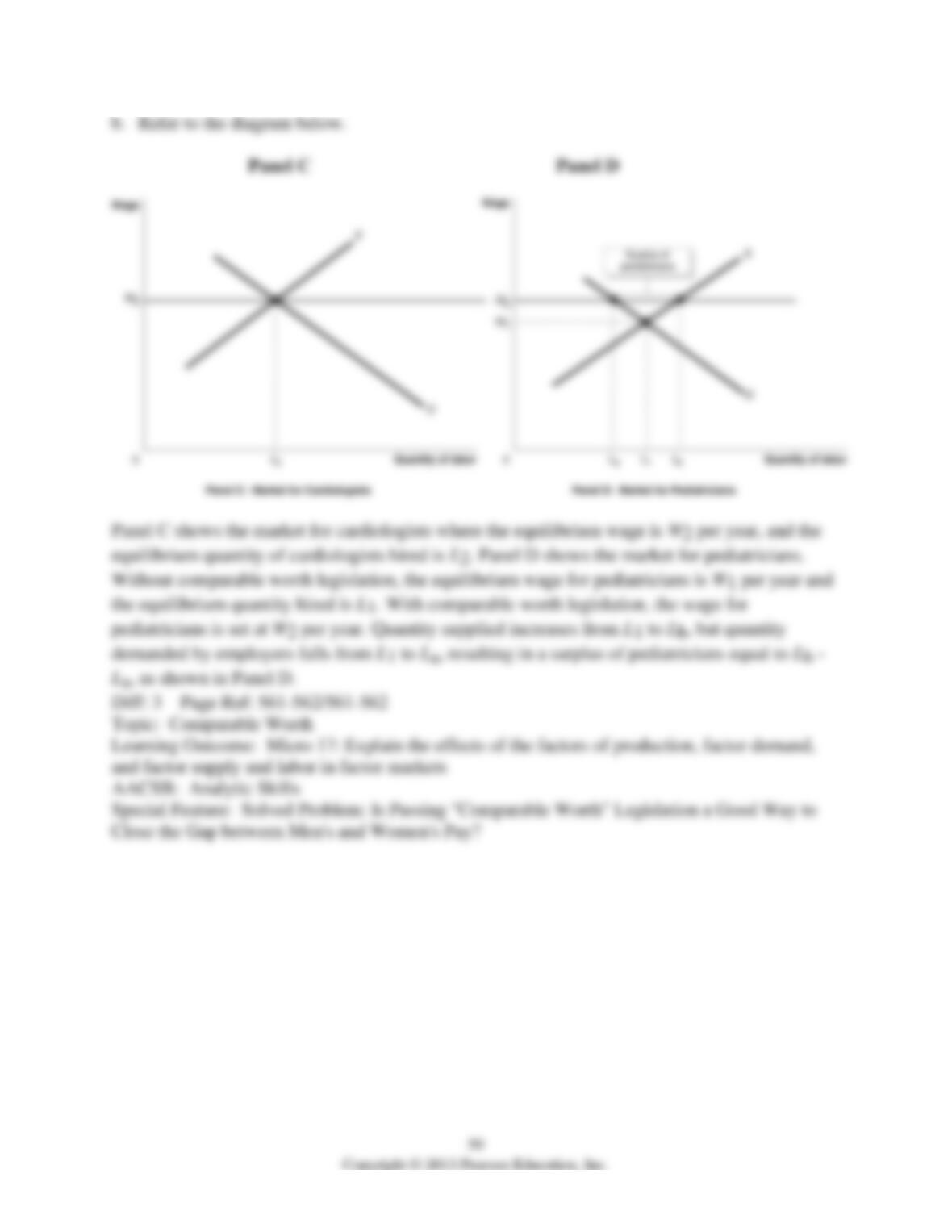
29) In the medical profession, pediatricians receive lower salaries than cardiologists. Suppose the
government passes comparable worth legislation that requires hospitals to pay pediatricians the
same salaries as cardiologists. Explain the effect of this legislation and illustrate your answer
with demand and supply graphs for the following two scenarios:
a. hospitals respond by placing salaries at a level between the two existing salaries
b. hospitals respond by placing pediatricians’ salaries at the initial level of cardiologists.
17.5 Personnel Economics
1) The application of economic analysis to human resources issues is called
A) resource economics.
B) personnel economics.
C) human economics.
D) labor economics.
2) Mel’s House of Cars is an automobile dealership that sells both new and used cars. Two other
dealerships located nearer Mel’s pay their salespeople a straight salary – they receive no
commission for each car they sell. Mel has decided to pay all of his salespeople a commission on
all car sales. Which of the following is most likely to occur as a result of Mel’s decision?
A) Mel will have difficulty finding salespeople. Research by labor economists has found that
most employees prefer the security of a salary to the uncertainty of being paid based on how
much revenue they generate for their employers.
B) Mel will experience a principal-agent problem. Some of his salespeople will tend to shirk
because they will not be paid if they sell no cars, regardless of how hard they work.
C) Mel will be able to hire some of the most productive salespeople who work for the other two
dealerships.
D) Mel risks violation of federal law that regulates firms’ compensation policies.