
6) The typical labor supply curve is upward-sloping but it is possible for the curve to be
backward bending – negatively sloped – at very high wage levels. Which of the following would
cause a backward bending supply curve?
A) This would occur when the income effect from an increase in the wage becomes larger than
the substitution effect.
B) This would occur when the substitution effect from an increase in the wage becomes larger
than the income effect.
C) This would occur if leisure is an inferior good.
D) This would occur when a large number of workers choose leisure rather than employment at
low wages; only a very large increase in the wage will lead these workers to prefer employment
to leisure.
7) Because leisure is a normal good, an increase in the wage rate will result in
A) an increase in the quantity of labor supplied because of both the substitution effect and the
income effect.
B) a decrease in the quantity of labor supplied because of the substitution effect and an increase
in the quantity of labor supplied because of the income effect.
C) an increase in the quantity of labor supplied because of the substitution effect and a decrease
in the quantity of labor supplied because of the income effect.
D) an increase in the quantity of labor supplied because of the substitution effect. At low wages
the income effect causes an increase in the quantity of labor supplied, but at high wages the
income effect causes a decrease in the quantity of labor supplied as the wage rises.

8) In order for a labor supply curve to be backward bending at high wages
A) leisure must be an inferior good.
B) the substitution effect of a wage increase must be greater than the income effect.
C) workers must have an irrational response to wage increases.
D) the income effect of a wage increase must be greater than the substitution effect.
9) The market supply curve for labor is
A) derived from the market supply curve for the output produced with labor.
B) perfectly inelastic if leisure is an inferior good.
C) determined by adding up the quantity of labor supplied by each worker at each wage, holding
constant all other variables that affect the willingness of workers to supply labor.
D) determined by adding up the wages each worker is willing to work for at a given quantity
supplied, holding constant all other variables that affect the willingness of workers to supply
labor.
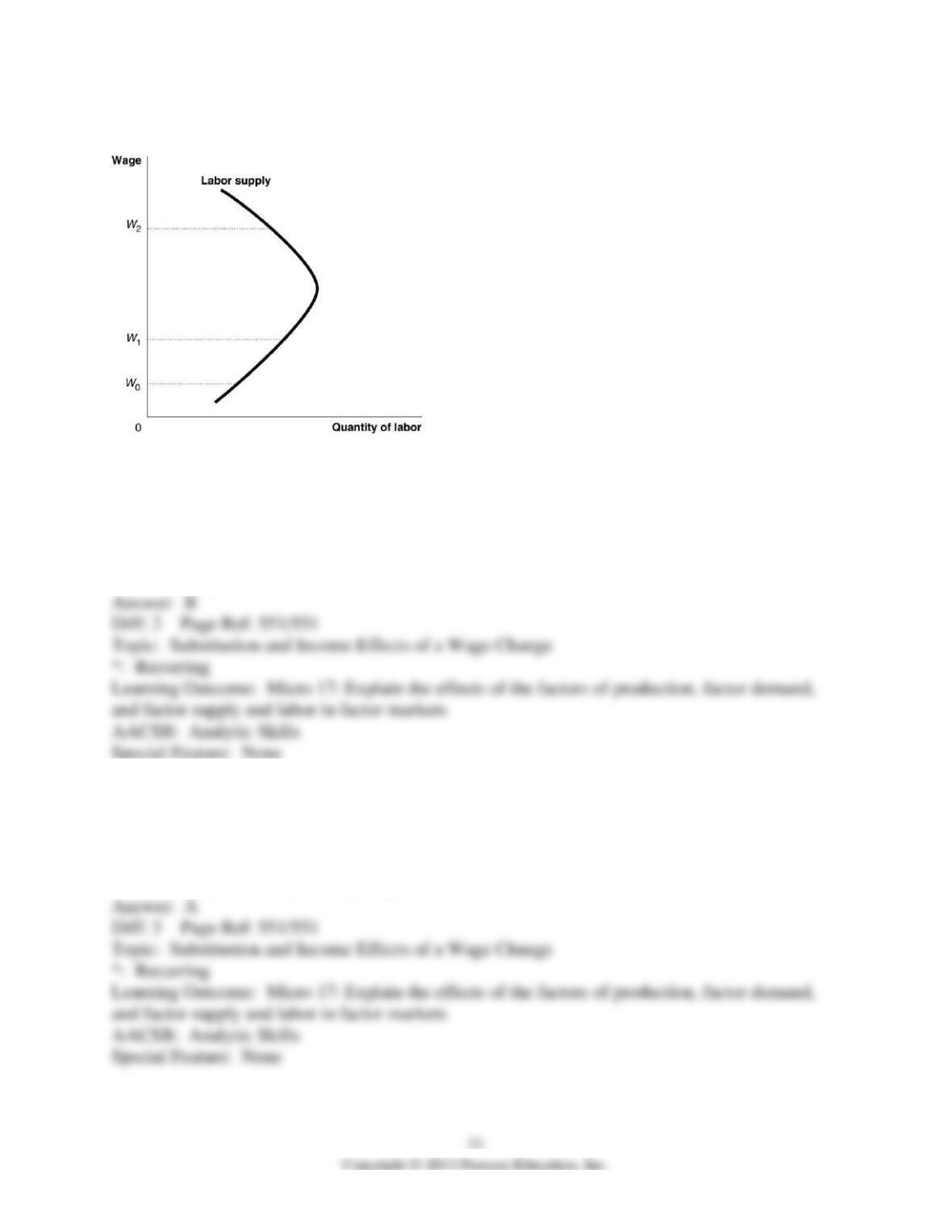
Figure 17-2
10) Refer to Figure 17-2. Which of the following is true if the wage rate increases from W0 to
W1?
A) The income effect is larger than the substitution effect.
B) The substitution effect is larger than the income effect.
C) The income effect and the substitution effect are equal.
D) The supply curve is unit-elastic.
11) Refer to Figure 17-2. Which of the following is true at W2?
A) The income effect is larger than the substitution effect.
B) The substitution effect is larger than the income effect.
C) The income effect and the substitution effect are equal.
D) The supply curve is positively sloped.

12) For most low-wage earners,
A) the income effect of a wage rate increase is likely to be larger than the substitution effect.
B) the substitution effect of a wage rate increase is likely to equal the income effect.
C) the opportunity cost of leisure is high.
D) the substitution effect of a wage rate increase is likely to be larger than the income effect.
13) Francis Crawford recently received a 20 percent wage increase and desires to work less. We
can conclude that at his current wage his supply of labor curve
A) has a positive slope.
B) has a negative slope.
C) is U-shaped.
D) is vertical.
14) The income effect of a wage increase will cause a worker to devote
A) more time to labor and more time to leisure.
B) more time to labor and less time to leisure.
C) less time to labor and more time to leisure.
D) less time to labor and less time to leisure.

15) Along an upward sloping labor supply curve, as the wage rate increases, the opportunity cost
of leisure ________, causing individuals to supply a ________ quantity of labor.
A) increases; greater
B) increases; lower
C) decreases; greater
D) remains constant, constant
16) Leisure is
A) an inferior good.
B) a complementary good to labor.
C) wasteful to society.
D) a normal good.
17) Which of the following variables will not cause the market supply curve of labor to shift?
A) increases in population
B) a favorable change in consumer tastes
C) a change in the labor participation rate of women
D) an increase in the number of people between the ages of 16 and 65

18) In recent years unemployment rates in several European countries have been higher than
unemployment rates in the United States. Many economists believe that European
unemployment rates have been higher because
A) of the different methods used to measure unemployment. If similar methods were used,
unemployment rates in Europe and the United States would be about the same.
B) European firms hire many seasonal workers from other countries, and this tends to inflate
unemployment rates in their countries.
C) unemployment benefits are more generous in Europe than in the United States.
D) the size of the military is much higher in the United States and all military personnel are
classified as employed.
19) Which of the following factors has significantly increased the supply of labor in the United
States since 1950?
A) a large increase in the substitution effect as a result of higher wages
B) a low birth rate and an aging population
C) an increase in the number of people who have received college degrees
D) an increase in the labor force participation rate of women
20) The substitution effect of a wage decrease examines the effect of the decrease in wage
income on a worker’s ability to consume goods and services.

21) If the income effect of a wage increase equals the substitution effect, the labor supply curve
is horizontal at the equilibrium wage.
22) Increases in population shift the market supply curve for labor to the right.
23) In many European countries it is much easier than in the United States for unemployed
workers to receive generous wage replacement income from their governments.

24) What is the shape of the labor supply curve implied by the following statements?
a. “I’m sorry, kids, but now that I’m earning more, I just can’t afford to come home early in the
afternoon, so I won’t be here when you get home from school.”
b. “They can pay me a lot or they can pay me a little. I’ll still put in my 8 hours a day.”
c. “Now that I have received a salary increase, I am going to work 36 hours instead of 40 hours
a week”
25) a. What are the two effects of an increase in the wage rate on an individual’s labor supply
decision? Briefly explain each effect.
b. Explain how a labor supply curve could be backward-bending.

26) What are the three most important variables that cause the market supply curve of labor to
shift?
17.3 Equilibrium in the Labor Market
1) If the labor supply is unchanged, an increase in the demand for labor will
A) increase the equilibrium wage and decrease the number of workers employed.
B) increase the equilibrium wage and increase the quantity of jobs demanded.
C) decrease the equilibrium wage and increase the number of workers employed.
D) increase the equilibrium wage and increase the number of workers employed.
2) Michael Spence proposed the signaling hypothesis. According to this hypothesis,
A) workers signal their desire to work for a particular firm by the way they answer questions in
job interviews.
B) employers signal their preferences for the type of employee they wish to hire through job ads
and the questions they ask during job interviews.
C) employers view a college education as a signal that potential workers have certain desirable
qualities.
D) high wages are a signal that workers have skills that are highly valued by employers.

3) Daniel Hammermesh and Stephen Donald studied the determinants of the earnings of college
graduates years after they graduated. Which of the following is one result of their study?
A) The earnings of identical twins were about 9 percent higher than the earnings of all other
students.
B) Students who had taken 15 credits of upper-division science and mathematics courses and
earned high grades in these courses earned about 10 percent more than students who took no
upper-division classes in these subjects.
C) Students who took more Advanced Placement (AP) courses while still in high school earned
significantly more income for each AP course they passed with a grade of 4 or 5.
D) Students who took at least three economics courses earned about 9 percent more income than
students who took no college economics courses.
4) Which of the following summarizes the impact of population growth on the labor market?
A) This will increase the labor supply, reduce the equilibrium wage and increase the quantity of
labor demanded.
B) There will be an increase in the demand for labor. As a result, the wage rate will rise and the
quantity of workers supplied will decrease.
C) There will be an increase in the demand for jobs. This will result in an increase in the
equilibrium wage rate and a movement along the labor supply curve.
D) There will be an increase in both the demand for labor and the supply of labor. As a result, the
equilibrium wage will not change.

5) Which of the following would cause an increase in the equilibrium wage?
A) The supply of labor increases more than the demand for labor.
B) The supply of jobs increases more than the demand for jobs.
C) The demand for labor increases faster than the supply of labor.
D) The supply of labor increases and the demand for labor decreases.
6) Suppose the labor market is in equilibrium. Which of the following statements is false?
A) The equilibrium wage rate is equal to the marginal revenue product of labor.
B) At the equilibrium wage, the quantity of labor demanded equals the quantity of labor
supplied.
C) Some workers will earn more than the equilibrium wage.
D) At the equilibrium wage, the demand for labor is equal to the supply of labor.
7) If the demand for labor is unchanged, an increase in the supply of labor will lead to
A) a decrease in the quantity of labor demanded and a decrease in the equilibrium wage.
B) an increase in the quantity of labor demanded and a decrease in the equilibrium wage.
C) an increase in the quantity of labor demanded and an increase in the equilibrium wage.
D) a decrease in the quantity of labor demanded and an increase in the equilibrium wage.

8) How will an increase in labor productivity affect equilibrium in the labor market?
A) The supply of labor will increase and the equilibrium wage and quantity of labor will
increase.
B) The demand for jobs will increase and the equilibrium wage and quantity of labor will
increase.
C) The demand for labor will increase and the equilibrium wage and quantity of labor will
increase.
D) The demand for labor will decrease because fewer workers will be needed to produce the
same output. The equilibrium wage and quantity of labor will decrease.
9) All else equal, if job turnover has people leaving jobs and finding new jobs in the same
industry, this will
A) increase the demand for labor and the supply of labor.
B) increase the demand for labor and decrease the supply of labor.
C) decrease the supply of labor, but not change the demand for labor.
D) not change demand or supply in the labor market.
10) If the number of employees who quit, are fired, or retire increases while the hiring of new
employees declines, this indicates that the
A) labor demand curve is shifting to the right.
B) labor supply curve is shifting to the right.
C) labor demand curve is shifting to the left.
D) labor supply curve and labor demand curve are both shifting to the right.

11) All else equal, a decrease in the supply of labor will shift the labor supply curve to the left
and decrease the equilibrium wage.
12) If the demand for labor is unchanged, population growth will increase the supply of labor
and increase the equilibrium wage.
13) According to the U.S. Bureau of Labor Statistics, between 2000 and 2005, real wages in
concrete work fell by 16.5%, despite a soaring demand for workers. This implies that the supply
of workers in this field increased faster than the demand for workers.
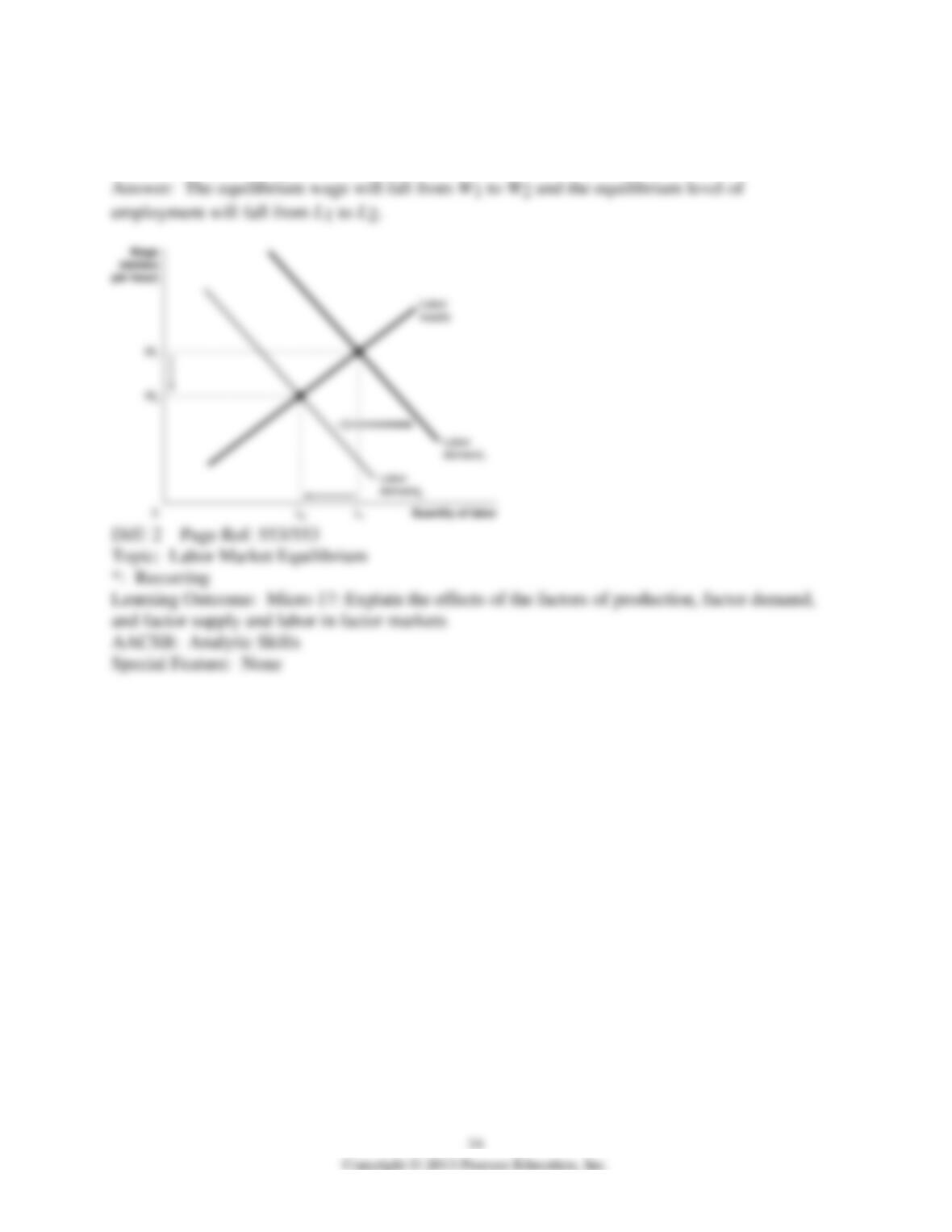
14) If the labor demand curve shifts to the left and the labor supply curve remains unchanged,
what will happen to the equilibrium wage and the equilibrium level of employment? Illustrate
your answer with a graph.
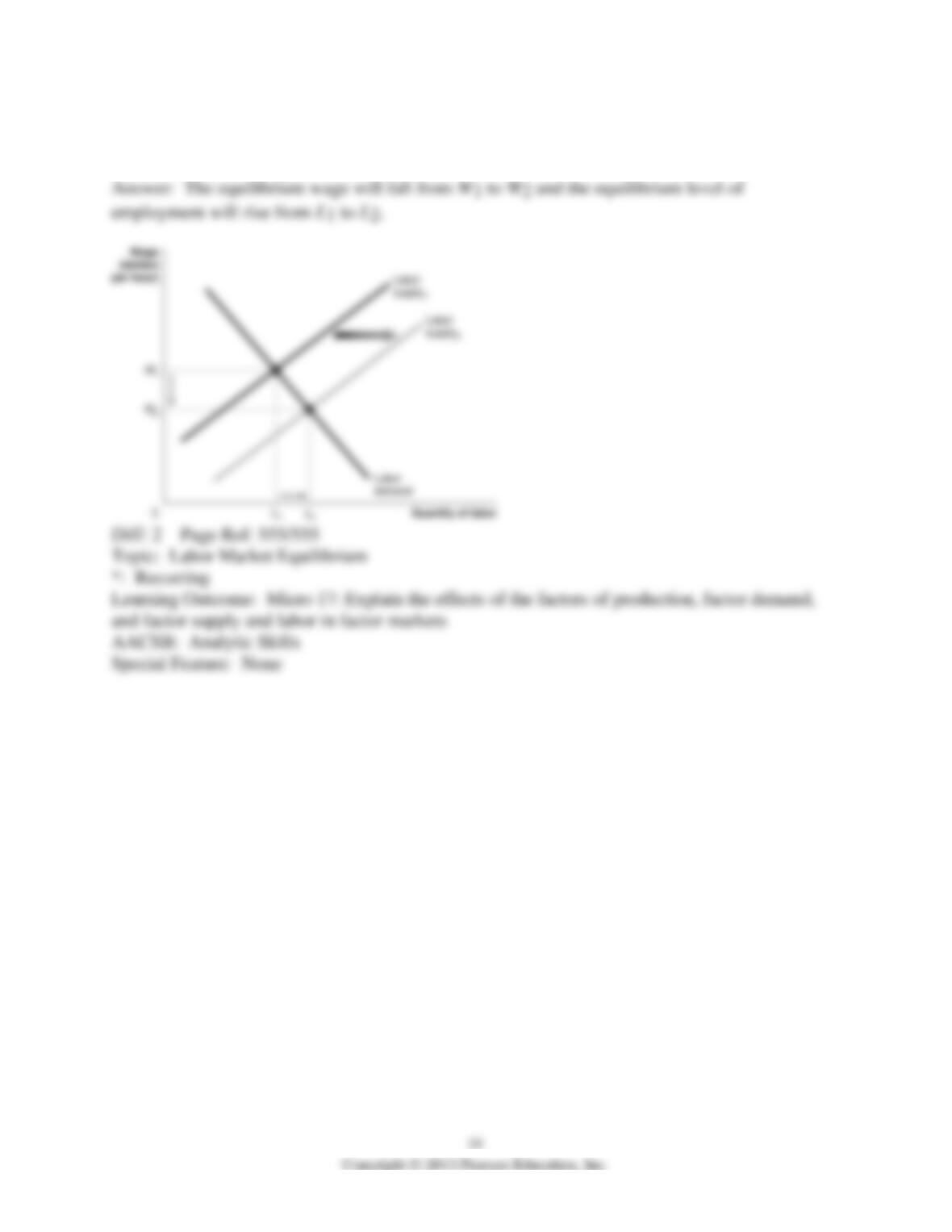
15) If the labor supply curve shifts to the right and the labor demand curve remains unchanged,
what will happen to the equilibrium wage and the equilibrium level of employment? Illustrate
your answer with a graph.
16) Consider the market for nurses in a given city. In each of the following cases, explain what
happens to the equilibrium wage rate and the quantity of nurses hired.
a. One of the major hospitals in the city closes.
b. A record number of students graduate with bachelor’s degrees in nursing.
c. Traditionally, nursing is a field that attracts women. However, changes in access to education
and to the labor force participation rate by women have led to a greater demand for the services
of women in a wide range of occupations. The demand for nurses, however, does not change.
d. Advances in medical technology reduce the amount of time physicians must spend with
patients in intensive care and increase the time that nurses spend with patients.
17) Economist Michael Spence uses a concept called the “signaling hypothesis” to argue that
college graduates don’t earn high incomes because the skills they learned while in college serve
to increase their productivity. Explain the signaling hypothesis. Is there evidence that the
signaling hypothesis is not valid?

17.4 Explaining Differences in Wages
1) One reason why the average salary of Major League Baseball players is higher than the
average salary of college professors is
A) the careers of most baseball players are much shorter than the careers of most college
professors.
B) the marginal revenue product of baseball players is greater than the marginal revenue product
of college professors.
C) college professors accept lower salaries in exchange for better working conditions.
D) competition among baseball club owners forces player salaries to be much higher than the
players’ marginal revenue products.
2) Adrian Gonzalez’s marginal product as a baseball player would be about the same as a Boston
Red Sox and a San Diego Padre. Why were the Red Sox willing to pay Gonzalez a higher salary
than he was paid as a San Diego Padre?
A) The Red Sox play needed a superstar to attract fans to their games. The Padres had no need to
attract fans to their games.
B) The Red Sox play more home games than the Padres. As a result, the Red Sox earn more
revenue from ticket sales that they can use to pay player salaries.
C) Gonzalez’s marginal revenue product is higher as a Red Sox than it was as a Padre.
D) The owner of the Red Sox was under more pressure from the fans and the Boston media to
pay Gonzalez a higher salary than the Padres were willing to pay.

3) The total value to society of having garbage removed is greater than the value of baseball
games. Why, then, are baseball players paid more than garbage collectors?
A) Although the total value of garbage removal is greater than the total value of baseball, wages
are determined by average values.
B) Garbage removal results in significant external benefits that are not captured in the price paid
for garbage removal. As a result, wages of garbage collectors do not reflect their social benefits.
C) There is greater competition in the garbage collection industry than there is in Major League
Baseball.
D) Wages do not depend on total values but marginal values. The marginal revenue product of
baseball players exceeds the marginal revenue product of garbage collectors.
4) The difference between the salaries paid to movie stars and to actors who play supporting
roles is much greater today than it was in the 1930s and 1940s. What factor explains this increase
in relative salaries over time?
A) Technological advances in the entertainment industry increase the revenue that successful
movies can earn. This has increased the movie studios’ willingness to pay high salaries to movie
stars.
B) Agents of movies stars are effective in obtaining large salaries for their clients today. Few
movie stars had agents to negotiate for them in the 1930s and 1940s.
C) The studio system that dominated the industry in the 1930s and 1940s no longer exists. The
studio system allowed movie studios to sign actors to long-term contracts that kept salaries
down.
D) There was no actors’ union in the 1930s and 1940s. The rise of strong actors’ unions has
caused salaries of movies stars to be greater today than in previous years.

5) Differences in marginal revenue products are the most important factor in explaining wage
differences. Other factors that explain wage differences include all but one of the following.
Which factor does not help explain differences in wages?
A) cognitive differentials
B) compensating differentials
C) discrimination
D) labor unions
6) Most economists believe that a small amount of the gap between the wages of white males
and the wages of other groups is due to discrimination. Which of the following factors is not
another factor that explains part of this gap?
A) differences in education
B) geographic location
C) differences in experience
D) differing preferences for jobs
7) The equilibrium level of employee compensation is determined by
A) the supply of labor and the supply of goods and services.
B) the demand for labor and the demand for goods and services.
C) the supply of goods and services and the demand for goods and services.
D) the supply of labor and the demand for labor.

8) In labor markets, the value of fringe benefits, such as health insurance,
A) is part of employee compensation.
B) is part of employee compensation only if employees are required to directly pay for the
benefits.
C) is not a part of employee compensation.
D) is part of employee compensation only if its value is not allowed to be deducted from the
employee’s personal income tax.
9) If an employer provides fringe benefits, such as health insurance, to employees, the costs of
those fringe benefits are borne primarily by the
A) employees.
B) employer.
C) government.
D) All of the above bear the costs equally.
10) An organization of employees that has the legal right to bargain with employers about wages
and working conditions is called a
A) closed shop.
B) guild.
C) labor union.
D) monopsony.