Microeconomics, 4e – Testbank 2 (Hubbard)
Chapter 17 The Markets for Labor and Other Factors of Production
17.1 The Demand for Labor
1) One difference between the labor market and markets for goods and services is
A) the demand in the labor market is inelastic; the demand for goods and services may be elastic
or inelastic.
B) the supply of labor is perfectly inelastic because the quantity supplied is constant. The
elasticity of supply for goods and services is different in different markets.
C) concepts of fairness arise more frequently in labor markets than in the markets for goods and
services.
D) in the labor market, firms are suppliers while households are demanders.
2) Adrian Gonzalez and other star baseball players earn millions of dollars annually. These
salaries are due to
A) the greed of players and their agents.
B) the demand and supply of labor in the market for baseball players.
C) the elastic demand for jobs in Major League Baseball.
D) the irrational behavior of team owners.

3) Major League Baseball teams are similar to other firms in that they use factors of production
to produce a product (baseball games). An example of capital used by teams to produce their
products is
A) the money teams earn from television contracts and ticket sales.
B) the land on which baseball games are played.
C) the labor of baseball players.
D) the ballparks where the games are played.
4) What is a factor market?
A) It is a market where financial instruments are traded.
B) It is a market where stocks and bonds are traded.
C) It is a market producers buy consumption and capital goods.
D) It is a market where resources used to produce final goods are traded.
5) The demand for labor is different from the demand for final goods and services because
A) the demand for labor is derived from the demand for the good or service the labor is used to
produce.
B) it is a demand for people, not inanimate objects.
C) the demand for labor is more inelastic than the demand for the goods and services produced
with this labor.
D) the law of demand does not apply to the demand for labor.

6) The demand for labor depends primarily on the additional output produced as a result of hiring
an additional worker and
A) the additional revenue received from selling the output produced as a result of hiring an
additional worker.
B) the payment made to the worker for producing the additional output.
C) the elasticity of demand for the output produced by the worker.
D) the number of workers willing to produce the additional output.
7) The term “derived demand” refers to
A) the demand for financial products called derivatives.
B) the demand for a factor of production that is derived from the demand for the good the factor
produces.
C) a firm’s estimated demand curve derived from sales data.
D) a demand curve that derives from the availability of resources.
8) An increase in the demand for orthodontic services leads to
A) an increase in the supply of orthodontists.
B) lower prices for orthodontic care.
C) an increase in the demand for orthodontists.
D) a rise in the rates of dental insurance.

9) The marginal product of labor is
A) the payment made to workers for their contribution to the output they produce.
B) equal to the demand for labor.
C) the change in a firm’s revenue as a result of hiring one more worker.
D) the additional output a firm produces as a result of hiring one more worker.
10) A firm should hire more workers to increase its profits if
A) the marginal product of labor is greater than the wage the firm will pay these workers.
B) the wage rate is less than the marginal revenue product of labor.
C) there is enough capital and other resources for the workers to use.
D) the demand for labor is elastic.
11) The demand curve for labor is also
A) the demand curve for the output produced with labor since the demand for labor is a derived
demand.
B) the marginal product of labor curve.
C) the marginal revenue product of labor curve.
D) the supply curve for the output labor is used to produce.

12) Which of the following describes a difference between the marginal product of labor and the
marginal revenue product of labor?
A) The marginal product of labor declines as each additional worker is hired because of the law
of diminishing returns. The marginal revenue product of labor declines as each additional worker
is hired because of diseconomies of scale.
B) The marginal product of labor declines as each additional worker is hired because of the law
of diminishing returns. The marginal revenue product increases as each additional worker is
hired because of increases in the productivity of labor.
C) The marginal product of labor is inelastic. The marginal revenue product of labor is elastic.
D) The marginal product of labor measures the change in output as additional workers are hired.
The marginal revenue product measures the change in revenue as additional workers are hired.
13) As more output is produced, the marginal product of labor declines
A) because of the law of diminishing returns.
B) if firms reduce the wage paid to labor.
C) if the firm’s output supply curve is inelastic.
D) because the firm’s marginal revenue declines.
14) A firm’s demand curve for labor slopes downwards because
A) of the law of diminishing marginal returns.
B) firms supply less labor as the wage rate rises.
C) workers supply less labor services as the wage rate falls.
D) of rising marginal product.

15) For a firm that is a price taker in the market for labor, the marginal revenue product of labor
equals the
A) marginal product of labor multiplied by the wage rate.
B) marginal product of labor multiplied by the product price.
C) marginal product of labor divided by the wage rate.
D) marginal product of labor multiplied by the marginal cost of production.
16) The change in a firm’s revenue as a result of hiring one more worker
A) is the definition of the marginal product of labor.
B) is equal to the firm’s marginal cost.
C) is the definition of the marginal revenue product of labor.
D) will be negative if the demand for the firm’s output is inelastic.
17) The marginal revenue product of labor is defined as
A) the change in the firm’s revenue as a result of selling one more unit of output.
B) the change in the firm’s output as a result of hiring one more worker.
C) the change in the firm’s profit as a result of hiring one more worker.
D) the change in the firm’s revenue as a result of hiring one more worker.

18) The benefit to the firm from hiring one additional worker is called the
A) marginal revenue product of labor.
B) marginal revenue.
C) marginal profit.
D) total revenue.
19) Holding the price of a firm’s output constant, if the marginal product of labor increases
A) the marginal revenue product of labor decreases.
B) the marginal revenue product of labor also increases.
C) the marginal products of other inputs also increase.
D) the marginal revenue product of labor may increase or decrease.
20) Hotspur Incorporated, a manufacturer of microwaves, is a price taker in both the input and
output markets. To maximize its profit, Hotspur will hire labor up to the point where
A) the marginal product of labor is no longer positive.
B) all economies of scale have been exhausted.
C) the marginal revenue product of labor equals the wage rate.
D) the marginal revenue product of labor equals the output price.
21) Marginal revenue product falls as more labor is hired because
A) the price of the product must fall for a perfectly competitive firm to sell more.
B) the wage rate rises as more workers work more hours.
C) the marginal product of labor is negative as additional units of labor are hired.
D) the marginal product of labor falls as a result of the law of diminishing returns.
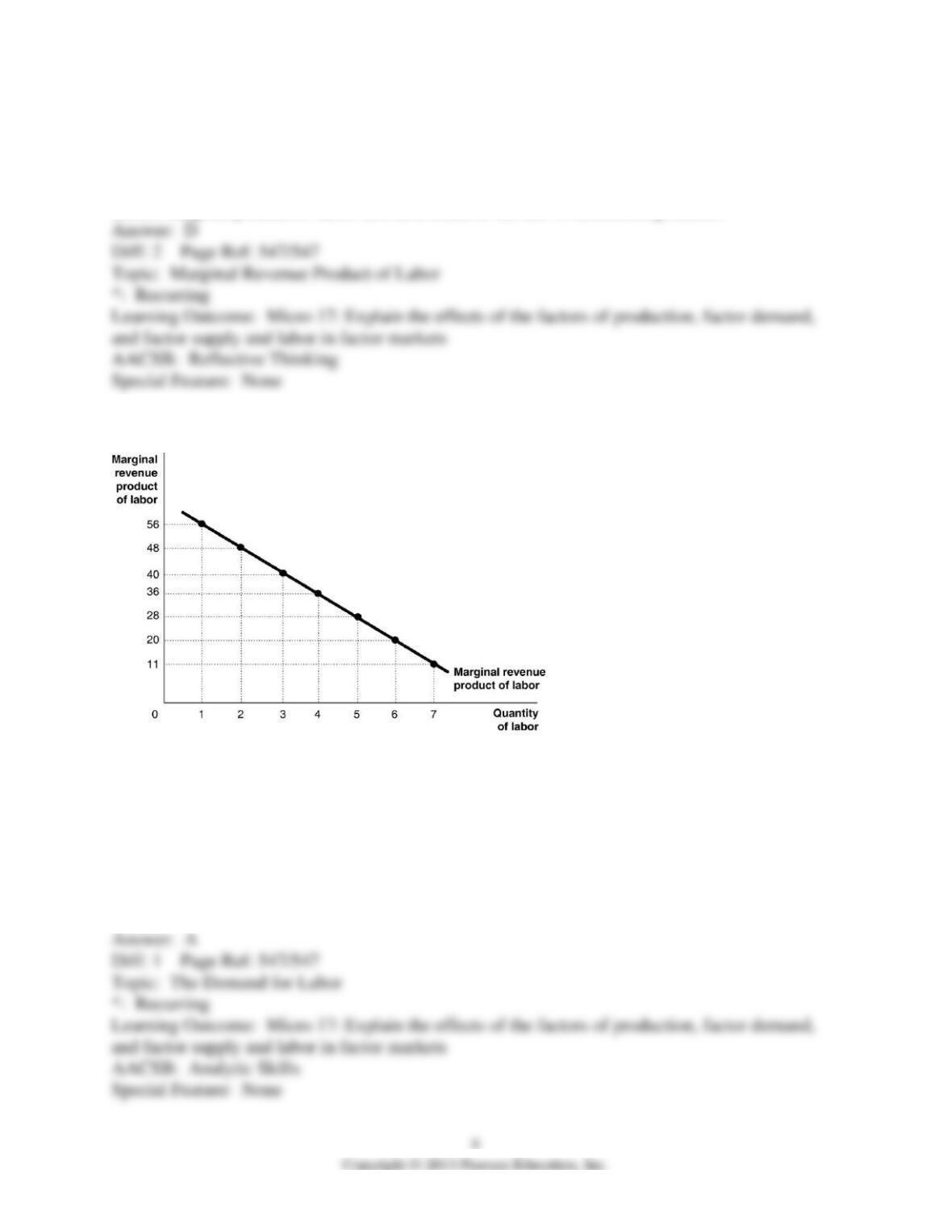
Figure 17-1
Figure 17-1 shows the marginal revenue product for Becca’s Baubles, a producer of hand-beaded
bracelets.
22) Refer to Figure 17-1. If the wage rate is $20, how many workers should Becca hire?
A) 6
B) 5
C) 4
D) 3

23) Refer to Figure 17-1. If Becca can sell her bracelets at $3 each, what is the marginal
product of the 4th worker?
A) $36
B) 12 bracelets
C) 36 bracelets
D) $144
24) Refer to Figure 17-1. Suppose the market price of bracelets falls to $2. What happens to the
curve given in the diagram?
A) Nothing, because labor’s productivity has not changed.
B) There will be a movement along the curve.
C) The curve shifts to the left.
D) We cannot answer the question without knowing if Becca would want to hire more workers.

Table 17-1
Number of
Workers
Output of
Microwave
Ovens per
Week
1
30
2
55
3
75
4
90
5
100
6
105
Hotspur Incorporated, a manufacturer of microwave ovens, is a price taker in its input and output
markets. The firm hires labor at a constant wage rate of $800 per week and sells microwave
ovens at a constant price of $80. Table 17-1 shows the relationship between the quantity of labor
it hires and the quantity of microwave ovens it produces.
25) Refer to Table 17-1. What is the amount of revenue added as a result of hiring the fourth
worker?
A) $1,200
B) $7,200
C) 15 microwaves
D) 90 microwaves
26) Refer to Table 17-1. What is the amount of profit added as a result of hiring the fourth
worker?
A) $7,200
B) $1,200
C) $800
D) $400

27) Refer to Table 17-1. What is Hotspur’s profit maximizing quantity of labor?
A) 2 workers
B) 3 workers
C) 5 workers
D) 6 workers
28) Which of the following is not held constant along a firm’s demand curve for labor?
A) the quantity of other inputs used by the firm
B) the wage rate
C) changes in technology
D) the price of the product produced by the firm
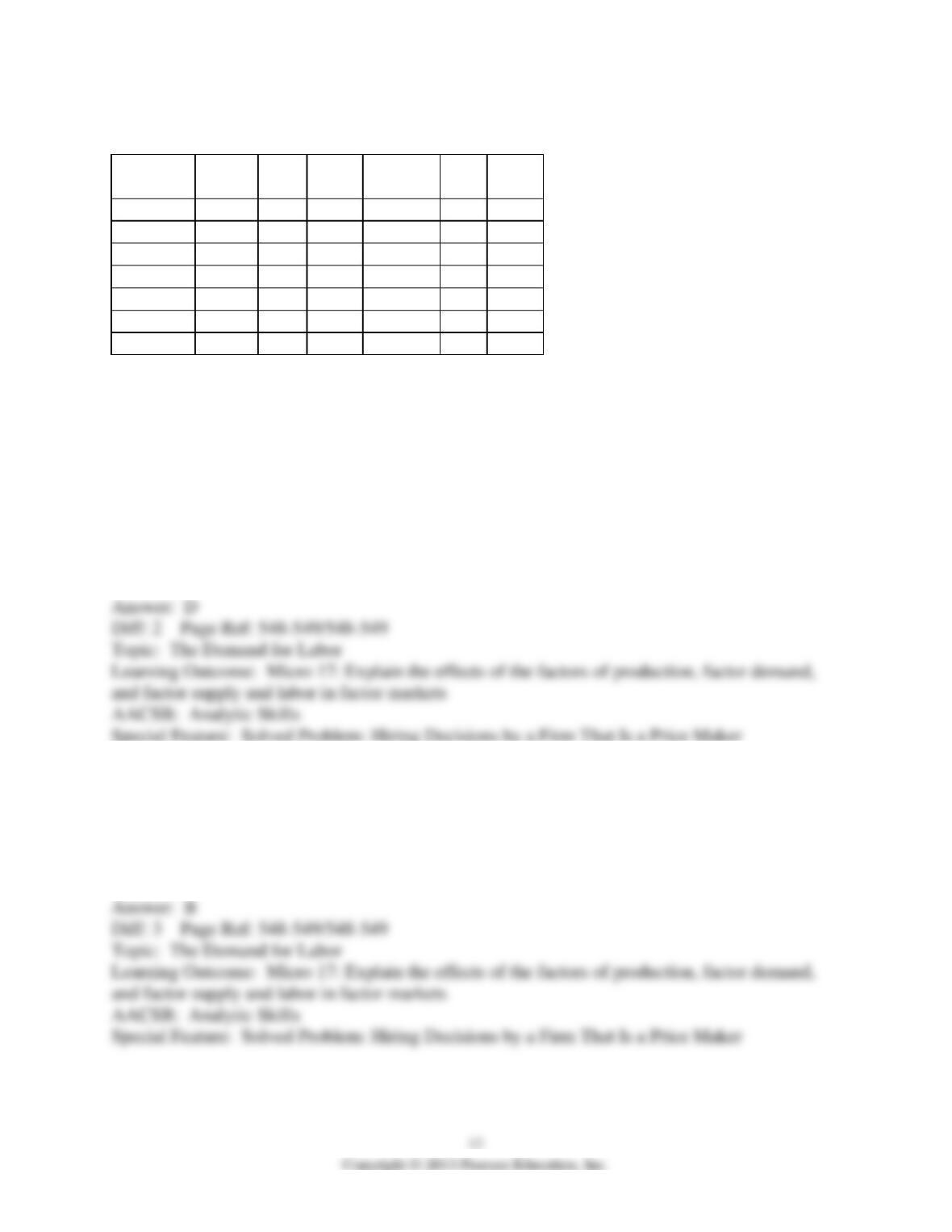
Table 17-2
Quantity
of Labor
Output
MPL
Price
Total
Revenue
MRP
L
Wage
0
0
—
$200
$0
—
$500
1
6
6
180
500
2
11
5
160
500
3
15
4
140
500
4
18
3
120
500
5
20
2
100
500
6
21
1
80
500
Table 17-2 lists data for the production of Apple iPods. Apple is assumed to be a price maker, so
to increase its sales of iPods the firm must lower its price. MPL and MRPL refer to the marginal
product of labor and the marginal revenue product of labor, respectively.
29) Refer to Table 17-2. What are the price and quantity of workers that result in the maximum
amount of revenue Apple would earn from selling iPods?
A) $180; 1
B) $140; 2
C) $120; 2
D) $120; 4
30) Refer to Table 17-2. What are the price and quantity of workers that result in the maximum
amount of profit Apple would earn from selling iPods?
A) $140; 2
B) $160; 2
C) $140; 3
D) $180; 1

31) Refer to Table 17-2. What are the quantity of labor and marginal revenue product of labor
that will maximize the profit Apple would earn from selling iPods?
A) 2; $160
B) 3; $340
C) 2; $680
D) 3; $140
32) Suppose a competitive firm is paying a wage of $12 an hour. Assume that labor is the only
input. If hiring another worker would increase output by four units per hour, then to maximize
profits the firm should
A) not change the number of workers it currently hires.
B) hire the extra worker.
C) layoff some workers.
D) There is not enough information to answer the question.
33) Suppose a competitive firm is paying a wage of $12 an hour and sells its product at $3 per
unit. Assume that labor is the only input. If the last worker hired produces four units of output
per hour, then to maximize profits the firm should
A) not change the number of workers it currently hires.
B) lay off some workers.
C) hire another worker.
D) There is not enough information to answer the question.
34) The market demand curve for labor
A) is determined by adding up the quantity of labor demanded by each firm at each wage,
holding constant the other variables that affect the willingness of firms to hire workers.
B) is the same as the market demand curve for the product labor produces because it is a derived
demand.
C) is determined by adding up the demand for labor by each firm at each wage, holding constant
the other variables that affect the willingness of firms to hire workers.
D) is perfectly inelastic because there is a finite number of workers in the market for labor.
35) An increase in a perfectly competitive firm’s demand for labor could be caused by
A) a decrease in the market wage rate.
B) an increase in the amount of human capital among the labor force.
C) an increase in the supply of labor.
D) a decrease in the market price of the product the firm produces.
36) Which of the following factors will not cause the labor demand curve to shift?
A) increases in human capital
B) changes in technology
C) change in the price of the product produced with labor
D) the wage rate

37) An increase in the supply of capital, which is a complement to labor, will lead to
A) a decrease in the quantity of labor demanded.
B) an increase in the demand for labor.
C) a decrease in the demand for labor.
D) an increase in the quantity of labor demanded.
38) An increase in the price of grape juice causes an increase in the marginal revenue product of
labor used to produce grape juice.
39) The marginal product of labor curve is the demand curve for labor.
40) A decrease in the amount of human capital acquired by workers will lead to decrease in the
supply of labor.
41) An increase in the supply of capital, which is a substitute to labor, will lead to a decrease in
the demand for labor.
42) The demand for labor is a derived demand. Explain what is meant by the term “derived
demand.”

17
Table 17-3
Number of
Hairdressers
Haircuts
per Day
Marginal
Product
Marginal
Revenue
Product
1
8
2
16
3
23
4
29
5
34
6
38
43) Refer to Table 17-3. The Hair Cuttery, a new hair salon, is ready to start hiring. The table
above shows the relationship between the number of hairdressers the firm hires and the quantity
of haircuts it produces.
a. Suppose the price of haircuts is $8. Complete the table by filling in the values for marginal
product and marginal revenue product.
b. The Hair Cuttery is an input price-taker. Suppose the wage paid to hairdressers is $40 per
day. What is the profit-maximizing number of hairdressers?
c. Suppose the wage rate rises to $60 per day.
(i) What happens to the firm’s demand curve for hairdressers?
(ii) What happens to the profit-maximizing quantity of hairdressers?
d. Suppose the wage rate is $40 per day and the price of haircuts is now $10.
(i) What happens to the firm’s demand curve for hairdressers?
(ii) What happens to the profit-maximizing quantity of hairdressers?
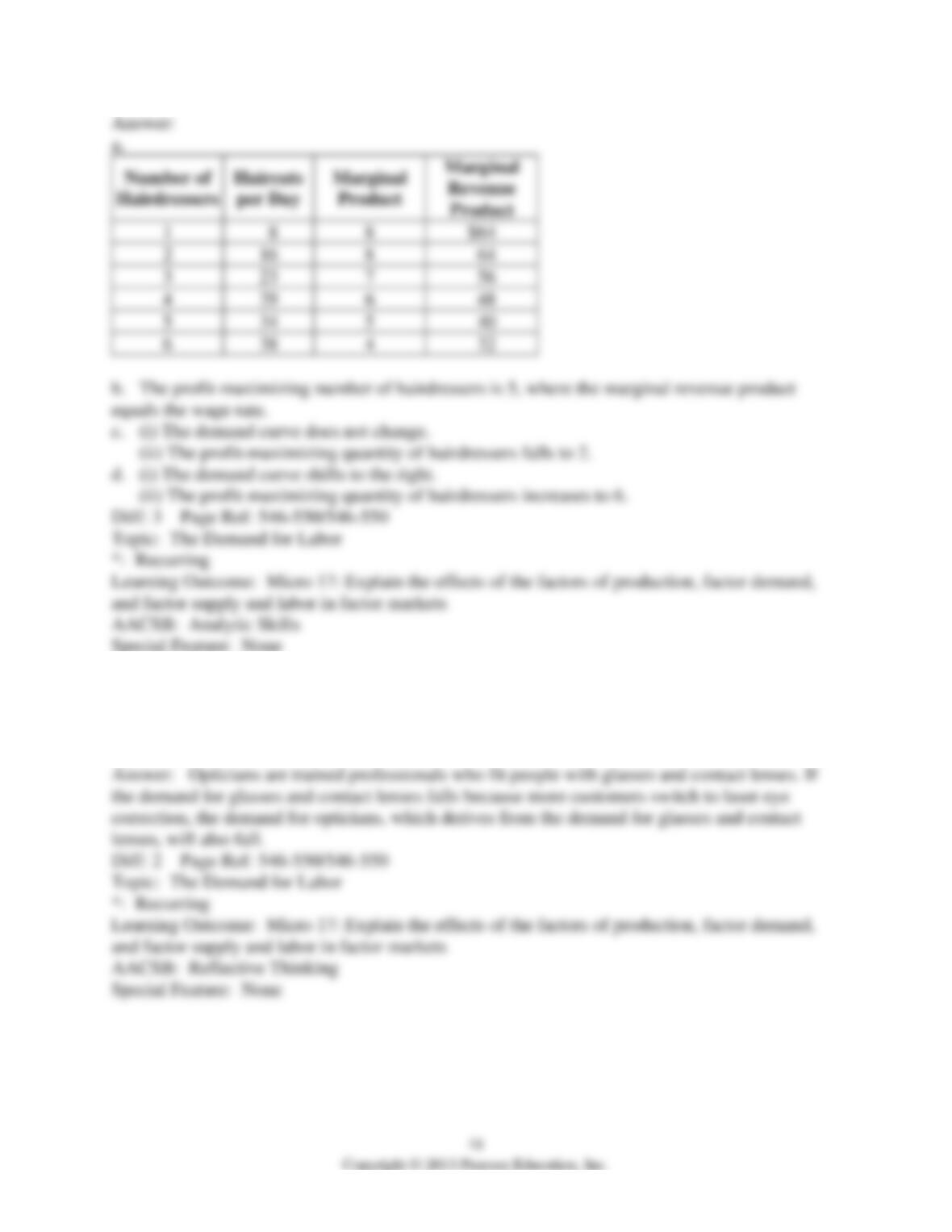
44) Explain how the market for opticians is affected as a result of the development of laser
technology which reduces the demand for glasses and contact lenses. In your explanation be sure
to show the connection between the market for glasses and contact lenses and the market for
opticians.

17.2 The Supply of Labor
1) The labor supply curve
A) shows the relationship between the wage rate and the quantity of labor supplied.
B) shows the quantity of jobs supplied at various wage rates.
C) is unit-elastic.
D) is U-shaped.
2) In general, the labor supply curve
A) slopes downward because firms will hire fewer workers at higher wages.
B) slopes upward because as the wage rises the opportunity cost of leisure increases.
C) is vertical at the equilibrium wage rate.
D) is perfectly elastic at the equilibrium wage rate.
3) The wage rate is the opportunity cost of
A) working.
B) working overtime.
C) leisure.
D) consumption.

4) Which of the following helps to explain why the supply curve of labor is upward sloping?
A) The supply curve of labor is a derived supply curve; since the output supply curve is upward-
sloping so is the labor supply curve.
B) As the wage rate rises, the income effect causes the quantity of labor supplied to increase.
C) The substitution effect of a price change makes a good more expensive relative to other
goods.
D) As the wage rate rises, the opportunity cost of leisure rises.
5) Which of the following statements is true?
A) As the wage rate rises, the substitution effect decreases the opportunity cost of leisure and
causes a worker to devote more time to working and less time to leisure.
B) As the wage rate rises, the substitution effect increases the opportunity cost of leisure and
causes a worker to devote more time to working and less time to leisure.
C) As the wage rate rises, the income effect increases the opportunity cost of leisure and causes a
worker to devote more time to working and less time to leisure.
D) As the wage rate rises, the income effect causes a worker to devote more time to work and
less time to leisure.