Exam
Name___________________________________
MULTIPLE CHOICE. Choose the one alternative that best completes the statement or answers the question.
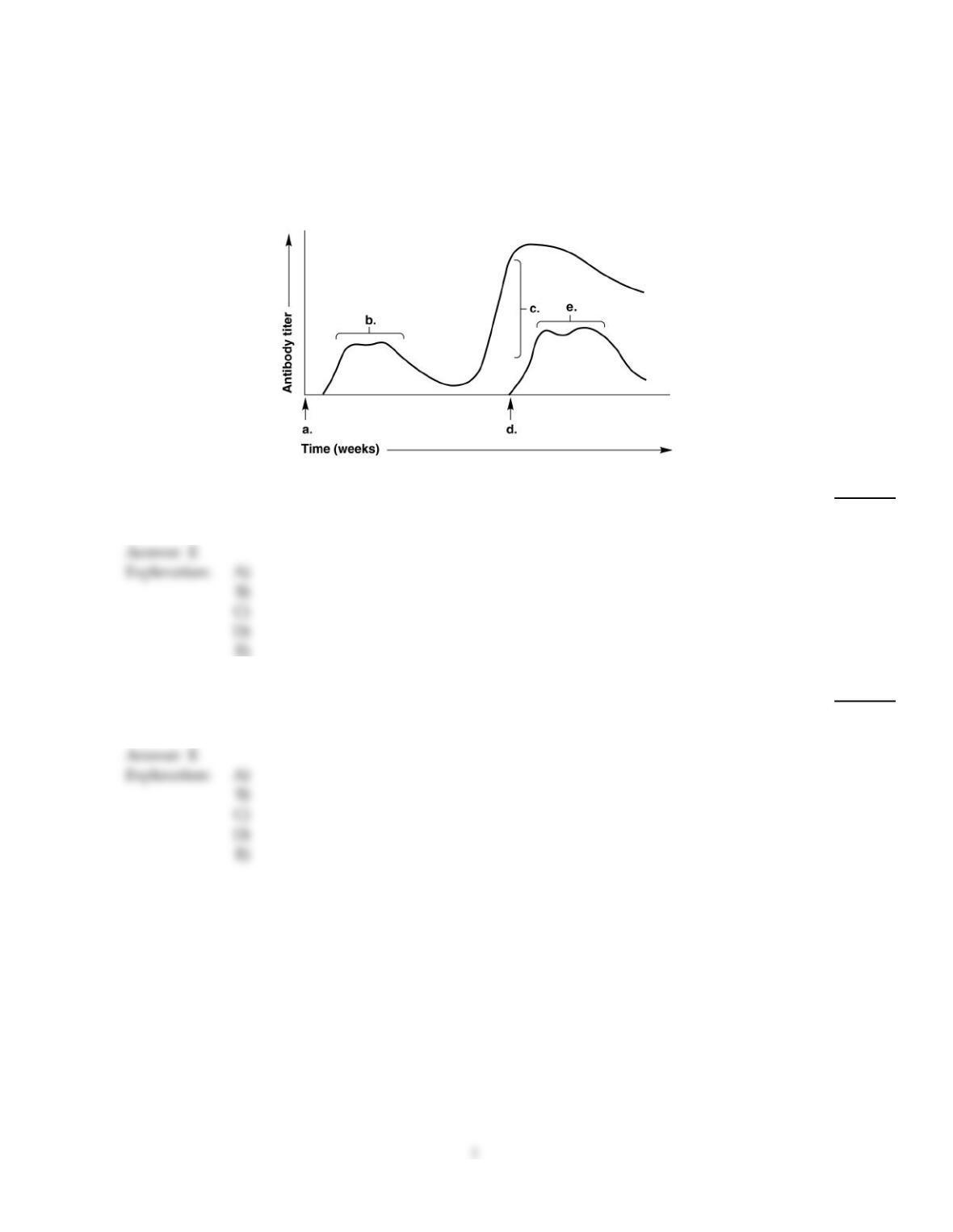
Figure 17.1
1)
In Figure 17.1, which letter on the graph indicates the highest antibody titer during the patient’s
response to a second antigen?
1)
A)
a
B)
b
C)
c
D)
d
E)
e
2)
Which of the following bacterial components would most likely result in B cell stimulation by
T–independent antigens?
2)
A)
ribosome
B)
pili
C)
flagellum
D)
plasmid
E)
capsule
3)
Which of the following cells is NOT an APC?
3)
A)
natural killer cells
B)
dentritic cells
C)
macrophages
D)
immature B cells
E)
None of the answers is correct; all of these are APCs.
4)
The specificity of an antibody is due to
4)
A)
its valence.
B)
the H chains.
C)
the L chains.
D)
the constant portions of the H and L chains.
E)
the variable portions of the H and L chains.
E
Explanation:
5)
Thymic selection
5)
A)
destroys T cells that do not recognize self–molecules of MHC.
B)
activates B cells.
C)
destroys CD4+ cells that attack self.
D)
destroys MHC molecules.
E)
destroys B cells that make antibodies against self.
A
Explanation:
6)
Which of the following is NOT a characteristic of B cells?
6)
A)
They are responsible for antibody formation.
B)
They have antibodies on their surfaces.
C)
They originate in bone marrow.
D)
They recognize antigens associated with MHC I.
E)
They are responsible for the memory response.
D
Explanation:
A
Explanation:

7)
IL–2, produced by TH cells,
7)
A)
activates TC cells to CTLs.
B)
activates macrophages.
C)
causes phagocytosis.
D)
stimulates TH cell maturation.
E)
activates antigen–presenting cells.
8)
What type of immunity results from transfer of antibodies from one individual to a susceptible
individual by means of injection?
8)
A)
innate immunity
B)
naturally acquired active immunity
C)
naturally acquired passive immunity
D)
artificially acquired active immunity
E)
artificially acquired passive immunity
E
Explanation:
9)
Plasma cells are activated by a(n)
9)
A)
T cell.
B)
B cell.
C)
APC.
D)
memory cell.
E)
antigen.
E
Explanation:
D
Explanation:

10)
Which of the following is the best definition of epitope?
10)
A)
specific regions on antigens that interact with antibodies
B)
specific regions on antigens that interact with T–cell receptors
C)
specific regions on antigens that interact with MHC class molecules
D)
specific regions on antigens that interact with haptens
E)
specific regions on antigens that interact with perforins
11)
Which of the following destroys virus–infected cells?
11)
A)
Treg
B)
CTL
C)
B cells
D)
dendritic cells
E)
TH
B
12)
The following events occur in cellular immunity. What is the third step?
12)
A)
Dendritic cell takes up antigen.
B)
Antigen enters M cell.
C)
TH cells proliferate.
D)
TH cell produces cytokines.
E)
Antibodies are produced.
C
13)
Which one of the following causes transmembrane channels in target cells?
13)
A)
hapten
B)
granzymes
C)
IL–1
D)
perforin
E)
IL–2
D
A

14)
Which of the following statements is NOT a possible outcome of antigen–antibody reaction?
14)
A)
opsonization
B)
clonal deletion
C)
ADCC
D)
agglutination
E)
activation of complement
15)
Which of the following statements about natural killer cells is FALSE?
15)
A)
They destroy virus–infected cells.
B)
They are stimulated by an antigen.
C)
They destroy cells lacking MHC I.
D)
They destroy tumor cells.
E)
None of the answers are correct; all of these statements are true.
16)
In addition to IgG, the antibodies that can fix complement are
16)
A)
IgD.
B)
IgE.
C)
IgA.
D)
IgM.
E)
None of the answers is correct.
17)
CD4+ T cells are activated by
17)
A)
complement.
B)
cytokines released by dendritic cells.
C)
interaction between CD4+ and MHC II.
D)
interaction between TCRs and MHC II.
E)
cytokines released by B cells.
5
18)
The presence of which of the following indicates a current infection rather than a previous infection
or vaccination?
18)
A)
IgM
B)
IgE
C)
IgD
D)
IgG
E)
IgA
19)
The antibodies that can bind to large parasites are
19)
A)
IgG.
B)
IgM.
C)
IgA.
D)
IgD.
E)
IgE.
20)
Which of the following statements about IL–12 is FALSE?
20)
A)
It activates macrophages.
B)
It inhibits some tumor cells.
C)
It causes TH cells to respond to HIV.
D)
It causes autoimmune diseases.
E)
It activates the TH1 pathway.
21)
Newborns’ immunity due to the transfer of antibodies across the placenta is an example of
21)
A)
innate immunity.
B)
naturally acquired active immunity.
C)
naturally acquired passive immunity.
D)
artificially acquired active immunity.
E)
artificially acquired passive immunity.
22)
What type of immunity results from recovery from mumps?
22)
A)
innate immunity
B)
naturally acquired active immunity
C)
naturally acquired passive immunity
D)
artificially acquired active immunity
E)
artificially acquired passive immunity
23)
What type of immunity results from vaccination?
23)
A)
innate immunity
B)
naturally acquired active immunity
C)
naturally acquired passive immunity
D)
artificially acquired active immunity
E)
artificially acquired passive immunity
24)
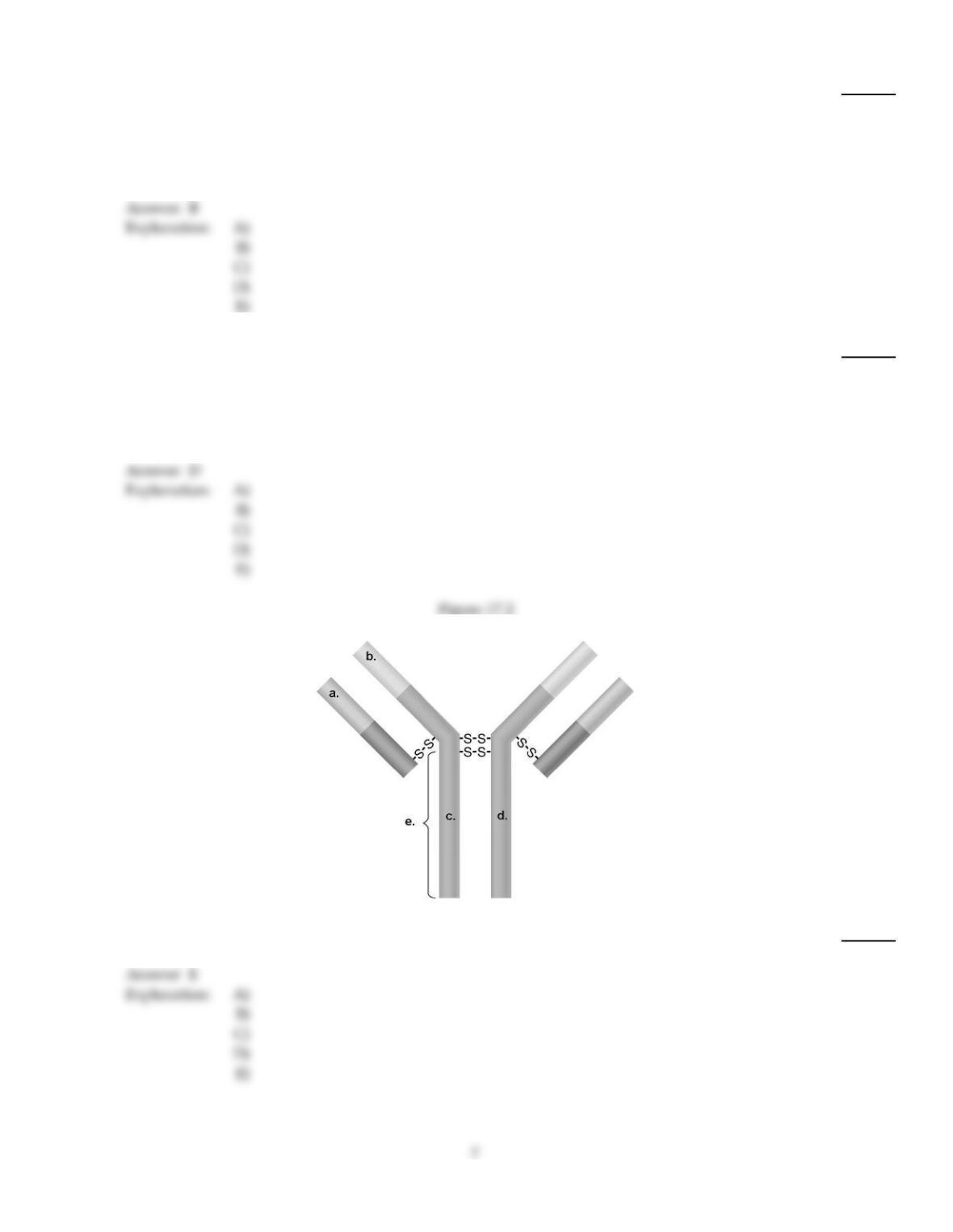
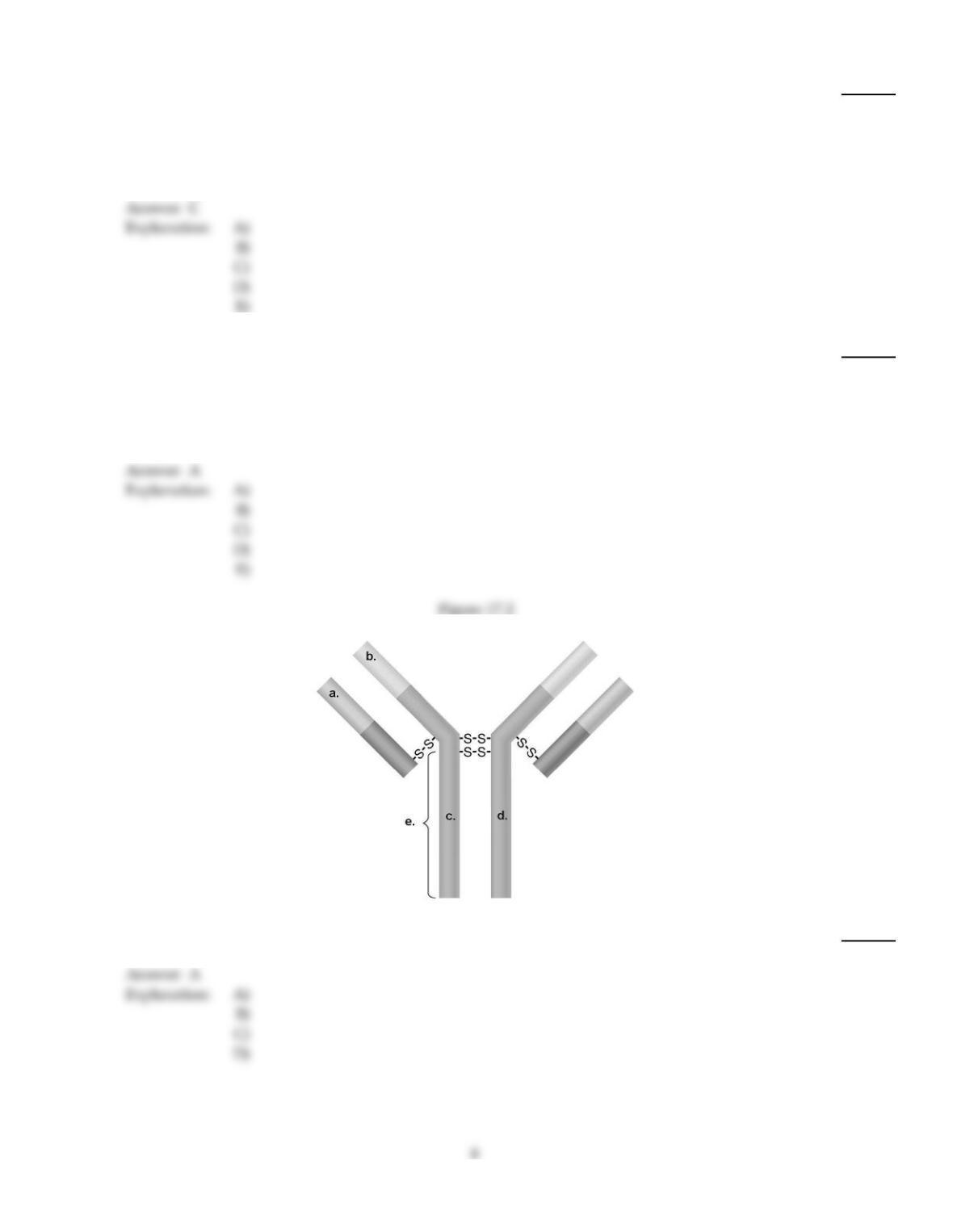
In Figure 17.2, what can attach to a host cell?
24)
A)
a and c
B)
b and c
C)
b
D)
a and d
E)
e
25)
An antibody’s Fc region can be bound by
25)
A)
antibodies.
B)
CTLs.
C)
macrophages.
D)
B cells.
E)
T helper cells.
26)
Which of the following is the best definition of antigen?
26)
A)
a chemical that elicits an antibody response and can combine with these antibodies
B)
a chemical that combines with antibodies
C)
a protein that combines with antibodies
D)
a pathogen
E)
something foreign in the body
27)
In Figure 17.2, which areas are different for all IgM antibodies?
27)
A)
a and b
B)
a and c
C)
b and c
D)
c and d

28)
Which of the following statements is FALSE?
28)
A)
The variable region of a light chain binds with antigen.
B)
The constant region of a heavy chain is the same for all antibodies.
C)
The Fc region attaches to a host cell.
D)
The variable region of a heavy chain binds with antigen.
E)
All of the answers are correct.
29)
Which of the following is NOT a characteristic of cellular immunity?
29)
A)
B cells make antibodies.
B)
The cells originate in bone marrow.
C)
T cells react with antigens.
D)
Cells are processed in the thymus gland.
E)
It can inhibit the immune response.
A
B
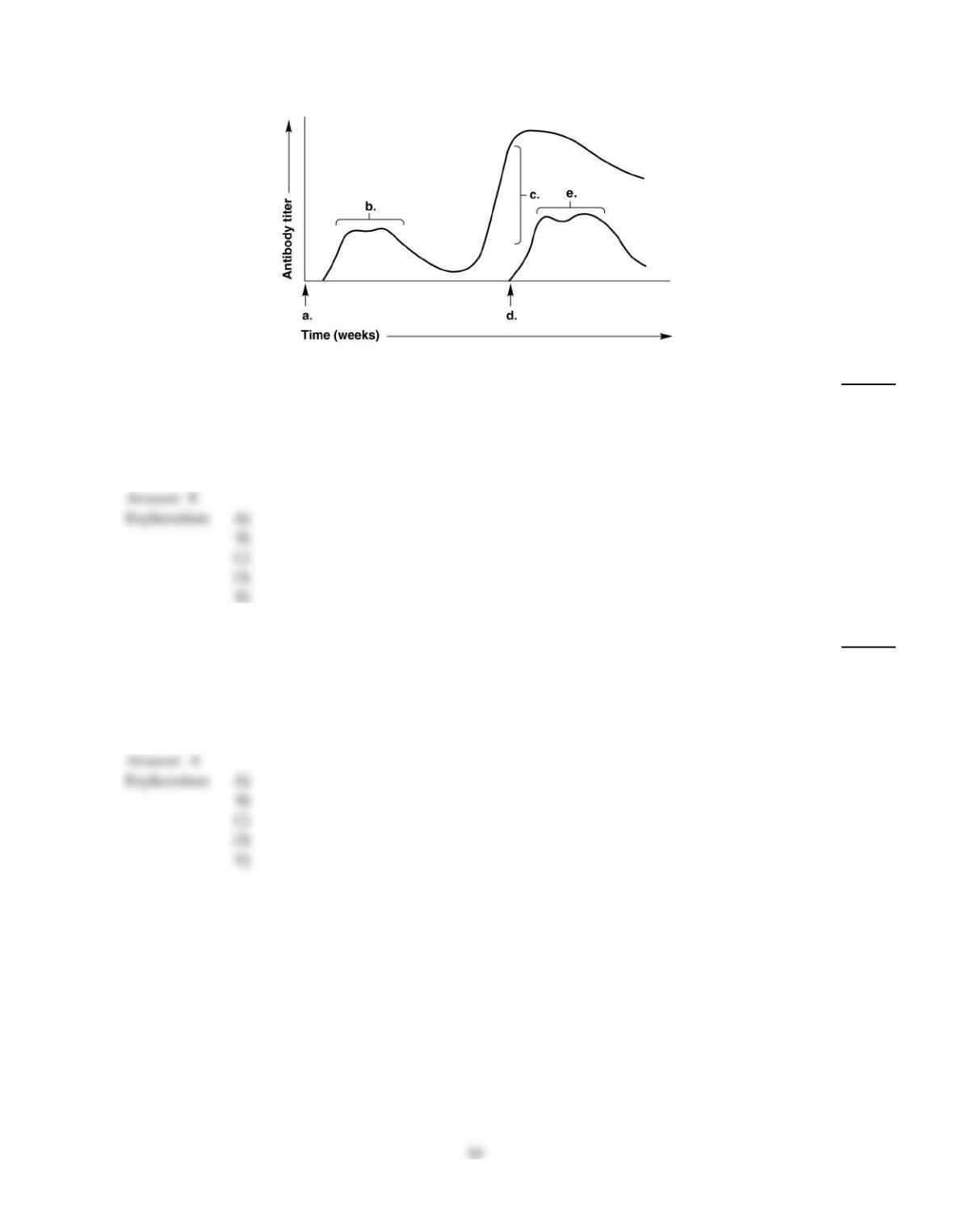
Figure 17.1
30)
In Figure 17.1, the arrow at time (c) indicates
30)
A)
the primary response.
B)
the T–cell response.
C)
exposure to a new antigen.
D)
the time of exposure to the same antigen as at time (a).
E)
the secondary response.
31)
ADCC is a process that is most effective in destroying
31)
A)
eukaryotic pathogens.
B)
bacterial toxins.
C)
extracellular viruses.
D)
virus–infected host cells.
E)
bacterial pathogens.
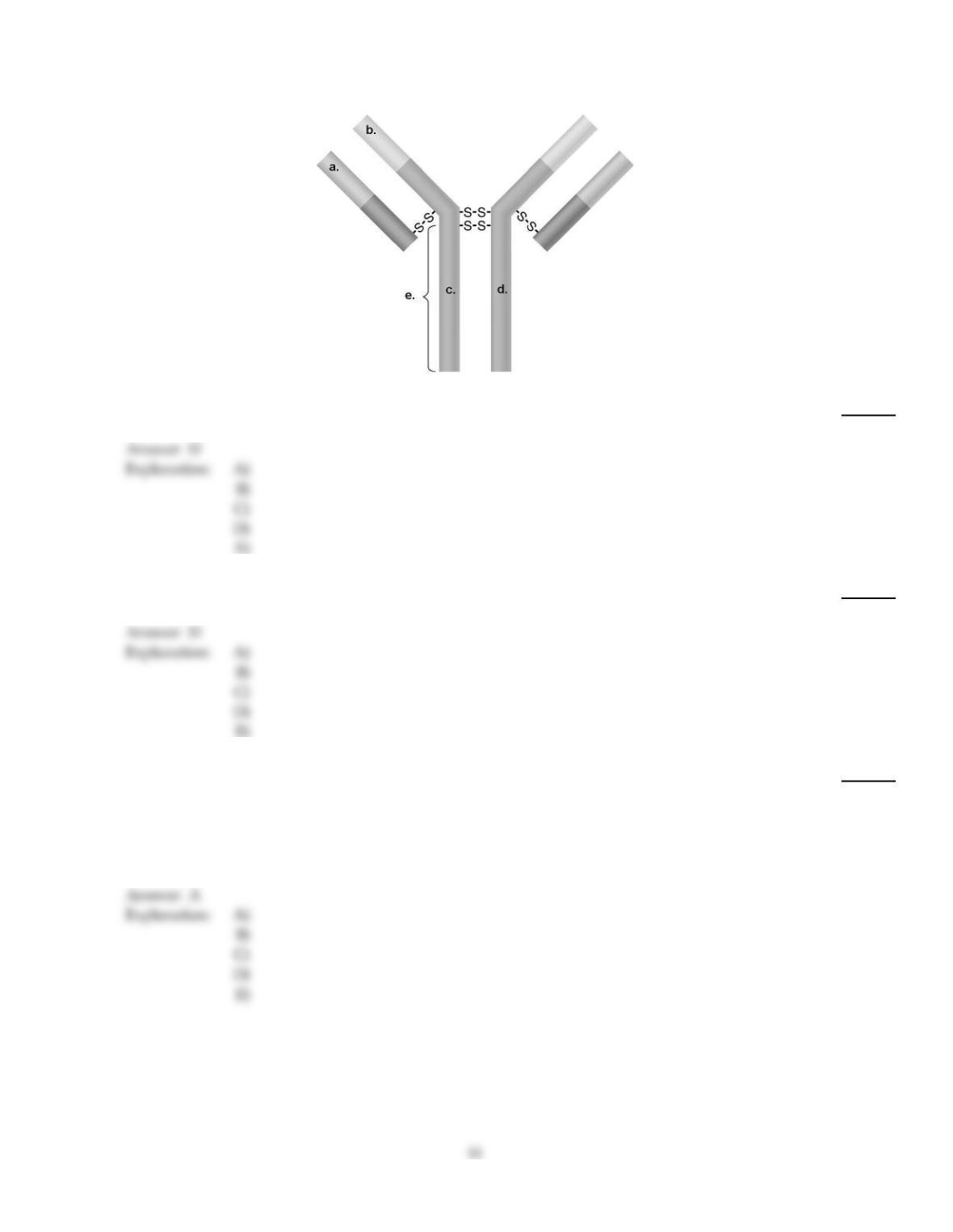
Figure 17.2
32)
In Figure 17.2, which areas are similar for all IgG antibodies?
32)
A)
a and b
B)
a and c
C)
b and c
D)
c and d
E)
b and d
33)
The antibodies found on the surface of B cells, and which always exist as monomers, are
33)
A)
IgG.
B)
IgM.
C)
IgA.
D)
IgD.
E)
IgE.
34)
When an antibody binds to a toxin, the resulting action is referred to as
34)
A)
neutralization.
B)
agglutination.
C)
apoptosis.
D)
opsonization.
E)
ADCC.
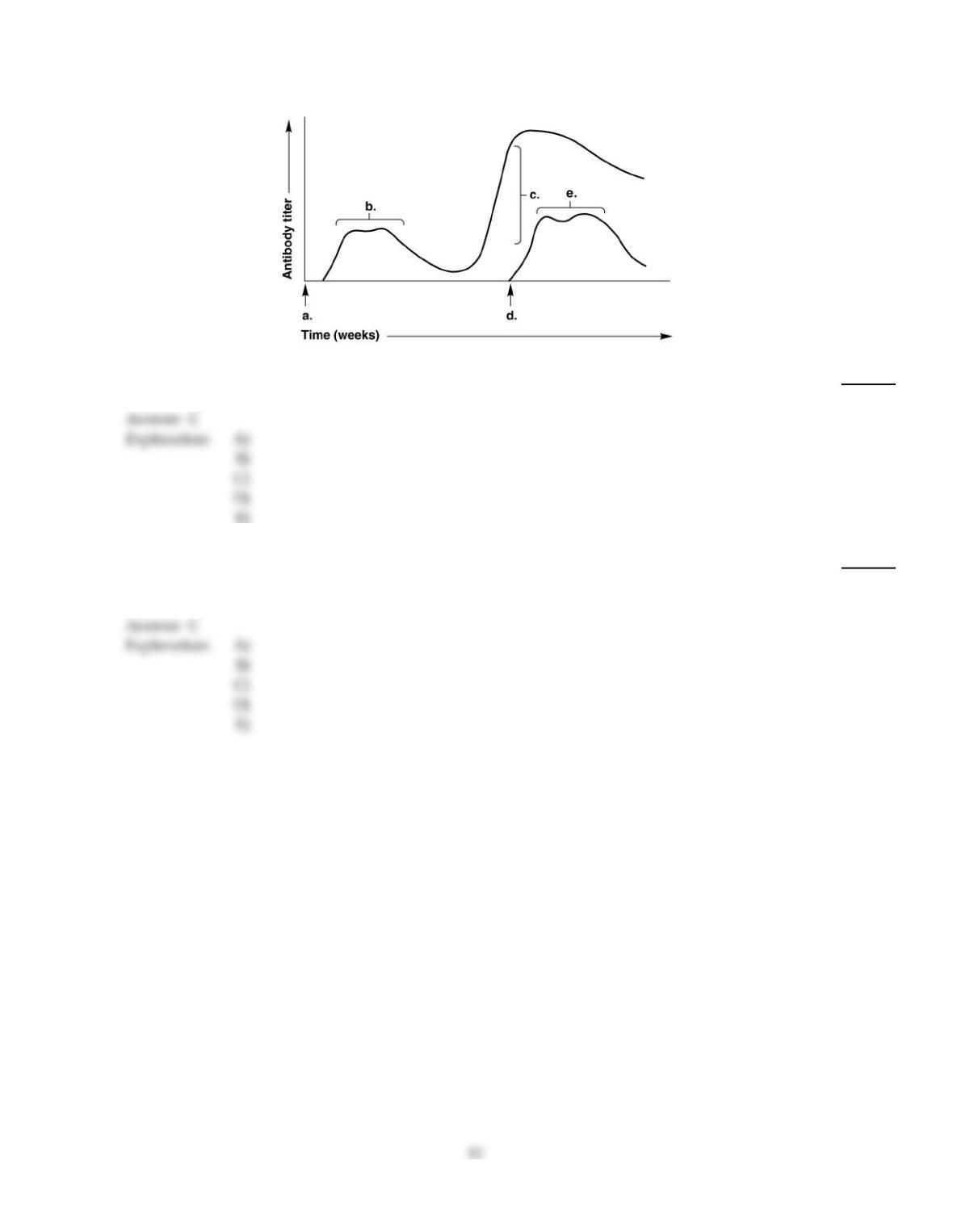
Figure 17.1
35)
In Figure 17.1, which letter on the graph indicates the patient’s secondary response to an antigen?
35)
A)
a
B)
b
C)
c
D)
d
E)
e
36)
At a minimum, the human immune system is capable of recognizing approximately how many
different antigens?
36)
A)
105
B)
1010
C)
1015
D)
1020
E)
1025
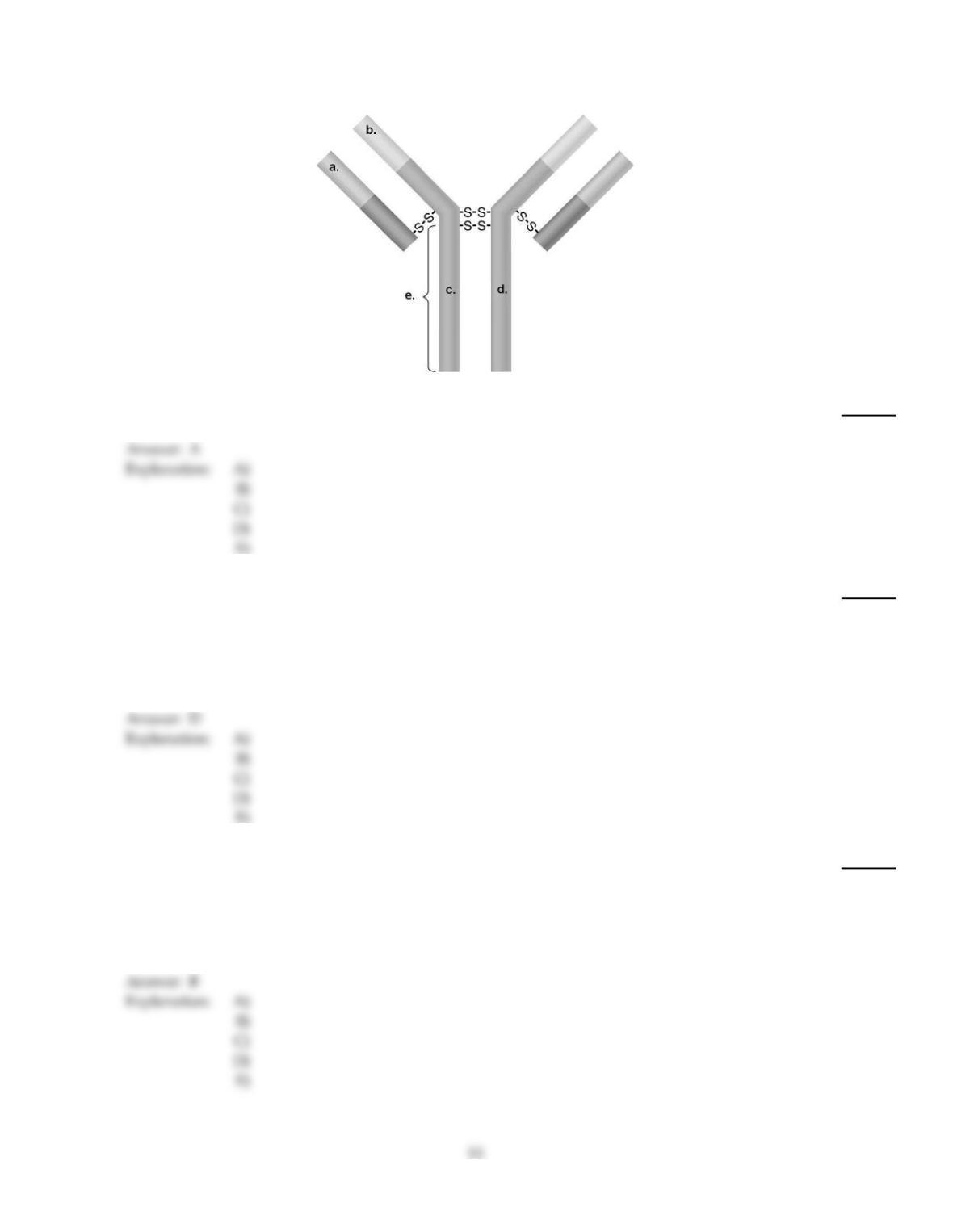
Figure 17.2
37)
In Figure 17.2, which areas represent antigen–binding sites?
37)
A)
a and b
B)
a and c
C)
b and c
D)
c and d
E)
b and d
38)
The following events elicit an antibody response. What is the third step?
38)
A)
TH cell produces cytokines.
B)
B cell is activated.
C)
Antigen–digest goes to surface of APC.
D)
TH cell recognizes antigen–digest and MHC II.
E)
APC phagocytizes antigen.
39)
Which of the following WBCs are NOT lymphocytes?
39)
A)
helper T cells
B)
M cells
C)
cytotoxic T cells
D)
NK cells
E)
B cells

40)
Large antibodies that agglutinate antigens are
40)
A)
IgG.
B)
IgM.
C)
IgA.
D)
IgD.
E)
IgE.
41)
Which of the following recognizes antigens displayed on host cells with MHC II?
41)
A)
natural killer cell
B)
basophil
C)
TC cell
D)
TH cell
E)
B cell
42)
Cytokines released by TH1 cells
42)
A)
kill parasites.
B)
convert TH1 cells to TH2 cells.
C)
convert B cells to T cells.
D)
convert TH2 cells to TH1 cells.
E)
activate CD8+ cells to CTLs.
43)
The most abundant class of antibodies in serum is
43)
A)
IgG.
B)
IgM.
C)
IgA.
D)
IgD.
E)
IgE.
44)
A Treg cell deficiency could result in
44)
A)
autoimmunity.
B)
transplant rejection.
C)
increased number of bacterial infections.
D)
increased severity of bacterial infections.
E)
increased number of viral infections.
45)
The antibodies found in mucus, saliva, and tears are
45)
A)
IgG.
B)
IgM.
C)
IgA.
D)
IgD.
E)
IgE.
TRUE/FALSE. Write ‘T’ if the statement is true and ‘F’ if the statement is false.
46)
Cytokines are protein–based chemical messengers that allow for communication between cells of
the immune system.
46)
47)
Cytokine storms negatively impact human health.
47)
48)
The variable region of the antibody is solely responsible the significant diversity of antigen targets.
48)
49)
The implementation of vaccinations occurred prior to experimental support for the germ theory of
disease.
49)
50)
When haptens attach to carrier molecules, an epitope forms on hapten which then can be bound to
antibody.
50)
51)
Apoptosis results in significant leakage of cellular contents.
51)
52)
Only dendritic cells produce interleukins.
52)
53)
Plasma cells will eventually differentiate into memory cells.
53)
54)
The production of interferons at an infection site is critical for chemotaxis.
54)
55)
Memory cells do not require B cell receptors.
55)
ESSAY. Write your answer in the space provided or on a separate sheet of paper.
56)
What adaptive immune responses, if any, could one expect to function normally in a human born without a
thymus?
57)
Describe the production of antibodies using the clonal selection theory.
58)
Can natural killer cells successfully perform duties without antibodies? Explain.
59)
A person has antibodies against the measles virus. Identify three ways in which these antibodies could be
acquired.
60)
Positive diagnosis of AIDS is made when a patient has antibodies against the human immunodeficiency virus
(HIV). Why does a patient have an immune deficiency if he or she is making antibodies?

Answer Key
Testname: C17

Answer Key
Testname: C17