Cost Accounting: A Managerial Emphasis, 6e
Chapter 17 – Process Costing
9) Which of the following is an error when accounting for transferred-in costs?
A) including transferred-in costs from previous departments
B) costing units at average costs
C) converting units to a common measurement when transferred in
D) consider costs assigned at the beginning of the period when calculating costs to be transferred on a
weighted average basis
E) consider costs assigned at the beginning of the period when calculating costs to be transferred on a
FIFO basis
10) Which of the following is FALSE concerning an operations-costing system?
A) It has characteristics of a job-costing system and of a process-costing system.
B) Within each operation, all product-units are treated exactly alike with respect to conversion costs.
C) Direct materials that are unique to different work orders, are specifically identified with the
appropriate work order, as in job-costing.
D) Work orders are used to specify direct materials and step–by-step operations.
E) A separate conversion cost is calculated for each work order, as in job costing.
11) Conceptually transferred-in costs from another department are similar to
A) direct labour.
B) finished goods inventory.
C) direct labour and materials.
D) manufacturing overhead.
E) materials provided by external suppliers.
12) An operation costing system would be applicable to
A) batches of similar products where each batch is a variation of a single design.
B) the construction of a bridge.
C) a suit-making operation.
D) Both A and C are correct..
E) Both A and B are correct.
Cost Accounting: A Managerial Emphasis, 6e
Chapter 17 – Process Costing
13) Managers find operation costing useful in cost management because it
A) often results in profit maximization.
B) results in cost minimization.
C) captures the financial impact of the control of physical processes.
D) overstates production costs.
E) understates operating income.
Cost Accounting: A Managerial Emphasis, 6e
Chapter 17 – Process Costing
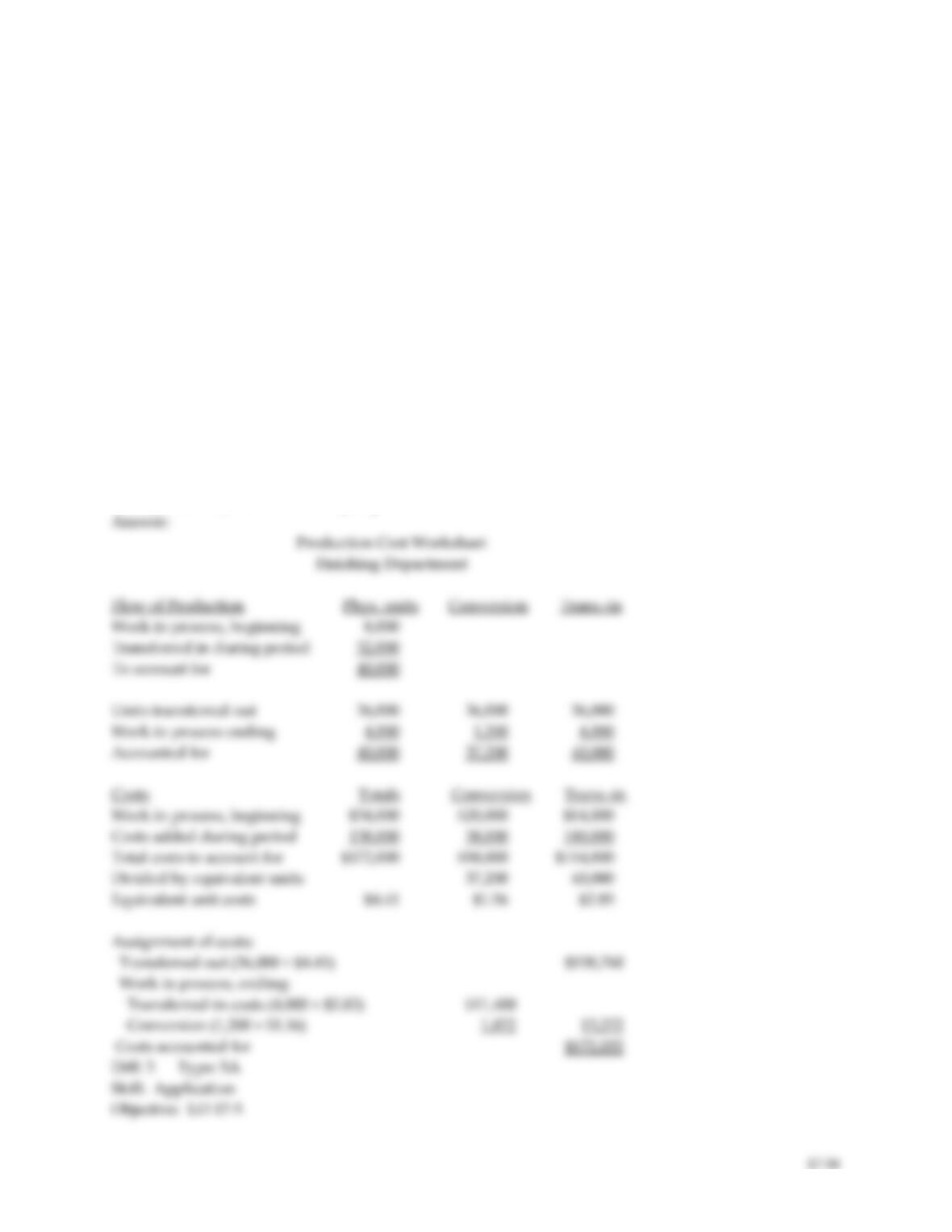
14) The Leather Factory has two departments that process all of its production, the Tanning Department
and the Finishing Department. Production begins in the Tanning Department, then the units are
transferred to the Finishing Department. Conversion costs are added evenly throughout the process, no
additional materials are added in the Finishing Department.
Beginning work-in-process in the finishing department was 60 percent complete as to conversion; ending
inventory was 30 percent complete. Additional information about the Finishing Department follows:
Beginning work-in-process inventory 8,000 units
Units transferred–in 32,000 units
Units placed in finished goods 4,000 units
Conversion costs $38,000
Transferred-in costs $100,000
Beginning work-in-process costs:
Transferred-in $14,000
Conversion $20,000
Required:
Using the weighted-average method determine the assignment of costs to units transferred-out and
ending inventory for the Finishing Department.
Cost Accounting: A Managerial Emphasis, 6e
Chapter 17 – Process Costing
17–59
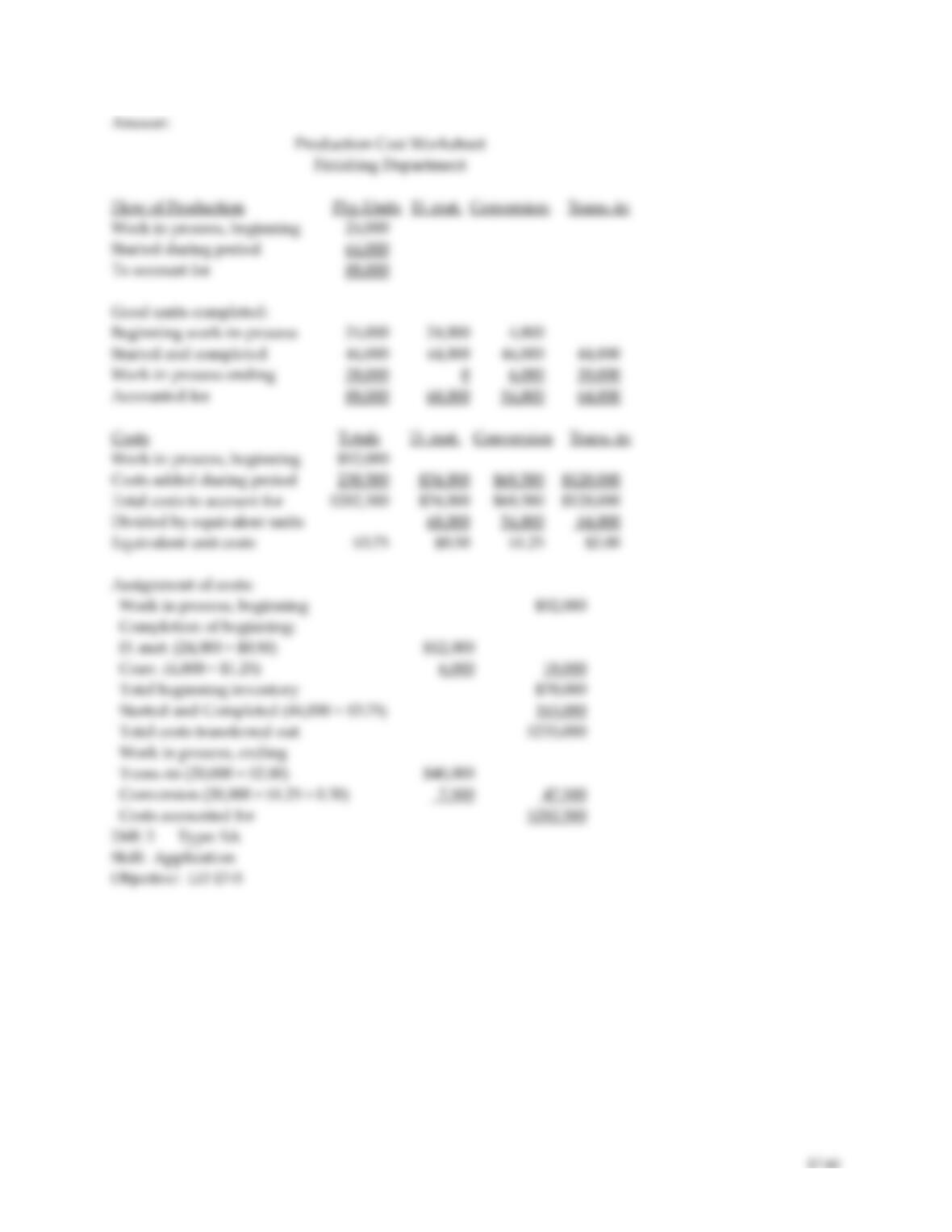
15) A company produces baseball bats and cricket paddles, and has two departments that process all
products. Direct materials are added at the end of the process; conversion costs are added evenly
throughout the process. Beginning work-in-process in the Finishing Department was 80 percent complete
as to conversion; ending inventory was 30 percent complete. Beginning inventories for the Finishing
Department included $24,000 for transferred-in costs and $28,000 for conversion costs. Additional
information is as follows:
Cutting Finishing
Beginning work-in-process units 20,000 24,000
Units started this period 60,000
Units transferred this period 64,000 68,000
Ending work-in-process units 20,000
Material costs added $48,000 $34,000
Conversion costs $28,000 $68,500
Transferred-out cost $128,000
Beginning work-in-process costs $52,000
Required:
Using the first-in, first-out method determine the assignment of costs to units transferred-out and ending
inventory for the Finishing Department.
Cost Accounting: A Managerial Emphasis, 6e
Chapter 17 – Process Costing

Cost Accounting: A Managerial Emphasis, 6e
Chapter 17 – Process Costing
17–61
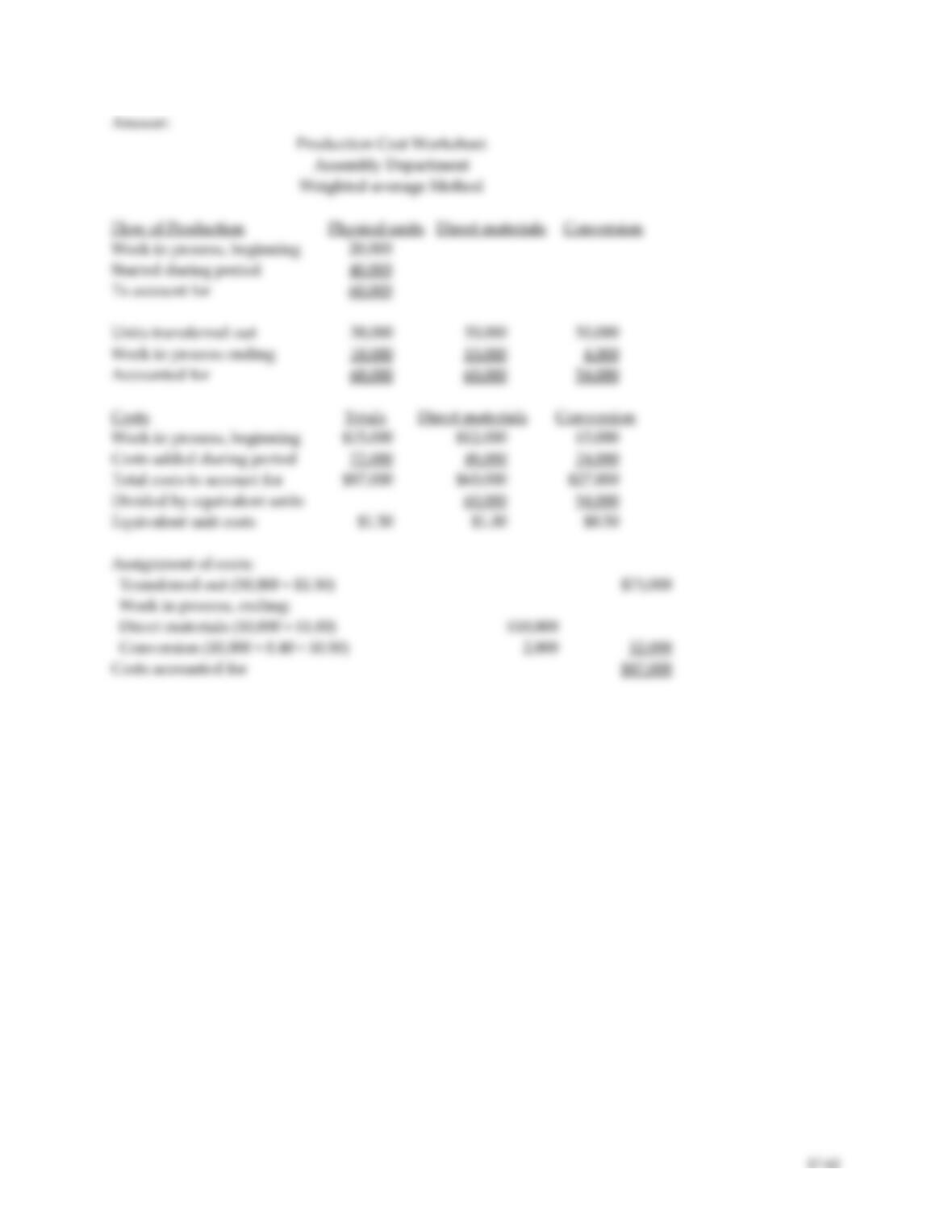
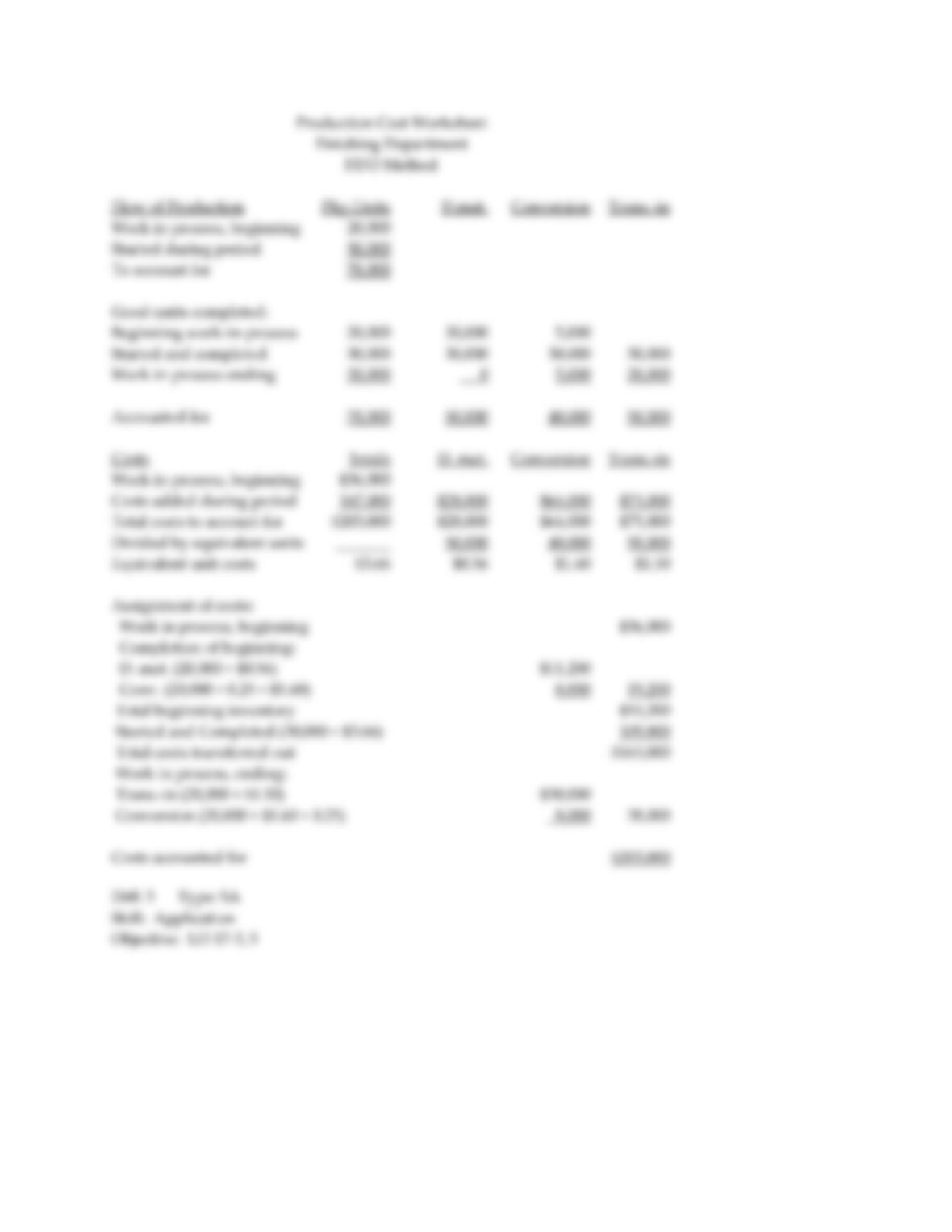
16) General Fabricators assembles its product in several departments. It has two departments that process
all units. During October the beginning work-in-process in the Assembly Department was half completed
as to conversion and complete as to direct materials. The beginning inventory included $12,000 for
materials and $3,000 for conversion costs. Ending work–in–process inventory in the Assembly
Department was 40 percent complete. Direct materials are added at the beginning of the process;
conversion costs are added evenly throughout the process.
Beginning work-in-process in the Finishing Department was 75 percent complete as to conversion. Direct
materials are added at the end of the process; conversion costs are added evenly throughout the process.
Beginning inventories included $16,000 for transferred-in costs and $20,000 for conversion costs. Ending
inventory was 25 percent complete. Additional information about the two departments follows:
Assembly Finishing
Beginning work-in-process units 20,000 20,000
Units started this period 40,000
Units transferred this period 50,000 50,000
Ending work-in-process units 20,000
Material costs added $48,000 $28,000
Other conversion costs $24,000 $64,000
Required:
Determine the assignment of costs to units transferred-out and ending inventory , using weighted–
average for the Assembly Department and FIFO for the Finishing Department.
Cost Accounting: A Managerial Emphasis, 6e
Chapter 17 – Process Costing
Cost Accounting: A Managerial Emphasis, 6e
Chapter 17 – Process Costing
17–63

Cost Accounting: A Managerial Emphasis, 6e
Chapter 17 – Process Costing
17–64
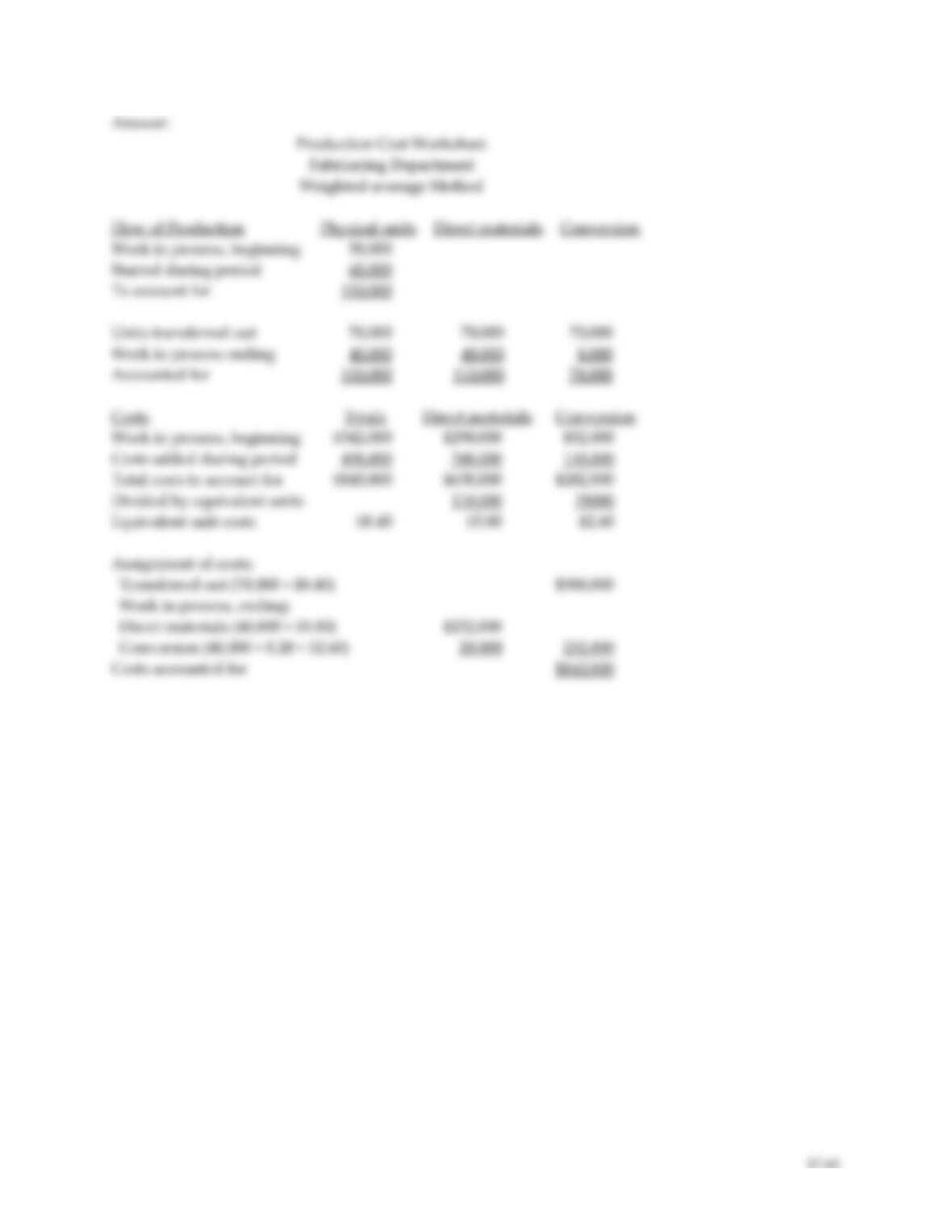
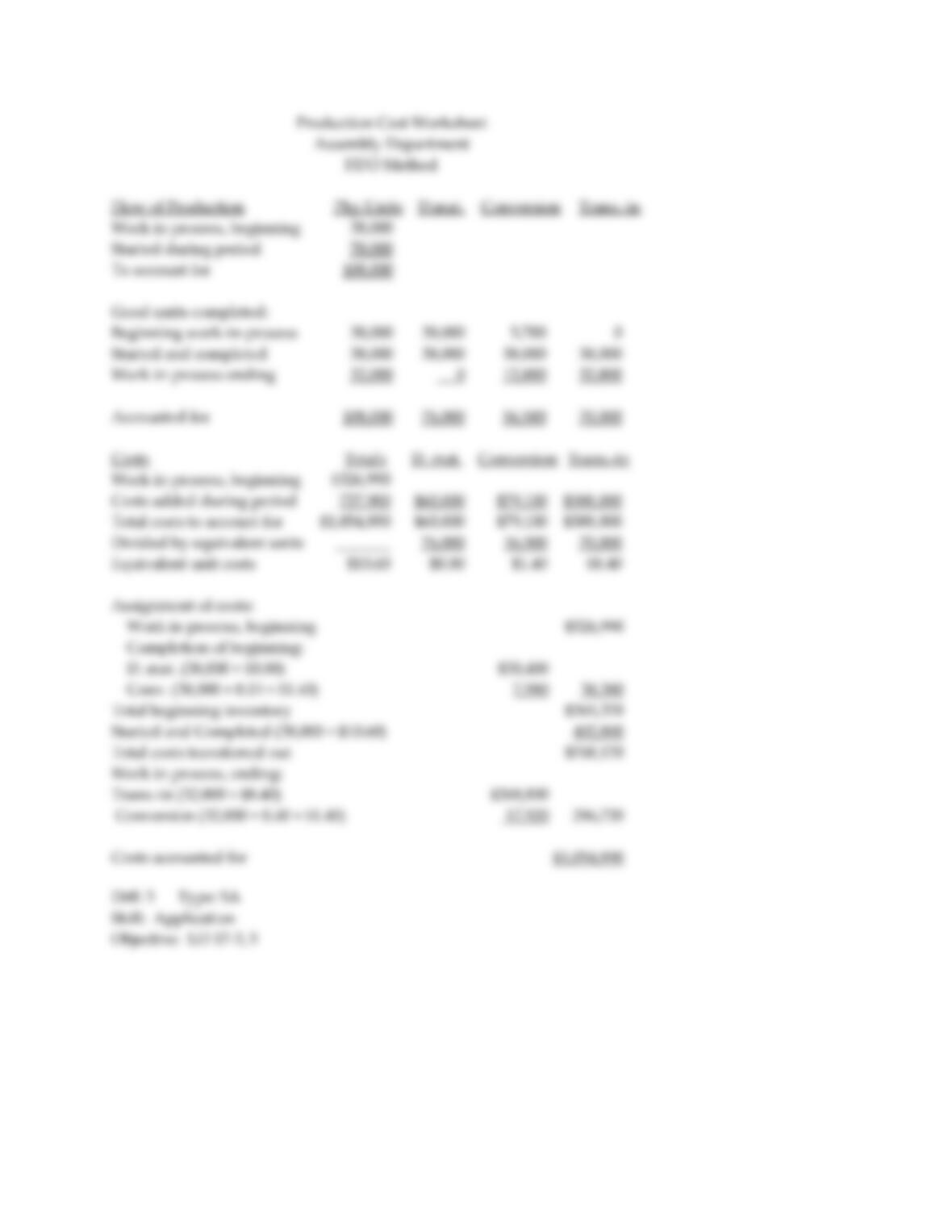
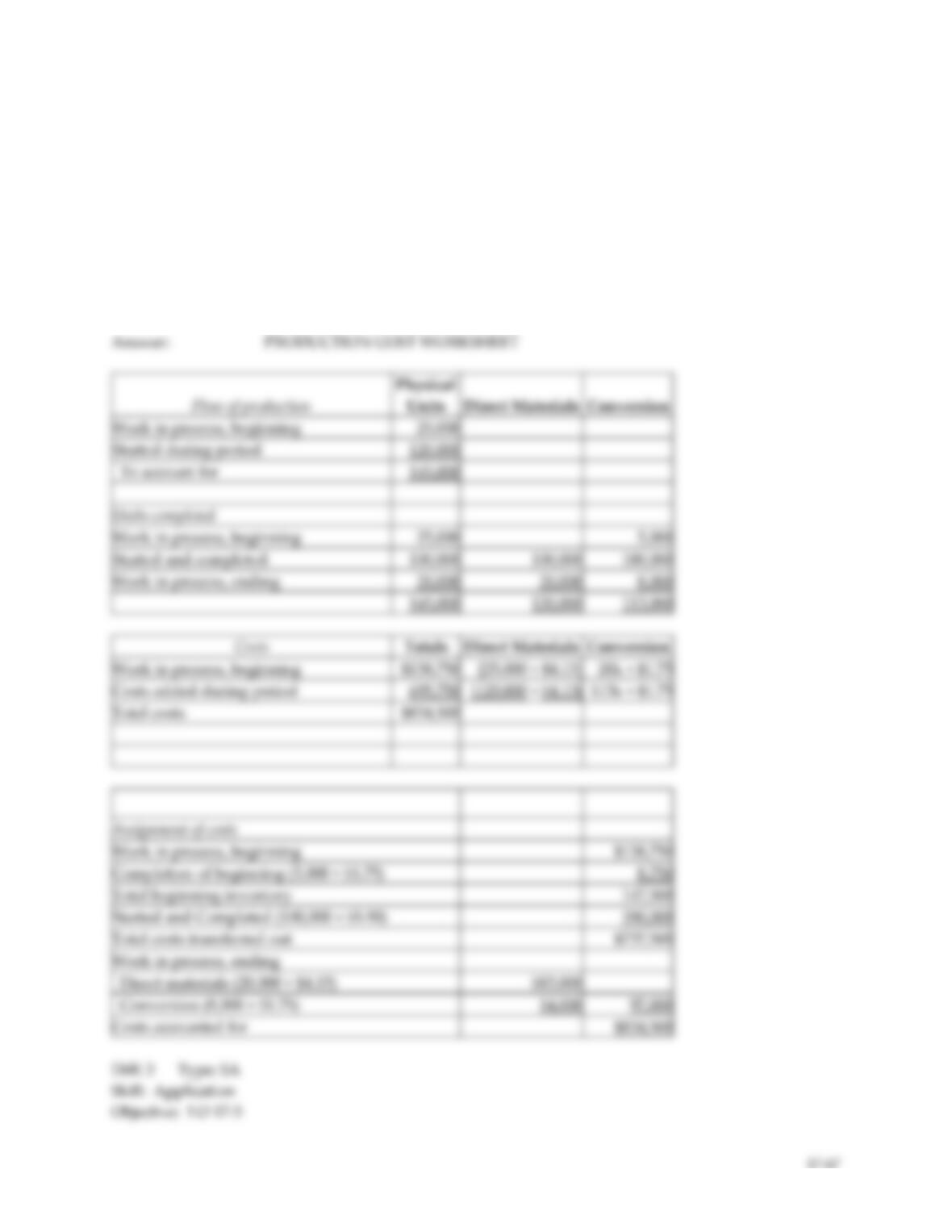
17) Caulfield Ltd. has two production departments in the manufacturing of its products. In the first
department, Fabricating, component parts are manufactured. In the second department, Assembly, the
components are assembled and finished. Direct materials are added at the start of production in
Fabricating and at the 90% point of the process in Assembly. During July the beginning work–in-process
of 50,000 units in the Fabricating Department was 40% complete with respect to conversion. The
Assembly Department had 38,000 units in beginning work in process; these units were 85% complete
with respect to conversion. On July 31, the ending work–in-process inventory was 20% complete in the
Fabricating Department and 40% complete in the Assembly Department. Conversion costs are added
evenly throughout both departments.
Beginning work-in-process in the Fabricating Department had costs assigned of $290,000 for direct
materials and $52,000 for conversion. In the Assembly Department, the beginning work in process
included $318,440 for transferred-in costs and $8,550 for conversion costs. Additional information about
the two departments follows:
Fabricating Assembly
Units started or transferred-in in July 60,000 ?
Units transferred out in July 70,000 76,000
Ending work in process ? ?
Material costs added $348,000 $60,800
Other conversion costs $150,800 $79,100
Required:
Determine the assignment of costs to units transferred-out and ending inventory , using weighted–
average for the Assembly Department and FIFO for the Finishing Department.
Cost Accounting: A Managerial Emphasis, 6e
Chapter 17 – Process Costing
Cost Accounting: A Managerial Emphasis, 6e
Chapter 17 – Process Costing
17–66
Cost Accounting: A Managerial Emphasis, 6e
Chapter 17 – Process Costing
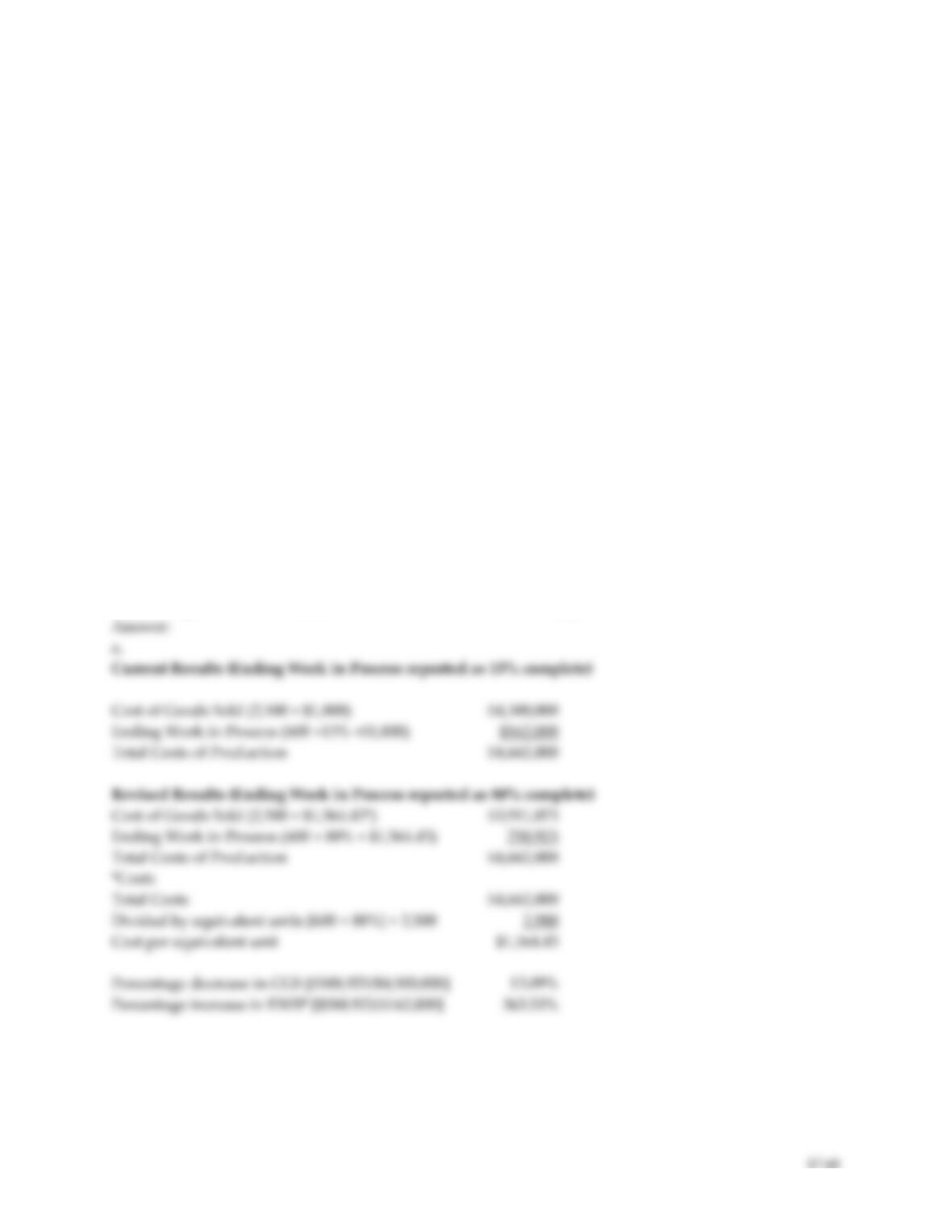
18) Marvin Ltd. uses an automated process in its manufacturing operations. On November 1, the
company had 25,000 units in beginning work in process which were 80% complete with respect to
conversion. During the month of November, it started 120,000 into production. On November 30, there
were 20,000 units in process, which were 40% complete with respect to conversion. Direct materials are
added at the beginning of the process, and no units are spoiled in production.
Marvin Ltd. uses standard costing and has determined that its standard costs are $4.15 for direct
materials and $1.75 for conversion.
Required:
Prepare a production cost worksheet using the FIFO method.
Cost Accounting: A Managerial Emphasis, 6e
Chapter 17 – Process Costing
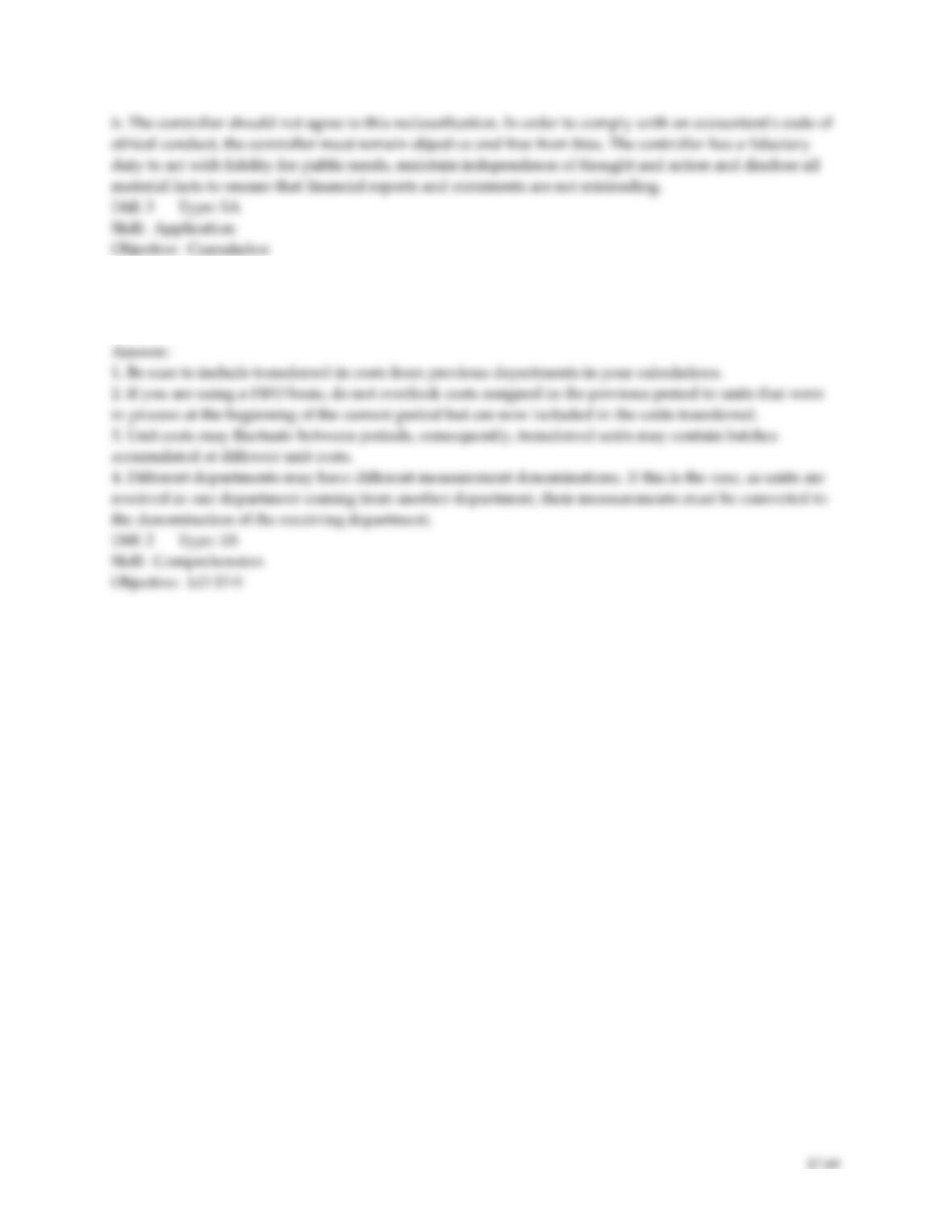
19) The president of Sampson Ltd. has approached the controller for the company with concerns over the
projected year end results. The company needs to present its financial statements to the bank to renew its
loan and the president is concerned that the loan may either be denied, or the renewal terms will impose
a much higher interest rate. The following summarizes the conversation between the president and the
controller:
President: I am very concerned about the upcoming loan renewal. Our cash position is low and our
operating results for the year were not as strong as expected. Our unit cost of production has come in at
$1,800 based on equivalent units of production of 2,590. I know that currently we have 600 units in
ending work in process that are only 15% complete. If we were to reclassify these as 80% complete, we
would increase our equivalent units of production by 390. Since all of our 2,500 completed units were
sold, this reclassification would lower our unit costs, reduce cost of goods sold and increase our ending
work in process inventory which could be used as collateral. This would improve our financial position
and allow us to renew our loan and keep our current rate of interest.
Controller: I think this is risky. It would be easy to determine that the units are not 80% complete.
President: I don’t see how. By the time we are audited, the units will have long since been completed and
shipped to customers.
Required:
Assume you are the controller for Sampson Ltd. and that you hold a professional accounting designation.
a. Determine the impact of the president’s proposal on the financial results for Sampson Ltd.
b. Referring back to the standards of ethical conduct, what should you do as controller?
Cost Accounting: A Managerial Emphasis, 6e
Chapter 17 – Process Costing
20) When there are multiple support departments within an organization, it is common to use journal
entries to transfer-in costs from one department to another. What are some of the points to remember
about these costs?