1. Which of the following assets makes use of the basket valuation technique?
a.
Swap agreements
b.
Oil facility
c.
Buffer stock facility
d.
Special drawing rights
2. Swap agreements are generally conducted by the:
a.
Federal Reserve with foreign central banks
b.
Federal Reserve with foreign commercial banks
c.
U.S. Treasury with foreign central banks
d.
U.S. Treasury with foreign commercial banks
United States – BPROG: Reflective Thinking – BPROG: Analysis
United States – PA – DISC: International trade and fi – DISC: International trade and finance
Facilities for Borrowing Reserves
BLOOM’S: Comprehension
3. Which of the following is a main central bank function of the International Monetary Fund?
a.
The conduct of open market operations
b.
The issuance of gold certificates
c.
The provision of monetary policy for member nations
d.
The granting of loans to member nations
United States – BPROG: Reflective Thinking – BPROG: Analysis
United States – PA – DISC: International trade and fi – DISC: International trade and finance
Facilities for Borrowing Reserves
BLOOM’S: Comprehension
4. The Federal Reserve’s swap network represents:
a.
Efforts to stabilize only the value of the dollar
b.
Efforts to stabilize only the value of foreign currencies
c.
Long-term borrowing among countries
d.
Short-term borrowing among countries
United States – BPROG: Reflective Thinking – BPROG: Analysis
United States – PA – DISC: International trade and fi – DISC: International trade and finance
Special Drawing Rights
BLOOM’S: Knowledge
5. International trade and investment are most frequently financed by the U.S. dollar and the:
a.
Japanese yen
b.
British pound
c.
Australian dollar
d.
Swiss franc
United States – BPROG: Reflective Thinking – BPROG: Analysis
United States – PA – DISC: International trade and fi – DISC: International trade and finance
Facilities for Borrowing Reserves
BLOOM’S: Knowledge
6. The purpose of international reserves is to finance:
a.
Short-term surpluses in the balance of payments
b.
Long-term surpluses in the balance of payments
c.
Short-term deficits in the balance of payments
d.
Long-term deficits in the balance of payments
United States – BPROG: Reflective Thinking – BPROG: Analysis
United States – PA – DISC: International trade and fi – DISC: International trade and finance
Nature of International Reserves
BLOOM’S: Comprehension
7. The currencies generally referred to as “reserve currencies” are the:
a.
Japanese yen and U.S. dollar
b.
Swiss franc and Japanese yen
c.
British pound and U.S. dollar
d.
Swiss franc and British pound
United States – BPROG: Reflective Thinking – BPROG: Analysis
United States – PA – DISC: International trade and fi – DISC: International trade and finance
Foreign Currencies
BLOOM’S: Knowledge
8. Which of the following does not represent a form of international liquidity?
United States – BPROG: Reflective Thinking – BPROG: Analysis
United States – PA – DISC: International trade and fi – DISC: International trade and finance
Facilities for Borrowing Reserves
BLOOM’S: Comprehension
a.
IMF reserve positions
b.
General arrangements to borrow
c.
U.S. government securities
d.
Reciprocal currency arrangements
9. Which of the following is not considered an “owned” reserve?
a.
National currencies
b.
Gold
c.
Special drawing rights
d.
Oil facility
Moderate
United States – BPROG: Reflective Thinking – BPROG: Analysis
United States – PA – DISC: International trade and fi – DISC: International trade and finance
Foreign Currencies
BLOOM’S: Comprehension
10. Which of the following is not considered a “borrowed” reserve?
a.
Special drawing rights
b.
Oil facility
c.
IMF drawings
d.
Reciprocal currency arrangement
a
Moderate
United States – BPROG: Reflective Thinking – BPROG: Analysis
United States – PA – DISC: International trade and fi – DISC: International trade and finance
Foreign Currencies
BLOOM’S: Comprehension
11. Eurodollars are:
a.
Dollar-denominated deposits in overseas banks
b.
European currencies used to finance transactions in the United States
c.
Dollars that U.S. residents spend in Europe
d.
European currencies used to finance imports from the United States
a
Moderate
c
Moderate
United States – BPROG: Reflective Thinking – BPROG: Analysis
United States – PA – DISC: International trade and fi – DISC: International trade and finance
Foreign Currencies
BLOOM’S: Knowledge
12. Which of the following is not a characteristic of the Eurodollar market? It:
a.
Is mainly located in the United Kingdom and continental Europe
b.
Operates as a financial intermediary, bringing together lenders and borrowers
c.
Deals in interest-bearing time deposits and loans to governments
d.
Grew in response to the deregulation of interest rate ceilings on U.S. savings accounts
Moderate
United States – BPROG: Reflective Thinking – BPROG: Analysis
United States – PA – DISC: International trade and fi – DISC: International trade and finance
Foreign Currencies
BLOOM’S: Comprehension
13. Which of the following assets was (were) created in 1970 to provide additional international liquidity, in the belief that
increasing world trade requires more liquidity for larger expected payments imbalances?
a.
Eurodollar market
b.
Special drawing rights
c.
Reciprocal currency arrangements
d.
General arrangements to borrow
Moderate
United States – BPROG: Reflective Thinking – BPROG: Analysis
United States – PA – DISC: International trade and fi – DISC: International trade and finance
Special Drawing Rights
BLOOM’S: Knowledge
14. Which of the following constitute(s) the largest component of the world’s international reserves?
a.
Gold
b.
Special drawing rights
c.
IMF drawings
d.
Foreign currencies
Moderate
United States – BPROG: Reflective Thinking – BPROG: Analysis
United States – PA – DISC: International trade and fi – DISC: International trade and finance
Nature of International Reserves
BLOOM’S: Knowledge
15. With an international gold standard, if a country ended up with a deficit from the balances on its current and capital
United States – BPROG: Reflective Thinking – BPROG: Analysis
United States – PA – DISC: International trade and fi – DISC: International trade and finance
Foreign Currencies
BLOOM’S: Comprehension
accounts, it would:
a.
Import gold to settle the balance
b.
Export gold to settle the balance
c.
Officially decrease the price of gold
d.
Officially increase the price of gold
16. Which of the following is not a condition of the international gold standard? That a nation must:
a.
Convert gold into paper currency, and vice versa, at a stipulated rate
b.
Permit gold to be freely imported and exported
c.
Tolerate wide fluctuations in its exchange rate
d.
Define its monetary unit in terms of a stipulated amount of gold
United States – BPROG: Reflective Thinking – BPROG: Analysis
United States – PA – DISC: International trade and fi – DISC: International trade and finance
BLOOM’S: Comprehension
17. All of the following exchange-rate systems require international reserves to finance balance-of-payments
disequilibriums except:
a.
Pegged or fixed exchange rates
b.
Managed floating exchange rates
c.
Adjustable pegged exchange rates
d.
Freely floating exchange rates
United States – BPROG: Reflective Thinking – BPROG: Analysis
United States – PA – DISC: International trade and fi – DISC: International trade and finance
Foreign Currencies
BLOOM’S: Comprehension
18. A dollar shortage would indicate that the dollar is:
a.
Undervalued in international markets
b.
Overvalued in international markets
c.
Overvalued in terms of gold
d.
Overvalued in terms of special drawing rights
United States – BPROG: Reflective Thinking – BPROG: Analysis
United States – PA – DISC: International trade and fi – DISC: International trade and finance
BLOOM’S: Comprehension
19. The U.S. gold outflow that began in the late 1940s and continued through the 1960s was due in part to:
a.
Crawling pegged exchange rates
b.
Freely floating exchange rates
c.
An undervalued dollar
d.
An overvalued dollar
United States – BPROG: Reflective Thinking – BPROG: Analysis
United States – PA – DISC: International trade and fi – DISC: International trade and finance
20. The U.S. dollar glut of the 1960s was due in part to:
a.
An undervalued dollar
b.
An overvalued dollar
c.
Freely floating exchange rates
d.
Crawling pegged exchange rates
United States – BPROG: Reflective Thinking – BPROG: Analysis
United States – PA – DISC: International trade and fi – DISC: International trade and finance
Foreign Currencies
BLOOM’S: Knowledge
21. For developing countries such as Mexico and Brazil, severe economic problems in the 1980s were caused by:
a.
A fall in the world demand for products produced by developing countries
b.
High prices of basic raw materials and other commodities
c.
Low real interest rates in the United States
d.
High levels of income and imports for the United States
United States – BPROG: Reflective Thinking – BPROG: Analysis
United States – PA – DISC: International trade and fi – DISC: International trade and finance
The Problem of International Debt
BLOOM’S: Knowledge
United States – BPROG: Reflective Thinking – BPROG: Analysis
United States – PA – DISC: International trade and fi – DISC: International trade and finance
Supply of International Reserves
BLOOM’S: Comprehension
22. In response to the international debt problem, the United States set up a special fund in 1986 to help make up for lost
oil revenues. Under the plan, the United States would make more money available as world oil prices fell. This plan was
designed to help:
a.
Argentina
b.
Saudi Arabia
c.
Mexico
d.
Brazil
23. Which indicator of international debt burden schedules interest and principal payments on long-term debt as a percent
of export earnings?
a.
Debt service ratio
b.
Debt-to-export ratio
c.
Ratio of external debt to gross domestic product
d.
Ratio of external debt to gross national product
a
Moderate
United States – BPROG: Reflective Thinking – BPROG: Analysis
United States – PA – DISC: International trade and fi – DISC: International trade and finance
Debt Reduction and Debt Forgiveness
BLOOM’S: Knowledge
24. Which term best describes the process in which the International Monetary Fund provides loans to countries facing
balance-of-payments difficulties provided that they initiate programs holding promise of correcting these difficulties?
a.
Conditionality
b.
Debt service
c.
Reciprocal currency arrangement
d.
Swap agreement
a
Moderate
United States – BPROG: Reflective Thinking – BPROG: Analysis
United States – PA – DISC: International trade and fi – DISC: International trade and finance
Debt Reduction and Debt Forgiveness
BLOOM’S: Knowledge
25. All of the following are major goals of the International Monetary Fund except:
a.
Promoting international cooperation among member countries
b.
Fostering a multilateral system of international payments
c.
Making long-term development and reconstruction loans
c
Moderate
United States – BPROG: Reflective Thinking – BPROG: Analysis
United States – PA – DISC: International trade and fi – DISC: International trade and finance
The Problem of International Debt
BLOOM’S: Knowledge
d.
Promoting exchange-rate stability and the elimination of exchange restrictions
26. Which international reserve asset was officially phased out of the international monetary system by the United States
in the early 1970s?
a.
Special drawing rights
b.
Swap agreements
c.
General arrangements to borrow
d.
Gold
Easy
United States – BPROG: Reflective Thinking – BPROG: Analysis
United States – PA – DISC: International trade and fi – DISC: International trade and finance
Gold
BLOOM’S: Knowledge
27. Bilateral agreements between central banks, which provide for an exchange of currencies to help finance temporary
balance-of-payments disequilibriums, are referred to as:
a.
IMF drawings
b.
Special drawing rights
c.
Buffer stock facility
d.
Swap agreements
Moderate
United States – BPROG: Reflective Thinking – BPROG: Analysis
United States – PA – DISC: International trade and fi – DISC: International trade and finance
Red. Bank Exposure to Dev. Nat. Debt
BLOOM’S: Comprehension
28. Which organization is largely intended to make long-term reconstruction loans to developing nations?
a.
Export-Import Bank
b.
World Bank
c.
International Monetary Fund
d.
United Nations
Moderate
United States – BPROG: Reflective Thinking – BPROG: Analysis
c
Moderate
United States – BPROG: Reflective Thinking – BPROG: Analysis
United States – PA – DISC: International trade and fi – DISC: International trade and finance
Demand for International Reserves
BLOOM’S: Knowledge
29. “Owned” international reserves consist of:
a.
Special drawing rights
b.
Oil facility
c.
IMF drawings
d.
Reciprocal currency arrangements
a
Moderate
United States – BPROG: Reflective Thinking – BPROG: Analysis
United States – PA – DISC: International trade and fi – DISC: International trade and finance
Nature of International Reserves
BLOOM’S: Comprehension
30. “Borrowed” international reserves consist of:
a.
IMF drawings
b.
Foreign currencies
c.
Gold
d.
Special drawing rights
a
Moderate
United States – BPROG: Reflective Thinking – BPROG: Analysis
United States – PA – DISC: International trade and fi – DISC: International trade and finance
Nature of International Reserves
BLOOM’S: Comprehension
31. Concerning international lending risk of commercial banks, ____ refers to the probability that part/all of the
interest/principal of a loan will not be repaid.
a.
Country risk
b.
Credit risk
c.
Currency risk
d.
Presidential risk
Easy
United States – BPROG: Reflective Thinking – BPROG: Analysis
United States – PA – DISC: International trade and fi – DISC: International trade and finance
International Lending Risk
BLOOM’S: Comprehension
32. Concerning international lending risk of commercial banks, ____ is closely related to political developments in a
borrowing country, especially the government’s views concerning international investments and loans.
United States – PA – DISC: International trade and fi – DISC: International trade and finance
Reducing Bank Exposure to Developing Nation Debt
BLOOM’S: Comprehension
a.
Economic risk
b.
Credit risk
c.
Country risk
d.
Currency risk
33. Concerning international lending risk of commercial banks, ____ is associated with possible changes in the exchange
value of a nation’s currency.
a.
Political risk
b.
Country risk
c.
Credit risk
d.
Currency risk
United States – BPROG: Reflective Thinking – BPROG: Analysis
United States – PA – DISC: International trade and fi – DISC: International trade and finance
International Lending Risk
BLOOM’S: Comprehension
34. To reduce their exposure to developing country debt, lending commercial banks have practiced all of the following
except:
a.
Making outright loan sales to other commercial banks
b.
Reducing their capital base as a cushion against losses
c.
Dealing in debt-for-debt swaps with foreign governments
d.
Dealing in debt/equity swaps with foreign governments
United States – BPROG: Reflective Thinking – BPROG: Analysis
United States – PA – DISC: International trade and fi – DISC: International trade and finance
Reducing Bank Exposure to Developing Nation Debt
BLOOM’S: Comprehension
35. To reduce losses on developing country loans, commercial banks sometimes sell their loans, at a discount, to a
developing country government for local currency which is then used to finance purchases of ownership shares in
developing country industries. This practice is known as:
a.
Debt forgiveness
b.
Debt buyback
c.
Debt-for-debt swap
United States – BPROG: Reflective Thinking – BPROG: Analysis
United States – PA – DISC: International trade and fi – DISC: International trade and finance
International Lending Risk
BLOOM’S: Comprehension
d.
Debt/equity swap
36. Concerning international debt, ____ refers to a negotiated reduction in the contractual obligations of the debtor
country and includes schemes such as markdowns and write-offs of debt.
a.
Debt/equity swap
b.
Debt-for-debt swap
c.
Debt forgiveness
d.
Debt sales
United States – BPROG: Reflective Thinking – BPROG: Analysis
United States – PA – DISC: International trade and fi – DISC: International trade and finance
The Problem of International Debt
BLOOM’S: Comprehension
37. The exchange of borrowing country debt for an ownership position in the borrowing country is known as:
a.
Debt forgiveness
b.
Debt-for-debt swap
c.
Debt reduction
d.
Debt/equity swap
United States – BPROG: Reflective Thinking – BPROG: Analysis
United States – PA – DISC: International trade and fi – DISC: International trade and finance
Debt Reduction and Debt Forgiveness
BLOOM’S: Comprehension
38. “Country risk” analysis is concerned with all of the following except:
a.
Depreciation of the borrowing country’s currency
b.
Political instability in the borrowing country
c.
Economic growth in the borrowing country
d.
External debt of the borrowing country
United States – BPROG: Reflective Thinking – BPROG: Analysis
United States – PA – DISC: International trade and fi – DISC: International trade and finance
United States – BPROG: Reflective Thinking – BPROG: Analysis
United States – PA – DISC: International trade and fi – DISC: International trade and finance
Reducing Bank Exposure to Developing Nation Debt
BLOOM’S: Comprehension
39. Debt reduction
a.
Refers to any voluntary scheme that lessens the burden on the debtor nation
b.
May be accomplished through debt rescheduling
c.
May be achieved through debt/equity swaps
d.
All of the above
United States – BPROG: Reflective Thinking – BPROG: Analysis
United States – PA – DISC: International trade and fi – DISC: International trade and finance
Debt Reduction and Debt Forgiveness
BLOOM’S: Comprehension
40. Most analysts feel that the financial difficulties in East Asia were triggered by
a.
Misallocation of investment
b.
Unavailability of cheap foreign labor
c.
Lack of alignment of the exchange rate with the dollar
d.
Surpluses in the trade accounts of the Asian countries
United States – BPROG: Reflective Thinking – BPROG: Analysis
United States – PA – DISC: International trade and fi – DISC: International trade and finance
International Lending Risk
BLOOM’S: Comprehension
41. A nation may experience debt-servicing problems because of
a.
Pursuit of improper macroeconomic policies
b.
Inadequate borrowing
c.
Adverse economic events
d.
Both a and c
United States – BPROG: Reflective Thinking – BPROG: Analysis
United States – PA – DISC: International trade and fi – DISC: International trade and finance
The Problem of International Debt
BLOOM’S: Comprehension
42. Swap arrangements
a.
Are agreements between governments
b.
Require repayment within a stipulated period
c.
Are usually multilateral agreements
International Lending Risk
BLOOM’S: Comprehension
d.
Are never initiated by telephone
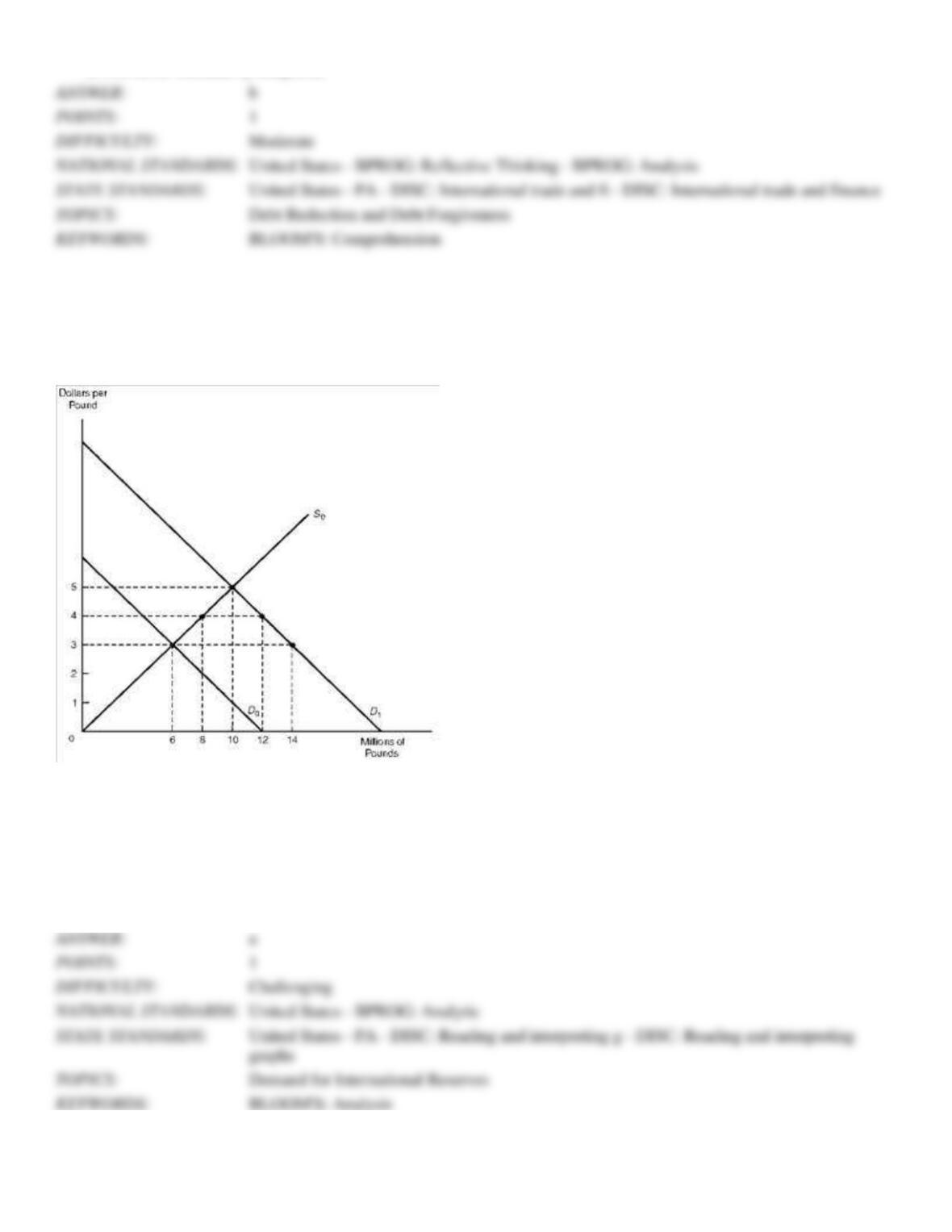
The diagram below represents the exchange market position of the United States in trade with the United Kingdom.
Starting at the equilibrium exchange rate of $3 per pound, suppose the demand for pounds rises from D0 to D1.
Figure 17.1 Foreign Exchange Market
43. In the market for British Pounds the demand is represented by D0 and supply by S0. If the exchange rate is fixed at $3
and the demand for pounds increases to D1, US monetary authorities will need to
a.
supply 8 million poundds to the market
b.
supply 4 million pounds to the market
c.
supply 2 million pounds to the market
d.
do nothing
United States – BPROG: Analytic
Demand for International Reserves
BLOOM’S: Analysis
44. In the market for British Pounds the demand is represented by D0 and supply by S0. If the exchange rate is allowed to
United States – BPROG: Reflective Thinking – BPROG: Analysis
United States – PA – DISC: International trade and fi – DISC: International trade and finance
Debt Reduction and Debt Forgiveness
BLOOM’S: Comprehension
rise as high as $4 and the demand for pounds increases to D1, US monetary authorities will need to
a.
supply 8 million pounds to the market
b.
supply 4 million pounds to the market
c.
supply 2 million pounds to the market
d.
do nothing
45. In the market for British Pounds the demand is represented by D0 and supply by S0. If the exchange rate is flexible
and the demand for pounds increases to D1, US monetary authorities will need to
a.
supply 8 million pounds to the market
b.
supply 4 million pounds to the market
c.
supply 2 million pounds to the market
d.
do nothing
Challenging
United States – BPROG: Analytic
Demand for International Reserves
BLOOM’S: Analysis
46. Under a system of fixed exchange rates, international reserves are needed to bridge the gap between monetary receipts
and monetary payments.
a.
True
b.
False
True
Moderate
United States – BPROG: Reflective Thinking – BPROG: Analysis
United States – PA – DISC: International trade and fi – DISC: International trade and finance
Nature of International Reserves
BLOOM’S: Comprehension
47. International reserves allow a country to finance disequilibria in its balance-of-payments position.
a.
True
b.
False
True
Challenging
United States – BPROG: Analytic
Demand for International Reserves
BLOOM’S: Analysis