ch17.doc Page 1
Chapter 17
Federal Government Accounting
TRUE/FALSE (CHAPTER 17)
1. If the U.S. Department of the Treasury, GAO, or OMB objects to a FASAB standard, it is
returned to the FASAB for reconsideration.
2. Federal operations consist of five fund types—the general fund, special funds, trust funds,
capital funds, and revolving funds.
3. Proprietary accounts are used to report the business-type activities of the federal government.
4. Stewardship assets are long-lived assets that are not given balance sheet recognition by the
federal government.
5. The federal agency balance sheet and statement of net cost are prepared on the full accrual
basis of accounting.
6. FASAB requires nonexchange revenues to reported on both the accrual and the cash basis of
accounting.
7. The federal government recognizes social insurance commitments (e.g. social security) to
beneficiaries as liabilities only when payments are due.
8. Federal agencies recognize the cost of loan guarantees when it is probable that borrowers will
default on their payments.
9. Military assets are required to be capitalized and depreciated until war is declared.
10. Pronouncements of the IFAC’s International Public Sector Accounting Standards Board
(IPSASB) state that third-world governments should prepare cash-basis financial statements. .
11. All members of the FASAB are federal employees.
12, The AICPA has granted the FASAB exclusive authority to established GAAP for federal
entities.
13. The unified budget of the federal government excludes Social Security, which is considered
“off-budget.”
14. Natural disasters, such as hurricanes, may result in recognized liabilities of the federal
government.
15. FASAB standards preclude disclosure of investments in human capital in federal financial
reports.
ch17.doc Page 2
MULTIPLE CHOICE (CHAPTER 17)
1. Which of the following is a unique characteristic of the federal government that necessitates
special accounting and reporting practices?
a) The types of its expenditures.
b) The size of its obligations.
c) The extent of its powers.
d) The range of its influence.
2. Which of the following is a function of the U.S. Department of the Treasury?
a) Adjudicating claims for and against the federal government.
b) Monitoring the execution of the federal budget.
c) Overseeing the central accounting and reporting systems.
d) Apportioning federal appropriations.
3. Which of the following is a responsibility of the Office of Management and Budget?
a) Assisting the president in preparing the federal budget.
b) Resolving bid protests that challenge government contract awards.
c) Keeping track of monetary assets and liabilities.
d) Arranging for audits of federal agencies
4. The amount of its budgeted resources that a federal agency currently has available for
spending is its
a) Appropriation.
b) Apportionment.
c) Cash balance.
d) Unencumbered obligations.
5. The CFO of the United States is
a) A position within OMB.
b) A position within GAO.
c) A position in the Department of the Treasury.
d) A cabinet position reporting to the U.S. president.
6. Which of the following has the responsibility for auditing all federal agencies and programs?
a) OMB.
b) FASAB.
c) GAO.
d) The Department of the Treasury.
ch17.doc Page 3
7. The Government Accountability Office (GAO) is part of which branch of the federal
government?
a) Executive branch.
b) Judicial branch.
c) Legislative branch.
d) None of the above; it is independent of all three branches of the federal government.
8. Which of the following is a role that GAO plays in the accounting and information
management policy of the United States?
a) Prescribing standards for auditing and evaluating government programs.
b) Developing integrated accounting systems that comply with applicable accounting
standards.
c) Apportioning federal appropriations.
d) Reviewing federal agencies’ spending plans.
9. Federal government accounting standards are the responsibility of which federal government
agency?
a) The Department of the Treasury.
b) The Office of Management and Budget.
c) The Government Accountability Office.
d) All of the above.
10. The Federal Accounting Standards Advisory Board is responsible for
a) Reviewing FASB and GASB standards.
b) Setting federal accounting standards.
c) Implementing federal accounting standards.
d) Developing federal auditing standards.
11. Which of the following is a true statement about the Federal Accounting Standards Advisory
Board?
a) It is a sub-agency of the OMB.
b) It is a shared jurisdiction board created following an agreement by three federal agencies.
c) It is an executive office function.
d) It was created by and reports to Congress.
12. Which of the following categories is included in the Objectives of Federal Financial
Reporting?
a) Operating performance.
b) Congressional performance.
c) Executive performance.
d) Audit performance.
13. Federal operations are accounted for in four types of funds. Which of the following is one of
the types of funds used?
a) Capital funds.
b) Revolving funds.
c) Special revenue funds.
d) Fiduciary funds.
ch17.doc Page 4
14. Federal government capital expenditures can be accounted for in which of the federal funds?
a) General fund
b) Special funds.
c) Trust funds.
d) All of the above.
15. Which of the following types of expenditures are not accounted for in the federal
government’s general fund?
a) Operating expenditures.
b) Capital expenditures.
c) Medicare.
d) Interest on public debt.
16. Which of the following is a false statement about federal special funds?
a) They are maintained primarily to account for resources that are designated for specific
programs or activities.
b) They are typically financed by dedicated fees.
c) They account for resources used to pay for national defense.
d) They are included in the unified budget of the federal government.
17. Which of the following funds is/are included in the category federal trust funds?
a) Old-Age and Survivors Insurance Fund (Social Security).
b) Supplementary Medical Insurance Fund (Medicare).
c) Neither (a) nor (b).
d) Both (a) and (b).
18. Federal government trust funds are
a) Composed of funds restricted by the donor/contributor.
b) Like endowment funds—only the income, not the principal, can be expended.
c) Any funds designated by law as trust funds.
d) Composed of funds that by law are dedicated to certain activities or programs.
19. Which of the following federal fund types is most similar to a state or local government’s
enterprise fund?
a) General fund.
b) Special funds.
c) Trust funds.
d) Revolving funds.
20. The U.S. Postal Service is accounted for in which of the following fund types?
a) General fund.
b) Special fund.
c) Trust fund.
d) Revolving fund.
ch17.doc Page 5
21. The unified budget of the federal government was originally intended to include which of the
following fund types?
a) General fund, all special funds, all trust funds, and all revolving funds.
b) General fund, all special funds, some trust funds, and all revolving funds.
c) General fund, some special funds, some trust funds, and all revolving funds.
d) General fund, all special funds, and all revolving funds.
22. Which of the following federal government accounting terms is most similar to an
encumbrance, as that term is used in state and local government accounting?
a) Apportionment.
b) Allotment.
c) Commitment.
d) Obligation.
23. Which of the following federal government accounting terms is most similar to an
appropriation, as that term is used in state and local government accounting?
a) Apportionment.
b) Allotment.
c) Commitment.
d) Obligation.
24. Which of the following is NOT a criterion for a federal government “component” to be
considered a reporting entity and therefore required to issue a financial report?
a) There is a management responsible for controlling and deploying the component’s
outputs and outcomes and for executing its budget. It is held accountable for its
performance.
b) The component is of sufficient size and significance that its financial statements would
provide a meaningful representation of its operations and financial condition.
c) The component is of sufficient cohesiveness of operations that its financial statements
would provide a meaningful representation of a specific program or type of activity.
d) Users are interested in the information to be reported in its financial statements and could
use it to make resource allocation and related decisions.
25. The Financial Report of the United States Government is prepared on which of the following
bases of accounting?
a) Cash.
b) Modified accrual.
c) Budgetary.
d) Accrual.
26. The United States Government Combined Statement of Receipts, Outlays, and Balances is
prepared on which of the following bases of accounting?
a) Cash.
b) Modified accrual.
c) Budgetary.
d) Accrual.
ch17.doc Page 6
27. Which of the following is NOT one of the basic government-wide federal financial
statements?
a) Balance sheet.
b) Statement of operations and changes in net position.
c) Statement of net cost
d) Statement of custodial assets.
28. Which of the following is NOT a main section of the Financial Report of the United States
Government?
a) Introductory section including letter of transmittal and MD&A.
b) Other stewardship information section.
c) Required supplemental information section.
d) Statistical section.
29. Which of the following is NOT a basic financial statement for a federal agency?
a) Balance sheet.
b) Statement of budgetary esources.
c) Statement of financing.
d) Statement of stewardship assets.
30. The FASAB requires that federal government agencies accrue nonexchange revenues when a
specifically identifiable, legally enforceable claim to resources arises, to the extent that
collection is probable and the amount is measurable. Thus, fines and penalties should be
accrued
a) Upon expiration of the period during which the offender may contest a court summons.
b) When the offender pays the fine before a court date.
c) When the court imposes a fine.
d) Any of the above would meet the criteria.
31. Under FASAB standards, nonexchange revenues do NOT include
a) Taxes and duties.
b) Fines and penalties.
c) Sales to other government entities.
d) Donations received by federal museums.
32. FASAB requires that federal agencies capitalize certain assets. Which of the
following assets should be capitalized?
a) Stewardship assets such as national parks and national forests.
b) Assets such as weapons systems and space exploration equipment.
c) Heritage assets that have only historical, artistic, or cultural significance.
d) Human capital.
33. The FASAB allows entities to value inventories held for sale at which of the following
values?
a) Historical cost, using FIFO.
b) Historical cost, using weighted average.
c) Latest acquisition cost.
d) All of the above.
ch17.doc Page 7
34. If a federal entity reports inventories held for sale at latest acquisition cost, it must
also report an allowance for unrealized holding gains or losses. The allowance
should be calculated as the difference between
a) Latest acquisition cost and FIFO historical cost.
b) Latest acquisition cost and weighted average historical cost.
c) Latest acquisition cost and LIFO historical cost.
d) Either a) or b).
35. The allowance for unrealized holding gains that appears in the cost of goods sold
section of a federal financial statement effectively does which of the following?
a) Adjusts the latest acquisition cost inventory valuation to the historical cost
valuation.
b) Increases the cost of goods sold by the increase in market value of the inventory.
c) Decreases the cost of goods sold by the increase in market value of the
inventory.
d) Adjusts the historical cost valuation to the latest acquisition cost inventory
valuation.
36. The federal government is required to recognize liabilities from nonexchange
transactions
a) When an exchange takes place.
b) When the event occurs and the anticipated outflows of resources are both
probable and measurable.
c) When due.
d) When formally acknowledged and an amount is due and payable as a result.
37. The federal government has declared a specific area a “natural disaster” area,
making residents of the area eligible for payments from the federal government.
When should the liability for such payments be recorded?
a) When an exchange takes place.
b) When the event occurs and the anticipated outflows of resources can be
estimated.
c) When anticipated outflows of resources are both probable and measurable.
d) When formally acknowledged and an amount is due and payable as a result.
38. Amounts due to social security beneficiaries should be “booked” (recorded as a
liability)
a) As beneficiaries earn benefits.
b) When beneficiaries reach the eligibility age for benefits..
c) When benefits become due and payable.
d) When the government formally acknowledges that benefits are due and payable.
39. When the federal government makes a direct loan at an interest rate below the
prevailing Treasury rate (a subsidized loan), an asset should be recorded for which
of the following amounts?
a) The face amount of the loan.
b) The present value of the future principal and interest payments discounted at the
stated rate.
c) The present value of the future principal and interest payments discounted at the
comparable Treasury rate.
d) No asset should be recorded.
ch17.doc Page 8
40. When the federal government makes a direct loan at an interest rate below the
prevailing Treasury rate (a subsidized loan), an expense should be recorded for
which of the following amounts?
a) The difference between the face value of the loan and the present value of the
estimated net cash receipts.
b) The difference between the present value of the estimated net cash receipts at
the stated rate of interest and the present value of the net cash receipts at the
prevailing interest rate.
c) The fair value of the loans.
d) No expense is recognized.
41. When the federal government guarantees a loan made by a private lender, the
federal government should record a liability for which of the following amounts?
a) The face amount of the loan.
b) The present value of the anticipated payments to the private lender discounted at
the government agency’s rate.
c) The present value of the anticipated payments to the private lender discounted at
the lender’s rate.
d) No liability should be recorded.
42. The Government Performance and Results Act of 1993 requires federal agencies to
do which of the following?
a) Develop strategic plans and operational objectives.
b) Develop measures of performance.
c) Report on the extent to which they have met their objectives.
d) All of the above.
43. Which of the following is a NOT a true statement with regard to accounting and
reporting for federal government agencies versus accounting and reporting for state
and local governments?
a) In their respective government-wide statements, state and local governments use
the accrual basis of accounting whereas federal agencies use the cash basis of
accounting.
b) State and local governments record appropriations whereas federal agencies
record apportionments.
c) Federal agencies use a dual-track method of accounting for proprietary accounts
and budgetary accounts; state and local governments use both budgetary and
proprietary accounts only in governmental funds.
d) The budget is recorded in the general ledger of a state or local government, but
not in the general ledger of a federal agency.
44. Which of the following statements is true of the International Public Sector
Accounting Standards Board?
a) It has been authorized by the United Nations to set accounting and financial
reporting standards for all countries with representation in the U.N.
b) It has indicated that a country’s financial statements should be on a cash basis or
a modified accrual basis of accounting, consistent with the country’s tradition,
until all countries’ accounting systems are more advanced.
c) It has indicated that the public sector standards promulgated by the GASB are
broadly consistent with IPSASB standards.
ch17.doc Page 9
d) It has shown little interest in convergence of its standards for governments with
those promulgated by the International Accounting Standards Board for
businesses.
45. The International Public Sector Accounting Standards Board has issued standards
calling for which of the following?
a) The capitalization and depreciation of governments’ infrastructure assets.
b) The expensing of borrowing costs no earlier than when cash is disbursed.
c) The recognition of inventories as an expense using the purchases method.
d) The preparation of budgets on the accrual basis.
46. Under FASAB standards, government agencies should recognize liabilities for grants
a) When Congress passes the related legislation.
b) When the grant announcement is made.
c) When the announcement is formally acknowledged by the grantee.
d) When payments are due.
47. When should federal entities recognize liabilities for natural disasters?
a) When the disaster occurs.
b) When the financial effect of the disaster is known or can be estimated.
c) When the government acknowledges financial responsibility and an amount is due and
payable.d) Never. The federal government does not accept responsibility for Acts of
God.
ch17.doc Page 10
PROBLEMS (CHAPTER 17)
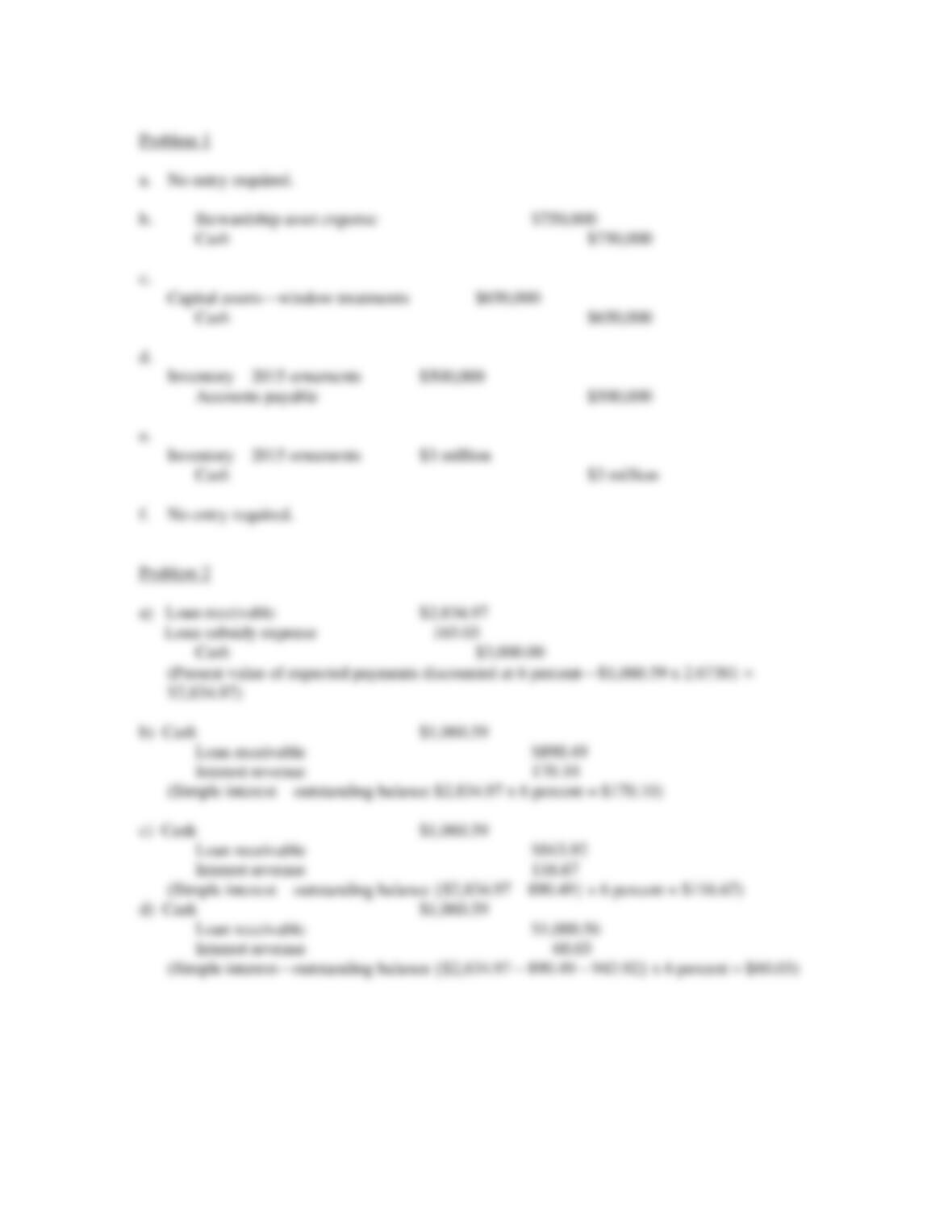
1. The federal government’s general fund reports the following transactions during 2014.
Prepare journal entries to record each of these transactions. If no entry is required, write “No
entry required.”
a. The general fund contracts with a construction firm to build an Afghan and Iraqi war
memorial based on a design selected by the Afghan and Iraqi War Veterans Commission.
The estimated cost of the project is $3.5 million.
b. The general fund makes a $750,000 progress payment on the Afghan and Iraqi War
Memorial contract.
c. The general fund purchases new window treatments for the living areas of the White
House. The cost is $650,000.
d. The general fund reviews and accepts a design for the 2015 White House Christmas
ornament and is billed $500,000 for the design cost.
e. The general fund contracts for the manufacture of 1.5 million 2015 Christmas ornaments.
The manufacturing cost for each ornament is $2.00. The ornaments are paid for and will
be available for sale in the White House beginning in August 2015.
f. The general fund elects to record its inventory of assets held for sale at historical cost.
2. A federal agency established to provide direct loans for older Americans enrolled in school or
college made a three-year, 3 percent direct loan of $3,000 to be repaid in three equal annual
installments of $1,060.59. The prevailing Treasury rate on short- and intermediate-term
securities is 6 percent. Prepare journal entries to record the loan and the three payments. If
no entry is required, write “No entry required.”
Present value factors, if needed
Present value of an annuity for 3 periods @ 6% = 2.67301
Present value of an annuity for 3 periods @ 3% = 2.82861
Present value of $1, @ 6%, 3 periods = .83962
Present value of $1, @ 3%, 3 periods = .91513

ch17.doc Page 11
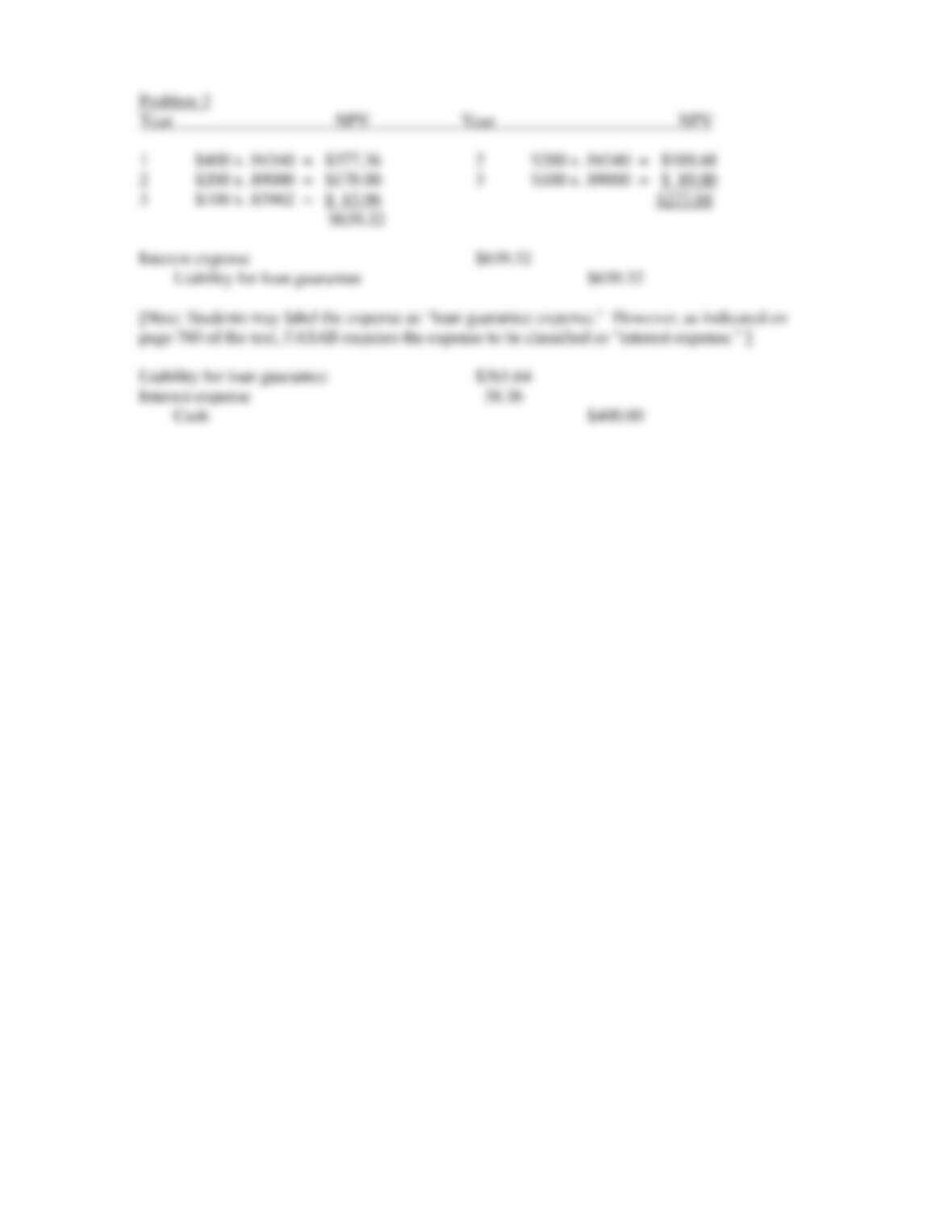
3. A federal agency was established to provide loan guarantees for students. At the beginning
of Year 1 the agency guarantees $100,000 of student loans. The payments that the agency
estimates it will have to make to lenders as a result of student defaults are as listed below.
The agency uses a discount rate of 6 percent. Prepare the necessary journal entries to record
the loan guarantee expense in Year 1 and the payment to the lenders in Year 2 of $400 on
defaulted loans. If no entry is required, write “No entry required.”
Present value factors, if needed, at 6% PV of $1 PV of an Annuity
1 period .94340 .94340
2 periods .89000 1.83339
3 periods .83962 2.67301
4 periods .79209 3.46511
5 periods .74726 4.21236
Estimates made at the end of year 1 Estimates made at the end of Year 2
End of Year Amount End of Year Amount
1 $400 2 $200
2 $200 3 $100
3 $100
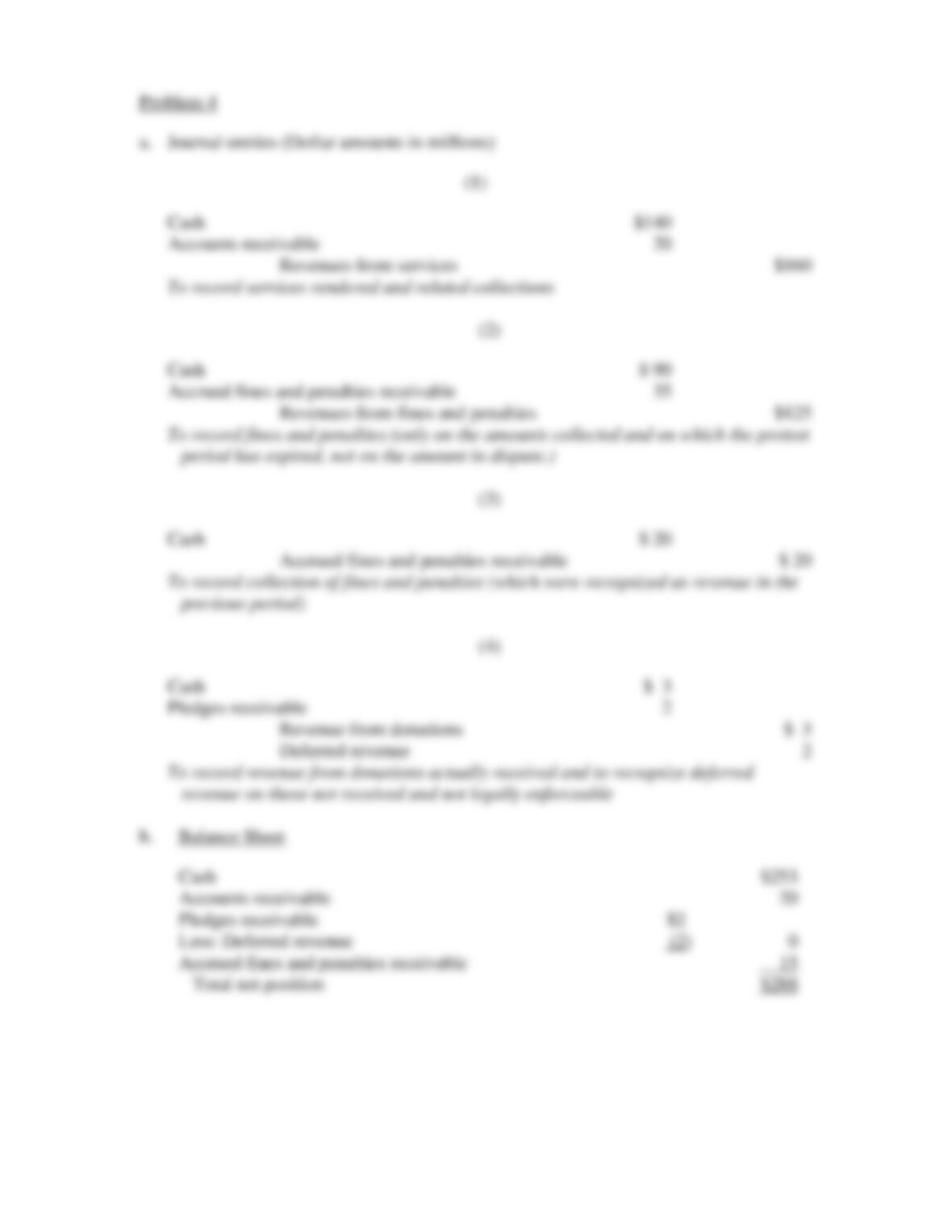
4. A federal environmental agency engaged in the following transactions during a particular
year.
1. It billed corporations for which it provided services $160 million. Of this, it collected
$140 million.
2. It levied $150 million in fines and penalties against corporations. Of this, $90 million was
collected in cash. Of the balance, the protest period has expired on $35 million, which the
agency expects to collect in the following year. The remaining $25 million is in dispute
and court dates have not yet been set.
3. It collected an additional $20 million in fines and penalties that had been assessed by
federal courts in the previous period.
4. It received cash donations of $3 million and pledges of an additional $2 million. The
agency’s counsel advises that the pledges are not legally enforceable.
a. Prepare journal entries to record the revenues and collections.
b. Show how the revenues and related receivables would be reported on the agency’s
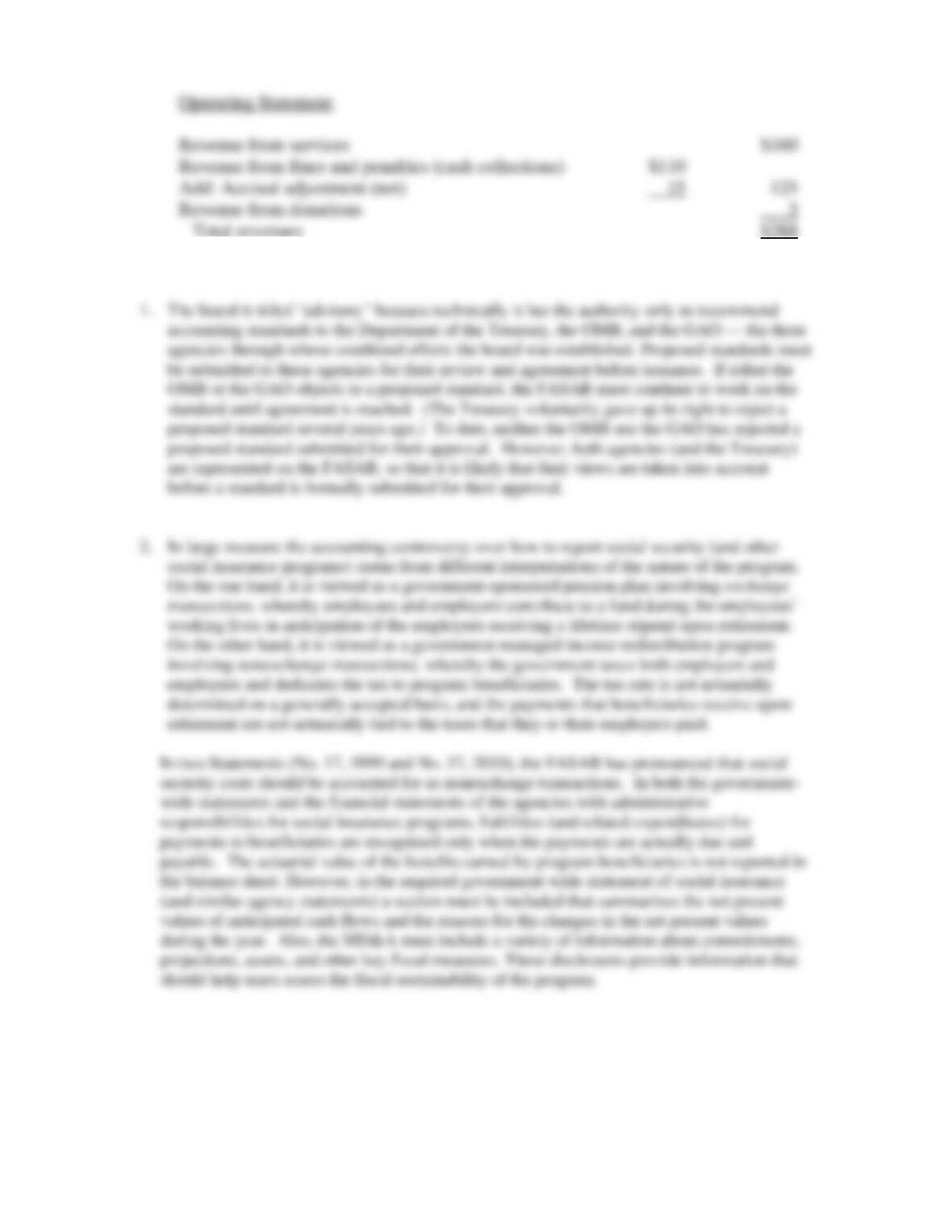
balance sheet and statement of net cost (i.e., an operating statement).
ch17.doc Page 12
ESSAYS (CHAPTER 17)
1. Why is the FASAB named an “advisory board”? What happens if the GAO or the OMB
rejects one of its standards?
2. One of the major problems encountered by the FASAB in setting standards for the federal
government-wide financial statements is how to classify future benefit payments to social
security beneficiaries. What are the underlying issues related to social security? How has the
FASAB resolved the issues? How is social security information presented in federal financial
statements?
3. One of the more difficult issues to address in state and local government accounting is the
reporting entity. A similar issue exists at the federal level. Discuss the financial reporting
entity issue at the federal level.
4. The federal government maintains a dual system of accounts. What are the two types of
accounts? Why does the federal government keep two types?
5. What is meant by a “unified budget”? Why are Social Security and Postal Service receipts
and disbursements not included in the unified budget?
6. The FASAB has explained that government liabilities are attributable to “events.” What are
“events”? What types of events has FASAB identified? Give some examples of each type.
When should liabilities be recognized for each type of event?

ch17.doc Page 13
ANSWERS TO TRUE/FALSE (CHAPTER 17)

ch17.doc Page 14
ANSWERS TO MULTIPLE CHOICE (CHAPTER 17)
ch17.doc Page 15
ANSWERS TO PROBLEMS (CHAPTER 17)
ch17.doc Page 16
ch17.doc Page 17
ch17.doc Page 18
Total revenues $288
ANSWERS TO ESSAYS (CHAPTER 17)
ch17.doc Page 19
ch17.doc Page 20