
Elements of Ecology, 9e (Smith)
Chapter 17 Factors Influencing the Structure of Communities
17.1 Short Answer Questions
1) The ________ is a group of plant and animal species that inhabits a given area.
2) A(n) ________ model of community structure assumes that the presence and absence of
individual species in a community result from independent responses to the physical
environment and interactions among species have no impact on community structure.
3) Patterns of temperature and ________ resulting from regional variations in climate are the
major determinant of regional and global patterns of vegetation distribution.
4) When interspecific interactions involve more than just two species, they are said to be
________.
5) ________ predation is a type of indirect interaction in which a predator enhances the success
of one or more inferior competitors by reducing the abundance of a superior competitor.
6) ________ competition is a type of indirect interaction that occurs when a single species of
predator feeds on two prey species.
7) When an indirect interaction is beneficial to one of two interacting species and neutral to the
other, the indirect interaction is termed indirect ________.

8) ________ or functional groups are groups of species in a community that are thought to have
similar roles in the community.
9) When prey populations are controlled by predators in a trophic level above them, they are said
to be under ________ control.
10) Variation in environmental conditions within a community is referred to as environmental
________.
11) In all experimental studies to date, the effect of increasing nutrient availability to plants has
been to ________ plant diversity.
1) Considerable evidence indicates that the null model of community structure is incorrect
because
A) each species responds independently of other species to the prevailing physical environment.
B) interactions among species have no significant influence on community structure.
C) when one species is removed, the populations of the other species are unaffected.
D) species interactions modify the fundamental niche of the species involved, influencing their
relative abundance and, in some cases, their distribution.
2) Which of the following is an example of a fundamental niche?
A) a mouse feeding on only small seeds in the presence of a competitor
B) an amphibian laying eggs in all possible habitats
C) a bird nesting on top of a tree in the presence of predators
D) a lizard feeding on insects only at dawn when snakes are present

3) What might one expect to see in a graph depicting realized niche space in a community?
A) one dominant species utilizing all of the resources
B) large overlap between species resource use
C) reduced overlap between species resource use
D) each species utilizing its full resources
4) In looking at a distribution map you see an empty space where habitat conditions are suitable
for that species. Why might that exist?
A) Other species outcompete it in that space.
B) That species prefers other areas.
C) The species has a limit to population growth.
D) The space is due to the null model.
5) Which of the following is evidence against the null model?
A) Bristlecone pine trees can survive harsh winters.
B) Climate change alters abundance of robins.
C) Invasive species cause California newts to go locally extinct.
D) Hurricanes can wipe out fauna on an island.
6) Plant community structure along an environmental gradient can often be explained by
A) differences among species in their competitive abilities.
B) differences among species in their abilities to tolerate stress.
C) differences among species in their resistance to herbivores.
D) a trade-off among species with respect to competitive ability and stress tolerance.
7) In aquatic environments, the three major environmental gradients of water that directly
influence the distribution and dynamics of communities include
A) temperature, depth, and oxygen content.
B) depth, flow rate, and salinity.
C) pressure, temperature, and depth.
D) flow rate, salinity, and oxygen content.

8) What happens to the species Chthamalus stellatus when Balanus balanoides is removed from
the lower intertidal zone?
A) Chthamalus is able to survive in the lower intertidal zone.
B) Chthamalus survives worse.
C) Balanus switches habitat to the upper intertidal zone.
D) There is no change in distribution for either species.
9) In comparison to the upper intertidal zone, species in the lower intertidal zone are more apt to
A) be desiccation tolerant.
B) have a lower metabolic rate.
C) have lower resource requirements.
D) be better competitors.
10) A competitive plant growing in wet conditions would be predicted to have
A) a larger root system.
B) high tolerance to water stress.
C) low metabolic rate.
D) many leaves and stems.
11) Spartina alterniflora allocates more ________ to outcompete Juncus gerardi.
A) carbon to root biomass
B) carbon to leafs
C) nutrients to herbivores
D) water to root biomass
12) Experiments on competition among species within a community reveal that
A) removing a group of species has relatively little effect on a community.
B) removing a single species has a stronger effect than removing a group of species from a
community.
C) removing a group of species has a stronger effect than removing a single species from a
community.
D) removing a single species has relatively little effect on a community.

13) Which is an example of a diffuse species interaction?
A) Removal of one beetle species from a community shows no effect.
B) Canada lynx cause population cycling in snowshoe hares.
C) Removal of sea otters results in kelp forest depletion.
D) Loss of starfish results in mussel outcompeting other species.
14) A diffuse species interaction infers the effects of
A) predation by one species on another is strong.
B) competition by one species on another is strong.
C) competition by one species on another is weak.
D) predation is stronger than those of competition.
15) What is a misconception about the Canada lynx and snowshoe hare cycling?
A) Canada lynx are the only predators on snowshoe hares.
B) Snowshoe hares impact resource abundance.
C) Snowshoe hare populations vary over time.
D) Rodents compete with snowshoe hares for grasses.
16) When apparent competition occurs, the
A) populations of predator and prey species are smaller.
B) population of the predator species is larger and the populations of the prey species are
smaller.
C) population of the predator species is smaller and the populations of the prey species are
larger.
D) populations of predator and prey species are larger.

17) When top-down control occurs within an intertidal zone along the rocky coastline of the
Pacific Ocean, which of the following species controls the abundance of other species?
A) kelp
B) mussels
C) barnacles
D) starfish
18) Which of the following is considered a keystone predator?
A) mussels
B) starfish
C) kelp bed
D) kelp bass
19) Which of the following communities could exhibit apparent competition?
A) species that share a predator but not resources
B) species the share resources but not a predator
C) species that do not share either resources or a predator
D) species with diffuse interactions
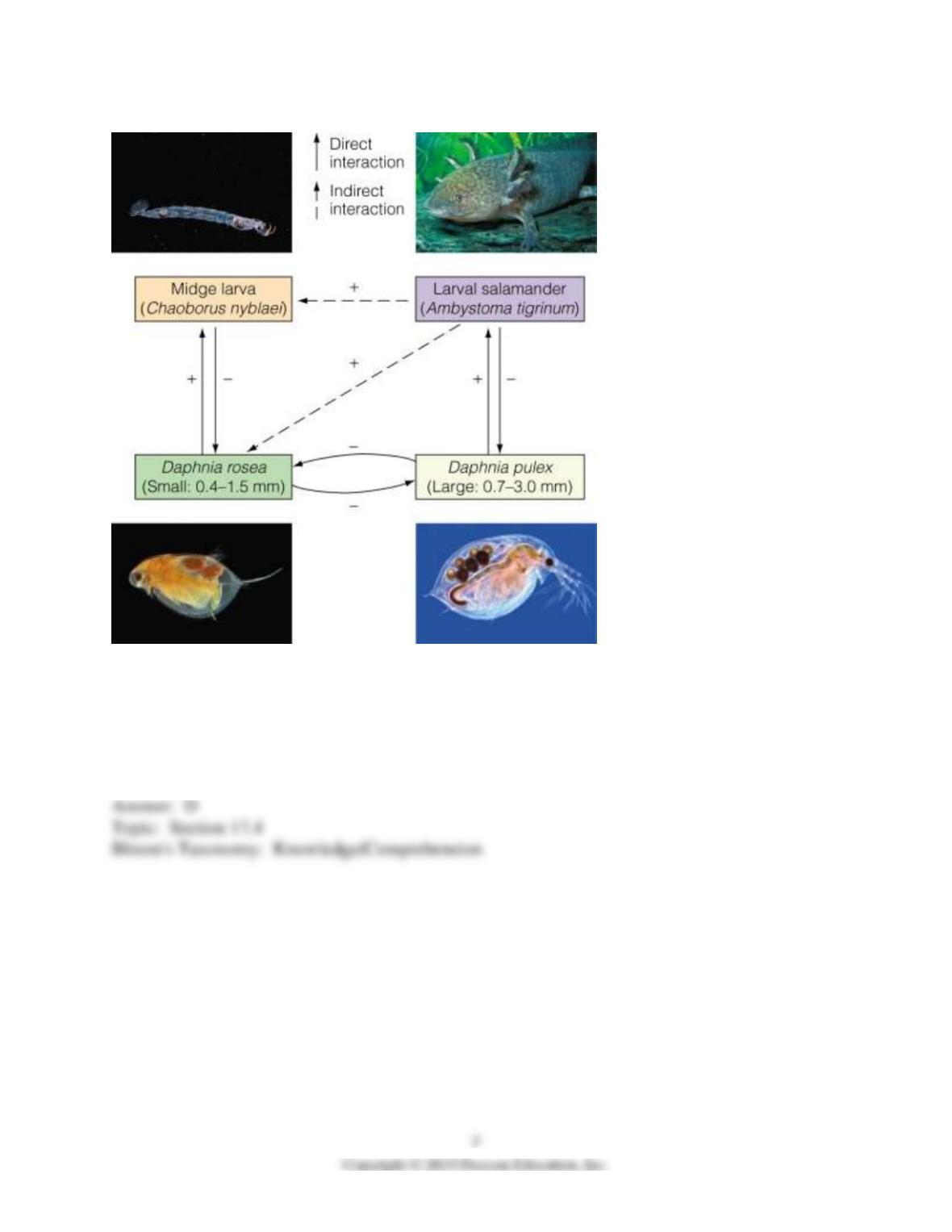
20)
What is the term when one species benefits from an indirect interaction and the other has a
neutral effect?
A) indirect competition
B) indirect mutualism
C) mutualism
D) indirect commensalism

21)
Increasing the resources for one species results in the increase of predator numbers. This reduces
the abundance of another prey species. This interaction is
A) indirect commensalism.
B) indirect mutualism.
C) apparent competition.
D) apparent predation.
22) Food webs are typically arranged into trophic levels with
A) primary producers at the bottom, herbivores in the middle, and carnivores at the top.
B) herbivores at the bottom, carnivores in the middle, and primary producers at the top.
C) carnivores at the bottom, herbivores in the middle, and primary producers at the top.
D) primary producers at the bottom, carnivores in the middle, and herbivores at the top.
23) Why might biologists assemble species into functional groups when examining community
structure?
A) to better focus on species by species interactions
B) to fit the null model
C) to understand the significance of a single species by assembling them in functional groups
D) to understand functional types because individual species might not be as significant

24) When bass were removed from a stream, an algal bloom occurred. This is an example of
A) top-down control.
B) bottom-up control.
C) the null model.
D) apparent competition.
25) Removal of sea otters from a system results in a massive increase in sea urchins and
subsequent loss of kelp beds. This is an example of
A) a trophic cascade.
B) apparent competition.
C) bottom-up control.
D) indirect mutualism.
26) The “world is green” hypothesis advocates which mechanism?
A) bottom-up control
B) top-down control
C) the null model
D) diffuse competition
27) Given large differences in moisture retention in soils, what would you predict?
A) decreased community diversity
B) no effect on community diversity
C) increased community diversity
D) more similar functional types in the community
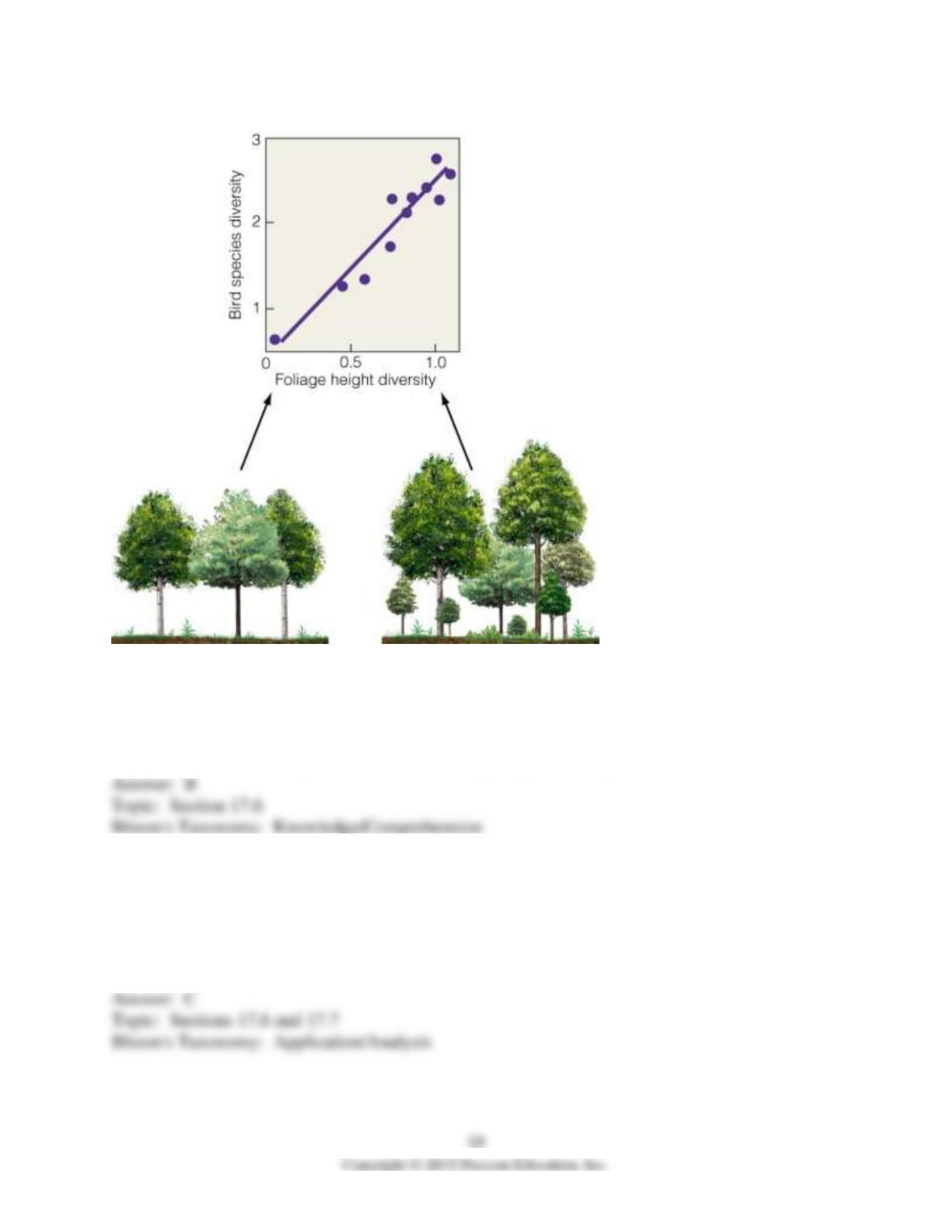
28)
What does this figure suggest?
A) Decreased foliage height diversity drives increased bird diversity.
B) Increased foliage height diversity drives increased bird diversity.
C) There is no relationship between foliage height and bird diversity.
D) Increased bird diversity drives increased foliage height diversity.
29) As the degree of environmental heterogeneity of a community increases, the number of plant
and animal species tends to
A) decrease.
B) remain the same.
C) increase.
D) increase initially and then decrease.
30) As the fertility of soil on the forest floor increases, the
A) growth rate of plants increases.
B) size of plants decreases.
C) density of plants decreases.
D) number of species of plants increases.
31) Why might increased soil fertility result in lower species diversity?
A) There is no relationship between soil fertility and species diversity.
B) Increased nutrients help more rare plants survive.
C) Dominant species are better able to outcompete other species.
D) Dominant species are less able to outcompete other species.
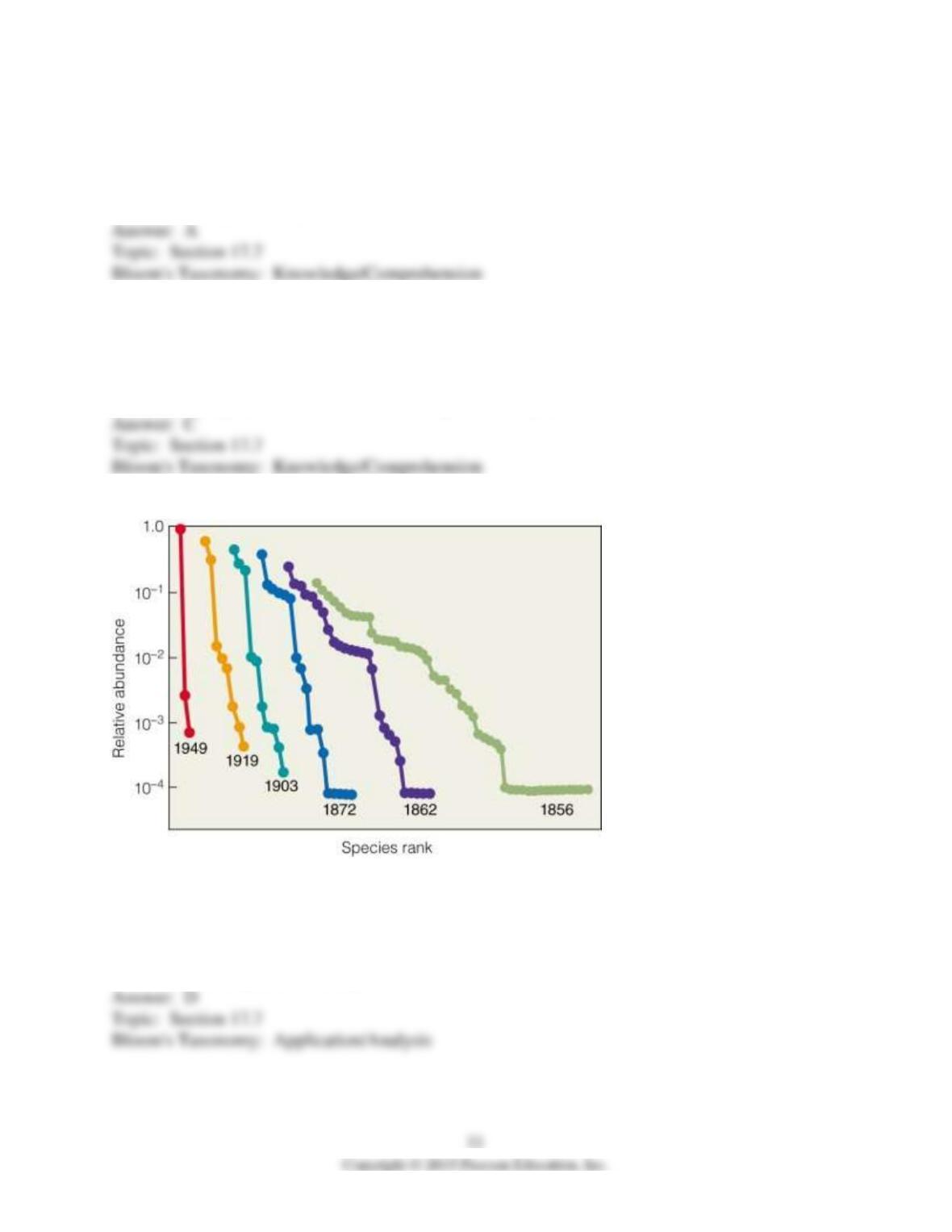
32)
This figure suggests that adding more and more nutrients over time will result in
A) an increase in species diversity.
B) an increase in species evenness.
C) a decrease in overall productivity.
D) a decrease in species diversity.

33) Why might increased nutrient availability result in increased species diversity in aquatic
systems while it results in decreases in terrestrial systems?
A) Aquatic systems have weaker competitive interactions.
B) Aquatic systems have stronger competitive interactions.
C) Nutrients are diluted too rapidly in aquatic systems.
D) Nutrients are always abundant in terrestrial systems.
34) In Yellowstone National Park, the reintroduction of wolves has led to
A) increased fruit consumption in elk.
B) a decrease in deciduous tree growth.
C) a decrease in the elk population.
D) an increase in the elk population.
35) Which of the following organisms have benefited from wolf reintroduction?
A) grizzly bears
B) beavers
C) woody plant species
D) all of the above
17.3 True/False Questions
1) Environmental conditions often vary spatially but do not tend to change over time in a given
place.
2) There is considerable evidence that community structure is influenced by interactions between
species.
3) Within a community, most species have a similar range of environmental tolerances.

4) Competition among plant species rarely involves only a single resource.
5) Species interactions within a community rarely involve only two species.
6) Diffuse interactions often occur among competing species but never among predator-prey
species.
7) Competitive interactions are often diffuse, whereas mutualisms are not.
8) The populations of keystone predators are controlled by the populations of their prey species.
9) Indirect interactions can be either positive or negative for the affected species.
10) The removal of a single species from a community can have unpredictable consequences.
11) The control of an herbivore population by a parasitoid is an example of top-down control.
12) The “world is green” hypothesis suggests that herbivore populations limit the number of
predators, allowing plant biomass to accumulate.

13) Environmental heterogeneity tends to be positively correlated with species diversity.
14) The diversity of an animal community is unrelated to the physical structure of a plant
community.
15) Competition for belowground resources is considered to be asymmetric because larger plants
have a disproportionate advantage in competition for those resources.
16) In aquatic communities, an increase in nutrients usually causes the number of autotrophic
species to increase.
17.4 Essay Questions
1) Explain the differing roles of fundamental niches and species interactions in controlling
community structure.
2) Discuss the factors that may lead to zonation among plants along an environmental gradient.
What factors tend to define the lower and upper boundaries along the environmental gradient of
each species?
3) Explain how apparent competition may potentially affect the population sizes of predator and
prey species.
4) Explain the difference between bottom-up and top-down control of community structure, and
discuss if one is more important than the other.

5) Summarize the “world is green” hypothesis of Nelson Hairston, Fred Smith, and Larry
Slobodkin. Is this an example of bottom-up or top-down control?
6) Discuss the impact of environmental heterogeneity on biological diversity within a
community.
7) When nutrients are added to terrestrial and aquatic communities, what are the effects on the
diversity of autotrophic species? Is there a difference between terrestrial and aquatic
communities?
8) What are the possible explanations for the paradox that diversity in terrestrial plant
communities decreases when nutrient availability increases?