Cost Accounting: A Managerial Emphasis, 6e
Chapter 17 – Process Costing
Chapter 17 Process Costing
17.1 Distinguish process- from job-costing allocation methods within the decision
framework, and apply the weighted-average method of inventory valuation when the
beginning work-in-process inventory is zero.
1) The primary difference between job costing and process costing is the extent of averaging used to
compute unit costs of products or services.
2) The first step in process costing is to calculate cost per equivalent unit.
3) Operating personnel must be able to estimate the percentage of work–in-process completed in process
costing.
4) Equivalent units measure output in terms of the physical quantities of each of the inputs (factors of
production) that have been consumed by the units.
5) Process costing is extremely useful when there are a variety of products produced, as compared to the
production of a single product.
6) Examples of industries that would use process costing include the pharmaceutical and semiconductor
industry.
Cost Accounting: A Managerial Emphasis, 6e
Chapter 17 – Process Costing
7) Process-costing systems separate costs into cost categories according to the timing of when costs are
introduced into the process.
8) When identical or similar units of products or services are mass produced, job-costing is used to
calculate an average production cost for all units produced.
9) Costing systems that are used for costing like or similar units of products in mass production are called
A) inventory-costing systems.
B) job-costing systems.
C) process-costing systems.
D) weighted-average costing systems.
E) bulk costing systems.
10) Which of the following manufactured products should use process costing?
A) 767 jet aircraft
B) bags of cement
C) custom build houses
D) designer original evening gowns
E) expensive jewelry
Cost Accounting: A Managerial Emphasis, 6e
Chapter 17 – Process Costing
11) Which of the following is FALSE concerning equivalent units?
A) Equivalent units are calculated separately for each cost category.
B) Equivalent units are equal to physical units.
C) Equivalent units measure output in terms of the physical quantities of the inputs consumed.
D) Equivalent units are necessary when process costing is used.
E) The number of equivalent units may be identical for direct materials and for conversion costs.
Use the information below to answer the following question(s).
Plastic Molding, Inc.’s costing system utilizes two cost categories; direct materials and conversion costs.
Each product must pass through the Assembly Department and the Testing Department. Direct materials
are added at the beginning of production. Conversion costs are allocated evenly throughout production.
Data for the Assembly Department for March are:
Work in process, beginning inventory, 40% converted
400 units
Units started during March
1,200 units
Work in process, ending inventory
200 units
Work in process, beginning inventory:
Direct materials
$200,000
Conversion costs
$200,000
Direct materials costs added during March
$2,000,000
Conversion costs added during March
$2,500,000
12) What is the unit cost for February in the Assembly Department?
A) $1,000
B) $1,750
C) $3,500
D) $3,750
E) $3,900
Cost Accounting: A Managerial Emphasis, 6e
Chapter 17 – Process Costing
13) How many units were completed and transferred out of the Assembly Department during March?
A) 200 units
B) 1,200 units
C) 1,400 units
D) 1,600 units
E) 1,720 units
14) Beginning inventory contained 5,000 units of goods that were 40 percent complete as to direct
material, and 50 percent complete as to conversion. What is the equivalent units completed for materials
and conversion at the beginning of the year, respectively?
A) 5,000 and 5,000
B) 1,000 and 5,000
C) 3,000 and 2,500
D) 2,000 and 2,500
E) 0 and 5,000
15) Which of the following is FALSE concerning process costing?
A) Process costing can only be used in manufacturing.
B) Process costing is used when outputs are homogeneous.
C) In process costing, labour and overhead costs are often combined and classified as conversion costs.
D) In process costing, some units will be incomplete at the end of the period.
E) Process costing averages unit costs of production.
Cost Accounting: A Managerial Emphasis, 6e
Chapter 17 – Process Costing
16) There are basically two distinct methods of calculating product costs.
Required:
Compare and contrast the two methods.
17) Describe three objectives of a costing system.
18) What is meant by the term “prime cost pool”?
Cost Accounting: A Managerial Emphasis, 6e
Chapter 17 – Process Costing
19) The president of the Gulf Coast Refining Corporation wants to know why his golfing partner, who is
the chief financial officer of a large construction company, calculates his costs by the job, but his own
corporation calculates costs by large units rather than by individual barrel of oil.
20) Discuss some typical products which would likely use process costing.
17.2 Contrast the journal entries for a process-costing system when there is and when
there is not ending work-in-process inventory using the weighted-average method of
inventory valuation.
1) Production costs are divided into three classifications: administrative costs, direct materials, and
conversion costs in process costing.
2) Process-costing journal entries and job-costing journal entries are similar with respect to direct
materials and conversion costs.
Cost Accounting: A Managerial Emphasis, 6e
Chapter 17 – Process Costing
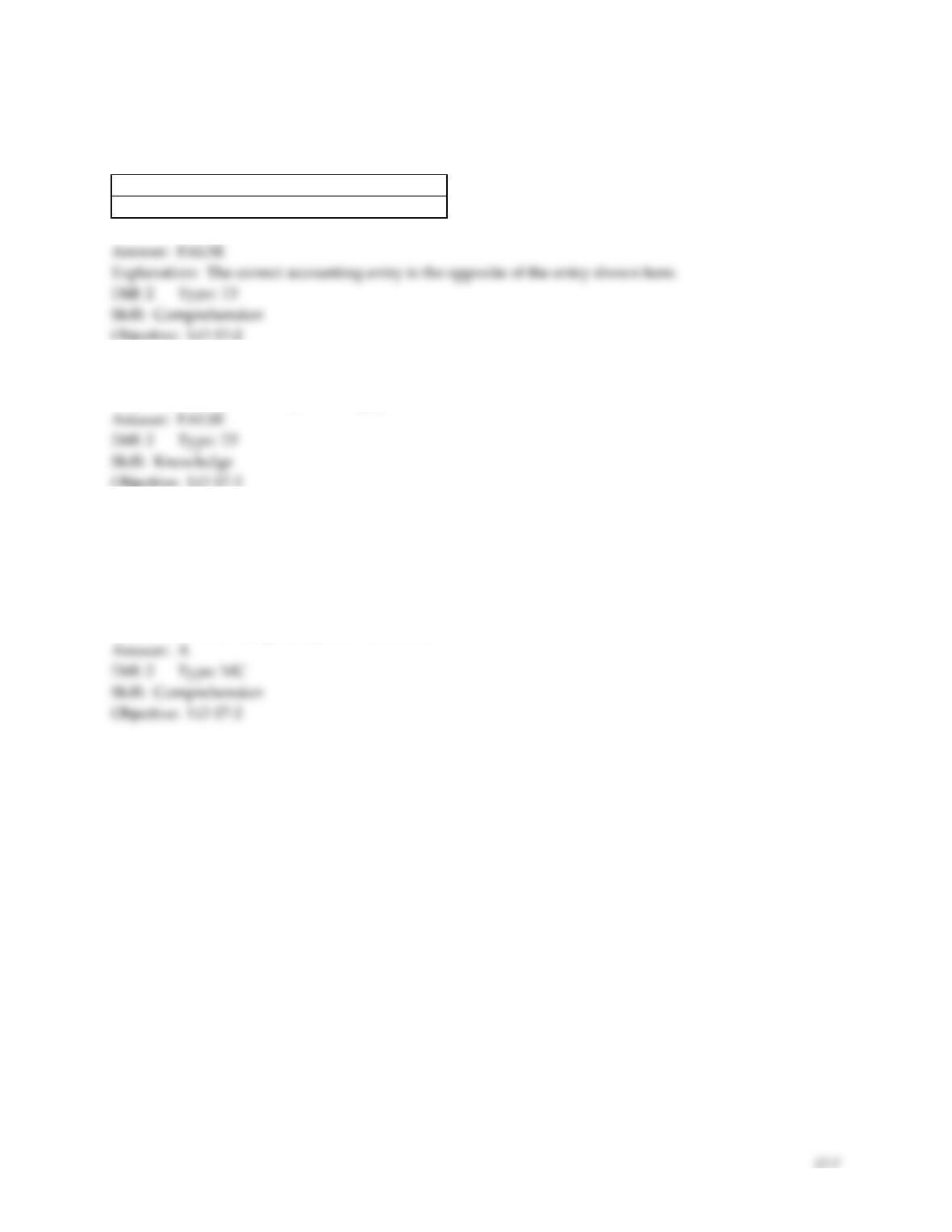
3) The accounting (for a bakery) entry to record the transfer of rolls from the mixing department to the
baking department is:
Work in Process-Mixing Department
Work in Process-Baking Department
4) Process-costing journal entries and job-costing journal entries are similar except for the multiple work–
in-process accounts in the job-costing system.
5) A key feature in process costing is that
A) total costs are divided by total equivalent units.
B) total units are multiplied by total costs.
C) (total costs times percentage allocated to each unit) are divided by total units.
D) (total units multiplied by the percentage allocated to each unit) is multiplied by total costs.
E) total units are multiplied by individual costs.
Cost Accounting: A Managerial Emphasis, 6e
Chapter 17 – Process Costing
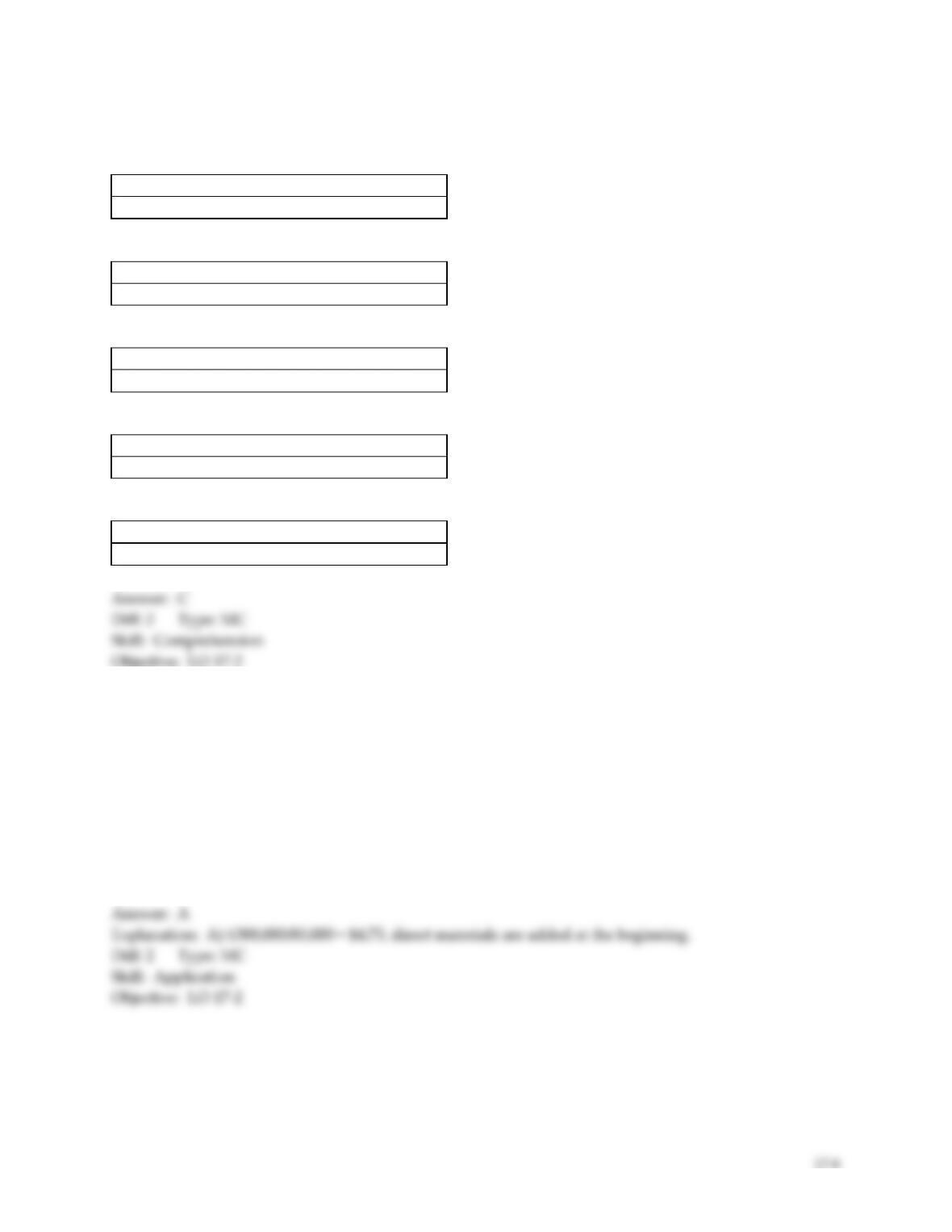
6) When a bakery transfers goods from the Baking Department to the Decorating Department, the
accounting entry is:
A)
Work in Process — Baking Department
Work in Process — Decorating Department
B)
Work in Process — Decorating Department
Accounts Payable
C)
Work in Process — Decorating Department
Work in Process-Baking Department
D)
Work in Process — Baking Department
Accounts Payable
E)
Finished Goods – Decorating Department
Work in Process-Baking Department
7) Excalibur Ltd. began operations on October 1 of the current year. Its production requires that direct
materials are added at the beginning of the process and conversion costs are incurred uniformly. Direct
materials costs for October were $380,000 and conversion costs were $1,750,000. There were 80,000 units
started during the month. The ending inventory was 25,000 units which were 60% complete. The cost per
equivalent unit for direct materials was:
A) $4.75
B) $15.20
C) $5.85
D) $5.43
E) $7.92
Cost Accounting: A Managerial Emphasis, 6e
Chapter 17 – Process Costing
8) Excalibur Ltd. began operations on October 1 of the current year. Its production requires that direct
materials are added at the beginning of the process and conversion costs are incurred uniformly. Direct
materials costs for October were $380,000 and conversion costs were $1,750,000. There were 80,000 units
started during the month. The ending inventory was 25,000 units which were 60% complete. The cost per
equivalent unit for conversion was:
A) $25.00
B) $21.88
C) $70.00
D) $116.67
E) $16.67
Cost Accounting: A Managerial Emphasis, 6e
Chapter 17 – Process Costing
Use the information below to answer the following question(s).
Father Time Clock Shop manufactures clocks on an automated assembly line. It utilizes two cost
categories: direct materials and conversion costs. Each product must pass through the Assembly
Department and the Testing Department. Direct materials are added at the beginning of production,
while conversion costs are allocated evenly throughout production, and the company uses weighted–
average costing.
Data for the Assembly Department are:
Work in process, beginning inventory
250 units
Direct materials (100% complete)
Conversion costs (50% complete)
Units started during June
800 units
Work in process, ending inventory
150 units
Direct materials (100% complete)
Conversion costs (75% complete)
Work in process, beginning inventory
Direct materials
$180,000
Conversion costs
$270,000
Direct materials costs added during June
$1,000,000
Conversion costs added during June
$1,000,000
9) Which of the following entries would be made to record the issue of direct materials in the Testing
Department, under process-costing?
A) debit to Testing Department assets
B) debit to Testing Department Materials Inventory
C) debit to Work in Process – Testing Department
D) credit to Direct Materials
E) credit to Work in Process – Testing Department
Cost Accounting: A Managerial Emphasis, 6e
Chapter 17 – Process Costing
10) The Zygon Corporation was recently formed to produce a semiconductor chip that forms an essential
part of the personal computer manufactured by a major corporation. The direct materials are added at the
start of the production process while conversion costs are added uniformly throughout the production
process. June is Zygon’s first month of operations, and therefore, there was no beginning inventory.
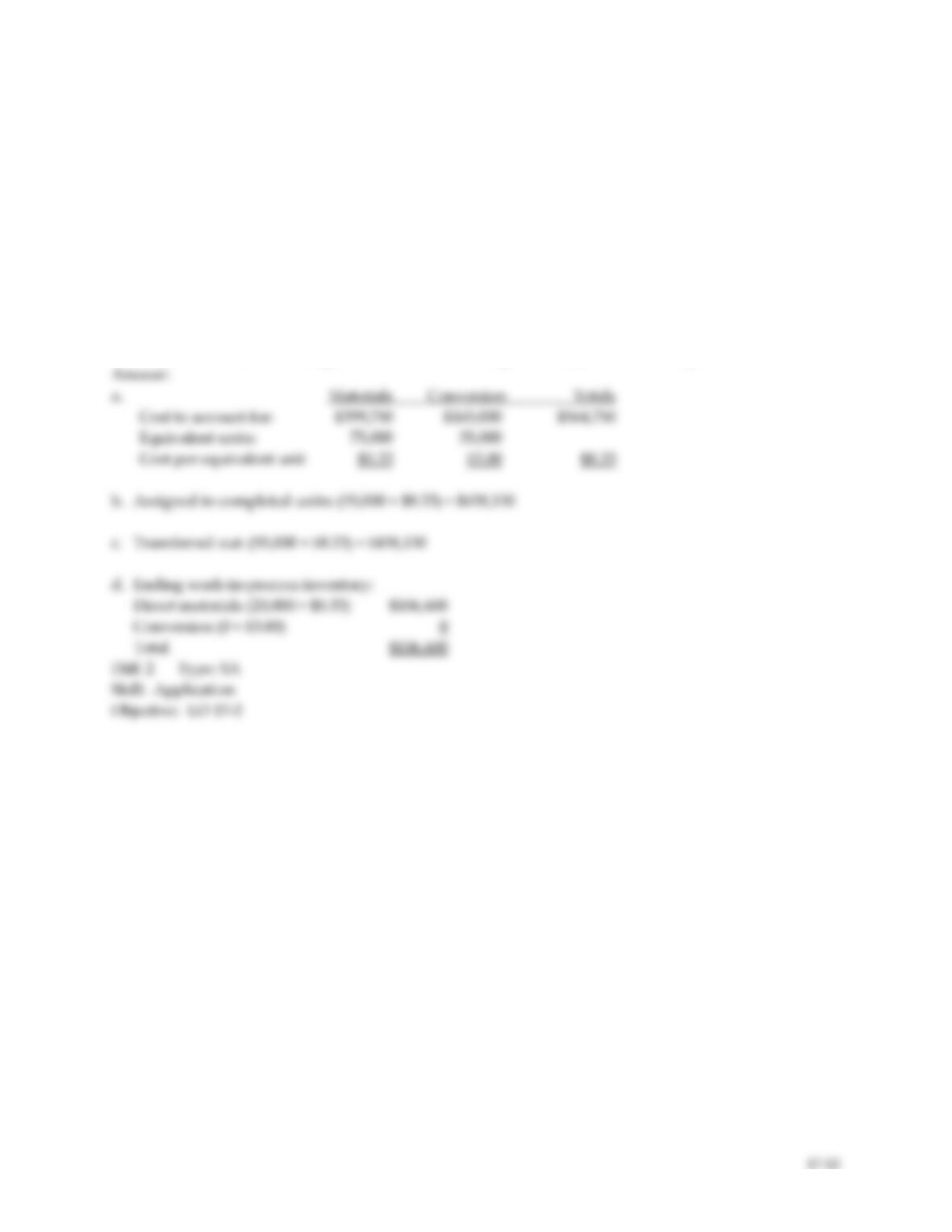
Direct materials cost for the month totaled $895,000, while conversion costs equaled $4,225,000.
Accounting records indicate that 475,000 chips were started in June and 425,000 chips were completed.
Ending inventory was 50% complete as to conversion costs.
Required:
a. What is the total manufacturing cost per chip for June?
b. Allocate the total costs between the completed chips and the chips in ending inventory.
Cost Accounting: A Managerial Emphasis, 6e
Chapter 17 – Process Costing
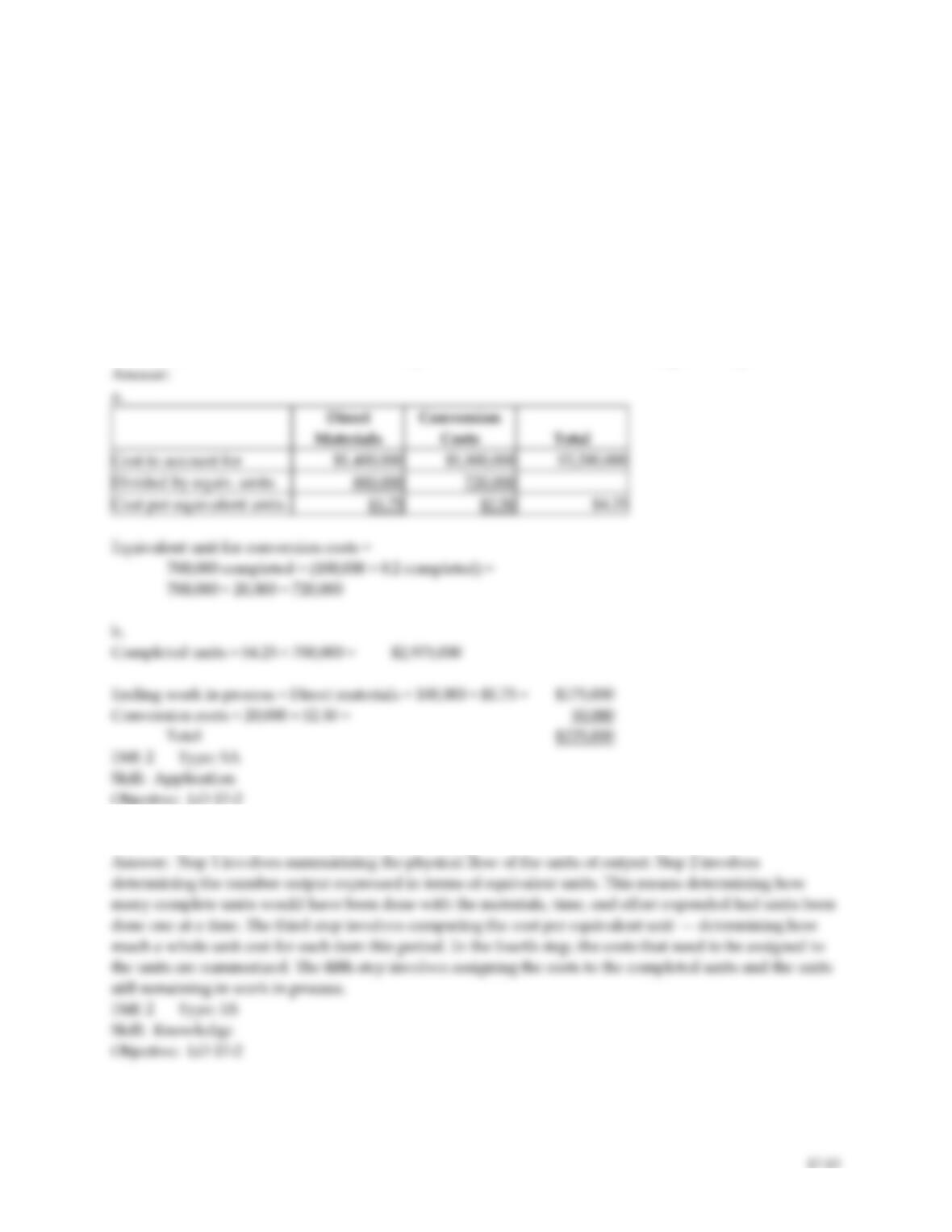
11) Treated Lumber Company specializes in processing treated wood. All direct materials are included at
the inception of the sawing process and conversion is applied at the end of the process. For December
there was no beginning inventory in the sawmill. Direct materials totalled $399,750 for the month and
conversion costs totalled $165,000. work–in-process records revealed that 75,000 boardmetres were started
in December and that 55,000 boardmetres were completed. Ending work–in-process units are complete
only in respect to direct materials costs.
Required:
a. What is the total manufacturing cost per equivalent unit (boardmetres) for December?
b. What are the costs assigned to completed boardmetres in December?
c. What are the costs transferred out during December?
d. What are the amounts assigned to December’s ending work–in-process inventory?
Cost Accounting: A Managerial Emphasis, 6e
Chapter 17 – Process Costing
12) The Parson Valve Corporation was recently formed to produce a brass valve that forms an essential
part of a compressor manufactured by a major corporation. The direct materials are added at the start of
the production process while conversion costs are added uniformly throughout the production process.
September is Parson’s first month of operations, and therefore, there was no beginning inventory. Direct
materials cost for the month totaled $1,400,000, while conversion costs equaled $1,800,000. Accounting
records indicate that 800,000 valves were started in September and 700,000 valves were completed.
Ending inventory was 20% complete as to conversion costs.
Required:
a. What is the total manufacturing cost per valve for September?
b. Allocate the total costs between the completed valves and the valves in ending inventory.
13) List and describe the five steps in process costing.
Cost Accounting: A Managerial Emphasis, 6e
Chapter 17 – Process Costing
17.3 Apply the weighted-average method of process costing to calculate the cost of
goods manufactured and transferred out when there is both beginning and ending
work-in-process inventory.
1) The final result of the process costing procedure is to compute the dollar amount of the credit to a
work-in-process account and the corresponding debit to finished goods and/or other work–in-process
accounts.
2) The weighted-average process costing method assigns the cost of the earliest equivalent units available
to units completed and transferred out, and the cost of the most recent equivalent units worked on
during the period to ending work–in-process inventory.
3) The weighted-average process costing method distinguishes between units started in the previous
period but completed during the current period and units started and completed during the current
period.
4) In the weighted-average method, costs of units completed and transferred out, and in ending work–in–
process, are calculated using average total costs obtained after merging costs of beginning work-in–
process and costs added in the current period.
5) Unit costs do not fluctuate between periods.
Cost Accounting: A Managerial Emphasis, 6e
Chapter 17 – Process Costing
6) In the weighted-average costing method, the costs of direct materials in beginning inventory are not
included in the cost per unit calculation since direct materials are almost always added at the start of the
production process.
7) Equivalent units in beginning work in process + equivalent units of work done in the current period
equals equivalent units completed and transferred out in the current period minus equivalent units in
ending work in process.
8) Which of the following is an assumption implicit in process-costing?
A) All completed units receive more direct material inputs than units in process.
B) All completed units receive less direct material inputs than units in process.
C) Opening inventory is always nil, for the cost calculations.
D) Ending inventory is always nil, for the cost calculations.
E) All completed units receive the same amount of direct material inputs and the same amount of
conversion costs.
9) Which of the following assertions is true concerning conversion costs?
A) Direct labour costs are always included in conversion costs.
B) The conversion period (for conversion costs calculation) can only include one operation.
C) When conversion costs are estimated to be over 80% complete, then the cost-benefit constraint requires
us to use 100% as the estimate.
D) Conversion costs are impossible to estimate with any reliability.
E) The conversion period often includes several operations, and it may be impossible to estimate
conversion costs with any reliability in some cases.
Cost Accounting: A Managerial Emphasis, 6e
Chapter 17 – Process Costing
10) Which of the following is NOT one of the procedures in process costing?
A) summarize the flow of physical units of output
B) assign costs to equivalent units based on their percentage of completion
C) compute equivalent unit costs
D) summarize total costs to account for
E) assign costs to completed units
Cost Accounting: A Managerial Emphasis, 6e
Chapter 17 – Process Costing
Use the information below to answer the following question(s).
Plastic Molding, Inc.’s costing system utilizes two cost categories; direct materials and conversion costs.
Each product must pass through the Assembly Department and the Testing Department. Direct materials
are added at the beginning of production. Conversion costs are allocated evenly throughout production.
Data for the Assembly Department for March are:
Work in process, beginning inventory, 40% converted
400 units
Units started during March
1,200 units
Work in process, ending inventory
200 units
Work in process, beginning inventory:
Direct materials
$200,000
Conversion costs
$200,000
Direct materials costs added during March
$2,000,000
Conversion costs added during March
$2,500,000
11) Which of the following journal entries correctly reflects the transfer of goods completed from the
Assembly Department to the Testing Department?
A)
Work in Process – Assembly
XXX
Work-in-process – Testing
XXX
B)
Work in Process – Testing
XXX
Work-in-process – Assembly
XXX
C)
Work in Process – Assembly
XXX
Finished Goods – Testing
XXX
D)
Finished Goods – Testing
XXX
Work-in-process – Assembly
XXX
E)
Finished Goods – Testing
XXX
Work-in-process – Testing
XXX
Cost Accounting: A Managerial Emphasis, 6e
Chapter 17 – Process Costing
12) The final of the accounting for processes with respect to process costing is to
A) compute the amount of debits to work-in-process.
B) compute the amount of credits to work–in-process.
C) compute the equivalent units for the period.
D) account for all units placed in process during the period.
E) account for all units in ending inventory at the end of the period.
Cost Accounting: A Managerial Emphasis, 6e
Chapter 17 – Process Costing
Use the information below to answer the following question(s).
Father Time Clock Shop manufactures clocks on an automated assembly line. It utilizes two cost
categories: direct materials and conversion costs. Each product must pass through the Assembly
Department and the Testing Department. Direct materials are added at the beginning of production,
while conversion costs are allocated evenly throughout production, and the company uses weighted–
average costing.
Data for the Assembly Department are:
Work in process, beginning inventory
250 units
Direct materials (100% complete)
Conversion costs (50% complete)
Units started during June
800 units
Work in process, ending inventory
150 units
Direct materials (100% complete)
Conversion costs (75% complete)
Work in process, beginning inventory
Direct materials
$180,000
Conversion costs
$270,000
Direct materials costs added during June
$1,000,000
Conversion costs added during June
$1,000,000
13) What are the equivalent units for direct materials and conversion costs, respectively?
A) 1,200.5 units; 1,160.64 units
B) 1,050 units; 1,012.5 units
C) 1,050 units; 887.5 units
D) 962 units; 990 units
E) 990 units and 962 units
Cost Accounting: A Managerial Emphasis, 6e
Chapter 17 – Process Costing
14) What is the total amount debited to the work-in-process account during the month of June?
A) $450,000
B) $2,000,000
C) $2,270,000
D) $2,450,000
E) $3,250,000
15) What is the direct materials cost per equivalent unit during June?
A) $982.92
B) $1,226.61
C) $952.38
D) $1,123.81
E) $1,000.00
16) What is the conversion cost per equivalent unit in June?
A) $1,254.32
B) $1,430.99
C) $987.65
D) $1,282.83
E) $1,320.17