Chapter 17: Advanced Issues in Revenue Recognition
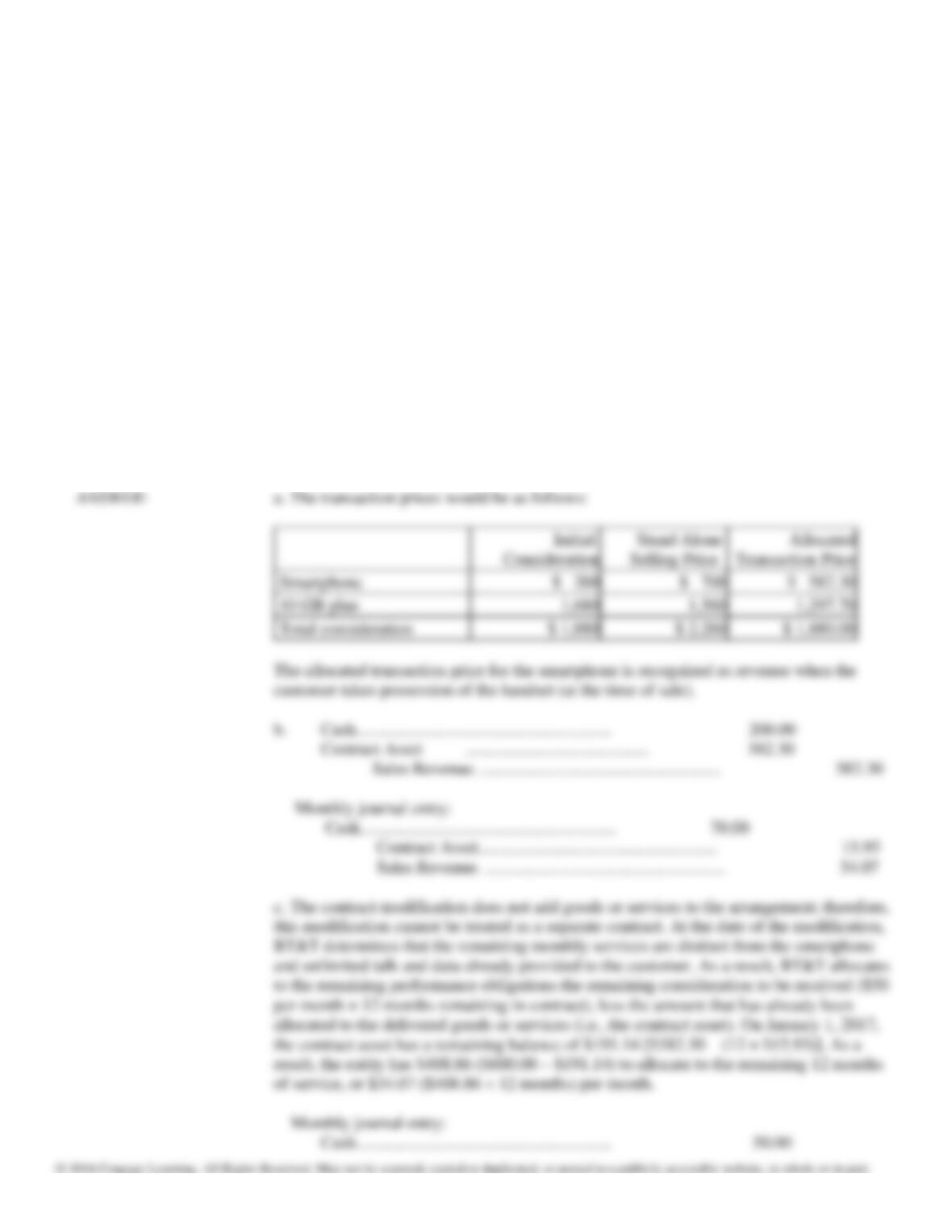
86. On January 1, 2017, BT&T Company enters into a 2-year contract with a customer for an unlimited talk and 10 GB
data wireless plan for $70 per month. The contract includes a smartphone for which the customer pays $200. BT&T
also sells the smartphone and monthly service plan separately, charging $700 for the smartphone and $65 for the
monthly service for the unlimited talk and 10 GB data wireless plan.
Required:
a.
Determine the transaction price for each performance obligation, assuming
that BT&T Company allocates the transaction price based on stand-alone
prices.
b.
Record the initial journal entry for BT&T Company’s sale of a 2-year
contract on January 1, 2017, and the monthly journal entry.
c.
On January 1, 2018, the customer realizes that she needs less data in her
wireless plan and downgrades to the unlimited talk and 2 GB data plan for
the remaining term of the contract (12 months). The unlimited talk and 2
GB data plan is priced at $50 per month, which is the BT&T current stand-
alone price for this plan that is available to all customers. Provide BT&T’s
new monthly revenue recognition journal entry.
Smartphone
10 GB plan
87. Thompson Construction began a construction project in 2016. The contract price was $1,250,000, and the estimated
costs were $1,000,000. Data for each year of the contract are as follows:
2016
2017
2018
Costs incurred during the year
$250,000
$600,000
$190,000
Estimated costs to complete
750,000
212,500
-0-
Partial billings
375,000
500,000
375,000
Collections
187,500
469,000
593,500
Required:
Assuming Thompson satisfies its performance obligation over time, determine:
(1)
The balance of Construction in Progress at the end of 2016.
(2)
How the net amount for construction in progress inventory should be reported
on the 2017 balance sheet.
(3)
The gross profit for 2018.
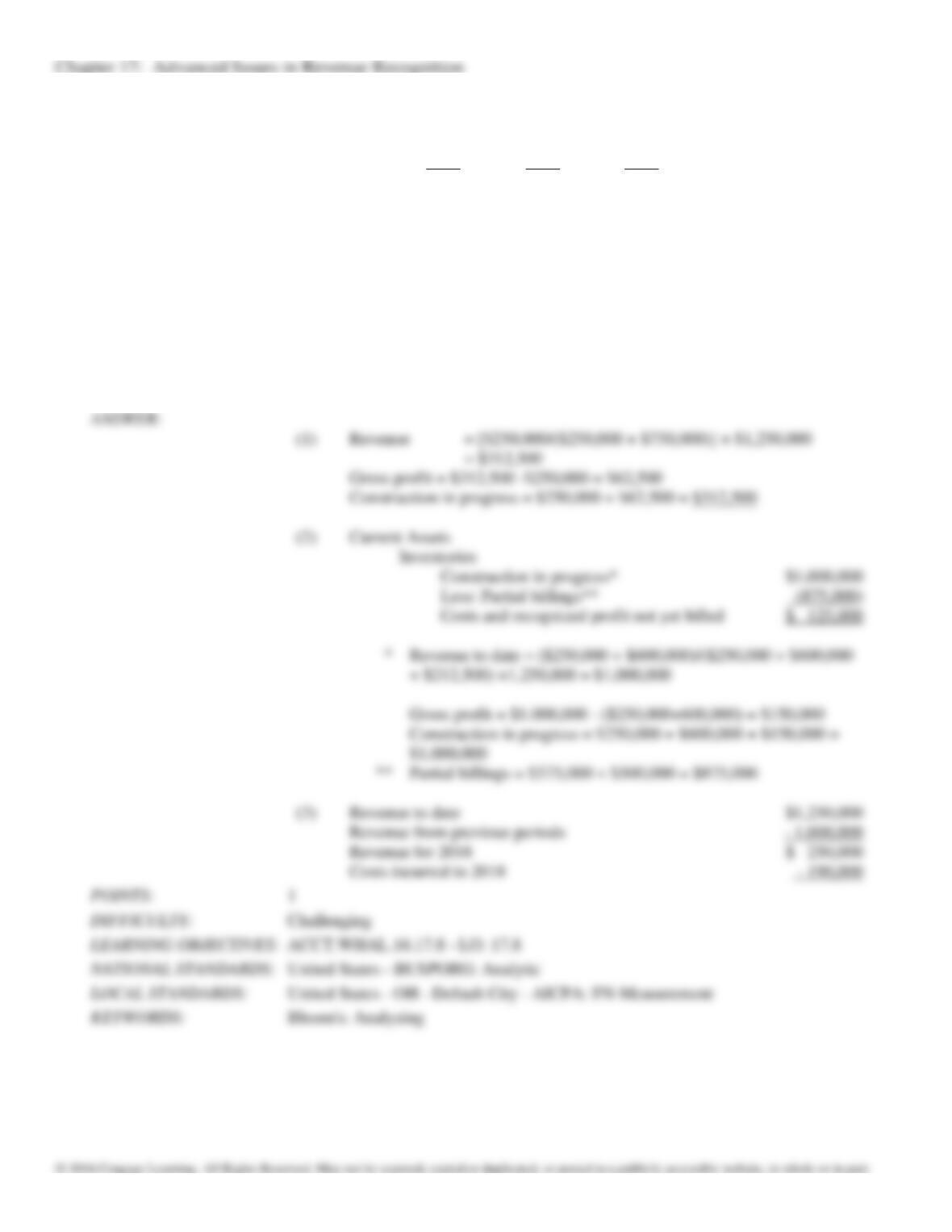
(1)
Revenue
= [$250,000/($250,000 + $750,000)] × $1,250,000
= $312,500
Gross profit = $312,500 –$250,000 = $62,500
Construction in progress = $250,000 + $62,500 = $312,500
(2)
Current Assets
Inventories
Construction in progress*
Less: Partial billings**
Costs and recognized profit not yet billed
*
+ $212,500) ×1,250,000 = $1,000,000
Gross profit = $1.000,000 – ($250,000+600,000) = $150,000
Partial billings = $375,000 + $500,000 = $875,000
(3)
Revenue to date
Revenue from previous periods
– 1,000,000
Revenue for 2018
Costs incurred in 2018
88. The Orlando Company is involved in a three-year long-term contract. The following data relate to this contract:
2016
2017
2018
Total
Contract price
$160,000
Cost incurred each year
$24,000
$24,000
$ 56,000
104,000
Cost incurred to date
24,000
48,000
104,000
Estimated cost to
complete
96,000
48,000
0
Partial billings each year
12,000
48,000
100,000
Cash collected from
billings
8,000
52,000
100,000
Required:
Prepare the journal entries for each of the following assuming Orlando satisfies its performance obligation over time:
2017 Entries
a.
Construction costs for the year
b.
Partial billings
c.
Cash collections
d.
Gross profit
2018 Entries
a.
Construction costs for the year
b.
Partial billings
c.
Cash collections
d.
Gross profit and closing of construction accounts
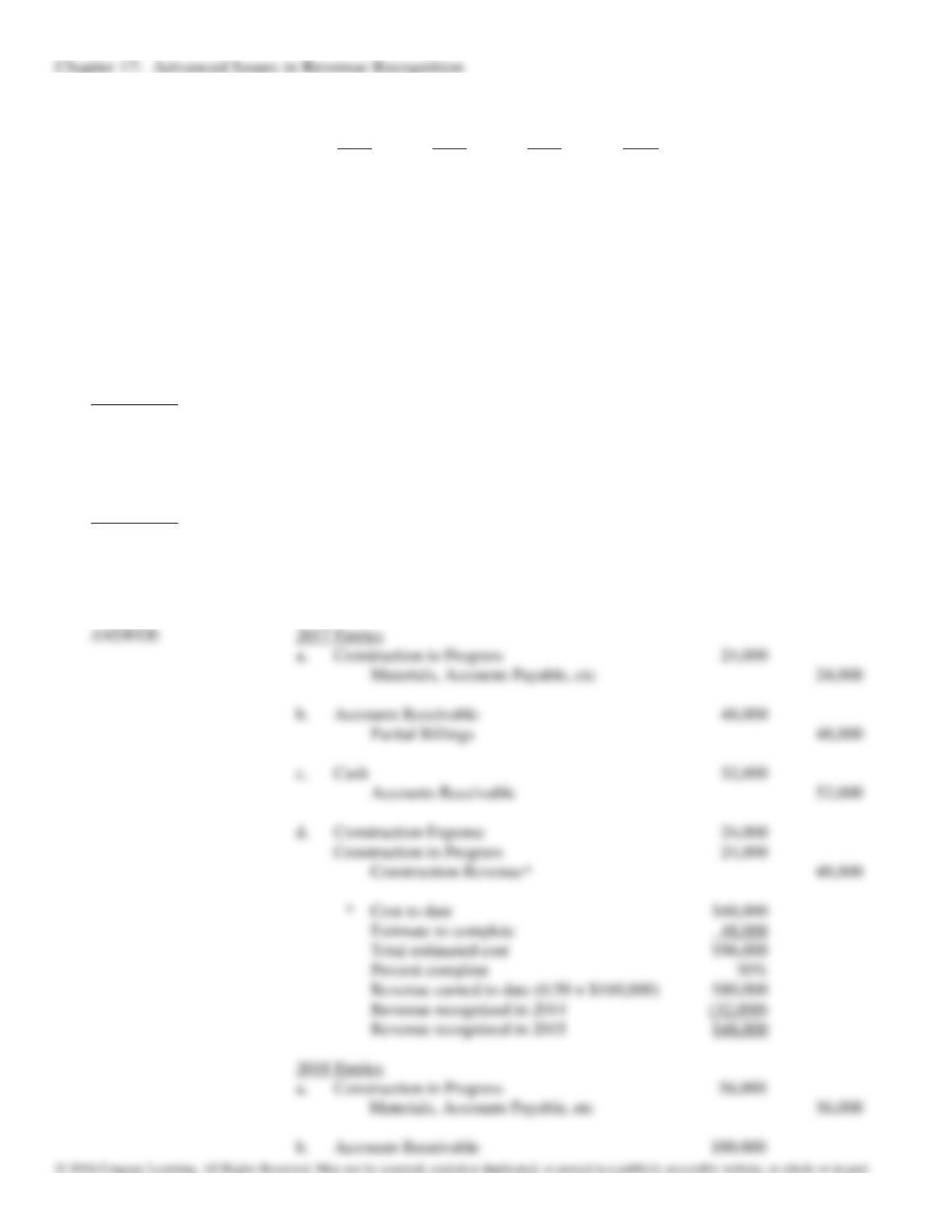
2017 Entries
a.
Construction in Progress
Materials, Accounts Payable, etc
24,000
b.
Accounts Receivable
Partial Billings
c.
Cash
Accounts Receivable
d.
Construction Expense
Construction in Progress
Construction Revenue*
48,000
Cost to date
Estimate to complete
48,000
Total estimated cost
Percent complete
Revenue earned to date (0.50 × $160,000)
$80,000
Revenue recognized in 2014
(32,000)
Revenue recognized in 2015
$48,000
a.
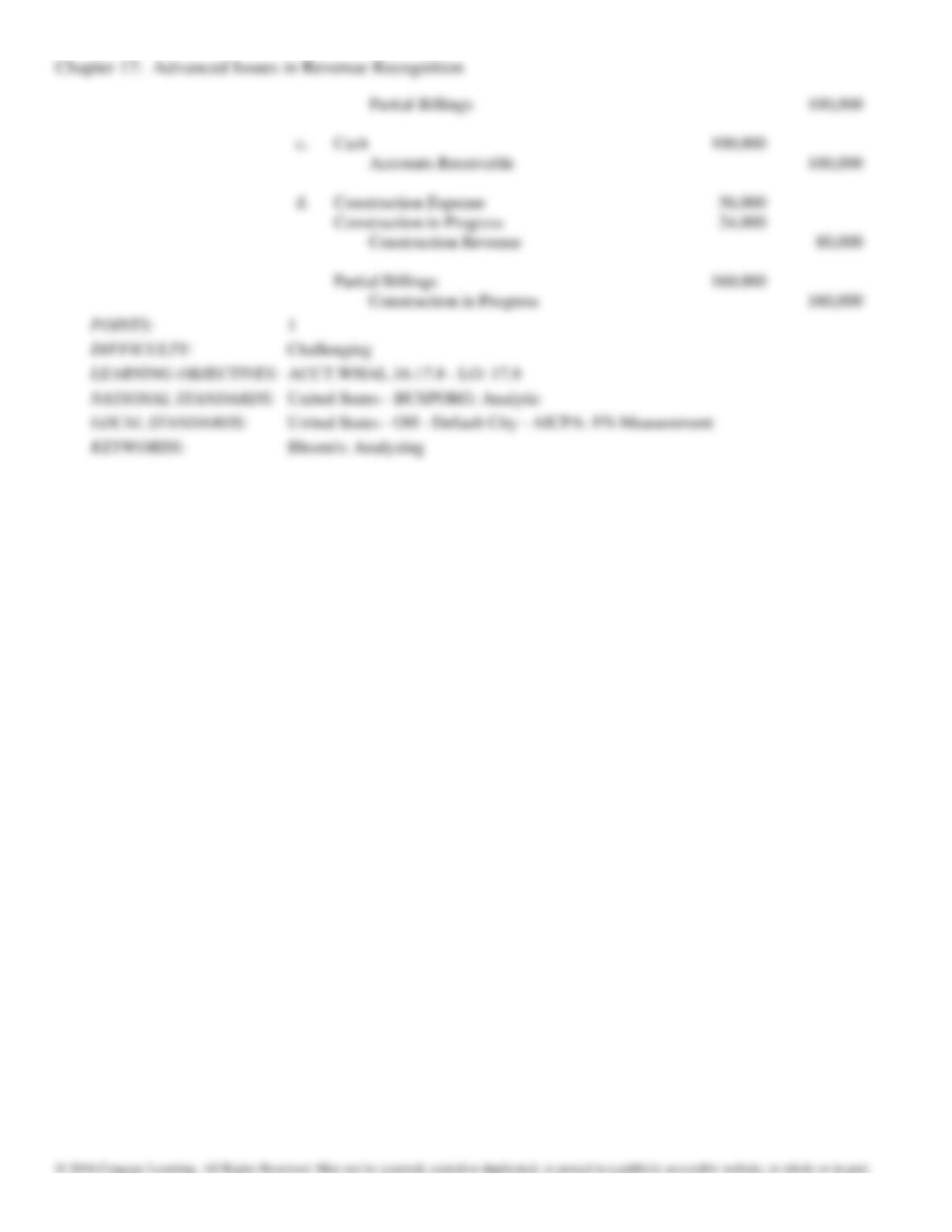
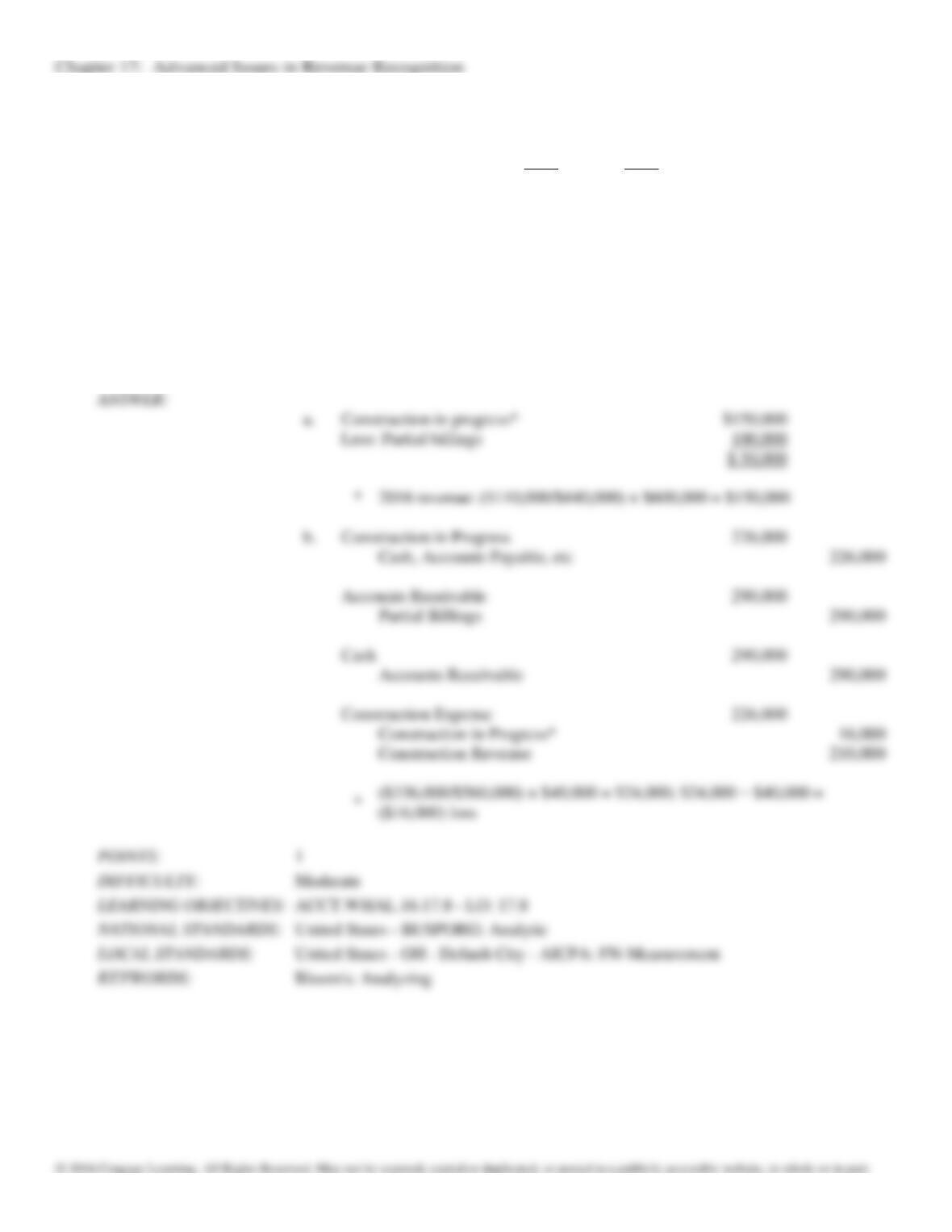
Construction in Progress
Materials, Accounts Payable, etc
b.
Accounts Receivable
89. Pensacola Building Co. signed a contract to build a road over a period of three years for a price of $600,000.
Information relating to the performance of the contract is summarized below:
2016
2017
Construction costs incurred during the year
$110,000
$226,000
Estimated costs to complete
330,000
224,000
Billings during the year (all collected in cash)
100,000
290,000
Required:
a.
Assuming Pensacola satisfies its performance obligation over time,
show how Construction in Progress would be disclosed on the
balance sheet at December 31, 2016.
b.
Assuming Pensacola satisfies its performance obligation over time,
prepare all 2017 entries.
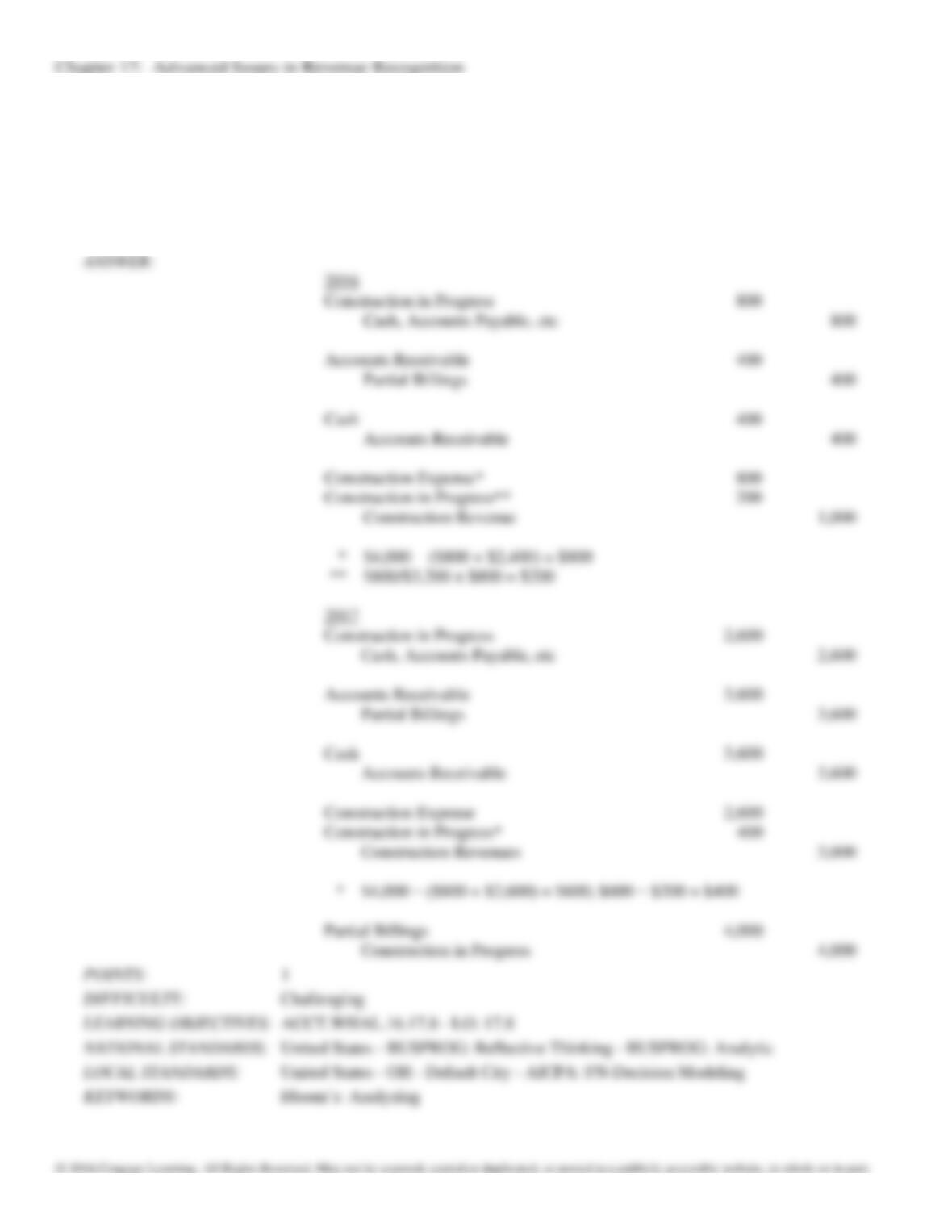
Construction in progress*
Less: Partial billings
2016 revenue: ($110,000/$440,000) × $600,000 = $150,000
b.
Construction in Progress
Cash, Accounts Payable, etc
Accounts Receivable
Partial Billings
Cash
Accounts Receivable
Construction Expense
Construction in Progress*
Construction Revenue
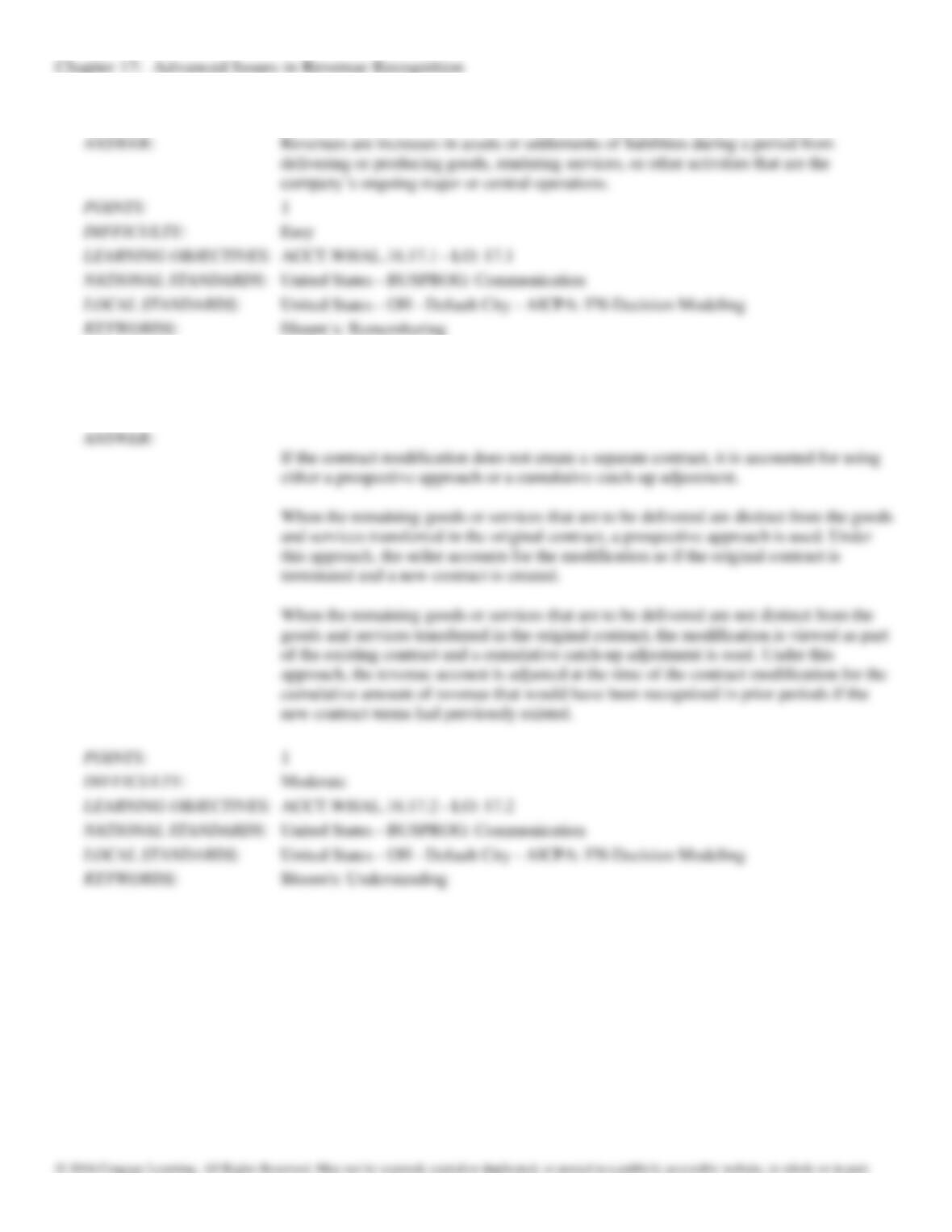
90. Panama Builders, Inc. signed a contract to build a certain project for $4,000. In 2016, $800 of cost was incurred and
$400 was billed to the customer and collected. At the end of 2016, it was estimated that it would take $2,400 to
complete the project. In 2017, actual additional costs to complete the project amounted to $2,600. The remainder of
the contract price was billed in 2017 and collected.
Required:
Prepare all journal entries for both years assuming Panama satisfies its performance obligation over time
91. What are revenues?
92. If a contract modification is determined not to result in a separate contract, how are the subsequent transactions
accounted for?
93. What is a performance obligation and under what circumstances does one or more performance obligations exist?
94. List indicators that a company may be an agent, not a principal, in a revenue transaction and explain the significance
of this relationship in revenue recognition.
95. What is the proper accounting for volume discounts on sales of products when there is uncertainty about whether the
discounted volume level will be attained?
96. Provide two examples of variable consideration. What are the two approaches for estimating variable consideration
and how does a company determine which approach should be used?
97. On what basis should the transaction price be allocated to various performance obligations? Identify the approaches
for estimating the stand-alone price.
98. Given that the determination of a variable transaction price may change over time, how is this change accounted for?
99. Under what conditions does a company recognize revenue over a period of time?
100. Describe the conditions when contract assets and contract liabilities are recognized and presented in financial
statements.
101. Mary Streen is getting up to speed on the new guidance on revenue recognition. She is trying to understand the
revenue recognition principle as it relates to the five-step revenue recognition process.
102. MeesaCard credit card company offers a loyalty program to its credit card users whereby the credit card company
gives the credit card user points for amounts purchased from merchants when using the credit card. These points may
be accumulated and redeemed for a number of different goods or services, including cash-back.
MeesaCard separately enters into arrangements with merchants under which the credit card company provides the
financing for the transaction between the merchant and the credit card user, in return for which the credit card
company receives a stated fee from the merchant. When the credit card user uses the credit card to make a purchase
from a merchant, MeesaCard honors its agreement with the merchant and advances the merchant the funding for the
amount of the transaction after deducting the fee to which the credit card company is entitled. However, as a result of
that transaction, MeesaCard now also has an obligation to the credit card user to provide the specified number of
points in the loyalty program.
Required:
a. How many performance obligations are involved in these activities?
b. Assuming there are two performance obligations, how would revenue be recognized?
c. Assuming there is only one performance obligation, how would revenue be recognized?
103. IT Services Co. provides online technology support for consumers remotely via the Internet. For a flat fee, it will
scan a customer’s personal computer (PC) for viruses, optimize the PC’s performance, and solve any connectivity
problems. When a customer calls to obtain the scan services, IT Services Co. describes the services it can provide
and states the price for those services. When the customer agrees to the terms stated by the representative, payment is
made over the telephone. IT Services Co. then provides the customer the information needed to obtain the scan
services (e.g., an access code for the website) and provides the services when the customer connects to the Internet
and logs onto IT Services Co.’s website, which may be that day but may also be at a future point in time.
Required:
a.
List the criteria for determining if there is a contract with a customer and determine if there
is a contract in this scenario.
b.
If so, when is revenue recognized?
104. Entity Suppliers contracts with its customer to deliver an imaging device and 50 replacement cartridges to be used
with the device. The contract price for the device is $100,000, and the cartridges, which are expected to be delivered
over six months, are priced at $1,000 each. The stand-alone selling price for the device is $100,000, and the stand-
alone selling price for each replacement cartridge is $1,250. The allocation of the transaction price based on the
relative selling prices is as follows:
Standalone selling
price
% of total
Allocation of the
contract prices
Imaging device
$100,000
61.5%
$92,250
Cartridges
62,500
38.5%
57,750
$162,500
100%
$150,000
After Entity Suppliers has delivered the imaging device and 40 cartridges, the parties agree to modify the contract to
increase the total number of cartridges.
Required:
For each of the following scenarios, determine if a separate contract is created by the modification and describe the
accounting for revenue recognition.
a.
Entity Suppliers agrees to increase the number of cartridges by 50 units at a
price of $1,250 each which is equal to the estimated stand-alone selling price for
the cartridges.
b.
Entity Suppliers agrees to increase the number of cartridges by 50 units at the
original contract price of $1,000 each which is significantly below the estimated
stand-alone selling price for the cartridges.
c.
Same as (b) except Entity Suppliers determines the contract price of $1,000 is
equal to the estimated stand-alone selling price for the cartridges after giving
consideration to any adjustments that would be made based on the facts and
circumstances.
Revised transaction price
Subtract amounts allocated to:
Previously delivered imaging device
Previously delivered cartridges
Allocable transaction price
Number of remaining performance obligations
60
Allocation to each promised cartridge
105. Revenue is recognized for accounting purposes when a performance obligation is satisfied. In some situations,
revenue is recognized over time as the fair values of assets and liabilities change. In other situations, however,
accountants have developed guidelines for recognizing revenue at the point of sale.
Required:
Explain and justify why revenue is often recognized at the time of sale.