
Name:
Class:
Date:
Chapter 17: Externalities and the Environment
True / False
1. Private property rights are easily assigned to open-access resources.
a. True
b. False
2. Pollution occurs because property rights to some open-access resources are well defined.
a. True
b. False
3. Pollution occurs because property rights to exhaustible resources are well defined.
a. True
b. False
4. Oil is an example of a renewable resource.
a. True
b. False
5. Smokers and loud talkers help in generating positive externalities.
a. True
b. False
6. It is in the long-run economic interest of the world to preserve rainforests, but it is not in the short-run economic
interest of the inhabitants of the countries involved to do so.
a. True
b. False
7. If the marginal social cost of producing a product exceeds the marginal social benefit, producers will produce less of it.
a. True
b. False
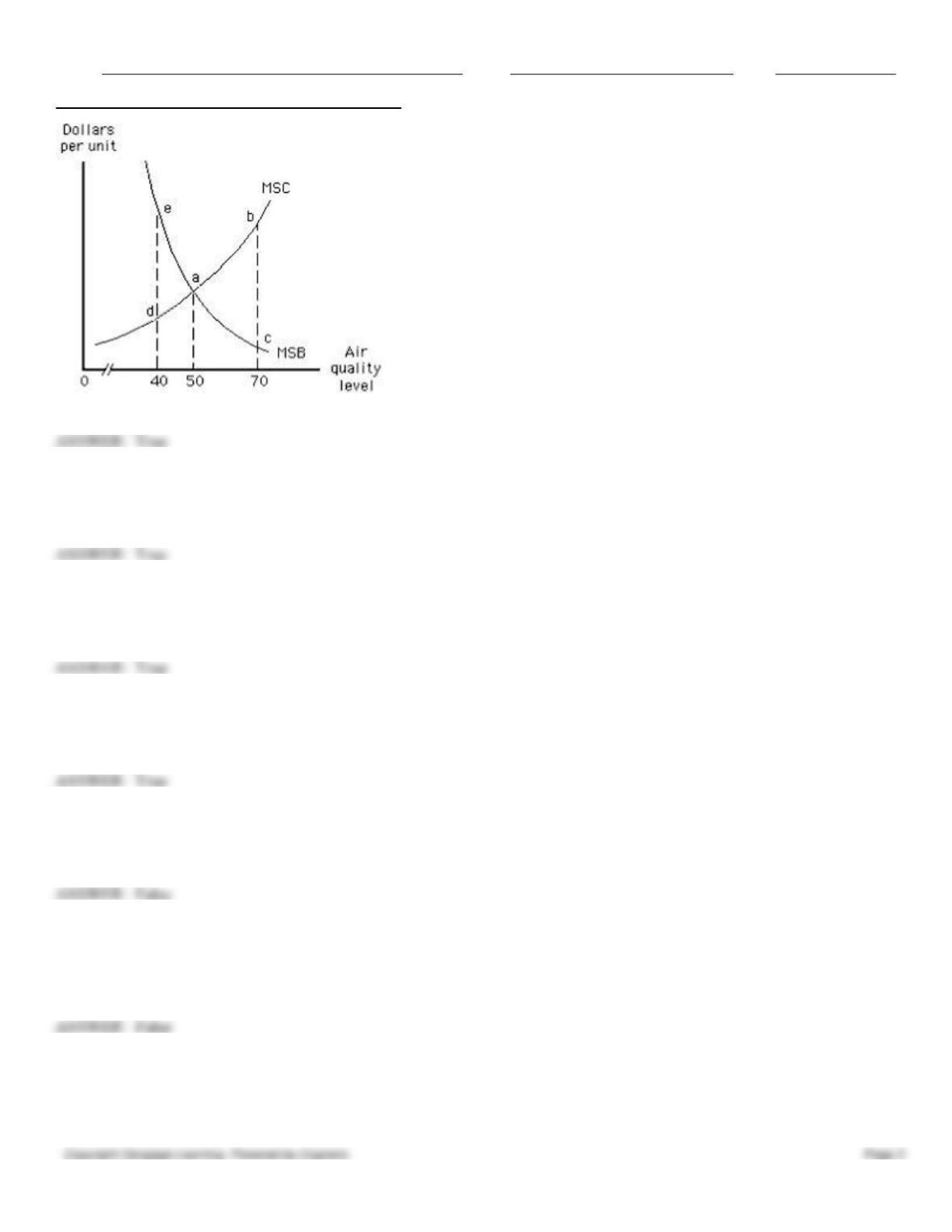
8. The following graph shows market equilibrium in the presence of an externality. The optimal air quality level is 50.
Figure 17.3
Name:
Class:
Date:
Chapter 17: Externalities and the Environment
a. True
b. False
9. The equilibrium price and quantity in a free market usually reflect private marginal costs and benefits, not social ones.
a. True
b. False
10. An increase in the marginal cost of reducing greenhouse gas emissions will lead to lower air quality.
a. True
b. False
11. Environmental problems result when social costs and benefits are different from private costs and benefits.
a. True
b. False
12. The marginal social benefit curve is downward sloping under variable technology.
a. True
b. False
13. To achieve the socially optimal level of pollution, the biggest polluters should be targeted for the greatest reduction in
pollution.
a. True
b. False
14. The optimal air quality is determined where the marginal social cost of improving air quality is equal to the marginal
social benefit from cleaner air.
a. True

Name:
Class:
Date:
Chapter 17: Externalities and the Environment
b. False
15. Coase argued that the free market should be able to solve an externality problem without assigning property rights.
a. True
b. False
16. The Coase solution to the externality problem works only when bargaining costs are high.
a. True
b. False
17. Marginal social cost includes both the marginal private cost and the marginal external cost that production imposes on
society.
a. True
b. False
18. When a system of pollution rights is in effect, polluters have no economic incentive to reduce the amount of pollution
they generate.
a. True
b. False
19. Government allocation of pollution rights cannot be efficient if polluters cannot be easily identified and monitored.
a. True
b. False
20. Most water pollution in the United States comes from manufacturing sites.
a. True
b. False
21. Most of the Superfund expenditures have been used for court costs and legal fees.
a. True
b. False
22. The United States recycles a greater portion of its garbage than Japan does.
a. True
b. False

Name:
Class:
Date:
Chapter 17: Externalities and the Environment
23. A society is better off if the level of education exceeds the private equilibrium.
a. True
b. False
24. In the absence of government intervention, the marginal social cost of pollution abatement would equal its marginal
social benefit.
a. True
b. False
25. Markets tend to underproduce goods that generate positive externalities.
a. True
b. False
26. Governments often subsidize activities that generate positive externalities in order to get people to engage in more of
them.
a. True
b. False
Multiple Choice
27. When the consumption of a good or service imposes costs to society that are not reflected in the market price of the
good, _____.
a. a negative externality arises
b. it implies that a renewable resource has been used in the production of the good
c. a positive externality arises
d. it implies that the good is a public good
e. it implies that a nonrenewable resource has been used in the production of the good
28. Which of the following is an example of a positive externality?
a. Water pollution.
b. John’s roommate going on a diet
c. Second-hand smoke
d. A loud conversation in the workplace
e. The emission of harmful gases by a factory
29. Private property rights are defined and enforced:
a. only in a capitalist economy.
b. only in a command economy.
c. by the largest firm in an economy.
d. by the market forces of demand and supply.
e. by government, by informal social actions, and by ethical norms.

Name:
Class:
Date:
Chapter 17: Externalities and the Environment
30. An externality is:
a. a cost of a transaction that is borne by the government.
b. a benefit of a transaction that is enjoyed by the firms.
c. a cost or benefit that arises when market price changes.
d. any cost or benefit of a transaction that is not accounted for in the market price.
e. the revenue generated by a firm.
31. _____ resources can be used indefinitely over time.
a. Open-access
b. Renewable
c. Cyclical
d. Recyclable
e. Exhaustible
32. Which of the following is a renewable resource?
a. Oil
b. Air
c. Coal
d. Iron ore
e. Uranium
33. Which of the following is true of renewable resources?
a. Additional units of these resources can be purchased in the market.
b. Additional units of these resources are provided by the government.
c. Worn-out units cannot be repaired for further use.
d. They can be drawn on indefinitely if used conservatively.
e. They are available in finite amounts.
34. Fishes in the ocean are:
a. exhaustible and also open-access resources.
b. renewable and also open-access resources.
c. private goods.
d. merit goods
e. renewable resources whenever property rights are well defined.
35. Which of the following is a source of a positive externality?
a. A factory that pollutes a river
b. A person who litters the street
c. A car that emits carbon monoxide
d. A company that engages in research and development

Name:
Class:
Date:
Chapter 17: Externalities and the Environment
e. A product that contributes to the greenhouse effect
36. A negative externality is likely to arise if:
a. the government sets up more schools.
b. a company introduces a research and development unit.
c. factories install devices to reduce the amount of chemicals released.
d. the government introduces a measles vaccine.
e. car owners refuse to pay for devices that reduce the emission of carbon monoxide.
37. A person can cause a negative externality by_______.
a. being immunized
b. having a loud conversation in the office
c. landscaping her lawn
d. paying taxes
e. attending school
38. An individual who listens to loud music late in the night is creating:
a. a positive externality.
b. a common-pool problem.
c. a negative externality.
d. a free-rider problem.
e. asymmetric information.
39. Negative externalities of open resources arise because:
a. there are no enforceable property rights to open-access resources.
b. these are private goods and government enforces property rights.
c. consumers have to pay for each unit of production.
d. the government undertakes the distribution of these resources.
e. these are available in finite amounts.
40. Pollution arises because:
a. the atmosphere is a nonrenewable resource.
b. the atmosphere is a renewable resource.
c. private property rights can be enforced on the atmosphere.
d. the atmosphere is an open-access resource.
e. the atmosphere is a private property.
41. Byproducts of production or consumption that impose costs on other consumers or firms are known as _______.
a. negative externalities
b. transaction costs
c. sunk costs

Name:
Class:
Date:
Chapter 17: Externalities and the Environment
d. positive externalities
e. moral hazards
42. Fish in the sea can be harvested till:
a. the marginal benefit of catching more fish is less than the marginal cost.
b. the marginal benefit of catching more fish is greater than the marginal cost.
c. the marginal benefit of catching more fish becomes negative.
d. the marginal benefit of catching more fish becomes infinity.
e. the marginal benefit of catching more fish becomes zero.
43. The common-pool problem arises:
a. when goods are not rival in consumption.
b. in the presence of asymmetric information.
c. when property rights are well defined.
d. when exhaustible resources are overused.
e. when renewable resources are overused.
44. Open-access resources tend to be ______.
a. conserved
b. taxed
c. overused
d. efficiently used
e. underutilized
45. Open-access resources are owned by:
a. every individual in society.
b. large firms.
c. no one.
d. the government.
e. nonprofit agencies.
46. Which of the following is an example of an open-access resource?
a. A city subway system
b. College education
c. The healthcare system in a city
d. Whales in the ocean
e. Pandas in a zoo
47. To solve the common-pool problem in fishing, governments can _____ or _____.
a. provide a subsidy; restrict production to the socially optimal level
b. impose a tax; restrict output

Name:
Class:
Date:
Chapter 17: Externalities and the Environment
c. impose property rights ; prohibit resource use entirely
d. impose a depletion tax; make property rights flexible
e. provide a subsidy; shutdown all firms in this industry
48. Suppose a city builds a new park that is advertised as being “open to the public” and the grass in the park is ruined by
overuse within two months. This would be an example of _____.
a. adverse selection
b. moral hazard
c. the common-pool problem
d. a positive externality
e. arbitrage
49. The depletion of rainforests due to human activities like logging or cattle ranching is an example of:
a. a negative externality.
b. a positive externality.
c. adverse selection.
d. moral hazard.
e. arbitrage.
50. Which of the following is true of open-access wildlife resources?
a. They are likely to be used efficiently.
b. They are not likely to be used at all.
c. It is unprofitable to use them.
d. They are likely to be used but unlikely to generate profit.
e. They are likely to be used until they become extinct.
51. The deforestation of rainforests due to human activities has increased because:
a. long-run economic considerations outweigh short-run considerations.
b. global economic considerations outweigh domestic considerations
c. private property rights can be enforced on rainforests.
d. the value of the jobs created by deforestation exceeds the cost to society.
e. there are no property rights on rainforests.
52. Which of the following is not an example of an open-access resource?
a. Deer in a forest
b. Fish in the ocean
c. Oil deposits
d. Wild flowers
e. Trees in a forest
Name:
Class:
Date:
Chapter 17: Externalities and the Environment
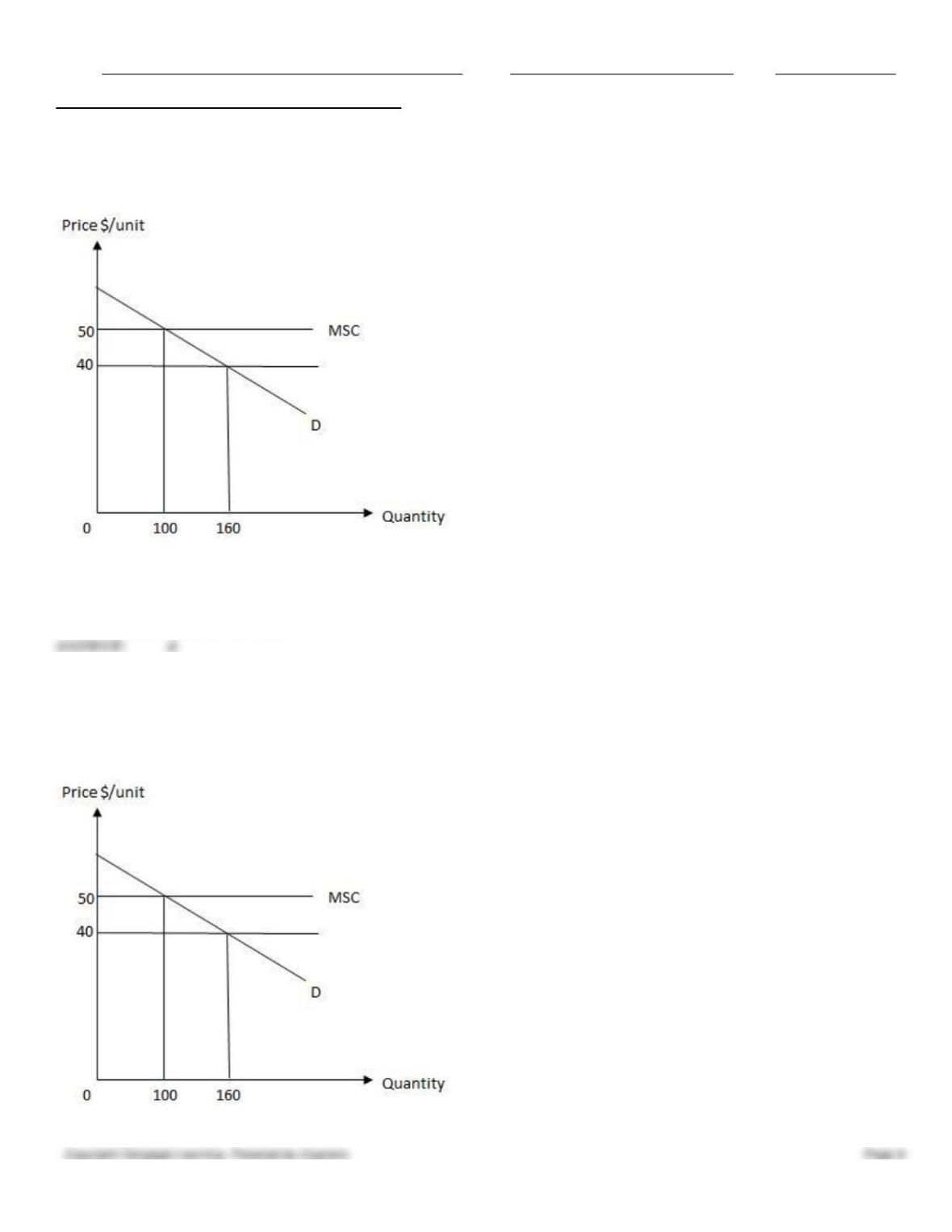
53. The following graph shows market equilibrium in the presence of an externality in an economy. The equilibrium level
of output for the firm is _____.
Figure 17.1
a. 0 units
b. 100 units
c. between 0 and 100 units
d. 160 units
e. between 100 and 160 units
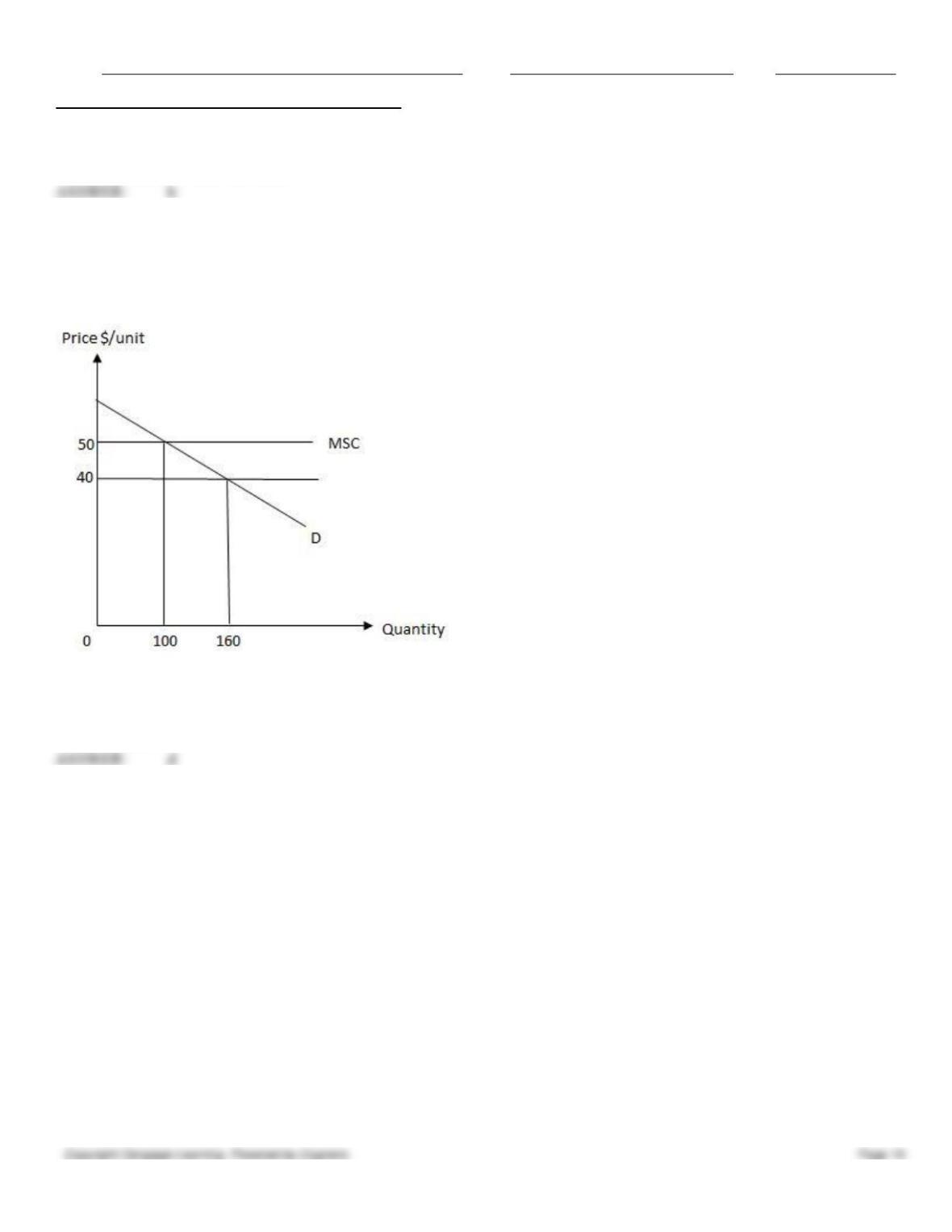
54. The following graph shows market equilibrium in the presence of an externality in an economy. The socially efficient
level of output is _____.
Figure 17.1
a. 0 units
b. 100 units
Name:
Class:
Date:
Chapter 17: Externalities and the Environment
c. between 0 and 100 units
d. 160 units
e. between 100 and 160 units
55. The following graph shows equilibrium in a market in the presence of an externality. The amount by which the total
social cost of producing the private equilibrium level of output exceeds the total social benefit is _____.
Figure 17.1
a. $3,000
b. $1,000
c. $5,000
d. $1,600
e. $1,400
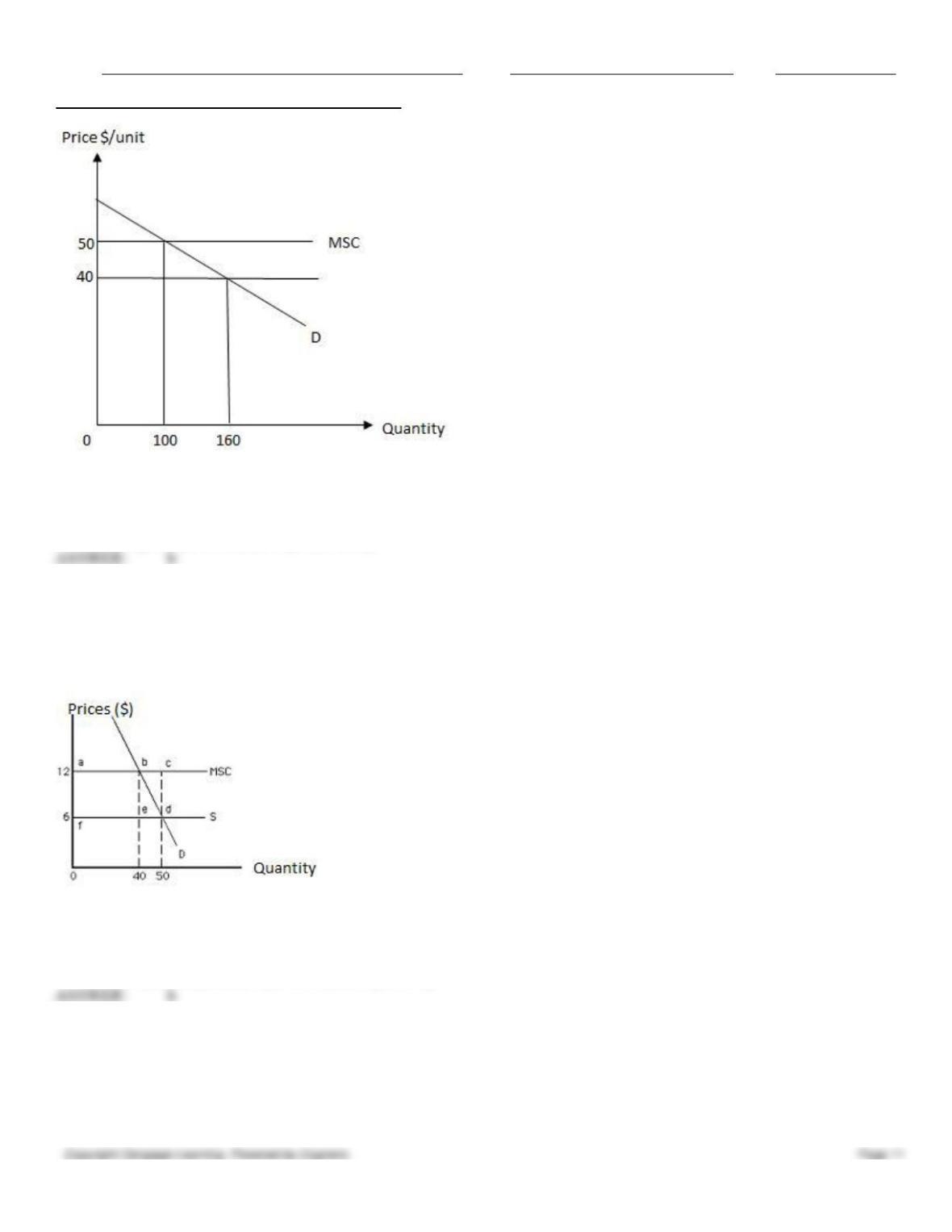
56. The following graph shows equilibrium in a market in the presence of an externality. If technology is fixed, the
discrepancy between the market output and the efficient level of output is eliminated by______.
Figure 17.2
Name:
Class:
Date:
Chapter 17: Externalities and the Environment
a. subsidizing production of the good by $10 per unit
b. taxing the firm producing the good $10 per unit
c. using a quota system to restrict production to 160 units.
d. subsidizing production of the good by $5 per unit
e. letting the private market operate freely
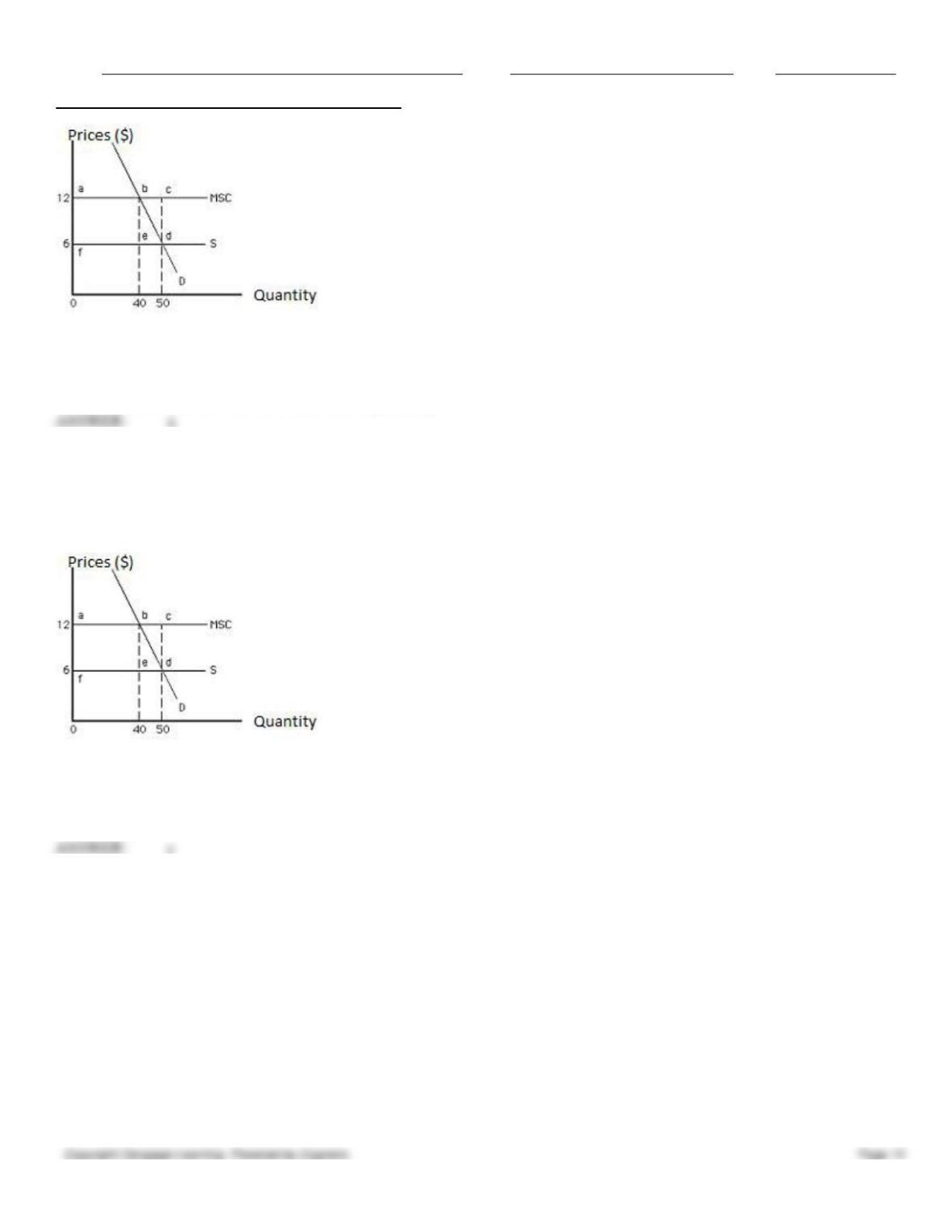
57. The following graph shows market equilibrium in the presence of an externality. The socially efficient price and level
of output are:
Figure 17.2
a. $6 and 50 units, respectively
b. $12 and 50 units, respectively
c. $12 and 40 units, respectively
d. $6 and 40 units, respectively
e. less than $6 and more than 50 units, respectively
58. The following graph shows market equilibrium in the presence of externality in an economy. The equilibrium price
and output (determined exclusively by private decisions) are _____.
Figure 17.2
Name:
Class:
Date:
Chapter 17: Externalities and the Environment
a. $6 and 50 units, respectively
b. $12 and 50 units, respectively
c. $12 and 40 units, respectively
d. $6 and 40 units, respectively
e. less than $6 and more than 50 units, respectively
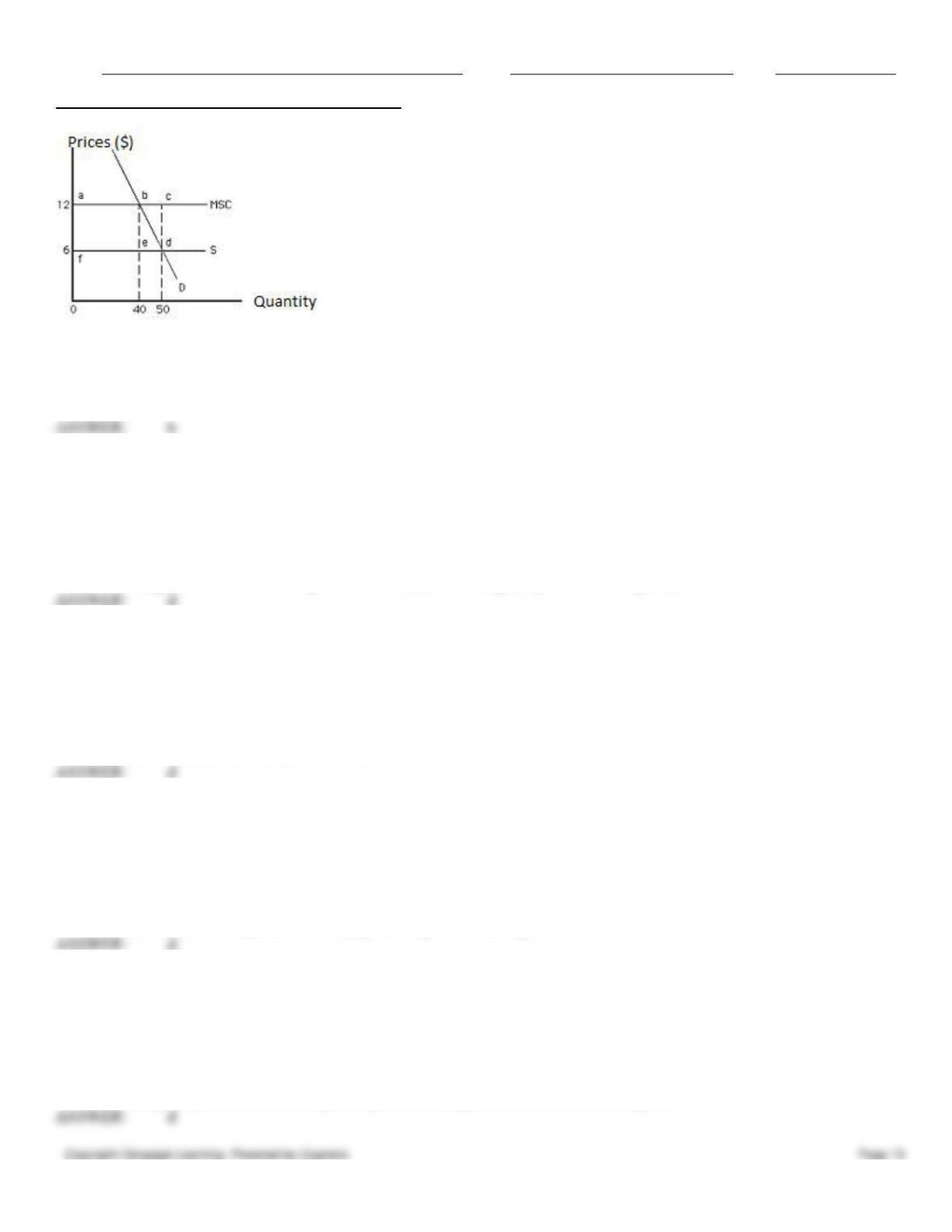
59. The following graph shows equilibrium in a market in the presence of externality in an economy. The total social gain
from producing the socially efficient output rather than the private equilibrium output is shown by the area ______.
Figure 17.2
a. abdf
b. bed
c. bcd
d. acdf
e. bcde
60. The following graph shows market equilibrium in the presence of an externality. The total social gain from producing
the socially efficient output is:
Figure 17.2
Name:
Class:
Date:
Chapter 17: Externalities and the Environment
a. $60.
b. $30.
c. $6.
d. $480.
e. $300.
61. At the market output and price for a good whose production causes pollution, _____.
a. the marginal social cost of production is negative
b. the marginal social cost of production exceeds the marginal social benefit of production
c. the marginal private cost of production equals the marginal private benefit of production
d. the marginal social benefit of production equals the marginal social cost of production
e. the marginal social benefit of production exceeds the marginal private cost of production
62. Economists view pollution as an economic problem that arises because:
a. private enterprises always minimize the amount of pollution produced.
b. profitable firms rarely pollute.
c. the level of pollution declines as the economy grows.
d. firms that pollute do not pay the full social cost of producing their output.
e. pollution costs are borne by the consumer.
63. If the marginal social cost of producing a good exceeds the marginal private cost, then:
a. the quantity of the good being produced is too less.
b. the price charged for the good is too high.
c. the good produces a positive externality.
d. the good produces a negative externality.
e. social welfare is likely to increase by producing more of the good.
64. The socially optimal level of output of a good that generates an externality occurs when:
a. the marginal private cost of production equal marginal private revenue.
b. the firm maximizes its profits.
c. the marginal private cost of production exceeds the marginal social cost of production.
d. the marginal social cost of production equals the marginal social benefit of production.
e. the marginal private cost of the good equals the marginal social benefit of the good.

Name:
Class:
Date:
Chapter 17: Externalities and the Environment
65. The marginal external cost is:
a. the additional cost imposed on society by producing an extra unit of a good.
b. the cost of producing an extra unit of damaged goods.
c. the additional cost of importing extra units of a good.
d. the total cost to society of producing a good.
e. the marginal cost divided by the marginal revenue.
66. Marginal social cost is equal to:
a. the total private cost of production.
b. marginal private cost.
c. marginal external cost.
d. marginal private cost plus marginal external cost.
e. marginal private cost divided by marginal external cost.
67. Society’s total cost of producing a good:
a. includes only the private cost to a firm.
b. includes only the external cost.
c. includes all private and external costs.
d. includes the sunk cost and the total variable cost of a firm.
e. includes only the average variable cost of production.
68. In order to increase a society’s total welfare, a production process that produces a negative externality should be
_____.
a. taxed
b. encouraged to produce goods in excess of the socially optimum level
c. prohibited
d. subsidized if the good is produced for foreign markets
e. subsidized if the good is produced for the domestic market
69. In a free market, a firm’s equilibrium output is determined:
a. where marginal social cost equals marginal social benefit.
b. where marginal private benefit equals marginal social benefit.
c. where marginal social cost equals marginal private cost.
d. where marginal private cost equals marginal private benefit.
e. by government.
70. The socially efficient level of output is determined where:
a. marginal social cost equals marginal social benefit.
b. marginal private cost equals marginal social benefit.
c. average social cost equals average private cost.
d. average private cost equals average social benefit.
e. total social cost equals total social benefit.

Name:
Class:
Date:
Chapter 17: Externalities and the Environment
71. Suppose the production of electricity generates pollution. In this case, the optimal level of electricity is produced when
the marginal social benefit from electricity production equals the _____.
a. marginal private cost of electricity production
b. marginal social cost of electricity production
c. marginal external cost of electricity production
d. marginal cost of labor used in electricity production
e. marginal cost of capital used in electricity production
72. To maximize social welfare in the presence of a negative externality, marginal __________ must equal marginal
__________.
a. social cost; private cost
b. private cost; external cost
c. social cost; social benefit
d. private cost; social benefit
e. social cost; external cost
73. If the marginal social benefit of consuming a product exceeds the marginal social cost, social welfare:
a. increases when output decreases.
b. decreases when output increases.
c. remains unchanged when output increases.
d. increases when output increases.
e. is at its maximum.
74. Imposition of tax on an open-access resource increases the marginal private cost of using the resource by _____.
a. zero
b. the amount of the tax
c. the marginal cost of the resource
d. the average private cost of using the resource
e. the average social cost of using the resource
75. The marginal social benefit of good air:
a. declines as air quality improves.
b. rises as air quality improves.
c. remains constant as air quality improves.
d. initially falls but rises with higher improvement.
e. initially rises but becomes negative wither greater improvement.
76. The optimal level of air pollution by a firm is:
a. the level at which the marginal private cost of improving air quality equals zero.
b. the level at which the marginal social cost of improving air quality equals the marginal social benefit.

Name:
Class:
Date:
Chapter 17: Externalities and the Environment
c. the level at which the average social cost of improving air quality equals the average social benefit.
d. the level at which the total social cost of improving air quality equals the total social benefit.
e. the level at which the marginal social cost of improving air quality is minimized.
77. When using the traditional command-and-control approach to environmental regulation, the government attempts to:
a. set a minimum requirement and then allows the firm to determine the most efficient method for achieving this
requirement.
b. determine the most efficient method for different industries.
c. make allowances for differences across industries and between firms.
d. set engineering standards that are applicable to all situations and do not recognize unique circumstances.
e. set a maximum requirement and then allows the individual firm the latitude of choosing the most efficient
method.
78. A tannery discovers a technology that makes it cheaper to reduce the air pollution it generates. On a graph of the
optimal level of air quality, the use of the new technology would be represented by:
a. a leftward shift of the marginal social cost curve.
b. a rightward shift of the marginal social cost curve.
c. movement to the right along the marginal social cost curve.
d. movement to the left along the marginal social cost curve.
e. a downward shift of the marginal social benefit curve.
79. When using the economic efficiency approach to control air and water pollution, the government:
a. forces each firm to produce emissions in the most cost-efficient manner irrespective of its cost structure.
b. offers each firm the flexibility to reduce emissions in the most cost-effective manner, given its unique cost
structure.
c. offers each firm the option of choosing between the cost-minimizing emission level and the profit-maximizing
emission level.
d. provides each firm with fixed rules for reducing pollution.
e. offers each firm the option of using either total cost pricing or average cost pricing when determining the
optimum emission level.
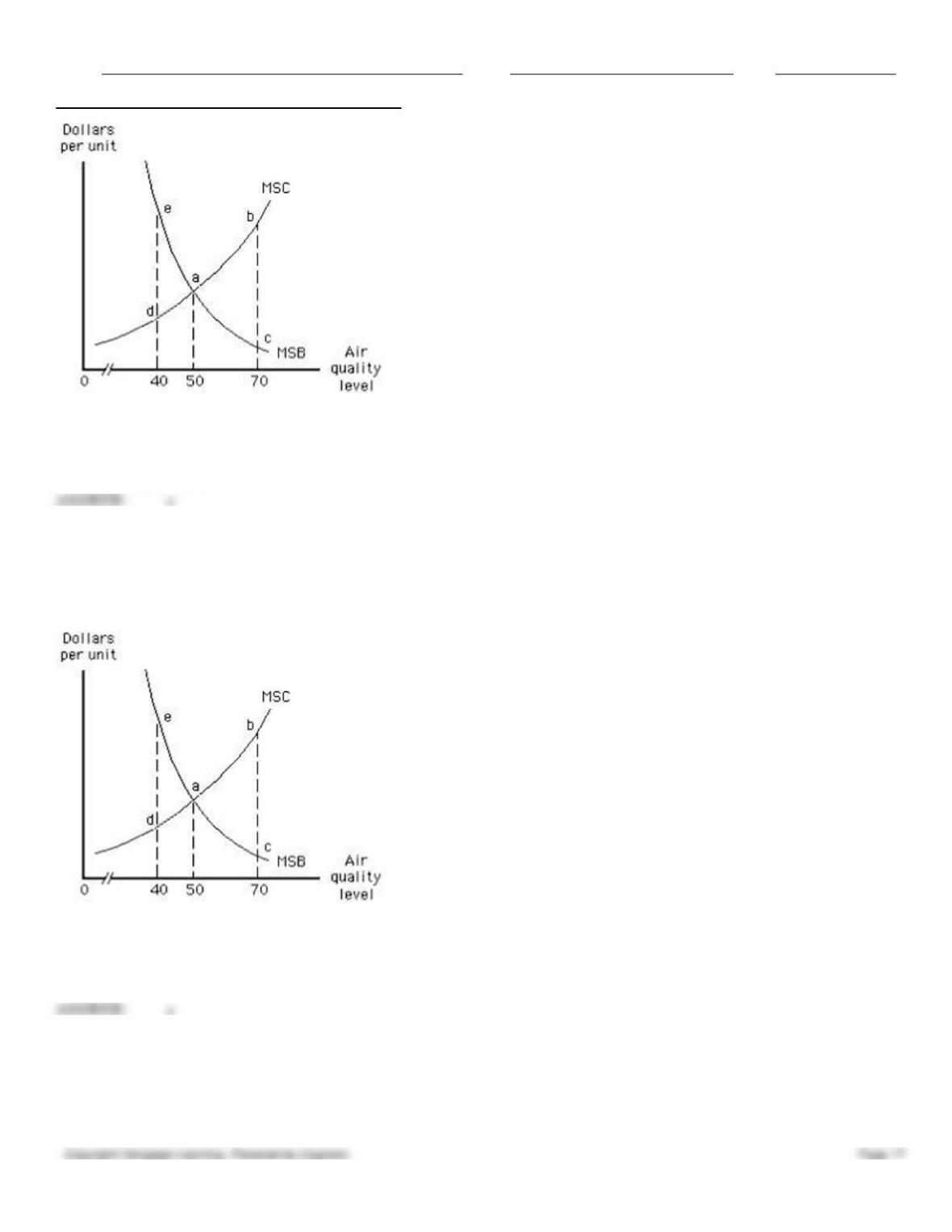
80. The following graph shows the market for pollution rights in an economy. The optimal level of air quality is ______.
Figure 17.3
Name:
Class:
Date:
Chapter 17: Externalities and the Environment
a. 0
b. 40
c. 50
d. 70
e. greater than 70
81. The following graph shows the market for pollution rights in an economy. The social welfare loss that results from 70
units of air quality is shown by area _____.
Figure 17.3
a. edcb
b. eda
c. bac
d. adc
e. eab
82. The optimal level of air quality will increase if:
a. the cost of polluting increases.
b. price of pollution reducing equipment increases.
c. a new process allows pollution to be removed more cheaply.