
Name:
Class:
Date:
chapter 17
Indicate whether the statement is true or false.
1. A data mart is typically smaller than a data warehouse.
a.
True
b.
False
2. Clustering is considered a supervised data mining technique.
a.
True
b.
False
3. Megan is examining the likelihood of people riding the subway. The dependent variable takes on the value of 1 if the
individual rides the subway and 0 otherwise. Therefore, she could use logistic regression to examine this question.
a.
True
b.
False
4. Segmentation is also known as clustering, and involves trying to group entities into similar clusters.
a.
True
b.
False
5. Data mining is used to examine known, expected patterns and relationships among variables.
a.
True
b.
False
Indicate the answer choice that best completes the statement or answers the question.
6. Suppose the odds of Team A winning are 5 to 1. Then, the odds ratio is:
a.
5/1
b.
1/5
c.
6/1
d.
1/6
7. A facts table has:
a.
few rows and many columns
b.
many rows and many columns
c.
many rows and few columns
d.
few rows and few columns
8. If the regression coefficient estimate from a logistic regression is positive, the probability of the dependent variable
taking on a value of 1:
a.
decreases
b.
approaches zero
c.
increases
d.
remains constant
9. In a facts table, a supermarket database is likely to have which item listed in rows?
a.
The number of units sold
Name:
Class:
Date:
chapter 17
b.
Revenue generated from a particular unit
c.
The department in which the unit was purchased
d.
The individual items purchased
10. Mya is investigating the factors that impact soda consumption. She examines a host of variables that help explain the
amount consumed. Which type of data mining methodology is she most likely to use?
a.
Market basket analysis
b.
Prediction
c.
Classification analysis
d.
Forecasting
11. The predicted value from a logistic regression will be:
a.
between 0 and 1
b.
between -1 and 1
c.
less than 0
d.
greater than 1
12. Bridget has partitioned data into two subsets. The original file contains 300,000 observations. The subset she is
currently working with has 60,000 observations. Which subset is she most likely to be using?
a.
The training set
b.
The original set
c.
The testing set
d.
The prediction set
13. Which methodology is used to group products that customers purchase together?
a.
Market basket analysis
b.
Prediction
c.
Classification analysis
d.
Forecasting
14. The testing set in data partitioning is:
a.
The first subset of data, which usually contains 70% of the records
b.
The second subset of data, which usually contains less than 70% of the records
c.
The initial dataset from which subsets are created
d.
The first subset of data, which usually contains 30% of the records
15. The higher the “score” for a particular member in logistic regression, the:
a.
higher the likelihood that member is in category 1
b.
lower the likelihood that member is in category 1
c.
higher the likelihood that member is in category 0
d.
higher the likelihood that member is not in a category
Amount
Spent
Female
Credit
Card
Name:
Class:
Date:
chapter 17
99
0
0
50
0
0
75
0
1
600
1
0
325
1
0
97
0
1
540
1
0
137
1
0
22
1
1
94
1
1
111
1
1
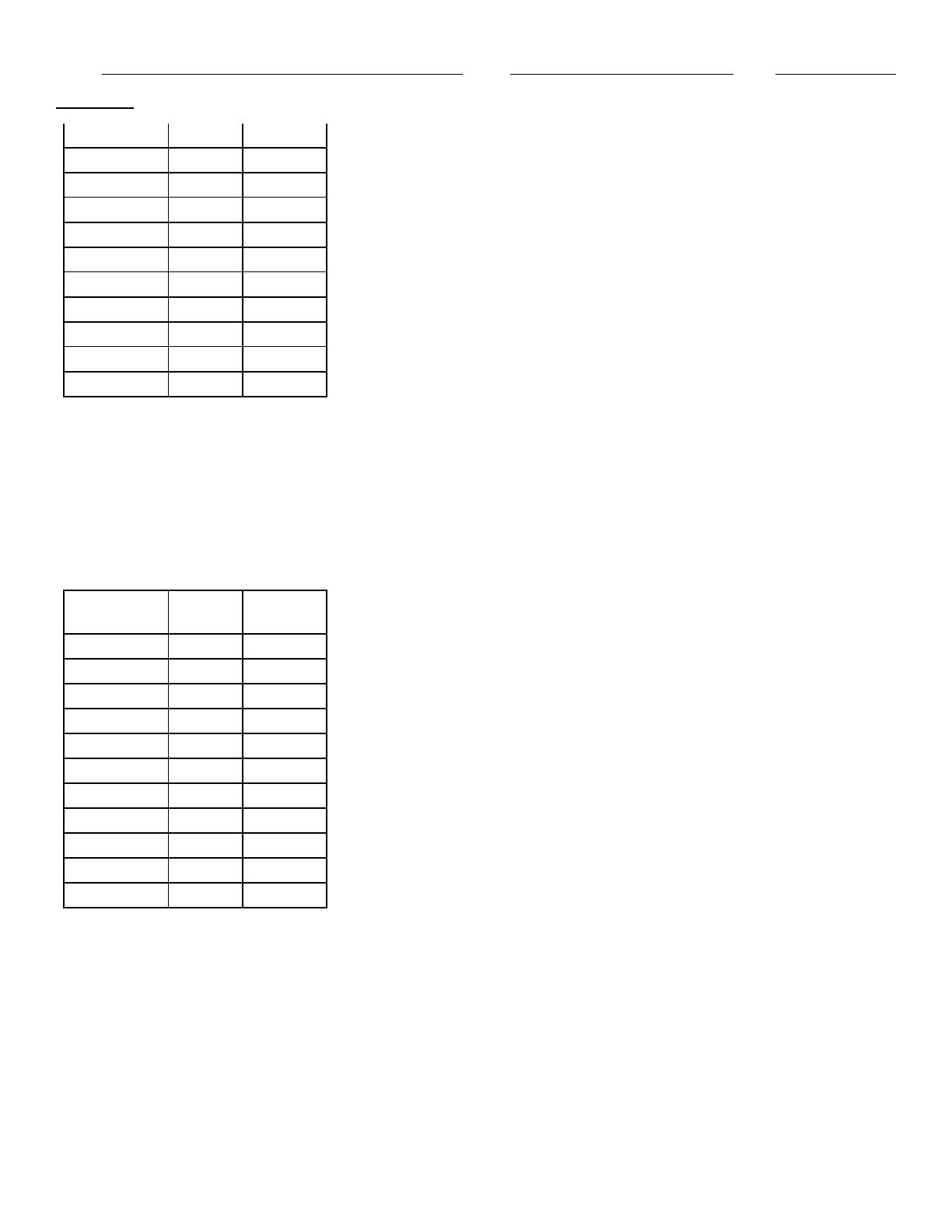
16. Melody is a department store manager and wants to examine whether or not female shoppers are more likely than
male shoppers to use a department credit card. “Female = 1” indicates the individual is a female. “Credit Card = 1”
indicates the individual used a credit card to make the purchase. “Amount spent” is in dollars. Which variables would be
the dependent and independent variables in Melody’s model?
17. The magnitude of the betas in a logistic regression cannot necessarily be used to determine which variables are the
“most important.” Explain.
Amount
Spent
Female
Credit
Card
99
0
0
50
0
0
75
0
1
600
1
0
325
1
0
97
0
1
540
1
0
137
1
0
22
1
1
94
1
1
111
1
1
18. If the estimate on the female variable is positive, what does this indicate about credit card usage?
19. Create a pivot table that illustrates something meaningful about the variables in the accompanying table.
20. What does the pivot table indicate about spending habits?
Name:
Class:
Date:
chapter 17
Answer Key

Name:
Class:
Date:
chapter 17