Chapter 17 – Energy Balance and Temperature Regulation
obesity
50. Nonexercise activity thermogenesis (NEAT), or the “fidget factor,” might explain some variation in fat storage among
people.
a.
True
b.
False
True
51. One of the problems in fighting obesity is that once fat cells are created they do not disappear with dieting and weight
loss.
a.
True
b.
False
True
52. Among American females 15 to 24 years old, the death rate associated with anorexia nervosa is 12 times higher than
the death rate from all other causes.
a.
True
b.
False
True
53. Recent studies indicate that normal body temperature varies among individuals and varies throughout the day, ranging
from 92.0°F in the morning to 99.9°F in the evening, with an overall average of 100°F.
a.
True
b.
False
False
54. Skin temperature may fluctuate between 68°F and 104°F (20°C and 40°C) without damage.
a.
True
b.
False
55. The elderly naturally have lower core temperatures, with a midday average of 97.7°F.
a.
True
b.
False
True
56. Heat output occurs by way of heat loss from exposed organs to the internal environment.
a.
True
b.
False
False
57. Conduction is the emission of heat energy from the surface of a warm body in the form of electromagnetic waves, or
heat waves, which travel through space.
a.
True
b.
False
False
58. The term convection refers to the transfer of heat energy by air (or water) currents.
a.
True
b.
False
True
59. Sweating is an active evaporative heat-loss process under parasympathetic nervous control.
a.
True
b.
False
False
60. The core temperature is monitored by central thermoreceptors, which are located in the hypothalamus itself, and in the
abdominal organs and elsewhere.
a.
True
Chapter 17 – Energy Balance and Temperature Regulation
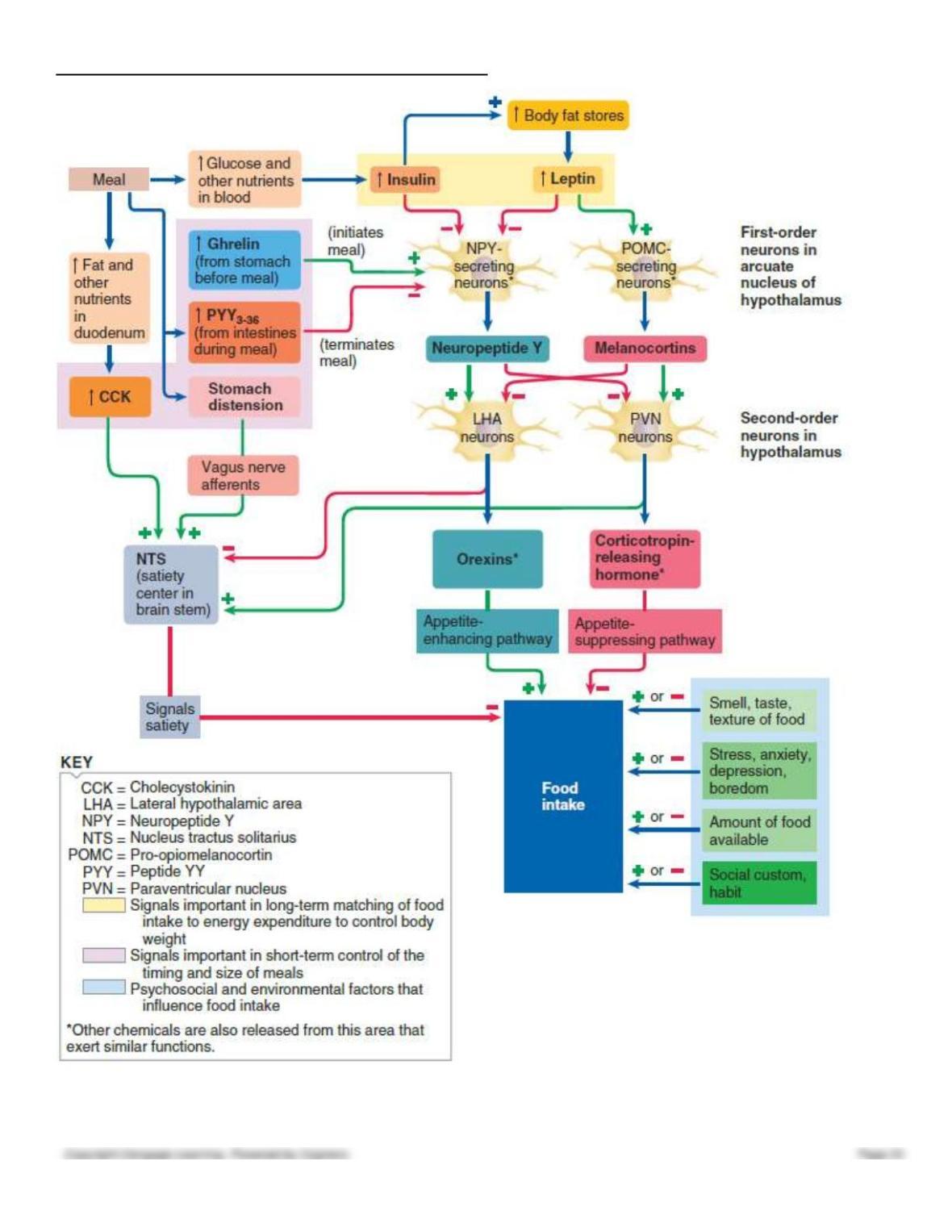
b.
False
True
61. Shivering consists of rhythmic, oscillating skeletal muscle contractions that occur at a rapid rate of 10 to 20 per
second.
a.
True
b.
False
True
62. During fever production, endogenous pyrogen raises the set point of the thalamic thermostat by triggering the local
release of histamines.
a.
True
b.
False
False
63. Fever production in response to an infection is a deliberate outcome and is not caused by a breakdown of
thermoregulation.
a.
True
b.
False
True
64. Normal metabolism produces enough heat to kill a person in less than 5 hours if the heat-loss mechanisms are
completely shut down.
a.
True
b.
False
True
65. Heat stroke is an extremely dangerous situation that arises from the complete destruction of the thalamus.
a.
True
b.
False
Chapter 17 – Energy Balance and Temperature Regulation
66. Cells capture a portion of the nutrient energy in the high-energy phosphate bonds of __________.
67. The __________ is a reflection of the body’s “idling speed,” or the minimal waking rate of internal energy
expenditure.
68. People should not have eaten any food within 12 hours before the BMR determination to avoid diet-induced
__________.
69. A more convenient method of indirectly determining the rate of heat production requires only measuring the person’s
__________ uptake per unit of time.
70. As thyroid hormone increases, the BMR __________.
71. Control of food intake to match changing metabolic expenditures is the major means of maintaining a(n) __________
energy balance.
72. The __________ of the hypothalamus plays a central role in both long-term control of energy balance and body
weight and short-term control of food intake from meal to meal.
73. __________, one of the most potent appetite stimulators ever found, leads to increased food intake, thus promoting
weight gain.
74. __________, most notably α-melanocytestimulating hormone (α-MSH) from the hypothalamus, suppress appetite,
thus leading to reduced food intake and __________.
75. Adipose tissue secretes several hormones, collectively termed __________, that play important roles in energy
balance and metabolism.
76. Some adipokines, like __________, are released only from visceral fat, the deep, “bad” fat that surrounds the
abdominal organs.
77. There are two versions of the FTO gene: the “normal” __________ variant and the “faulty” __________ variant.
78. Characteristics of anorexia nervosa include altered secretion of many hormones, absence of __________, and
__________ body temperature.
79. In contrast to the constant high temperature in the __________, the temperature within the __________ is generally
cooler and may vary substantially.
80. The __________ and axillary temperatures are comparable, whereas __________ temperature averages about 1°F
higher.
81. Heat __________ occurs by way of heat gain from the external environment and internal heat production.
82. Heat always moves down a thermal gradient from a(n) __________ to a(n) __________ region.
83. The rate of heat transfer by conduction depends on the temperature difference between the touching objects and the
thermal __________ of the substances involved.
84. Heat is continuously lost in expired air as a result of the air being __________ during its passage through the
respiratory system.
85. Eccrine sweat glands also produce __________, a newly discovered antimicrobial peptide — a natural antibiotic in
sweat that helps defend against potential skin infections.
86. The __________ region of the hypothalamus, activated by cold, triggers reflexes that mediate heat production and
heat conservation.
87. Non-shivering thermogenesis is mediated on cold exposure by the __________ nervous system, which increases heat
production by stimulating __________ fat.
88. The mitochondria of __________ fat contain a unique uncoupling protein called __________.
89. Wearing light-colored, loose clothing is __________ than being nude.
90. The most striking feature of heat stroke is a lack of compensatory heat-loss measures, such as __________.
Chapter 17 – Energy Balance and Temperature Regulation
Use this figure (17-2) to answer the corresponding questions.
91. Which number(s) in the figure represent a method of heat transfer in which the rate of transfer depends on the
Chapter 17 – Energy Balance and Temperature Regulation
temperature difference between two objects and their thermal conductivity?
a.
1
b.
2
c.
3
d.
4
e.
1 and 2
b
17.1 Energy Balance
HUPH.SHER.16.17.1.4 – Describe how food intake is controlled by the hypothalamus
92. Which number(s) in the figure represent evaporative heat loss?
a.
1
b.
2
c.
3
d.
4
e.
2 and 3
d
17.1 Energy Balance
HUPH.SHER.16.17.1.4 – Describe how food intake is controlled by the hypothalamus
93. Which number(s) in the figure represent the mechanism by which sweating promotes heat loss?
a.
1
b.
2
c.
3
d.
4
e.
1 and 4
d
17.1 Energy Balance
HUPH.SHER.16.17.1.4 – Describe how food intake is controlled by the hypothalamus
94. Which number(s) in the figure represent the transfer of heat energy by air or water currents?
a.
1
b.
2
c.
3
d.
4
e.
2 and 3
17.1 Energy Balance
HUPH.SHER.16.17.1.4 – Describe how food intake is controlled by the hypothalamus
95. Which number(s) in the figure represent the emission of heat energy in the form of electromagnetic waves?
a.
1
b.
2
c.
3
d.
4
e.
1 and 3
17.1 Energy Balance
HUPH.SHER.16.17.1.4 – Describe how food intake is controlled by the hypothalamus
96. Describe the importance of the satiety center.
17.1 Energy Balance
HUPH.SHER.16.17.1.4 – Describe how food intake is controlled by the hypothalamus
97. Discuss the two categories of obesity.
17.1 Energy Balance
98. Describe a thermoneutral zone.
thermoneutral zone.
17.2 Temperature Regulation
99. Discuss the causes, symptoms, and effects of hypothermia.
Hypothermia, a fall in body temperature, occurs when generalized cooling of the body
100. Describe the causes, symptoms, and effects of heat exhaustion.