
CHAPTER 17: ACTIVITY RESOURCE USAGE MODEL AND TACTICAL
DECISION MAKING
1. Tactical decision making consists of choosing among alternatives with an immediate or limited end in view.
a. True
b. False
2. Sound tactical decision making is limited to achieve small objectives.
a. True
b. False
3. The first of the six steps of the tactical decision model is to recognize and define the problem.
a. True
b. False
4. The last of the six steps of the tactical decision model is to choose the quickest way to solve the problem.
a. True
b. False
5. Tactical cost analysis uses cost data to identify the choice that will bring the organization the most benefit.
a. True
b. False
6. Relevant costs and revenues are present costs and revenues that differ across alternatives.
a. True
b. False
7. A sunk cost is irrelevant because it has no influence over future decisions, so it is depreciated.
a. True
b. False
8. An irrelevant cost is one that is the same for more than one alternative and has no bearing on future decisions.
a. True
b. False
Chapter 17: Activity Resource Usage Model and Tactical Decision Making
9. A tariff is a tax on exports levied by the federal government.
a. True
b. False
10. Foreign trade zones are set up by the U.S. government to facilitate warehousing and/or manufacturing
for companies.
a. True
b. False
11. The activity resource usage model focuses on sorting out the behavior of various activity costs and assess
their relevancy.
a. True
b. False
12. For flexible resources, if the demand for an activity changes across alternatives, then resource spending will
remain the same and costs are relevant.
a. True
b. False
13. Committed resources are acquired in advance of usage, through implicit contracting.
a. True
b. False
14. Changes in cost of an activity can occur if the demand for the resource exceeds the supply or if the demand for
the resource drops.
a. True
b. False
15. Flexible resources are acquired way ahead of time.
a. True
b. False
Chapter 17: Activity Resource Usage Model and Tactical Decision Making
16. Tactical decision making includes decisions to make or buy a component.
a. True
b. False
17. Outsourcing refers to the move of a business function to another company, either in or out of the U.S.
a. True
b. False
18. Choosing to make or buy may reduce the cost of producing the main product and increase the quality.
a. True
b. False
19. A keep-or-drop decision uses irrelevant cost analysis to determine whether to continue or discontinue a segment or
line of business.
a. True
b. False
20. A special-order decision focuses on whether a specially priced order should be accepted or rejected.
a. True
b. False
21. Decisions consisting of selecting among alternatives with immediate ends in views
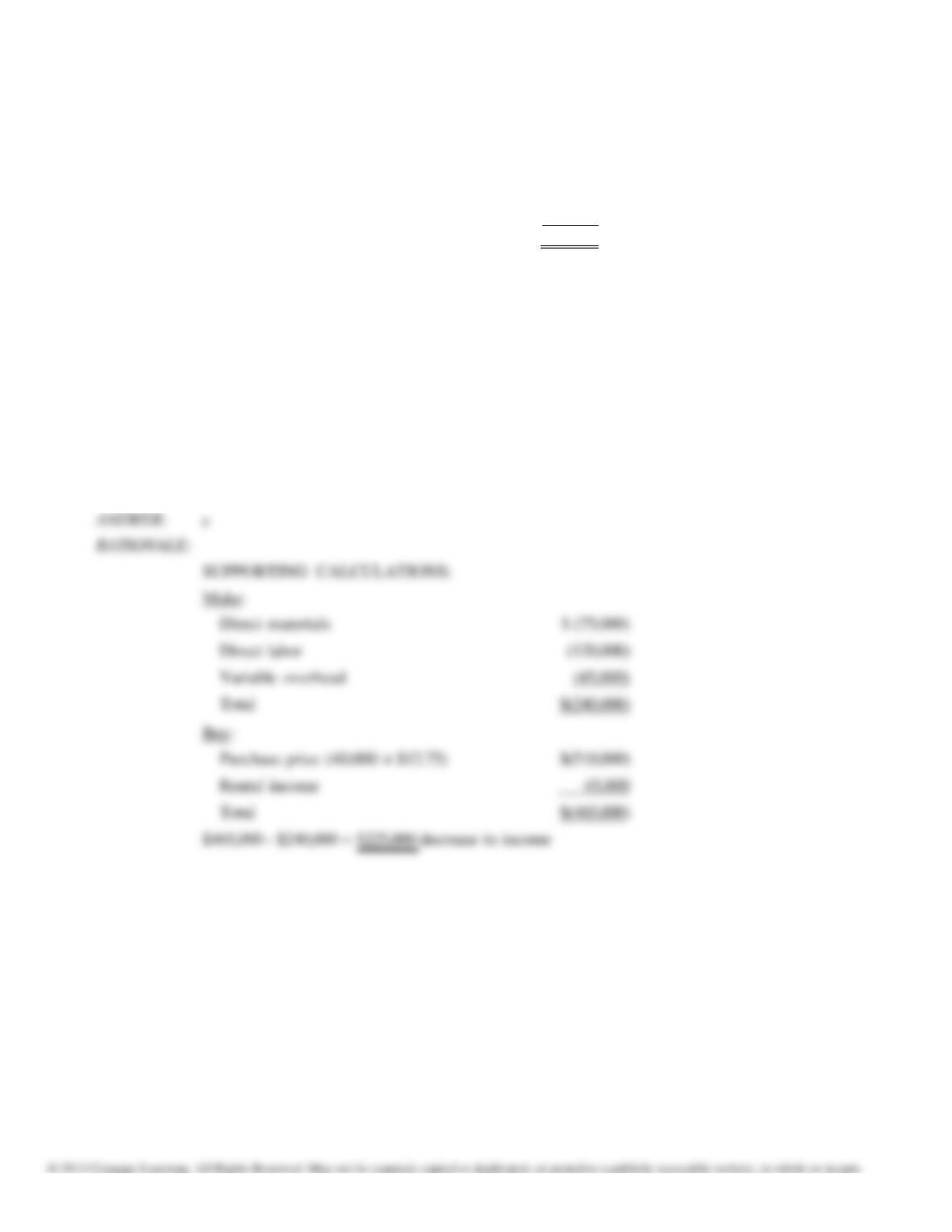
are called decisions.
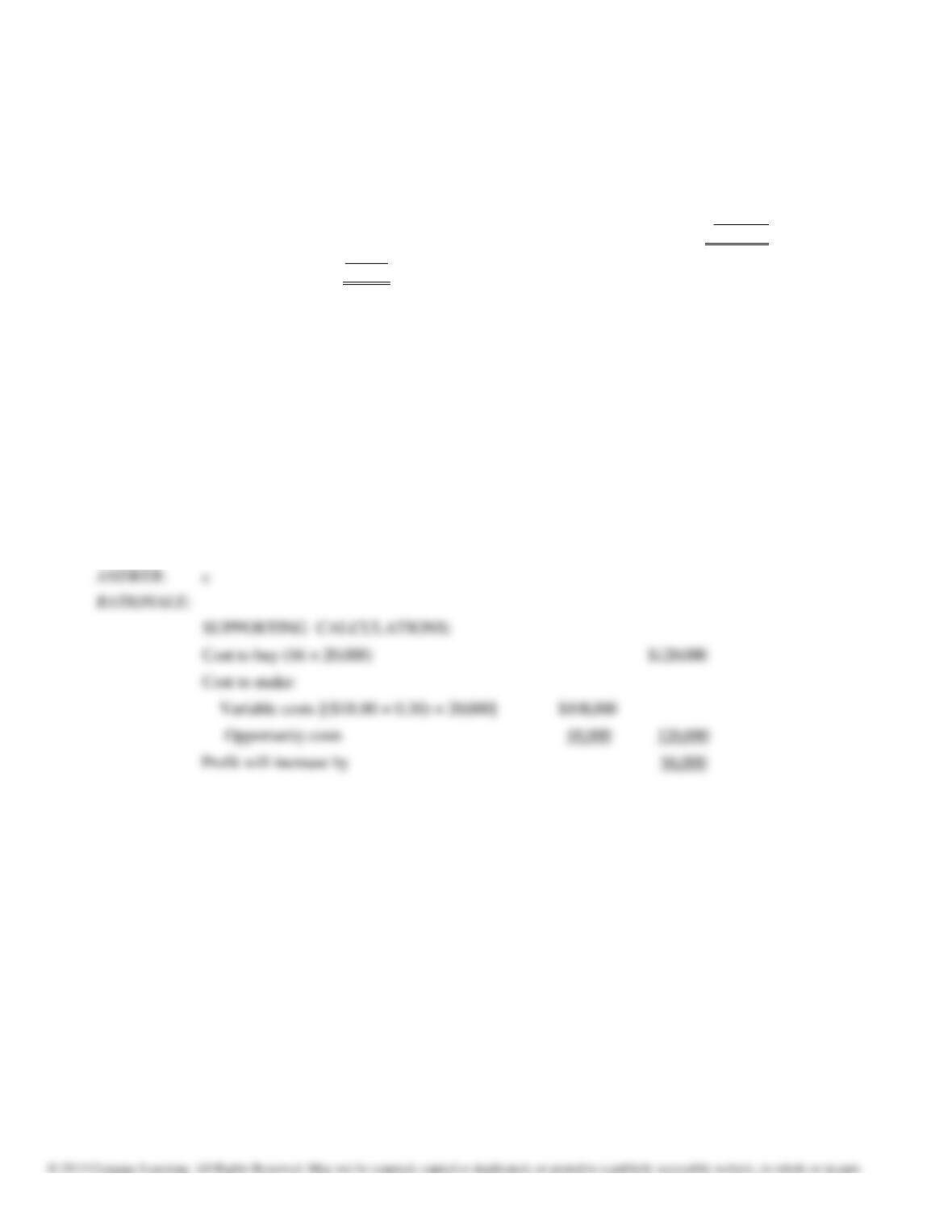
22. Future costs which differ across alternatives are called costs.
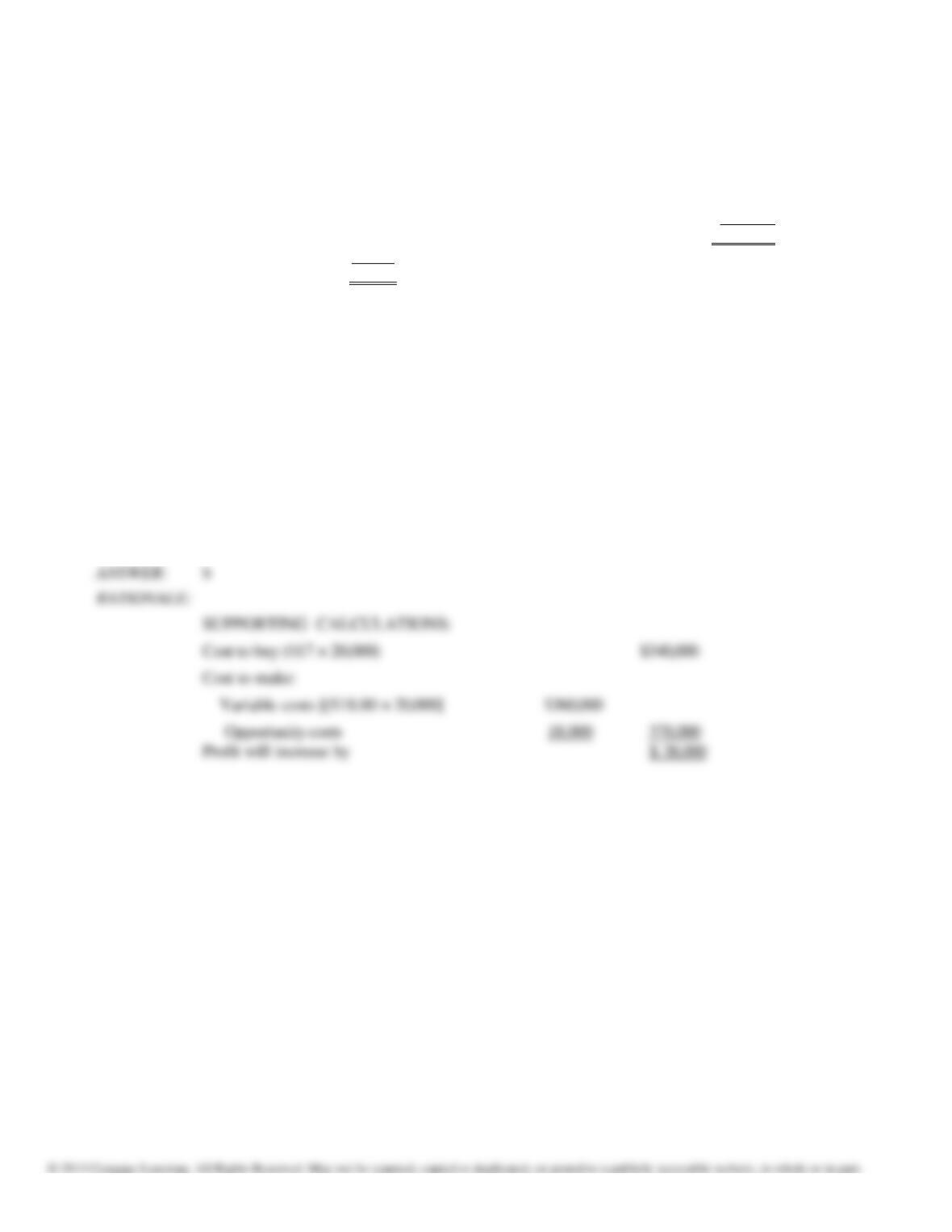
23. A model is a set of procedures that, if followed, will lead to a decision.
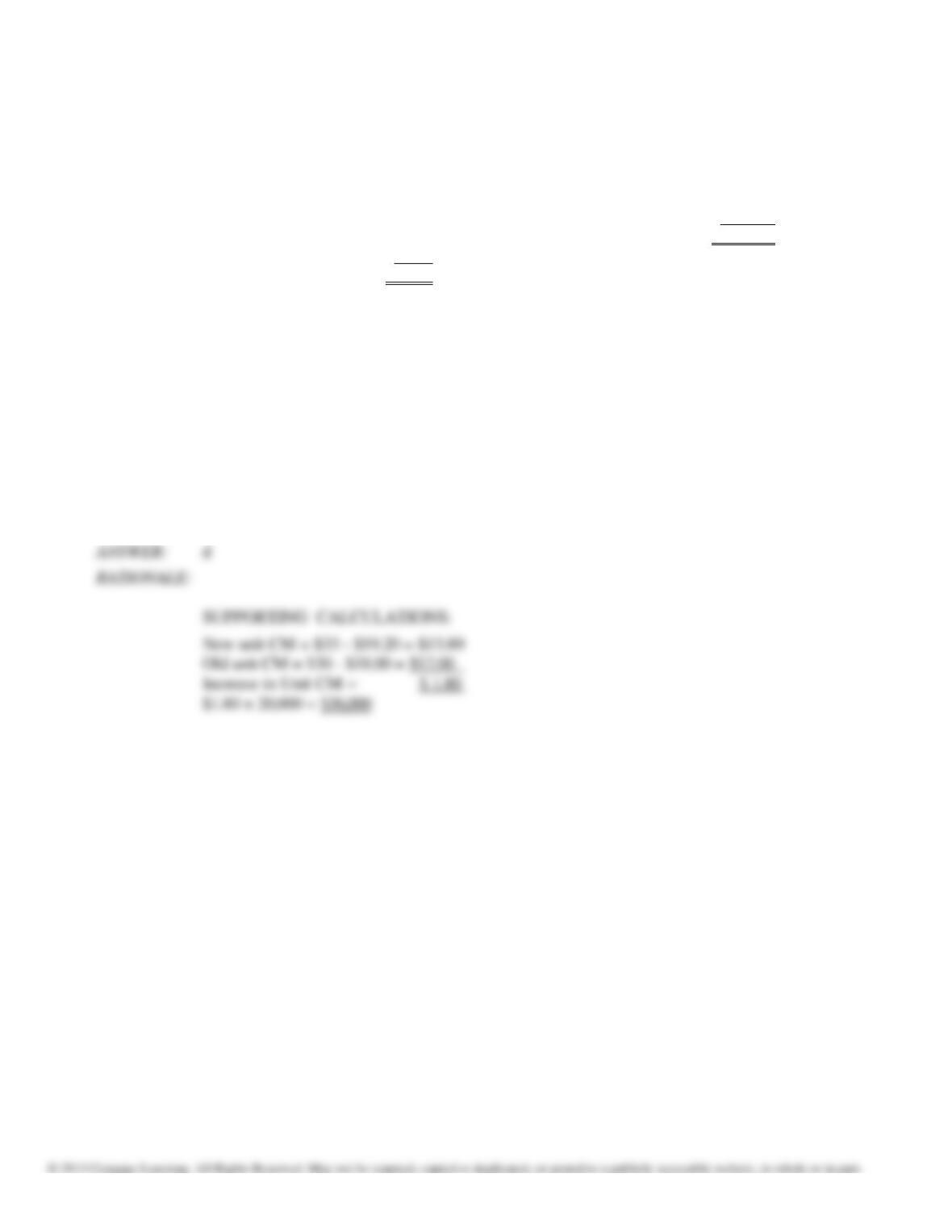
24. Past cost represents an allocation of a cost already incurred.
Chapter 17: Activity Resource Usage Model and Tactical Decision Making
25. Areas that are physically on U.S. soil but considered to be outside U.S. commerce
are called zones.
26. The cost of acquiring activity capacity is called spending.
27. Leasing or buying a building are examples of resources.
28. A doctor choosing between buying laboratory tests externally or performing the tests in house is an example of a
decision.
29. In a keep-or-drop decision, the income or loss determines whether a segment is kept or dropped.
30. A decision to accept or reject a specially priced order is an example of a
decision.
31. The choosing among alternatives with an immediate or limited end in view consists of:
a. Tactical decision making
b. Long-run decision making
c. Universal decision making
d. all of the above
32. Tactical decision making relies
a. only on relevant cost information.
b. only on qualitative factors.
c. on relevant costs as well as other qualitative factors.
d. on neither relevant costs nor qualitative decisions.

Chapter 17: Activity Resource Usage Model and Tactical Decision Making
33. The steps in the tactical decision making process are:
I. Comparing relevant costs and relating to strategic goals
II. Identifying feasible alternatives
III. Identifying costs and benefits and eliminating irrelevant costs
IV. Selecting best alternative
V. Defining the problem
What is the proper sequence of steps?
a. I, II, V, III, IV
b. II, I, V, III, IV
c. V, II, III, I, IV
d. V, III, II, IV, I
34. Which of the following is NOT a step in the tactical decision-making process?
a. Compare full costs and benefits for alternatives.
b. Identify feasible alternatives.
c. Select the best alternative.
d. Recognize and define the problem.
35. Which of the following statement is true concerning the nature of tactical decisions?
a. Tactical decisions are often small-scale actions.
b. Tactical decisions often have an immediate or limited end in view.
c. Tactical decisions should support alternatives that result in long–term competitive advantage.
d. all of the above statements are true.
36. Sound tactical decision making
a. only concerns the short run.
b. consists of large scale actions that serve a broad purpose.
c. consists of supporting the strategic objectives of the firm.
d. only concerns the long run.
37. Qualitative factors that should be considered when evaluating a make-or-buy decision are
a. the quality of the outside supplier‘s product.
b. whether the outside supplier can provide the needed quantities.
c. whether the outside supplier can provide the product when it is needed.
d. all of the above.

Chapter 17: Activity Resource Usage Model and Tactical Decision Making
38. The use of relevant cost data to identify the alternative that provides the greatest benefit to the organization
describes
a. target cost analysis.
b. functional cost analysis.
c. activity cost analysis.
d. tactical cost analysis.
39. An important qualitative factor to consider regarding a special order is the
a. variable costs associated with the special order.
b. avoidable fixed costs associated with the special order.
c. effect the sale of special-order units will have on existing customers.
d. incremental revenue from the special order.
40. Future costs that differ across alternatives describe
a. relevant costs.
b. target cost.
c. full costs.
d. activity-based costs.
41. A purchasing agent has two potential firms from which to buy materials for production. If both firms charge the
same price, the material cost is a(n)
a. irrelevant cost.
b. relevant cost.
c. sunk cost.
d. opportunity cost.
42. Relevant costs are
a. past costs.
b. future costs.
c. full costs.
d. cost drivers.

Chapter 17: Activity Resource Usage Model and Tactical Decision Making
43. The future costs that differ across alternatives are called
a. Sunk costs
b. Irrelevant costs
c. Relevant costs
d. Past costs
44. In order for costs or benefits to be relevant, what must be true?
a. All decisions must relate to future.
b. Identifying relevant costs and benefits is an easy process.
c. Relevancy will relate both to the future and the past.
d. all of the above are true statements.
45. Sunk costs are
a. future costs that have no benefit.
b. relevant costs that have only short-run benefits.
c. target costs.
d. always irrelevant.
46. Which item is NOT an example of a sunk cost?
a. materials needed for production
b. purchase cost of machinery
c. depreciation
d. all are sunk costs
47. One of Maersk cargo ships hit an iceberg and sank. In deciding whether or not to salvage the ship, its book value
is a(n)
a. relevant cost.
b. discretionary cost.
c. opportunity cost.
d. sunk cost.

Chapter 17: Activity Resource Usage Model and Tactical Decision Making
48. Which of the following statements is TRUE when making a decision between two alternatives?
a. Variable costs may not be relevant when the decision alternatives have the same activity levels.
b. Variable costs are not relevant when the decision alternatives have different activity levels.
c. Sunk costs are always relevant.
d. Fixed costs are never relevant.
49. Maldovar Company is considering purchasing a new machine to replace a machine purchased one year ago
that is not achieving the expected results. The following information is available:
Expected maintenance costs of new machine $12,000 per year
Purchas price of existing machine $150,000
Expected cost savings of new machine $20,000 per year
Expected maintenance costs of existing machine $8,000 per year
Resale value of existing machine $35,000
Which of these items is IRRELEVANT?
a. Expected maintenance costs of new machine
b. Expected maintenance costs of existing machine
c. Purchase cost of existing machine
d. Expected resale value of existing machine
50. Which of the following costs is NOT relevant to a special-order decision?
a. the direct labor costs to manufacture the special-order units
b. the variable manufacturing overhead incurred to manufacture the special-order units
c. the portion of the cost of leasing the factory that is allocated to the special order
d. all of the above costs are relevant
51. Which of the following costs is NOT relevant to a make–or-buy decision?
a. $20,000 of direct labor used to manufacture the parts
b. $25,000 in rent from leasing the production space to another company if the part is purchased
from an outside supplier
c. the supervisor’s salary of $35,000 that will be avoided if the part is purchased from an outside supplier
d. $40,000 of depreciation on the plant used to manufacture the parts

Chapter 17: Activity Resource Usage Model and Tactical Decision Making
52. Which of the following costs is NOT relevant to a decision to sell a product at split-off or process the
product further and then sell the product?
a. joint costs allocated to the product
b. the selling price of the product at split-off
c. the additional processing costs after split-off
d. the selling price of the product after further processing
53. Which of the following costs is NOT relevant for special decisions?
a. incremental costs
b. sunk costs
c. avoidable costs
d. all of the above costs are relevant for special decisions
54. Which of the following costs is relevant to a make–or–buy decision?
a. original cost of the production equipment
b. annual depreciation of the equipment
c. the amount that would be received if the production equipment were sold
d. the cost of direct materials purchased last month and used to manufacture the component
55. Which of the following is NOT a way that companies might reduce tariffs?
a. Alter materials to increase the domestic content.
b. Restrict the amount of imported materials.
c. Increase the amount of imported materials.
d. Utilize foreign trade zones.
56. The U.S. government has set up foreign trade zones (FTZ) that
a. are located on U.S. soil but are considered to be outside of U.S. commerce for tariff purposes.
b. are located in foreign countries and designed to export to the United States.
c. are located in foreign countries and are designed to import from the United States.
d. are located in the United States and are considered part of the United States for tariff purposes.
Chapter 17: Activity Resource Usage Model and Tactical Decision Making
57. For flexible resources, which of the following statements is true?
a. A change in resource spending will only occur if the demand for a resource drops permanently and exceeds
demand enough so the activity capacity will be reduced.
b. Often, resources are acquired in advance for multiple periods and are therefore irrelevant.
c. Decisions often affect multi-period capabilities.
d. If the demand for an activity changes across alternatives, then resource spending will change and the cost
of the activity will be relevant to the decision.
58. Which of the following would be TRUE?
Category
of Cost
Relationships
Relevancy
a.
Flexible Demand changes Irrelevant
b.
Flexible Demand constant Irrelevant
c.
Committed Demand increase >
Unused capacity Not relevant
d.
Committed Demand increase <
Unused capacity Relevant
59. The cost of acquiring activity capacity is(are)
a. Joint costs
b. Variable costing
c. Absorption costing
d. Resource spending
60. Santa Lucia Industries employs 500 workers in the factory. These workers produced 85,000 units in 2016.
Due to a special order, the units produced in 2017 increased to 95,000 units. However, Santa Lucia
produced these units without adding workers. How is that possible?
a. The labor cost associated with the additional units sold will be a relevant cost.
b. The employees were a flexible resource in this situation.
c. The plant had some unused activity capacity.
d. none of the above

Chapter 17: Activity Resource Usage Model and Tactical Decision Making
61. Upfront resource spending
a. is always relevant because it relates to the future.
b. is always relevant because it could reduce future costs.
c. is a sunk cost and therefore never relevant.
d. is always relevant because upfront resource spending will generate future revenues or benefits.
62. In the activity resource model, flexible resources are
a. resources acquired in advance of usage.
b. resources acquired as used and needed.
c. usually acquired in lumpy amounts.
d. are normally fixed or mixed costs.
63. Which of the following items would be classified as committed resources (short-term)?
a. salaried employees
b. depreciation on building
c. fuel to generate electricity internally
d. lease on machinery
64. Which of the following items would be classified as flexible resources?
a. salaried employees
b. depreciation on building
c. fuel to generate electricity internally
d. lease on machinery
65. Which of the following items would be classified as committed resources (long-term)?
a. salaried employees
b. depreciation on building
c. lease on machinery
d. both b and c
Chapter 17: Activity Resource Usage Model and Tactical Decision Making
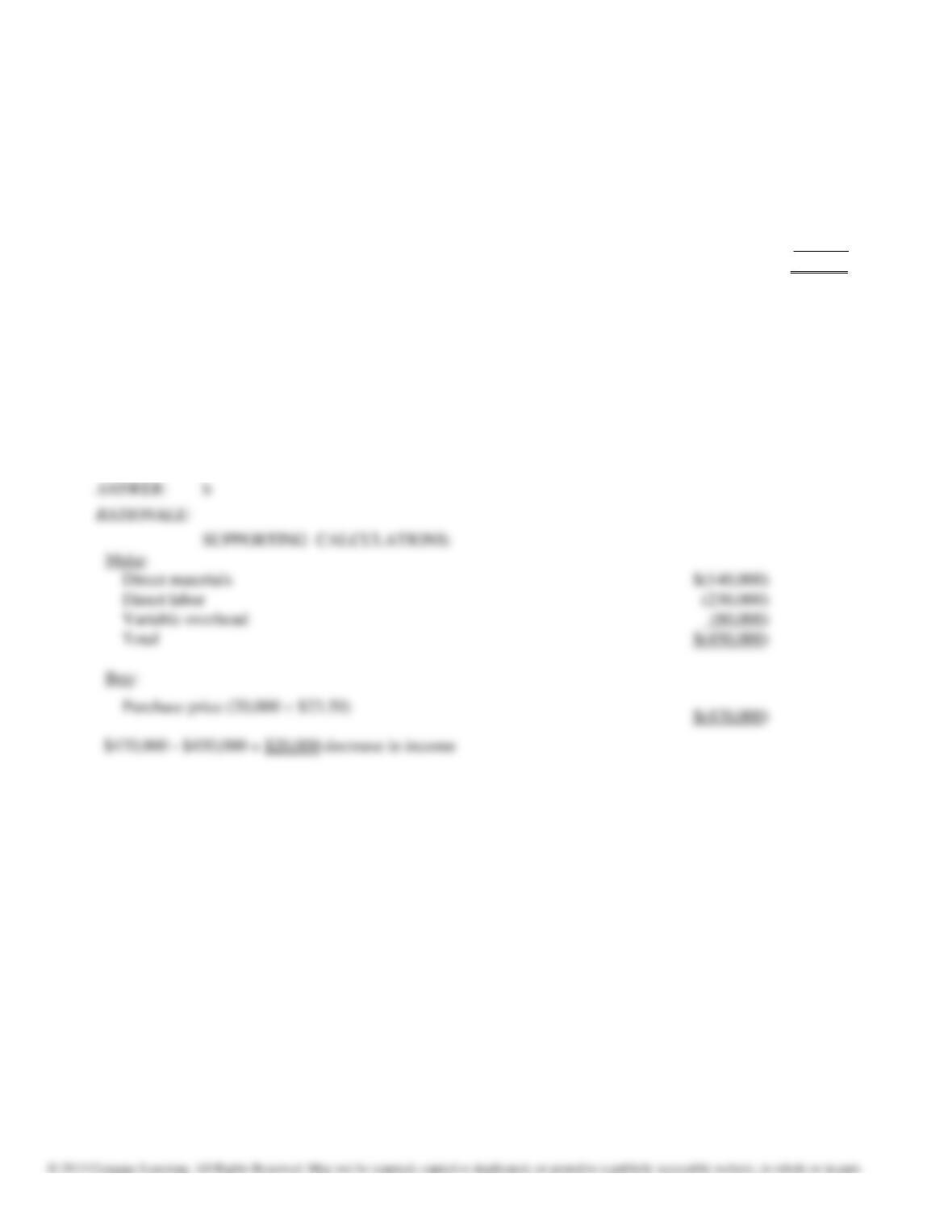
66. Yankton Industries manufactures 20,000 components per year. The manufacturing cost of the components
was determined as follows:
Direct materials
$140,000
Direct labor
230,000
Variable manufacturing overhead
80,000
Fixed manufacturing overhead
120,000
Total
$570,000
An outside supplier has offered to sell the component for $23.50.
What is the effect on income if Yankton Industries purchases the component from the outside supplier?
a. $20,000 increase
b. $20,000 decrease
c. $80,000 decrease
d. $80,000 increase
Chapter 17: Activity Resource Usage Model and Tactical Decision Making
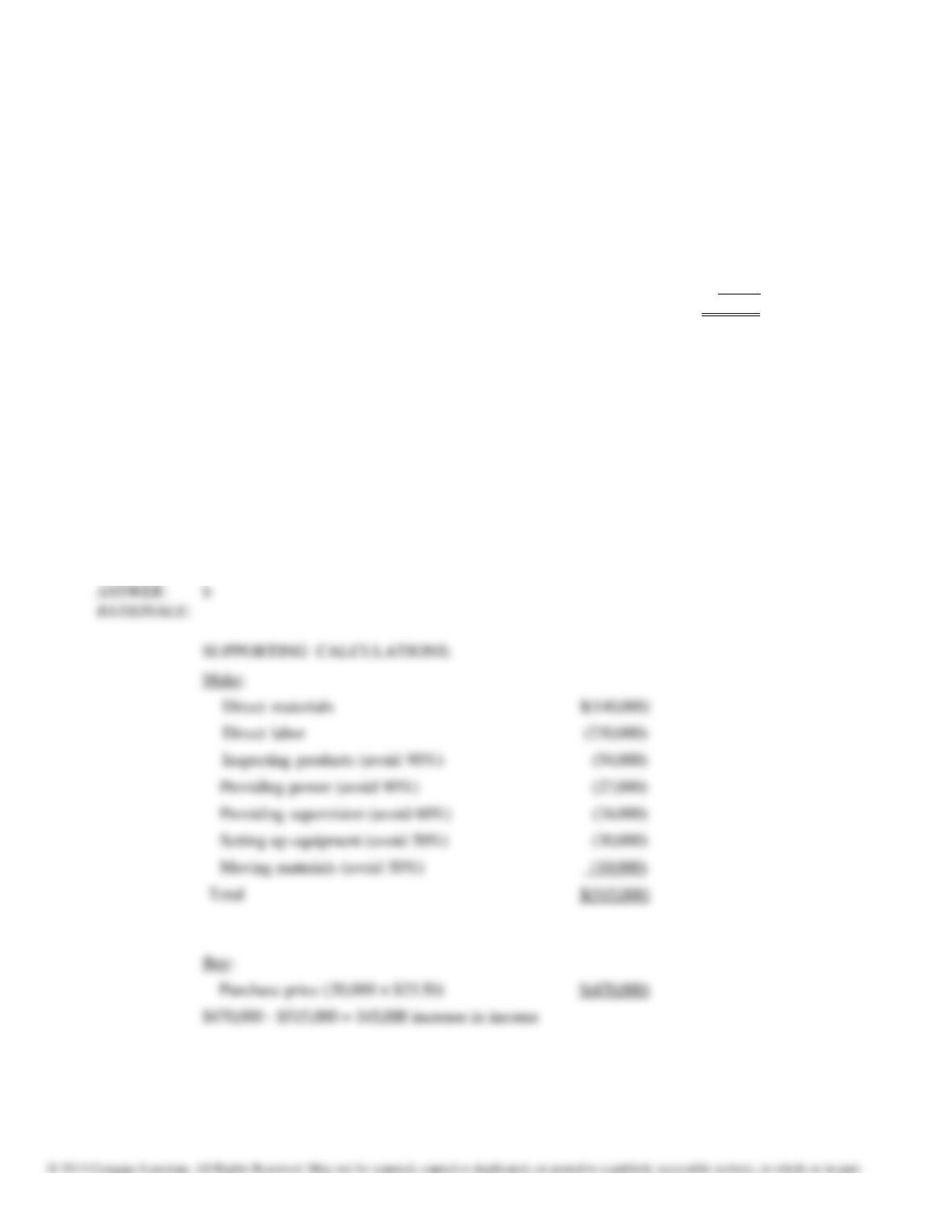
67. Yankton Industries manufactures 20,000 components per year. The manufacturing cost of the components
was determined as follows:
Direct materials
$140,000
Direct labor
230,000
Inspecting products
60,000
Providing power
30,000
Providing supervision
40,000
Setting up equipment
60,000
Moving materials
20,000
Total
$580,000
If the component is not produced by Yankton, inspection of products and provision of power costs will only be 10
percent of the production costs; moving materials costs and setting up equipment costs will only be 50 percent of
the production costs; and supervision costs will amount to only 40 percent of the production amount. An outside
supplier has offered to sell the component for $23.50.
What is the effect on income if Yankton Industries purchases the component from the outside supplier?
a. $25,000 increase
b. $45,000 increase
c. $80,000 decrease
d. $80,000 increase
Chapter 17: Activity Resource Usage Model and Tactical Decision Making
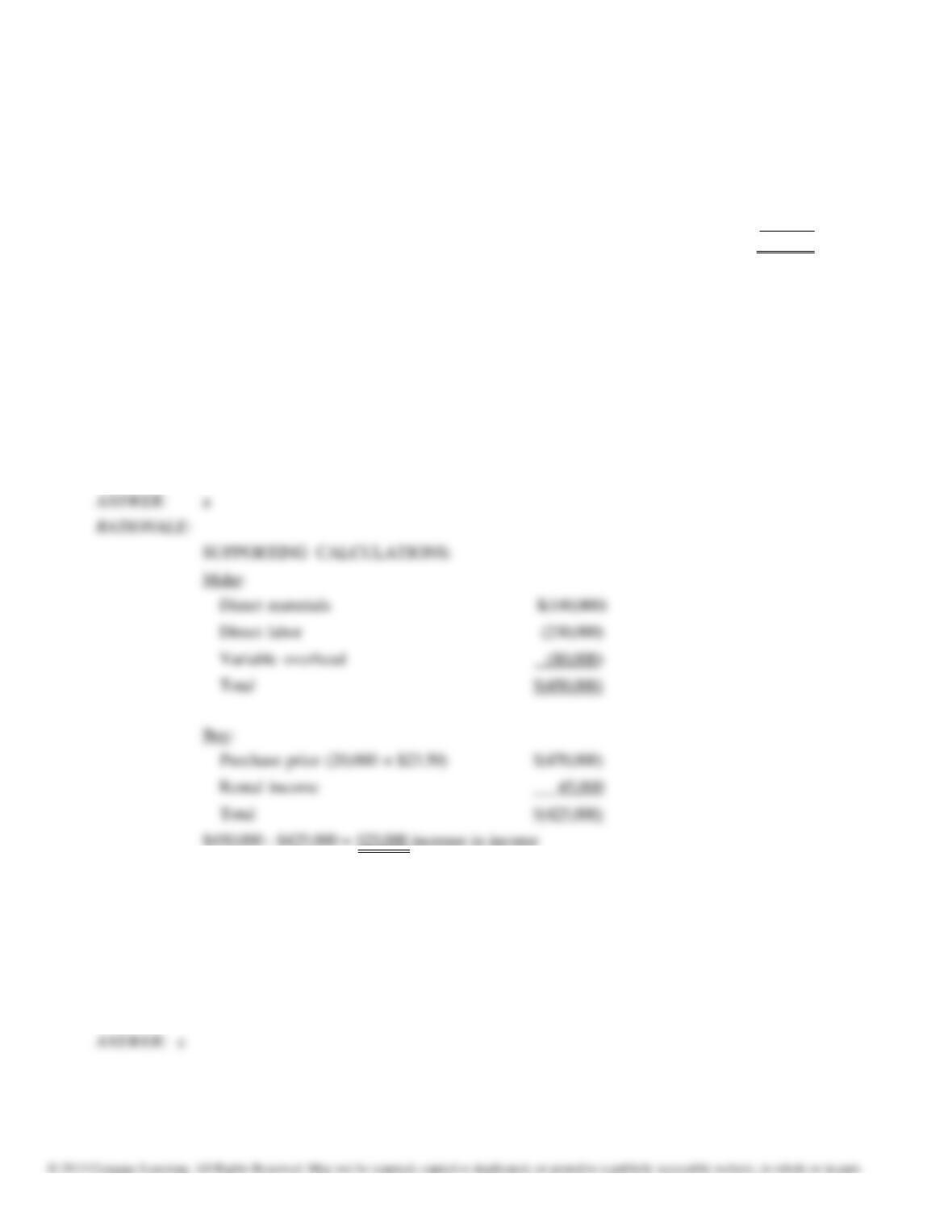
68. Yankton Industries manufactures 20,000 components per year. The manufacturing cost of the components
was determined as follows:
Direct materials
$140,000
Direct labor
230,000
Variable manufacturing overhead
80,000
Fixed manufacturing overhead
120,000
Total
$570,000
An outside supplier has offered to sell the component for $23.50.
Yankton Industries can rent its unused manufacturing facilities for $45,000 if it purchases the component from the
outside supplier.
What is the effect on income if Yankton purchases the component from the outside supplier?
a. $25,000 increase
b. $45,000 increase
c. $75,000 decrease
d. $105,000 increase
69. A decision to make a component internally versus purchasing from a supplier is a
a. special–order decision.
b. keep-or-drop a product-line decision.
c. make-or–buy decision.
d. both a and c.
Chapter 17: Activity Resource Usage Model and Tactical Decision Making
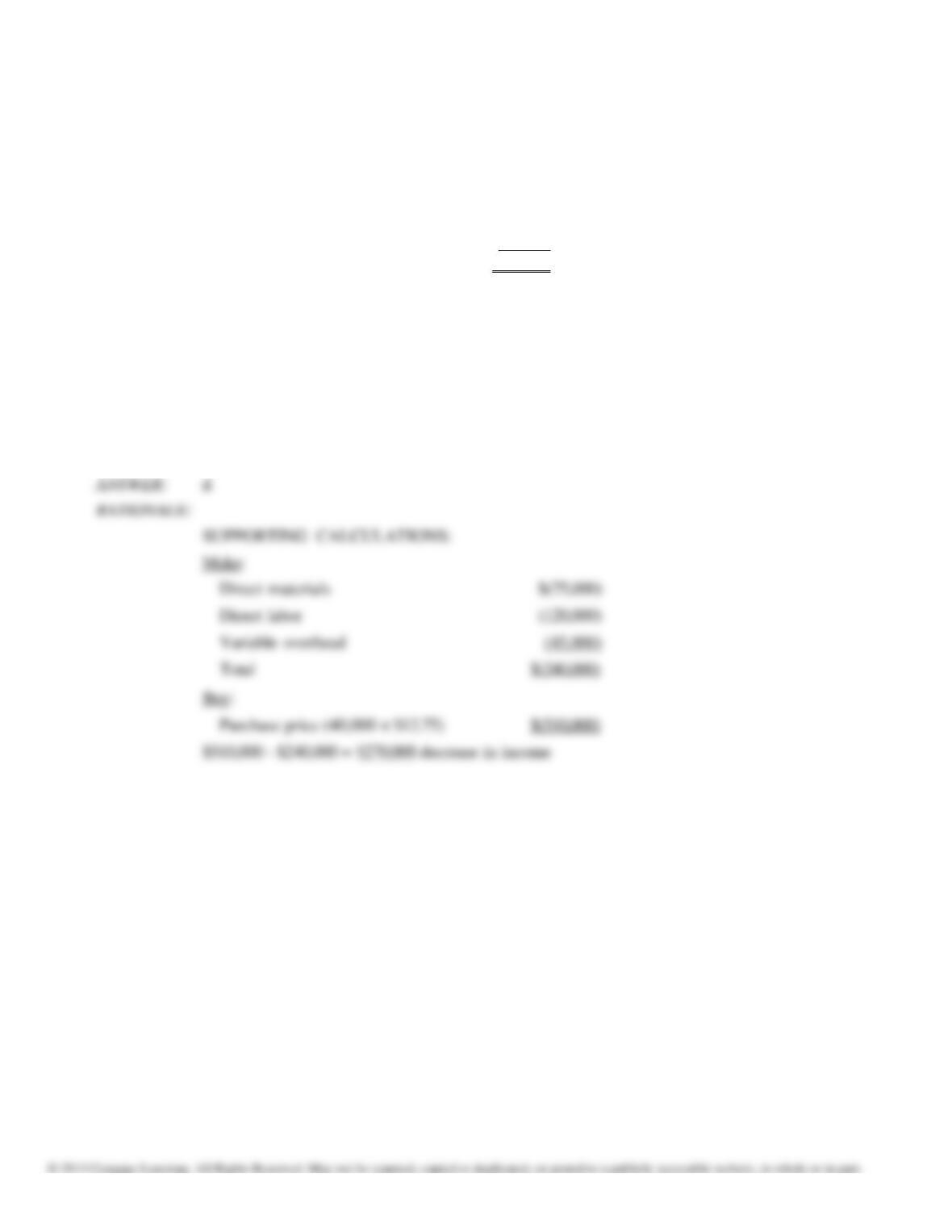
70. Concierge Industries manufactures 40,000 components per year. The manufacturing cost of the components was
determined as follows:
Direct materials
$75,000
Direct labor
120,000
Variable manufacturing overhead
45,000
Fixed manufacturing overhead
60,000
Total
$300,000
An outside supplier has offered to sell the component for $12.75.
What is the effect on income if Concierge Industries purchases the component from the outside supplier?
a. $30,000 increase
b. $30,000 decrease
c. $270,000 increase
d. $270,000 decrease
Chapter 17: Activity Resource Usage Model and Tactical Decision Making
71. Concierge Industries manufactures 40,000 components per year. The manufacturing cost of the components
was determined as follows:
Direct materials
$75,000
Direct labor
120,000
Variable manufacturing overhead
45,000
Fixed manufacturing overhead
60,000
Total
$300,000
An outside supplier has offered to sell the component for $12.75.
Concierge Industries can rent its unused manufacturing facilities for $45,000 if it purchases the component from the
outside supplier.
What is the effect on income if Concierge purchases the component from the outside supplier?
a. $195,000 increase
b. $165,000 decrease
c. $225,000 decrease
d. $135,000 increase
Chapter 17: Activity Resource Usage Model and Tactical Decision Making
72. Hobart Company produces speakers for PA systems. The speakers are sold to retail music stores for
$30. Manufacturing and other costs are as follows:
Variable costs per unit:
Fixed costs per month:
Direct materials
$ 9.00
Factory overhead
$120,000
Direct labor
4.50
Selling and admin.
60,000
Factory overhead
3.00
Total
$180,000
Distribution
1.50
Total
$18.00
The variable distribution costs are for transportation to the retail music stores. The current production and sales
volume is 20,000 per year. Capacity is 25,000 units per year.
A Memphis manufacturing firm has offered a one-year contract to supply speaker parts at a cost of $6.00 per unit.
If Hobart Company accepts the offer, it will be able to reduce variable costs by 30 percent and rent unused space
to an outside firm for $18,000 per year. All other information remains the same as the original data. What is the
effect on profits if Hobart Company buys from the Memphis firm?
a. decrease of $19,000
b. increase of $19,000
c. increase of $6,000
d. increase of $13,000
Chapter 17: Activity Resource Usage Model and Tactical Decision Making
73. Hobart Company produces speakers for home stereo units. The speakers are sold to retail music stores for
$30. Manufacturing and other costs are as follows:
Variable costs per unit:
Fixed costs per month:
Direct materials
$ 9.00
Factory overhead
$120,000
Direct labor
4.50
Selling and admin.
60,000
Factory overhead
3.00
Total
$180,000
Distribution
1.50
Total
$18.00
The variable distribution costs are for transportation to the retail music stores. The current production and sales
volume is 20,000 per year. Capacity is 25,000 units per year.
A Memphis manufacturing firm has offered a one-year contract to supply speaker parts at a cost of $17.00 per
unit. If Hobart Company accepts the offer, it will be able to rent unused space to an outside firm for $18,000 per
year. All other information remains the same as the original data. What is the effect on profits if Hobart Company
buys from the Memphis firm?
a. decrease of $19,000
b. increase of $38,000
c. increase of $19,000
d. decrease of $6,000
Chapter 17: Activity Resource Usage Model and Tactical Decision Making
74. Hobart Company produces speakers for PA systems. The speakers are sold to retail music stores for
$30. Manufacturing and other costs are as follows:
Variable costs per unit:
Fixed costs per month:
Direct materials
$ 9.00
Factory overhead
$120,000
Direct labor
4.50
Selling and admin.
60,000
Factory overhead
3.00
Total
$180,000
Distribution
1.50
Total
$18.00
The variable distribution costs are for transportation to the retail music stores. The current production and sales
volume is 20,000 per year. Capacity is 25,000 units per year.
The speakers are currently unpackaged. Packaging them individually would increase costs by $1.20 per unit.
However, the units could then be sold for $33.00. All other information remains the same as the original data. What
is the effect on profits if Hobart Company packages the speakers?
a. no change
b. decrease of $24,000
c. decrease of $36,000
d. increase of $36,000
Chapter 17: Activity Resource Usage Model and Tactical Decision Making
75. Composite Company uses 5,000 units of part AA1 each year. The cost of manufacturing one unit of part
AA1 at this volume is as follows:
Direct materials
$11.00
Direct labor
15.00
Variable overhead
6.00
Fixed overhead
4.00
Total
$36.00
An outside supplier has offered to sell Composite Company unlimited quantities of part AA1 at a unit cost of
$32.00. If Composite Company accepts this offer, it can eliminate 50 percent of the fixed costs assigned to
part AA1. Furthermore, the space devoted to the manufacture of part AA1 would be rented to another
company for $24,000 per year. If Composite Company accepts the offer of the outside supplier, annual
profits will
a. increase by $17,000.
b. increase by $24,000.
c. increase by $34,000.
d. increase by $3,500.
Cost to buy (5,000 $32) + ($2.00 5,000)
Cost to make (5,000 $36) + $24,000
Profits increase by
Figure 17-1
The following data pertains to the Montrose Company’s three products:
M
N
O
Unit sales per month
9,000
14,000
8,000
Selling price per unit
$6.00
$11.25
$ 7.50
Variable costs per unit
3.00
9.00
7.00
Unit contribution margin
$3.00
$ 2.25
$ 0.50
Batches
5
10
5
Setups
6
3
1
Direct fixed costs
Advertising
$3,000
$2,000
$1,000
Supervision
5,000
5,000
5,000
Common fixed costs
Inspecting products ($10,000)
Materials handling ($4,000)
Customer service ($5,000)
Plant depreciation ($6,000)
General administration ($8,000)