Exam
Name___________________________________
MULTIPLE CHOICE. Choose the one alternative that best completes the statement or answers the question.
1)
The daily tidal range is GREATEST during ________ tide.
1)
A)
ebb
B)
neap
C)
spring
D)
none of these
2)
A sand ridge connecting an island to the mainland or to another island is a ________.
2)
A)
tombolo
B)
breakwater
C)
sea stack
D)
jetty
3)
One result of wave refraction is that wave energy is concentrated ________.
3)
A)
in the recessed areas between headlands
B)
in estuaries
C)
on headlands projecting into the water
D)
none of the above
4)
Erosional retreat of a(n) ________ leads to enlargement and extension of a wave–cut platform in the
inland direction.
4)
A)
wave–cut barrier beach
B)
wave–cut cliff
C)
offshore, wave–cut, breakwater bar
D)
wave–cut tombolo
5)
A sandbar that completely crosses a bay, sealing it off from the open ocean is a ________.
5)
A)
sea stack
B)
coastal barrier
C)
tombolo
D)
none of these
6)
Waves begin to “feel bottom” when the depth of water is ________.
6)
A)
three times as great as the wavelength
B)
equal to one–half the wavelength
C)
twice as great as the wavelength
D)
equal to the wavelength
7)
A ridge of sand projecting into a bay and often having a hooked end is a ________.
7)
A)
sea stack
B)
jetty
C)
groin
D)
spit
8)
The height, length, and period of a wave depend upon ________.
8)
A)
the fetch
B)
the length of time the wind has blown
C)
the wind speed
D)
all of these
9)
Large estuaries are more common on a(n) ________ coastline.
9)
A)
submergent
B)
retreating
C)
emergent
D)
stable
10)
An isolated remnant of wave erosion is a ________.
10)
A)
sea stack
B)
spit
C)
jetty
D)
groin
11)
Which one of the following structures is built to protect boats from large breaking waves?
11)
A)
jetty
B)
groin
C)
seawall
D)
breakwater
12)
When waves reach shallow water, they are often bent and tend to become parallel to the shore. This
process is termed ________.
12)
A)
translation
B)
refraction
C)
oscillation
D)
reflection
13)
The zigzag movement of sand grains along a beach is ________.
13)
A)
caused by obliquely breaking waves
B)
called beach drift
C)
All of the above.
D)
None of the above.
14)
Which one of the following is a landform created by wave erosion?
14)
A)
sea arch
B)
spit
C)
estuary
D)
tombolo
15)
Fetch is ________.
15)
A)
the distance between the trough of a wave and the still water level
B)
the circular pattern made by water particles when a wave passes
C)
a method of shoreline erosion control
D)
none of these
16)
A hurricane causes the most damage in the coastal zone because of ________.
16)
A)
the hurricane’s width
B)
population density
C)
heavy rain
D)
storm surge
17)
A flat, bench–like surface cut in rock along a coast is a ________.
17)
A)
spit
B)
sea stack
C)
wave–cut platform
D)
tombolo
18)
The movement of sand parallel to the shore ________.
18)
A)
is created by waves approaching at an oblique angle
B)
is achieved by longshore currents
C)
may create spits
D)
all of the above
19)
The presence of which one of the following would indicate that the land had been uplifted or that
sea level had fallen?
19)
A)
elevated marine terrace
B)
an estuary
C)
a tombolo
D)
a sea stack
20)
The movement of water within the surf zone that parallels the shore is termed ________.
20)
A)
salinity current
B)
longshore current
C)
beach drift
D)
tidal current
21)
The daily tidal range is LEAST during ________ tide.
21)
A)
ebb
B)
neap
C)
spring
D)
none of these
22)
Which of the following is designed to prevent or retard shoreline erosion?
22)
A)
beach nourishment
B)
seawall
C)
groin
D)
all of these
23)
Which of the following is a tidal current?
23)
A)
flood tide
B)
spring tide
C)
ebb tide
D)
both flood and ebb tide
D
24)
A poleward–moving ocean current is ________.
24)
A)
warm
B)
warm only in the Southern Hemisphere
C)
warm only in the Northern Hemisphere
D)
cold
A
25)
Chesapeake Bay and Delaware Bay are ________.
25)
A)
excellent examples of large estuaries
B)
former river valleys that were flooded by a rise in sea level
C)
associated with a submergent coast
D)
all of the above
D
26)
A ________ is an isolated remnant of bedrock standing above a wave–cut platform.
26)
A)
sea span
B)
sea stack
C)
sea spit
D)
sea rampart
B
D
SHORT ANSWER. Write the word or phrase that best completes each statement or answers the question.
Word Analysis. Examine the words and/or phrases for each question below and determine the relationship among the
majority of words/phrases. Choose the option that does not fit the pattern.
27)
a. breakwater b. groin c. seawall d. beach
nourishment
27)
28)
The ________ is the distance the wind has traveled across open water.
28)
Word Analysis. Examine the words and/or phrases for each question below and determine the relationship among the
majority of words/phrases. Choose the option that does not fit the pattern.
29)
a. wave height b. wave period c. wave refraction d. fetch
29)
30)
As a deep–water wave enters shallow water, the wave slows down and rotates toward
being parallel with the shoreline. This process is known as ________.
30)
31)
Low and narrow offshore ridges of sand that parallel the coast are called ________.
31)
32)
Currents within the surf zone that flow parallel to the shore are known as ________
currents.
32)
33)
A ridge of sand that connects an island to the mainland or to another island is a(n)
________.
33)
34)
The low–lying zones that are alternately covered by water during flood tide and exposed
following ebb tide are called ________.
34)
35)
When caves on opposite sides of a headland unite, a(n) ________ results.
35)

Word Analysis. Examine the words and/or phrases for each question below and determine the relationship among the
majority of words/phrases. Choose the option that does not fit the pattern.
36)
a. sea stack b. bar c. tombolo d. barrier
island
36)
37)
Structures called ________ are built parallel to the shoreline to protect boats from the force
of large breaking waves.
37)
38)
What term denotes a sand bar built across the former mouth of an estuary, separating it
from the open sea?
38)
39)
A barrier built at a right angle to the beach for the purpose of trapping sand that is moving
parallel to the shore is called a(n) ________.
39)
Word Analysis. Examine the words and/or phrases for each question below and determine the relationship among the
majority of words/phrases. Choose the option that does not fit the pattern.
40)
a. spring tide b. flood currents c. neap tide d. tidal flat
40)
TRUE/FALSE. Write ‘T’ if the statement is true and ‘F’ if the statement is false.
41)
The turbulent water created by breaking waves is called surf.
41)
42)
Although the Sun influences the tides, its effect is considerably less than the effect of the Moon.
42)
43)
The horizontal distance separating successive wave crests is called the wave period.
43)
44)
Neap tides occur about the time of the first quarter and third quarter phases of the Moon.
44)

45)
Groins are constructed for the purpose of maintaining or widening beaches that are losing sand.
45)
46)
Longshore sand transport and longshore currents depend on waves impinging parallel to a
shoreline.
46)
47)
The Gulf Coast lacks barrier islands.
47)
48)
Tidal flats are submerged during ebb tide.
48)
49)
The largest daily tidal range occurs in association with spring tides.
49)
50)
Elevated wave–cut platforms in Southern California are evidence that this coastal area is emergent.
50)
51)
A baymouth bar is a manmade feature designed to control wave erosion.
51)
52)
As the tide rises, water flows in toward the shore as the ebb tide.
52)
MATCHING. Choose the item in column 2 that best matches each item in column 1.
Match the tide with the appropriate description.
53)
lowest high tides and highest low
tides of the month
A)
neap tides
53)
8
54)
Sun, Moon, and Earth form a right
triangle in space
55)
Sun, Moon, and Earth lie on a straight
line in space
56)
highest high tides and lowest low
tides of the month
A)
spring tides
54)
55)
56)
ESSAY. Write your answer in the space provided or on a separate sheet of paper.
Critical thinking and discussion questions. Use complete sentences, correct spelling, and the information presented in
chapter 17 to answer the questions below.
57)
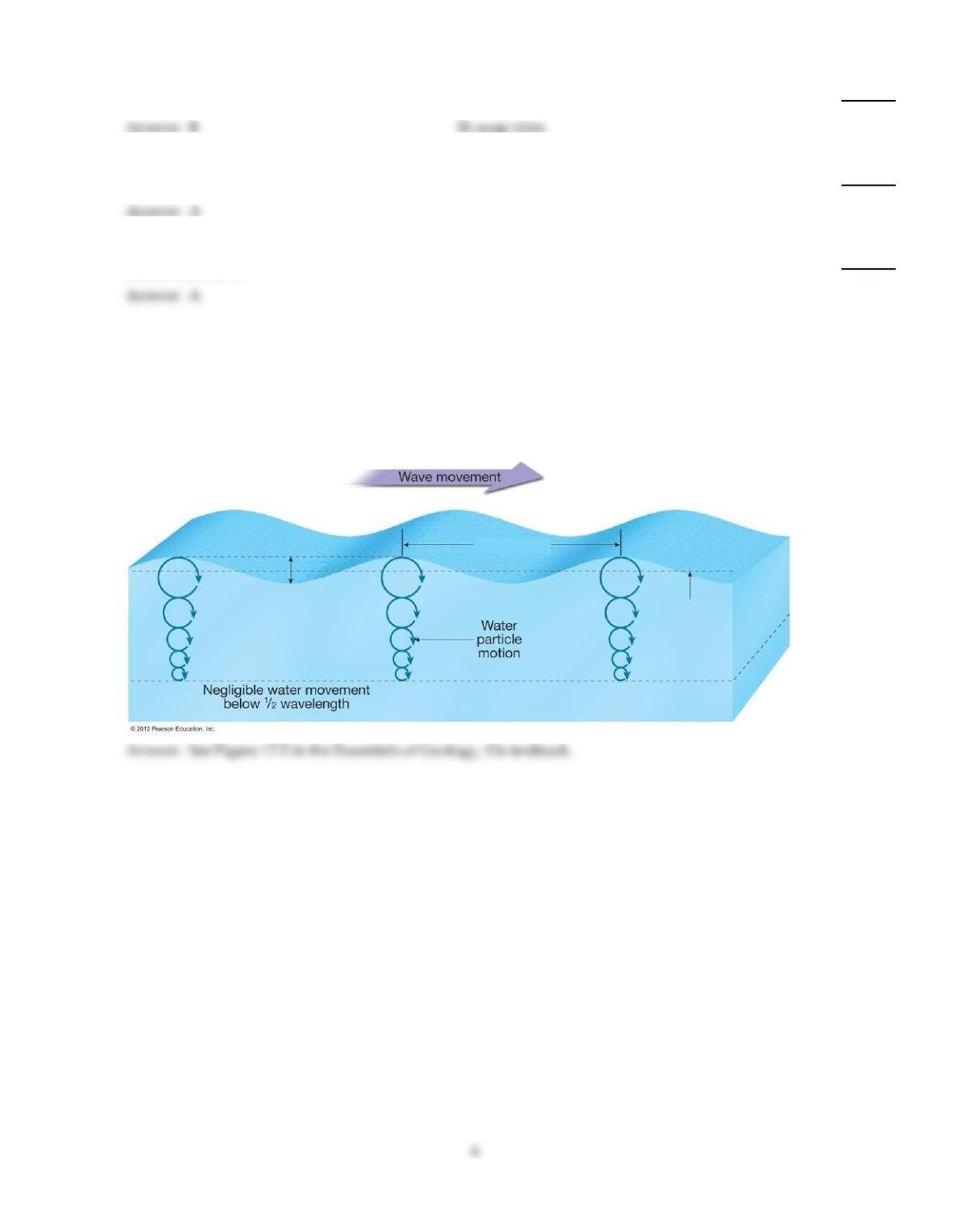
Label the basic parts of a wave on the diagram below.
neap tides
58)
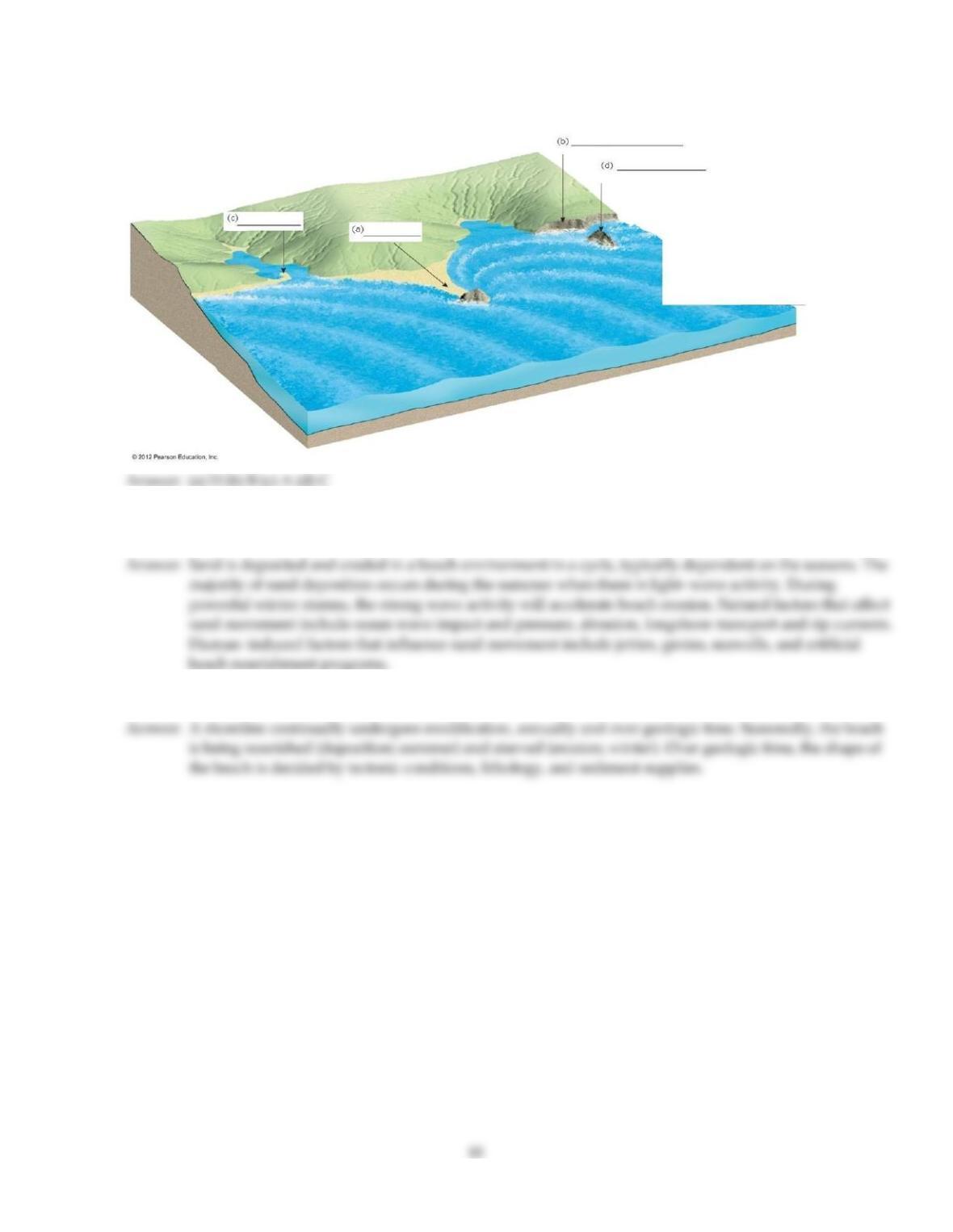
Match the features on the illustration below with the correct answer for each one.
A. tombolo B. wave–cut cliff C. spit D. sea stack
59)
Briefly discuss the movement of sand on a beach environment. Include those factors, both natural and
human–induced, that affect sand movement.
60)
Shorelines are temporary geologic and topographic features. Explain this statement.
61)
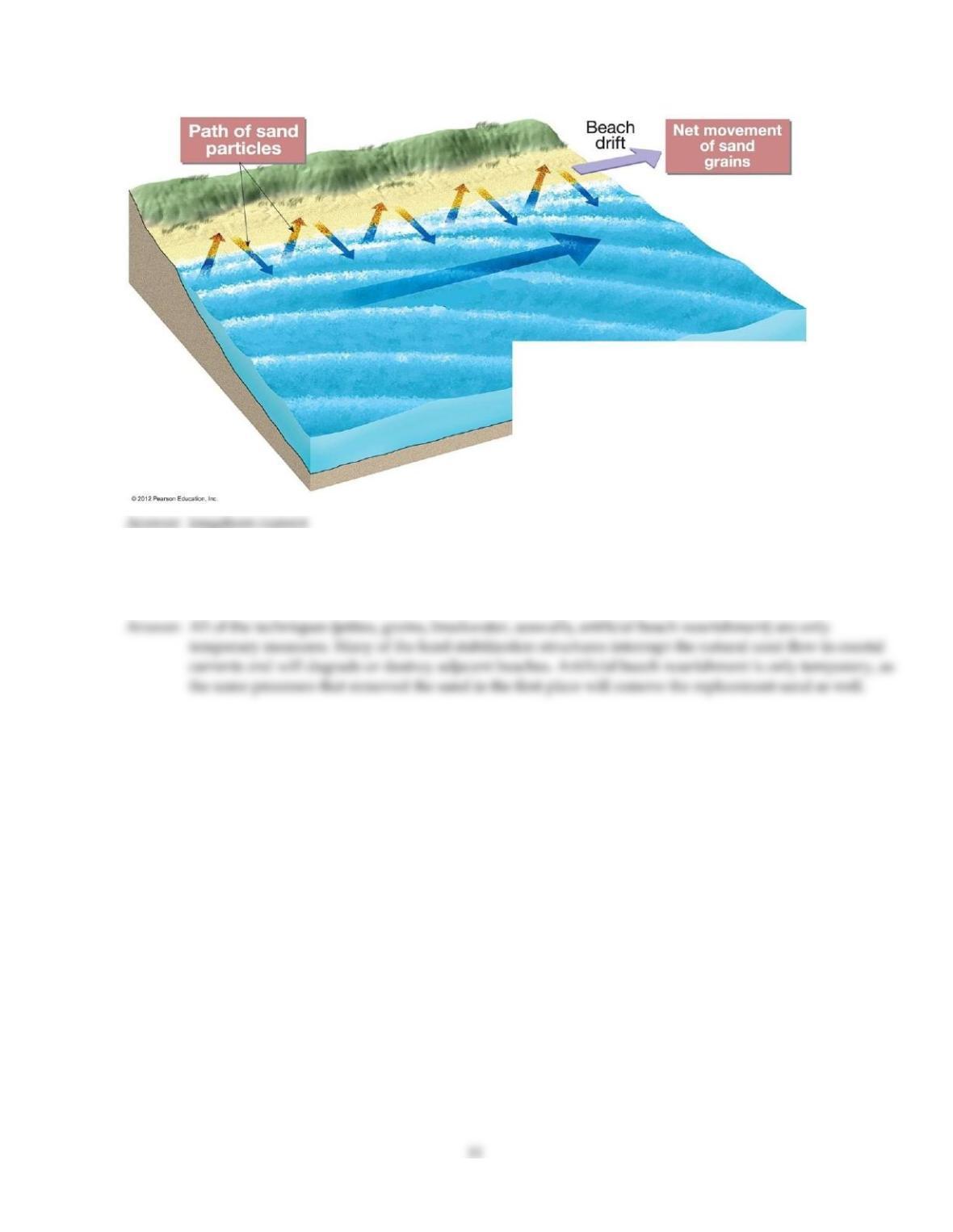
What type of current is illustrated in the diagram below?
62)
A variety of techniques and efforts are used to stabilize shorelines throughout the world. Are all of these efforts
only temporary measures or are any of them permanent? Also, does urbanization and development of coastal
areas always contribute to shoreline erosion? Explain.
Answer Key
Testname: C17
Answer Key
Testname: C17
13