Biology: A Guide to the Natural World, 5e (Krogh)
Chapter 17 The Means of Evolution: Microevolution
1) Organisms that can interbreed with each other in nature but are genetically isolated from all
other organisms are a:
A) genus.
B) clone.
C) species.
D) family.
2) Which of the following statements about evolution is true?
A) Evolution involves maintaining a constant frequency of alleles in the gene pool.
B) Populations evolve.
C) Individuals evolve.
D) Evolution can proceed to a limited extent without the occurrence of mutation.
3) A population is:
A) a group of organisms that can successfully interbreed in nature but do not interbreed with
other such groups.
B) all the members of a species that live in a defined geographic region at the same time.
C) all the different species that live in a defined geographic area at the same time.
D) a group of different species that share common features.
4) The gene pool for a particular gene would include:
A) the sum of all the alleles for all the traits in the population.
B) all the alleles for a given trait in a particular individual organism of the population.
C) the sum of all the phenotypes in the population.
D) all the alleles for a particular gene in all the individuals in the population.

5) The genetic makeup of any organism is its ________, which determines the physical
characteristics called its ________.
A) genotype; alleles
B) gene pool; alleles
C) phenotype; genotype
D) genotype; phenotype
6) If every sexually reproducing organism has only two alleles for each gene, how can there be a
range of traits seen for a physical characteristic?
A) One of the alleles in an organism is expressed at different levels, while the other is turned off.
B) Sometimes one of the alleles works, and other times the other allele works.
C) There can be more than two variations of a gene in a population.
D) In a population there are only two variations of a gene, but they are blended differently during
sexual reproduction.
7) At its most basic level, evolution is a:
A) change in the frequency of alleles in a population.
B) change in the frequency of alleles in an individual.
C) new species arising from an existing species.
D) change in an individual’s phenotype caused by mutations.
8) What is the difference between microevolution and macroevolution?
A) Microevolution is hypothetical because changes are too small to be observed, whereas
macroevolution is detectable.
B) Microevolution deals with microscopic organisms, whereas macroevolution deals with larger
ones.
C) Microevolution describes what happens in small populations, whereas macroevolution deals
with large populations.
D) Microevolution describes changes within a population over a short period of time, whereas
macroevolution describes larger changes such as the formation of new species over longer
periods of time.

3
9) The formation of new species over many generations is an example of:
A) microevolution.
B) macroevolution.
C) gene pools.
D) allelic variants.
10) If within a large population no mutations occur, no migration occurs, all mating is random,
and each individual has an equal chance of reproducing, which of the following will probably
happen?
A) No evolution will occur.
B) A bottleneck will occur.
C) A change in allele frequency will lead to rapid evolution.
D) Extinction will occur.
11) As world travel becomes easier and human populations intermix, the occurrence of what
phenomenon will probably decrease?
A) mutation
B) sexual selection
C) immigration
D) founder effect and genetic drift
Refer to the scenario below, and then answer the following question(s).
Two European men and two Polynesian women settled on a previously uninhabited tropical
island. All four of the settlers have brown eyes, a dominant trait, but one of the Europeans is
heterozygous and carries the recessive gene for blue eyes.
12) No new settlers arrive, and nobody leaves the island. After a few generations, the percentage
of blue-eyed individuals increases from the original zero to 25 percent. This is probably due to
which of the following factors?
A) genetic drift
B) mutation
C) gene flow
13) After several generations, 35 percent of the island population is found to have AB+ blood.
This is much higher than the percentage of AB+ people in the populations from which the
original settlers came. The high percentage of AB+ blood is probably due to:

A) founder effect.
B) selective mutation.
C) disruptive selection.
D) nonrandom mating.
14) Which of the following is ultimately responsible for introducing new alleles into a
population?
A) mutation
B) natural selection
C) sexual selection
D) genetic drift
15) The only known population of a reptile species lives on an African mountain. The population
is relatively large, but no close relatives of this species are known. Suppose you could stop all
mutations within the population and all emigration out of this population. Which statement best
describes the probable future of this population?
A) The population will decline and become extinct after a few generations because of excessive
inbreeding.
B) Evolution will continue as natural selection acts on the genetic variability that exists in the
population.
C) Although the population will cease to change, it may survive for as long as the environment
remains constant.
D) Genetic drift will cause major evolutionary changes in the population.
16) Shrews have been documented to travel across frozen lakes and establish populations on
previously uninhabited islands; thus, the shrews have a limited gene pool. If this limited gene
pool has allele frequencies that are very different from the allele frequencies found in the original
population, then this would be an example of:
A) natural selection.
B) population bottleneck.
C) divergent evolution.
D) founder effect.
17) Imagine a population of monkeys in South America whose habitat has been reduced to the
point where only 25 monkeys survive. This is an example of:
A) population bottleneck.
B) founder effect.
C) genetic drift.
D) natural selection.
18) The most immediate effect of sexual displays and contests in animals (such as bighorn sheep
bashing their heads together) is:
A) mutations.
B) differential mating success.
C) disruptive selection.
D) stabilizing selection.
19) Genetic drift occurs when:
A) chance occurrences alter gene frequencies.
B) reproduction is nonrandom within the population.
C) gene flow within the population is less than gene flow between populations.
D) the population has not yet stabilized.
20) The mate-attracting elaborate plumage of the male peacock is a result of:
A) genetic drift.
B) adaptation to the environment.
C) sexual selection.
D) gene flow.
21) Evolution by genetic drift is most obvious in:
A) invertebrate species.
B) migratory species.
C) aquatic populations.
D) small populations.
22) Mutations:
A) are always detrimental.
B) account for most of the change in allele frequency in a population.
C) may do nothing, may be harmful, or may be beneficial.
D) are always beneficial.
23) Which of the following processes is not an agent of microevolution?
A) gene flow
B) natural selection
C) mutation
D) polygenic inheritance
E) genetic drift
24) ________ is necessary for a population to survive over successive generations in response to
environmental changes.
A) Adaptation
B) Sexual selection
C) Speciation
D) Gene flow
25) In order for migration to alter allele frequencies in another population:
A) a large portion of the population must die off.
B) a large portion of the population must leave as new individuals arrive.
C) the gene pool of the migrating population must be different from the population it is joining.
D) the gene pools of the populations involved must be very similar.
26) Two nearby populations in which there is some movement of individuals between the
populations are an example of:
A) disruptive selection.
B) bottleneck effect.
C) genetic drift.
D) gene flow.
27) A bottleneck may be dangerous to a population because:
A) the potential for natural selection is greatly increased.
B) mutation rate is increased.
C) genetic variability is diminished.
D) mutation rate is decreased.

28) Which of the following is most likely to cause genetic changes in a population that make it
better adapted to its environment?
A) nonrandom mating
B) natural selection
C) gene flow
D) genetic drift
29) The term “natural selection” is not interchangeable with the term “evolution” because:
A) natural selection is just a theory, whereas evolution has been proven.
B) a population may evolve in ways other than through natural selection.
C) Darwin coined the term “natural selection,” but not “evolution.”
D) natural selection does not always lead to evolution.
30) Habitats set aside for endangered species are often sectioned into areas by roads, producing
separate small populations. This causes problems in conservation because it reduces:
A) gene flow between populations.
B) the number of potential leaders.
C) sharing of resources.
D) interaction among generations.
31) Even though in a similar habitat, a founder population that breaks away from the parent
population may become very different because of:
A) mutation.
B) genetic drift.
C) natural selection.
D) the bottleneck effect.

9
32) Extreme hunting pressure has caused northern elephant seals to become less genetically
diverse because of:
A) genetic drift.
B) population bottleneck.
C) natural selection.
D) founder effect.
33) Which of the following is incorrectly paired?
A) gene flow: genes move from one population to another
B) bottleneck effect: changes in allele frequencies due to chance events
C) founder effect: only a small portion of an original population’s gene pool are represented
D) sexual selection: mating based on phenotype
34) The greater prairie chicken once flourished on the prairies of Illinois. The conversion of
prairie to farmland reduced their numbers from millions to only 50 birds by 1993. Poor genetic
diversity resulted in only 50 percent of eggs hatching. Bringing in birds from neighboring states
increased their genetic diversity, which improved the egg-hatching rate to 90 percent. These
changes in genetic diversity were the result of:
A) loss of genetic diversity through natural selection and restoration of genetic diversity by
genetic drift.
B) loss of genetic diversity through mutation and restoration of genetic diversity by gene flow.
C) loss of genetic diversity through genetic drift and restoration of genetic diversity by natural
selection.
D) loss of genetic diversity through genetic drift and restoration of genetic diversity by gene
flow.
35) Which of the following statements is true?
A) The advantage a trait conveys depends on its environmental context.
B) A population will always evolve to fit current conditions.
C) All traits are simultaneously maximized in a population.
D) All traits currently in a population must have provided a reproductive advantage at some
point in time.
36) Which of the following males in a given population would be considered the most fit in an
evolutionary sense?
A) one that produced 1,000 offspring, of which 100 survived but 99 did not reproduce

B) one that produced 100 offspring, of which 10 survived but 9 did not reproduce
C) one that produced 1,000 offspring, all of which died before reaching reproductive age
D) one that produced two offspring, both of which survived and produced offspring of their own
37) Which of the following possibilities is the best indicator of an organism’s evolutionary
fitness?
A) the number of eggs it produces over its lifetime
B) the number of gametes it produces during the years when it is likely to be reproducing
C) the number of offspring it produces over its lifetime that survive to breed.
D) the number of offspring it produces over its lifetime
38) For the Galapagos Islands finch species Geospiza fortis, drought conditions produced a
change in the population in which the next generation had larger beaks than the previous one.
What produced this change in the population?
A) Birds with larger beaks had higher fitness, so they could produce more offspring that
inherited the same trait.
B) Birds with smaller beaks flew to nearby islands where food was more plentiful.
C) Birds with smaller beaks had higher fitness, but they were outcompeted by birds with larger
beaks.
D) Birds with smaller beaks had higher fitness, but they waited to reproduce until wet weather
returned.
39) Which of these humans is the “fittest” as far as natural selection is concerned?
A) a person with seven children who is killed in an automobile accident at age 40
B) a person who lives to the age of 105 and has two children
C) a person who lives to the age of 110 and has no children
D) a very popular film star who is still alive, is very rich, and has three children from three
spouses
11
40) How successful an individual is at passing on its genes to the next generation is known as:
A) microevolution.
B) adaptation.
C) fitness.
D) sexual selection.
Read the statement below, and then answer the following question(s).
A small population of deer is introduced to an island. All the males have 11 to 13 points on their
antlers.
41) If after several generations most males have antlers with 20 points, this development will
have been the result of:
A) directional selection.
B) disruptive selection.
C) founder effect.
D) bottleneck effect.
42) If after several generations 30 percent of the males have antlers with 9 to 11 points, 40
percent have antlers with 15 to 17 points, and 20 percent have antlers with 12 to 14 points, this
development will have been the result of:
A) directional selection.
B) disruptive selection.
C) founder effect.
D) stabilizing selection.
43) If after several generations all males have 12-point antlers, this development will have been
due to:
A) directional selection.
B) disruptive selection.
C) founder effect.
D) stabilizing selection.
44) Phenotypes that show a wide range of almost continuous variation, such as height or skin
color in humans, are probably:
A) due to several sets of alleles working together.

B) due to both alleles of one gene working together.
C) acquired characteristics.
D) dominant.
45) You are studying leaf size in a natural population of plants. The second season is particularly
dry, and the following year the average leaf size in the population is smaller than the year before.
But the amount of overall variation is the same, and the population size hasn’t changed. Also,
you’ve done experiments that show that small leaves are better adapted to dry conditions than are
large leaves. Which of the following has occurred?
A) stabilizing selection
B) directional selection
C) genetic drift
D) disruptive selection
46) The most important kind of selection acting on a well-adapted population in a relatively
constant environment is:
A) disruptive.
B) stabilizing.
C) directional.
D) catastrophic.
47) Disruptive selection operates whenever:
A) a phenotype is more successful because it is rare.
B) natural selection is disrupted by genetic drift.
C) the extremes in a distribution of phenotypes are more fit than the average.
D) only the largest individuals survive.

48) How have Caesarean sections and intensive neonatal (near-birth) medical care likely affected
the average birth weight of American babies?
A) Birth weight is now subject to disruptive selection instead of stabilizing selection.
B) Average birth weights have significantly decreased.
C) Gene flow will occur in the direction of larger and smaller infants.
D) Stabilizing selection for birth weight no longer has as much of an influence.
49) For a particular character, natural selection can favor an average phenotype or extreme
phenotypes. In order to do this, a character must be:
A) under the control of many genes.
B) under the control of only two alleles for a gene.
C) not under the control of any genes.
D) controlled by a dominant allele for a gene.
50) African black-bellied seedcracker finches have beaks that are either large or small. Only
large-beaked birds can crack open hard seeds, and small-beaked birds are more adept at handling
small seeds. Both have an advantage over intermediate-sized beaks. This is an example of a
response to:
A) directional selection.
B) stabilizing selection.
C) disruptive selection.
D) sexual selection.
51) Male guppies are known for their bright colors. Having bright colors attracts mates, but it
also attracts predators. So in an environment with a lot of predators, male guppies have more dull
colors. In an experiment, guppies were removed from an area with predators to an area without
predators. Over a period of 12 months the population became much more colorful. This is an
example of a response to:
A) directional selection.
B) stabilizing selection.
C) disruptive selection.
D) mutation.
52) The basic units that evolve are species.

53) There can be more than two varieties of alleles for a particular gene in a population.
54) A small minority of mutations is adaptive, providing an improvement to the gene pool of the
population.
55) Genetic drift has a much more significant effect on small populations than on large
populations.
56) Without mutation, evolution would eventually cease, because mutations create the variation
that evolution acts upon.
57) A population of salamanders migrates from a sand beach to a pebble beach and evolves over
many generations from a solid color to speckled coloration. This process is called stabilizing
selection.
58) If a species of bird with an intermediate beak size evolves into two varieties, one with large
beaks and one with small beaks, this could result from disruptive selection.
Match the following.
A) sexual selection
B) stabilizing selection
C) founder effect
D) genetic drift
E) gene flow
59) A small number of individuals from one area establish a new isolated population in another
area. The gene frequencies of the new population differ from those of the original population.
Topic: Section 17.3
Skill: Knowledge/Comprehension
60) Females tend to mate with brightly colored males.
Topic: Section 17.3
Skill: Knowledge/Comprehension
61) Alleles migrate into or out of a population from neighboring populations.
Topic: Section 17.3
Skill: Knowledge/Comprehension
62) Chance events change allele frequencies in populations.
Topic: Section 17.3
Skill: Knowledge/Comprehension
63) Individuals with average phenotypes are favored over those with extreme phenotypes.
Topic: Section 17.5
Skill: Knowledge/Comprehension
64) The smallest unit that can participate in evolution is a ________.
65) The original source of variation within a population comes from ________.
66) When a population decreases in number until a small remnant of the original population
remains, a ________ has occurred.
67) In ________ selection, individuals with an intermediate phenotype are favored over other
individuals in the population.
68) ________ characters are continuously variable.
69) Cheetahs are not a healthy species. Several million years ago they were widespread in Africa
and Asia, but their numbers fell drastically during the last ice age and again when they were
hunted to near extinction in the nineteenth century. Now, they suffer from low survivorship (a
large number of animals dying), poor sperm quality, and greater susceptibility to disease.
Normally, an animal will reject tissue transplanted from another animal, but cheetahs will not
reject tissue grafted on to them from another cheetah. What happened to the cheetah? How did
their genetic variation change? Where does genetic variation ultimately come from? What
mechanism can maintain and increase genetic variation in natural populations?
70) One solution to the problem of species extinction is captive breeding in zoos and gardens.
What are some of the problems associated with this solution?
71) List five mechanisms by which gene frequencies in a population can be altered. Describe
each briefly.
72) Male long-tailed widowbirds have unusually long tails, about 20 inches in length, whereas
the females have short tails. In an experiment with long-tailed widowbirds, one group of males
had their tails clipped to 5 inches, a second group were left with normal 20-inch tails, and a third
group had their tails lengthened to 30 inches by gluing on feathers clipped from the tails of other
birds. If sexual selection is responsible for the males having such long tails, predict what will
happen when similar numbers of females are placed in the territories of each group of males.
73) The concept of evolution has always been connected with some notion of progress–natural
selection pushing populations toward better and better adaptations to create “perfect organisms.”
How would you argue that evolution does not craft perfect organisms?
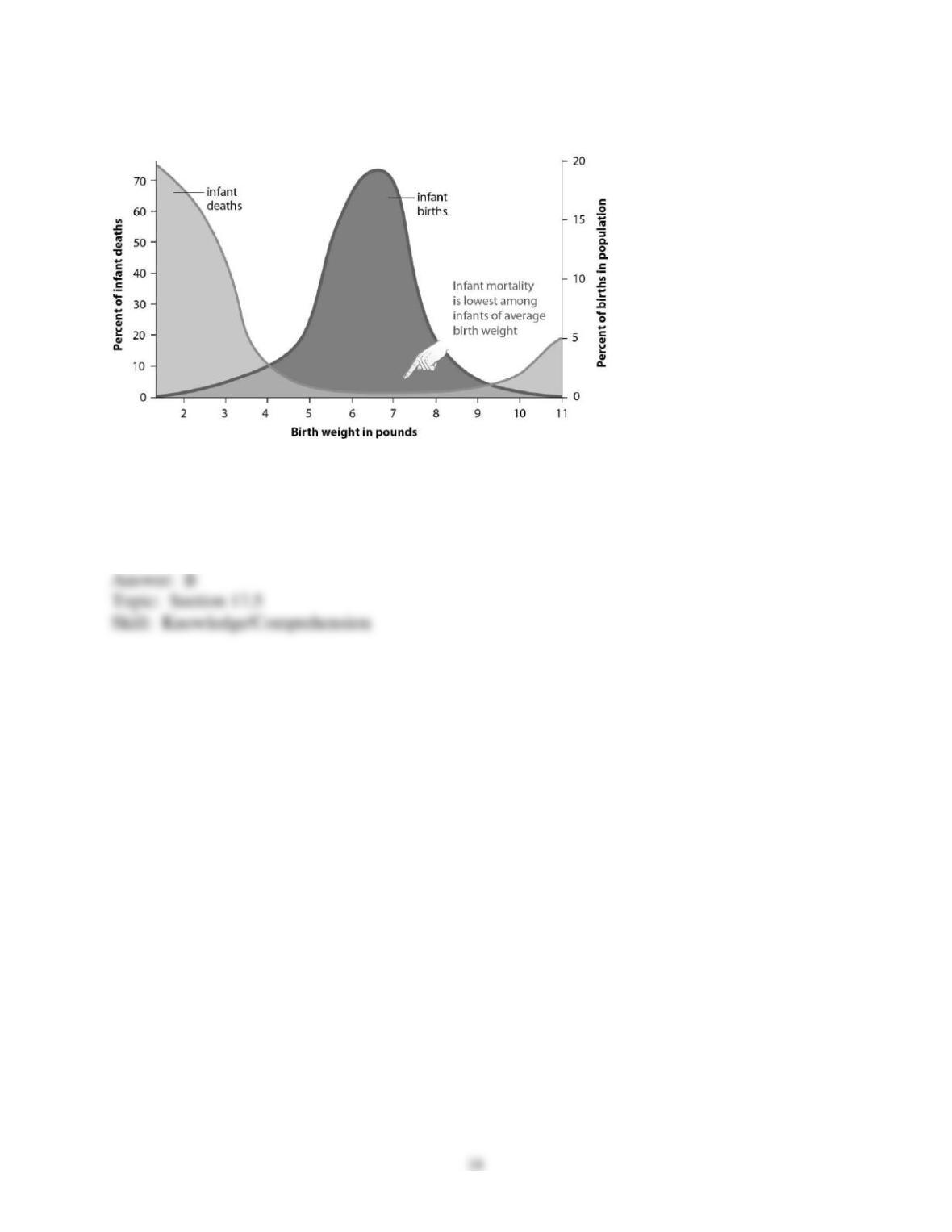
Refer to the figure below, and then answer the question that follows.
74) Human birth weights are an example of:
A) disruptive selection.
B) stabilizing selection.
C) directional selection.
D) sexual selection.
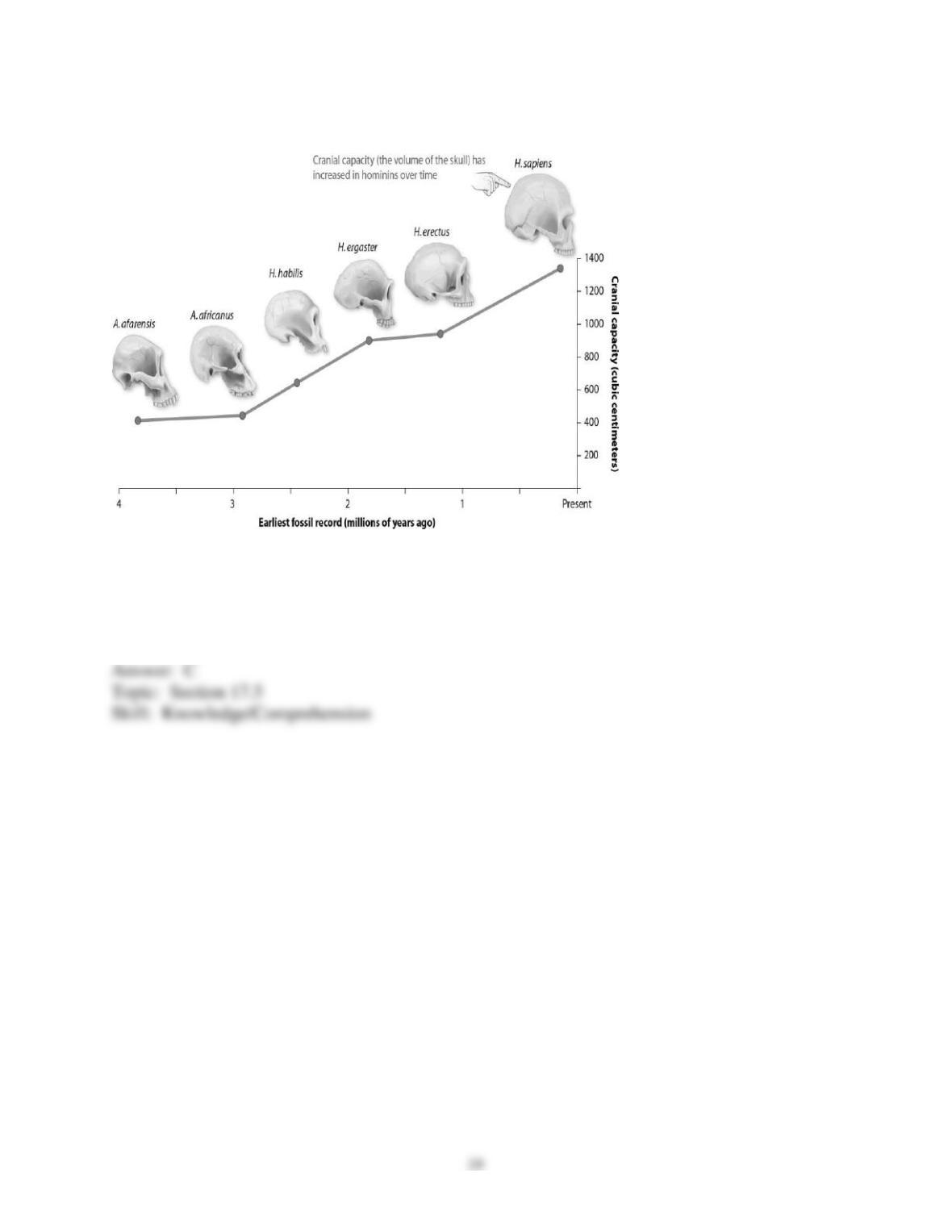
Refer to the figure below, and then answer the question that follows.
75) The changes in cranial capacity over the course of human evolution are an example of:
A) disruptive selection.
B) stabilizing selection.
C) directional selection.
D) sexual selection.