
Chapter 17—Metabolism: An Overview
MULTIPLE CHOICE
1. All are characteristics of metabolism EXCEPT:
a.
a process which synthesizes either energy or complex cellular substances.
b.
a process of intermediates.
c.
the conversion of food energy into energy of motion.
d.
a free-flow unregulated process.
e.
a process responding to the momentary energy requirements of a cell.
2. Most organisms show ____ in their major pathways of metabolism.
a.
marked similarity
b.
some similarity
c.
minimal similarity
d.
considerable diversity
e.
major diversity
3. Which of the following statements is true regarding metabolic pathways?
a.
catabolic pathways are generally reductive while anabolic pathways are generally
oxidative
b.
catabolic pathways use a wide variety of substrates to produce a small number of waste
products.
c.
an amphibolic pathway is extremely wasteful because it simultaneously operates as both
an anabolic pathway and a catabolic pathway.
d.
NAD+ is used as a reducing agent in catabolic pathways while NADPH is used as an
oxidizing agent in anabolic pathways
e.
none of the above
4. Likely the most ancient of the metabolic pathways in which energy is released from glucose and
captured in the form of ATP under anaerobic conditions is called:
a.
photooxidation.
b.
oxidative phosphorylation.
c.
citric acid cycle.
d.
glycolysis.
e.
none of the above.
5. Photoheterotrophs require:
a.
organic carbon sources and light.
b.
carbon dioxide and light.
c.
organic carbon sources and oxidation-reduction reactions.
d.
carbon dioxide and inorganic compounds.
e.
carbon dioxide and oxidation-reduction reactions.

6. All of the following are chemoheterotrophs EXCEPT:
a.
Staphylococci aureus.
b.
fungi.
c.
algae.
d.
animals.
e.
non-photosynthetic roots.
7. What is the relationship between photoautotrophs and heterotrophic cells?
a.
Photoautotrophs use light energy for synthesis of organic molecules while heterotrophs
metabolize organic substances for fuel and building blocks.
b.
photoautotrophs use organic compounds as a source of carbon while heterotrophs use CO2
as a source of carbon.
c.
Photoautotrophs synthesize CO2 while heterotrophs synthesize O2.
d.
Heterotrophs convert solar energy into chemical energy while photoautotrophs break
down organic molecules.
e.
There is no relationship between the two.
8. Which statement is most likely to be true concerning obligate anaerobes?
a.
These organisms can use oxygen if it is present in their environment.
b.
These organisms cannot use oxygen as their final electron acceptor.
c.
These organisms carry out fermentation for at least 50% of their ATP production.
d.
Most of these organisms are vegetative fungi.
e.
None of the above.
9. Some species can adapt to anaerobic conditions by substituting other electron acceptors for oxygen in
their energy-producing pathways and are called:
a.
aerobes.
b.
obligate aerobes.
c.
facultative anaerobes.
d.
obligate anaerobes.
e.
none of the above.
10. Solar energy is converted to the chemical energy of organic molecules by ____, and ____ recover this
energy by metabolizing the organic substrates.
a.
photoautotrophs; heterotrophs
b.
heterotrophs; chemoautotrophs
c.
chemoautotrophs; heterotrophs
d.
photoautotrophs; chemoautotrophs
e.
none are true.

11. All are characteristics of anabolism EXCEPT:
a.
assembly of complex molecules.
b.
formation of new covalent bonds.
c.
ATP provides energy.
d.
NADPH is an electron donor.
e.
all are true.
12. All are true about the relationship between catabolism and anabolism EXCEPT:
a.
They occur simultaneously.
b.
Products of one process provide substrates for the other.
c.
They occur in many of the same organelles.
d.
The generation of ATP by catabolism provides the energy required by anabolism.
e.
Anabolism is endergonic while catabolism is exergonic.
13. Metabolon characteristics include all EXCEPT:
a.
“units of metabolism”.
b.
discrete multienzyme complex.
c.
soluble enzymes associated into stable multienzyme complexes.
d.
membrane bound multienzyme systems.
e.
all are characteristics.
14. Which of the following is the major advantage of a multi-enzyme complex?
a.
it’s large size enables it to span an entire membrane
b.
the product of one enzyme is passed directly to the next enzyme without the possibility of
diffusion
c.
multi-enzyme complexes are much less likely to be inhibited
d.
all of the above
e.
none of the above
15. What are the final products of aerobic catabolism?
a.
pyruvate and H2O.
b.
acetyl-CoA and CO2.
c.
CO2 and H2O.
d.
pyruvate and acetyl-CoA.
e.
ammonia and O2.
16. Many of the catabolic pathways converge to the common two-carbon intermediate:
a.
alanine.
b.
acetyl group of acetyl-CoA.
c.
lactic acid.
d.
glucose.
e.
carbon dioxide.

Garrett/Grisham 5e Test Bank 4
17. The definition of an amphibolic pathway is:
a.
a pathway found in animals living in both land and water.
b.
a pathway that is carried out both in water and organic solvents.
c.
a pathway found on both sides of the mitochondrial membrane.
d.
a pathway that is both anabolic and catabolic in nature.
e.
all of the above.
18. Since both glycolysis and gluconeogenesis are spontaneous pathways, which of the following explains
how this is true?
a.
glycolysis uses 10 enzyme catalyzed steps while gluconeogenesis uses 11
b.
the three irreversible steps of glycolysis have alternate routes for gluconeogenesis
c.
glycolysis converts glucose to pyruvate while gluconeogenesis converts pyruvate to
glucose
d.
glycolysis is oxidative while gluconeogenesis is reductive
e.
glycolysis is catabolic while gluconeogenesis is anabolic
19. In the case of shared anabolic and catabolic pathways, the ____ serve as the points of regulation.
a.
largest enzymes
b.
ATP producing enzymes
c.
NADH utilizing enzymes
d.
rate-limiting enzymes
e.
all are true
20. In phototrophs, ____ and ____ are the two energy-rich primary products from the transformation of
light energy into chemical energy.
a.
ATP; NAD+
b.
NADPH; ATP
c.
NADH; NADPH
d.
ATP; NADH
e.
ATP; NADH
21. Energy is generally extracted from phototrophs and chemotrophs by:
a.
hydrolysis reactions.
b.
condensation-cleavage reactions.
c.
oxidative-reduction reactions.
d.
acid-base reactions.
e.
phosphorylation reactions.
22. Whcih of the following is NOT a characteristic of aerobic catabolic pathways?
a.
an example of a catabolic pathway is the conversion of hexoses to 3-carbon compounds
b.
ADP is phosphorylated to ATP as a result of such pathways.
c.
NADH is a common product of such pathways
d.
Water is oxidized to O2
e.
generally, the energy produced by such pathways is greater than the energy required to
activate the substrates for the pathway

23. All of the following are examples of energy transduction EXCEPT:
a.
dehydrogenase catalyzed reactions
b.
isomerase reactions
c.
oxidative phosphorylation
d.
NAD+– NADH shuttle
e.
all of the above are correct
24. Dehydrogenases are enzymes that:
a.
move hydrogens within the molecule.
b.
add hydrogens across double bonds.
c.
transfer hydrogens between substrates.
d.
transfer hydride ions to NAD+ (or NADP+) and release a proton.
e.
all are true.
25. From the following types of organic molecules, the order of most reduced to most oxidized is:
A.
aldehyde
B.
hydrocarbon
C.
CO2
D.
alcohol
E.
carboxylic acid
a.
A, B, C, D, E
b.
B, E, A, D, C
c.
C, B, E, A, D
d.
B, D, A, E, C
e.
C, D, E, B, A
26. A possible function of NADPH is to:
a.
provide reducing equivalents to synthesize glucose from CO2.
b.
carry electrons from anabolic reactions.
c.
provide a source of hydrogens for oxidative biosynthesis.
d.
be reduced by hydride ions to form NAD+.
e.
produce an oxidative product.
27. In photosynthesis, NADPH is generated as light is used to oxidize ____ to ____.
a.
water; O2
b.
water; CO2
c.
NADPH; O2
d.
water; NADP+
e.
CO2; NADPH

Garrett/Grisham 5e Test Bank 6
28. One advantage of nuclear magnetic resonance (NMR) spectroscopy for the investigation of
metabolism is that it utilizes:
a.
radioisotopes.
b.
specific metabolic inhibitors.
c.
autoradiography.
d.
non-invasive techniques.
e.
none are true.
29. In prokaryotic cells, phospholipid synthesis and oxidative phosphorylation are carried out in:
a.
plasma membranes.
b.
cytosol.
c.
mitochondria.
d.
ribosomes.
e.
endoplasmic reticulum.
30. The enzymes of glycolysis and those of the citric acid cycle are found in which cellular compartments
in muscle cells?
a.
both in the cytoplasm
b.
glycolysis in cytoplasm and citric acid cycle in mitochondria
c.
both in mitochondria
d.
glycolysis in cytoplasm and citric acid cycle in lumen of the endoplasmic reticulum
e.
both in the lumen of the endoplasmic reticulum
31. Which of the following statements regarding nutrition is FALSE?
a.
Dietary protein is a source of essential amino acids
b.
Organisms can produce all of the essential energy yielding nutrients and micronutrients
needed
c.
Complex carbohydrates can provide simple sugars for the glycolytic pathway
d.
Essential fatty acids are components of biological membranes
e.
Fiber is needed to help clear the digestive tract
32. When an individual has a ____ nitrogen balance, excess dietary protein is converted into ____.
a.
negative; energy
b.
positive; energy
c.
negative; nucleic acids
d.
positive; protein for storage
e.
both b and d are true
33. When dietary carbohydrate consumption exceeds the energy needs of the individual, excess
carbohydrate is converted to ____ and ____ for energy storage.
a.
amino acids; glucose
b.
fructose; triacylglycerols
c.
triacylglycerols; glycogen
d.
glycogen; protein
e.
none of the above.

34. When carbohydrate intake is low, ____ are formed from acetate units to provide metabolic fuel for the
____ and other tissue.
a.
fatty acids; liver
b.
ketone bodies; brain
c.
ketone bodies; liver
d.
amino acids; brain
e.
sterols; heart
35. Excess carbohydrate and fat in the human diet is stored as triacylglycerols. The risk of which of the
following would be increased in an individual who consistently consumes too much fat and
carbohydrate?
a.
atherosclerosis
b.
heart disease
c.
colon cancer
d.
breast cancer
e.
all of the above
36. Dietary fiber includes all EXCEPT:
a.
pectins
b.
cellulose
c.
lignins
d.
gums
e.
all are dietary fiber
37. The nutritional benefits provided by foods high in fiber result from:
a.
providing increased digestion speed.
b.
stimulation of regular functions of the colon and slowing the rate of absorption of certain
foods.
c.
providing for growth of microorganisms that utilize fiber.
d.
increased vitamin release from complexes with fiber.
e.
none of the above.
38. All of the following are a coenzyme or a precursor of a coenzyme EXCEPT:
a.
thiamin.
b.
riboflavin.
c.
retinol.
d.
niacin.
e.
biotin.

39. All are characteristics of coenzymes EXCEPT:
a.
carry functional groups.
b.
maintenance of original structure.
c.
provide a broader range of catalytic properties.
d.
can be derived from water-soluble vitamins.
e.
can serve as an electron carrier.
40. Which of the following is a result of a high fat, high protein, low carbohydrate diet?
a.
the bloodstream has a healthy level of ketone bodies
b.
glycogen stores are close to maximum capacity
c.
the brain operates most efficiently on this type of diet
d.
ketone body production generally exceeds rate of elimination
e.
none of the above
41. The dehydrogenase enzymes facilitate the direct transfer of hydride anion. Which of the following
coenzymes is required for this transfer?
a.
biotin
b.
folic acid
c.
lipoic acid
d.
TPP
e.
NAD+
42. All are coenzymes with an adenine nucleotide portion EXCEPT:
a.
ATP.
b.
NADH.
c.
Coenzyme A.
d.
FADH2.
e.
FMNH2.
43. What is a characteristic difference between FAD and NAD+?
a.
NAD+ is a stronger oxidizing agent than FAD.
b.
Only FAD participates in oxidation-reduction reactions.
c.
NAD+ binds tightly to its enzyme while FAD only binds loosely.
d.
NAD+ transfers two electrons while FAD can transfer one or two.
e.
NAD+ is re-oxidized easily by molecular oxygen while FAD is not.
44. Pantothenic acid is the vitamin portion of ____. It forms ____ linkages with acyl groups.
a.
ATP; phosphoester
b.
ATP; thioester
c.
Coenzyme A; phosphoester
d.
Coenzyme A; thioester
e.
TPP; phosphoester

45. Pyridoxal-5-phosphate (PLP) is involved in all EXCEPT:
a.
aminotransferases (transaminases).
b.
– and -decarboxylations.
c.
– and -eliminations.
d.
racemizations.
e.
all of the above.
46. Thioesters have higher ____ than that of oxygen esters.
a.
mobility
b.
electronegativity
c.
resonance
d.
positive G
e.
group transfer potential
47. What causes pyridoxal-5-phosphate (PLP) to be so versatile?
a.
It reacts very quickly with simple sugars.
b.
Its ability to be a one or two electron carrier.
c.
The formation of a thioester bond.
d.
Its ability to transfer methyl groups.
e.
Its ability to form a Schiff base and act as an electron sink.
48. All of the coenzymes listed participate in electron transfer EXCEPT:
a.
FAD.
b.
biotin.
c.
NAD+.
d.
vitamin C.
e.
lipoic acid.
49. ______ is often used in carboxylation reactions while ____ is often used in decarboxylation reactions.
a.
thiamine pyrophosphate; lipoate
b.
lipoate; biotin
c.
biotin; thiamine pyrophosphate
d.
pyridoxal-5-phosphate; biotin
e.
lipoate; pyridoxal-5-phosphate
50. ____ functions to couple acyl-group transfer and electron transfer during oxidation and
decarboxylations of ____.
a.
biotin; propionate
b.
lipoate; propionate
c.
lipoate; -keto acids
d.
TPP; -keto acids
e.
TPP; acetyl-CoA

51. In a biotin-dependent carboxylation, _____ provides the energy for activation of ____.
a.
acetyl CoA; carbon dioxide
b.
ATP; lysine amine group
c.
NADH; bicarbonate
d.
ATP; bicarbonate
e.
acetyl CoA; carboxyl group
52. Pyruvate + CoA + NAD+ → ____ + CO2 + ____
a.
oxaloacetate; ATP
b.
malonyl CoA; NADH + H+
c.
methylmalonyl CoA; biotin
d.
acetyl CoA; NADH + H+
e.
succinyl CoA; NAD+
53. Which vitamin is essential to vision?
a.
A
b.
C
c.
D2
d.
B12
e.
B1
54. Retinol and the carotenoids follow the pathways of ____ digestion and absorption.
a.
complex carbohydrates
b.
proteins
c.
simple sugars
d.
nucleic acids
e.
lipids
55. Cholecalciferol is hydroxylated twice to form ____ that acts like a ____ to regulate ____ and ____
metabolism.
a.
24,25-hydroxyvitamin D; vitamin D-binding protein; calcium; chloride
b.
ergosterol; vitamin D-binding protein; sodium; calcium
c.
7-dehydrocholesterol; hormone; calcium; phosphate
d.
1,25-dihydroxycolecarciferol; prehormone; sodium; phosphate
e.
1,25-dihydroxycolecarciferol; hormone; calcium; phosphate
56. What are the principal minerals in the human body?
a.
iron and chloride
b.
sodium and potassium
c.
calcium and sodium
d.
calcium and phosphorus
e.
sulfur and phosphorus

57. Unsaturated fatty acids in membranes are particularly susceptible to ____ and vitamin E may provide
protection because it is a potent ____.
a.
oxidation; antioxidant
b.
reduction; reducing agent
c.
reduction; reducing agent
d.
substitution; reactant
e.
substitution; reactant
58. What vitamin is needed for coagulation of blood and what must happen for it to be functional?
a.
vitamin D, a co-translational modification of serine.
b.
vitamin K, a posttranslational carboxylation of glutamate.
c.
vitamin K, a co-translational carboxylation of aspartate.
d.
vitamin D, a posttranslational glycosylation of serine.
e.
vitamin E, a posttranslational glycosylation of tyrosine.
59. The statements are correct about the diseases caused by vitamin deficiencies EXCEPT:
a.
niacin deficiency leads to gout.
b.
vitamin A deficiency leads to night blindness that can be reversed by adding -carotene to
the diet.
c.
vitamin B12 prevents pernicious anemia.
d.
vitamin D deficiency leads to demineralization of bones and rickets.
e.
vitamin C prevents scurvy.
60. What coenzyme is found in pyruvate decarboxylase that aids in the decarboxylation of -keto acids?
a.
Thiamine pyrophosphate
b.
Folic acid
c.
Biotin
d.
Lipoic acid
e.
none of the above
61. The cofactors NAD+, NADPH and FAD all have what common chemical feature?
a.
they all contain a guanine nucleotide
b.
they all contain a sulfhydryl group that acts as a nucleophile
c.
they all pick up or release two electrons during an oxidation/reduction reaction
d.
they all can be used for phosphorylation of enzyme substrates
e.
none of the above
62. The conversion of glucose-6-phosphate to glucose-1-phosphate has a G´ of + 8.4 kJ/mol. How can
a reaction such as this proceed in a cell?
a.
it must be coupled to ATP hydrolysis
b.
the product must be rapidly used in a subsequent step of the pathway
c.
it can only occur with the help of an enzyme
d.
this reaction can not proceed and must go in the reverse manner
e.
both B and C are correct
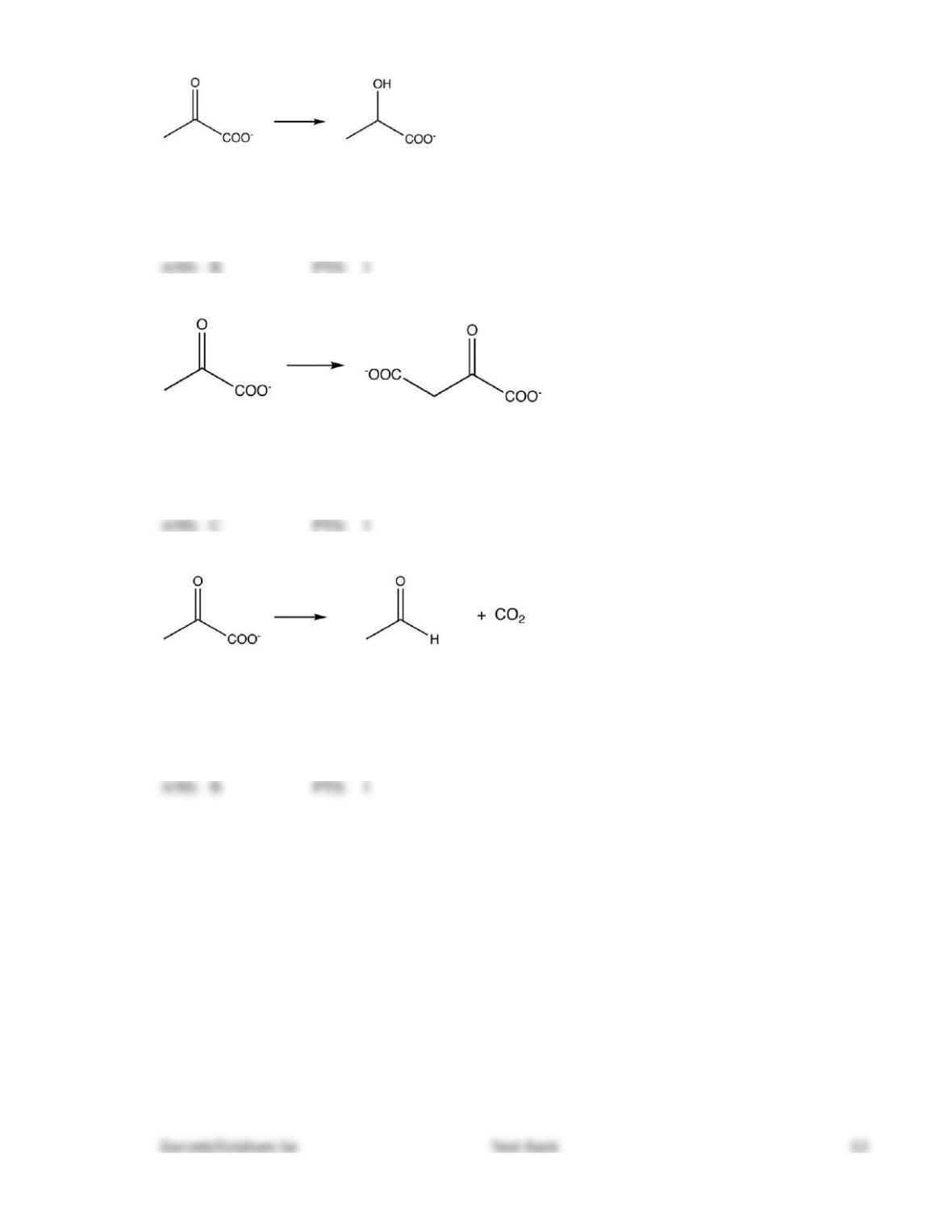
63. For the following reaction, what coenzyme is missing from the reactants?
a.
FADH2
b.
NAD+
c.
acetyl CoA
d.
NADH
e.
NADPH
64. What coenzyme would be required in the following reaction?
a.
ADP
b.
thiamine pyrophosphate
c.
biotin
d.
lipoic acid
e.
coenzyme A
65. What coenzyme would be required in the following reaction?
a.
NAD+
b.
thiamine pyrophosphate
c.
biotin
d.
lipoic acid
e.
coenzyme A