Chapter 17: Activity Resource Usage Model and Tactical Decision Making
105. Modesto Company produces CD Players for home stereo units. The CD Players are sold to retail stores for
$30. Manufacturing and other costs are as follows:
Variable costs per unit:
Fixed costs per month:
Direct materials
$ 9.00
Factory overhead
$120,000
Direct labor
4.50
Selling and admin.
60,000
Factory overhead
3.00
Total
$180,000
Distribution
1.50
Total
$18.00
The variable distribution costs are for transportation to the retail stores. The current production and sales volume is
20,000 per year. Capacity is 25,000 units per year.
A San Diego wholesaler has proposed to place a special one-time order of 10,000 units at a reduced price of $24
per unit. The wholesaler would pay all distribution costs, but there would be additional fixed selling and
administrative costs of $3,000. All other information remains the same as the original data. What is the effect on
profits if the special order is accepted?
a. increase of $12,000
b. increase of $57,000
c. increase of $75,000
d. decrease of $168,000
Chapter 17: Activity Resource Usage Model and Tactical Decision Making
106. Yosemite Company produces Blu-Ray Players for home stereo units. The Blu-Ray Players are sold to retail
stores for $30. Manufacturing and other costs are as follows:
Variable costs per unit:
Fixed costs per month:
Direct materials
$ 9.00
Factory overhead
$120,000
Direct labor
4.50
Selling and admin.
60,000
Factory overhead
3.00
Total
$180,000
Distribution
1.50
Total
$18.00
The variable distribution costs are for transportation to the retail stores. The current production and sales volume is
20,000 per year. Capacity is 25,000 units per year.
An Atlanta wholesaler has proposed to place a special one-time order for 7,000 units at a special price of $25.20
per unit. The wholesaler would pay all distribution costs, but there would be additional fixed selling and
administrative costs of $6,000. In addition, assume that overtime production is not possible and that all other
information remains the same as the original data. What is the effect on profits if the special order is accepted?
a. increase of $30,900
b. increase of $54,900
c. increase of $36,900
d. increase of $176,400
Additional revenues (7,000 $25.20)
Additional costs:
Variable (7,000 $16.50)
Fixed
6,000
Opportunity cost (2,000 $12)
Profits increase by
Chapter 17: Activity Resource Usage Model and Tactical Decision Making
107. Menagerie Products had the following unit costs:
Direct materials
$24
Direct labor
10
Variable factory overhead
8
Fixed factory overhead (allocated)
18
A one-time customer has offered to buy 900 units at a special price of $47 per unit. Assuming that sufficient
unused production capacity exists to produce the order and no regular customers will be affected by the order, how
much additional profit (loss) will be generated from the special order?
a. $6,000 loss
b. $4,500 profit
c. $12,500 profit
d. $42,300 profit
108. Albatross Products had the following unit costs:
Direct materials
$24
Direct labor
10
Variable factory overhead
8
Fixed factory overhead (allocated)
18
A one–time customer has offered to buy 2,000 units at a special price of $48 per unit. Because of capacity
constraints, 1,000 units will need to be produced during overtime. Overtime premium is $8 per unit. How much
additional profit (loss) will be generated by accepting the special order?
a. $30,000 loss
b. $4,000 profit
c. $24,000 loss
d. $4,000 loss
Chapter 17: Activity Resource Usage Model and Tactical Decision Making
Sales Value
Additional
Product
Units Produced
at Split-Off
Costs
Sales Value
A1
3,000
$10,000
$2,500
$15,000
B2
5,000
30,000
3,000
35,000
C3
4,000
20,000
4,000
25,000
D4
6,000
40,000
6,000
45,000
109. Cellestial Manufacturing Company produces Products A1, B2, C3, and D4 through a joint process. The joint
costs amount to $200,000.
If Processed Further
If Product B2 is processed further, profits will
a. increase by $2,000.
b. decrease by $3,000.
c. increase by $32,000.
d. increase by $30,000.
110. Cellestial Manufacturing Company produces Products A1, B2, C3, and D4 through a joint process. The joint
costs amount to $200,000.
If Processed Further
Sales Value
Additional
Product
Units Produced
at Split-Off
Costs
Sales Value
A1
3,000
$10,000
$2,500
$15,000
B2
5,000
30,000
3,000
35,000
C3
4,000
20,000
4,000
25,000
D4
6,000
40,000
6,000
45,000
Which product(s) should be sold at split-off to maximize profits in the short run?
a. Product A1
b. Product B2
c. Product D4
d. Products A1 and D4
Revenues
$5,000
$2,500
B2
$5,000
$3,000
C3
$5,000
$4,000
D4
$5,000
$6,000
Chapter 17: Activity Resource Usage Model and Tactical Decision Making
111. Davidian Company uses a joint process to produce products W, X, Y, and Z. Each product may be sold at its
split- off point or processed further. Additional processing costs of specific products are entirely variable. Joint
processing costs for a single batch of joint products are $120,000. Other relevant data are as follows:
Sales Value
Additional
Sales Value of
Product
at Split-Off
Processing Costs
Final Product
W
$ 40,000
$ 60,000
$ 80,000
X
$ 12,000
$ 4,000
$ 20,000
Y
$ 20,000
$ 32,000
$120,000
Z
$ 28,000
$ 20,000
$ 32,000
$100,000
$116,000
$252,000
Which products should Davidian process further?
a. all
b. none
c. all except Z
d. X and Y
112. Davidian Company uses a joint process to produce products W, X, Y, and Z. Each product may be sold at its
split- off point or processed further. Additional processing costs of specific products are entirely variable. Joint
processing costs for a single batch of joint products are $120,000. Other relevant data are as follows:
Sales Value
Additional
Sales Value of
Product
at Split-Off
Processing Costs
Final Product
W
$ 40,000
$ 60,000
$ 80,000
X
$ 12,000
$ 4,000
$ 20,000
Y
$ 20,000
$ 32,000
$120,000
Z
$ 28,000
$ 20,000
$ 32,000
$100,000
$116,000
$252,000
Processing Y further will cause profits to
a. increase by $68,000.
b. increase by $52,000.
c. decrease by $32,000.
d. increase by $120,000.
Chapter 17: Activity Resource Usage Model and Tactical Decision Making
113. Information about three joint products follows:
A
B
C
Anticipated production
5,000 lbs.
1,000 lbs.
2,000 lbs.
Selling price/lb. at split–off
$10
$30
$16
Additional processing costs/lb.
after split-off (all variable)
$ 6
$12
$24
Selling price/lb. after further
processing
$20
$40
$50
The cost of the joint process is $60,000. Which of the joint products should be sold at split-off?
a. A
b. B
c. C
d. both A and B
A
114. Information about three joint products follows:
X
Y
Z
Anticipated production
12,000 lbs.
8,000 lbs.
7,000 lbs.
Selling price/lb. at split–off
$16
$26
$48
Additional processing costs/lb.
after split-off (all variable)
$ 8
$20
$20
Selling price/lb. after further
processing
$20
$40
$70
The cost of the joint process is $140,000. Which of the joint products should be processed further?
a. X
b. Y
c. Z
d. both X and Y
X
Y
$26
$48
Chapter 17: Activity Resource Usage Model and Tactical Decision Making
115. Information about three joint products follows:
X
Y
Z
Anticipated production
12,000 lbs.
8,000 lbs.
7,000 lbs.
Selling price/lb. at split–off
$16
$26
$48
Additional processing costs/lb.
after split-off (all variable)
$ 8
$20
$20
Selling price/lb. after further
processing
$20
$40
$70
The cost of the joint process is $140,000.
If the firm is currently processing all three products beyond split-off, the firm’s income would be
a. $736,000.
b. $654,000.
c. $596,000.
d. $514,000.
Chapter 17: Activity Resource Usage Model and Tactical Decision Making
116. Information about three joint products follows:
X
Y
Z
Anticipated production
15,000 lbs.
10,000 lbs.
8,750 lbs.
Selling price/lb. at split–off
$16
$26
$48
Additional processing costs/lb.
after split-off (all variable)
$ 8
$20
$20
Selling price/lb. after further
processing
$20
$40
$70
The cost of the joint process is $140,000.
Assuming all of the sell now or process further decisions were correctly made, what will be the firm‘s income?
a. $562,960
b. $500,240
c. $455,875
d. $797,500
117. Describe the steps in the decision-making process. What is the role of qualitative factors in tactical
decision- making?
118. What are relevant costs? How do they relate to decision making?
Chapter 17: Activity Resource Usage Model and Tactical Decision Making
119. The following three situations are given for Gioulis Architects:
I. Gioulis Architects employs 10 architects who can supply a capacity of 18,000
billable hours per year. The costs related to these 10 architects amounts to
$900,000 or $50 per hour. Last year, the firm billed 17,800 hours. Next year, the
firm estimates billing hours to take a slight downturn to 17,000 hours. However,
Gioulis plans to retain all 10 architects.
II. Gioulis Architects also employs surveyors on a contract basis. Last year, Gioulis
contracted with 8 surveyors to provide surveys for existing projects. Due to the
expected downturn for next year, Gioulis will only contract services of 7
surveyors as needed.
III. Gioulis currently leases space in a building at the cost of $36,000 per year. They
are outgrowing their space and contemplating a decision to design and build their
own building at a cost of $250,000. The new building would have space for at
least 18 architects.
Identify which resource category relates to each situation under the activity resource usage model and explain your
choice.
120. How is understanding of committed resources and flexible resources important to the activity resource
usage model? How does this relate to relevance?
Chapter 17: Activity Resource Usage Model and Tactical Decision Making
121. Senior Company currently buys 35,000 units of a part used to manufacture its product at $40 per unit.
Recently the supplier informed Senior Company that a 20 percent increase will take effect next year.
Senior has some additional space and could produce the units for the following per–unit costs (based on
35,000 units):
Direct materials
$16
Direct labor
12
Variable overhead
12
Fixed overhead
10
Total
$50
If the units are purchased from the supplier, $200,000 of fixed costs will continue to be incurred. In
addition, the plant can be rented out for $20,000 per year if the parts are purchased externally.
Required:
Should Senior Company buy the part externally or make it internally?
Chapter 17: Activity Resource Usage Model and Tactical Decision Making
122. Mystical Corporation manufactures a single product with the following unit costs for 5,000 units:
Direct materials
$ 60
Direct labor
30
Factory overhead (40% variable)
90
Selling expenses (60% variable)
30
Administrative expenses (20% variable)
15
Total per unit
$225
Recently, a company approached Mystical Corporation about buying 1,000 units for $225. Currently, the
models are
sold to dealers for $412.50. Mystical’s capacity is sufficient to produce the extra 1,000 units. No additional
selling expenses would be incurred on the special order.
Required:
a. What is the profit earned by Mystical Corporation on the original 5,000 units?
b. Should Mystical accept the special order if its goal is to maximize short-run profits?
How much will income be affected?
c. Determine the minimum price Mystical would want to receive in order to increase profits by
$7,500 on the special order.
d. When making a special order decision, what qualitative aspects of the decision
should Mystical Corporation consider?
Chapter 17: Activity Resource Usage Model and Tactical Decision Making
123. Mortimer Company manufactures three joint products: X, Y, and Z. The cost of the joint process is
$30,000. Information about the three products follows:
X
Y
Z
Anticipated production
5,600 lbs.
10,000 lbs.
2,500 lbs.
Selling price/lb. at split–off
$2.00
$1.00
$3.00
Additional processing costs/lb.
after split-off (all variable)
$1.50
$1.25
$.75
Selling price/lb. after
further processing
$2.50
$3.75
$6.25
Allocated joint costs
$12,000
$10,500
$7,500
Required:
a. Determine whether each product should be sold at split-off or processed further. Show all
supporting calculations in good form.
b. Determine the firm‘s income if the firm processed all three products beyond split-off.
Chapter 17: Activity Resource Usage Model and Tactical Decision Making
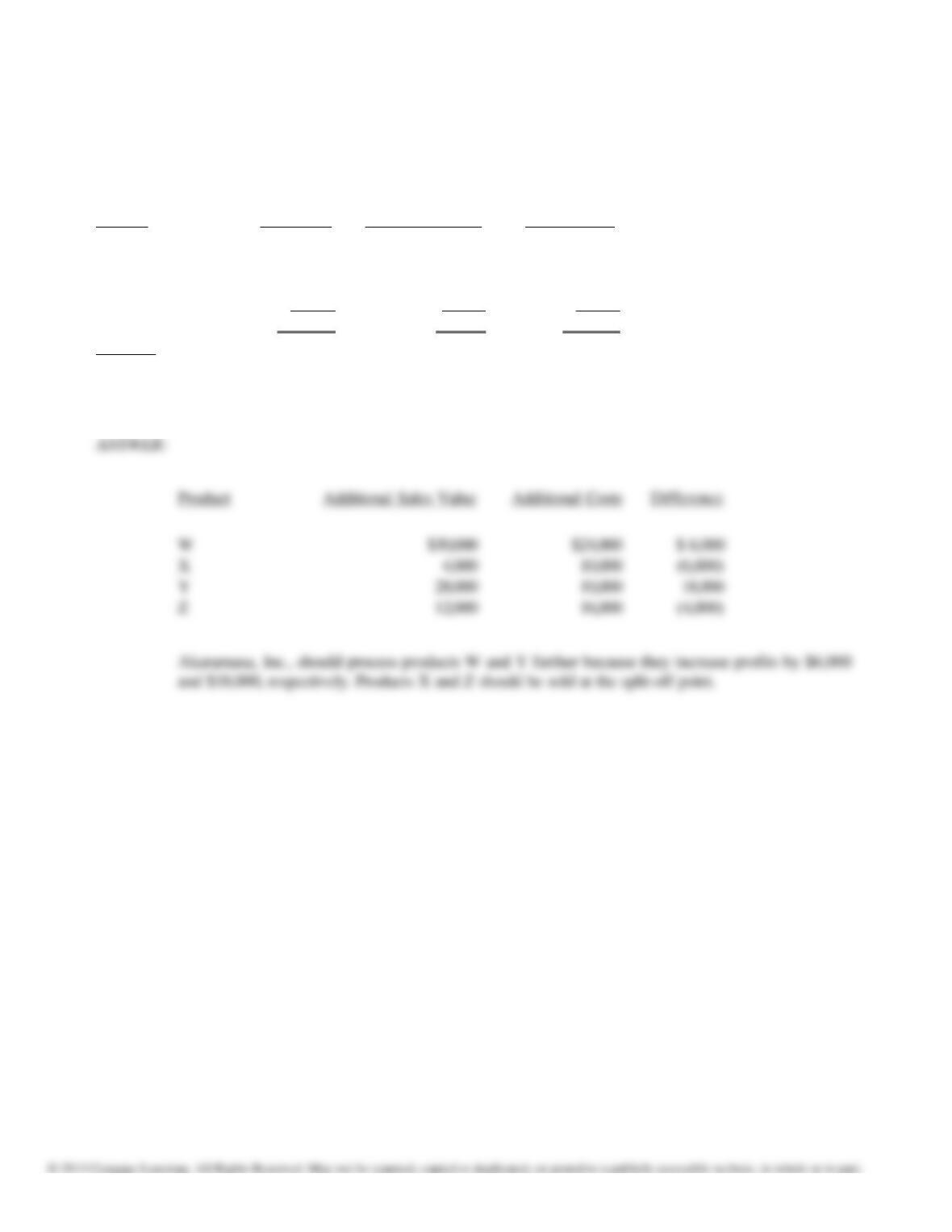
124. Akaramasa, Inc., uses a joint process to produce Products W, X, Y, Z. Each product may be sold at its split-
off point or processed further. Additional processing costs of specific products are entirely variable. Joint
processing costs for a single batch of joint products are $200,000. Other relevant data are as follows:
Sales Value
Additional
Sales Value of
Product
at Split–off
Processing Costs
Final Product
W
$ 40,000
$24,000
$ 70,000
X
16,000
10,000
20,000
Y
20,000
10,000
48,000
Z
24,000
16,000
36,000
$100,000
$60,000
$174,000
Required:
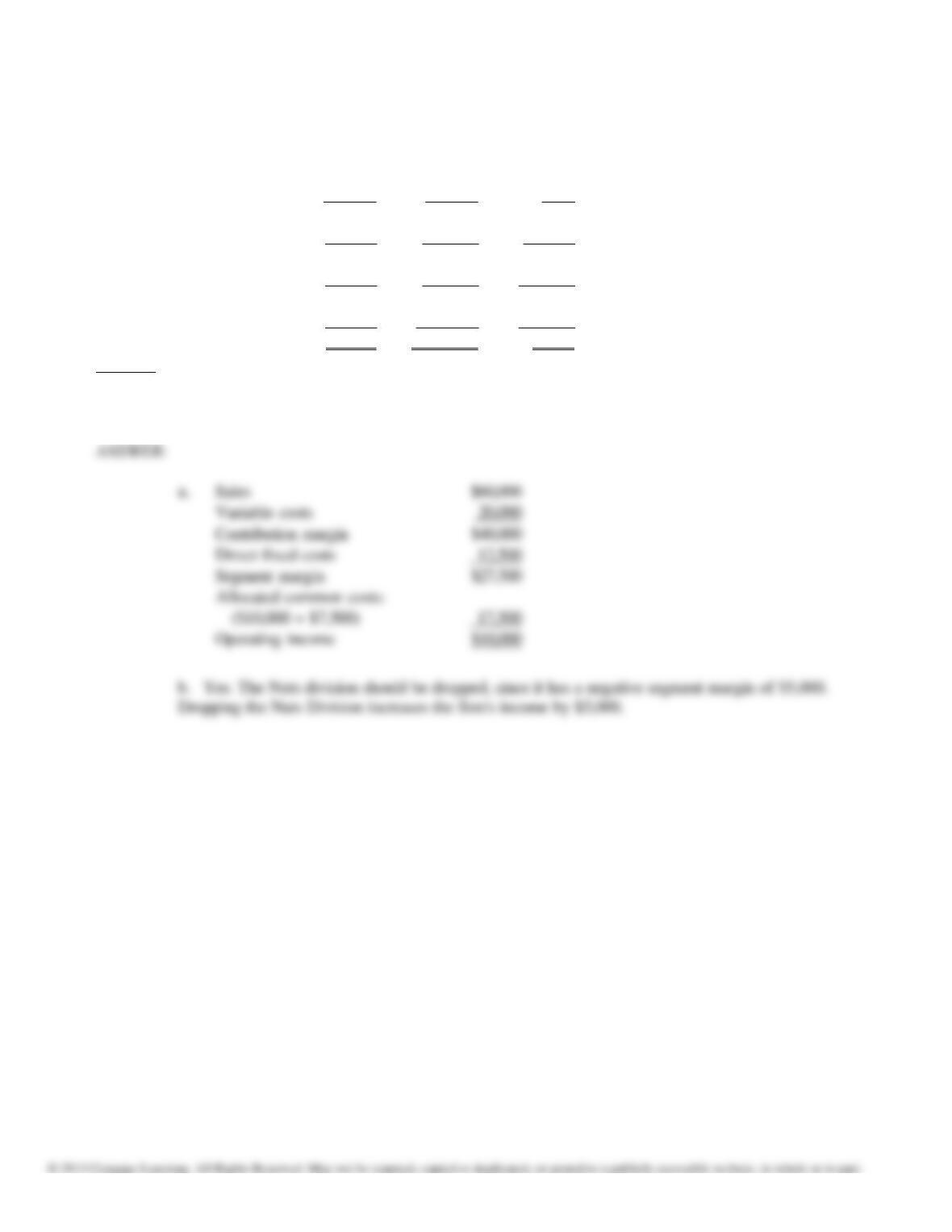
a. Determine which products should be processed further.
b. How will processing each product further affect profits?
W
X
Y
Chapter 17: Activity Resource Usage Model and Tactical Decision Making
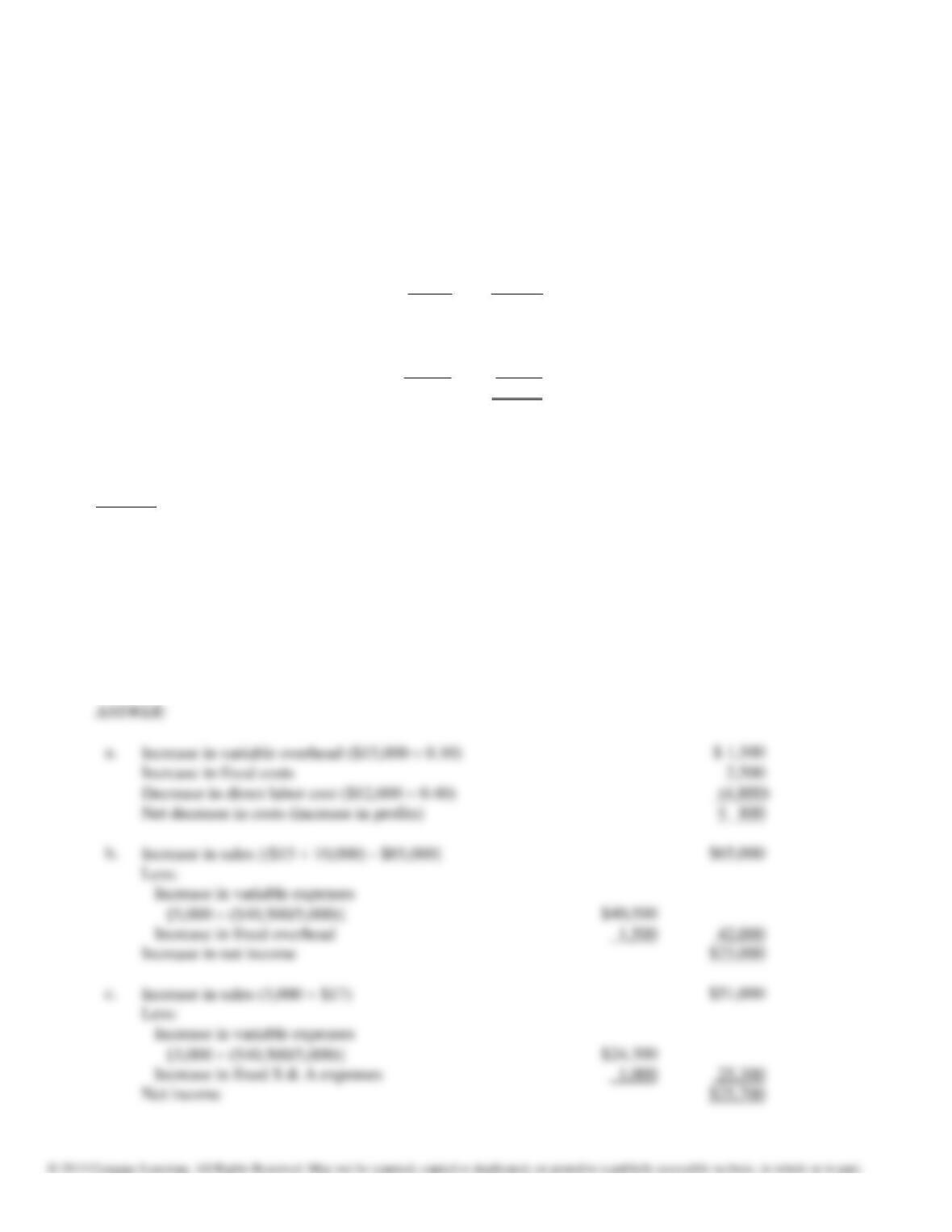
125. The operations of Mouser Corporation are divided into the Bolt Division and the Nuts Division. Projections for
the next year are as follows:
Bolt
Nuts
Division
Division
Total
Sales
$60,000
$ 40,000
$100,000
Variable costs
20,000
15,000
35,000
Contribution margin
$40,000
$ 25,000
$ 65,000
Direct fixed costs
12,500
30,000
42,500
Segment margin
$27,500
$ (5,000)
$ 22,500
Allocated common costs
10,000
7,500
17,500
Operating income (loss)
$17,500
$(12,500)
$5,000
Required:
a. Determine operating income for Mouser Corporation as a whole if the Nuts Division is dropped.
b. Should the Nuts Division be eliminated?
Contribution margin
$40,000
Direct fixed costs
Segment margin
$27,500
Allocated common costs:
Chapter 17: Activity Resource Usage Model and Tactical Decision Making
126. Bollinger Company’s 2016 income statement is as follows:
Sales (5,000 units × $17)
$85,000
Less variable expenses:
Cost of goods sold:
Direct materials
$15,000
Direct labor
12,000
Variable factory overhead
15,000
Selling and administrative
2,500
44,500
Contribution margin
$40,500
Less fixed expenses:
Factory overhead
$10,000
Selling and administrative
15,000
25,000
Net income (loss)
$15,500
In an attempt to improve the company’s profit performance, management is considering a number of alternative
actions.
Required:
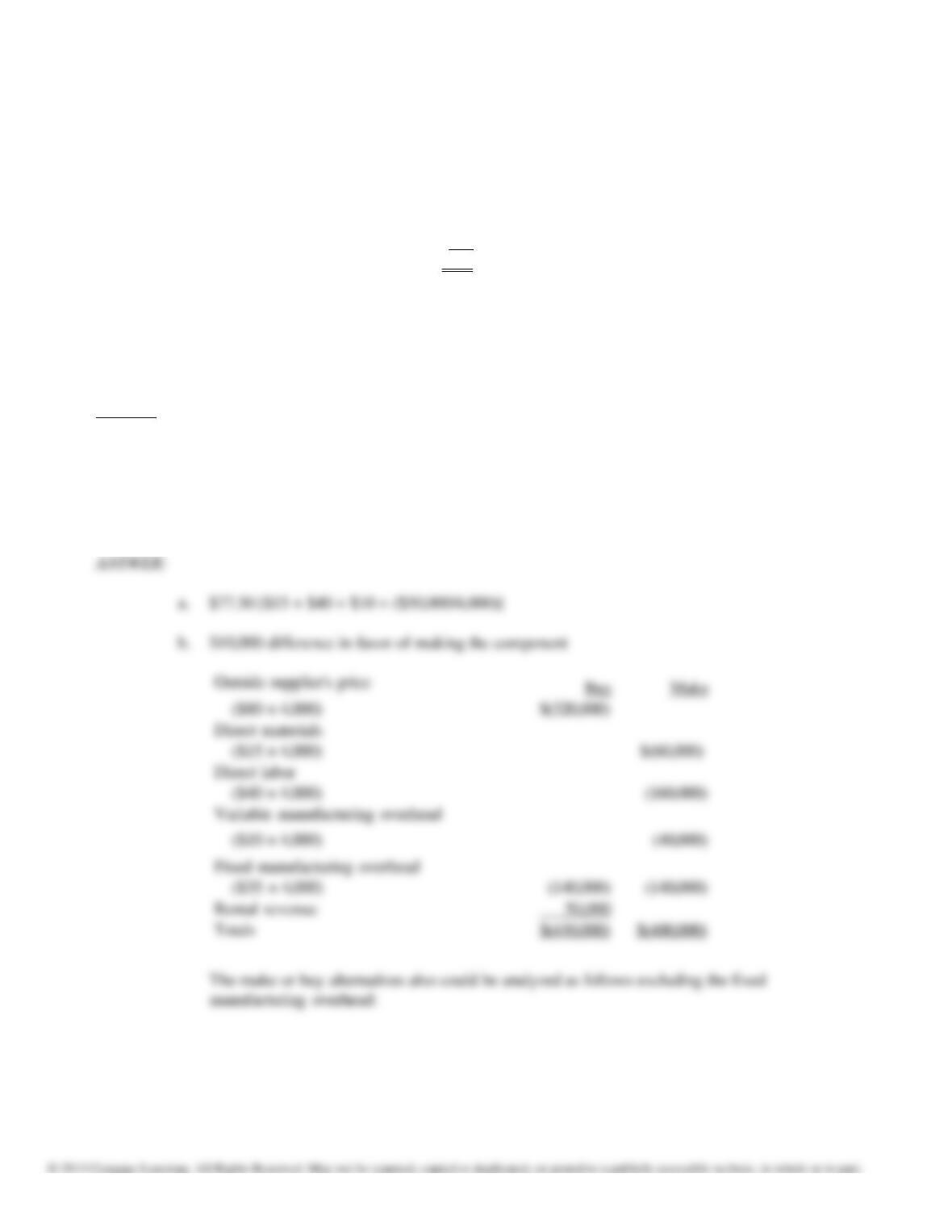
Determine the effect of each of the following on monthly profit. Each situation is to be evaluated independently of
all the others.
a. Purchasing automated assembly equipment. This action should reduce direct labor costs by 40
percent. It also will increase variable overhead costs by 10 percent and fixed factory overhead
by $2,500.
b. Reducing the unit selling price by $2 per unit. This should increase the monthly sales by 5,000
units. Fixed factory overhead will increase by $1,500.
c. Increase fixed selling and administrative expenses by $1,000 for advertising costs. The number
of units sold will increase to 8,000 units.
Increase in variable overhead ($15,000 0.10)
Increase in fixed costs
2,500
Net decrease in costs (increase in profits)
Increase in sales [($15 10,000) – $85,000]
Less:
[5,000 ($40,500/5,000)]
Increase in fixed overhead
1,500
Increase in sales (3,000 $17)
Increase in variable expenses
Increase in fixed S & A expenses
1,000
Net income
Chapter 17: Activity Resource Usage Model and Tactical Decision Making
127. The management of Villanueva Industries has been evaluating whether the company should continue
manufacturing a component or buy it from an outside supplier. A $100 cost per component was determined as
follows:
Direct materials
$ 15
Direct labor
40
Variable manufacturing overhead
10
Fixed manufacturing overhead
35
Total
$100
Villanueva Industries uses 4,000 components per year. After Splendor, Inc., submitted a bid of $80 per component,
some members of management felt they could reduce costs by buying from outside and discontinuing production of
the component. If the component is obtained from Splendor, Inc., Villanueva’s unused production facilities could be
leased to another company for $50,000 per year.
Required:
a. Determine the maximum amount per unit Villanueva should pay an outside supplier.
b. Indicate if the company should make or buy the component and the total dollar difference in
favor of that alternative.
c. Assume the company could eliminate production supervisors with salaries totaling $30,000 if the
component is purchased from an outside supplier. Indicate if the company should make or buy
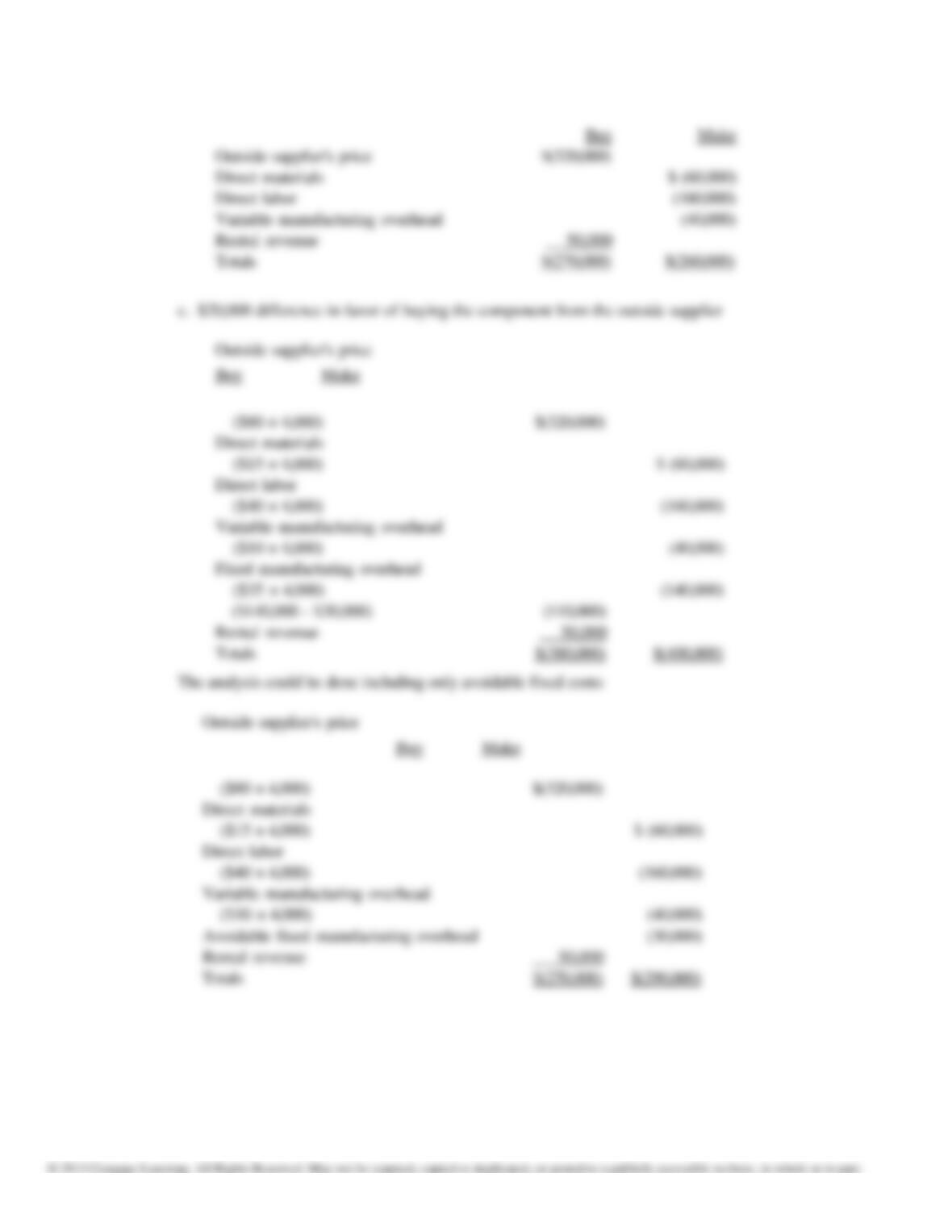
the component and the total dollar difference in favor of that alternative.
Chapter 17: Activity Resource Usage Model and Tactical Decision Making
Chapter 17: Activity Resource Usage Model and Tactical Decision Making
Manufacturing
$160,000
Selling and administrative
120,000
280,000
Operating income
$168,000
$ 960,000
128. Campbell Company has an annual capacity of 18,000 units. Budgeted operating results for 2016 are as follows:
Revenues (16,000 units @ $60)
$960,000
Variable costs:
Manufacturing
$384,000
Selling
128,000
512,000
Contribution margin
$448,000
Fixed costs:
A foreign wholesaler wants to buy 1,000 units at a price of $40 per unit. All fixed costs would remain within the
relevant range. Variable selling costs on the special order would be the same as variable selling costs for regular
orders.
Required:
a. Determine the effect on operating income if the company produces the special order.
b. Should the company produce the special order?
c. Determine operating income if the customer had wanted a special order of 3,000 units and the
company produced the special order.
d. Should the company produce the 3,000-unit special order?
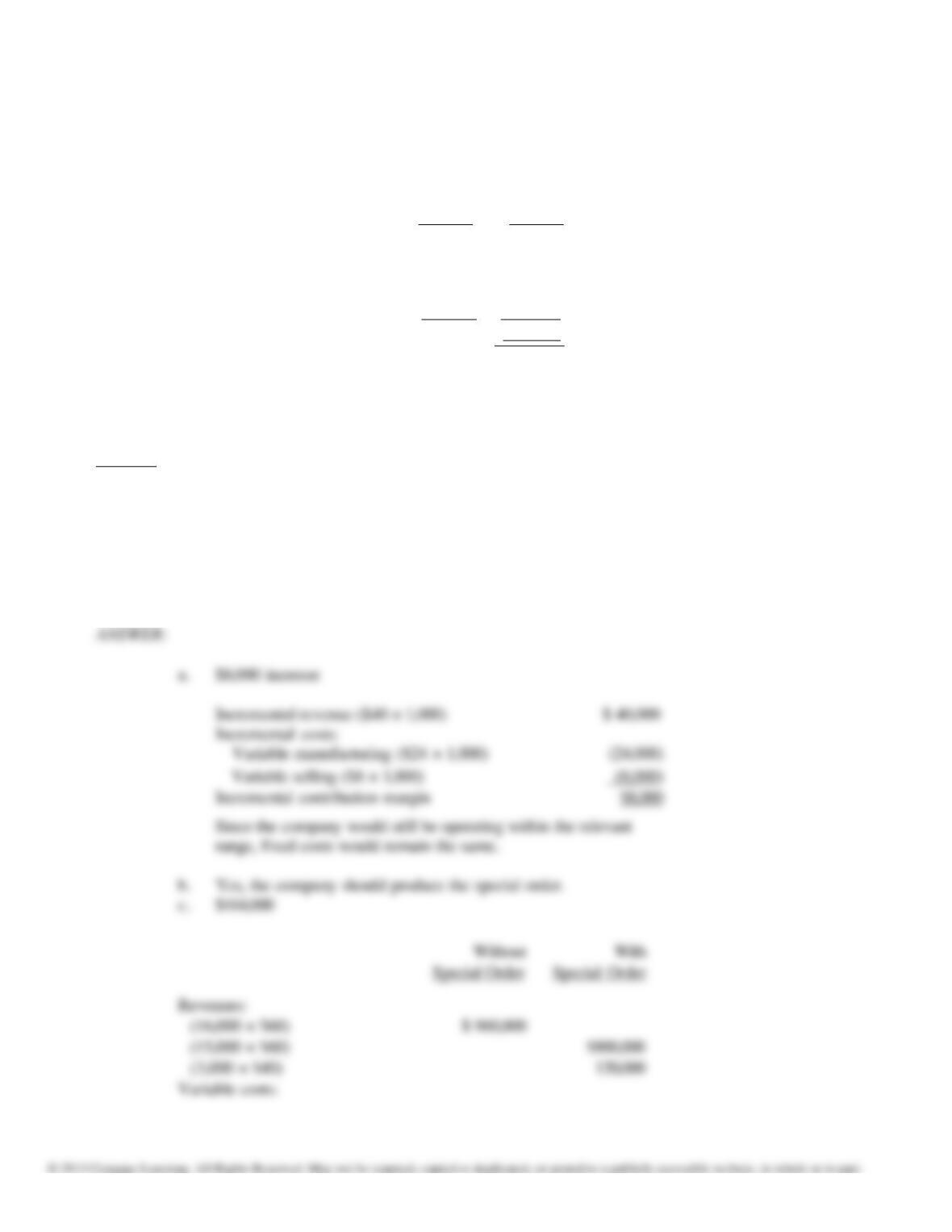
e. Discuss any nonquantitative factors the company might want to consider when making the
decision.
Chapter 17: Activity Resource Usage Model and Tactical Decision Making
Chapter 17: Activity Resource Usage Model and Tactical Decision Making
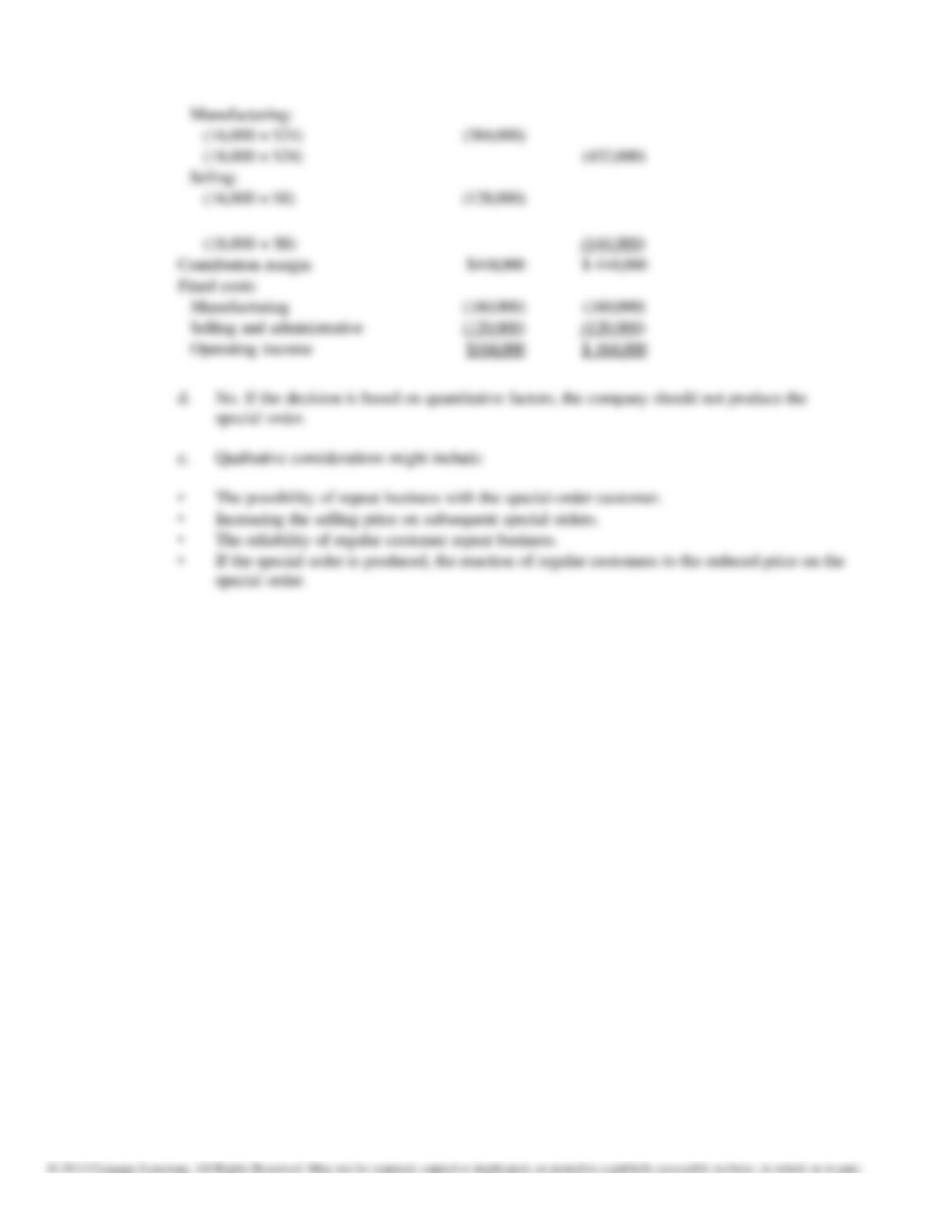
129. Boniatillo Corporation, which produces one product, had the following income statement for a recent month:
Boniatillo Corporation Income
Statement
For the Month of March 2016
Sales
$30,000
Cost of goods sold
27,000
Gross profit
$3,000
Selling and administrative
2,500
Net income
$500
There were no beginning or ending inventories of work-in–process or finished goods. Boniatillo’s manufacturing
costs were as follows:
Direct materials (1,200 units × $5)
$6,000
Direct labor (1,200 units × $8)
9,600
Variable overhead (1,200 units × $4.50)
5,400
Fixed overhead
6,000
Total
$27,000
Average cost per unit
$22.50
Selling and administrative expenses are all fixed.
Boniatillo has just received a special order from a firm in China to purchase 900 units at $20 each. The order will not
affect the selling price to regular customers.
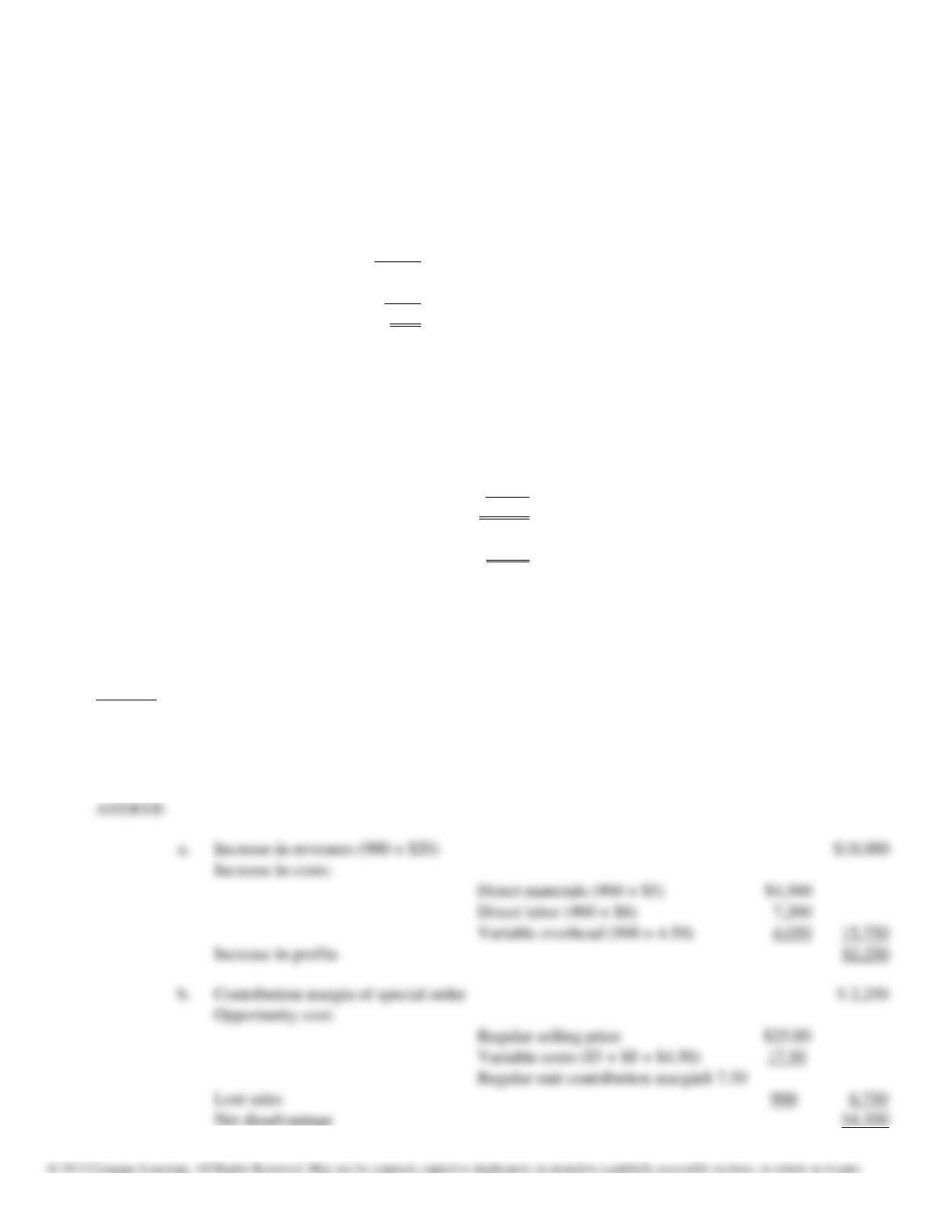
Required:
a. Prepare a differential analysis of the relevant costs and revenues associated with the decision to
accept or reject the special order, assuming Boniatillo has excess capacity.
b. Determine the net advantage or disadvantage (profit increase or decrease) of accepting the
order, assuming Boniatillo does not have excess capacity.