
Chapter 17: Sustainability Accounting
Learning Questions
True /
False
Multiple Choice
Matching
Exercises
Short
Answer
Problems
1. What are sustainability and
sustainable management?
1-6
1-5
2. What are sustainability
accounting, sustainability
management accounting, and
sustainability reporting?
3. What are the motivations and
frameworks for external
sustainability reporting?
4. What management
accounting tools are useful
for sustainability
management and reporting?
S: Questions from the study guide
W: Questions from web quizzes on the student web site
Level of Complexity*
True /
False
Multiple
Choice
Matching
Exercises
Short
Answer
Problems
Foundation: Repeat or paraphrase
information; Reason to single correct
solution; Perform computations; etc.
All
All
All
Step 1: Identify the problem, relevant
information, and uncertainties
Step 2: Explore interpretations and
connections
Step 3: Prioritize alternatives and
implement conclusions
Step 4: Envision and direct strategic
innovation
*Based on level in Steps for Better Thinking (Exhibit 1.10, textbook p. 16):
Note: Step 1, 2, 3, and 4 questions in this test bank are intentionally open-ended and subjective, giving students the
opportunity to demonstrate skills such as judgment, reasoning, identification of uncertainties, identification or analysis of
pros and cons, and so on. Therefore, student answers may not exactly match those shown in the solutions.

17-2 Cost Management
True / False
1. Management accountants contribute to sustainability efforts by establishing internal and external
measurement and reporting processes.
2. “Sustainable management” is the ability to direct the course of an enterprise in ways that reduce all
forms of capital (human, natural, manufactured, and financial).
3. The triple bottom line includes economic, environmental, and social considerations.
4. The triple bottom line refers to the effect in which a company’s profit increases by three-fold when
they begin to consider environmental and social aspects.
5. Internal impacts are costs and benefits inside the organization that are recognized in the entity’s
conventional accounting system.
6. External impacts are costs and benefits that are recognized in the entity’s accounting system, but the
information for the values are generated outside the organization.
7. Sustainability accounting is the systematic recording, reporting, and analysis of quantitative and
qualitative information about sustainable management practices and performance.
8. In recent times, all companies have organizational strategies for communicating information about
sustainability efforts and performance, called sustainability reporting.
9. Most companies are motivated to issue sustainability reports by ethical considerations.
10. Tracking and tracing sustainability costs, and identifying cost pools and related cost drivers, are
crucial for sustainability management accounting purposes.
Multiple Choice
1. Which of the following is a synonym for sustainability?
a. Double bottom line
b. Corporate Social Responsibility
c. Human capital
d. Economic impact
2. The triple bottom line refers to which of the following three value systems:
a. economic, environmental, and social.
b. economic, organic, and social
c. economic, environmental, and ecological
d. economic, environmental, and sustainable
3. Internal impacts are also called:
a. Direct impacts
b. Private impacts
c. None of the above
d. Both
4. If an organization has a strategy to use only recycled inputs, then their budgets and plans likely
include:
I. Increased costs to obtain materials
II. Plans to source the materials
III. Milestone dates by which achievements should occur
a. I and II only
b. II and III only
c. I and III only
d. I, II, and III
Chapter 17: Sustainability Accounting 16-3
5. Strategies for sustainable management are unlikely to be developed unless managers:
a. have identified specific operating plans.
b. have established performance measurement for sustainable initiatives.
c. have identified sustainability as part of the organizational vision and core competencies.
d. have detailed operative plans with respect to sustainable management.
6. Sustainability accounting is:
a. recording and analysis of quantitative and qualitative information about sustainable practices and
performance
b. quantifying the costs of sustainable practices
c. reporting to external stakeholders about sustainability
d. reporting qualitative information about an organizations sustainable practices and performance.
7. Internal Sustainability Reporting includes
I. Sustainability reports for shareholders
II. Support for Operating Plans
III. Support for Strategic Plans
a. I and II only
b. II and III only
c. I and III only
d. I, II, and III
8. Communicating information about sustainability efforts and performance
a. is required by GAAP
b. is consistent across all organizations
c. is required by regulation
d. varies widely across organizations
9. Sustainability management accounting includes:
I. budgeting and forecasting
II. assurance services
III. implementing and monitoring internal controls
a. I and II only
b. II and III only
c. I and III only
d. I, II, and III
10. Sustainability accounting includes:
I. financial accounting value systems
II. environmental value systems
III. social value systems
a. I and II only
b. II and III only
c. I and III only
d. I, II, and III
11. In 2008, the top two motivations to explain sustainability reporting were:
a. ethical considerations and economic considerations
b. reputation or brand and innovation & learning
c. employee motivation and risk management
d. strengthened supplier relationships and access to capital
12. Greenwashing is
a. using environmentally safe cleaning products
b. publicizing environmental friendly policies without making substantive changes in their
environmental impact
17-4 Cost Management
c. ensuring that produce is washed and does not contain e-coli
d. when carwashes reuse the water, rather than using new water for each car washed.
13. To reduce the suspicion that a company is engaged in “impression management”, a company’s
sustainability information can
I. follow Global Reporting Initiative (GRI) standards
II. include lots of visuals suggesting environmental friendliness
III. be transparent
a. I and II only
b. II and III only
c. I and III only
d. I, II, and III
14. Firms that report GRI core indicators are more likely to:
I. improve sustainability
II. establish programs to reach targets for metrics reported
III. conform with laws
a. I and II only
b. II and III only
c. I and III only
d. I, II, and III
15. GRI core indicators include:
I. economic indicators
II. environmental indicators
III. labor practices indicators
a. I and II only
b. II and III only
c. I and III only
d. I, II, and III
16. Traditional management accounting practices tend to overlook potentially significant costs and
benefits within relevant cost decision making because:
a. accounting recognition is delayed when costs are contingent on future events
b. relevant revenues and costs are not isolated in the accounting system
c. opportunity costs are not measured
d. all of the above.
17. Material flow accounting divides outputs into three major categories:
a. good units, scrap, and waste
b. products, emissions, and byproducts
c. products, waste, and emissions
d. good units, bad units, and waste
18. In “Material flow cost accounting”, final product that is produced and transferred out is often referred
to as:
a. Completed units
b. Positive product
c. Negative product
d. Outputs
19. Life cycle assessment refers to:
I. evaluating all the activities involved in the design, development, production, sale,
transportation, and disposal of a product or service
II. is often referred to as cradle to grave
III. involves summing the costs of the activities throughout both internal and external value
chains

Chapter 17: Sustainability Accounting 16-5
a. I and II only
b. II and III only
c. I and III only
d. I, II, and III
20. All of the following are recommended strategies for incorporating sustainability into a balanced
scorecard except:
a. Scaling the measures in the financial perspective by the cost of externalities.
b. An additional “sustainability” perspective can be added to the scorecard
c. quantitative separate sustainability balanced scorecard can be developed
d. Environmental and social strategic objectives can be integrated within the traditional four
perspectives.
Matching
1. Several categories for sustainability costs are listed below. Indicate which measures are Internal (I)
and which are external (E)
____ 1. Hidden Costs
____ 2. Contingent Costs
____ 3. Externalities
____ 4. Image and Relationship Costs
____ 5. Conventional Costs
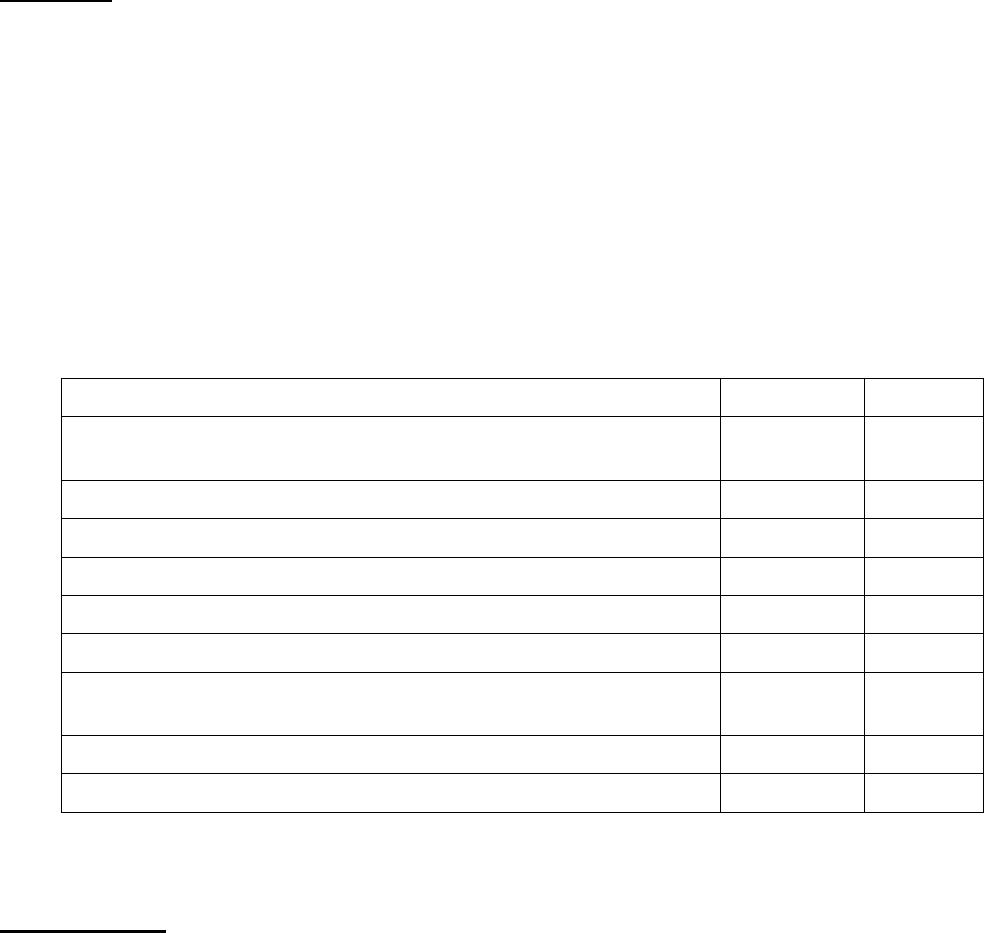
2. Several examples of Global reporting Initiative Core Indicators are listed below on the left, and the
GRI categories are listed on the right. Match the lettered items on the right with the
appropriate item on the left. Each numbered item has only one correct answer, and each
lettered item may be used only once.
____ 1. Number of incidents in which
employees were dismissed or
disciplined for corruption
____ 2. Ratio of basic salary of men to
women by employee category
____ 3. Percentage of materials used
that are recycled input
materials
____ 4. Measures taken to contribute
to the elimination of child
labor
____ 5. Whether the organization sells
products that are banned in
certain markets
____ 6. Economic value distributed
A. Environment
B. Economic
C. Social Performance: Labor practices
and decent work
D. Social Performance: Human rights
E. Social Performance: Society
F. Social Performance: Product
Responsibility
17-6 Cost Management
Exercises
1. Basil Corporation is planning to buy solar panels that will reduce the amount of electricity bought
from the grid. The company’s required rate of return for equipment is 8%. The solar panels cost
$250,000 and should save about $22,500 per year in electricity costs. The vendor stated that the
panels should last 25 years. Ignore taxes and inflation.
A. What is the NPV for this project?
B. Based on the NPV, should Basil make the purchase?
C. What is the payback period?
D. What qualitative factors, including strategic risks, might affect this decision?
2. Royal Dutch Shell XXX. The company published a report showing comparisons of sustainability
indicators for 2009 and 2008. For each of the sustainability indicators, explain whether the change
from 2007 to 2008 suggests an improvement (I) or deterioration (D) in Royal Dutch Shell’s
sustainable management
INDICATOR
2009
2008
A. Total Greenhouse gas emissions (millions tonnes CO2
equivalent)
67
75
B. Hydrofluorocarbons (tonnes)
24
23
C. Sulfur dioxide (thousand tonnes)
141
175
D. Sabotage spills (thousand tonnes)
13.9
6.5
E. Fresh water use (million cubic metres)
198
224
F. Hazardous waste disposal (thousand tonnes)
962
688
G. Lost time injuries per million exposure hours (employees and
contractors)
0.4
0.6
H. In supervisory/professional positions (%women)
26.4
24.7
I. % countries with anti-child labour procedures in place
98
100
Short Answer
1. Describe how the role of environmental and social issues in business has changed over the last
decade.
2. Describe how management accountants contribute to the efforts to measure, monitor and motivate
improved social and environmental performance.
3. Differentiate between internal impacts and external impacts.
4. Describe what is meant by “building a business case” for sustainable management.
5. How do firms generally evaluate organizational sustainability performance?
6. Describe greenwashing.
7. How can companies reduce accusations of greenwashing?
Chapter 17: Sustainability Accounting 16-7
8. Why do traditional management accounting practices tend to overlook potentially significant
sustainability costs and benefits within non-routine decisions?
Problems
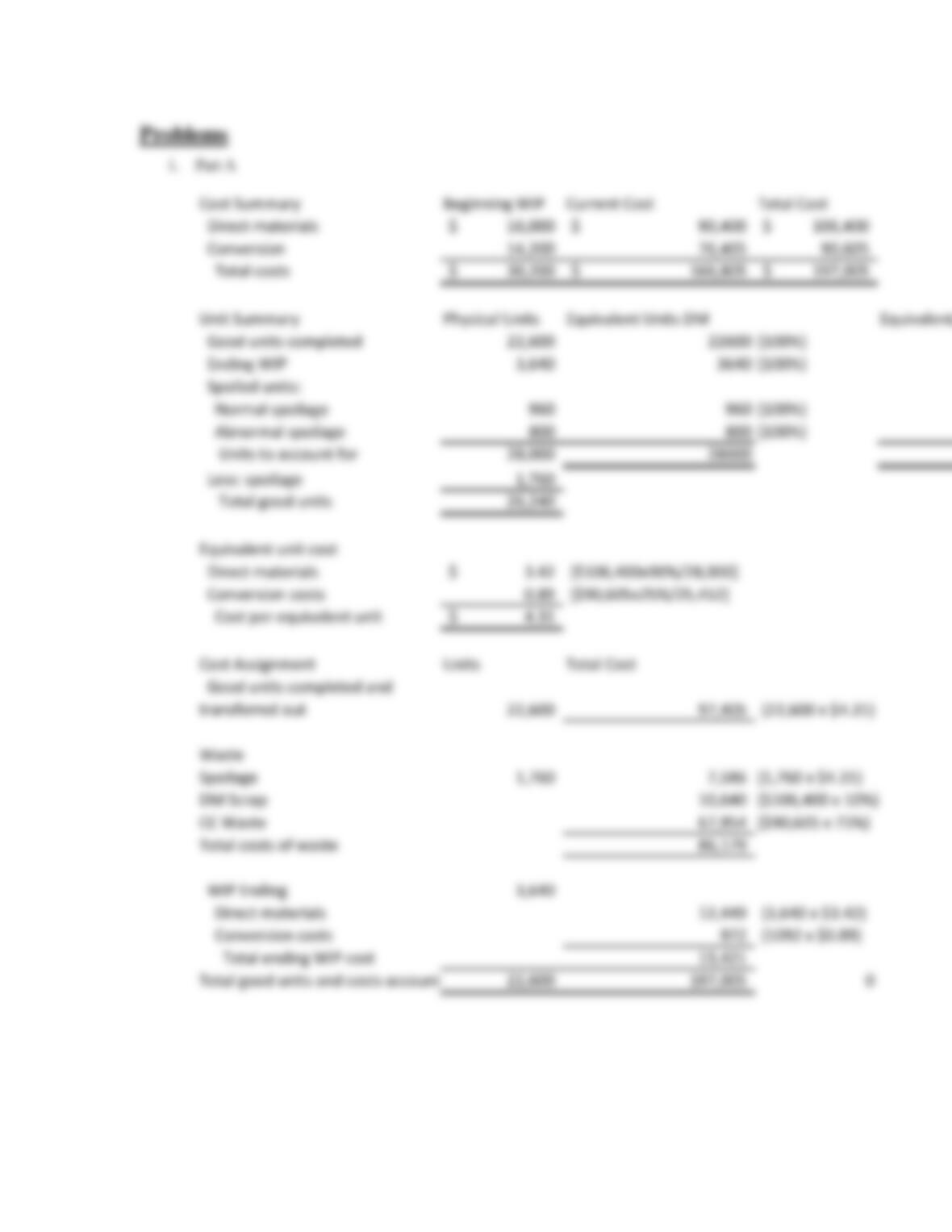
1. The Journey Company operates under a process cost system using the weighted average method. All direct
materials are added at the beginning of production in the department, and conversion costs are incurred evenly
throughout production. Inspection occurs when production is 100% completed.
Following are data for January. All unfinished work at the end of January is 30% completed. The beginning
inventory is 80% completed.
Beginning inventories
Direct Materials
$16,000
Conversion Costs
14,200
Costs added during current period
Direct Materials
$90,400
Conversion Costs
76,405
Physical Units
Units in beginning inventory
4,000
Units started this month
24,000
Total units completed and transferred out
22,600
Normal spoilage
960
Abnormal spoilage
800
A. Following a material flow analysis, the company’s accountant estimates that 10% of the direct
materials and 75% of conversion costs are classified as “waste and emissions.” Assume these
percentages apply to both beginning inventories and current period costs.
Prepare a material flow cost report using the Weighted Average method.
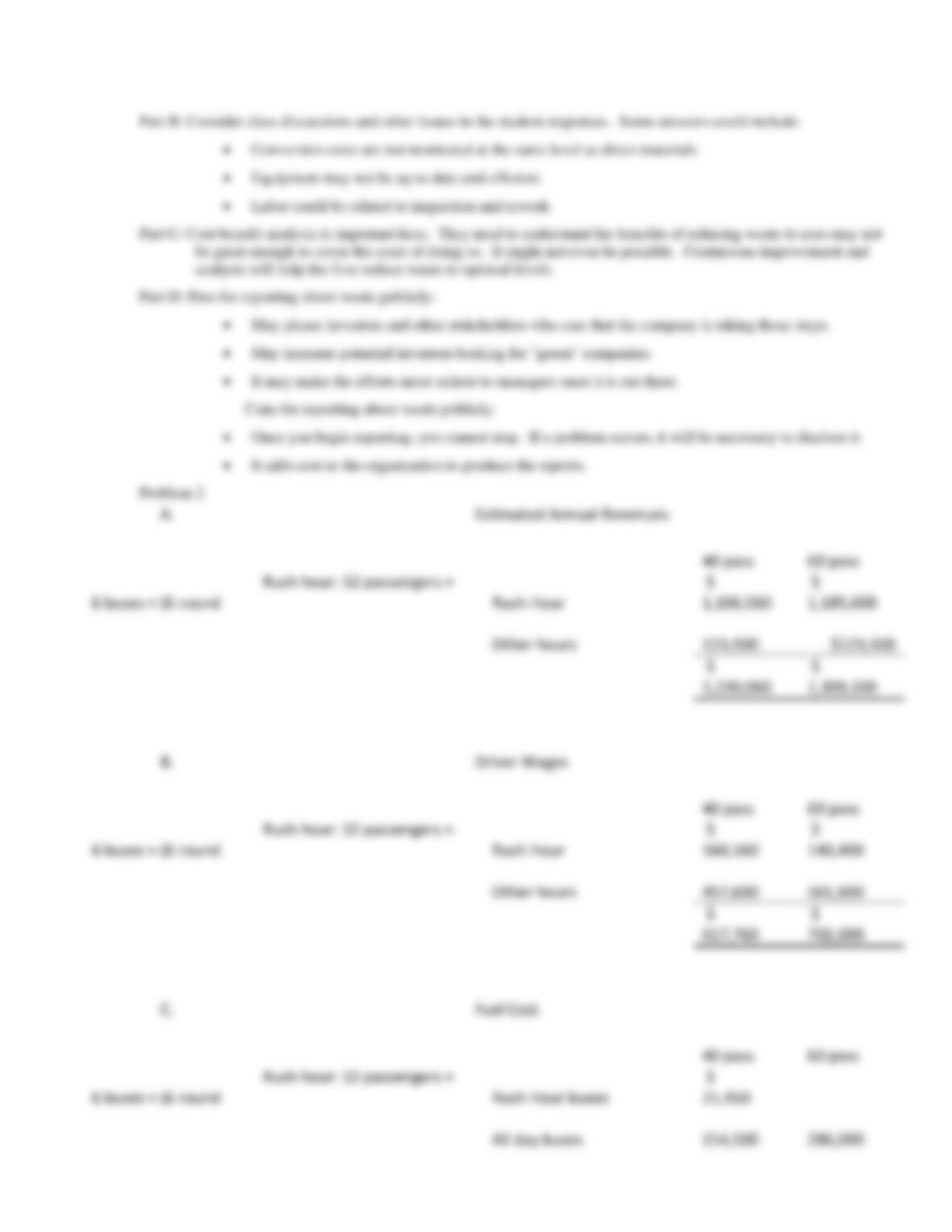
B. Provide a possible explanation for the higher proportion of waste in conversion costs compared to
direct materials.
C. Should the managers of Rally Company establish a goal of eliminating all waste and emissions?
Explain your reasoning.
D. Suppose the managers are interested in presenting Rally as a company that is concerned about the
environment. What are the pros and cons of publicly reporting data about the amount of waste in the
company’s manufacturing operations?

17-8 Cost Management
2. Many citizens of Collingwood Township travel each work day between Collingwood and a nearby city,
Stayner. To reduce the need for building more lanes on the freeway and to comply with local sustainability policies, the
township has decided to establish an express bus service that uses environmentally friendly fuel. Collingwood plans to
charge $0.95 for a one-way fare. Township managers want to purchase either a 40 or 60 passenger bus. Following are
data for the buses.
Number of passengers
40
60
Number of buses
7
5
Useful life in years
9
9
Purchase price per bus
$270,000
$325,000
Average miles per gallon
12
9
Salvage value per bus
$8,000
$9,500
Drivers’ hourly wage
$22
$27
Fuel price per gallon
$3.30
$3.30
Other annual cash expenses
$5,000
$4,500
During the four hours of “rush hour” traffic each day, all buses would be in service and expected to operate at full
capacity (township regulations prohibit bus passengers from standing). The buses would make six round trips during
these periods. For the other 16 hours of operation, about 500 passengers are expected to ride the buses, and five buses
would cover the route. Part-time drivers would be used for the extra time during rush hours. A bus traveling the route all
day would go 600 miles, and one traveling only during rush hours would go 150 miles per day during the 260 work days
each year.
A. Prepare a schedule for the estimated annual revenues for each alternative.
B. Prepare a schedule for the estimated annual drivers’ wages for each alternative.
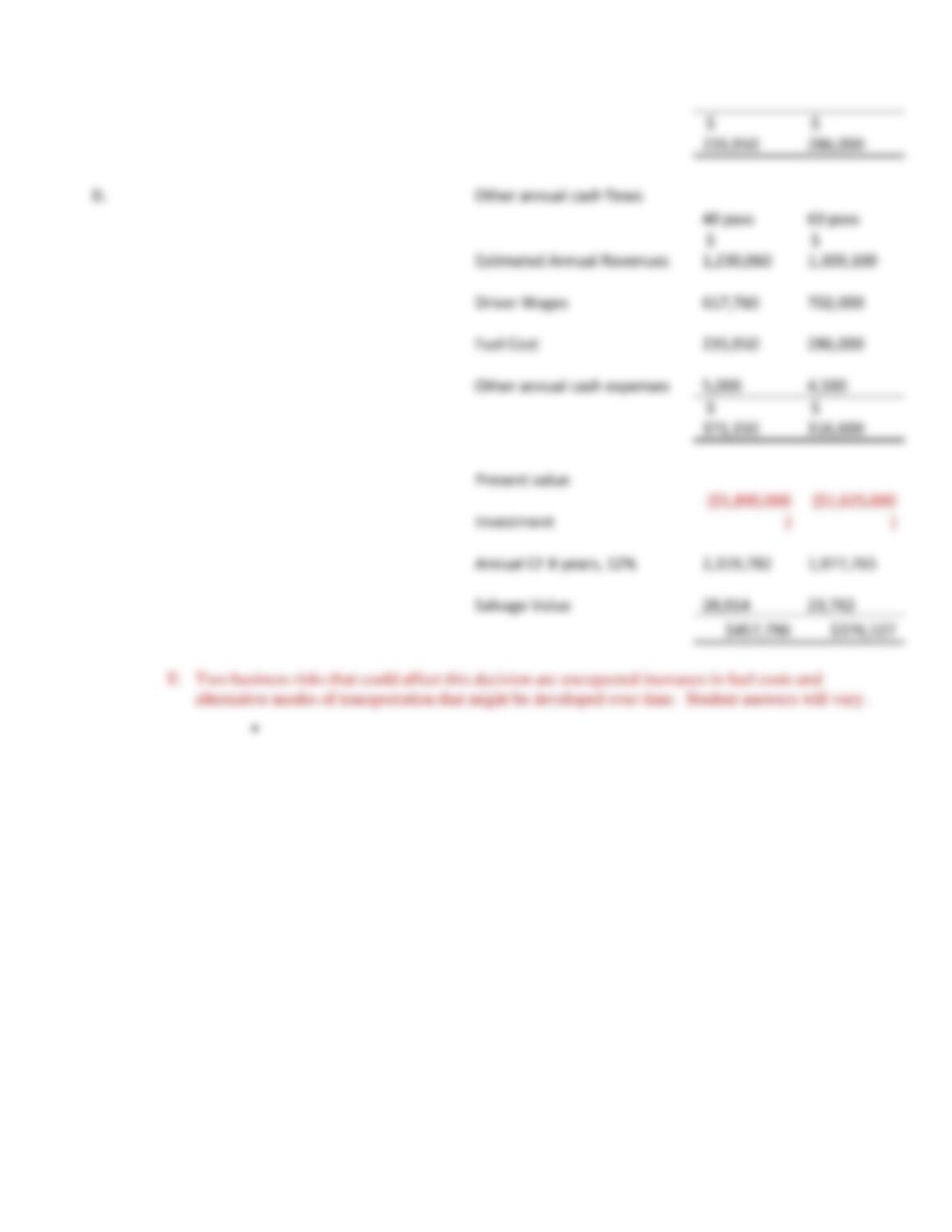
C. Prepare a schedule for the annual cost of fuel for each alternative.
D. Assuming that Collingwood requires a minimum rate of return of 8%, calculate the net present value of
each bus option. Ignore inflation and taxes.
E. List two business risks that could affect this decision.

Chapter 17: Sustainability Accounting 16-9
Answers
True / False
Multiple Choice
Matching
17-10 Cost Management
Exercises
Chapter 17: Sustainability Accounting 16-11
Short Answer
17-12 Cost Management
Chapter 17: Sustainability Accounting 16-13
17-14 Cost Management