143. Harley Company manufactures a product that passes through two processes. The following information is
available for the first department for October.
All materials are added at the beginning of the process.
Beginning work in process consisted of 25,000 units that were 80 percent complete with respect to conversion.
Ending work in process consisted of 15,000 units that were 40 percent complete with respect to conversion.
During the month, 90,000 units were started in process.
Required:
A.
Prepare a physical flow schedule.
B.
Compute equivalent units using the weighted average method.
A.
Physical flow schedule:
Units to account for:
Units in beginning work in process
25,000
Units started
90,000
Units accounted for:
Units completed and transferred out:
From beginning work in process
25,000
100,000
Units in ending work in process
15,000
Total units accounted for
115,000
B.
Equivalent units:
Conversion
Materials
Cost
Units in EWIP ´ Fraction complete:
Materials (15,000 ´ 100%)
15,000
Conversion (15,000 ´ 40%)
6,000
144. King Corporation produces a product that passes through two departments. For December, the following
equivalent unit schedule was prepared for the first department:
Materials
Conversion
Cost
Units completed
10,000
10,000
Units in EWIP ´ Fraction complete:
Materials (2,000 ´ 100%)
2,000
Conversion (2,000 ´ 25%)
500
Equivalent units of output
12,000
10,500
Costs assigned to beginning work in process:
Materials:
$14,000
Conversion:
$20,000
Manufacturing costs incurred during the month:
Materials:
$34,000
Conversion:
$43,000
Required:
A.
Compute the unit cost for December using the weighted average method.
B.
Determine the cost of goods transferred out.
C.
Determine the cost of ending work in process.
A.
Cost per equivalent unit:
Materials = ($14,000 + $34,000)/12,000 = $4.00
Conversion = ($20,000 + $43,000)/10,500 = $6.00
Total unit cost = $10.00 per equivalent unit
B.
Cost of goods transferred out = $10 ´ 10,000 = $100,000
C.
Cost of ending work in process
= (2,000 ´ $4) + (500 ´ $6)
= $8,000 + $3,000 = $11,000
145. Royal, Inc., manufactures products that pass through two or more processes. The company uses the
weighted average method to compute unit costs. During April, equivalent units were computed as follows:
Materials
Conversion
Cost
Units completed
90,000
90,000
Units in EWIP ´ Fraction complete:
Materials (4,000 ´ 100%)
4,000
Conversion (4,000 ´ 30%)
1,200
Equivalent units of output
94,000
91,200
The unit cost was computed as follows:
Materials
$5.00
Conversion cost
3.00
Total cost per unit
$8.00
Required:
A.
Determine the cost of the goods transferred out.
B.
Determine the cost of ending work in process.
A.
Cost of goods transferred out = $8.00 ´ 90,000 = $720,000
Cost of ending work in process:
Materials (4,000 ´ $5.00)
$20,000
Conversion (1,200 ´ $3.00)
3,600
Total cost
$23,600
146. Indigo Inc., manufactures a product that passes through two processes. The following information is
available for the first department for September.
All materials are added at the beginning of the process.
Beginning work in process consisted of 200 units that were 60 percent complete with respect to conversion.
Ending work in process consisted of 500 units that were 10 percent complete with respect to conversion.
During the month, 3,000 units were started in process.
Required:
A.
Prepare a physical flow schedule.
B.
Compute equivalent units using the weighted average method.
C.
How would your answer change in part B if the beginning work in process consisted of 200 units that were 80 percent complete with
respect to conversion?
A.
Physical flow schedule:
Units to account for:
Units started
3,000
Total units to account for
3,200
Units completed and transferred out:
Started and completed
2,500
From beginning work in process
200
2,700
Total units accounted for
3,200
B.
Equivalent units:
Conversion
Units completed
2,700
2,700
Units in EWIP ´ Fraction complete:
Materials (500 ´ 100%)
Equivalent units of output
3,200
2,750

147. Delilah, Incorporated, manufactures quality hair care products. The ingredients are combined in the mixing
department and put in 16-ounce containers in the packaging department.
The following information pertains to the mixing department for the month of May:
Units
(Gallons)
Work in process, May 1
(100% complete materials,
75% labor and overhead)
10,000
Started during May
50,000
Work in process, May 31
(100% complete materials,
50% labor and overhead)
8,000
The costs in work in process at May 1 in the mixing department were as follows:
Mixing
Department
Work in process, May 1:
Materials
$15,000
Direct labor
20,000
Manufacturing overhead
17,600
Total costs
$52,600
The costs added by the mixing department during the month of May were as follows:
Mixing
Department
Materials
$ 90,000
Direct labor
120,000
Manufacturing overhead
100,000
Total costs added
$310,000
Round unit costs to two decimal places.
Required:
A.
Prepare a physical flow schedule for the mixing department for May.
B.
Using the weighted average method, determine the equivalent units of production for materials and conversion for the mixing
department for May.
C.
Using the weighted average method, determine the cost per equivalent unit of production for materials and conversion for the mixing
department for May.
D.
Using the weighted average method, determine the cost of goods transferred out and the cost of ending work in process for the
mixing department.
148. AL Corporation produces a product that passes through two departments. For January, the following
equivalent unit schedule was prepared for the first department:
Materials
Conversion
Cost
Units completed
120,000
120,000
Units in EWIP ´ Fraction complete:
Materials (10,000 ´ 100%)
10,000
Conversion (10,000 ´ 40%)
4,000
Equivalent units of output
130,000
124,000
Costs assigned to beginning work in process:
Materials:
$68,000
Conversion:
$33,000
Manufacturing costs incurred during the month:
Materials:
$75,000
Conversion:
$60,000
Required:
A.
Compute the unit cost for January using the weighted average method.
B.
Determine the cost of goods transferred out.
C.
Determine the cost of ending work in process.
A.
Cost per equivalent unit:
Materials = ($68,000 + $75,000)/130,000 = $1.10
Conversion = ($33,000 + $60,000)/124,000 = $0.75
Total unit cost = $1.85 per equivalent unit
B.
Cost of goods transferred out = $1.85 ´ 120,000 = $222,000
C.
Cost of ending work in process
= (10,000 ´ $1.10) + (4,000 ´ $0.75)
= $11,000 + $3,000 = $14,000
149. Mermain Inc., manufactures products that pass through two processes. The company uses the weighted
average method to compute unit costs. During March, equivalent units were computed as follows:
Materials
Conversion
Cost
Units completed
50,000
50,000
Units in EWIP ´ Fraction complete:
Materials (9,000 ´ 100%)
9,000
Conversion (9,000 ´ 80%)
7,200
Equivalent units of output
59,000
57,200
Cost was added as follows:
Materials
$ 73,750
Conversion cost
57,200
Total cost
$130,950
Required:
A.
Determine the cost of the goods transferred out.
B.
Determine the cost of ending work in process.
C.
Determine the cost of the goods transferred out if materials in ending work in process had been 90% complete and conversion in
ending work in process had been 70% complete. Round costs per unit to 2 decimals if necessary.
A.
Cost of goods transferred out = ($1.25 + $1.00) ´ 50,000 = $112,500
B.
Cost of ending work in process:
Materials (9,000 ´ $1.25)
$11,250
Conversion (7,200 ´ $1.00)
7,200
Total cost
$18,450
C.
Materials equivalent units = 50,000 + (9,000 ´ .9) = 58,100
Conversion equivalent units = 50,000 + (9,000 ´ .7) = 56,300
Materials cost per unit = $73,750/58,100 = $1.27
Conversion cost per unit = $57,200/56,300 = $1.02
Cost of units transferred out = 50,000 ´ ($1.27 + $1.02) = $114,500
150. Davidson Company manufactures a product that passes through two processes. The following information
is available for the first department for October.
All materials are added at the beginning of the process.
Beginning work in process consisted of 20,000 units that were 80 percent complete with respect to conversion.
Ending work in process consisted of 15,000 units that were 40 percent complete with respect to conversion.
During the month, 90,000 units were started in process.
Required:
A.
Prepare a physical flow schedule.
B.
Compute equivalent units using the FIFO method.
151. List the five steps in preparing a production report.
Physical unit flow analysis
Computation of unit cost
A.
Physical flow schedule:
Units to account for:
Total units to account for
110,000
Units accounted for:
Started and completed
75,000
From beginning work in process
20,000
95,000
Total units accounted for
110,000
Conversion
Materials
Cost
Conversion (20,000 ´ 20%)
4,000
Materials (15,000 ´ 100%)
15,000
Conversion (15,000 ´ 40%)
6,000
152. Titan Manufacturing uses a process cost system. The following information pertains to operations for the
month of December.
Units
Beginning work-in-process inventory, December 1
7,000
Started in production during December
185,000
Completed production during December
93,500
Ending work-in-process inventory, March 31
98,500
The beginning inventory was 80% complete for materials and 40% complete for conversion costs. The ending inventory was 85% complete for
materials and 30% complete for conversion costs.
Costs pertaining to the month of December are as follows:
Beginning inventory costs are: materials, $38,200; conversion cost $41,400.
Costs incurred during December are: materials used, $462,300; conversion cost $602,700.
Required:
A. Using the weighted average method calculate the total equivalent units of production for direct materials and conversion cost.
B. Using the weighted average method, calculate the unit cost of materials and conversion for December.
C. Using the weighted average method, calculate the total cost of the units in the ending work–in-process inventory at December 31.
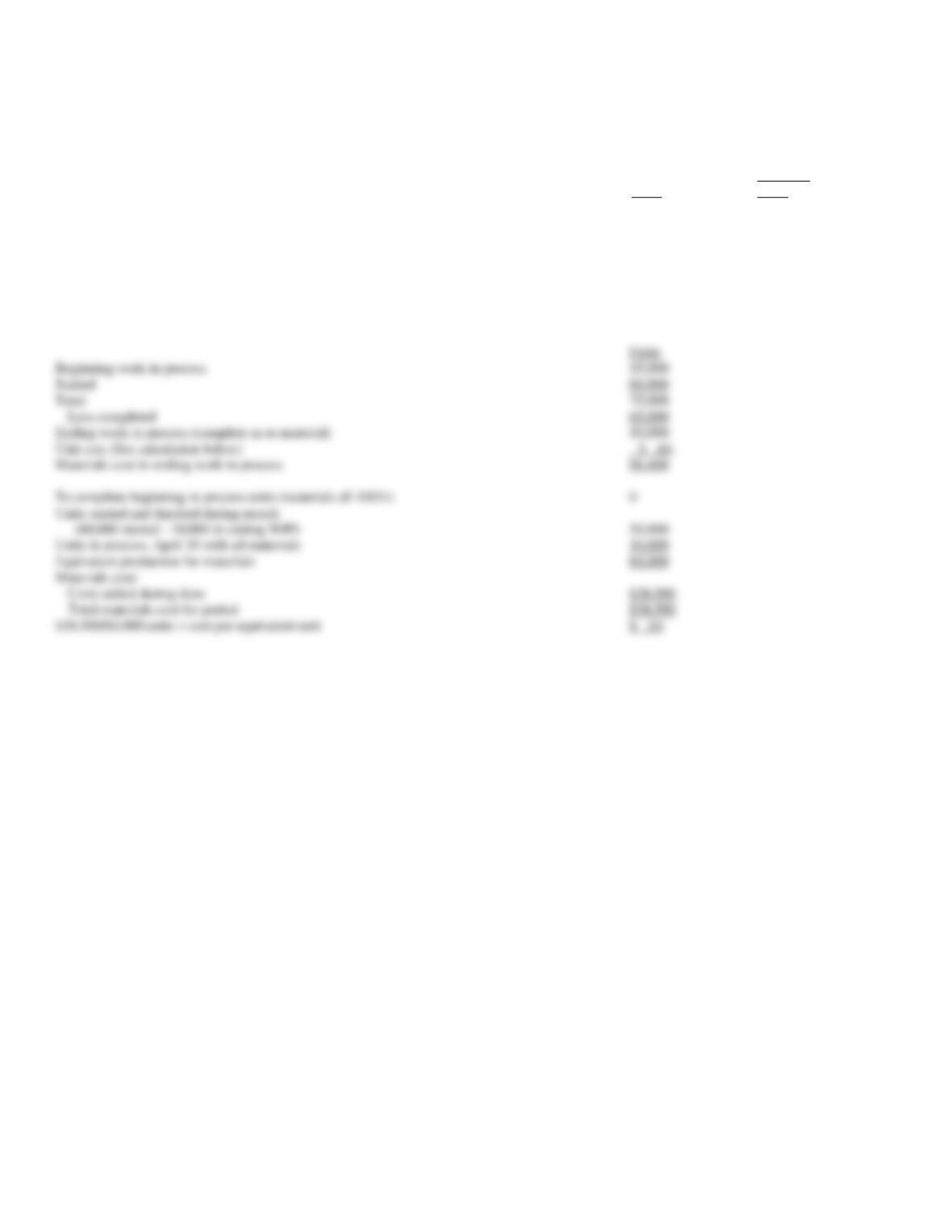
Direct
Conversion
Materials
Cost
Completed
93,500
93,500
Ending WIP
83,725
29,550
Equivalent units of Production
177,225
123,050
Direct
Conversion
Materials
Cost
Completed
93,500
93,500
Ending WIP
83,725
29,550
Equivalent units of Production
177,225
123,050
Unit direct materials cost = ($38,200 +$462,300)/177,225 = $2.82
Unit conversion cost = ($41,400 + $602,700)/123,050 = $5.23
Direct
Conversion
Materials
Cost
Completed
93,500
93,500
Ending WIP
83,725
29,550
Equivalent units of Production
177,225
123,050
Unit direct materials cost = ($38,200 +$462,300)/177,225 = $2.82
Unit conversion cost = ($41,400 + $602,700)/123,050 = $5.23
EWIP = ($2.82 x 83,725) + ($5.23 x 29,550) = $335,876.40
153. Plemmon Company adds materials at the beginning of the process in the forming department, which is the
first of two stages of its production cycle. Information concerning the materials used in the forming department
in April follows:
Materials
Units
Costs
Work in process at April 1
15,000
$ 8,000
Units started during April
60,000
$38,500
Units completed and transferred to next department
during April
65,000
Using the FIFO method, what is the materials cost of the work in process at April 30 (round unit calculations to the nearest cent)?
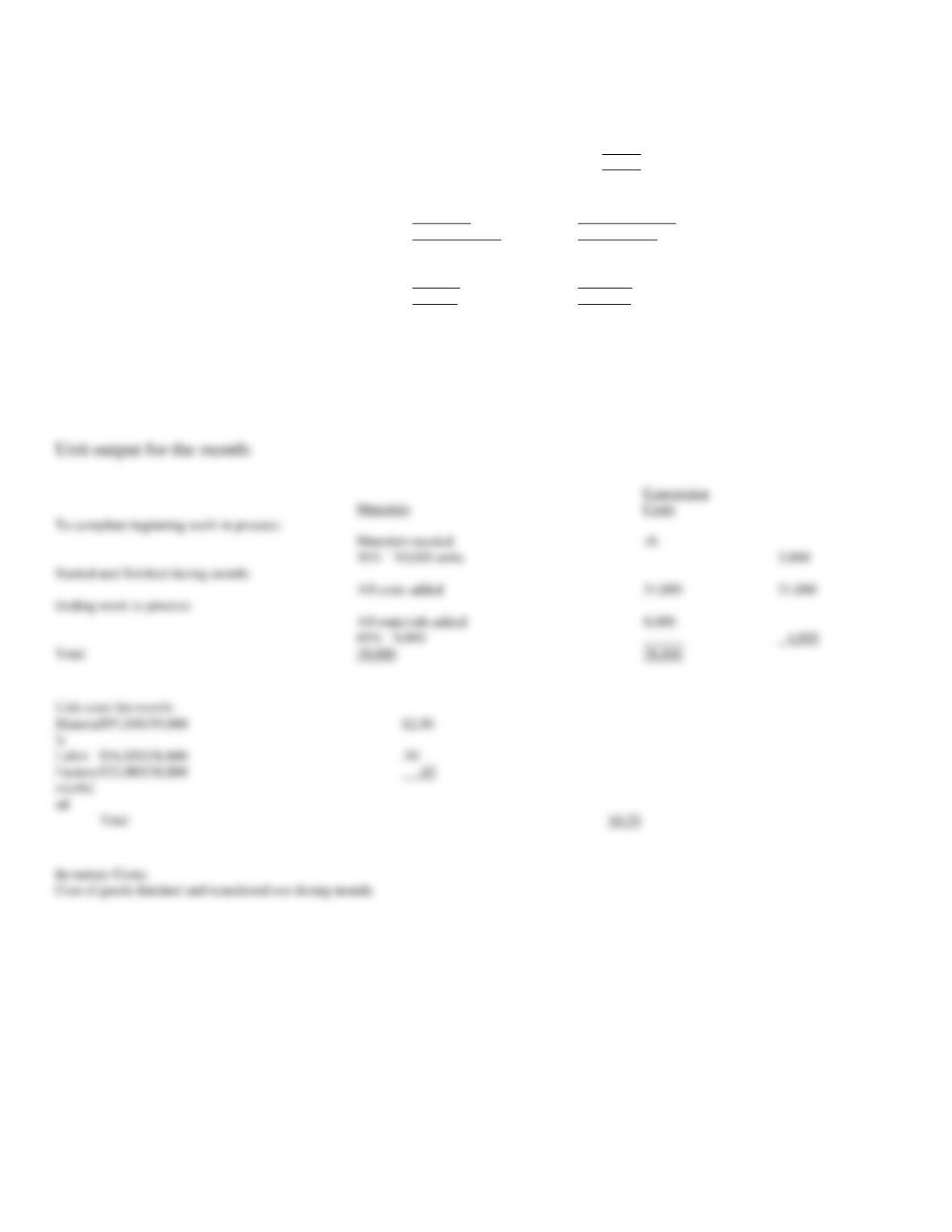
Units
Beginning work in process
15,000
Started
60,000
Total
75,000
Less completed
65,000
Ending work in process (complete as to material)
10,000
Unit cost (See calculation below)
$ .64
Materials cost in ending work in process
$6,400
To complete beginning in process units (materials all 100%)
0
Units started and finished during month
(60,000 started – 10,000 in ending WIP)
50,000
Units in process, April 30 with all materials
10,000
Equivalent production for materials
60,000
Materials cost:
Costs added during June
$38,500
Total materials cost for period
$38,500
$38,500/60,000 units = cost per equivalent unit
$ .64
154. The Roberto Company had computed the flow of units for Department A for the month of May as follows:
Work in process, May 1:
10,000
Started into production during May
39,000
Units to be accounted for
49,000
Beginning
Added during the
work in process
current month
Materials
$20,800
$ 97,500
Labor
5,200
34,920
Factory overhead
4,800
32,980
Total
$30,800
$165,400
Materials are added at the beginning of the process. There were 8,000 units of work in process at
May 31. The work in process at May 1 was 70 percent complete as to direct labor and factory overhead costs and the work in process at May 31 was
60 percent complete as to direct labor and factory overhead costs. What was the cost of the goods transferred out and in ending work in process using
the FIFO method?
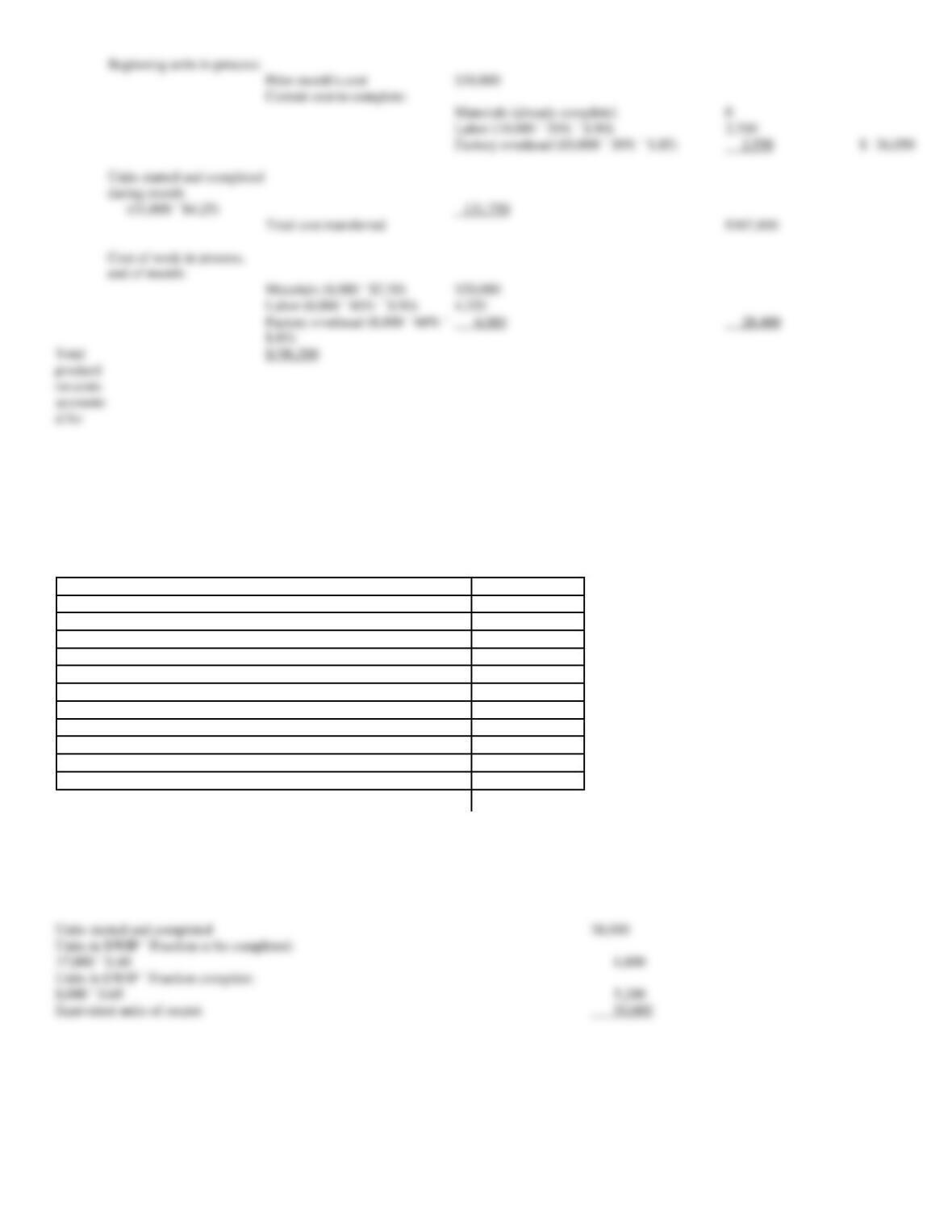
Conversion
Materials
Costs
To complete beginning work in process:
Materials needed
-0-
30% ´ 10,000 units
3,000
Started and finished during month:
All costs added
31,000
31,000
Ending work in process:
All materials added
8,000
60% ´ 8,000
4,800
Total
39,000
38,800
Labor
$34,920/38,800
.90
Total
$4.25
155. Garrison Inc. manufactures product where all manufacturing inputs are applied uniformly. The company
produced the following physical flow schedule for July:
Units to account for:
Units in BWIP (60% complete)
17,000
Units started
46,000
Total units to account for
63,000
Units accounted for:
Units completed:
From BWIP
17,000
Started and completed
38,000
55,000
Units, EWIP (65% completed)
8,000
Total units accounted for
63,000
Required: Prepare a schedule of equivalent units using the FIFO method
Units started and completed
38,000
Units in BWIP ´ Fraction to be completed:
17,000 ´ 0.40
6,800
Units in EWIP ´ Fraction complete:
8,000 ´ 0.65
5,200
Equivalent units of output
50,000
Beginning units in process:
Prior month’s cost
$30,800
Current cost to complete:
Materials (already complete)
0
Labor (10,000 ´ 30% ´ $.90)
2,700
Factory overhead (10,000 ´ 30% ´ $.85)
2,550
(31,000 ´ $4.25)
131,750
Total cost transferred
$167,800
Materials (8,000 ´ $2.50)
$20,000
Labor (8,000 ´ 60% ´ $.90)
4,320
d for
156. Describe the differences between process costing and job-order costing.
157. Describe how process costing for services differs from process costing for manufactured goods.
158. Explain the role of the departmental production report in process costing and name the five steps for
completing the departmental production report.
159. Explain how nonuniform inputs and multiple departments affect process costing.
Accounting for production under process costing is complicated by nonuniform application of manufacturing
inputs and the presence of multiple processing departments. Assuming uniform application of conversion costs
(direct labor and overhead) is not unreasonable. Direct labor input is usually needed throughout the process, and
overhead is normally assigned on the basis of direct labor hours. Direct materials, on the other hand, are not as
likely to be applied uniformly. In many instances, materials are added at either the beginning or the end of the
process.
160. Describe the differences in the ways that prior-period costs and output are treated under the weighted
average method and the FIFO method?
161. You Decide