Exam
Name___________________________________
TRUE/FALSE. Write ‘T’ if the statement is true and ‘F‘ if the statement is false.
1) The Record Date falls before the Ex–Dividend Date.
MULTIPLE CHOICE. Choose the one alternative that best completes the statement or answers the question.
2) The way a firm chooses between alternate uses of free cash flow is referred to as
A) retention ratio.
B) payout policy.
C) call policy.
D) debt policy.
3) The date on which the board of directors of a company authorizes the dividend is called the ________ date.
A) declaration
B) record
C) ex–dividend
D) distribution
4) The firm will pay the dividend to all shareholders of record on a specific date, set by the board, called the
________ date.
A) declaration
B) record
C) ex–dividend
D) distribution
5) The date two business days prior to the date on which all shareholders of record receive a payment is called
the ________ date.
A) declaration
B) record
C) ex–dividend
D) distribution
6) The date on which a firm pays out dividends is called the ________ date.
A) declaration
B) record
C) ex–dividend
D) distribution
7) A one–time payment to shareholders that is much larger than a regular dividend is often referred to as a
________ dividend.
A) taxable
B) divesting
C) special
D) ex–day
8) Dividend payments that are the result of liquidation of assets are known as ________ and are taxed as capital
gains.
A) return of capital
B) rolling dividends
C) alternate payments
D) private earnings
9) An alternate way to pay investors is when the firm uses cash to buy shares of its own outstanding stock, also
known as
A) dividend investment.
B) retained earnings.
C) initial public offering.
D) share repurchases.
10) A firm may announce its intention to buy its own shares in the open market like any other investor, also
known as a(n)
A) open market purchase.
B) tender offer.
C) targeted repurchase.
D) greenmail.
11) When a firm offers to buy its shares at a pre specified price during a short time period it is also known as a(n)
A) open market purchase.
B) tender offer.
C) targeted repurchase.
D) greenmail.
12) When a firm purchases shares directly from a major shareholder it is also known as a(n)
A) open market purchase.
B) tender offer.
C) targeted repurchase.
D) greenmail.
13) A firm may decide to eliminate the threat of a takeover by a major shareholder by purchasing shares from
him at a premium also known as a(n)
A) open market purchase.
B) tender offer.
C) targeted repurchase.
D) greenmail.
14) The date on which the board authorizes the dividend is the
A) declaration date.
B) distribution date.
C) record date.
D) ex–dividend date.
15) The firm will pay the dividend to all shareholders who are registered owners on a specific date, set by the
board, called the
A) declaration date.
B) record date.
C) distribution date.
D) ex–dividend date.
16) Anyone who purchases the stock on or after the ________ date will not receive the dividend.
A) distribution
B) record
C) ex–dividend
D) declaration
17) The firm mails dividend checks to the registered shareholders on the
A) ex–dividend date.
B) declaration date.
C) distribution date.
D) record date.
18) Which of the following statements is FALSE?
A) From an accounting perspective, dividends generally reduce the firm’s current (or accumulated)
retained earnings.
B) The way a firm chooses between paying dividends and retaining earnings is referred to as its payout
policy.
C) Most companies that pay dividends pay them semiannually.
D) Occasionally, a firm may pay a one–time, special dividend that is usually much larger than a regular
dividend.
19) A firm can repurchase shares through a(n) ________ in which it offers to buy shares at a prespecified price
during a short time period–generally within 20 days.
A) tender offer
B) open market share repurchase
C) targeted repurchase
D) Dutch auction share repurchase
20) Another to method to repurchase shares is the ________, in which the firm lists different prices at which it is
prepared to buy shares, and shareholders in turn indicate how many shares they are willing to sell at each
price.
A) tender offer
B) Dutch auction share repurchase
C) targeted repurchase
D) open market share repurchase
21) A(n) ________ may occur if a major shareholder desires to sell a large number of shares but the market for
the shares is not sufficiently liquid to sustain such a large sale without severely affecting the price.
A) open market share repurchase
B) Dutch auction share repurchase
C) tender offer
D) targeted repurchase
22) A(n) ________ is the most common way that firms repurchase shares.
A) targeted repurchase
B) Dutch auction share repurchase
C) tender offer
D) open market share repurchase
23) Danroy Inc has announced a $5 dividend. If Danroy’s last price while trading cum–dividend is $65, what
should its first ex–dividend price be (assuming perfect capital markets)?
A) $60
B) $65
C) $70
D) $75
24) A firm has assets of $250 million, of which $25 million is cash. It has debt of $100 million. If the firm were
to repurchase $10 million of its stock, what would its new debt–to–equity ratio be?
A) 71.4%
B) 28.6%
C) 80%
D) 20%
SHORT ANSWER. Write the word or phrase that best completes each statement or answers the question.
25) What choices does a firm have in using its free cash flow?
26) What are the ways in which a firm can pay out its free cash flow?
27) What are the ways in which a firm can retain its free cash flow?
28) What are the characteristics of special dividend?
29) What are the different ways a firm can repurchase shares?
TRUE/FALSE. Write ‘T’ if the statement is true and ‘F‘ if the statement is false.
30) In a perfect capital market, when a dividend is paid, the share price drops by the amount of the dividend
when the stock begins to trade ex–dividend.
31) With perfect capital markets, an open market repurchase increases the stock price as the number of
MULTIPLE CHOICE. Choose the one alternative that best completes the statement or answers the question.
32) The share price falls when a dividend is paid because the reduction in cash decreases the
A) liabilities of the firm.
B) current account of the firm.
C) market value of assets.
D) equity of the firm.
33) Suppose a firm does not pay a dividend but repurchases stock using $20 million of cash, the market value of
the firm decreases by
A) $20 million.
B) –$20 million.
C) 0.
D) cannot say for sure
34) A firm has $300 million of assets that includes $50 million of cash and 10 million shares outstanding. If the
firm uses $30 million of its cash to repurchase shares, what is the new price per share?
A) $25
B) $27
C) $30
D) $32
35) A firm has $400 million of assets that includes $50 million of cash and 10 million shares outstanding. If the
firm uses $40 million of its cash to repurchase shares, what is the new price per share?
A) $38
B) $40
C) $42
D) $44
36) A firm has $200 million of assets that includes $50 million of cash and 8 million shares outstanding. If the
firm uses $20 million of its cash to repurchase shares, what is the new price per share?
A) $25
B) $27
C) $30
D) $32
37) When a firm repurchases shares the supply of shares is ________ but at the same time the firm’s assets
________.
A) reduced, declines
B) increased, declines
C) reduced, increase
D) increased, increase
38) Homemade dividend refers to the process by which an investor
A) can take on more debt.
B) chooses between equity and debt.
C) can sell shares to create a dividend policy to suit his preferences.
D) reinvests dividend payments.
39) A firm has $300 million of assets that includes $50 million of cash and 10 million shares outstanding. The
firm uses $30 million of its cash to pay dividends. If an investor has 1000 shares, how many shares must he
sell to create a homemade dividend of $3900.
A) 33.3 shares
B) 40.2 shares
C) 50.5 shares
D) 60.3 shares
40) A firm has $400 million of assets that includes $50 million of cash and 10 million shares outstanding. The
firm uses $40 million of its cash to pay dividends. If an investor has 1000 shares, how many shares must she
sell to create a homemade dividend of $4900.
A) 25 shares
B) 30 shares
C) 35 shares
D) 40 shares
41) A firm has $500 million of assets that includes $50 million of cash and 10 million shares outstanding. The
firm uses $50 million of its cash to pay dividends. If an investor has 1000 shares, how many shares must he
sell to create a homemade dividend of $6575.
A) 25 shares
B) 30 shares
C) 35 shares
D) 40 shares
42) Modigliani and Miller Dividend Irrelevance states that in perfect capital markets, holding ________ policy
fixed, the firm’s choice of dividend policy is irrelevant and does not affect the initial share price.
A) debt
B) investment
C) interest rate
D) equity issuance
43) Which of the following statements is FALSE?
A) In perfect capital markets, holding fixed the investment policy of a firm, the firm’s choice of dividend
policy is irrelevant and does not affect the initial share price.
B) In a perfect capital market, when a dividend is paid, the share price drops by the amount of the
dividend when the stock begins to trade ex–dividend.
C) In perfect capital markets, an open market share repurchase has no effect on the stock price, and the
stock price is the same as the ex–dividend price if a dividend were paid instead.
D) In perfect capital markets, investors are indifferent between the firm distributing funds via dividends
or share repurchases. By reinvesting dividends or selling shares, they can replicate either payout
method on their own.
Use the information for the question(s) below.
Omicron Technologies has $50 million in excess cash and no debt. The firm expects to generate additional free cash
flows of $40 million per year in subsequent years and will pay out these future free cash flows as regular dividends.
Omicron’s unlevered cost of capital is 10% and there are 10 million shares outstanding. Omicron’s board is meeting to
decide whether to pay out its $50 million in excess cash as a special dividend or to use it to repurchase shares of the firm’s
stock.
44) Omicron’s enterprise value is closest to:
A) $500 million
B) $900 million
C) $450 million
D) $400 million
45) Including its cash, Omicron’s total market value is closest to:
A) $500 million
B) $900 million
C) $400 million
D) $450 million
46) Assume that Omicron uses the entire $50 million in excess cash to pay a special dividend. The amount of
the special dividend is closest to:
A) $5.00
B) $9.00
C) $4.00
D) $4.50
47) Assume that Omicron uses the entire $50 million in excess cash to pay a special dividend. The amount of
the regular yearly dividends in the future is closest to:
A) $4.50
B) $5.00
C) $4.00
D) $9.00
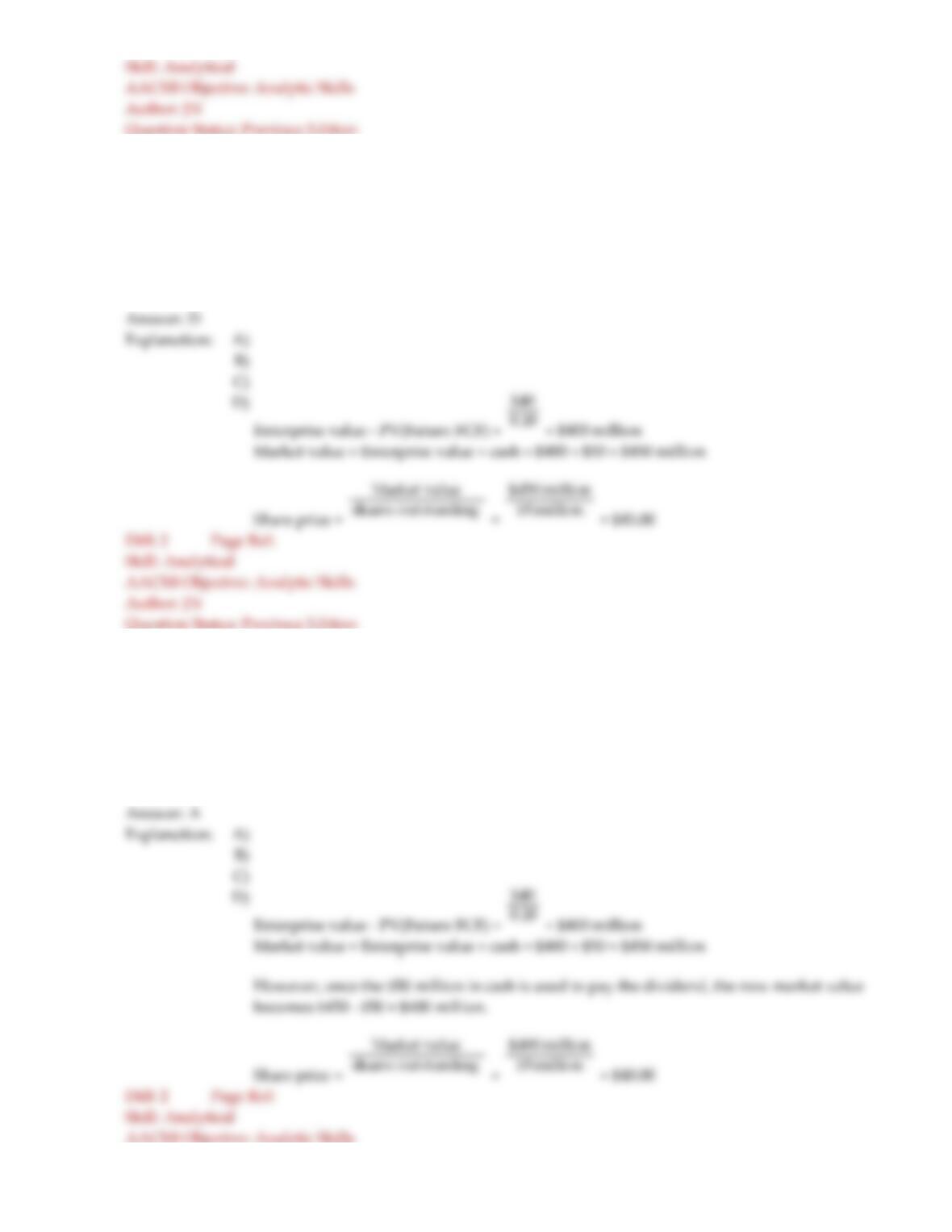
48) Assume that Omicron uses the entire $50 million in excess cash to pay a special dividend. Omicron’s
cum–dividend price is closest to:
A) $50.00
B) $40.00
C) $5.00
D) $45.00
49) Assume that Omicron uses the entire $50 million in excess cash to pay a special dividend. Omicron’s
ex–dividend price is closest to:
A) $40.00
B) $5.00
C) $50.00
D) $45.00
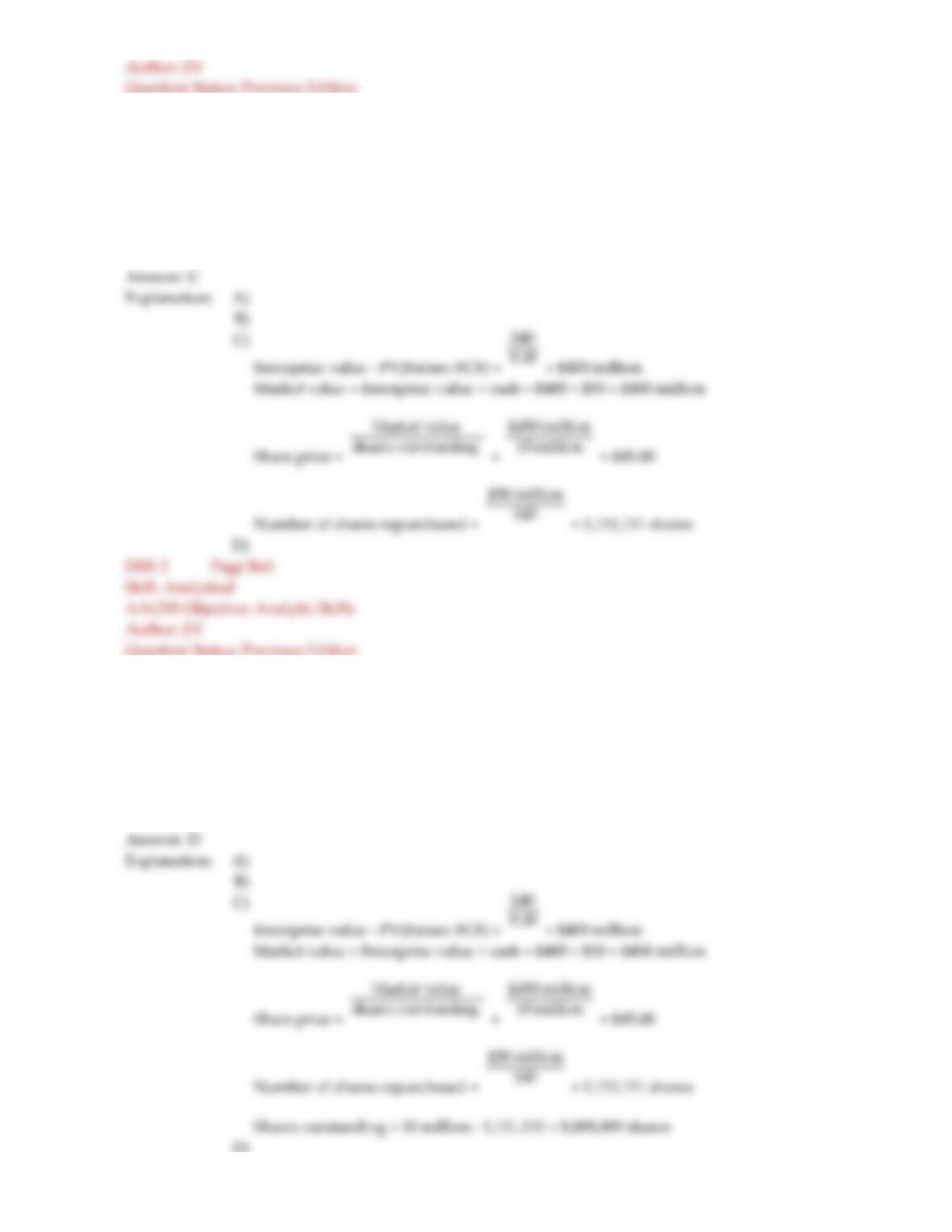
50) Assume that Omicron uses the entire $50 million to repurchase shares. The number of shares that Omicron
will repurchase is closest to:
A) 1.0 million
B) 1.2 million
C) 1.1 million
D) 0.9 million
51) Assume that Omicron uses the entire $50 million to repurchase shares. The number of shares that Omicron
will have outstanding following the repurchase is closest to:
A) 8.8 million
B) 1.2 million
C) 9.0 million
D) 8.9 million
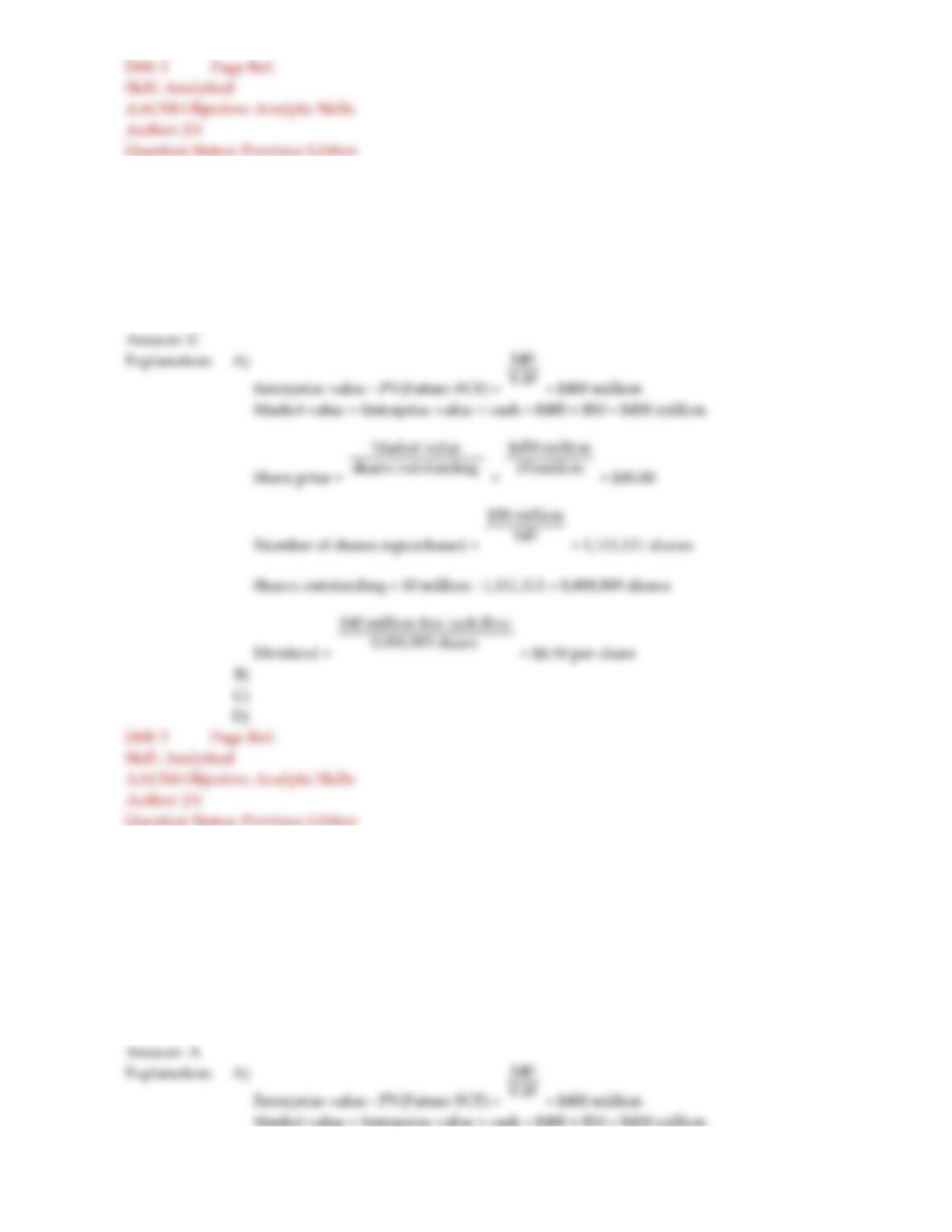
52) Assume that Omicron uses the entire $50 million to repurchase shares. The amount of the regular yearly
dividends in the future is closest to:
A) $9.00
B) $5.00
C) $4.50
D) $4.00
53) Assume that you own 2500 shares of Omicron stock and that Omicron uses the entire $50 million to
repurchase shares. Suppose you are unhappy with Omicron’s decision and would prefer that Omicron used
the excess cash to pay a special dividend. The number of shares that you would have to sell in order to
receive the same amount of cash as if Omicron paid the special dividend is closest to:
A) 275
B) 310
C) 125
D) 250
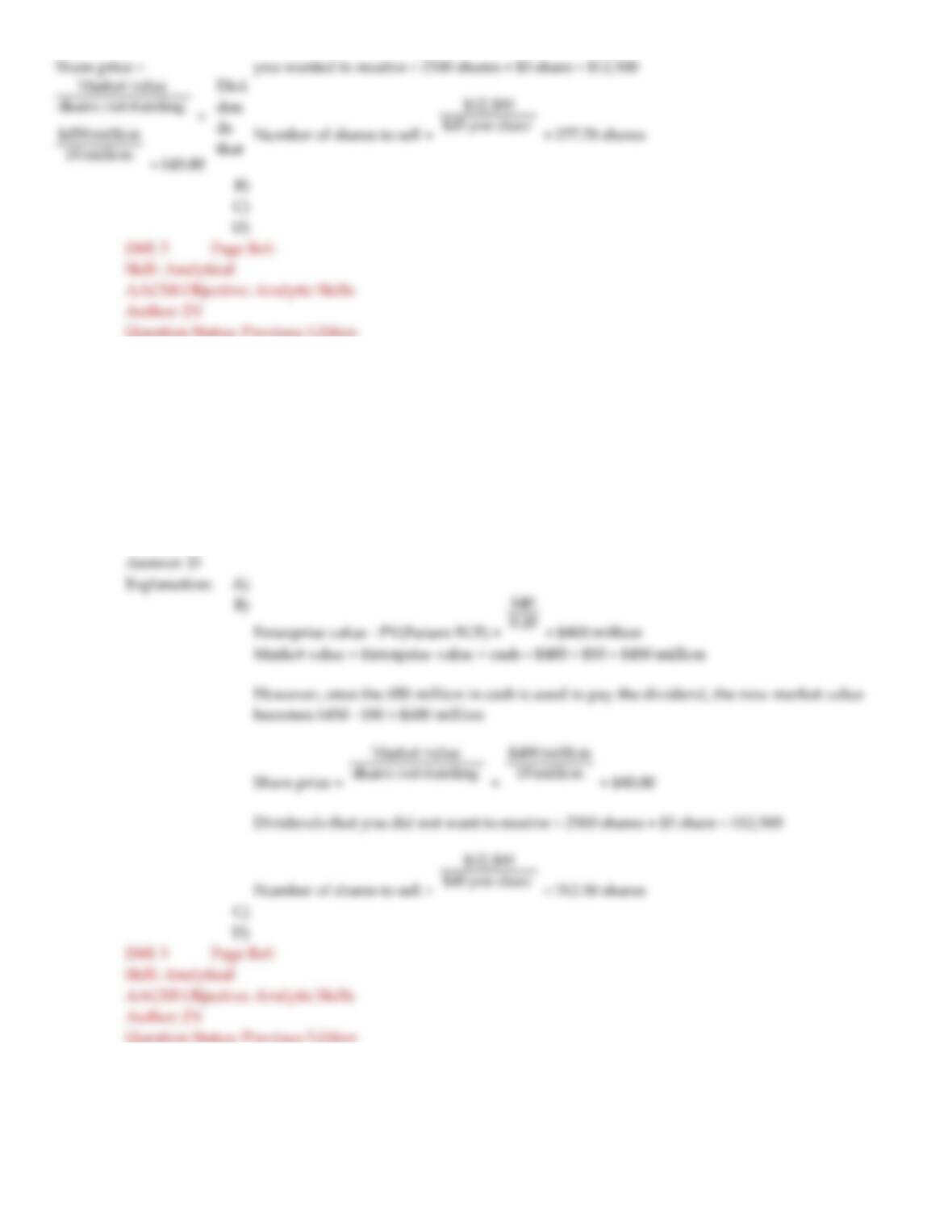
54) Assume that you own 2500 shares of Omicron stock and that Omicron uses the entire $50 million to pay a
special dividend. Suppose you are unhappy with Omicron’s decision and would prefer that Omicron used
the excess cash to repurchase shares. The number of shares that you would have to buy in order to undo
the special cash dividend that Omicron paid is closest to:
A) 125
B) 275
C) 250
D) 310
55) A firm has $75 million of assets that includes $12 million of cash and 25 million shares outstanding. If the
firm uses $12 million of cash to repurchase shares, what is the new price per share?
A) $1