Exam
Name___________________________________
MULTIPLE CHOICE. Choose the one alternative that best completes the statement or answers the question.
1)
This biome has a well–developed vertical structure with three distinct layers: an overstory, a
middle canopy, and understory.
1)
A)
Desert
B)
Midlatitude broadleaf and mixed forest
C)
Tropical rain forest
D)
Mediterranean shrubland
2)
Large woody vines that are rooted in the soil and found in tropical forests are called
2)
A)
understory.
B)
bryophytes.
C)
epiphytes.
D)
lianas.
3)
In which of the following biomes would one likely find wolf, elk, moose, bear, lynx, beaver,
wolverine, and a number of migratory birds?
3)
A)
Tropical savanna
B)
Tropical rain forest
C)
Boreal and montane forest
D)
Desert
4)
The flora and fauna of this biome is characterized by high biodiversity, including many lianas,
epiphytes, and arboreal animal species, such as sloths, monkeys, lemurs, and snakes.
4)
A)
Tropical rain forest
B)
Temperate rain forest
C)
Boreal and montane forest
D)
Mediterranean shrubland
5)
Moist continental climates support several distinct communities of woody vegetation in this biome
in North America, Europe, and Asia.
5)
A)
Midlatitude grassland
B)
Tropical rain forest
C)
Tropical savanna
D)
Midlatitude broadleaf and mixed forest
6)
This biome occupies more than one–third of Earth’s land area and is characterized by xerophytic
vegetation, low precipitation, and high potential evapotranspiration.
6)
A)
Tropical savanna
B)
Deserts
C)
Mediterranean shrubland
D)
Midlatitude grasslands
7)
Distinctive oceanic regions identified on the basis of organisms, ocean floor topography, currents,
areas of nutrient–rich upwelling circulation, or areas of significant predation are called
7)
A)
the littoral zone.
B)
the ocean biome.
C)
mari regions.
D)
large marine ecosystems (LMEs).
8)
Which of the following would one likely NOT find in the Arctic and alpine tundra biome?
8)
A)
Sedges and mosses
B)
Grasses
C)
Low growing shrubs
D)
Broadleaf deciduous trees
9)
Characteristic fauna of this biome include large ungulates (hooved mammals), such as giraffe,
zebra, buffalo, gazelle, wildebeest, antelope, and rhinoceros.
9)
A)
Tropical savanna
B)
Tropical rain forest
C)
Midlatitude grassland
D)
Midlatitude broadleaf and mixed forest
10)
Which of the following is TRUE about the distribution of Earth’s biodiversity?
10)
A)
In general, there tends to be greater biodiversity at higher latitudes than lower latitudes.
B)
There is a universally accepted manner to delineate Earth‘s biodiversity.
C)
Earth‘s biodiversity is spread unevenly across the planet.
D)
The distribution of Earth’s biodiversity is driven solely by climate.
11)
This biome is typically found in areas with marine west coast climates, characterized by high
precipitation, moderate air temperatures, summer fog, and an overall maritime influence.
11)
A)
Tropical savanna
B)
Temperate rain forest
C)
Midlatitude grassland
D)
Boreal and montane forest
12)
Despite the high–level of biodiversity, this biome has infertile soils, principally Oxisols, to which
the vegetation has roots systems that capture nutrients from litter decay.
12)
A)
Temperate rain forest
B)
Midlatitude grasslands
C)
Tropical rain forest
D)
Boreal and montane forest
13)
In which biome would one most likely find xerophytic species?
13)
A)
Tropical rain forest
B)
Boreal and montane forest
C)
Midlatitude broadleaf and mixed forest
D)
Deserts
14)
Rainforests occupy approximately ________ of the world’s land area, but represent about ________
of Earth’s species.
14)
A)
12%; 65%
B)
2%; 12%
C)
10%; 35%
D)
7%; 50%
15)
This biome is generally located north of the 10°C (50°F) isotherm for the warmest month, such as
the extreme northern areas of North America and Russia.
15)
A)
Boreal and montane forest
B)
Midlatitude broadleaf and mixed forest
C)
Arctic tundra
D)
Temperate rain forest
16)
Which of the following soil types is most associated with the tallgrass prairie (midlatitude
grassland)?
16)
A)
Spodosols
B)
Mollisols
C)
Oxisols
D)
Andisols
17)
Local names of this biome include the Chaco, Caatinga, brigalow, and dornveld.
17)
A)
Tropical seasonal forest and scrub
B)
Mediterranean shrubland
C)
Arctic and alpine tundra
D)
Tropical rain forest
18)
In which of the following regions would one likely NOT find a tropical rain forest?
18)
A)
The Pacific Northwest in the United States
B)
Equatorial Africa
C)
Southeast Asia
D)
The Amazon region in South America
19)
Which of the following best describes the vegetation of the Mediterranean shrubland biome?
19)
A)
Sclerophyllous
B)
Broadleaf deciduous
C)
Needleleaf evergreen
D)
Semideciduous
20)
Distinct regions of broadly similar flora and fauna are called
20)
A)
biomes.
B)
biogeographic realms.
C)
biozones.
D)
ecospheres.
21)
The most extensive anthropogenic biome is
21)
A)
forested lands.
B)
rangelands.
C)
settlements.
D)
cropland.
22)
This biome occurs in equatorial regions with erratic rainfall and typically occur on the margins of
tropic rainforests.
22)
A)
Tropical seasonal forest and scrub
B)
Tropical savanna
C)
Temperate rain forest
D)
Mediterranean shrubland
23)
Dry summers and winter precipitation maxima characterize this small biome is located in 5
disparate locations, typically on the west coast of continents between 30° and 40° latitude.
23)
A)
Tropical savanna
B)
Mediterranean shrubland
C)
Midlatitude grassland
D)
Midlatitude broadleaf and mixed forest
24)
Which of the following best describes an invasive species?
24)
A)
Approximately 90% of all introduced non–native species become invasive species.
B)
Dispersal, even if anthropogenic, is a normal biogeographic process and, therefore, no cause
of alarm.
C)
Non–native species become invasive when they become established in a new area, taking
over niches that were already occupied by native species.
D)
An invasive species is any non–native introduced species, whether it becomes established or
not.
25)
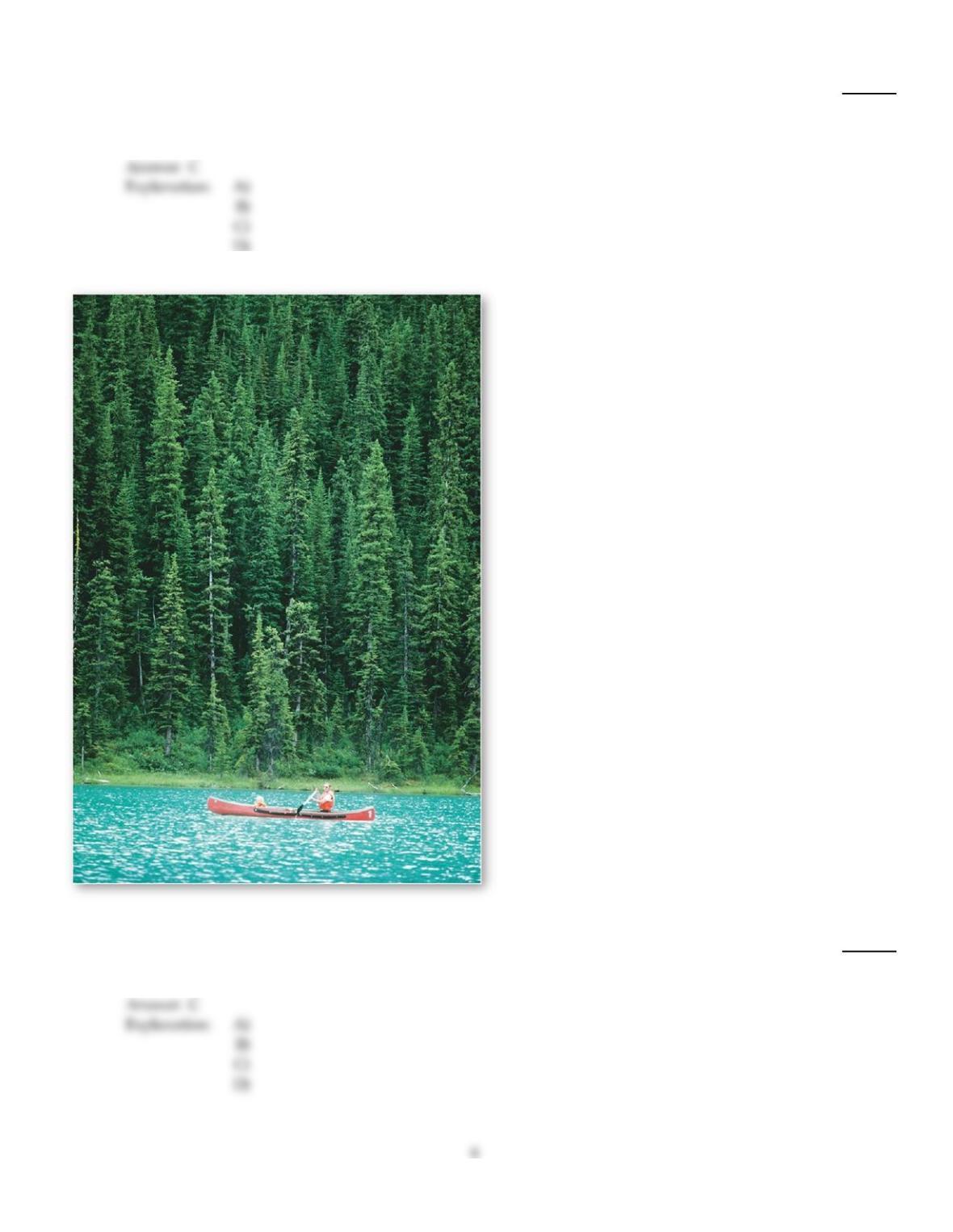
The 98th meridian marks an important biophysical mark in North America for this biome where
increasing aridity produces vegetation of a distinctly different height.
25)
A)
Desert
B)
Mediterranean shrubland
C)
Midlatitude grassland
D)
Midlatitude broadleaf and mixed forest
26)
This extensive biome is dominated by evergreen needleleaf forests.
26)
A)
Temperate rain forest
B)
Midlatitude broadleaf and mixed forest
C)
Boreal and montane forest
D)
Tropical seasonal forest and scrub
27)
Of all the natural biomes, this one is most modified by human activity.
27)
A)
Midlatitude grassland
B)
Midlatitude broadleaf and mixed forest
C)
Tropical savanna
D)
Tropical rainforest
28)
Trees and shrubs that seasonally loose their leaves are called
28)
A)
evergreens.
B)
annual herbs.
C)
bryophytes.
D)
deciduous.
29)
The naturalist and father of zoogeography Alfred Russel Wallace noted a distinct difference in the
fauna between several islands in the Malay Archipelago (present–day Indonesia). He used these
differences to delineate the boundary between the Australian and Oriental biogeographic realms.
Which of the following best describes the reason for these differences?
29)
A)
A deep ocean barrier inhibited dispersal between the two realms.
B)
Aboriginal tribes in Australia have greatly altered the fauna of Australia relative to the
Oriental realm.
C)
The environments of Australia and Asia are completely different, despite their relative close
proximity.
D)
Asia and European traders interacted for centuries prior to Wallace’s discovery. Among the
results of this interaction was an exchange of European (Palearctic) fauna and Oriental fauna.
30)
Which of the following is NOT a subdivision of the desert biome?
30)
A)
Cold desert and semidesert
B)
Polar desert
C)
Tropical desert
D)
Warm desert
31)
Which of the following is a topic of research in conservation biogeography?
31)
A)
The effects of climate change on biodiversity
B)
The distribution and effects of invasive species
C)
Conservation planning and the establishment of protected areas
D)
Invasive species, climate change, and conservation planning are all topics of research in
conservation biology.
32)
Which of the following is NOT an anthropogenic biome?
32)
A)
Pastoral village
B)
Residential rangelands
C)
Boreal and montane forest
D)
Populated forest
33)
This biome, with some deciduous trees and an open parkland vegetation type, are transitional
between tropical rain forest and grassland.
33)
A)
Broadleaf and mixed forest
B)
Temperate rain forest
C)
Tropical seasonal forest and scrub
D)
Mediterranean shrubland
34)
Though New Zealand is relatively close to Australia, it’s faunal assemblages are quite different. For
instance, there are no native marsupials in New Zealand. Which of the following best accounts for
these differences?
34)
A)
New Zealand is an island, whereas Australia is a continent. As such, one wouldn’t expect
them to have the same faunal assemblages.
B)
New Zealand was isolated from Australia during critical evolutionary times.
C)
New Zealand experienced a major extinction that wiped out its marsupials and other
Australian fauna.
D)
The environments of Australia and New Zealand are completely different, despite their close
proximity.
35)
Which of the following is NOT one of the major groups of terrestrial vegetation biogeographers
designate?
35)
A)
Desert
B)
Phytoplankton
C)
Grassland
D)
Forest
36)
This biome occupies large portions of the eastern United States, central Europe, and Asia.
36)
A)
Tropical savanna
B)
Midlatitude broadleaf and mixed forest
C)
Temperate rain forest
D)
Boreal and montane forest
37)
Which of the following best describes the climate characteristics of the tropical seasonal forest and
scrub?
37)
A)
Consistently warm and wet
B)
Low precipitation and exceptionally hot
C)
Moderate due to maritime effects
D)
Monsoonal rains and always warm
38)
According to MacArthur and Wilson’s theory of island biogeography, which of the following is
CORRECT?
38)
A)
The number of species increases with island area.
B)
The number of species decreases with island area.
C)
There is no relationship between species number and island area.
39)
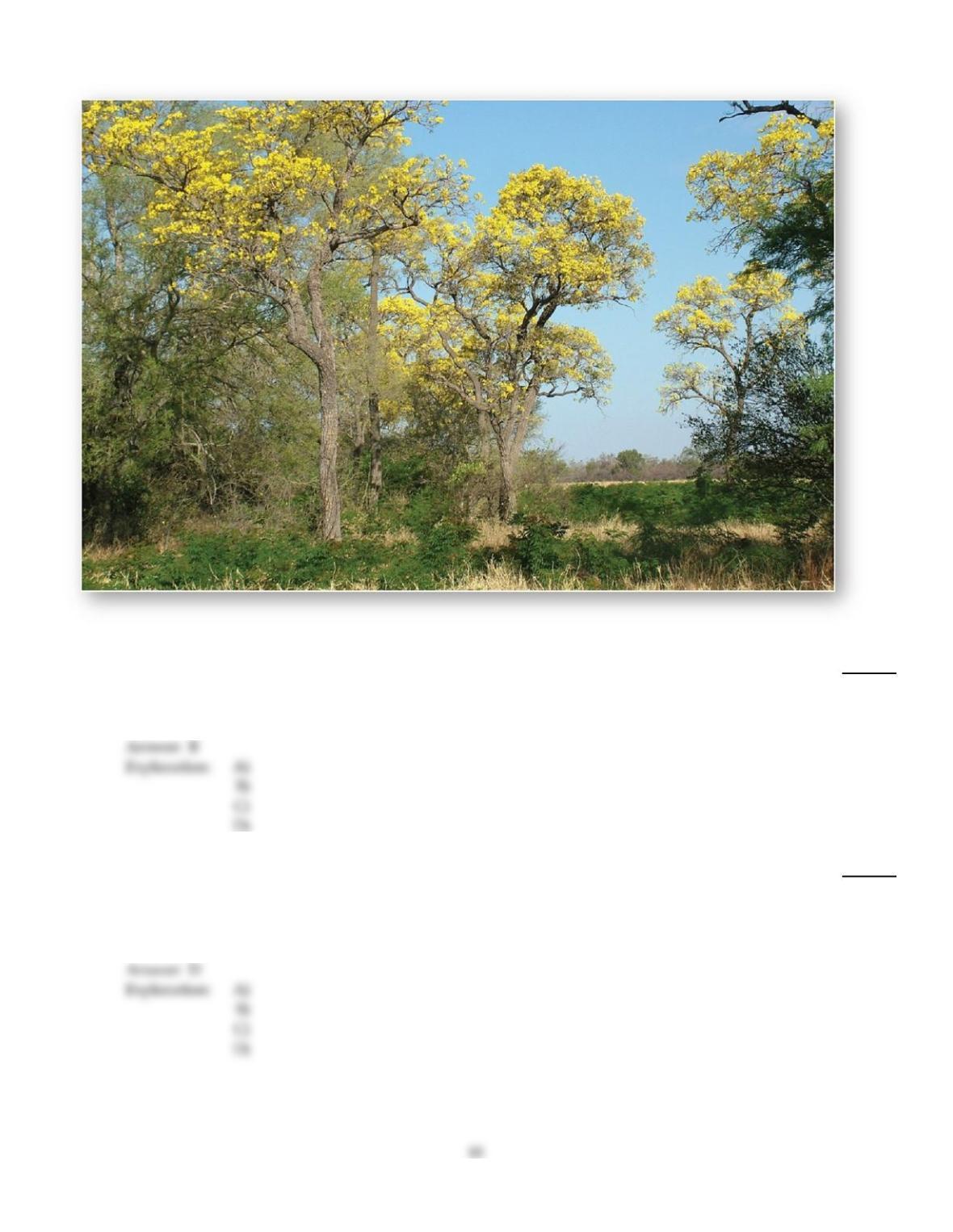
Trumpet trees (Tabebuia caraiba), a dry–season deciduous tree, would likely be found in which of
the following biomes?
39)
A)
Tropical rain forest
B)
Tropical seasonal forest and scrub
C)
Midlatitude grassland
D)
Desert
40)
Earth’s tallest trees are the
40)
A)
giant ash (Eucalyptus regnans).
B)
coast douglas fir (Pseudotsunga menziessii).
C)
sitka spruce (Picea sitchensis).
D)
coast redwoods (Sequoia sempervirens).
41)
The climate of the tropical rain forest biome is best described as
41)
A)
consistently warm and wet.
B)
consistently warm, but seasonally dry.
C)
having a distinct cold and warm season.
D)
mild winter with a very hot summer.
42)
Representative animals in this biome include red fox, white–tailed deer, southern flying squirrel,
opossum, bear, and a great variety of birds.
42)
A)
Arctic and alpine tundra
B)
Desert
C)
Midlatitude broadleaf and mixed forest
D)
Tropical savanna
C
43)
The largest area of tropical savanna is found in
43)
A)
Australia.
B)
Asia.
C)
Africa.
D)
North America.
C
44)
Home to the endangered Northern Spotted Owl, this biome is now characterized by anthropogenic
disturbance and mostly secondary–growth forest.
44)
A)
Temperate rain forest
B)
Desert
C)
Midlatitude grassland
D)
Arctic and alpine tundra
A
45)
Which of the following best describes the vegetation of the tropical seasonal forest and scrub
biome?
45)
A)
Broadleaf evergreen
B)
Sclerophyllous
C)
Xerophytic
D)
Semideciduous
D
A
46)
This extensive biome stretches from the east coast of Canada to the Canadian Rockies, as well as
across the entire extent of Russia to the European Plain and at high elevations at lower latitudes.
46)
A)
Desert
B)
Midlatitude broadleaf and mixed forest
C)
Arctic and alpine tundra
D)
Boreal and montane forest
47)
Which of the following best describes the vegetation of the tropical rain forest biome?
47)
A)
Seasonal deciduous
B)
Sclerophyllous
C)
Broadleaf evergreen
D)
Perennial herbaceous
48)
The soils of the boreal forest acidic and leached of humus and clays, belonging to the ________ soil
order.
48)
A)
Andisols
B)
Entisols
C)
Oxisols
D)
Spodosols
49)
Which of the following is NOT a regional name for the Mediterranean shrubland biome?
49)
A)
Mattoral
B)
Taiga
C)
Maquis
D)
Chaparral
50)
Which of the following regarding biomes is NOT true?
50)
A)
Biomes often reflect potential mature vegetation, rather than actual vegetation of an area.
B)
Most biomes have been greatly altered by human intervention.
C)
Biomes are defined by native species to a region.
D)
The boundaries between most biomes are sharp and easily delineated.
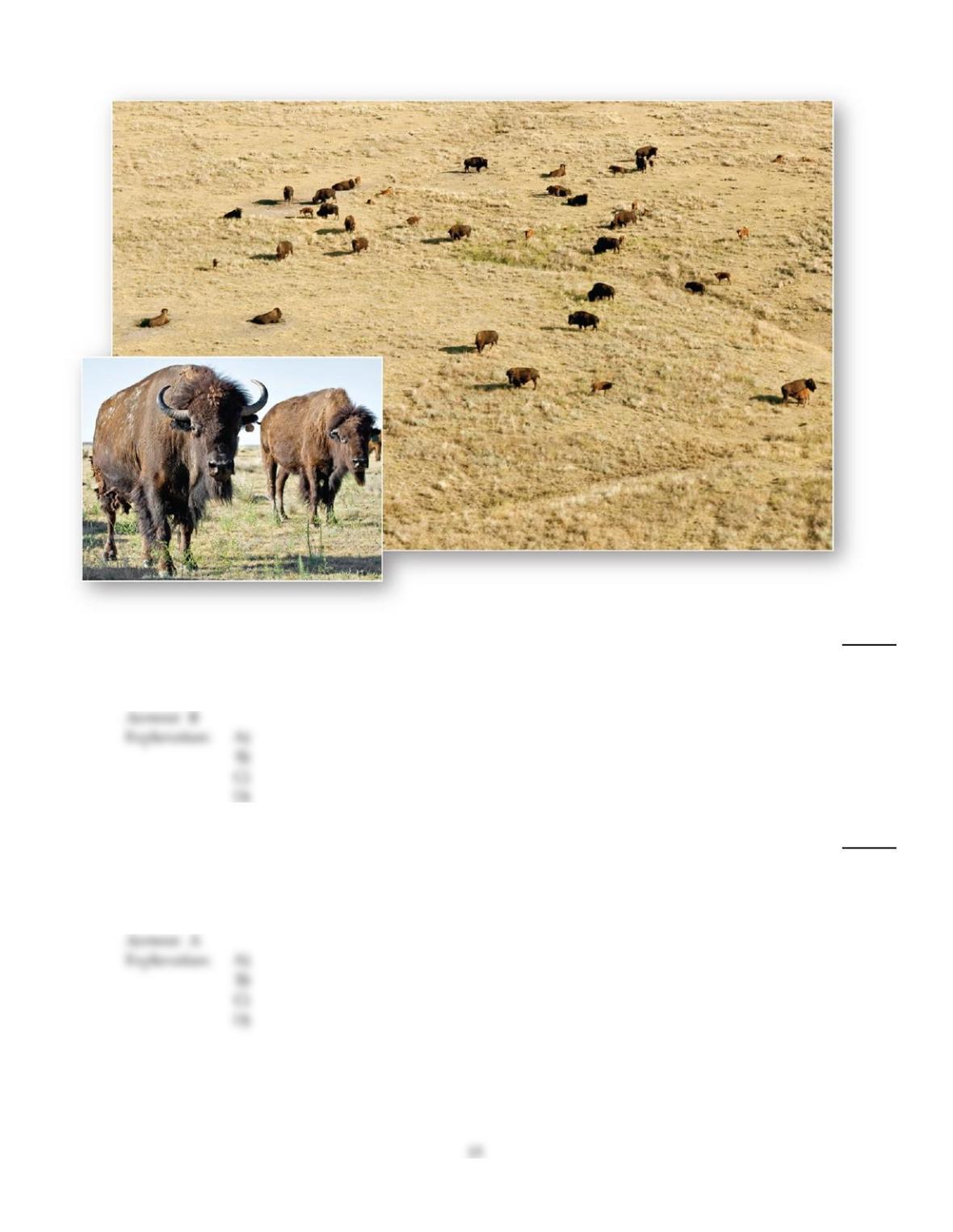
51)
The near annihilation of the American bison (Bison bison) has restricted its occurrence to a few
protected remnants and preserves in this biome.
51)
A)
Boreal and montane forest
B)
Midlatitude grassland
C)
Tropical savanna
D)
Midlatitude broadleaf and mixed forest
52)
Shrub vegetation refers to
52)
A)
low shrubs and grasses with some adaptations to semiarid conditions.
B)
woody plants with small, leathery evergreen leaves.
C)
a plant that survives seasonally unfavorable conditions underground.
D)
drought resistant.
53)
Which of the following climate types is associated with the midlatitude broadleaf and mixed forest
biome?
53)
A)
Marine west coast
B)
Humid subtropical (warm summer)
C)
Mediterranean
D)
Humid continental (cool summer)
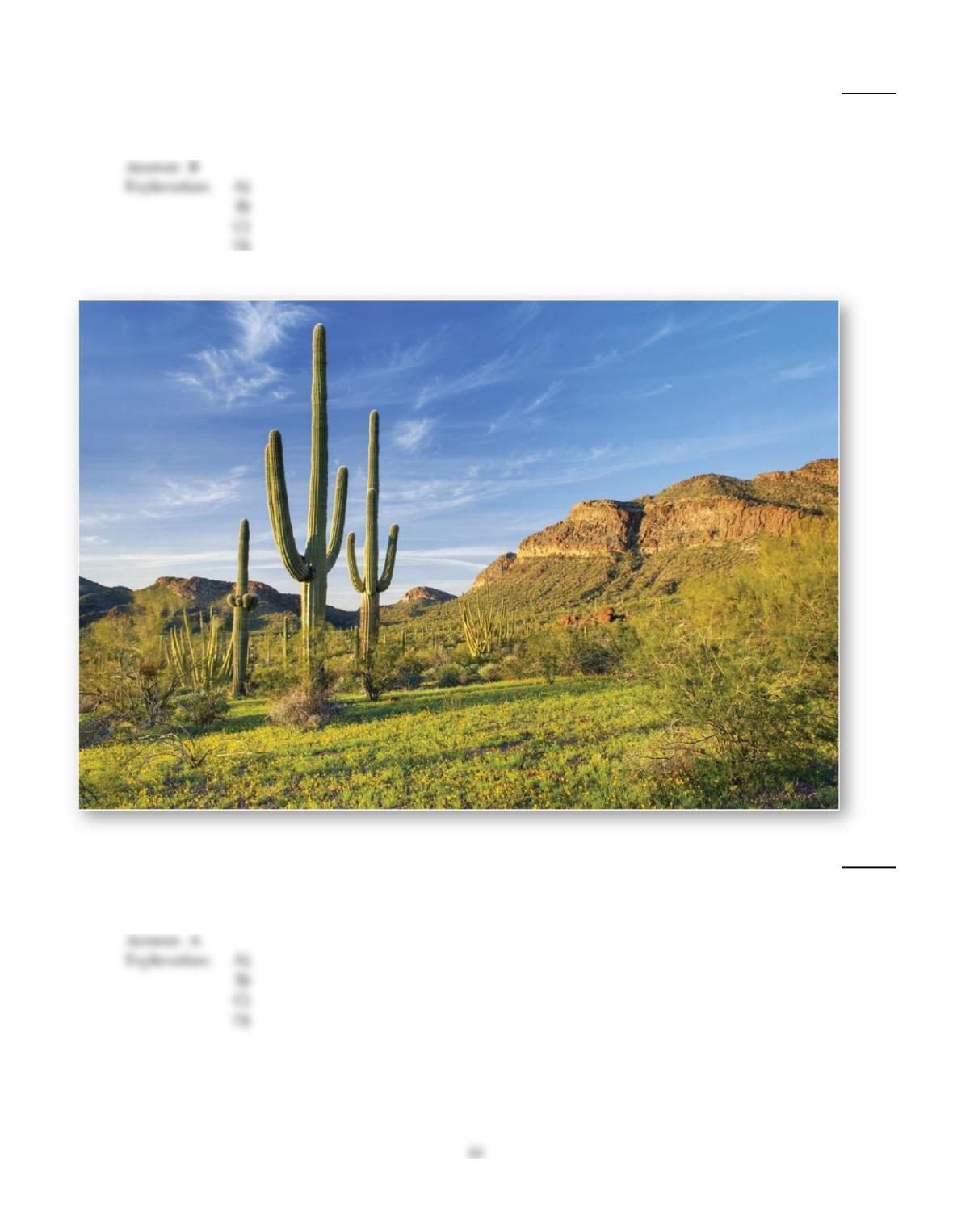
54)
Succulents, such as the saguaro cactus (Carnegiea gigantea) found in southern Arizona, southeastern
California, northern Mexico, and the Baja Peninsula, are representative vegetation in which biome?
54)
A)
Deserts
B)
Tropical savanna
C)
Midlatitude grassland
D)
Mediterranean shrubland
55)
The most powerful biotic agent on Earth, influencing all ecosystems on a planetary scale is
55)
A)
the sun.
B)
detritivores.
C)
humans.
D)
tertiary consumers.
56)
According to MacArthur and Wilson’s theory of island biogeography, which of the following is
CORRECT?
56)
A)
The number of species increases with island isolation.
B)
The number of species decreases with island isolation.
C)
There is no relationship between species number and island isolation.
57)
This biome consists of large expanses of xerophytic grassland, scattered trees and shrubs adapted to
drought, grazing by large herbivores, and fire.
57)
A)
Tropical rain forest
B)
Mediterranean shrubland
C)
Tropical savanna
D)
Desert
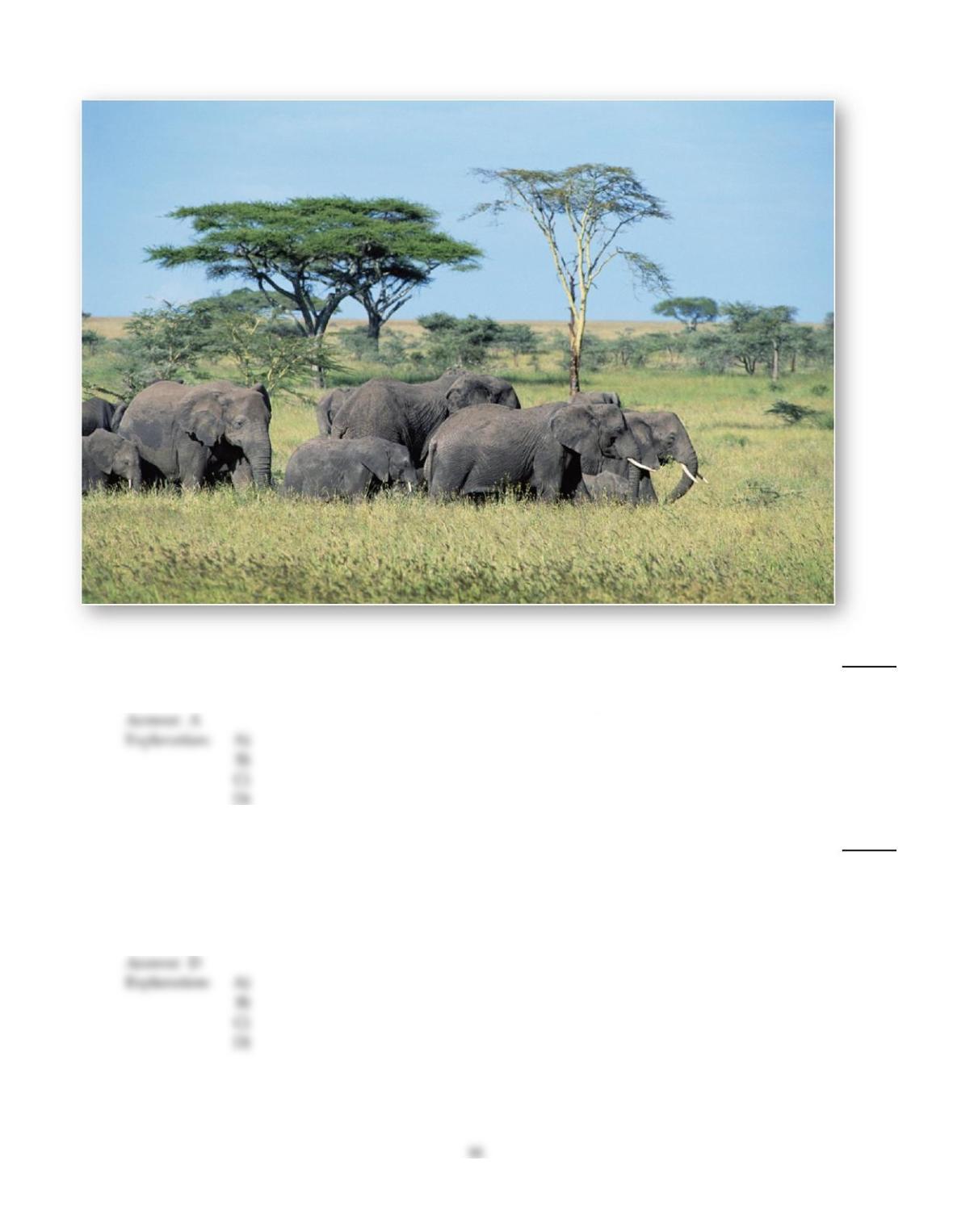
58)
Acacias and elephants in southern Africa are indicative of which biome?
58)
A)
Tropical savanna
B)
Desert
C)
Arctic and alpine tundra
D)
Midlatitude grassland
59)
Which of the following is NOT an issue in biodiversity conservation in the 21st century?
59)
A)
Threats to endangered species
B)
Human population growth
C)
The ill effects of climate change
D)
Biodiversity conservation in the 21st century requires addressing threats to endangered
species, the ill effects of climate change, and human population pressures.
60)
The subdiscipline of biogeography that utilizes biogeographic principles, theories, and analyses to
solve problems in biodiversity management is known as
60)
A)
phylogenetic biogeography.
B)
conservation biogeography.
C)
island biogeography.
D)
historical biogeography.
61)
Which biome occurs at high elevations above the treeline, even at lower latitudes?
61)
A)
Midlatitude broadleaf and mixed forest
B)
Temperate rain forest
C)
Alpine tundra
D)
Boreal and montane forest
62)
Large, stable communities of plants and animals whose boundaries are closely linked to climate
and soils are called
62)
A)
biomes.
B)
ecospheres.
C)
biogeographic realms.
D)
biozones.
63)
The boundary zone between adjacent biomes in which traits from both biomes may be found is
called the
63)
A)
transitional matrix.
B)
ecotone.
C)
boundary layer.
D)
edge effect.
TRUE/FALSE. Write ‘T’ if the statement is true and ‘F’ if the statement is false.
64)
The most extensive anthropogenic biome is croplands.
64)
65)
All needleleaf trees are evergreen.
65)
66)
Anthropogenic biomes, while not replacing the concept of terrestrial biomes classification, provide
insight into the role humans have played in shaping the world’s ecosystems.
66)
67)
The boreal and montane forest biome is characterized by broadleaf deciduous trees.
67)
68)
Fire is an important ecological factor in the tropical savanna and midlatitude Mediterranean
shrublands biomes.
68)
69)
Though occupying only 7% of the world’s total land area, tropical rain forests account for
approximately 50% of Earth’s species and about half of its remaining forests.
69)
70)
Biomass in a rain forest is concentrated in the dense mass of overhead leaves of the overstory and
canopy.
70)
71)
Due to the dense tropical rain forest canopy, only about 1% of the sunlight arriving at the canopy
reaches the forest floor.
71)
72)
Boreal forest soils are subject to podzolization.
72)
73)
The Mediterranean shrubland biome is the most extensive terrestrial biome.
73)
74)
Midlatitude grasslands are found only in North America.
74)
75)
Deserts, by definition, contain very little vegetation and are represented instead by large areas of
windswept sand (ergs).
75)
76)
Biomes are based on potential mature vegetation rather than the actual vegetation.
76)
77)
Humans are the most powerful biotic agent on Earth, influencing all ecosystems on a planetary
scale.
77)
78)
Several distinct communities of midlatitude broadleaf and mixed forests are found in North
America, Europe, and Asia.
78)
79)
In general, the tropical seasonal forest and scrub biome has more erratic rainfall than the tropical
rain forest biome.
79)
80)
Alpine tundra vegetation is characterized by evergreen needleleaf trees.
80)
81)
Despite widespread tropical deforestation, tropical rain forests are able to quickly regenerate owing
to the extremely fertile conditions in the biome.
81)
82)
Biogeographic regions (realms) are delineated based on species assemblages and their evolutionary
history.
82)
83)
The boundaries between biomes are usually abrupt and related to rapid environmental changes,
such as those caused by climate or topography.
83)
84)
The largest areas of tropical savanna occur in South America, particularly in Venezuela.
84)
85)
The Mediterranean shrubland biome is characterized by dry summers and wet winters.
85)
86)
Tropical savannas are treeless areas in the equatorial region.
86)
87)
Alfred Russel Wallace’s zoogeographic realms roughly correspond to continental plate boundaries.
87)
88)
The range of environmental conditions in ecotones make them areas of high biodiversity.
88)
89)
The boundaries of biogeographic regions are usually quite arbitrary, usually following political
boundaries rather than being based on biophysical criteria.
89)
90)
The most modified biome by human activity is the midlatitude grasslands.
90)
91)
Earth’s remaining undisturbed ecosystems have become a focus of tourism, recreation, and
scientific attention.
91)
92)
Rain forests only occur in equatorial areas.
92)
93)
Most desert plants are xerophytic with numerous mechanisms to cope with dry conditions.
93)
94)
The biome concept has been applied equally to marine and aquatic systems as it has to terrestrial
systems.
94)
95)
Species extinctions are inevitable, so expending resources on combating species loss is pointless.
95)
96)
MacArthur and Wilson’s theory of island geography posits that the number of species on an island
is a dynamic equilibrium between the rates of immigration and extinction.
96)
97)
Invasive species can alter community dynamics and may lead to declines in native species.
97)
98)
Each year, an area of tropical rain forest approximately the size of Wisconsin is cleared.
98)
99)
Most forests in the temperate rain forest are old growth.
99)
100)
All areas now classified as Arctic tundra were covered by ice during the Pleistocene glaciations.
100)
101)
“Wallace‘s line,” which serves as a dividing line between different biogeographic realms and
separates several present–day Indonesian islands from one another, is so named to show the
arbitrary nature of such delineations.
101)
102)
Earth’s biodiversity is evenly spread across the planet.
102)
103)
In part, the high diversity of the tropical rain forest is due to the extremely fertile soils found in the
biome.
103)
104)
A biome is a large, stable community of plants and animals whose boundaries are closely linked to
climate.
104)
105)
New Zealand and Australia’s remarkably similar fauna suggests that they were connected, either as
a single land mass or by a land bridge, during critical evolutionary times.
105)
106)
Due to international pressure, tropical deforestation has largely ceased EXCEPT in a few isolated
pockets of Amazonia and equatorial Africa.
106)
107)
Most non–native species introduced to a new community become established there.
107)
ESSAY. Write your answer in the space provided or on a separate sheet of paper.
108)
What is conservation biogeography? What are its primary focuses?
109)
Discuss the extent of deforestation in the tropics and why it is such an important environmental issue.
110)
What are the important factors used in defining a biogeographic realm?
111)
Describe the concept of an anthropogenic biome. In which anthropogenic biome do you live? Explain your
answer.
112)
Discuss the vegetation, soil orders, temperature patterns, and state of the environment in the biome in which
you live.
113)
Invasive species represent a threat to biodiversity worldwide. Based on either the examples presented in the
textbook or outside sources, describe several invasive species of concern in your area. What factors contributed
to their spread. Why are these species of concern, both in a broad context, as well as within your area.
114)
Discuss the concept of the biome, including the various factors used to characterize one.
115)
Discuss the main concepts of island biogeography. How has it been applied to the formation of biosphere
reserves?
Answer Key
Testname: C17
Answer Key
Testname: C17
Answer Key
Testname: C17
26