
Chapter 17—Long-Term Debt and Leasing
MULTIPLE CHOICE
1. A syndicated loan is:
a.
A loan obtained through illegal channels
b.
A large-denomination loan arranged by a group of commercial banks for a single borrower
c.
A loan sold to a second creditor
d.
A group of small loans combined to obtain a better interest rate from a single commercial
bank
e.
A loan where interest payments are stripped from the loan and sold to a syndicate of banks
2. Financial Accounting Standards Board (FASB) Statement #13 requires that operating leases be
included on the balance sheet by reporting:
a.
an asset and liability
b.
only the liability for the lease payment
c.
only an asset valued at the cost of the leased asset
d.
a change in net worth
e.
none of the above is correct
3. Debt covenants:
a.
restrict the firm from privately placing debt.
b.
are the documents describing features of a bond issue, e.g., coupon rate, maturity, and act
as the contract between the issuer and buyer.
c.
place operating and financial constraints on a borrower.
d.
restrict a firm from seeking debt from multiple lenders.
e.
are created when a firm misses a scheduled coupon payment.
4. Which of the following is a positive covenant?
a.
prohibit the sale of accounts receivable
b.
fixed asset restrictions
c.
maintain satisfactory accounting records
d.
prohibit borrowing additional long-term debt
e.
prohibit business combinations
5. Payment of interest on __________ is required only when earnings are available from which to make
such payments.
a.
subordinated debentures
b.
debentures
c.
collateral trust bonds
d.
equipment trust certificates
e.
income bonds
6. Which of the following parties can be a lessor?

a.
manufacturer’s leasing subsidiary
b.
independent leasing company
c.
commercial banks
d.
life insurance companies
e.
all of the above
7. The __________ of the financial lease makes it quite similar to certain types of long-term debt.
a.
length of time
b.
renewal options
c.
indenture
d.
noncancelable feature
e.
lease rating feature
8. __________ loans are typically arranged for infrastructure projects—such as toll roads and tunnels.
a.
Eurocurrency
b.
Project finance
c.
Operating
d.
Collateral
e.
Private placement
9. __________ would be considered a negative covenant in a long-term debt agreement.
a.
A requirement that the borrower agree not to consolidate, merge or combine with another
firm
b.
A requirement that additional borrowing be subordinated
c.
A sinking fund requirement
d.
a and b
e.
b and c
10. Anna’s Amazing Ant Farms is negotiating a term loan. The lender is likely to require a claim on the
firm’s __________, and Anna should expect this __________ loan to be associated with a __________
interest rate than __________ loans.
a.
plant; unsecured; lower; secured
b.
machinery; unsecured; higher; secured
c.
machinery; secured; lower; unsecured
d.
machinery; secured; higher; unsecured
e.
plant; pledged; lower; unpledged
11. Which of the following types of bonds is unsecured?
a.
mortgage bonds
b.
collateral trust bonds
c.
debentures
d.
equipment trust certificates

e.
none of the above
12. In a market with high uncertainty regarding future interest and inflation rates, investors would prefer
__________.
a.
subordinated debentures
b.
floating-rate bonds
c.
extendible notes
d.
a and b
e.
b and c
13. Which of the following increase the relative cost of issuing public debt over obtaining a syndicated
loan?
a.
bond rating fees
b.
trustee fees
c.
a longer term
d.
a and b
e.
all of the above
14. Global Intelligence Co. (GIC) is a Canadian firm raising funds in Britain, Germany, and Switzerland
through a Canadian-dollar bond issue. International Runners Attire (IRA) is a Swiss firm issuing U.S.
dollar-denominated bonds in the United States. GIC is involved in the __________ market, while IRA
is participating in the __________ market.
a.
foreign bond; Eurobond
b.
Eurobond; foreign bond
c.
Eurobond; income bond
d.
foreign bond; income bond
e.
income bond; Eurobond
15. A firm issued q bonds with an initial maturity of y years and proceeds per bond of $pb. There are 10
years remaining to maturity, the firm is in the 40 percent tax bracket, and the bonds have a $1,000 par
value. The total discount for this issue is __________; the annual amount of discount amortized for
this issue is __________; and the tax savings from the unamortized discount associated with the
retirement now of this issue is __________.
a.
$w1; $w2; $w4
b.
$a1; $w2; $w3
c.
$a1; $a2; $w3
d.
$a1; $a2; $a3
e.
$w2; $a2; $a3

16. Syndicated loans:
a.
appeal to borrowers wishing quick access to small sums of money
b.
can have very flexible borrowing terms and can be quickly arranged, but therefore have
very wide spreads over LIBOR
c.
are useful in funding debt-financed acquisitions because large sums can be quickly and
discreetly obtained
d.
are typically fixed-rate offerings with large spreads and are structured similar to term loans
e.
are flexible term loans provided to a group of borrowers by a syndicate of lenders,
allowing fast access to large sums of money
17. Assuming payments are made at the end of each year, what is the annual payment required to retire a
$s loan with a term of 5 years and an interest rate of i%; how much of this payment represents interest
at the end of year 1?
a.
$w; $a2
b.
$a1; $a2
c.
$a1; $w
d.
$a1; $a1
e.
$a2; $a2
18. When considering a lease-versus-purchase decision, a firm will find purchasing more attractive if there
is a __________ risk of obsolescence, borrowing opportunities are __________, and required lessor
returns are __________.
a.
low; inexpensive; high
b.
low; expensive; high
c.
low; expensive; low
d.
high; inexpensive; high
e.
high; expensive; high
19. If a lease is classified as an operating lease, __________, while a lease classified as a financial lease
__________.
a.
its duration is usually five years or less and the underlying asset has significant market
value when the lease ends; is for a longer term and ownership of the underlying asset must
be transferred to the lessee
b.
the asset that is leased has a useful life that is longer than the lease’s term; deals with assets
prone to obsolescence
c.
total payments over the lease period are greater than the lessor’s initial cost; includes a
lessor which supplies about 20 percent of the cost of the asset
d.
it may contain an option to purchase at a “bargain price”; may contain an option to
purchase at “fair market value”

e.
the lessee generally receives an option to cancel and the lease need not be capitalized;
obligates the lessee to make payments over a predefined period and must be shown on a
firm’s balance sheet
20. Lester’s Lobsters is in the t-percent tax bracket. Assuming no purchase option exists and lease
payments are made at the beginning of each year, what is the yearly after-tax cash outflow for a
leasing contract with an annual payment of $ap and a term of term years?
a.
$ap
b.
$ans2
c.
$ans3
d.
none of the above
21. Lazyworks Corp. is planning an issue of debt. Either it will issue bonds that are putable but not
callable, or it will issue bonds that are callable but not putable. In either case, the size of the issue
would be the same. Which option would require a higher yield on the debt?
a.
the callable bonds
b.
the putable bonds
c.
the callable bonds in a falling interest rate environment, and the putable bonds in a rising
interest rate environment
d.
it is impossible to say
22. Which of the following is not a desirable feature of collateral?
a.
imperishable
b.
highly variable in quality
c.
have a high value relative to its bulk
d.
have a well-established secondary market
e.
These are all desirable features.
23. Which bond would you expect to have a higher value all other things equal?
a.
Bonds with call and convertible features
b.
Bonds with call but not convertible features
c.
Bonds without call but convertible features
d.
Bonds without call or convertible features
24. Which of the following loans would you expect to have the highest interest rate?
a.
A short-term, large loan to a highly leveraged firm
b.
A long-term, small loan to a highly leverage firm
c.
A long-term, large loan to a highly leveraged firm
d.
Leverage dominates all other factors
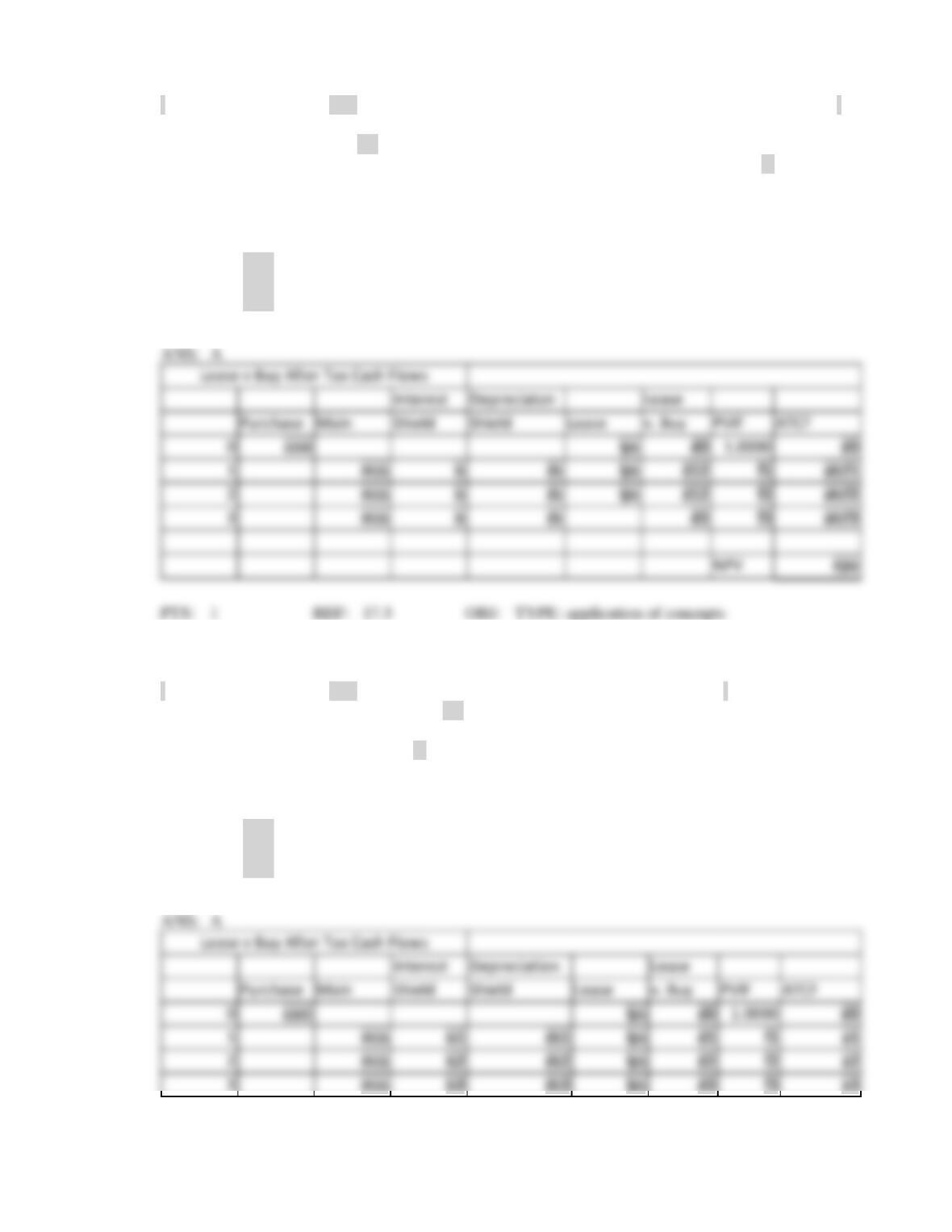
25. A real estate development firm is considering buying a bulldozer or leasing one for clearing land.
Given the following information, should the firm buy or lease the bulldozer? The marginal tax rate is
t%, the bulldozer costs $cost. If purchased, the firm will finance the bulldozer over three years at i%,
interest only at the end of each year and the balance due at the end of the third year. If owned,
maintenance costs would be mc per year (at the end of each year). The firm will depreciate the
bulldozer straight-line to an actual salvage value of zero. The lease payment would be $lp per year
(paid at the beginning of the year).
What is the present value of leasing versus buying the bulldozer?
a.
about $ans1
b.
about $ans2
c.
about $ans3
d.
leasing is a negative NPV
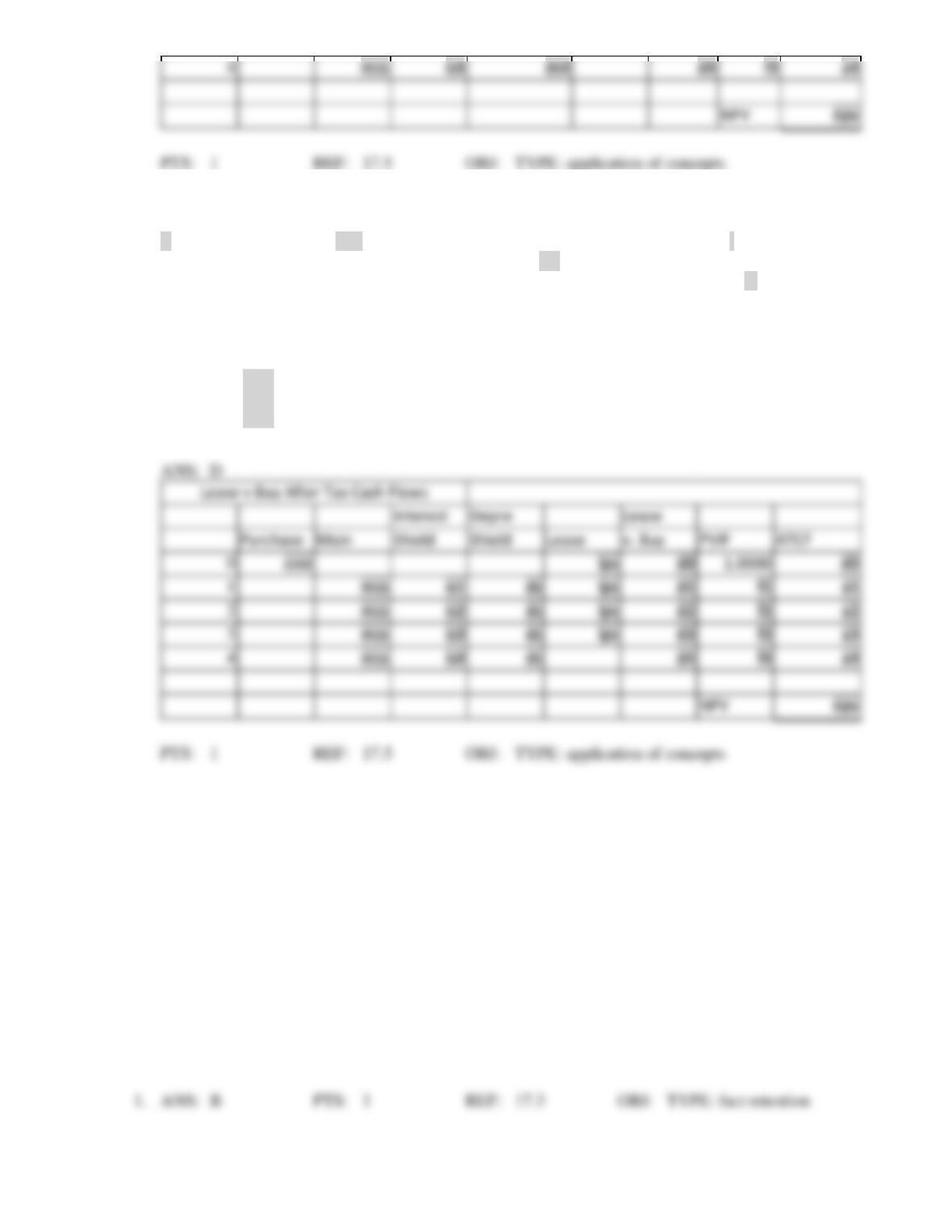
26. A real estate development firm is considering buying a bulldozer or leasing one for clearing land.
Given the following information, should the firm buy or lease the bulldozer? The marginal tax rate is
t%, the bulldozer costs $cost. If purchased, the firm will finance the bulldozer at i% amortized over 4
years. If owned, maintenance would be mc per year (at the end of each year). The firm will
depreciate the bulldozer using 3-year MACRs (the 3-year MACRS schedule is 33.33, 44.45, 14.81,
7.41). The lease payment would be $lp per year (paid at the beginning of the year) for 4 years.
What is the present value of leasing versus purchasing the bulldozer?
a.
about $ans1
b.
about $ans2
c.
about $ans3
d.
The NPV of leasing is negative
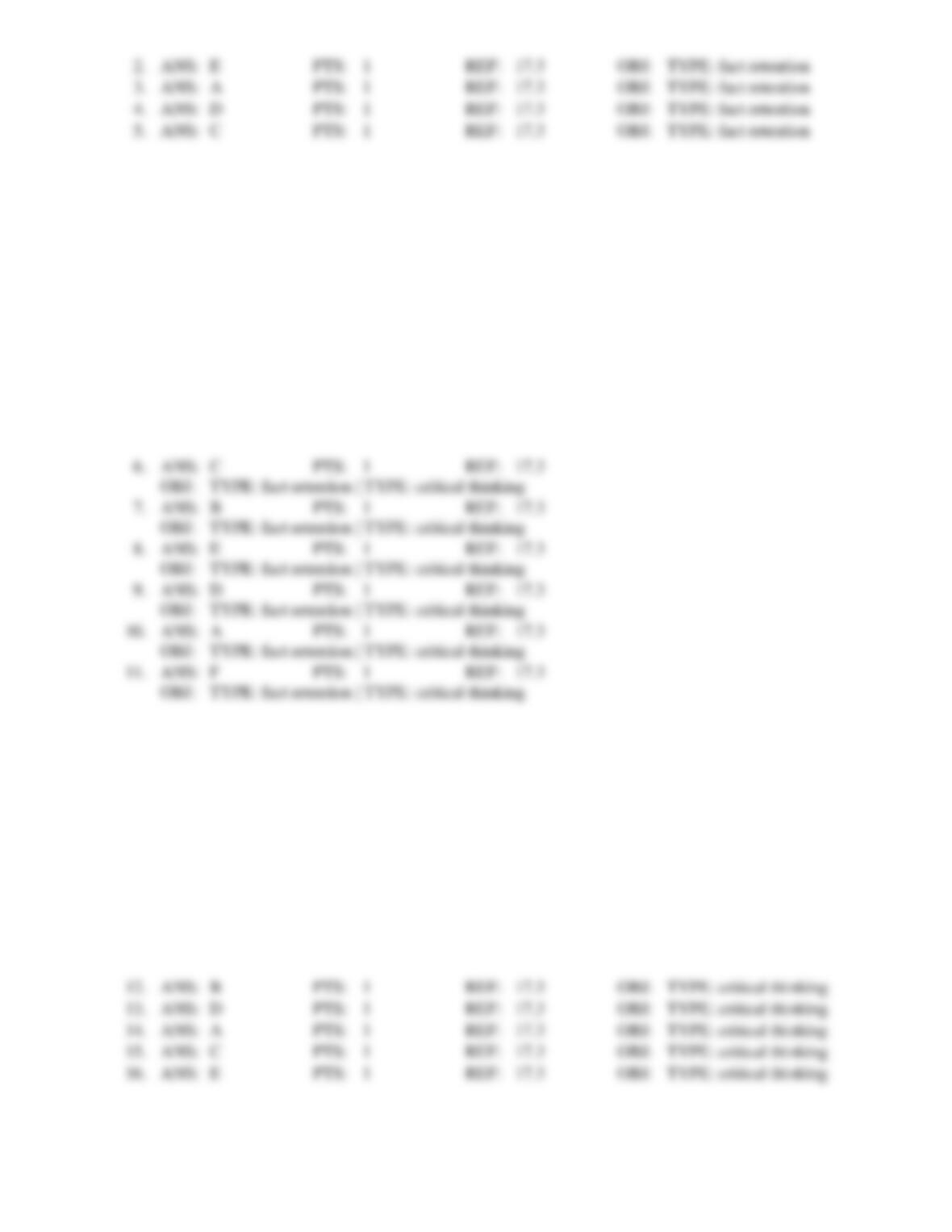
27. A real estate development firm is considering buying a bulldozer or leasing one for clearing land.
Given the following information, should the firm buy or lease the bulldozer? The marginal tax rate is
T%, the bulldozer costs $cost. If purchased, the firm will finance the bulldozer at i% amortized over
4 years. The firm will buy a maintenance contract for mc per year. The firm will depreciate the
bulldozer straight-line its actual salvage value of zero. The lease payment would be $lp per year (paid
at the beginning of the year) for 4 years and all taxes and maintenance is paid by the lessor.
What is the present value difference between leasing and buying the bulldozer?
a.
about $ans1
b.
about $ans2
c.
about $ans3
d.
The NPV of leasing versus buying is negative
MATCHING
Match the following terms with their best definitions:
a.
Debentures
b.
Putable Bonds
c.
Collateral Trust Bonds
d.
Income Bonds
e.
Mortgage Bonds
1. Bonds that can be redeemed at par at the option of their holder
2. Bonds secured by real estate or buildings
3. Unsecured bonds
4. Bonds with interest required only when earnings are available from which to make such payments
5. Bonds secured by stock and bonds owned by the issuer
Match the following terms with their best descriptions:
a.
indenture
b.
subordinated debentures
c.
junk bonds
d.
call feature
e.
stock purchase warrants
f.
equipment trust certificates
6. debt rated Ba or BB or lower
7. claims are not satisfied until the claims of senior creditors are paid
8. occasionally attached as “sweeteners” to make a debt issue more attractive
9. gives the issuer the opportunity to retire bonds prior to maturity
10. legal document stating terms under which a bond is issued
11. used to finance transportation equipment
Match the following Standard & Poor’s bond rating with the appropriate interpretation:
a.
AA
b.
BBB
c.
B
d.
C
e.
D
12. minimum investment grade
13. income bond
14. bank investment quality
15. speculative
16. in default

SHORT ANSWER
1. List the advantages of leasing that may cause a firm to prefer leasing over buying.
2. What is the appropriate discount rate to use in the lease versus purchase decision and why is it
appropriate?
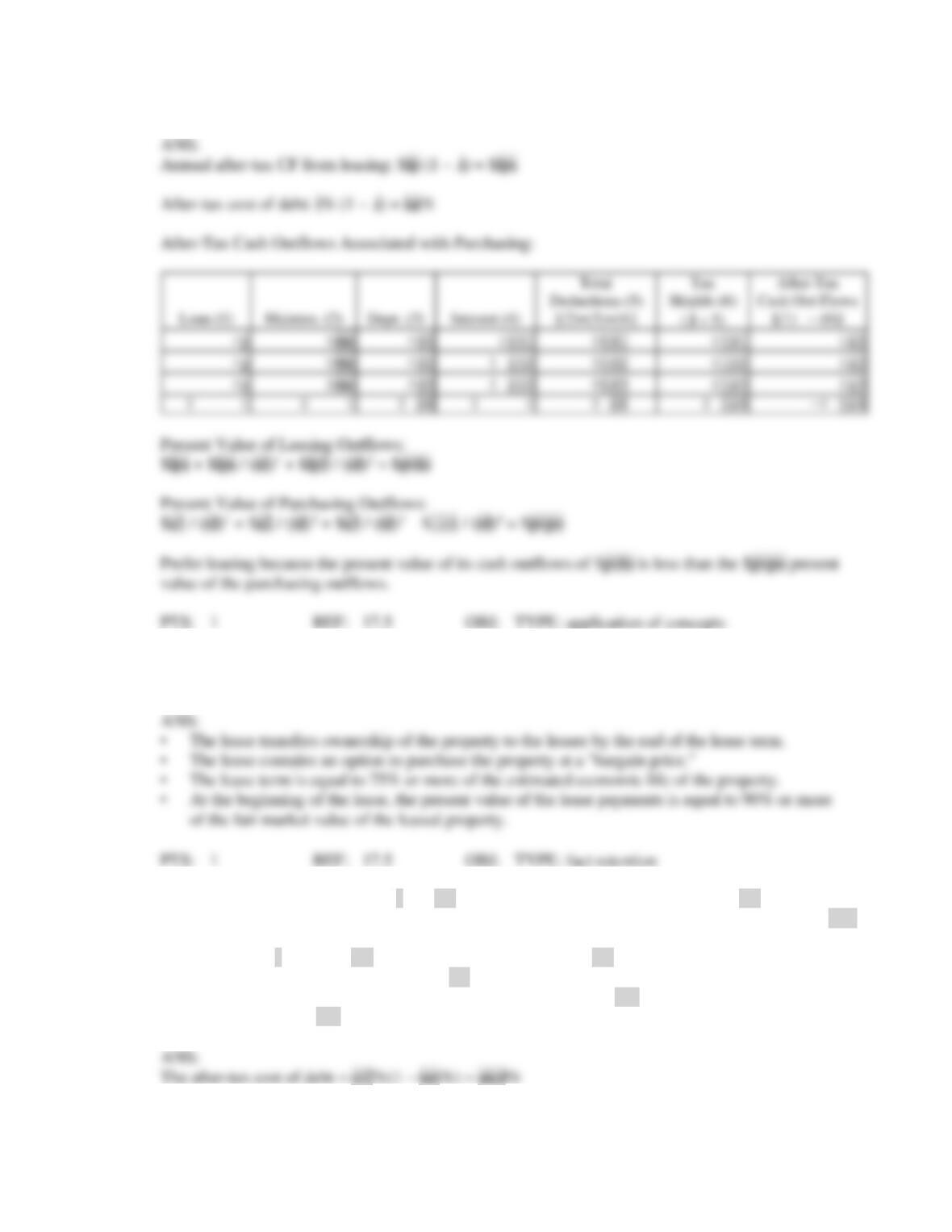
3. DFB Corp. is considering acquiring a new machine costing $cost. The new machine would save the
firm $spy per year in operating expenses. The firm can either lease the machine or borrow funds to buy
the machine.
The three-year lease terms require a lease payment of $lp per year payable at the beginning of the year.
The lessor is extending a purchase option at the beginning of the third year allowing DFB Corp. to
purchase the machine for $POC. The lessor would provide maintenance of the machine. As an
alternative, DFB Corp. can purchase the machine with a three-year loan at a i% interest rate requiring
payments at the end of each year. (The loan amortization schedule is provided below.) The
maintenance of the machine will cost the firm $mc per year. The firm is in the t% tax bracket.
Depreciation on the machine will be handled under the three-year MACRS class using rounded rates
for years 1 through 4 (33%, 45%, 15%, 7%). DFB Corp. would continue to use the machine after the
three years.
Loan Amortization Schedule:
End of Loan
Year
Payment
Interest
Repaid
Principle
Principal
Remaining
1
$p
$in1
$rp1
$pr1
2
$p
$ in2
$rp2
$pr2
3
$p
$ in3
$rp3
—-*
*Difference due to rounding
Should the firm lease or buy the machine? (Show your work.)
4. According to FASB No. 13, if a lease meets any one of four elements, the lease is considered a
financial lease. What are the four elements?
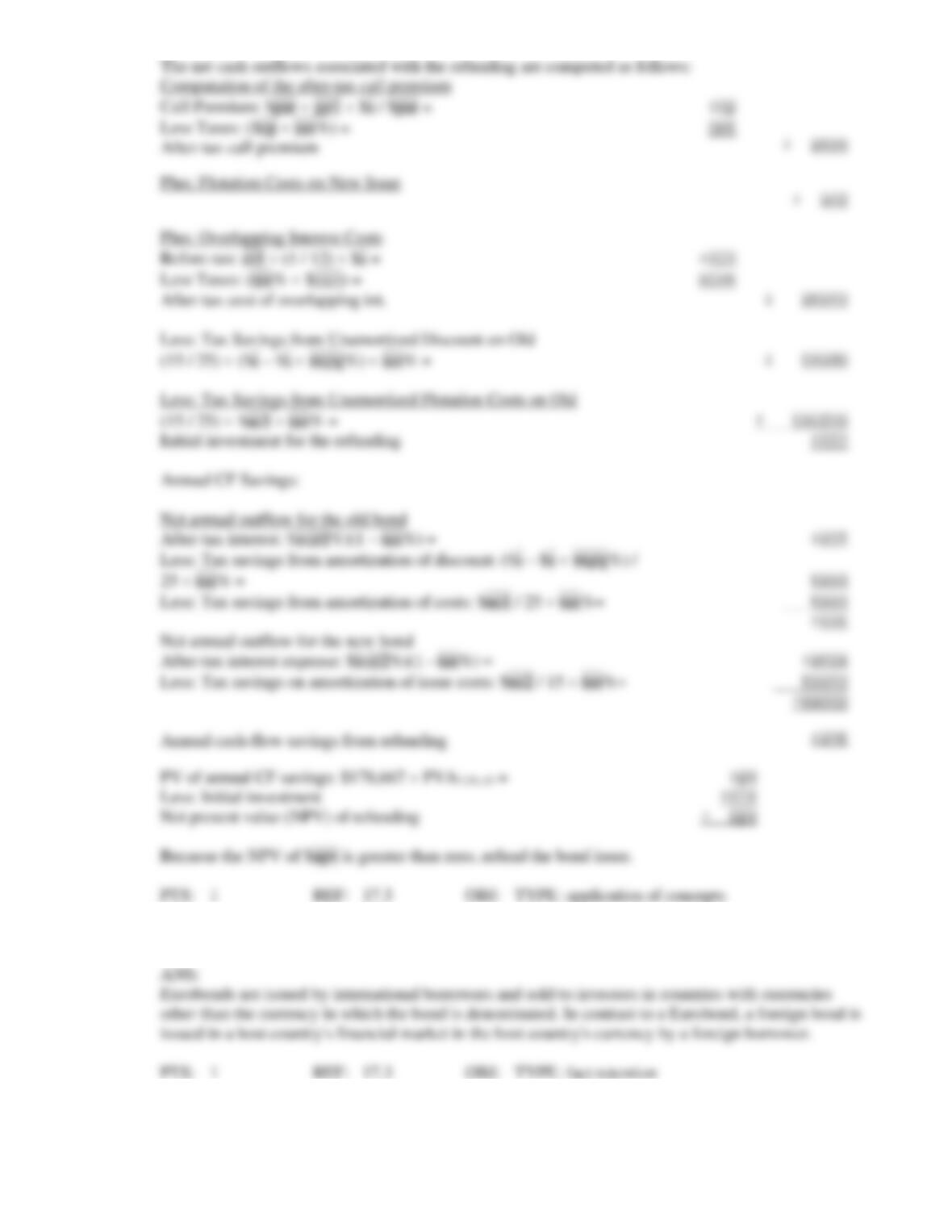
5. A firm currently has outstanding $s of $par par callable bonds with a coupon rate of cr1% and original
maturity of 25 years. The bonds have been on the books for 10 years and were originally sold for perc
percent of par value. The bonds are callable at a premium equal to one annual coupon payment per
bond. The new $s issue of $par par bonds would be issued at a cr2% coupon with a maturity of 15
years. The marginal tax rate of the firm is tax%. The issues would both be outstanding for a one-month
overlapping period. The underwriting costs of the old issue were $uc1 and the underwriting costs for
the new issue will be $uc2. Should the firm refund the bond issue? (Show your work)
6. Contrast Eurobonds and foreign bonds.
7. What is the purpose of debt covenants?
8. Identify the characteristics of a term loan agreement.
9. Explain why bondholders often prefer a sinking fund requirement be included in the bond indenture.
10. What is the purpose of FASB No. 13?
11. What would a typical dollar call premium be for a $a bond with an r% coupon rate? What would be
the dollar callable amount?
NARRBEGIN: NAR 17-1
Bond Corporation
The Bond Corporation is contemplating calling $cc0 million of t1 year, $pvb par value bonds issued t2
years ago with a coupon interest rate of r1%. The bonds have a call price of $cp and were initially sold
at par. The initial flotation cost was $ifc. Bond Corporation intends to sell $cc0 million of t2-year,
$pvb par value bonds with an r2% coupon interest rate and use its proceeds to immediately refund the
old bonds. The new bonds will be sold at their par value. The flotation cost on the new issue is $tc.
The firm is currently in the r3% tax bracket and expects a one-month period of overlapping interest.
NARREND
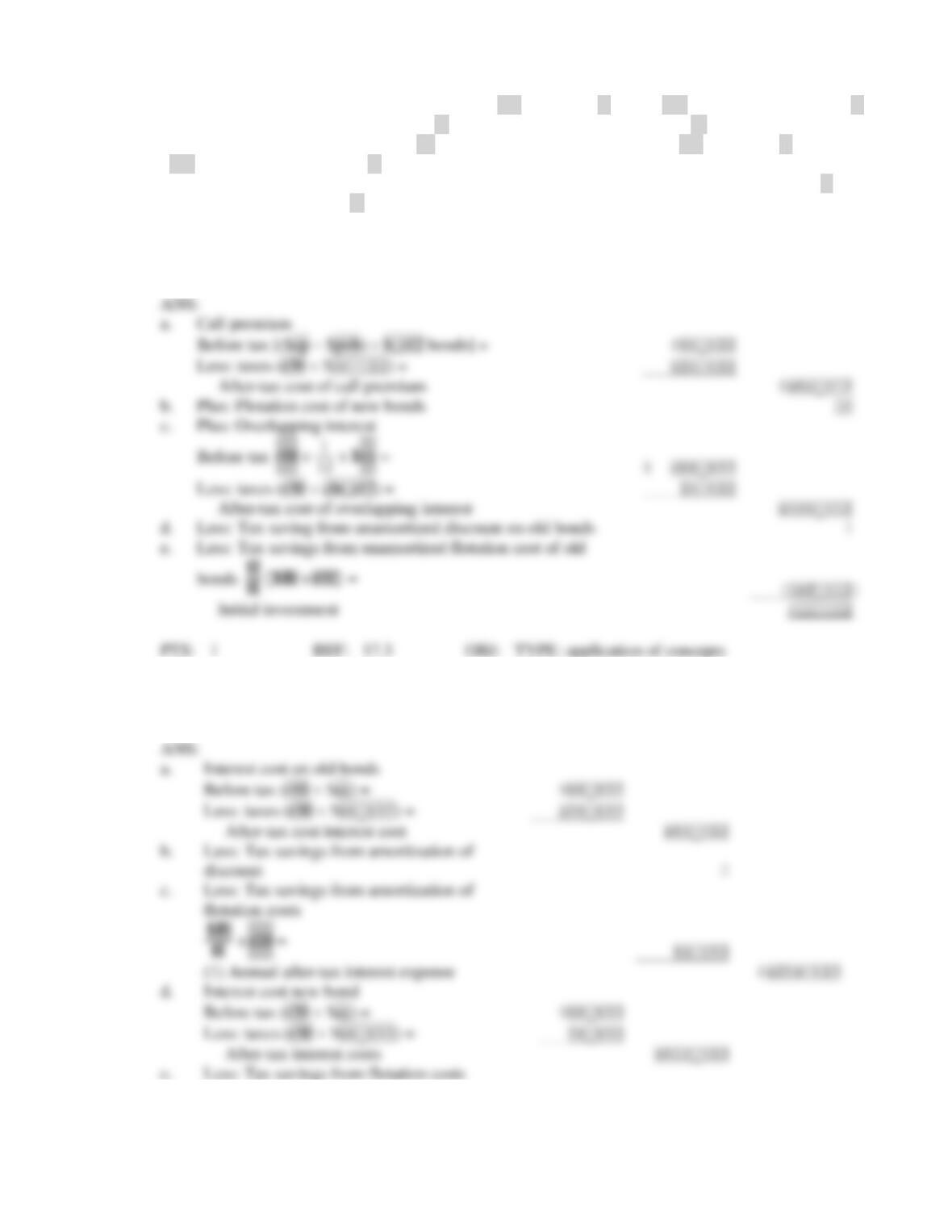
12. Refer to Bond Corporation. Calculate the initial investment required to refund the old bonds.
13. Refer to Bond Corporation. Find the annual cash flow savings for Bond Corporation’s proposed
refunding decision.
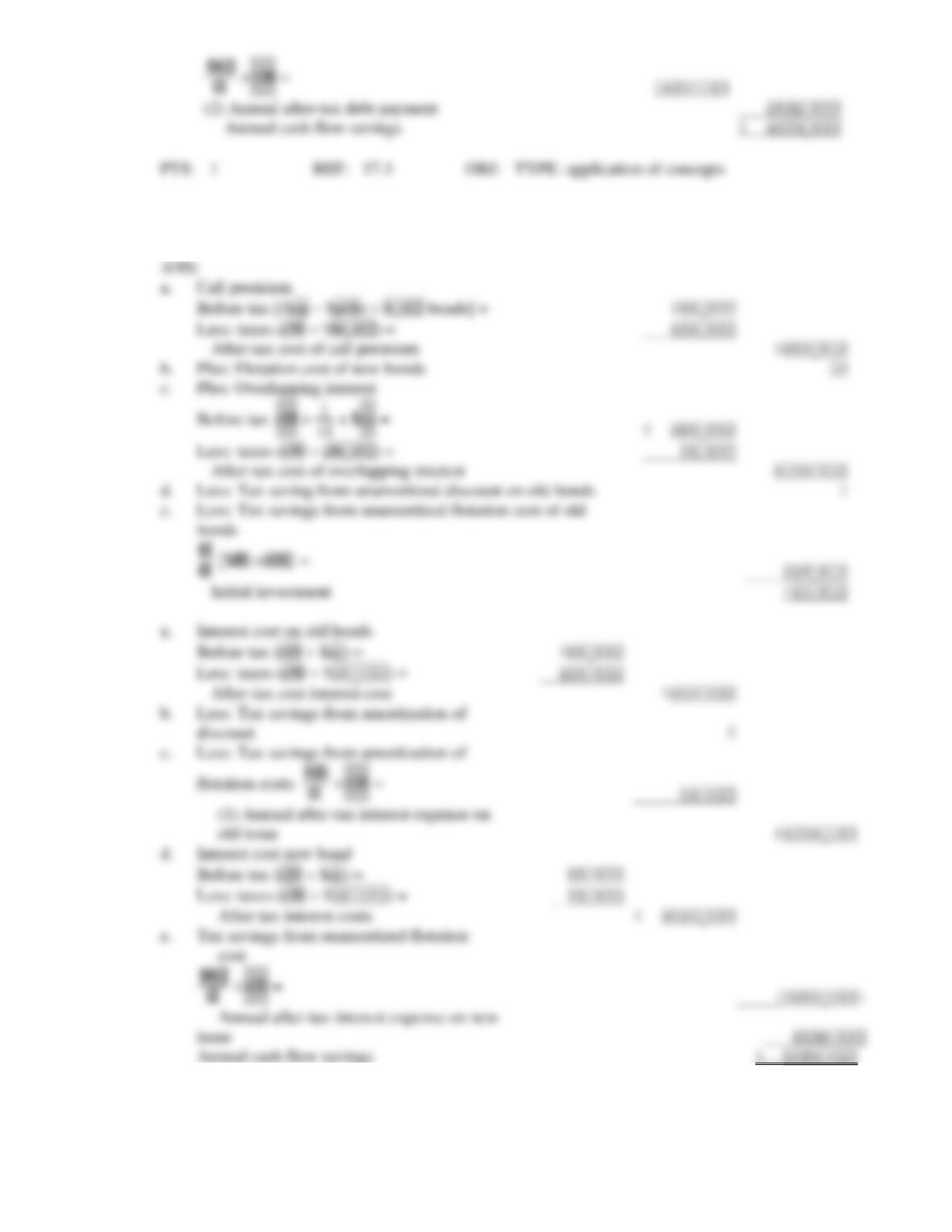
14. Refer to Bond Corporation. Find the net present value of refunding for Bond Corporation’s refunding
decision and give your recommendation.
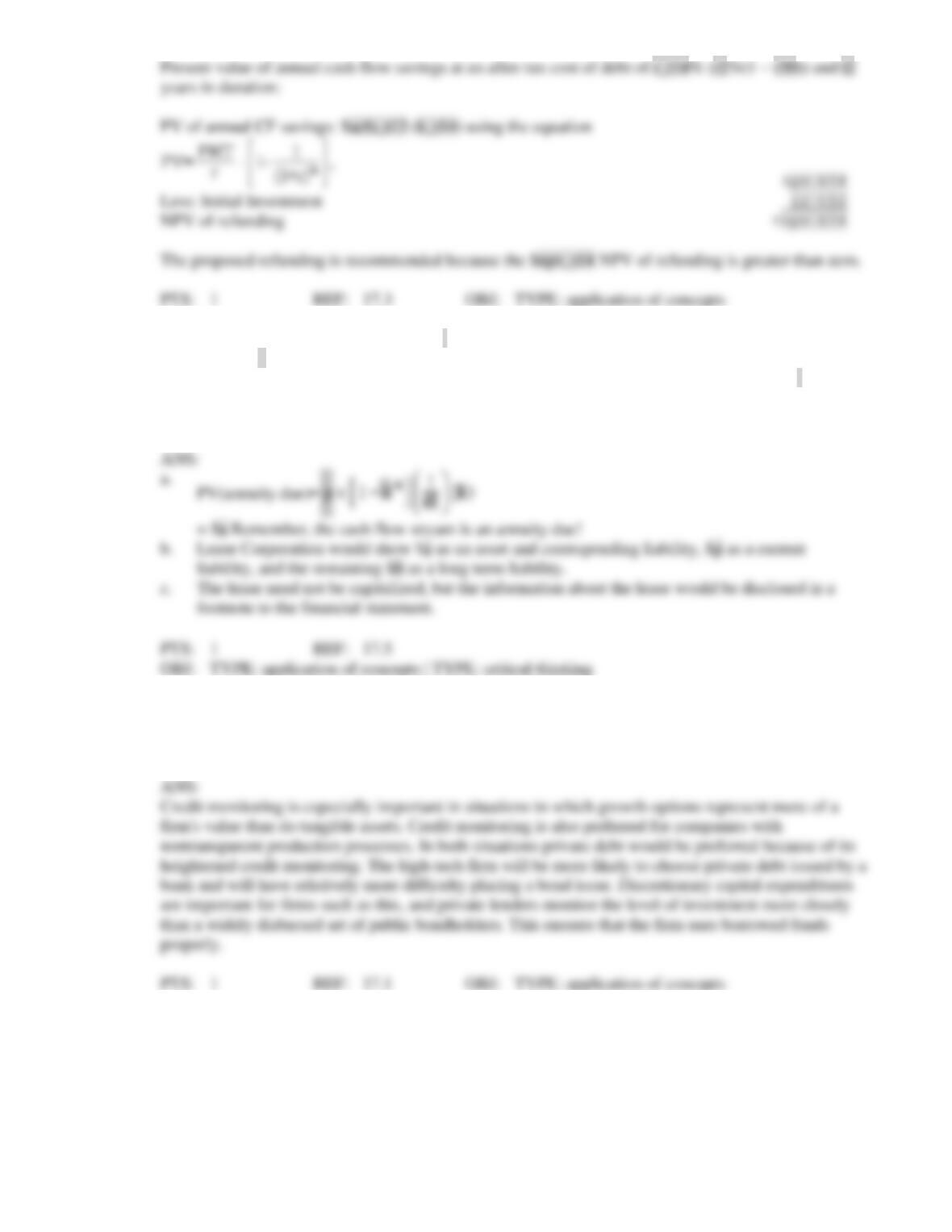
15. Lease Corporation is leasing an asset for t years. The lease requires annual beginning-of-year
payments of $p.
a.
Capitalize the lease using FASB Standard No. 13 if the firm’s after-tax borrowing rate is r%.
b.
If it were a financial lease, how would it be shown on the firm’s balance sheet?
c.
If it was an operating lease, how would it be shown on the firm’s balance sheet?
= $a Remember, the cash flow stream is an annuity due!
liability, and the remaining $b as a long term liability.
footnote to the financial statement.
16. Briefly discuss the role of credit monitoring in the choice between public and private debt. As a
particular example, would you expect a high-tech firm with a proprietary manufacturing technique to
be more or less likely to borrow from a bank or bond issue?
17. You are considering an investment in a new firm with great growth potential. Although you are
somewhat concerned about this firm’s ability to make promised debt payments, you feel more than
compensated with the value you will receive in attached stock purchase warrants. Describe the total
worth of your investment in terms of the individual values of the bond and the warrant, and comment
qualitatively on the value from the two different securities for this type of firm.
Less: Initial Investment
NPV of refunding
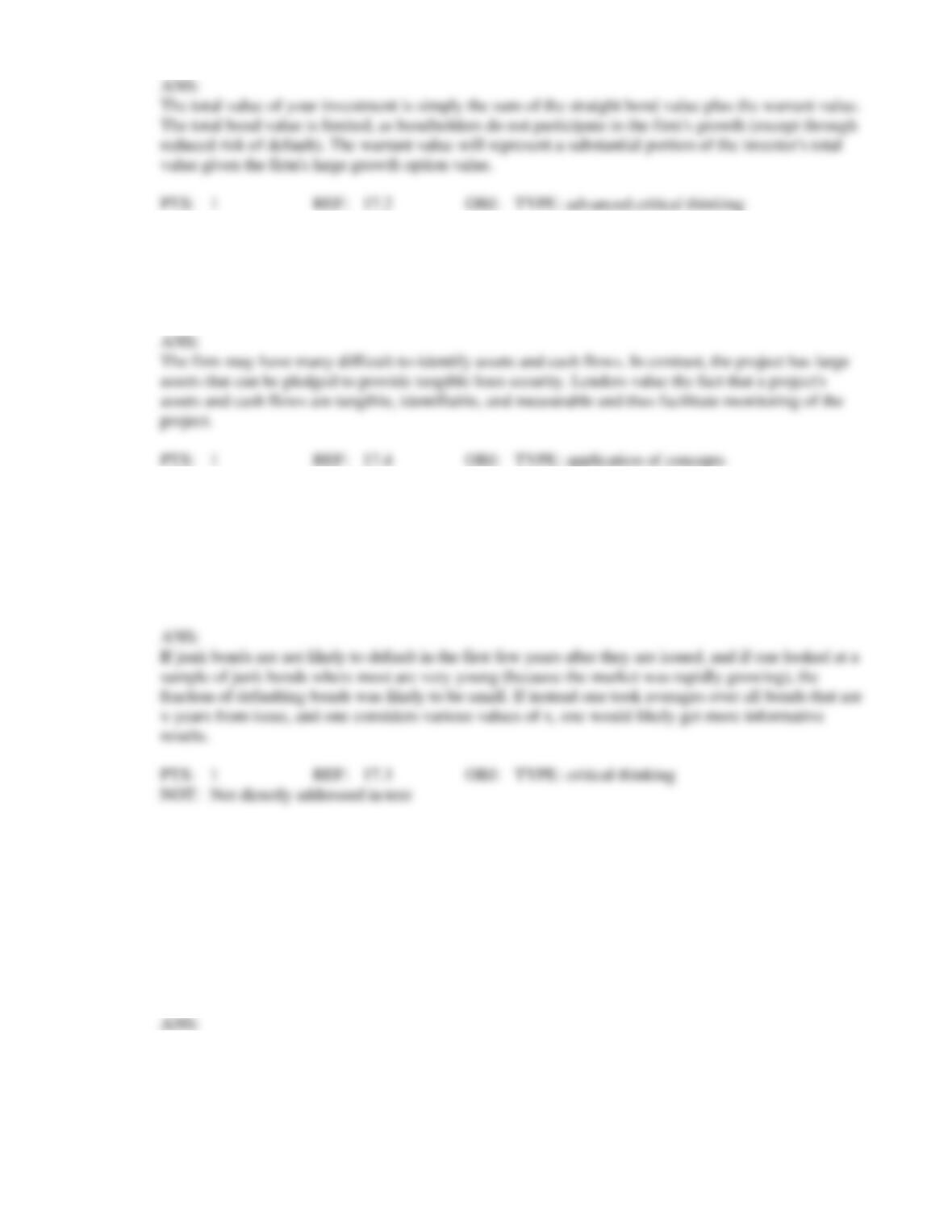
18. Project financing is often used to provide loans to large stand-alone projects with clearly identifiable
assets and, once built, generate significant amounts of free cash flow for many years. Why might a
lender be willing to provide funds to a large firm’s project, when it is not willing to extend credit to the
firm itself?
19. There was a small but rapidly growing volume of original-issue junk bonds in the 70’s and early 80’s.
Suppose that a researcher looked at the fraction of all those junk bonds outstanding which defaulted in
1981, and found that the fraction was very small. Similar results were found for other years in that era,
and the researcher concluded that the promised yields on junk bonds were too high—investors could
make excess risk-adjusted returns by buying junk bonds. Aside from the possibility that the early 80’s
were just good years in the market, is there any other explanation for the data?
ESSAY
1. Your friend advises you to purchase a callable bond based on the following pitch:
“You own a 15-year debt obligation that will yield 8%. If the company decides to call the bond prior to
maturity, you will be paid a premium and your yield will be even greater. You can’t lose.”
Critically assess your friend’s logic in a succinct essay.
2. Explain the special legal arrangements required to protect bondholders.
3. Discuss the problem of obsolescence of an asset as it relates to leasing.
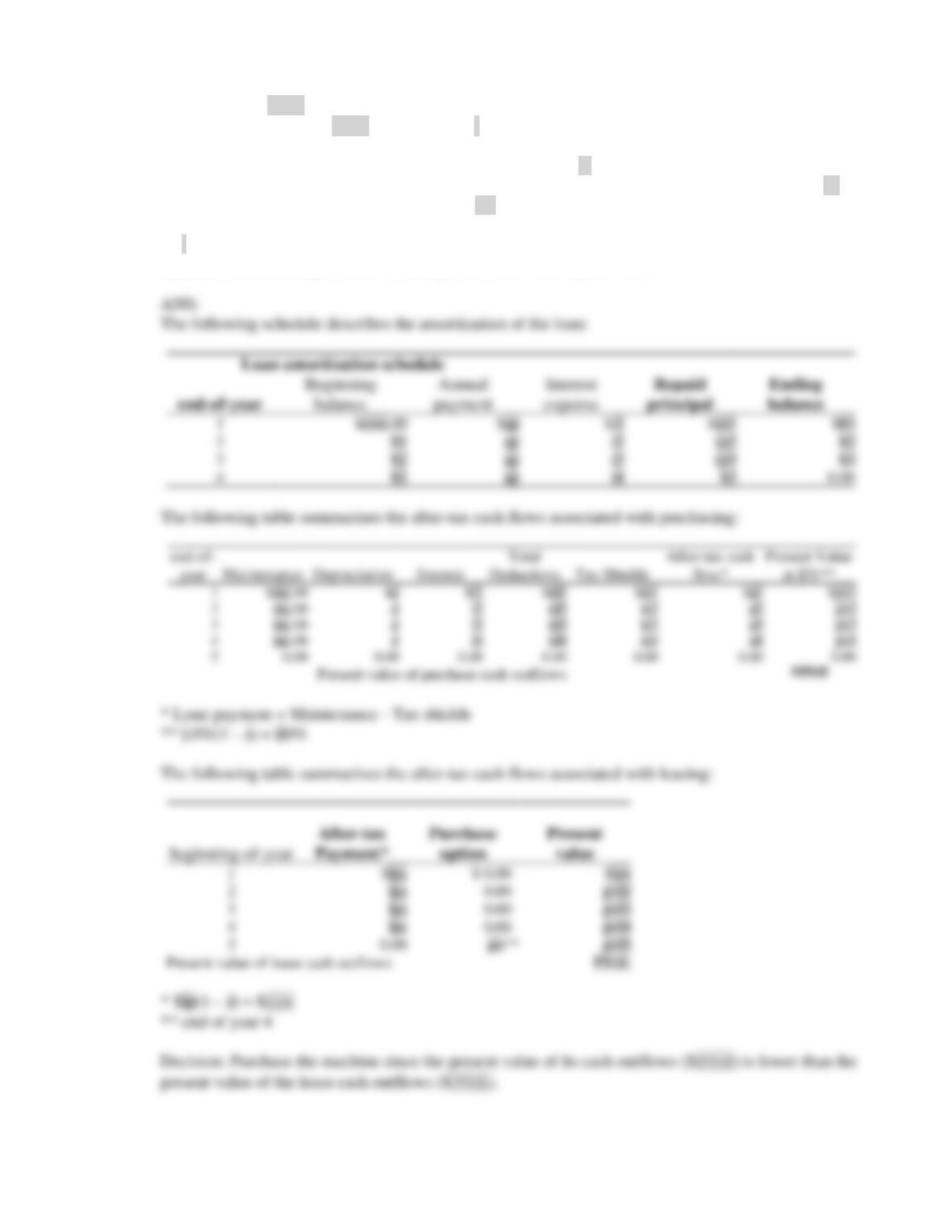
4. Ms. Amelia Bond is evaluating a financial lease opportunity for A.P. Green, Inc. She has decided to
employ a new manufacturing process that requires the use of a new machine. The machine can be
purchased for $cost and will be depreciated on a straight-line basis over its useful life of four years.
The interest rate on the $cost loan would be i percent, and the company would be required to make
equal annual installments at the end of the next four years. A.P. Green Inc. also has the option of
leasing the equipment. The annual lease payment would be $lp (paid at the beginning of each year)
and A.P. Green, Inc. will purchase the machine from the lessor at the end of the fourth year for $po.
The company will pay maintenance costs of $mc if it purchases the asset, whereas maintenance would
be covered by the lessor under the lease. Ms. Bond estimates the marginal tax rate of the company to
be t percent. Should Ms. Bond recommend that the company borrow to finance the purchase of the
equipment or is leasing the best financing alternative? Show your work.
5. Japan, Switzerland, and the United States together constitute the largest portion of the foreign bond
market. Describe the foreign bond market and explain how a firm based in France would issue bonds
in the foreign market.
6. Explain the advantage to a company of issuing callable bonds.
7. Describe the relation between bond yield and bond ratings.