48. An advantage of international reserves is that they allow countries to sustain temporary balance-of-payments deficits
until acceptable adjustment measures can operate to correct the disequilibrium.
a.
True
b.
False
True
Moderate
49. With floating exchange rates, countries require sizable amounts of international reserves for the stabilization of
exchange rates.
a.
True
b.
False
False
Moderate
50. When exchange rates are fixed by central bankers, the need for international reserves disappears.
a.
True
b.
False
False
Moderate
51. When exchange rates are fixed by central bankers, international reserves are necessary for financing payments
imbalances and the stabilization of exchange rates.
a.
True
b.
False
True
Moderate
52. There exists a direct relationship between the degree of exchange rate flexibility and the need for international
reserves.
a.
True
b.
False
False
Moderate
53. With floating exchange rates, payments imbalances tend to be corrected by market-induced fluctuations in the
exchange rate, and the need for exchange-rate stabilization and international reserves disappears.
a.
True
b.
False
True
Moderate
The diagram below represents the exchange market position of the United States in trade with the United Kingdom.
Starting at the equilibrium exchange rate of $3 per pound, suppose the demand for pounds rises from D0 to D1.
Figure 17.1 Foreign Exchange Market
Moderate
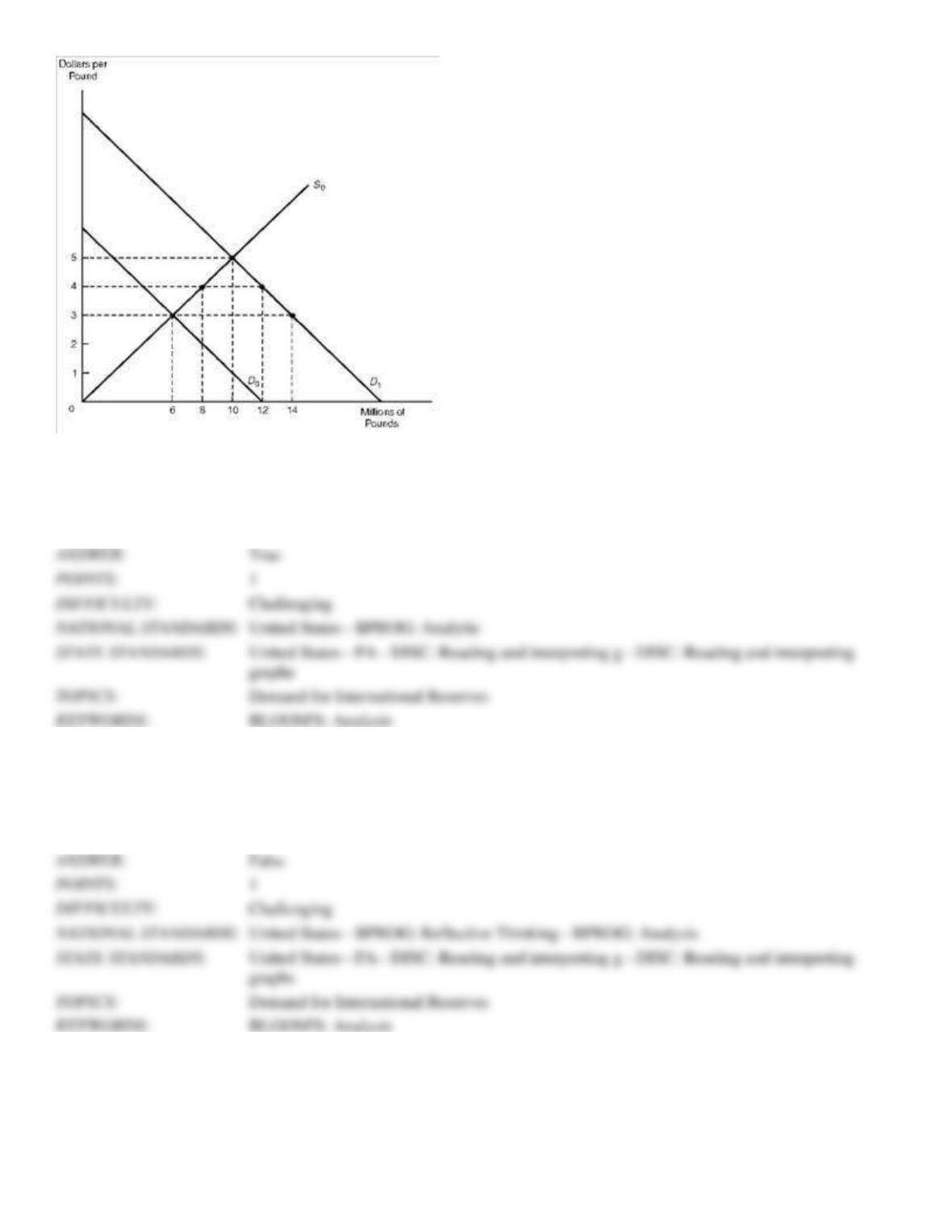
54. Refer to Figure 17.1. Under a fixed exchange rate system, U.S. monetary authorities would have to supply 8 million
pounds in exchange for dollars to keep the exchange rate at $3 per pound.
a.
True
b.
False
55. Refer to Figure 17.1. If the exchange rate was allowed to rise to $4 per pound, U.S. monetary authorities would have
to supply 6 million pounds to the foreign exchange market in exchange for dollars to maintain this rate.
a.
True
b.
False
False
Challenging
56. Refer to Figure 17.1. Under a floating exchange rate system, the exchange rate would rise to $4 and U.S. monetary
authorities would have to supply 4 million pounds to the foreign exchange market in exchange for dollars to maintain this
rate.
a.
True
b.
False
True
Challenging
graphs
57. To the extent that adjustments in prices, interest rates, and income levels promote balance-of-payments equilibrium,
the demand for international reserves decreases.
a.
True
b.
False
True
Moderate
58. The greater a nation’s propensity to apply tariffs and quotas to key sectors, the greater will be the need for international
reserves.
a.
True
b.
False
False
Moderate
59. The demand for international reserves is negatively related to the level of world prices and income.
a.
True
b.
False
False
Moderate
60. The demand for international reserves tend to increase with the level of world income and trade activity.
a.
True
b.
False
False
Challenging
61. If a nation with a balance-of-payments deficit is willing and able to initiate quick actions to increase export receipts
and decrease import payments, the amount of international reserves needed will be relatively large.
a.
True
b.
False
False
Moderate
62. The supply of international reserves consists of owned reserves and borrowed reserves.
a.
True
b.
False
True
Moderate
63. Foreign currencies constitute the smallest component of the world’s international reserves.
a.
True
b.
False
False
Moderate
64. Gold constitutes the largest component of the world’s international reserves.
a.
True
b.
False
False
True
Moderate
65. The U.S. dollar has been considered a reserve (key) currency because trading nations have been willing to hold it as an
international reserve asset.
a.
True
b.
False
True
Moderate
66. The U.S. dollar, Japanese yen, British pound, and Mexican peso are the major reserve currencies of the international
monetary system.
a.
True
b.
False
False
Moderate
67. By the 1990s, the British pound had replaced the U.S. dollar as the world’s key currency.
a.
True
b.
False
False
Moderate
68. A goal of the International Monetary Fund is to make short-term loans to member nations so as to allow them to
correct balance of payments disequilibriums without resorting to measures that would destroy national prosperity.
a.
True
b.
False
Moderate
Gold
69. When granting loans to financially troubled nations, the International Monetary Fund requires some degree of
conditionality, meaning that the borrowing nation must agree to implement economic policies as mandated by the IMF.
a.
True
b.
False
True
Moderate
70. The International Monetary Fund has sometimes demanded that financially-troubled nations, that borrow from the
IMF, undergo austerity programs including slashing of public spending and private consumption.
a.
True
b.
False
True
Moderate
71. The main purpose of the International Monetary Fund is to grant long-term loans to developing nations to help them
finance the development of infrastructure such as roads, dams, and bridges.
a.
True
b.
False
False
Moderate
72. Gold is currently the most widely used asset in the international monetary system.
a.
True
True
Moderate
b.
False
73. In 1974 the United States revoked a 41-year ban on U.S. citizen’s ownership of gold.
a.
True
b.
False
True
Moderate
United States – BPROG: Reflective Thinking – BPROG: Analysis
United States – PA – DISC: International trade and fi – DISC: International trade and finance
Gold
BLOOM’S: Knowledge
74. In 1975 the official price of gold was abolished as the unit of account for the international monetary system. As a
result, gold was demonetized as an international reserve asset.
a.
True
b.
False
Moderate
United States – BPROG: Reflective Thinking – BPROG: Analysis
United States – PA – DISC: International trade and fi – DISC: International trade and finance
Gold
BLOOM’S: Knowledge
75. In the 1970s, the major industrial countries abandoned the managed-floating exchange rate system and adopted a
system of fixed exchange rates tied to the price of gold.
a.
True
b.
False
False
Moderate
United States – BPROG: Reflective Thinking – BPROG: Analysis
United States – PA – DISC: International trade and fi – DISC: International trade and finance
Gold
76. Created by the International Monetary Fund, special drawing rights (SDRs) are unconditional rights to draw
currencies of other nations, thus enabling countries to finance their current-account deficits.
False
Moderate
United States – BPROG: Reflective Thinking – BPROG: Analysis
United States – PA – DISC: International trade and fi – DISC: International trade and finance
Gold
BLOOM’S: Knowledge
a.
True
b.
False
77. The value of the SDR is tied to a currency basket consisting of the U.S. dollar, German mark, Japanese yen, French
franc, and British pound.
a.
True
b.
False
True
Moderate
78. The SDR has replaced the dollar, yen, and mark as the key asset of the international financial system.
a.
True
b.
False
False
Moderate
79. Because the value of the SDR is tied directly to the value of the U.S. dollar, a 10 percent dollar depreciation would
result in a 10 percent decrease in the SDR’s value.
a.
True
b.
False
False
Moderate
80. A main purpose of the International Monetary Fund is to make loans of foreign currencies to member countries which
True
Moderate
are experiencing current-account surpluses.
a.
True
b.
False
81. When a deficit nation borrows from the International Monetary Fund, it purchases with its currency the foreign
currency required to help finance the payments deficit.
a.
True
b.
False
True
Moderate
82. The so-called General Arrangements to Borrow provide a permanent increase in the supply of international reserves.
a.
True
b.
False
False
Moderate
83. Swap arrangements are bilateral agreements between central banks to allow countries to temporarily borrow funds to
ease current-account deficits and discourage speculative capital flows.
a.
True
b.
False
True
Moderate
False
Moderate
84. IMF drawings, swap arrangements, buffer stock facility, and compensatory financing for exports are classified as
owned reserves rather than borrowed reserves.
a.
True
b.
False
85. Concerning international lending risk, credit risk refers to the probability that part or all of the interest rate or principal
of a loan will not be repaid.
a.
True
b.
False
True
Moderate
86. Concerning international lending risk, country risk refers to the risk that part or all of the interest or principal of a loan
will not be repaid.
a.
True
b.
False
False
Moderate
87. Concerning international lending risk, currency risk is the risk of asset losses due to changing currency values.
a.
True
b.
False
True
Moderate
False
Moderate
88. A country with a high debt/export ratio and a high debt service/export ratio would likely be considered as an attractive
place in which to invest by foreign residents.
a.
True
b.
False
89. A debt buyback is a debt-reduction technique in which a government of a debtor nation buys loans from commercial
banks at a discount.
a.
True
b.
False
True
Moderate
90. Under a debt-for-debt swap, a commercial bank sells its loans at a discount to a developing country government for
local currency which it then uses to finance an equity investment in the debtor country.
a.
True
b.
False
False
Moderate
91. A debt-equity swap results in a trade surplus nation forgiving the loans made to a trade-deficit nation.
a.
True
b.
False
False
Moderate
False
Moderate
92. Eurocurrencies are deposits, denominated and payable in dollars and other foreign currencies, in banks outside the
United States, primarily in London, the market’s center.
a.
True
b.
False
93. Why do countries hold international reserves?
Moderate
94. How can a bank reduce its exposure to the debt of developing nations?
Moderate
95. Describe the eurocurrency market.
Moderate
96. Are international reserve needs different for different exchange rate regimes?
True
Moderate