
17
Property Transactions: Dispositions of Trade or Business Property
Solutions to Tax Research Problems
17-58 The research question is: decide whether the fact that the grandmother used the
residence for personal purposes is relevant in determining the character of the
property to the heir, R. If the grandmother’s use of the property does determine
the property’s character for R, then R has a nondeductible loss on the sale of a
personal-use asset. Otherwise, R has a § 1231 asset, the loss on which qualifies
for favorable ordinary deduction treatment.
Based on the cited cases, the character of property in the hands of its owner is
determined on the basis of how he or she uses it. The use by a prior owner, even a
deceased benefactor, is not considered. R is, therefore, able to treat the loss as a §
1231 loss; and, since she has no other § 1231 transactions or capital asset
transactions, deduct it as an ordinary deduction. Campbell, 5 T.C. 272 (1945),
involved a taxpayer who inherited a residence from a parent. The taxpayer never
occupied the home but offered it for sale or rent. It was never rented before being
sold, and the court determined that it was sold, in a “transaction entered into for
profit.” Crawford, 16 T.C. 678 (1951), dealt with a taxpayer who inherited most
of a personal residence from her husband. She vacated the premises immediately
and offered it for rent, and later purchased the remaining interest. Even though the
property never rented, she held the property for income-producing purposes.
17-59
a. MACRS, and a 27.5-year life was required in 1989. D=epreciation: Cost
assignable to building = $120,000 × 80% = $96,000. Cost assignable to office
= $96,000 × 20% = 19,200. Depreciation for 15 years = $19,200 × 15 / 27.5 =
$10,473 (for 15 years and 1 month = $10,531).
b. No, there is no Section 1250 recapture if the required straight line method is
used.
c. All of J’s gain is excludable except any depreciation since 1996 (123.5 months
depreciation = $7,815) must be recaptured. The character of the gain is 25%
gain.
17
Property Transactions: Dispositions of Trade or Business Property
Test Bank
True or False

________ 1. Both land and a building used as rental property and held for more than
one year are § 1231 assets.
________ 2. The portion of the gain on the sale of timber that qualifies for § 1231
treatment is only the difference between the fair market value at the
beginning of the tax year of harvest and the adjusted basis of the timber.
________ 3. Unharvested crops sold along with land do not qualify for § 1231
treatment, and therefore produce ordinary income at the time of the sale.
________ 4. The long-term holding period under § 1231 for cattle and horses is 12
months; for other livestock, 24 months.
________ 5. Three rental houses held by a person who earns her living as a physician
are not § 1231 property since the activity does not constitute a trade or
business.
________ 6. The gain or loss on the disposition of a machine used in a trade or
business for one year or less is a short-term capital gain or loss.
________ 7. As part of the § 1231 netting process, casualty and theft gains and losses
involving business capital assets and § 1231 assets are combined. If a net
gain results, each casualty or theft is treated separately as a casualty gain
or loss.
________ 8. If the § 1231 netting process results in a loss, the taxpayer must look
back to the prior five years to see if any net § 1231 gains were reported
in those years.
________ 9. If § 1245 property is sold on the installment basis, any depreciation
recapture must be reported in the year of sale, even if the amount of
money collected in that year is less than the recaptured amount.
________ 10. L sold a machine that had cost $6,000 during the current year for $3,200.
The machine was used in her business for 21 months and was expensed
under § 179. L must report ordinary income, rather than potential capital
gain, of $3,200.
________ 11. W sold an automobile that had been used in his business during the
current year. Depreciation of $6,700 had been claimed. If the straight
line method had been used, the depreciation expense would have been
$4,500. W’s § 1245 recapture potential is $2,200.
________ 12. During the current year, Q sold a desk used in her business. The gain
realized was $50 and the § 1245 recapture potential was $375. Q has
ordinary gain of $50 and § 1231 gain of $325.
________ 13. During the current year, X sold an office building that was purchased

before 1981 and had been used in his business. Depreciation of $12,700
had been claimed. If the straight line method had been used, the
depreciation expense would have been $8,500. W’s § 1250 recapture
potential is $4,200.
________ 14. Nonresidential real property acquired during the years 1981 through
1986 is classified as § 1245 property if the taxpayer used the accelerated
method of recovering cost.
________ 15. There is never any depreciation recapture on the sale of an asset when it
is sold at a loss.
________ 16. As a general rule, § 1245 (i.e., the full recapture rule) applies to
depreciable personalty but not realty.
________ 17. As a general rule, § 1250 (i.e., the partial recapture rule) applies to
depreciable personalty but not realty.
________ 18. In order for there to be depreciation recapture under either § 1245 or §
1250, the property must be held more than one year.
________ 19. Section 1245 is referred to as the full recapture rule since all of the gain
may be ordinary income.
________ 20. Section 1250 is referred to as the partial recapture rule since only a
portion of the depreciation allowed may be recaptured.
________ 21. W sold some office furniture at a gain that was partly ordinary income
and partly § 1231 gain. W sold the furniture for more than its original
cost.
________ 22. X sold a rental house at a small loss. The loss is a § 1250 loss.
________ 23. Y sold a partially depreciated office building at a gain, all of which was
§ 1231 gain. The building was depreciated using an accelerated method.
________ 24. Z sold an office building at a gain, all of which was unrecaptured § 1250
gain. The building was sold for its original purchase price or less.
________ 25. If straight-line depreciation is used by an individual for real estate, no §
1250 recapture will be recognized if the property is sold at a gain.
________ 26. The additional depreciation recapture for a corporation under § 291 is 20
percent of the § 1231 gain.
Multiple Choice
________ 27. Which one of the following is not generally considered § 1231 property?

a. Land held 13 months and used in a trade or business as a parking lot
b. Crops growing on farm land held 20 years
c. Cattle held 12 months and used in ranching
d. Equipment used in a printing business and held 15 months
________ 28. H sold several business properties that were § 1231 property during the
current year. His overall gain was $32,000 and he had depreciation
recapture of $12,500. The only other § 1231 transactions H has had were
in the two prior years. He had a net gain of $3,500 two years ago and a
net loss of $12,000 last year. How are H’s gains for the current year
treated?
a. $12,500 ordinary gain; $19,500 long-term capital gain
b. $21,000 ordinary gain; $11,000 long-term capital gain
c. $24,500 ordinary gain; $ 7,500 long-term capital gain
d. $32,000 ordinary gain
________ 29. Y suffered a theft of depreciable assets that were held for two years for
use in her business. The assets were worth $1,000 and had a basis of
$1,200. Y’s only other property transaction resulted in a short- term
capital loss of $2,500. What is the impact on Y’s adjusted gross income?
a. $0
b. $3,700 reduction
c. $3,000 reduction
d. $3,500 reduction
________ 30. R realized a gain of $10,000 on a fire that destroyed part of a warehouse.
R also sold several assets during the current taxable year as follows:
Business use equipment held three years $ 3,000 gain
Investment land held 15 years 12,000 gain
Travel trailer used for personal trips 4,000 loss
The depreciation allowed on the equipment was $6,500 and was
calculated using the straight line method. Assuming R’s taxable income
is $70,000 before these transactions, what is his taxable income for the
year (assuming these items do not affect any other deductions)?

a. $95,000, $25,000 of which is long-term capital gain
b. $91,000, $ 18,000 of which is long-term capital gain
c. $95,000, $22,000 of which is long-term capital gain
d. $95,000, $12,000 of which is long-term capital gain
________ 31. G sold a file cabinet used in her business for $250. She had purchased it
for $400 and deducted depreciation of $220. What is the amount and
character of G’s gain or loss recognized on this sale?
a. $70 ordinary income
b. $70 §1231 gain
c. $150 § 1231 loss
d. $220 ordinary income and $150 § 1231 loss
________ 32. Which of the following is not true of depreciation recapture under §
1245?
a. In involuntary conversions and like-kind exchanges, depreciation
recapture is limited to the gain recognized.
b. The recapture potential generally is the amount of additional
depreciation.
c. Any gain recognized is ordinary income to the extent of the recapture
potential.
d. Recapture from installment sales must be reported in the year of the
sale, regardless of whether or not any sales proceeds are collected in
that year.
________ 33. N purchased a camera for use in his photography business for $1,200.
Depreciation of $624 was allowed as a business deduction before the
camera was sold. Which of the following is not true?
a. If the camera is sold for $550, § 1231 applies to the loss.
b. If the camera is sold for $1,000, § 1231 applies to the gain.
c. If the camera is sold for $1,300, §§ 1245 and 1231 apply to the gain.
d. All are true.
________ 34. Five years ago, Wilson James purchased a photocopier with a five-year

recovery period for use in his business for $8,000. He deducted
depreciation totaling $7,078 in the five years. In the current year, after
owning and using the machine 58 months, James sold it for $1,122.
What are the amounts of his depreciation recapture and § 1231 gain,
respectively?
a. $200; $0
b. $0; $200
c. $0; $0
d. $100; $100
________ 35. C sold a house held for rental purposes for $40,000, recognizing § 1250
recapture of $3,000 and § 1231 gain of $5,000. Which of the following is
not necessarily true?
a. The basis of the property was $32,000.
b. The depreciation allowed was $3,000 greater than straight-line
depreciation would have been.
c. The total depreciation allowed was $8,000.
d. None of the above statements is necessarily true from these limited
facts.
________ 36. During the year, V sold an apartment purchased in 1980. Assume that V
claimed all depreciation allowed. The sale is summarized as follows:
Sales Price Cost Accelerated Depreciation Allowed
Alternate Straight-line Depreciation
Furniture and appliances $ 1,400 $-3,200 $ 2,800
$ 2,500
Building and improvements 90,000 80,000 35,000 31,000
Land 10,000 7,000 n/a n/a
How much ordinary income does V have under § 1245 and § 1250,
respectively?
a. $300 and $0
b. $300 and $4,000
c. $1,000 and $0

d. $1,000 and $4,000
________ 37. During the year, V sold an apartment purchased in 1980. Assume that V
claimed all depreciation allowed. The sale is summarized as follows:
Sales Price Cost Accelerated Depreciation Allowed
Alternate Straight-line Depreciation
Furniture and appliances $ 2,400 $ 3,200 $ 1,800
$ 1,500
Building and improvements 90,000 80,000 35,000 31,000
Land 10,000 7,000 n/a n/a
What is V’s§ 1231 gain?
a. $44,000
b. $45,000
c. $48,000
d. $49,000
________ 38. The gains and losses from sales of capital assets for the current year by
G are summarized as follows:
Long-term gains $ 3,000
Short-term gains 1,000
Short-term losses (8,000)
G has § 1245 recapture of $1,500 from one transaction and a § 1231 loss
of $1,000 from another. The net decrease in A.G.I, from these
transactions is
a. $0
b. $2,500
c. $3,000
d. $3,500
________ 39. The gains and losses from sales of capital assets for the current year by
H are summarized as follows:

Long-term gains $ 3,000
Short-term gains 3,000
Short-term losses (1,800)
Assuming H has a net § 1231 gain of $1,600 and depreciation recapture
of $2,000, what is the increase in his A.G.I., if any, from these
transactions?
a. $2,000
b. $5,800
c. $9,600
d. $7,800
________ 40. Which of the following is statements is false regarding depreciation
recapture under § 1250?
a. Depreciation recapture that existed at the death of the taxpayer
carries over to the beneficiaries.
b. Recapture is generally not required upon the gift of § 1250 property.
c. In nontaxable transactions that do not trigger recapture under § 1250,
the excess depreciation taken on the property prior to the nontaxable
exchange carries over to the property received or purchased.
d. All of the above are false.
________ 41. Which of the following Code provisions or combinations of Code
provisions cannot apply to the sale of a single asset?
a. Sections 1245 and 1231
b. Sections 1245 and 1250
c. Section 1250 only
d. Sections 291, 1250, and 1231
________ 42. X Corporation sold the following depreciable assets during the current
year
Building used in business, depreciated using straight line, held 15 years,
cost = $50,000, basis = $30,000, gain = $40,000

Equipment used in business, depreciated using straight line, held five
years, cost = $5,000, basis = $0, gain = $4,000
Land used in business, held 15 years
How much is total depreciation recapture for X Corporation for the year?
a. $44,000
b. $4,000
c. $0
d. $8,000
________ 43. K sold a building (held seven years and depreciated using an accelerated
method) at a gain of $12,000 during the current year. The depreciation
allowed was $45,000 and the straight line depreciation would have been
$39,500. Which of the following is not true?
a. K has § 1250 recapture of $5,500.
b. K has unrecaptured § 1250 gain of $6,500.
c. K has § 1231 gain of $6,500.
d. K’s § 1231 gain qualifies for the 15 percent capital gain rate.
________ 44. A’s gains an losses for the year are summarized as follows:
• Gain of $4,000 on the sale of corporate stocks held three years.
• Loss of $400 on the sale of equipment held two years.
• Gain of $9,000 on the sale of rent house held six years. Straight line
depreciation allowed was $6,000.
After netting the gains and losses, how are they treated?
a. $12,600 N15CG
b. $6,600 N15CG, $6,000 N25CG
c. $7,000 N15CG, $6,000 N25CG, $400 ordinary loss
d. $7,000 N15CG, $5,600 N25CG
17
Property Transactions: Dispositions of Trade or Business Property
Solutions to Test Bank
True or False
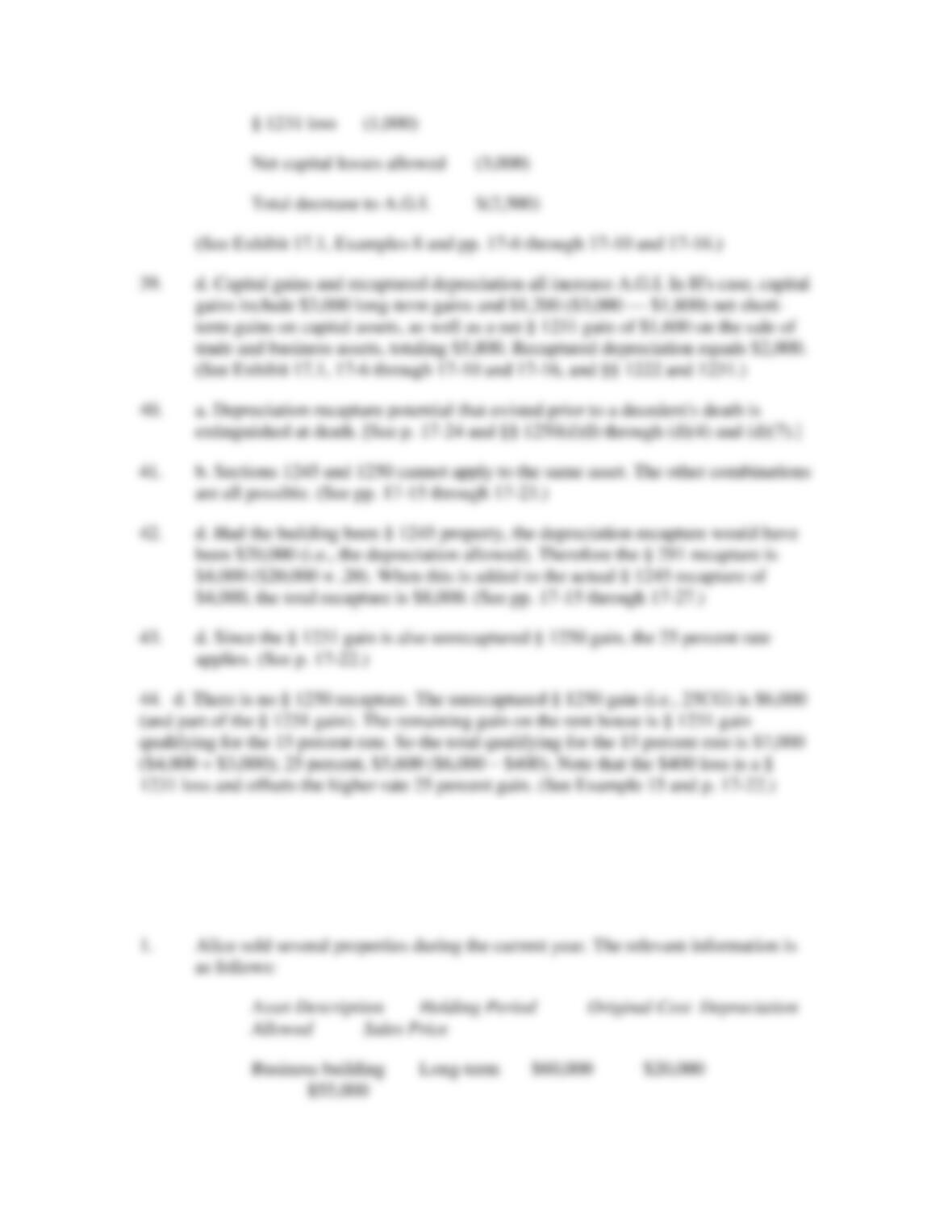
Multiple Choice
17
Property Transactions: Dispositions of Trade or Business Property
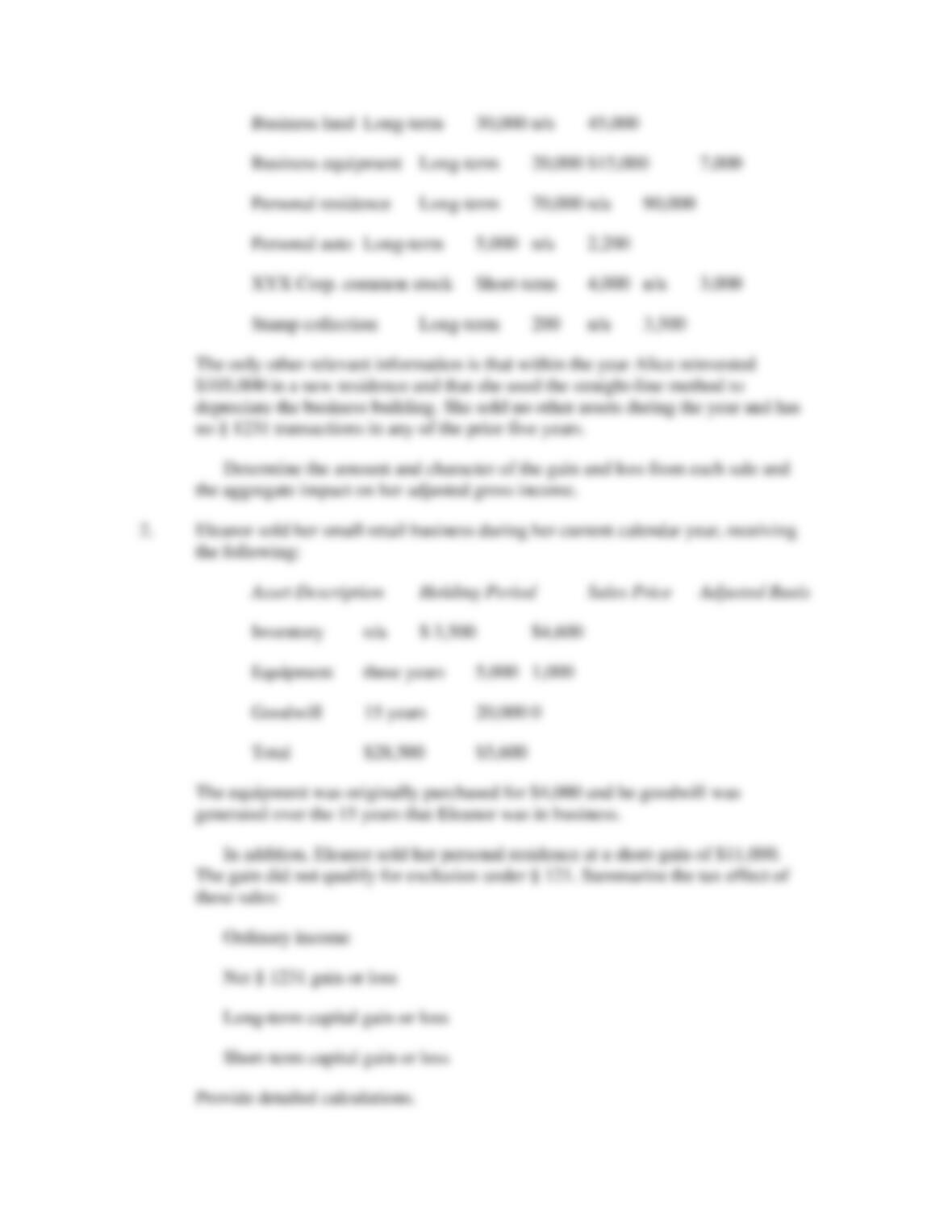
Comprehensive Problems
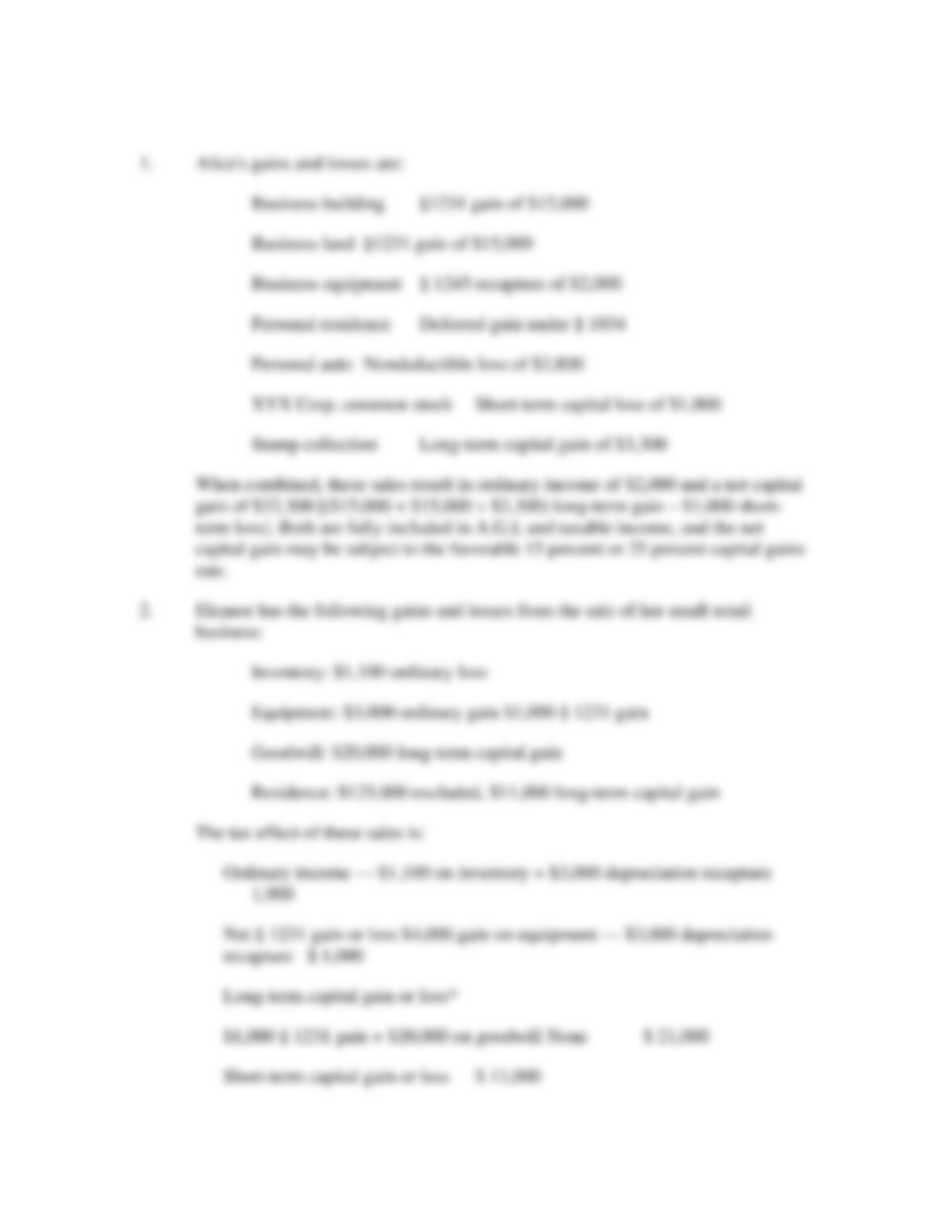
Solutions to Comprehensive Problems