
CHAPTER 17—FINANCIAL PLANNING AND CONTROL
TRUE/FALSE
1. Errors in the sales forecast can be offset by similar errors in costs and income forecasts. Thus, as
long as the errors are not large, sales forecast accuracy is not critical to the firm.
2. As a firm’s sales grow its current asset accounts tend to increase. For instance, as sales increase
the firm’s purchases increase and its level of accounts payable will increase. Thus, spontaneously
generated funds will arise from transaction accounts that increase as sales increase.
3. The term “spontaneously generated funds” generally refers to increases in the cash account that
result from growth in sales, assuming the firm is operating with a positive profit margin.
4. To determine the amount of additional funds needed, you may subtract the expected increase in
liabilities (a source of funds) from the sum of the expected increases in retained earnings and
assets (both uses of funds).
5. Two key objectives of financial planning and control are to avoid cash squeezes and to improve
profitability.
6. One limitation of operating breakeven analysis is that variable cost must be assumed constant
throughout the analysis in order to completely analyze changes in fixed investment.
7. Breakeven analysis can be used to determine how large sales of a new product must be for the
firm to achieve profitability, but it is not useful in studying the effects of a general expansion in
the firm’s operations.
8. Operating costs include variable costs, depreciation, and interest charges.
9. The DOL is an index number that measures the effect of a change in sales price on the operating
breakeven point.
10. Other things held constant, if a firm is operating at a profit and then sales increase, the degree of
operating leverage will decline.

Chapter 17 Financial Planning and Control 363
11. Today, computer simulation models can calculate multiple breakeven charts providing
management with an idea of how the firm’s breakeven point would change under different
assumptions for key variables.
12. Two firms which have the same operating leverage must also have the same ROA, since
operating leverage and ROA both measure the effective utilization of assets by the firm.
13. The higher the percentage of a firm’s total costs that are fixed, the higher the degree of operating
leverage and the lower the operating breakeven point.
14. Alternative methods for producing a given product often have different degrees of operating
leverage and hence have different breakeven points and degrees of risk.
15. The closer a firm is to its operating breakeven point, the greater is the absolute value of the
degree of operating leverage.
16. The purpose of financial breakeven analysis is to determine the level of sales a firm needs in
order to cover the fixed and variable costs associated with producing and selling inventory items.
17. If a firm has no preferred stock, its financial breakeven point is the sales level that results in net
income equal to zero.
18. The degree of financial leverage gives an indication of how a change in EBIT will affect EPS.
19. Everything else equal, the higher the DFL is for a firm, the closer its operations are to its financial
breakeven point.
20. Everything else equal, the higher the DFL is for a firm, the closer its operations are to its
operating breakeven point.
21. Two firms that have the same financial leverage must also have the same ROE, because both
financial leverage and ROE measure the risk associated with equity financing.
22. Other things held constant, a high degree of total leverage will mean that a relatively small
change in sales will result in a large change in EPS.
364 Chapter 17 Financial Planning and Control
23. Financial planning involves the projection of sales, income, and assets as well as the
determination of the resources needed to achieve these projections.
24. Financial control involves the projection of sales, income, and assets as well as the determination
of the resources needed to achieve these projections.
25. Financial planning involves implementing the financial plans, or forecasts, and dealing with the
feedback and adjustment process that is necessary to ensure the goals of the firm are pursued
appropriately.
26. In general, excess capacity means more external financing is required to support increases in
operations than would be needed if the firm previously operated at full capacity.
27. A firm that only utilizes 40% of its fixed assets capacity to generate $1,000,000 in sales will be
able to increase sales to $4,000,000 before full capacity is reached and plant and equipment
would have to be increased.
28. Lumpy assets are assets that cannot be acquired in small increments; they must be obtained in
large discrete amounts.
29. Breakeven analysis is important in the planning and control process because the cost-volume-
profit relationship can be influenced greatly by the proportion of the firm’s assets that are fixed.
30. A firm whose degree of operating leverage (DOL) is equal to three means that a given percentage
change in sales will change earnings per share by three times as much.
31. The degree of total leverage shows how a change in sales will affect operating income.
32. The fact that long-term debt and equity funds are raised infrequently and in large amounts lessens
the need for the firm to forecast them on a continual basis.
33. The projected balance sheet method assumes that the key ratios are constant, which means, for
example, that if you plotted a graph of inventories versus sales, the regression line would be
linear and would have a positive Y-intercept.
34. The projected balance sheet forecasting method would be appropriate if, in a regression of sales
on each asset and spontaneous liability, the regression line was linear and passed through the
origin.

Chapter 17 Financial Planning and Control 365
35. If any firm with a positive net worth is operating its fixed assets at full capacity, if its dividend
payout ratio is 100 percent, and if it wants to hold all financial ratios constant, then for any
positive growth rate in sales, the firm will require external financing.
36. Breakeven analysis can involve determining the magnitude of the firm’s profit or losses at output
levels on and around the point where revenues equal costs.
37. The operating breakeven volume in units can be found by dividing the firm’s total fixed cost in
dollars by its profit margin per unit (i.e., price less variable cost).
38. One potential benefit of high operating leverage is that it can reduce the average cost per unit at
high levels of output, thus generating a competitive cost advantage.
39. The firm’s cost-volume-profit relationship is most influenced by variable cost and, thus, the level
of fixed or operating costs plays a relatively minor role.
40. Other things held constant, a high degree of operating leverage will mean that a relatively small
change in sales will result in a large change in operating income.
41. If firm A uses more operating leverage than firm B, firm A will probably have a greater
percentage profit margin per unit than firm B, if both firms are otherwise identical and operating
above their respective operating breakeven levels.
42. Suppose a firm uses a high degree of operating leverage and operates in an industry whose sales
are greatly affected by changes in the overall level of economic activity. The riskiness of that
firm’s earnings stream will likely be greater than the earnings of a firm in the same industry which
has a lower degree of operating leverage.
43. The higher the DOL, the greater the firm’s use of debt and the more earnings will change
following a change in sales.
44. A high degree of operating leverage, other things held constant, means that a relatively small
change in unit sales will result in a large change in operating income.
45. It is more difficult to estimate fixed and variable cost per unit for a project during planning than
once the project is underway. This is because, once a project is operational, the firm has access to
clearly reported and separated actual costs that the project incurs.

366 Chapter 17 Financial Planning and Control
46. An advantage of breakeven analysis is that it can be applied with equal precision whether a firm’s
cost curve is linear or nonlinear.
47. If a small change in sales results in a large change in EPS, then it must be caused by the financial
leverage associated with the firm.
48. Other things held constant, the greater the firm’s use of debt, the greater the change in EPS that
will result from a change in sales volume.
49. Management need not consider economies of scale in operations when constructing pro forma
financial statements since economies of scale do not impact the financial statements.
MULTIPLE CHOICE
1. The projected balance sheet method of forecasting is based on which of the following
assumptions?
a.
All balance sheet accounts are tied directly to sales.
b.
Most balance sheet accounts are tied directly to sales.
c.
The current level of total assets are optimal for the current sales level.
d.
Answers a and c above.
e.
Answers b and c above.
2. The projected balance sheet forecasting method produces accurate results unless which of the
following condition(s) is (are) present?
a.
Fixes assets are “lumpy.”
b.
Strong economies of scale are present.
c.
Excess capacity exists because of a temporary recession.
d.
Answers a, b, and c all make the projected balance sheet method inaccurate.
e.
Answers a and c make the projected balance sheet method inaccurate, but as the text
explains, the assumption of increasing economies of scale is built into the projected
balance sheet method.
3. Which of the following statements is correct?
a.
One of the key steps in the development of pro forma financial statements is to identify
those assets and liabilities which increase spontaneously with net income.
b.
The first, and most critical, step in constructing a set of pro forma financial statements is
establishing the sales forecast.
c.
Pro forma financial statements as discussed in the text are used primarily to assess a firm’s
historical performance.
d.
All else equal, if a firm operates at full capacity, the greater its payout ratio, the less
additional funds that will be needed for a particular growth in sales.
e.
The projected balance sheet forecasting method produces accurate results when fixed
assets are lumpy and when economies of scale are present.

Chapter 17 Financial Planning and Control 367
4. Assume a portion of a firm’s long-term funds includes either debt or preferred stock. Which of the
following statements is correct?
a.
The firm must possess operating leverage, which means that a change in net income will
result in a greater percentage change in earnings before interest and taxes (EBIT).
b.
The firm has financial leverage, which means that a change in sales will result in a greater
percentage change in EBIT.
c.
The firm has financial leverage, which means that a change in EBIT will result in a greater
percentage change in earnings per share (EPS).
d.
The firm doesn’t have leverage, because leverage is created through the use of common
equity financing only.
e.
None of the above is a correct answer.
5. The degree of financial leverage for ABC Inc. is 2.5, and the degree of financial leverage for
XYZ Corporation is 1.5. According to this information, which firm is considered to have greater
financial risk?
a.
ABC Inc.
b.
XYZ Corporation.
c.
The degree of financial leverage is not a measure of financial risk, so it is not possible to
tell which firm has the greater financial risk given the above information.
d.
To determine which firm has the greater financial risk, we need to know the operating
income (NOI or EBIT) of each firm. XYZ Corporation would have less financial risk if its
operating income is at least twice that of ABC Inc.
e.
None of the above is a correct answer.
6. Which of the following is a key determinant of financial leverage?
a.
Level of debt.
b.
Technology.
c.
Labor costs.
d.
Amount of fixed assets used by the firm.
e.
Variable cost of goods sold.
7. Once the “base case” forecasted financial statements have been prepared, top managers want to
know
a.
how realistic the results are.
b.
how to attain the results.
c.
what impact changes in operations would have on the forecasts.
d.
All of the above.
e.
None of the above.

368 Chapter 17 Financial Planning and Control
8. When constructing pro forma financial statements, which of the following steps should be
completed first?
a.
Forecast next period’s balance sheet.
b.
Determine the additional funds needed, AFN, to support expected growth.
c.
Forecast next period’s income statement.
d.
Consider the impact of external financing on the additional funds needed (AFN) to
determine how much additional interest or dividends must be paid to support expected
growth—that is, consider financing feedbacks.
e.
Determine whether the firm is operating above or below its operating breakeven point.
9. Which of the following liabilities is most likely to increase spontaneously with an increase in
sales?
a.
Notes payable
b.
Long-term bonds
c.
Preferred stock
d.
Accounts payable
e.
Common stock
10. Which of the following accounts will not rise spontaneously with an increase in sales?
a.
Accounts payable
b.
Accrued wages
c.
Accrued taxes
d.
Accounts receivable
e.
Notes payable
11. The decision of how to raise additional funds needed to support sales growth is based on several
factors including
a.
firm’s ability to handle additional debt.
b.
conditions in the equity markets.
c.
firm’s current capital structure.
d.
existing debt covenants.
e.
All of the above.
12. Which of the following factors might cause “spontaneous” assets and liabilities to change at a
different rate than sales?
a.
Lumpy assets
b.
Economies of scale
c.
Excess capacity
d.
All of the above
e.
Answers b and c above

Chapter 17 Financial Planning and Control 369
13. By definition, a firm’s operating breakeven point represents the level of production and sales at
which
a.
additional funds needed equals zero.
b.
variable costs equals operating revenue.
c.
fixed variable costs equals operating revenue.
d.
net operating income equals zero.
e.
the cost of equity equals the cost of debt.
14. By definition, a firm’s financial breakeven point is the level of operating income (NOI) where its
a.
stock value is maximized.
b.
earnings before interest and taxes (EBIT) equal zero.
c.
earnings per share equal zero.
d.
taxes equal zero.
e.
interest expense equal zero.
15. All else equal, which of the following activities should increase the financial risk of a firm?
a.
decrease common stock dividends
b.
issue new bonds
c.
issue new common stock
d.
repurchase (pay off) outstanding debt
e.
an increase in the fixed operating costs
16. Expert Analysts Resources (EAR) has provided you with the following information about three
companies you are currently evaluating:
Degree of Operating
Degree of Financial
Company
Leverage (DOL)
Leverage (DFL)
Acme
1.5
6.0
Apex
3.0
4.0
Alps
5.0
2.0
According to this information, which firm would be considered riskiest?
a.
Acme, because its DFL equals 6.0, which is the highest leverage associated with any of
the three firms.
b.
Acme, because its degree of total leverage (DTL) is almost equal to 10.
c.
Apex, because it has the highest degree of total (DTL).
d.
Alps, because it has the highest DOL.
e.
Acme, because is has the lowest DOL.

370 Chapter 17 Financial Planning and Control
17. Considering each action independently and holding other things constant, which of the following
actions would reduce the firm’s need for additional capital?
a.
An increase in the dividend payout ratio.
b.
A decrease in the profit margin.
c.
A decrease in the days sales outstanding.
d.
An increase in expected sales growth.
e.
A decrease in the accrual accounts (accrued wages and taxes).
18. Which of the following statements is correct?
a.
Any forecast of financial requirements involves determining how much money the firm
will need and is obtained by adding together increases in assets and spontaneous liabilities
and subtracting operating income.
b.
The projected balance sheet method of forecasting financial needs requires only a forecast
of the firm’s balance sheet. Although a forecasted income statement helps clarify the
financing needs, it is not essential to the balance sheet method.
c.
Because dividends are paid after taxes from retained earnings, dividends are not included
in the projected balance sheet method of forecasting.
d.
The projected balance sheet method forces recognition of the fact that new financing
creates additional financial obligations. For instance, new financing can increase expenses
which can actually decrease taxes but increase the projected financial need.
e.
Financing feedback describes the effect on the firm’s stock price of the announcement that
the firm will sell new equity or debt to raise needed capital.
19. The degree of operating leverage has which of the following characteristics?
a.
The closer the firm is operating to breakeven quantity, the smaller the DOL.
b.
A change in quantity demanded will produce the same percentage change in EBIT as an
identical change in price per unit of output, other things held constant.
c.
The DOL is not a fixed number for a given firm, but will depend upon the time zero values
of the economic variables Q (Quantity), P (Price), and V (Volume).
d.
The DOL relates the change in net income to the change in net operating income.
e.
If the firm has no debt, the DOL will equal 1.
20. If a firm’s degree of total leverage (DTL) is 8.0, which of the following must be correct?
a.
The firm must have fixed operating costs.
b.
The firm must have fixed financial costs.
c.
The firm must have both fixed operating costs and fixed financial costs.
d.
The firm must have some fixed costs, but not enough information is given to determine
whether the fixed costs are operating, financial, or both.
e.
With the information given, we cannot tell whether the firm has any fixed costs (either
operating or financial) at all.

Chapter 17 Financial Planning and Control 371
21. All else equal, one firm will have a lower breakeven point than another firm if
a.
its fixed costs are higher.
b.
its selling price of the product is higher.
c.
its variable operating cost per unit is higher.
d.
All of the above.
e.
None of the above.
22. Everything else equal, a firm can reduce its operating breakeven point by
a.
increasing its fixed costs.
b.
decreasing the selling price of the product that is sold.
c.
increasing the contribution margin, which is the product’s selling price less its variable
cost.
d.
increasing the variable cost per unit.
e.
None of the above is correct.
23. If a firm has a degree of operating leverage (DOL) that is greater than 1.0, the we know that a 1.0
percent change in __________ will cause in a change in __________ that is __________ 1.0
percent.
a.
EBIT; sales; greater than
b.
EBIT; net income; greater than
c.
sales; EBIT; less than
d.
sales; EBIT; greater than
e.
EBIT; net income; less than
24. Business risk is related with the operations of the firm. Which of the following is not directly
associated with—that is, not a part of—business risk?
a.
product demand variability
b.
sales price variability
c.
relative amount of fixed operating costs
d.
degree of price flexibility with respect to changes in operating costs
e.
changes in required returns due to financing decisions
25. Everything else equal, if a firm shifts its capital structure to include more debt than before the
shift, then the firm’s business risk should
a.
increase because the degree of financial leverage increases.
b.
decrease because the degree of operating leverage decreases.
c.
not change because capital structure decisions should affect the firm’s financial risk, not its
business risk.
d.
not change because, although additional common stock will increase financial risk, the
business risk should decrease by the same amount.
e.
increase because the degree of financial leverage increases.
372 Chapter 17 Financial Planning and Control
26. Which of the following statements is correct?
a.
The first pass using the projected balance sheet method determines the financing feedback
effects and determines how much in additional funds are needed. The second pass
completes the cycle, identifies the full financing need, and eliminates further feedback
effects.
b.
Interest expense on additional new debt is the only income statement account affected by
financing feedback, and dividends payable to new common stock is the only balance sheet
account affected.
c.
The projected balance sheet method is useful for determining additional funds needed,
however, it cannot be used in evaluating dividend policy and capital structure decisions.
d.
One reason a firm’s managers may choose to meet additional funds needed requirements
through common stock is that it involves no financing feedback effects. Since no new debt
is used, interest expense will be considered fully in the first pass, the income statement
will remain unchanged, and no second pass is needed.
e.
If new debt and new stock are used to meet new financing needs, net income will decrease
from the first pass to the second pass even though taxes decrease. In addition, if dividends
are to be paid on new stock, this will further decrease the amount of retained earnings
available for financing needs.
27. For a particular product, Sandbarr Corporation has operating fixed costs of $30,000, of which
depreciation of $15,000 is the only non-cash outlay. The unit sale price is $4.20 per unit and
variable costs are $2.20 per unit. What is the operating cash breakeven point in units for
Sandbarr?
a.
3,572 units
b.
6,818 units
c.
10,000 units
d.
15,000 units
e.
7,500 units
28. The Price Company will produce 55,000 widgets next year. Variable costs will equal 40 percent
of sales, while operating fixed costs will total $110,000. At what price must each widget be sold
for the company to achieve an EBIT of $95,000?
a.
$2.00
b.
$4.45
c.
$5.00
d.
$5.37
e.
$6.21

Chapter 17 Financial Planning and Control 373
29. You are the owner of a small business which has the following balance sheet:
Current assets
$ 5,000
Accounts payable
$ 1,000
Net fixed assets
10,000
Accruals
1,000
Long-term debt
5,000
Common equity
8,000
Total assets
$15,000
Total
$15,000
Fixed and current assets are fully utilized, and the sales/assets and sales/spontaneous liabilities
ratios will remain constant. Next year you expect sales to increase by 50 percent. You also expect
to retain $2,000 of next year’s earnings within the firm. What is next year’s additional external
funding requirement, i.e., what is your firm’s AFN?
a.
No additional funds are required.
b.
$3,500
c.
$4,500
d.
$5,500
e.
The answer depends on this year’s sales level.
Current assets
$ 7,500
Accounts payable
$ 1,500
Net fixed assets
Accruals
1,500
Long-term debt
5,000
Common equity
10,000
and equity
Total assets
$22,500
$18,000
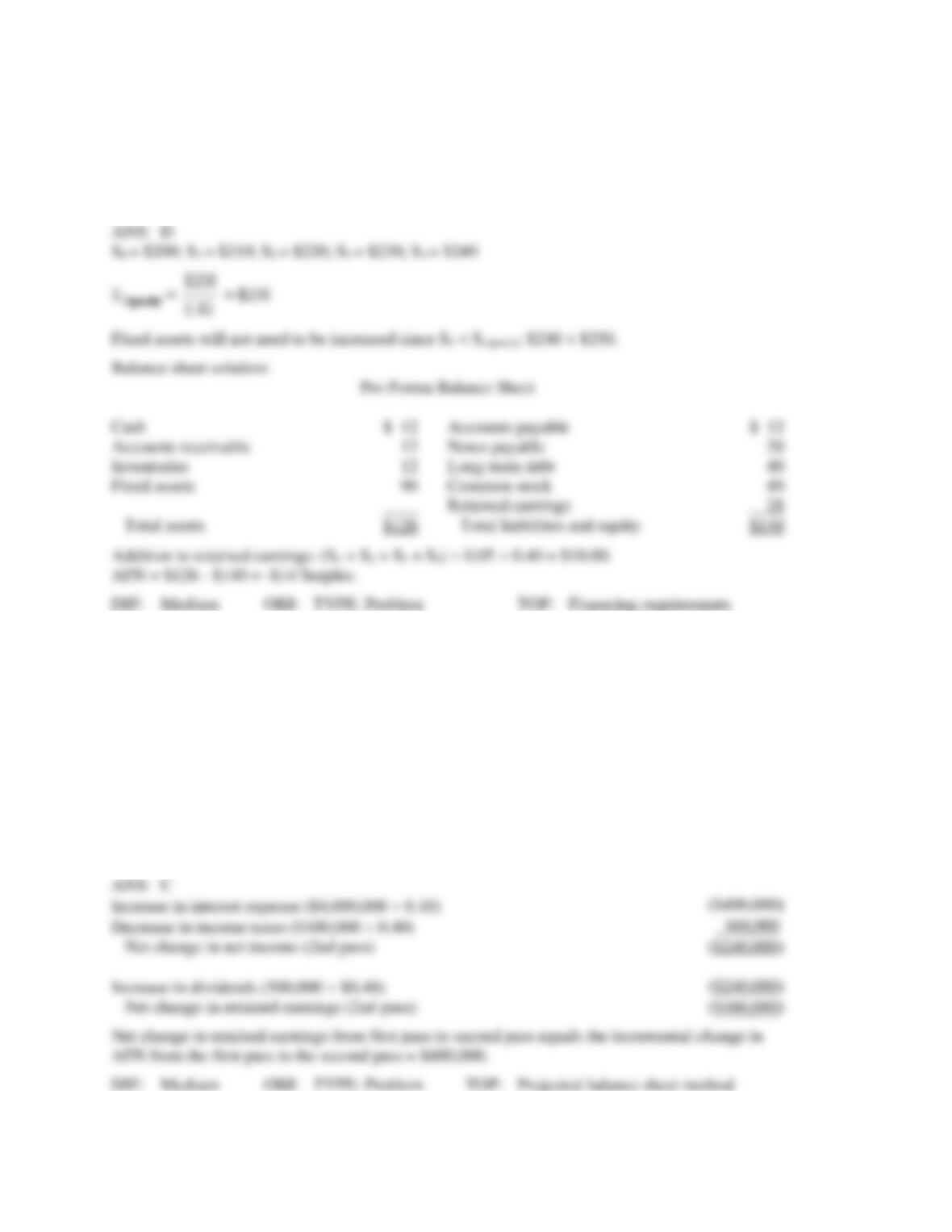
30. A firm has the following balance sheet:
Cash
$10
Accounts payable
$ 10
Accounts receivable
10
Notes payable
20
Inventories
10
Long-term debt
40
Fixed assets
90
Common stock
40
Retained earnings
10
Total assets
$120
Total liabilities and equity
$120
Fixed assets are being used at 80 percent of capacity; sales for the year just ended were $200;
sales will increase $10 per year for the next 4 years; the profit margin is 5 percent; and the
dividend payout ratio is 60 percent. Assume that fixed assets cannot be sold. What are the total
external financing requirements for the entire 4 years, i.e., the total AFN for the 4-year period?
374 Chapter 17 Financial Planning and Control
a.
$4.00
b.
$2.00
c.
-$0.80 (Surplus)
d.
-$14.00 (Surplus)
e.
$0
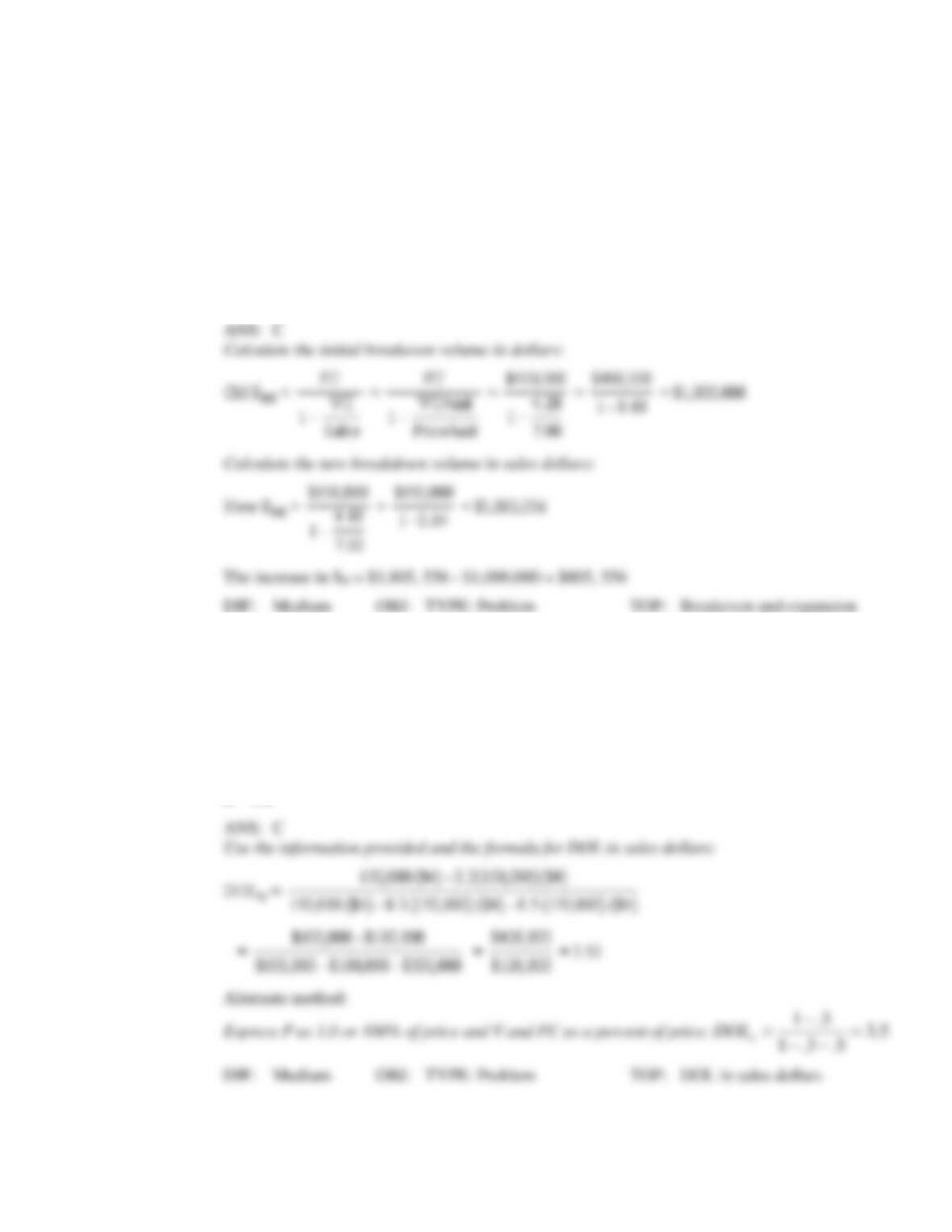
31. Compuvac Company has just completed its first pass forecast using the projected balance sheet
method. The firm has determined that it needs $4 million in new debt which can be sold at par
with a 10% annual coupon. Additionally, the firm will sell 500,000 shares of new common equity
at $18.10 per share. Next year’s expected dividend is $0.48 per share. The firm expects that taxes
will be $160,000 less under the second pass than they were under the first pass based on a 40%
tax rate. Given this information, what is the incremental change in AFN for Compuvac going
from the first pass to the second pass?
a.
$240,000
b.
$0
c.
$480,000
d.
$160,000
e.
$640,000
Chapter 17 Financial Planning and Control 375
32. Martin Corporation currently sells 180,000 units per year at a price of $7.00 per unit; its variable
cost is $4.20 per unit; and fixed operating costs are $400,000. Martin is considering expanding
into two additional states which would increase its fixed costs to $650,000 and would increase its
variable unit cost to an average of $4.48 per unit. If Martin expands it expects to sell 270,000
units at $7.00 per unit. By how much will Martin’s operating breakeven sales dollar level change?
a.
$183,333
b.
$456,500
c.
$805,556
d.
$910,667
e.
$1,200,000
33. Marcus Corporation currently sells 150,000 units a year at a price of $4.00 a unit. Its variable
costs are approximately 30% of sales, and its fixed operating costs amount to 50% of revenues at
its current output level. Although fixed costs are based on revenues at the current output level, the
cost level is fixed. What is Marcus’ degree of operating leverage in sales dollars?
a.
1.0
b.
2.2
c.
3.5
d.
4.0
e.
5.0
376 Chapter 17 Financial Planning and Control
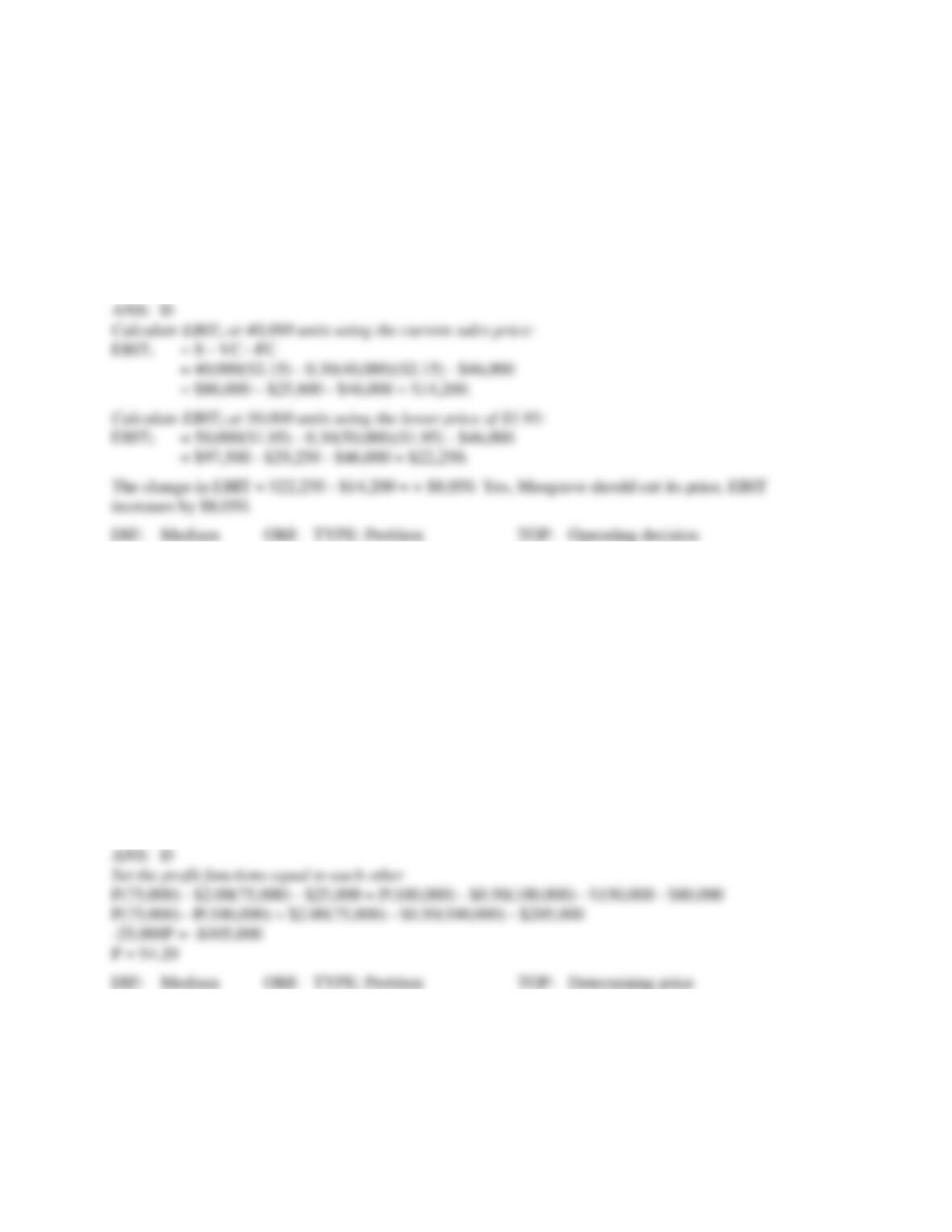
34. Musgrave Corporation has fixed operating costs of $46,000 and variable costs that are 30% of the
current sales price of $2.15. At a price of $2.15, Musgrave sells 40,000 units. Musgrave can
increase sales by 10,000 units by cutting its unit price from $2.15 to $1.95, but variable cost per
unit won’t change. Should it cut its price?
a.
No, EBIT decreases by $6,000.
b.
No, EBIT decreases by $250.
c.
Yes, EBIT increases by $11,500.
d.
Yes, EBIT increases by $8,050.
e.
Yes, EBIT increases by $5,050.
35. Carolina Vineyards is considering two alternative production methods for turning grapes into
wine. One method calls for using a hand-operated press, while the other would employ a new,
automated press. It has been estimated that the variable cost per bottle will amount to $2.00 using
the old press and $0.50 using the new machine. If the new machine is purchased, fixed operating
costs will equal $150,000, and interest charges will be $80,000. Fixed operating costs of $25,000
will be incurred if the company decides to use the old press, and interest costs will be zero
because no debt will be needed. Assume that sales (in units) will be 100,000 bottles under the
automated method and 75,000 units under the labor intensive method. What sales price per unit
would cause Carolina to be indifferent between the two methods?
a.
$2.00
b.
$2.20
c.
$4.00
d.
$4.20
e.
$6.00

Chapter 17 Financial Planning and Control 377
Information on the Crum Company:
2000
2001
1st pass
2001
2nd pass
Sales
$1,000.00
Operating costs
800.00
EBIT
$ 200.00
Interest
16.00
EBT
$ 184.00
Taxes (40%)
73.60
Net Income
$ 110.40
Dividends (60%)
66.24
Add’n to R.E.
$ 44.16
Current Assets
$ 700.00
Net fixed Assets
300.00
Total assets
$1,000.00
A/P and Accruals
$ 150.00
N/P 8.00%
200.00
Common stock
150.00
Retained earnings
500.00
Total Liab & Equity
$1,000.00
AFN
Profit Margin
11.04%
ROE
16.98%
Debt/Assets
35.00%
Current ratio
2.00 times
Payout Ratio
60.00%
Interest
AFN Financing:
Weights:
Dollars:
Interest
Expense:
N/P
0.3500
Common Stock
0.6500
1.0000
36. Refer to Crum Company. Crum expects sales to grow by 50% in 2001, and operating costs
should increase at the same rate. Fixed assets were being operated at 40% of capacity in 2000, but
all other assets were used to full capacity. Underutilized fixed assets cannot be sold. Current
assets and spontaneous liabilities should increase at the same rate as sales during 2001. The
company plans to finance any external funds needed as 35% notes payable and 65% common
stock. After taking financing feedbacks into account, and after the second pass, what is Crum’s
projected ROE using the projected balance sheet method?

378 Chapter 17 Financial Planning and Control
a.
16.98%
b.
23.73%
c.
25.68%
d.
19.61%
e.
23.24%
Chapter 17 Financial Planning and Control 379
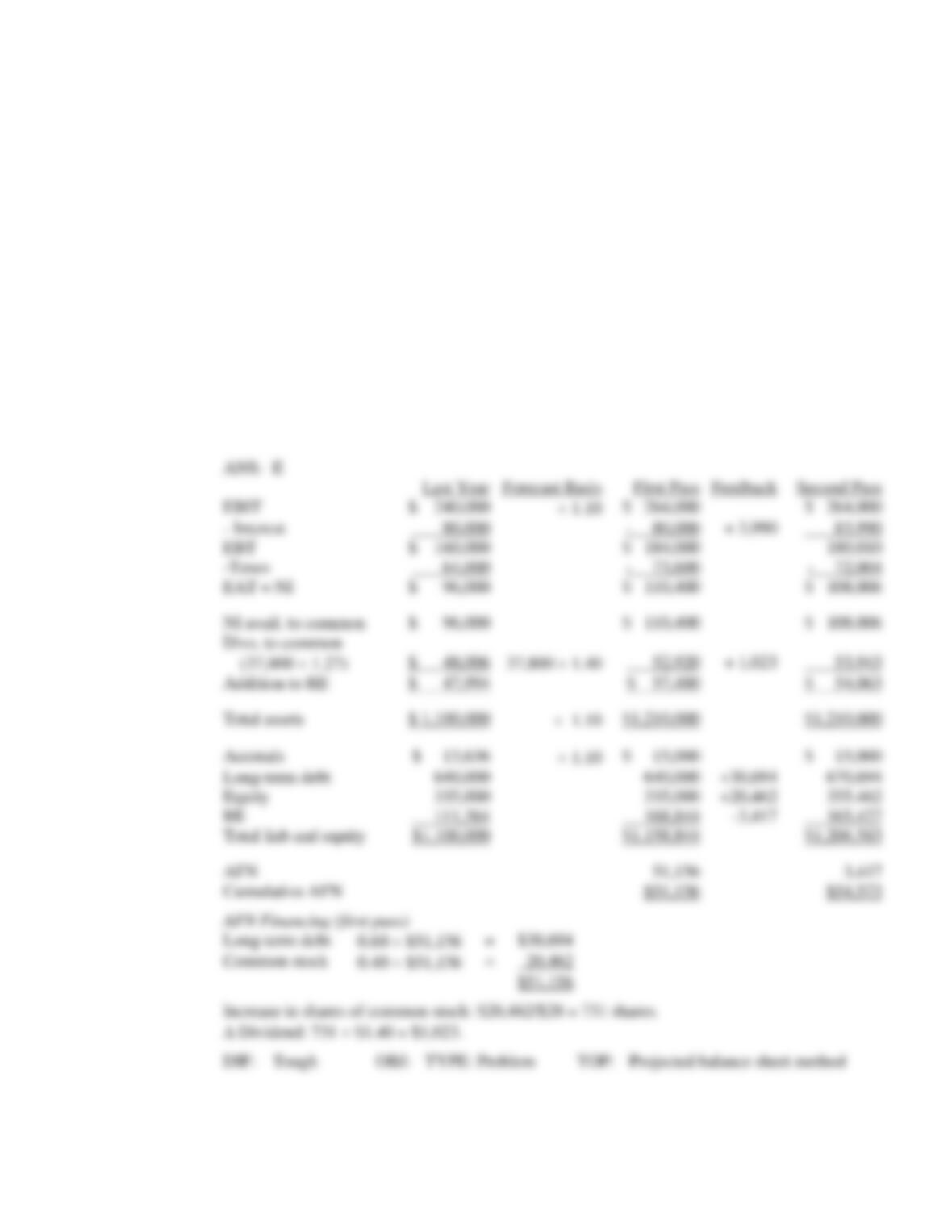
37. Hogan Inc. generated EBIT of $240,000 this past year using assets of $1,100,000. The interest
rate on its existing long-term debt of $640,000 is 12.5 percent and the firm’s tax rate is 40 percent.
The firm paid a dividend of $1.27 on each of its 37,800 shares outstanding from net income of
$96,000. The total book value of equity is $446,364 of which the common stock account equals
$335,000. The firm’s shares sell for $28.00 per share in the market. The firm forecasts a 10%
increase in sales, assets, and EBIT next year, and a dividend of $1.40 per share. If the firm needs
additional capital funds, it will raise 60% with debt and 40% with equity. The cost of any new
debt will be 13%. Spontaneous liabilities are estimated at $15,000 for next year, representing an
increase of 10% over this year. Except for spontaneous liabilities, the firm uses no other sources
of current liabilities and will continue this policy in the future. What will be the cumulative AFN
Hogan will need to balance its projected balance sheet using the projected balance sheet method
through the first two passes?
a.
$5,013
b.
$3,417
c.
$51,156
d.
$26,228
e.
$54,573

380 Chapter 17 Financial Planning and Control
Trident Food Corporation
Trident Food Corporation generated the following income statement for the most recent fiscal
year, which ended December 31, 2000:
Sales revenues
$150,000
Variable cost of sales
(112,500)
Gross profit
37,500
Fixed operating costs
(24,000)
Net operating income (EBIT)
13,500
Interest
(10,000)
Earnings before taxes
3,500
Taxes (40%)
(1,400)
Net income
2,100
Each item of inventory Trident Foods produces has a selling price of $20.
38. Refer to Trident Food Corporation. What is the degree of operating leverage for Trident Foods?
a.
2.78
b.
10.71
c.
3.86
d.
3.00
e.
4.00
39. Refer to Trident Food Corporation. What is the degree of total leverage for Trident Foods?
a.
42.86
b.
10.71
c.
71.43
d.
17.86
e.
6.43
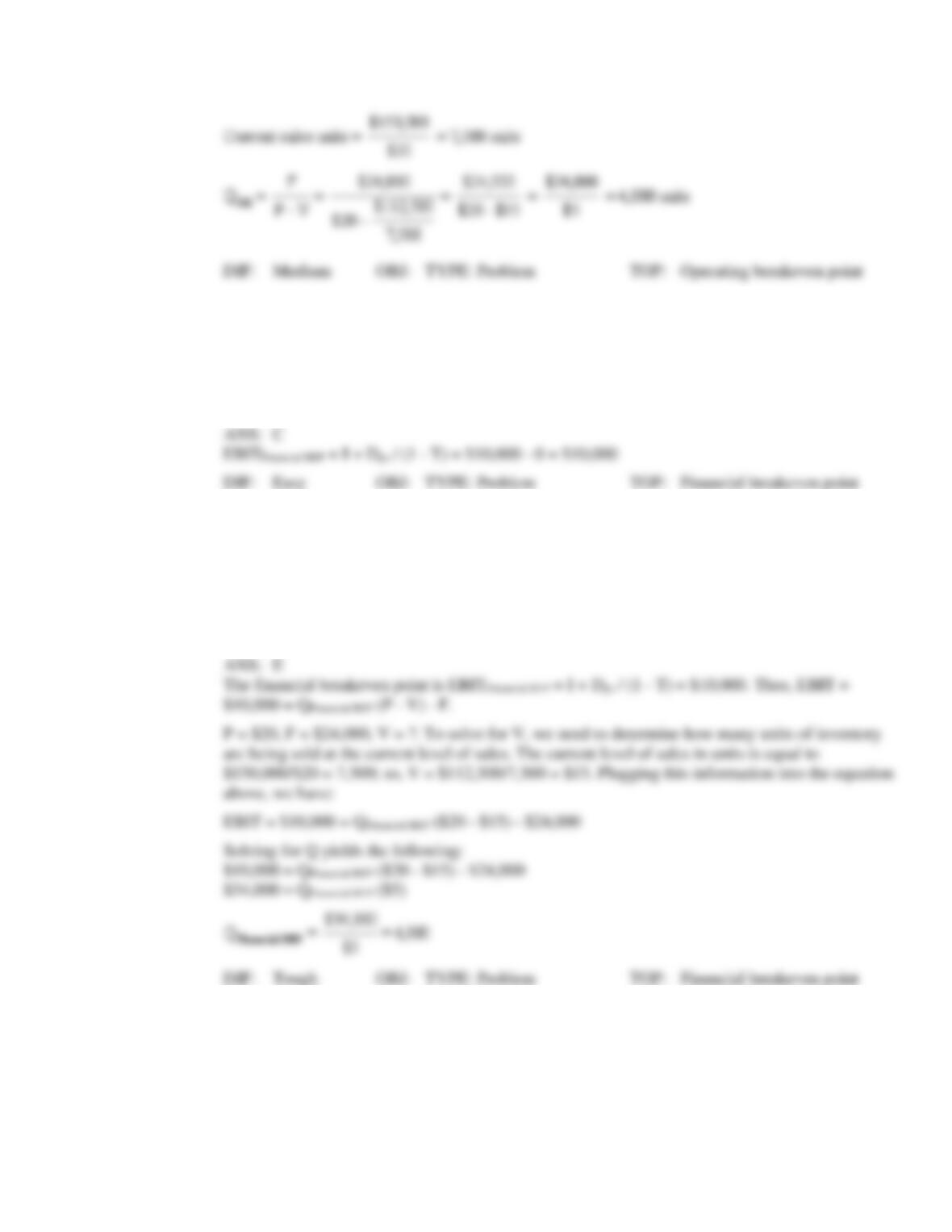
40. Refer to Trident Food Corporation. What is the operating breakeven point in sales units (Q) for
Trident Foods?
a.
7,500
b.
5,625
c.
6,825
d.
4,800
e.
2,700
Chapter 17 Financial Planning and Control 381
41. Refer to Trident Food Corporation. What is the financial breakeven point for Trident Foods?
a.
EBIT = $146,500
b.
Sales = 4,800 units
c.
EBIT = $10,000
d.
Net income = $10,000
e.
EBIT = $11,400
42. Refer to Trident Food Corporation. How many units of inventory must Trident Foods sell if it
wants to operate at its financial breakeven point?
a.
2,000
b.
500
c.
4,800
d.
2,280
e.
6,800