Exam
Name___________________________________
MULTIPLE CHOICE. Choose the one alternative that best completes the statement or answers the question.
1)
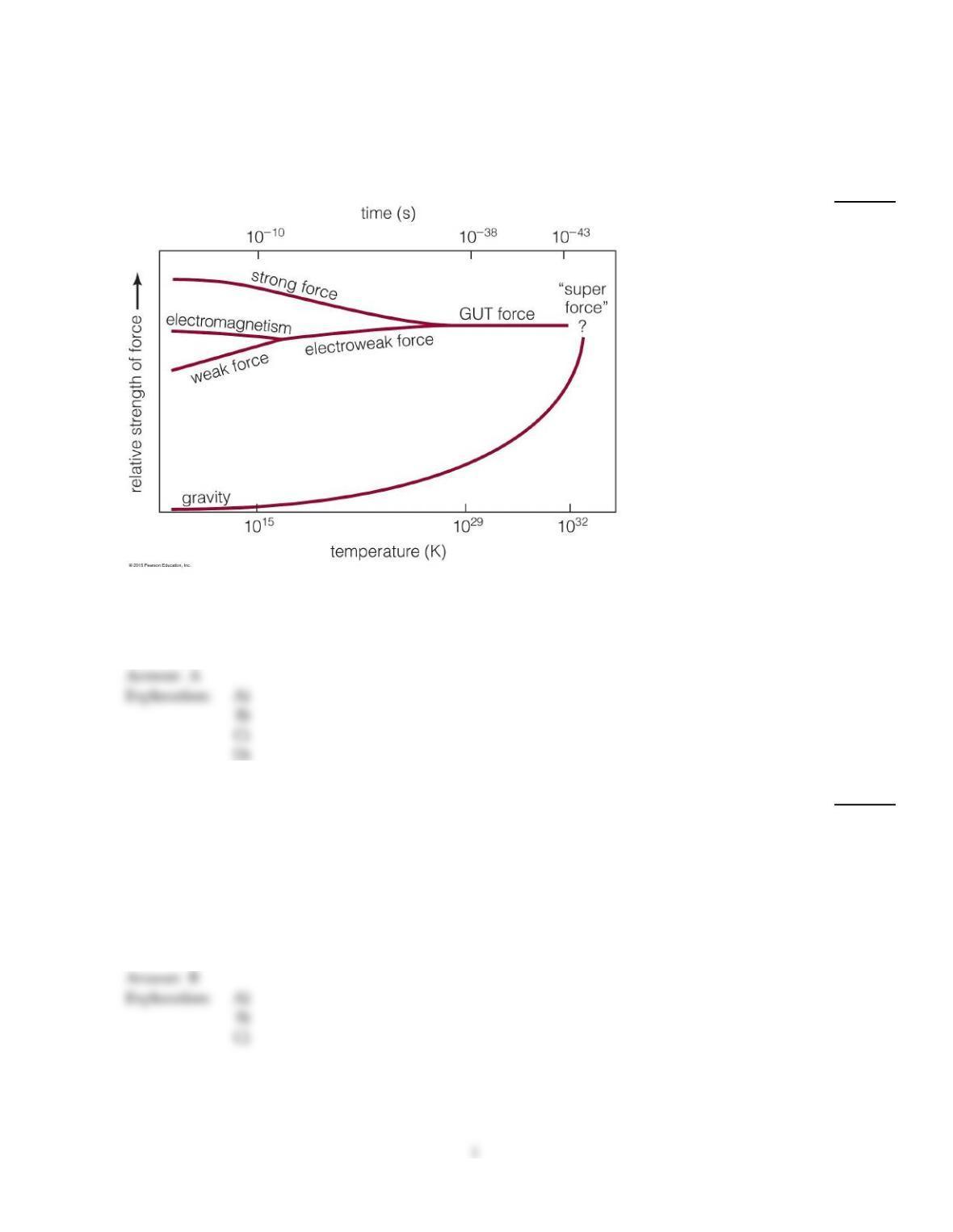
This figure shows the relative strength of the four basic forces as a function of temperature. At what
temperature does the strong force become distinct from the electroweak force?
1)
A)
about 1027 K
B)
about 1015 K
C)
about 1032 K
D)
These forces were never unified.
2)
In order for the cosmic microwave background to show hydrogen absorption lines at the redshift
corresponding to the universe’s age of 380,000 years, what condition would have been necessary?
2)
A)
There would have needed to be ionized hydrogen (which would contradict the idea that the
CMB originates at the time the universe cooled enough for protons and electrons to combine,
making neutral atoms).
B)
There would have needed to be cooler hydrogen clouds (which would contradict the
observation of a uniform temperature in all directions).
C)
There would have needed to be even warmer hydrogen clouds (which would contradict the
observation of a uniform temperature in all directions).

3)
Why do we expect the cosmic background radiation to be almost, but not quite, the same in all
directions?
3)
A)
The overall structure of the universe is very uniform, but the synthesis of different elements
produces varying signatures within the background radiation.
B)
The overall structure of the universe is very uniform, but the universe must have contained
some regions of higher density in order for galaxies to form.
C)
The overall structure of the universe is very uniform, but intervening gas between us and the
era of nuclei absorbs wavelengths depending on the composition and redshift of the gas.
D)
Dark matter will smooth out the spectrum, but the small patches of “light” matter create
fluctuations in the temperature.
E)
The temperature of the universe can be found by taking an average over the entire sky, but
individual stars will create peaks in the temperature over small angles.
4)
The Big Bang theory is supported by two major lines of evidence that alternative models have not
successfully explained. What are they?
4)
A)
(1) The theory correctly predicts that the universe should be expanding; (2) the theory
correctly predicts the observed ratio of spiral to elliptical galaxies in the universe.
B)
(1) The theory predicts the existence of and the specific characteristics of the observed cosmic
microwave background; (2) the theory correctly predicts the observed overall chemical
composition of the universe.
C)
(1) The theory predicts the episode of inflation that we think occurred in the early universe;
(2) the theory predicts the existence of large quantities of dark matter.
D)
(1) The theory correctly predicts that the universe should be expanding; (2) the theory
predicts the existence of and the specific characteristics of the observed cosmic microwave
background.
5)
The four fundamental forces that operate in the universe today are ________.
5)
A)
nuclear force, electromagnetic force, gravity, tidal force
B)
strong force, weak force, electric force, magnetic force
C)
nuclear force, gravity, electric force, magnetic force
D)
strong force, weak force, electromagnetic force, gravity

6)
Creation science claims that scientific evidence can and does prove God made the universe. Select
the statement which does not identify a legitimate objection to this claim. (Recall the hallmarks of
science.)
6)
A)
Scientists are not allowed to believe in God.
B)
Science cannot prove (or disprove) the existence of a superpowerful, supernatural deity.
C)
The statement that “God did it” cannot be falsified by science, and therefore it is not a
statement that science can test.
D)
If “God did it” is the explanation for everything, then final exams in astronomy would be very
simple (all answers would be the same!), and science experiments would be very easy to
explain, but we wouldn’t learn much about the natural world.
7)
What happens when matter collides with anti–matter?
7)
A)
The two particles destroy each other, and create photons.
B)
The two particles attract each other, and form a neutral atom.
C)
The two particles repel each other, and they fly apart.
8)
Which of the following claims cannot be proved or disproved by science?
8)
A)
The universe was created by God.
B)
The universe started out very hot.
C)
The universe is about 2000 years old.
D)
The universe is about 14 billion years old.
9)
Olbers’ paradox is an apparently simple question, but its resolution suggests that the universe is
finite in age. What is the question?
9)
A)
Why is the sky dark at night?
B)
How many stars are in the universe?
C)
Can we measure the position and momentum of an electron at the same time?
D)
What would it be like to ride on a beam of light?

10)
Based on our current understanding of physics, we can understand the conditions that prevailed in
the early universe as far back in time as about ________.
10)
A)
one ten–billionth of a second after the Big Bang
B)
10–45 seconds after the Big Bang
C)
380,000 years after the Big Bang
D)
10 billion years ago
11)
Evidence that the cosmic background radiation is the remnant of a Big Bang comes from predicting
characteristics of remnant radiation from the Big Bang theory and comparing these predictions with
observations. Four of the five statements below are real. Which one is fictitious?
11)
A)
The cosmic background radiation is expected to have a perfect thermal spectrum, and
observations from the COBE spacecraft verify this prediction.
B)
The cosmic background radiation is expected to contain redshifted emission lines from
hydrogen and helium, and it does.
C)
The cosmic background radiation is expected to have a temperature just a few degrees above
absolute zero, and its actual temperature turns out to be 2.73 K.
D)
The cosmic background radiation is expected to look essentially the same in all directions,
and it does.
E)
The cosmic background radiation is expected to have tiny temperature fluctuations at the
level of about 1 part in 100,000. Such fluctuations were found in the COBE data.
12)
Which of the following statements best explains what we mean when we say that the electroweak
and strong forces “froze out” at 10–38 second after the Big Bang?
12)
A)
These two forces first became distinct at this time.
B)
These forces are important only at temperatures below the freezing point of watera
temperature that the universe reached at an age of about at 10–38 second.
C)
Following this time, neither the strong nor electroweak forces were ever important in the
universe again.
D)
Freezing out was a term coined by particle physicists who think that the Big Bang theory is
really cool.

13)
Why might inflation have occurred at the end of the GUT era?
13)
A)
An enormous amount of energy was released when the strong and electroweak forces froze
out from the GUT force.
B)
Gravity was an extremely weak force at this period in time.
C)
The universe was too small and needed to grow quickly.
D)
There wasn’t enough matter present to slow down the expansion at that time.
E)
Large amounts of matter and antimatter annihilated at this time.
14)
Which of the following is not consistent with observations of the cosmic microwave background?
14)
A)
The matter density (both luminous and dark matter combined) in the universe is only about
one–fourth of the critical density.
B)
The universe is at least 20 billion years old.
C)
The universe is geometrically “flat” (in the four dimensions of spacetime).
D)
Dark energy, whatever it is, represents the majority of the energy content of the universe.
B
15)
Which of the following histories are in the correct order of occurrence?
15)
A)
The Big Bang, then the expansion starts, then the Sun and stars make the first elements
heavier than helium.
B)
The Big Bang happens simultaneously with the start of the expansion of the universe, then
stars make the first elements heavier than helium, then the Sun forms.
C)
The Big Bang happens simultaneously with the start of the expansion of the universe, then the
Sun and stars make the first elements heavier than helium.
D)
The Big Bang, then the expansion starts, then stars make the first elements heavier than
helium, then the Sun forms.
B
16)
Which event in the history of the universe happened last?
16)
A)
The GUT force separated into the electroweak force and strong force.
B)
The electroweak force separated into electromagnetic and weak nuclear forces.
C)
Stable helium nuclei formed.
D)
Neutral atoms formed.
D
A

17)
Which adjective does not necessarily describe a known feature of the early universe? (Be sure to
consider the universe as a whole, not just the observable universe.)
17)
A)
hot
B)
dense
C)
small
D)
filled with intense radiation
18)
Which forces have physicists shown to be the same force under conditions of very high
temperature, as confirmed by experiments in particle accelerators?
18)
A)
gravity and the strong force
B)
the electromagnetic and weak forces
C)
the strong and electromagnetic forces
D)
gravity and the weak force
E)
the strong and weak forces
19)
Early in the history of the universe, the universe was
19)
A)
hotter.
B)
colder.
C)
the same temperature it is now.
20)
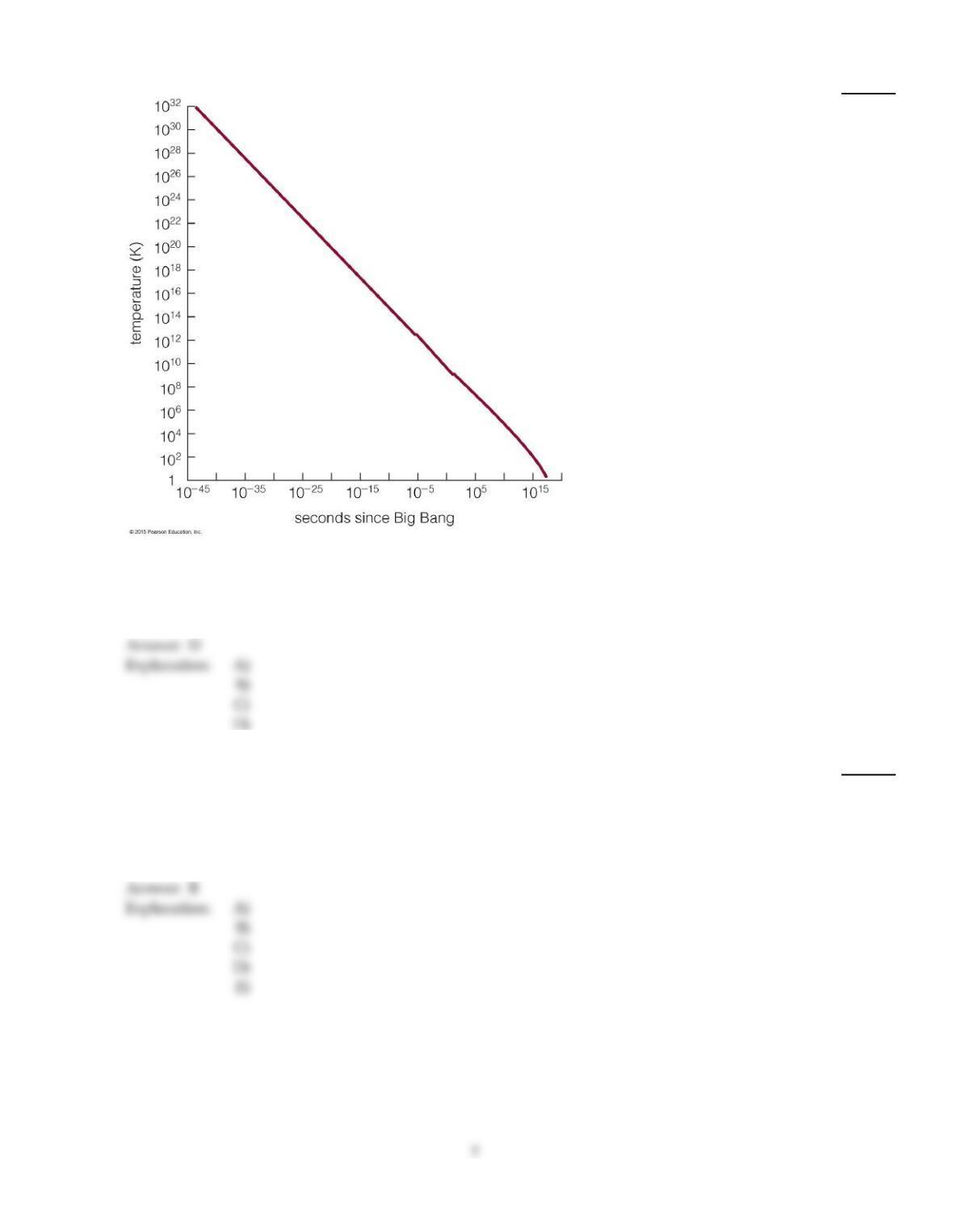
This figure shows the temperature of the universe over time, according to models of the Big Bang.
At what age did the universe cool to 1 million degrees?
20)
A)
about 10–3 seconds after the Big Bang
B)
about 1015 seconds after the Big Bang
C)
about 1 second after the Big Bang
D)
about 107 seconds after the Big Bang
21)
How many forces operated in the universe during the GUT era?
21)
A)
One: a single, symmetric “super force”
B)
Two: gravity and the GUT force
C)
Two: gravity and the electroweak force
D)
Three: gravity, the strong force, and the electroweak force
E)
All four of the known forces

22)
Which of the following statements correctly summarizes the events in the early universe according
to the Big Bang theory?
22)
A)
Forces and various subatomic particles began to appear during the first second after the Big
Bang. For reasons not understood, the particles were all made of ordinary matter and none
were made of antimatter, thus explaining why we live in a universe made of matter. The
particles underwent some fusion for the first 380,000 years after the Big Bang, at which time
the first stars were born.
B)
An episode of what we call inflation initiated the event of the Big Bang. Once the Big Bang got
underway, particles and forces began to appear one by one. The forces produced protons,
which fused to make hydrogen and helium until the universe was about 380,000 years old.
Then gravity began to act, turning the hydrogen and helium into galaxies.
C)
The Big Bang began with the initiation of what we call inflation, which gradually slowed to
the current expansion rate of the universe. Forces came to exist for a different reason, having
to do with quantum fluctuations in the space–time continuum. Particles came to exist as a
result of cracks made when forces froze. Once there were particles, gravity brought them
together to make stars, and the stars then turned the particles into hydrogen, helium, and
other elements.
D)
The universe began with the forces unified. During the first fraction of a second, the forces
separated and there was a brief but important episode of inflation. Subatomic particles of both
matter and antimatter then began to appear from the energy present in the universe. Most of
the particles annihilated to make photons, but some became protons, neutrons, electrons, and
neutrinos. The protons and neutrons underwent some fusion during the first five minutes,
thereby determining the basic chemical composition of the universe.
23)
Why is the nucleosynthesis era so important in determining the chemical composition of the
universe?
23)
A)
Except for a small amount of elements heavier than helium produced later by stars, the
chemical composition of the universe is the same now as at the end of the nucleosynthesis era.
B)
By knowing how much matter was created during the nucleosynthesis era, we can determine
whether the universe is open or closed.
C)
We can observe spectra from this era to determine what the primordial mix of the elements
was at the beginning of the universe.
D)
We can study the processes that occurred during the nucleosynthesis era to determine how
most of the elements in the universe were created.
E)
All the elements except hydrogen were produced in the nucleosynthesis era.

24)
What kinds of atomic nuclei formed during the nucleosynthesis era?
24)
A)
roughly equal amounts of hydrogen, helium, lithium, beryllium, and boron
B)
essentially all of the chemical elements, except for those heavier than uranium
C)
only helium
D)
only hydrogen
E)
hydrogen, helium and trace amounts of lithium, beryllium, and boron
25)
The Big Bang theory seems to explain how elements were formed during the first few minutes after
the Big Bang. Which hypothetical observation below (these are not real observations) would call our
current theory into question?
25)
A)
the discovery of a galaxy with a helium abundance of only 10% by mass
B)
the discovery of a planet that with no helium in its atmosphere
C)
the discovery of a galaxy with 27% helium rather than the 25% that theory tells us was
produced in the Big Bang
D)
the discovery of a star–like object made entirely of carbon and oxygen
A
26)
A GUT (grand unified theory) refers to theories that
26)
A)
unify all four forces.
B)
unify the strong force and the electromagnetic and weak forces.
C)
unify gravity and the strong and weak forces.
D)
unify the electromagnetic and weak forces.
E)
unify gravity and the electromagnetic and weak forces.
B
27)
What happened to all of the quarks that existed freely during the particle era?
27)
A)
They froze out of the soup of particles at the end of the era.
B)
They combined in groups to make protons, neutrons, and their antiparticles.
C)
They evaporated.
D)
They combined in groups to make electrons and neutrinos.
B
E

28)
Why can’t current theories describe what happened during the Planck era?
28)
A)
We do not understand the properties of the antimatter that would have been produced at this
time.
B)
We do not yet have a theory that links the weak and electromagnetic forces.
C)
We do not yet have a theory that links quantum mechanics and general relativity.
D)
The Planck era was the time before the Big Bang, and we cannot describe what happened
before the beginning of the universe.
E)
We do not yet have a theory that explains how the universe underwent a rapid period of
inflationary expansion.
29)
What happens when a particle of matter meets its corresponding antiparticle of antimatter?
29)
A)
They can form a complete atom.
B)
They fuse to make a heavier particle.
C)
The question makes no sense, since antimatter does not really exist.
D)
The combined mass of the two particles is completely transformed into energy (photons).
30)
From what cosmic epoch do the photons in the cosmic background radiation originate?
30)
A)
during the era of galaxy formation
B)
the moment of the Big Bang
C)
the end of the Planck era
D)
the end of the era of nuclei
E)
during the era of nucleosynthesis
31)
The electromagnetic force is stronger than gravity. Why is it over–powered by gravity on large
scales?
31)
A)
Electrical charge is canceled out by mass.
B)
Most objects are electrically neutral.
C)
The electromagnetic force only works on scales of about an atomic nucleus.
D)
The electromagnetic force follows an inverse cube law with distance, rather than an inverse
square law.

32)
What are the two key observational facts that led to widespread acceptance of the Big Bang model?
32)
A)
the cosmic background radiation and the expansion of the universe
B)
the cosmic background radiation and the near–critical density of the universe
C)
the predominance of matter over antimatter and the large scale structure of the universe
D)
the cosmic background radiation and the helium content of the universe
E)
the predominance of matter over antimatter and the near–critical density of the universe
33)
The cosmic microwave background gives us a view of the universe when it was
33)
A)
380,000 years old.
B)
14 billion years old.
C)
3–5 minutes old.
D)
about 1 million years old.
34)
Why can’t current theories describe what happened during the Planck era?
34)
A)
We do not yet have a theory that links quantum mechanics and general relativity.
B)
We do not know how hot or dense the universe was during that time.
C)
The Planck era was the time before the Big Bang, and we cannot describe what happened
before that instant.
D)
We do not understand the properties of antimatter.
35)
In stars, helium can sometimes be fused into carbon and heavier elements (in their final stages of
life). Why didn’t the same fusion processes produce carbon and heavier elements in the early
universe?
35)
A)
Helium fusion occurred, but the carbon nuclei that were made were later destroyed by the
intense radiation in the early universe.
B)
Temperatures in the early universe were never above the roughly 100 million Kelvin required
for helium fusion.
C)
By the time stable helium nuclei had formed, the temperature and density had already
dropped too low for helium fusion to occur.
D)
No one knowsthis is one of the major mysteries in astronomy.

36)
Why did the Big Bang not produce heavier elements?
36)
A)
By the time helium could survive, the temperature had become too low for heavier elements
to form.
B)
They did, but radioactive decay caused these elements to disappear again.
C)
Too many high energy photons were present during the era of nucleosynthesis for heavy
elements to form.
37)
Which of the following statements cannot be tested by science today?
37)
A)
The expansion of the universe is now accelerating.
B)
Our universe is flat.
C)
Prior to the Planck time, our universe sprouted from another universe.
D)
The universe is 14 billion years old.
C
38)
Laboratory experiments conducted with particle accelerators confirm predictions made by the
theory that unifies ________.
38)
A)
the electromagnetic and weak forces into the electroweak force
B)
the strong and weak forces into the combined nuclear force
C)
the unification of all four forces into a single “superforce”
D)
the strong, weak, and electromagnetic forces into the GUT force
A
39)
Which of the following hypothetical observations, if true, would disprove a prediction of the Big
Bang theory?
39)
A)
the discovery of a galaxy with 30% helium abundance
B)
the discovery of a galaxy moving toward us
C)
the discovery of two galaxies at the same distance, moving away with slightly different
speeds
D)
the discovery that the temperature of the universe is only 2.73 K
E)
the discovery of a galaxy with 10% helium abundance
E
A

40)
According to the Big Bang theory, why do we live in a universe that is made of almost entirely of
matter rather than antimatter?
40)
A)
Einstein’s famous equation E=mc2 tells us that energy can turn into matter, but does not tell
us that it can turn into antimatter.
B)
During the first 0.001 second after the Big Bang, particles and antiparticles were made in
almost but not perfectly equal numbers. Everything annihilated except the very slight excess
of matter particles.
C)
GUT theories predict that under the conditions that prevailed in the early universe, the
normal laws of physics would have been suspended so that only matter particles were
created, and no particles of antimatter.
D)
The fact that we live in a universe made of matter is not surprising, because antimatter has
never been shown to exist for real.
41)
Which of the following statements about the cosmic background radiation is not true?
41)
A)
It has a temperature of about 3 degrees K above absolute zero.
B)
It had a much higher temperature in the past.
C)
It appears essentially the same in all directions (it is isotropic).
D)
It is the result of a mixture of radiation from many independent sources, such as stars and
galaxies that formed within the first billion years of the Big Bang.
E)
It was discovered by Penzias and Wilson in the mid–1960s.
42)
If observations had shown that the cosmic microwave background was perfectly smooth (rather
than having very slight variations in temperature), then we would have no way to account for
________.
42)
A)
the relationship between the strong and the weak force
B)
how galaxies came to exist
C)
the fact that our universe is expanding
D)
the existence of helium in the universe

43)
Why did the era of nuclei end when the universe was about 380,000 years old?
43)
A)
Photons were finally able to escape the plasma of the early universe and were no longer
available to produce hydrogen and helium nuclei.
B)
Atomic nuclei were finally able to escape the plasma of the early universe.
C)
The nucleosynthesis era that produced the nuclei heavier than helium ended.
D)
All the free particles had combined to form the nuclei of atoms.
E)
The universe had expanded and cooled enough for stable, neutral atoms to form.
44)
Helium originates from
44)
A)
mostly from stellar nucleosynthesis with a small contribution from the Big Bang.
B)
the Big Bang only.
C)
radioactive decay of elements heavier than carbon.
D)
stellar nucleosynthesis only.
E)
mostly from the Big Bang with a small contribution from stellar nucleosynthesis.
45)
A “GUT” (grand unified theory) refers to theories that ________.
45)
A)
unify gravity with the strong and weak forces
B)
unify the electromagnetic and weak forces
C)
unify all four forces together
D)
unify the strong force with the electromagnetic and weak forces
46)
Which statement about the cosmic microwave background is not true?
46)
A)
It is the result of a mixture of radiation from many independent sources, such as stars and
galaxies.
B)
With the exception of very small variations, it appears essentially the same in all directions in
which we look into space.
C)
Its spectrum corresponds to a temperature of just under 3 degrees above absolute zero.
D)
It is thought to be radiation that began its journey to our telescopes when the universe was
about 380,000 years old.

47)
The cosmic microwave background peaks at a wavelength of about 1 mm, and the universe has a
temperature of about 3 K. If the microwave background peaked at a wavelength of 10
micrometers, what would its temperature be? (Hint: see Cosmic Calculations 5.1 and 17.1)
47)
A)
about 0.03 K
B)
about 300 K
C)
about 30 K
D)
about 0.3 K
48)
(From a science quiz that appeared in the weekly magazine The Economist.) Economic history is
easier to write than the history of the universe. Nevertheless, most cosmologists now think that
when the universe was formed,
48)
A)
first there was a Big Bang. There has not been any inflation yet, but if it comes it will cause
recession.
B)
first there was a Big Bang and then inflation (of space) which caused recession (of all matter,
away from the Big Bang).
C)
first there was inflation, which caused the Big Bang, then recession.
49)
In principle, if we could see all the way to the cosmological horizon we could see the Big Bang
taking place. However, our view is blocked for times prior to about 380,000 years after the Big
Bang. Why?
49)
A)
Before that time, the gas in the universe was dense and ionized and therefore did not allow
light to travel freely.
B)
Before that time, the universe was too crowded with stars.
C)
380,000 years after the Big Bang marks the time when stars were first born, and thus began to
shine the light by which we can see the universe.
D)
Before that time, the universe was dark so there was no light to illuminate anything.
50)
What is the significance of the Planck time?
50)
A)
It is the time when the cosmic microwave background was released.
B)
It is the amount of time required for two protons to fuse to make deuterium.
C)
It is the time at which inflation is thought to have occurred.
D)
Before it, conditions were so extreme that our current understanding of physics is insufficient
to predict what might have occurred.

51)
What was the significance of the end of the era of nucleosynthesis, when the universe was about 5
minutes old?
51)
A)
It marks the time at which the first stars formed.
B)
It marks the time at which the expansion of the universe had settled down to its current rate.
C)
The basic chemical composition of the universe had been determined.
D)
The proportions of dark matter and luminous matter had been determined.
52)
Why did the era of nucleosynthesis end?
52)
A)
Too many heavy elements were produced.
B)
The temperature of the universe became too low.
C)
Neutrinos carried off too much energy.
D)
The density of the universe became too low.
53)
How does the idea of inflation account for the existence of the “seeds” of density from which
galaxies and other large structures formed?
53)
A)
Inflation predicts that gravity would have been very strong and thereby would have
concentrated mass into seeds.
B)
Inflation tells us that the universe should have a “flat” overall geometry, and this led to the flat
disks of galaxies.
C)
Inflation would have caused random, microscopic quantum fluctuations to grow so large in
size that they became the seeds of structure.
D)
Inflation predicts that temperatures and densities should have become nearly equal
throughout the universe.
54)
Olbers’ paradox is an apparently simple question, but its resolution suggests that the universe is
finite in age. What is the simple question posed by Olbers’ paradox?
54)
A)
Why is the sky dark at night?
B)
What would it be like to ride on a beam of light?
C)
How many stars are in the universe?
D)
Can we measure the position and momentum of an electron at the same time?
E)
How does the Sun produce energy?

55)
How long after the Big Bang was the Planck time, the time at which our current theories become
completely unable to describe conditions any earlier in the universe?
55)
A)
10–43 seconds
B)
380,000 years
C)
10–35 seconds
D)
3 minutes
E)
10–10 seconds
56)
According to the Big Bang theory, how many forcesand which onesoperated in the universe
during the GUT era?
56)
A)
3 forces: gravity, the strong force, and the electroweak force
B)
2 forces: the strong force and the electroweak force
C)
2 forces: gravity and a single force that later became the strong, weak, and electromagnetic
forces
D)
1 force that represented the unification of all four forces that operate today
57)
How does the theory of inflation explain the near–uniformity of the cosmic microwave
background?
57)
A)
Prior to rapid inflation, all regions of space were close enough to bounce radiation
back–and–forth and reach the same temperature.
B)
Matter was near the critical–density for a universal collapse, which smoothed out the
differences in temperatures.
C)
The expanding universe would have cooled.
D)
Matter expanded into regions of space that had no matter, and thus ended up at the same
temperature.

58)
Approximately how long did the nucleosynthesis era last?
58)
A)
10–10 seconds
B)
5 seconds
C)
5 minutes
D)
0.001 seconds
E)
5 years
59)
What direct evidence do we have that the weak and electromagnetic forces were once unified as a
single force?
59)
A)
Temperatures in the center of the Sun can reproduce the conditions during the Electroweak
era.
B)
Particle accelerators on Earth can reach energies equivalent to the high temperatures of the
Electroweak era and have produced particles predicted by the unified theory.
C)
The most advanced telescopes are able to see back to the GUT era in the universe.
D)
Detectors on Earth have received photons and high–energy particles from the GUT era.
E)
We have no direct evidence of such a unified force.
60)
We have direct experimental evidence (from large particle accelerators) for the physical conditions
in the universe back to about ________ after the Big Bang.
60)
A)
380,000 years
B)
1 million years
C)
10–10 seconds
D)
300 years
E)
3 minutes

61)
What do we mean by inflation?
61)
A)
a sudden expansion of the universe driven by the energy released when the strong and
electroweak forces froze out from the GUT force
B)
the expansion of universe starting with the instant after the Big Bang
C)
the rapid expansion of the universe, driven by white dwarf supernova, that we still observe
today
D)
the sudden release of photons when particles and antiparticles annihilate each other
E)
the photons released when electrons and protons first combined, forming the Cosmic
Microwave Background Radiation
62)
Why does the Big Bang theory predict that the cosmic background radiation should have a perfect
thermal radiation spectrum?
62)
A)
The background radiation came from the heat of the universe, with a peak corresponding to
the temperature of the universe.
B)
The light from all the stars and gas in the sky averaged over the entire universe will be a
perfect thermal radiation spectrum.
C)
The spectrum of 75 percent hydrogen and 25 percent helium must be a perfect thermal
radiation spectrum.
D)
The spectrum of pure hydrogen gas must be a perfect thermal radiation spectrum.
E)
It doesn’t predict that the cosmic background radiation should have a perfect thermal
radiation spectrum.
63)
Rank these times based on the wavelength of the peak intensity of the cosmic background radiation
at those times, from shortest to longest. (Hint: consider how the temperature of the universe or the
cosmic background radiation changed with time.)
63)
A)
100 million years after the Big Bang, 1 million years after the Big Bang, today
B)
1 million years after the Big Bang, 100 million years after the Big Bang, today
C)
today, 1 million years after the Big Bang, 100 million years after the Big Bang
D)
today, 100 million years after the Big Bang, 1 million years after the Big Bang

64)
Which of the following observations cannot be explained by the Big Bang theory unless we assume
that an episode of inflation occurred?
64)
A)
the existence of the cosmic microwave background
B)
the fact that the universe is expanding
C)
the fact that about 25% of the ordinary matter in the universe consists of helium
D)
the fact that the temperature of the cosmic microwave background is almost the same
everywhere
65)
How do we determine the conditions that existed in the very early universe?
65)
A)
We look all the way to the cosmological horizon, where we can see the actual conditions that
prevailed all the way back to the first instant of the Big Bang.
B)
We work backward from current conditions to calculate what temperatures and densities
must have been when the observable universe was much smaller in size.
C)
The conditions in the very early universe must have been much like those found in stars
today, so we learn about them by studying stars.
D)
We can only guess at the conditions, since we have no way to calculate or observe what they
were.
66)
What do we mean by inflation?
66)
A)
the expansion of the universe that we still observe today
B)
a sudden and extremely rapid expansion of the universe that occurred in a tiny fraction of a
second during the universe’s first second of existence
C)
the sudden release of photons when a particle and antiparticle annihilate one another
D)
quantum fluctuations by high speed, relativistic particles in a state of false vacuum that
caused disturbances in the space–time continuum leading to the process described in the
question to which this answer refers
67)
What is the temperature of the universe (as a whole) today?
67)
A)
3000 K
B)
3 K
C)
300 K
D)
The universe cannot be said to have a single temperature.

68)
Why do we think tiny quantum ripples should have been present in the very early universe?
68)
A)
The annihilation of matter and antimatter particles caused tiny explosions that produced
ripples in the radiation field.
B)
The principles of quantum mechanics require that matter and antimatter particles formed
from high–energy photons continuously eject energy into the universe causing the ripples.
C)
The energy released when the strong force froze out of the GUT force caused shock waves
that produced ripples in the universe.
D)
The principles of quantum mechanics require that the energy fields at any point in space be
continually fluctuating.
E)
The shock wave of the Big Bang caused ripples that expanded outward with time.
69)
What is postulated to have caused a sudden inflation of the early universe?
69)
A)
the energy released from the annihilation of matter and antimatter
B)
the energy released in the fusion of protons and neutrons to produce helium
C)
the energy absorbed by the separation of the electromagnetic and weak forces
D)
the energy absorbed by giant quantum fluctuations
E)
the energy released from the “freezing out” of the strong force from the GUT force
70)
What are the two possible explanations for not seeing something glowing brightly along every
line–of–sight?
I) The universe is infinite in size and infinitely old, but dust absorbs starlight from far away stars.
II) The universe has a finite number of stars.
III) The universe is changing in some way as to prevent us from seeing an infinite number of stars.
70)
A)
I and III
B)
I and II
C)
II and III

71)
Which of the following is not an observed characteristic of the cosmic microwave background?
71)
A)
It contains prominent spectral lines of hydrogen, the primary chemical ingredient of the
universe.
B)
It has a perfect thermal radiation spectrum.
C)
Its temperature is a little less than 3 Kelvin (3 degrees above absolute zero).
D)
Its temperature is the same everywhere, except for small variations at the level of 1 part in
100,000.
72)
The Planck era refers to the time period
72)
A)
before the Big Bang.
B)
after the GUT era.
C)
after inflation.
D)
before the Planck time.
E)
after the Planck time.
73)
Why is the night sky dark?
73)
A)
The dust clouds in interstellar space block the light.
B)
Dark matter obscures light from distant objects.
C)
The universe is finite in age.
D)
The universe has a physical edge, beyond which there is nothing.
74)
What is the Big Bang theory?
74)
A)
the idea that the universe as we see it formed when two massive galaxies collided together
B)
the idea that all matter and energy in the universe began in an unimaginably dense state, and
then space itself began expanding
C)
the idea that the galaxy formed from the supernova explosion of a massive star
SHORT ANSWER. Write the word or phrase that best completes each statement or answers the question.
75)
Why is the era of nucleosynthesis so important in determining the chemical composition of
the universe?
75)
76)
Briefly describe the two key pieces of evidence that support the Big Bang theory.
76)
77)
Briefly explain why radiation was trapped for 380,000 years during the era of nuclei, and
why the cosmic background radiation was formed at the end of this era.
77)
78)
What did the COBE satellite find regarding the smoothness of the cosmic background
radiation?
78)
79)
Briefly explain how Hubble’s discovery of a relationship between galactic distance and
redshift led to the idea of the Big Bang. (Hint: review chapter 16)
79)
80)
Why weren‘t many elements heavier than helium produced during the nucleosynthesis
era?
80)
81)
Briefly describe one of the three questions left unanswered by the standard Big Bang theory
which are solved by inflation. That is, describe either the structure problem, the uniformity
(or smoothness) problem, or the density (or flatness) problem.
81)
82)
What is Olbers’ paradox, and what is its resolution?
82)
83)
What do we mean by inflation, and why might it have occurred at the end of the GUT era?
83)
TRUE/FALSE. Write ‘T’ if the statement is true and ‘F’ if the statement is false.
84)
The Big Bang produced no elements heavier than helium because it was never hot enough for
helium to undergo fusion.
84)
85)
Observations of the cosmic background radiation from the COBE satellite revealed tiny variations
in its temperature by about 1 part in 100,000.
85)
86)
If inflation really occurred, then our observable universe is only a tiny portion of the entire universe
born in the Big Bang.
86)
87)
In the cosmic timeline for the universe starting at the Big Bang, we live in the Planck era.
87)
88)
A postulated inflationary era in which the early universe expanded in size by a factor of 1030 in
approximately 10–36 seconds is incompatible with the theory of relativity because the universe
would have expanded faster than the speed of light.
88)
89)
The Big Bang predicts that the universe should be 25 percent hydrogen and 75 percent helium.
89)

90)
Recent measurements of the temperature fluctuations in the cosmic microwave background
radiation support the prediction of inflation that the overall geometry of the universe is flat.
90)
91)
In the particle era, particles of matter outnumbered particles of antimatter by about 1 particle in one
billion.
91)
92)
Galaxies formed from tiny density perturbations that formed prior to the inflationary period.
92)
93)
The observed composition of ordinary matter in the universe—roughly 75 percent hydrogen and 25
percent helium by mass—closely matches theoretical predictions based on the Big Bang model.
93)
ESSAY. Write your answer in the space provided or on a separate sheet of paper.
94)
The Cosmic Microwave Background Radiation: The CMB is one of the true observational bonanzas of 20th– and
21st–century astronomy. Make as complete a list as possible of the various observations of the cosmic
microwave background that have been used to confirm, challenge, and extend the Big Bang theory for the origin
and evolution of the universe.
95)
Evidence for Inflation: What is the observational evidence the universe underwent a brief but very rapid period of
inflation at the end of the GUT era, early in the history of the universe. Does any of this evidence count as direct
observational evidence? Does the validity of the Big Bang depend on inflation being correct?
96)
Falsifying a theory: The steady state universe was an alternate hypothesis to the Big Bang. Summarize this
hypothesis, and explain the two observations which disproved it.

Answer Key
Testname: C17
Answer Key
Testname: C17
Answer Key
Testname: C17